
California
California Dashcam Laws: Mounting Rules, Audio Recording, and Evidence (2026)
Independently fact-checked against primary sources (last audited August 22, 2026). · Reviewed by the RecordingLaw editorial team. · Law checked current as of August 22, 2026. · 4 primary sources cited on this page. How we verify our legal content
Are Dashcams Legal in California?
Yes. Dashcams are legal in California. The state legalized video event recorders in personal vehicles in 2011, and the rules have been updated several times since then. The current framework is governed by two primary statutes: Vehicle Code Section 26708, which controls where a dashcam can be physically mounted, and Penal Code Section 632, which controls whether the dashcam can record audio.
The distinction between video and audio matters greatly. Video-only dashcams face fewer legal restrictions. The moment a dashcam captures sound, it falls under California's strict two-party consent wiretapping law, one of the most protective privacy statutes in the country.
Understanding both statutes is essential before installing or operating a dashcam in California. The penalties for violating either law range from traffic citations to felony charges, depending on the circumstances.
Windshield Mounting Rules Under CVC 26708
California Vehicle Code Section 26708 prohibits driving with any object or material placed on the windshield that obstructs the driver's clear view. However, the statute carves out a specific exemption for "video event recorders" in subsection (b)(13).
The Three Legal Mounting Zones
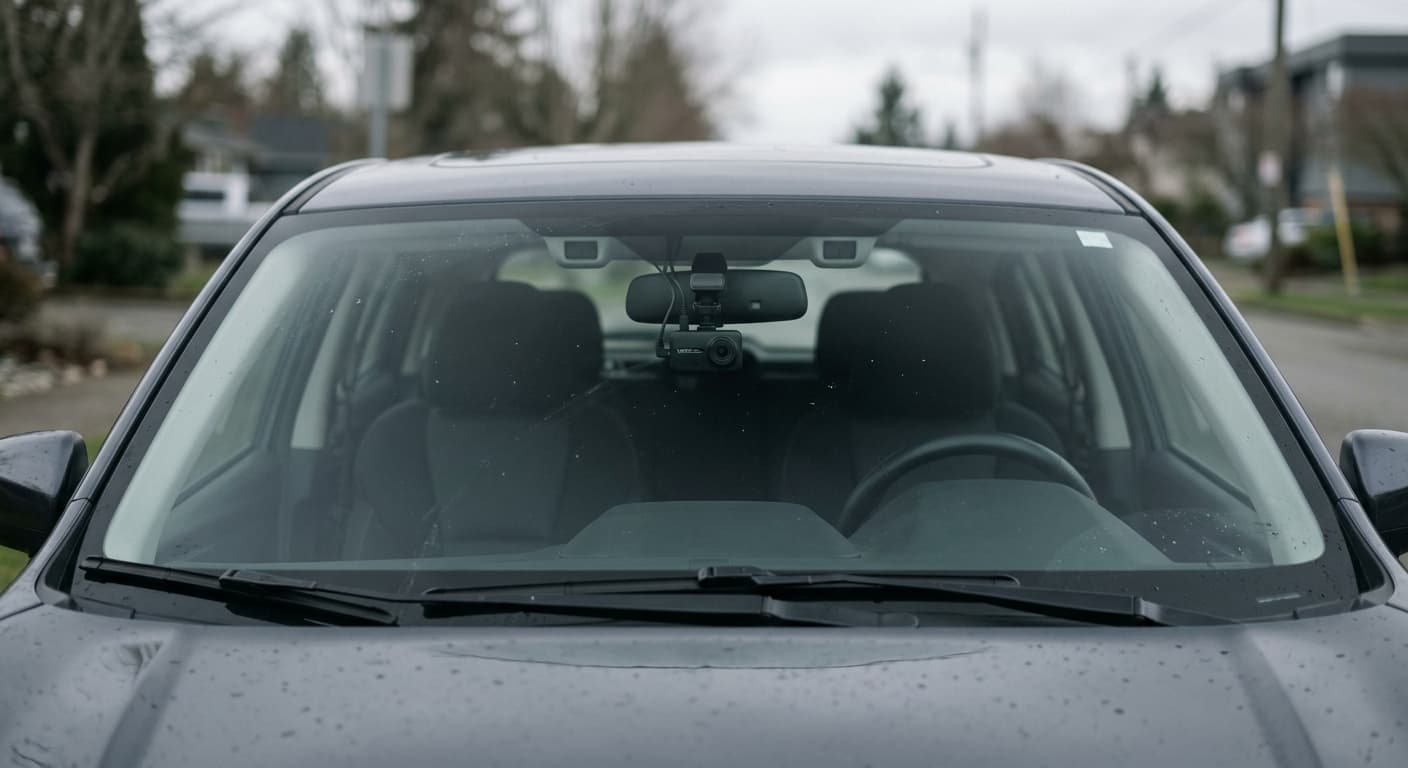
CVC 26708(b)(13)(A) permits a dashcam to be mounted on the windshield in exactly three locations:
- Passenger-side lower corner: A 7-inch square area in the lower corner of the windshield farthest from the driver.
- Driver-side lower corner: A 5-inch square area in the lower corner of the windshield nearest to the driver, and the device must be positioned outside the airbag deployment zone.
- Upper center: A 5-inch square area mounted to the center uppermost portion of the interior of the windshield, typically behind the rearview mirror.
Any dashcam mounted outside these three zones can result in a traffic citation under CVC 26708. Officers may pull you over for windshield obstruction even if you believe the camera is positioned unobtrusively.
Dashboard Mounting Alternative
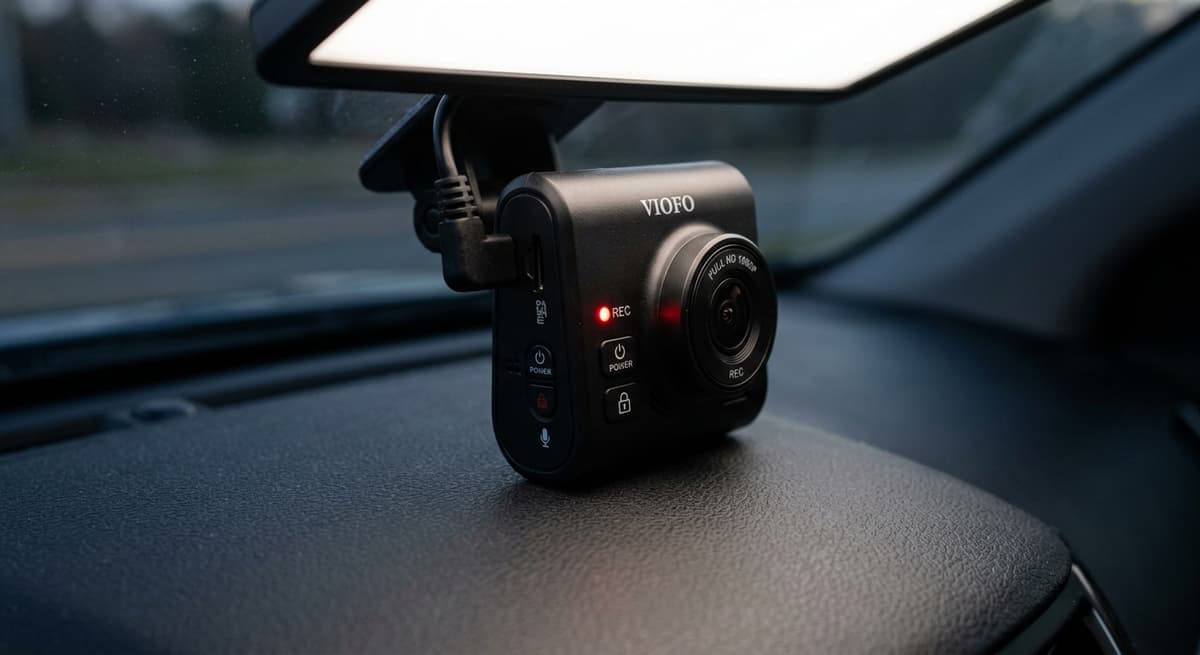
There is no size restriction for dashcams mounted on the vehicle's dashboard rather than the windshield. If your camera does not fit within the permitted windshield zones, dashboard mounting is a straightforward alternative that avoids the CVC 26708 placement rules entirely.
What Qualifies as a "Video Event Recorder"
The statute defines a video event recorder as a device that "continuously records in a digital loop, recording audio, video, and G-force levels, but saves video only when triggered by an unusual motion or crash or when operated by the driver to monitor driver performance." The device must store no more than 30 seconds of footage before and after a triggering event.
This definition was written with traditional event-based dashcams in mind. Many modern dashcams record continuously and store hours of footage on large memory cards. Whether these devices technically fall within the CVC 26708(b)(13) exemption or need to rely on the dashboard mounting alternative is an area where the statute has not kept pace with current technology. For maximum legal certainty, drivers using continuous-recording dashcams may want to consider dashboard mounting.
Audio Recording and Penal Code 632
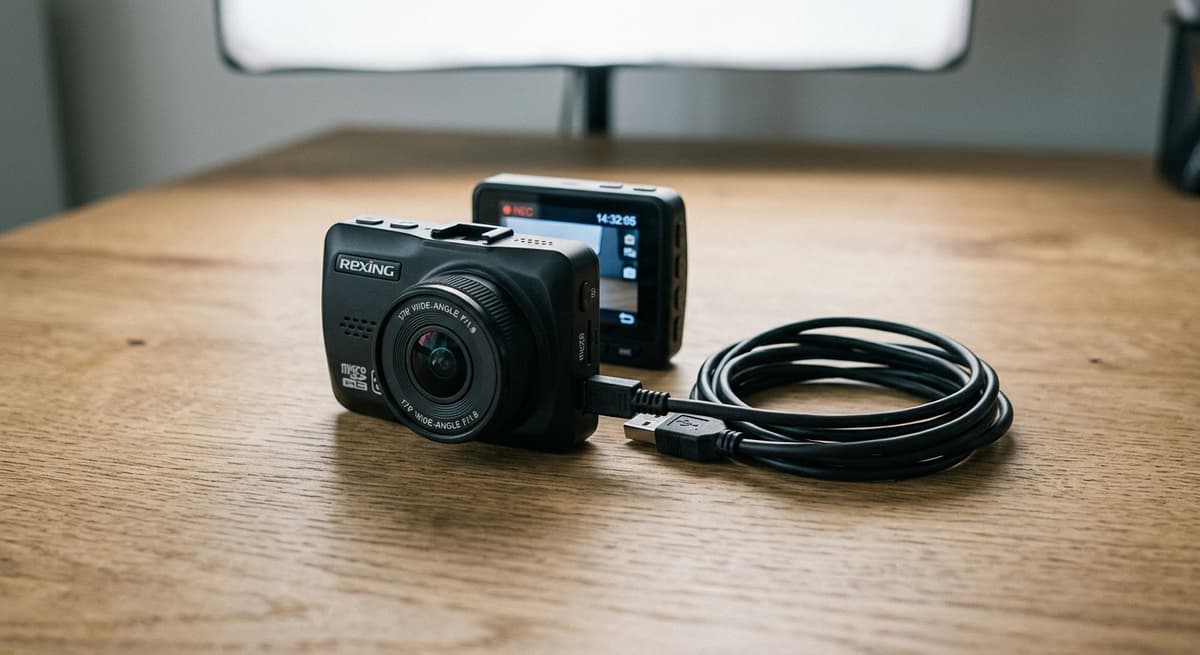
This is where California dashcam law becomes most consequential. California is a two-party consent state, meaning that recording a confidential conversation requires the consent of every person involved. This rule comes from Penal Code Section 632.
What Counts as a Confidential Communication
PC 632 defines a "confidential communication" as any communication carried on in circumstances where a party reasonably expects the conversation to remain private. Conversations between vehicle occupants often qualify, because people in a car typically expect that their words are not being captured.
The statute excludes communications made in a public gathering, in legislative or judicial proceedings open to the public, or in circumstances where the parties may reasonably expect to be overheard or recorded.
How This Applies to Dashcams
If your dashcam records audio and captures a conversation between you and a passenger, both of you must consent. If a backseat passenger is talking on the phone and your dashcam picks up that conversation, you may be recording a confidential communication without the caller's knowledge.
Running a dashcam with audio enabled while carrying passengers who have not consented can expose you to criminal liability. This applies whether you are giving a friend a ride, carpooling with coworkers, or driving for a rideshare company.
Penalties for Violating PC 632
The consequences of an unlawful audio recording in California are serious:
- First offense: A fine of up to $2,500 and/or up to one year in county jail, or, if charged as a felony, 16 months, two years, or three years in state prison.
- Subsequent offenses: A fine of up to $10,000 and/or up to one year in county jail, or, if charged as a felony, 16 months, two years, or three years in state prison.
- Civil liability: Victims may also sue for damages of $5,000 per violation or three times the actual damages, whichever is greater.
The Simple Compliance Path: Disable Audio
The easiest way to comply with PC 632 is to disable audio recording on your dashcam entirely. A video-only dashcam does not trigger the two-party consent law. Most modern dashcams have a setting to turn off the microphone, and this single adjustment eliminates the biggest legal risk associated with dashcam use in California.
If you want to keep audio recording enabled, you must inform every occupant of your vehicle and obtain their consent before they enter or at the start of the trip.
Passenger Notice Requirements Under CVC 26708
Beyond PC 632, Vehicle Code Section 26708(b)(13)(B) imposes its own notice requirement specifically for video event recorders. Any vehicle equipped with a video event recorder must display a visible notice stating that a passenger's conversation may be recorded.
This notice should be posted where passengers can easily see it, such as on the dashboard, sun visor, or a window. The statute does not specify the exact format, but the notice must clearly communicate that recording is taking place.
Notice Does Not Replace Consent
Posting a notice satisfies CVC 26708, but it does not automatically satisfy PC 632. The two statutes serve different purposes. CVC 26708 requires disclosure. PC 632 requires consent. A sign that says "This vehicle may record audio and video" addresses the CVC notice requirement, but you still need actual consent from passengers for the audio recording to be lawful under the Penal Code.
For practical purposes, many California drivers combine the two by posting a sign and treating a passenger's decision to remain in the vehicle after seeing the sign as implied consent. Whether a court would accept implied consent in every situation remains an open question, so obtaining explicit verbal consent is the safer approach.
Uber, Lyft, and Rideshare Dashcam Rules
Rideshare drivers in California face the most complex dashcam compliance landscape because they regularly carry passengers who have no prior relationship with them.
Uber's Official Policy
Uber permits drivers to use "video cameras, dash cams, your phone, or other recording devices to help ensure safety during rides." However, Uber requires drivers to inform riders if they are being recorded and to comply with all local laws regarding consent. Sharing or broadcasting a passenger's image or recording without permission violates Uber's Community Guidelines and may result in deactivation.
Lyft's Approach
Lyft similarly allows dashcam use but defers to state and local law on consent requirements. In California, this means rideshare drivers must address both the CVC 26708 notice requirement and the PC 632 two-party consent requirement.
Practical Compliance for Rideshare Drivers
Most rideshare drivers in California who use dashcams follow one of these approaches:
- Video only: Disable audio recording entirely. This eliminates the PC 632 concern. A posted notice satisfies CVC 26708.
- Audio with sign: Post a clearly visible notice that audio and video recording is in progress. Treat the passenger's decision to proceed with the ride after seeing the sign as implied consent.
- Audio with verbal notice: Inform each passenger at the start of the ride that the dashcam records both audio and video. If a passenger objects, disable the audio.
The safest option remains disabling audio entirely, which is what the majority of California rideshare drivers choose to do.
Dual-Facing Cameras and Passenger Privacy
Many rideshare drivers use dual-facing dashcams with one lens pointed at the road and one pointed at the cabin. The cabin-facing camera records passengers directly. While video recording of passengers is generally permissible with proper notice, audio recording remains subject to PC 632. The combination of a camera pointed directly at a passenger plus audio recording raises heightened privacy concerns that could draw scrutiny in a legal dispute.
Rear-Facing Dashcams
Rear-facing dashcams that record through the back window to capture traffic behind the vehicle operate under the same rules as forward-facing dashcams. The legal analysis changes when the camera faces into the vehicle cabin and records passengers in the backseat.
Cabin-Facing Cameras
A camera that records the interior of your vehicle captures passengers, their belongings, and potentially their conversations. Video recording of the cabin is legal provided you post the required CVC 26708 notice. Audio recording of the cabin requires two-party consent under PC 632.
If you regularly transport passengers, especially children whose parents may not be present, a cabin-facing camera with audio presents the highest legal risk. Children cannot provide legally meaningful consent, and parents may not have been informed.
Road-Facing Rear Cameras
A rear dashcam that faces outward through the back window to record other vehicles and road conditions follows the same mounting and placement rules as a front-facing dashcam. These cameras primarily capture public roadways where there is no reasonable expectation of privacy, so they present minimal legal risk.
Commercial Fleet Dashcams
California imposes additional requirements on employers who install dashcams in commercial vehicles.
AB 984: Employer Vehicle Monitoring Restrictions
Assembly Bill 984, signed into law on September 29, 2022, and effective January 1, 2023, restricts how employers can use tracking and monitoring devices in company vehicles. The law applies to dashcams when they function as employee monitoring tools.
Under AB 984, employers must provide employees with written notice before monitoring begins. The notice must include:
- A description of the specific activities that will be monitored.
- A description of the data that will be collected.
- Whether the data will be used for employment-related decisions, including discipline or termination.
- The identity of third parties who will receive the data and the purpose of any data transfers.
- Which organizational positions can access the data.
Monitoring through dashcams is permitted only during work hours and only when "strictly necessary" for the performance of the employee's duties. Employers may not monitor employees during off-duty periods.
Penalties for Employer Violations
Employers who violate AB 984's notice requirements face civil penalties of $250 for the initial violation and $1,000 per employee for each subsequent violation. Penalties are calculated per employee, per violation, and per day that monitoring occurs without proper notice.
Employee Access to Footage
CVC 26708(b)(13)(C) provides that when a person is driving for hire as an employee in a vehicle equipped with a video event recorder, the employer must provide unedited copies of the recordings upon the employee's request. The copies must be provided free of charge within five days of the request.
SB 506: 2026 Commercial Vehicle Update
Senate Bill 506, enacted in October 2025 and effective January 1, 2026, amended Vehicle Code Section 26708 to update the windshield placement rules for certain commercial vehicles. The law broadens the exemption for "vehicle safety technology" on windshields of heavy commercial vehicles.
For motortrucks with three or more axles and a gross vehicle weight rating exceeding 10,000 pounds, dashcams and other safety devices may now be mounted in compliance with federal regulations under 49 CFR 393.60. The federal standard requires devices to be mounted no more than 8.5 inches below the upper edge of the windshield wiper-swept area and no more than 7 inches above its lower edge, and outside the driver's sight lines to the road and highway signs and signals. This is a significant expansion from the previous 5-inch and 7-inch zones that still apply to passenger vehicles.
Dashcam Footage as Evidence in California Courts
California courts generally accept dashcam footage as admissible evidence in both criminal and civil cases. However, admissibility depends on several factors.
Requirements for Admissibility
For dashcam footage to be admitted as evidence in a California courtroom, it must meet these standards:
- Relevance: The footage must relate directly to the issues in the case.
- Authentication: The party introducing the footage must establish that it is genuine and has not been altered. This typically means testimony from the person who operated the dashcam or an expert who examined the file metadata.
- Lawful collection: If the footage includes audio recordings obtained without proper consent, a court may exclude it under PC 632.
- Clarity: Courts may exclude footage that is too unclear, heavily edited, or misleading to be useful.
How Dashcam Footage Helps in Court
Dashcam recordings can serve as powerful evidence in several types of cases:
- Car accidents: Footage showing the moments before and during a collision can establish fault, vehicle speeds, traffic signals, and road conditions.
- DUI stops: Dashcam video may contradict or support an officer's account of erratic driving.
- Hit-and-run identification: A forward-facing camera can capture the license plate and vehicle description of a driver who flees the scene.
- Road rage incidents: Video evidence of aggressive driving or confrontational behavior strengthens criminal or civil claims.
The Double-Edged Sword
Dashcam footage can also work against you. If the recording shows that you were speeding, distracted, or making an unsafe maneuver at the time of an accident, the opposing party or their insurer can use your own footage as evidence of your fault. If you have dashcam footage related to a legal matter, consult with an attorney before sharing it with anyone.
Dashcam Footage and Insurance Claims
Insurance companies in California will consider dashcam footage when evaluating accident claims, but their response to such evidence varies.
Strengthening Your Claim
Clear dashcam footage that shows the other driver caused the accident can significantly strengthen your position. Insurance adjusters are more likely to accept liability and offer fair settlement amounts when confronted with unambiguous video evidence. This is especially valuable in disputes where both drivers give conflicting accounts of what happened.
Limitations with Insurers
Insurance companies are not required to accept dashcam footage at face value. Some insurers treat dashcam video on the same level as photographs, and internal policies may use deliberately vague language about how video evidence is weighed. An attorney experienced in California personal injury law can help present dashcam evidence in the most effective way during settlement negotiations.
Filing a Claim with Dashcam Evidence
When filing an insurance claim with dashcam evidence in California:
- Save the original, unedited footage immediately after an incident.
- Make backup copies and store them securely.
- Do not post the footage on social media before consulting an attorney.
- Provide the footage to your own insurance company as part of your claim documentation.
- Share footage with the other driver's insurer only with guidance from your attorney.
Police Access to Your Dashcam Footage
Law enforcement in California cannot simply take your dashcam or demand your footage without legal authority. The Fourth Amendment to the U.S. Constitution protects against unreasonable searches and seizures, and this protection extends to personal recording devices.
When Police Need a Warrant
Police generally need either your voluntary consent or a valid search warrant to access your dashcam footage. If an officer requests your dashcam recording at the scene of an accident or traffic stop, you have the right to decline. Refusing to hand over footage is not obstruction of justice.
Exceptions to the Warrant Requirement
There are limited circumstances where police may access dashcam footage without a warrant:
- Consent: If you voluntarily provide the footage, no warrant is needed.
- Plain view doctrine: If footage is visible on a dashcam's screen during a lawful traffic stop, officers may observe what is displayed.
- Exigent circumstances: In emergencies involving immediate threats to life or imminent destruction of evidence, officers may seize a dashcam without a warrant.
- Incident to arrest: If you are lawfully arrested, officers may search your vehicle and seize the dashcam as part of that search.
Your Rights During a Police Encounter
If police ask for your dashcam footage, you may politely decline and request that they obtain a warrant. A warrantless seizure of the device itself is often lawful under the exceptions above (for example, incident to a lawful arrest or exigent circumstances); it is an unlawful SEARCH of the footage, not a lawful seizure, that risks suppression under the Fourth Amendment.
Penalties Summary Table
| Violation | Statute | Penalty |
|---|---|---|
| Improper dashcam windshield mounting | CVC 26708 | Traffic citation and fine |
| Recording audio without all-party consent (first offense) | PC 632 | Up to $2,500 fine and/or up to 1 year in county jail (felony: 16 months-3 years state prison) |
| Recording audio without all-party consent (subsequent) | PC 632 | Up to $10,000 fine and/or up to 1 year in county jail (felony: 16 months-3 years state prison) |
| Civil damages for unlawful audio recording | PC 637.2 | $5,000 per violation or 3x actual damages |
| Employer monitoring without notice (initial) | AB 984 | $250 civil penalty |
| Employer monitoring without notice (subsequent) | AB 984 | $1,000 per employee per violation per day |
Related California Recording Laws
More California Recording Topics
- California Recording Laws
- California Video Recording
- California Medical Recording
- California Schools Recording
- California Workplace Recording
- California Police Recording
- California Phone Calls Recording
- California Security Cameras Recording
- California Voyeurism Recording
- California Landlord Tenant Recording
- California Public Recording Recording
- California Biometric Privacy Laws
- Surveillance Camera Laws
More California Laws
Frequently Asked Questions
Is it legal to have a dashcam in California?
Yes, dashcams are legal in California. Video-only dashcams face minimal restrictions beyond proper windshield placement under CVC 26708. If your dashcam records audio, California's two-party consent law (Penal Code 632) requires that all vehicle occupants consent to being recorded. You must also post a visible notice in the vehicle stating that conversations may be recorded.
Can I record audio with my dashcam in California?
You can, but only with the consent of every person whose voice may be captured. California is a two-party consent state under Penal Code 632. Before recording audio, you must inform all passengers and obtain their agreement. If any passenger declines, you must disable the audio recording. The simplest compliance approach is to turn off the dashcam microphone entirely and record video only.
Where can I legally mount a dashcam on my windshield in California?
CVC 26708 permits windshield mounting in three zones: a 7-inch square in the lower passenger-side corner, a 5-inch square in the lower driver-side corner (outside the airbag deployment zone), or a 5-inch square at the upper center of the windshield. You can also mount a dashcam on the dashboard with no size restriction.
Can Uber and Lyft drivers use dashcams in California?
Yes. Both Uber and Lyft allow drivers to use dashcams. However, California law requires rideshare drivers to post a visible notice about recording and to obtain consent from passengers before recording audio. Most California rideshare drivers disable audio recording and post a notice to comply with both CVC 26708 and Penal Code 632.
Can dashcam footage be used as evidence in a California car accident case?
Yes. California courts generally accept dashcam footage as admissible evidence if it is relevant to the case, has been authenticated as genuine and unaltered, and was collected lawfully. Footage that includes audio recorded without proper consent may be excluded. Dashcam evidence can establish fault in car accidents, identify hit-and-run vehicles, and document road conditions at the time of a collision.
Do police need a warrant to take my dashcam footage in California?
Generally, yes. The Fourth Amendment protects against unreasonable search and seizure, so California police typically need your voluntary consent or a valid search warrant to access your dashcam footage. You may decline to hand over a recording, and doing so is not obstruction of justice. Narrow exceptions allow warrantless access, including footage in plain view during a lawful stop, exigent circumstances involving an immediate threat or risk that evidence will be destroyed, or a seizure incident to a lawful arrest.
Updates
Fixed a self-contradiction about police access to dashcam footage: officers may lawfully seize a dashcam without a warrant in some circumstances, but generally need a warrant to search its footage, matching Riley v. California and the page's own exceptions list.
Independently fact-checked against the cited primary sources; governing law re-checked for recent changes
Corrected the 49 CFR 393.60 mounting description: the federal rule requires safety devices to sit OUTSIDE the driver's sight lines (not within them) and added the companion 7-inch lower-edge limit.
Governing law re-checked for recent changes
Corrected the PC 632 penalties: California Penal Code 632 caps county jail time at one year but does not cap state-prison time when charged as a felony (wobbler); felony exposure is up to 16 months, two, or three years in state prison per the default felony sentencing triad in Penal Code 18.
Governing law re-checked for recent changes
Reviewed and approved by an editor
The Law Behind This Article
This article rests on the statutory provisions below, held in our own legal record and retrieved from the official source. Tap a section to read the operative text.
California Penal Code
§ 632In forcecited in 39 of our articles
(a) A person who, intentionally and without the consent of all parties to a confidential communication, uses an electronic amplifying or recording device to eavesdrop upon or record the confidential communication, whether the communication is carried on among the parties in the presence of one another or by means of a telegraph, telephone, or other device, except a radio, shall be punished by a fine not exceeding two thousand five hundred dollars ($2,500) per violation, or imprisonment in a county jail not exceeding one year, or in the state prison, or by both that fine and imprisonment. If the person has previously been convicted of a violation of this section or Section 631, 632.5, 632.6, 632.7, or 636, the person shall be punished by a fine not exceeding ten thousand dollars ($10,000) per violation, by imprisonment in a county jail not exceeding one year, or in the state prison, or by both that fine and imprisonment.
Official text (excerpt) · last checked 2026-08-31 · Read the full text in our law library · Verify at leginfo.legislature.ca.gov
Cited in 267 court opinions in our collectionLatest citing opinion in our collection: 2026
In the courts (editorial summary, independently checked):Kimmel v. Goland (1990) held the section 47(2) litigation privilege does not bar a damages claim under Section 632 for recording confidential conversations without consent. Lieberman v. KCOP Television, Inc. (2003) held a Section 632 violation is complete the moment the recording is made, whether or not it is disclosed.
Opinions citing this section in our collection:
- Rubin v. Green (California Supreme Court 1993, 4 Cal. 4th 1187)“…f telephone conversations with defendants, an offense under Penal Code section 632. We noted that defendants alleged that…”
- Kimmel v. Goland (California Supreme Court 1990, 51 Cal. 3d 202)✓Mobilehome owners secretly taped phone calls with park management in anticipation of suing; the court held the section 47(2) litigation privilege did not bar the cross-complaint for damages under Penal Code section 632, since the injury came from recording, not publication.
- Shulman v. Group W Productions, Inc. (California Supreme Court 1998, 74 Cal. Rptr. 2d 843)✓A TV producer put a wireless microphone on the flight nurse treating a crash victim. No section 632 claim was before the court, but it called section 632 and the intrusion tort laws of general applicability and said the press may not eavesdrop in violation of section 632.
Identified automatically from the court opinions citing this section — not a ranking of which case controls.
Also relied on in: California Recording Laws (2026): All-Party Consent Rules, US Recording Laws by State (2026): All 50 States Explained, Can an Employer Record Conversations Without Consent? (2026)
California Vehicle Code
§ 26708In forcecited in 4 of our articles
(a) (1) A person shall not drive any motor vehicle with any object or material placed, displayed, installed, affixed, or applied upon the windshield or side or rear windows. (2) A person shall not drive any motor vehicle with any object or material placed, displayed, installed, affixed, or applied in or upon the vehicle that obstructs or reduces the driver’s clear view through the windshield or side windows. (3) This subdivision applies to a person driving a motor vehicle with the driver’s clear vision through the windshield, or side or rear windows, obstructed by snow or ice. (b) This section does not apply to any of the following: (1) Rearview mirrors. (2) Adjustable nontransparent sunvisors that are mounted forward of the side windows and are not attached to the glass.
Official text (excerpt) · last checked 2026-09-07 · Read the full text in our law library · Verify at leginfo.legislature.ca.gov
Cited in 56 court opinions in our collectionLatest citing opinion in our collection: 2026
In the courts (editorial summary, independently checked):California courts read section 26708(a)(2) to require an objective basis that an object actually obstructed the driver's view. People v. White (2003) held an air freshener on a mirror did not justify a stop where the officer never said it blocked his view; People v. Colbert (2007) found such a basis on fuller testimony.
Opinions citing this section in our collection:
- People v. White (California Court of Appeal 2003, 132 Cal. Rptr. 2d 371)✓An officer stopped a car for a tree-shaped air freshener on the mirror; the court held section 26708(a)(1) does not reach an object not affixed on the windshield, and that with no testimony the view was obstructed there was no reasonable basis under subdivision (a)(2).
- People v. Colbert (California Court of Appeal 2007, 68 Cal. Rptr. 3d 912)✓An officer stopped a car for a 4.75-inch tree air freshener on the mirror and testified from his own experience how an object that size hides cars and pedestrians; the court held that testimony gave an objectively reasonable basis under section 26708(a)(2).
- Klarfeld v. State of California (California Court of Appeal 1983, 142 Cal. App. 3d 541)✓A tint installer and car owners challenged sections 26708 and 26708.5 as vague; the court held the terms are not unconstitutionally vague and declared applied tint may not go on the windshield or front side windows, but may go behind the driver if the car has required mirrors.
Identified automatically from the court opinions citing this section — not a ranking of which case controls.
Also relied on in: Window Tint Laws by State (2026): Legal VLT Limits, California Window Tint Laws (2026): Legal VLT Limits, California Windshield Mounting Laws (2026 Guide)
Code of Federal Regulations Title 49
§ 393.60Glazing in specified openings.In forcecited in 15 of our articles
(a) Glazing material. Glazing material used in windshields, windows, and doors on a motor vehicle manufactured on or after December 25, 1968, shall at a minimum meet the requirements of Federal Motor Vehicle Safety Standard (FMVSS) No. 205 in effect on the date of manufacture of the motor vehicle. The glazing material shall be marked in accordance with FMVSS No. 205 (49 CFR 571.205, S6). (b) Windshields required. Each bus, truck and truck-tractor shall be equipped with a windshield. Each windshield or portion of a multi-piece windshield shall be mounted using the full periphery of the glazing material. (c) Windshield condition. With the exception of the conditions listed in paragraphs (c)(1), (c)(2), and (c)(3) of this section, each windshield shall be free of discoloration or damage in the area extending upward from the height of the top of the steering wheel (excluding a 51 mm (2 inch) border at the top of the windshield) and extending from a 25 mm (1 inch) border at each side of the windshield or windshield panel.
Official text (excerpt) · last checked 2026-07-28 · Read the full text in our law library · Verify at ecfr.gov
Cited in 3 court opinions in our collectionLatest citing opinion in our collection: 2021
In the courts (editorial summary, independently checked):The 70 percent light transmittance floor of 49 CFR 393.60(d) covers the windshield and the windows immediately right and left of the driver. Grooms Hauling, LLC v. Robinson (2020) applied it through Pennsylvania adoption and rejected racial profiling claims over tint citations; State v. Ford (2021) noted that Kansas adopts it too.
Opinions citing this section in our collection:
- United States of America, Government v. Robert L. Pierre, Defendant (District Court, D. New Hampshire 2015, 2015 DNH 083)“…rallel luminous transmittance of not less than 70 percent.” 49 C.F.R. 393.60(c). Neither the Government nor the defe…”
- GROOMS HAULING, LLC v. ROBINSON (District Court, E.D. Pennsylvania 2020)✓Officers repeatedly cited a Black-owned hauling company whose truck windows passed only 17 to 20 percent of light; treating 49 CFR 393.60's 70 percent transmittance standard as the governing rule, the court granted the officers summary judgment on the profiling claims.
- State v. Ford (Court of Appeals of Kansas 2021)“…Relevant to this appeal are regulations on window tinting (49 C.F.R. § 393.60[d]), medical examiner certificates (49…”
Identified automatically from the court opinions citing this section — not a ranking of which case controls.
Also relied on in: Connecticut Windshield Mounting Laws (2026 Guide), Idaho Windshield Mounting Laws (2026 Guide), Kansas Windshield Mounting Laws (2026 Guide)
Search our full record of US law — 2.1 million sections, every state + federal →
Sources and References
- California Vehicle Code Section 26708 - Windshield obstructions and video event recorder exemptions(leginfo.legislature.ca.gov).gov
- California Penal Code Section 632 - Eavesdropping and two-party consent requirements(leginfo.legislature.ca.gov).gov
- SB 506 (2025-2026) - Transportation omnibus bill amending CVC 26708 for commercial vehicles(leginfo.legislature.ca.gov).gov
- AB 984 - Alternative devices employer monitoring notice requirements(leginfo.legislature.ca.gov).gov
- Uber official dashcam policy for drivers(help.uber.com)