
California
California Landlord-Tenant Recording and Surveillance Laws (2026)
Independently fact-checked against primary sources (last audited August 22, 2026). · Reviewed by the RecordingLaw editorial team. · Law checked current as of August 22, 2026. · 10 primary sources cited on this page. How we verify our legal content
title: "California Landlord-Tenant Recording and Surveillance Laws (2026)" meta_description: "California landlord-tenant recording and surveillance laws explained. Learn rules for cameras in apartments, audio recording under PC 632, tenant rights, and penalties."
Overview of California Landlord-Tenant Recording Laws
California has some of the strongest privacy protections in the country, and those protections extend directly into the landlord-tenant relationship. Whether you are a landlord considering security cameras for your apartment building or a tenant wondering about your rights, understanding these laws is critical to avoiding both criminal charges and civil liability.
The legal framework governing recording and surveillance in rental properties draws from several California statutes. Penal Code 632 controls audio recording and eavesdropping. Penal Code 647(j) prohibits hidden cameras and visual invasions of privacy. Civil Code 1954 governs when and how a landlord may enter a rental unit. Together, these statutes create a detailed set of rules that both landlords and tenants must follow.
California is a two-party consent state, which means that recording a private conversation without the knowledge and consent of everyone involved is a crime. This foundational principle affects nearly every recording scenario in a rental property, from security cameras with microphones to phone calls between landlords and tenants.
Landlord Surveillance Cameras in Common Areas
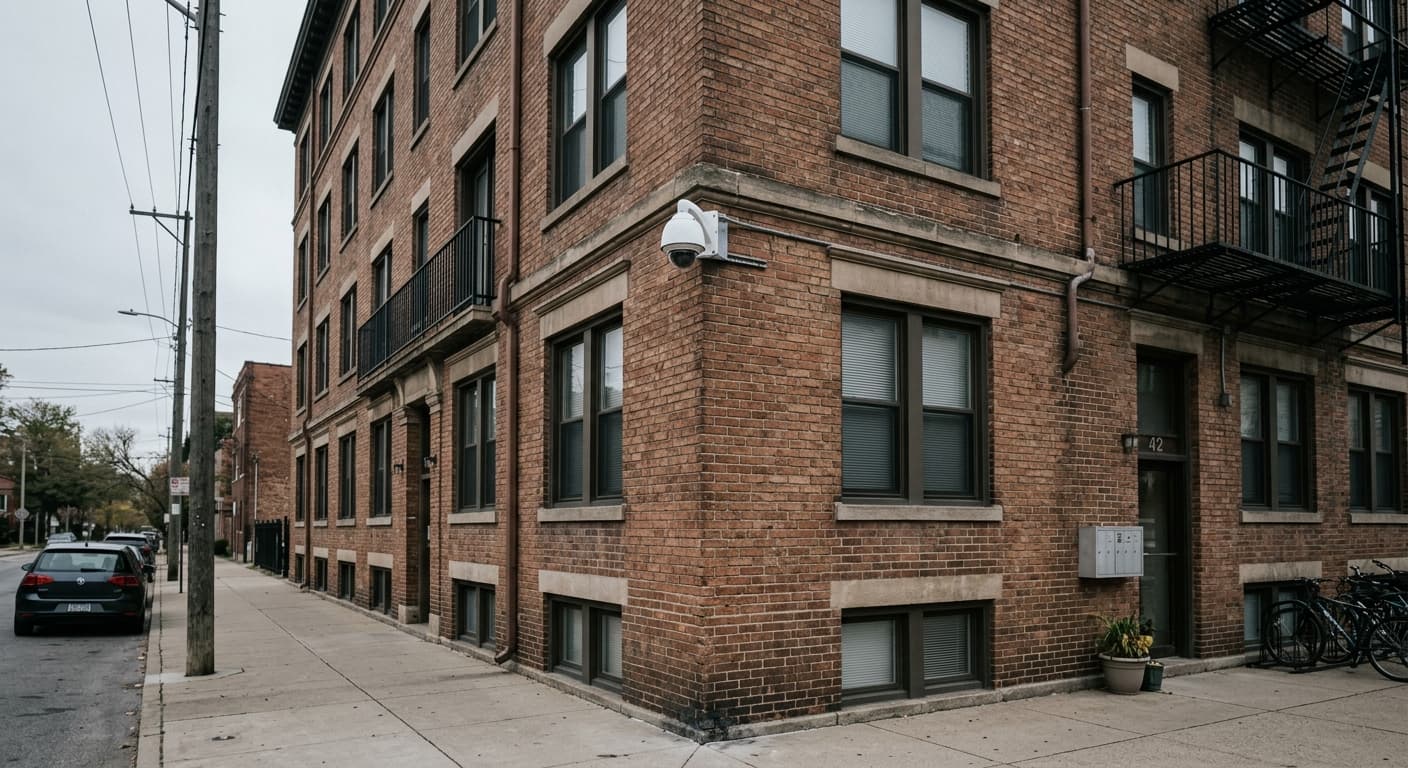
Landlords in California have the legal right to install video surveillance cameras in the common areas of apartment buildings and rental properties. Common areas include spaces shared by all tenants and visitors where there is no reasonable expectation of privacy.
Where Landlords Can Place Cameras
Landlords may legally install video cameras in the following locations:
- Building lobbies and entryways
- Hallways and stairwells
- Parking lots and garages
- Laundry rooms
- Mailbox areas
- Exterior grounds and walkways
- Building perimeters and gates
These locations are considered shared or semi-public spaces. Because tenants and visitors understand that other people can observe them in these areas, there is no reasonable expectation of privacy that would prevent video recording.
Where Cameras Are Prohibited
California law draws a firm line at private spaces. Landlords may never place cameras in:
- Individual apartment or rental unit interiors
- Bathrooms, including shared bathroom facilities
- Changing areas or dressing rooms
- Any location where a camera could see inside a tenant's unit when a door or window is open
A camera placed outside an apartment door that captures the interior of the unit when the door opens can violate the tenant's privacy rights. Landlords should position cameras to avoid any angle that reveals the inside of a private living space.
Audio Recording Restrictions for Surveillance Systems
This is where many landlords run into trouble. Even when a camera is lawfully placed in a common area, enabling audio recording on that camera introduces a separate set of legal requirements under Penal Code 632.
California's two-party consent rule means that recording a conversation requires the consent of all parties involved. However, there is a distinction that matters here. Penal Code 632 specifically applies to "confidential communications," which are conversations carried on in circumstances that reasonably indicate the parties desire the conversation to remain private.
In truly public common areas like a large building lobby or outdoor parking lot, conversations may not carry a reasonable expectation of privacy. In those settings, audio recording may be permissible. But in smaller, more enclosed common spaces such as a laundry room or narrow hallway, tenants may reasonably expect their conversations to be private, making audio recording without consent a potential violation.
The safest practice for landlords is to either disable audio recording on all surveillance cameras or post clear, visible signage stating that both video and audio recording are in use.
Best Practices for Landlord Camera Systems
While California does not have a statute that explicitly requires landlords to notify tenants about common area cameras, transparency is the best legal protection. Landlords should follow these guidelines:
- Include a surveillance disclosure clause in the lease agreement
- Post visible signs near all camera locations stating that video recording is in progress
- Keep cameras visible rather than hidden
- Disable audio recording capabilities on common area cameras, or obtain written consent
- Store recorded footage securely and limit access to authorized personnel
- Establish a retention policy for recorded footage (30 days is standard)
Cameras Inside Rental Units Are Illegal
A landlord should never install or operate a camera inside a tenant's occupied rental unit. Under California Penal Code 647(j)(3), it is a crime for a landlord to use a concealed camera to secretly record a tenant, without the tenant's knowledge or consent, for the purpose of invading their privacy. A disclosed camera does not fall under this specific statute's concealment element, but it still exposes a landlord to serious legal risk, including civil invasion-of-privacy claims and a breach of the tenant's right to quiet enjoyment, so interior cameras should be treated as off-limits regardless of disclosure.
Penal Code 647(j): Criminal Invasion of Privacy
Penal Code 647(j) makes it a misdemeanor to use a concealed camera to secretly record another person in any location where that person has a reasonable expectation of privacy. A tenant's home is the clearest example of such a location.
First offense penalties:
- Up to six months in county jail
- Fine of up to $1,000
Repeat offense penalties:
- Up to one year in county jail
- Fine of up to $2,000
Civil Liability
Beyond criminal penalties, a landlord who installs cameras inside a rental unit faces significant civil liability. Tenants can sue for invasion of privacy and may recover substantial damages. The emotional distress caused by discovering hidden surveillance in your home can support large damage awards.
What About Smoke Detectors and Other Devices?
Reports of hidden cameras disguised as smoke detectors, alarm clocks, or USB chargers have become increasingly common. If a landlord places any recording device disguised as a household object inside a rental unit, this constitutes a criminal offense under both Penal Code 647(j) and potentially Penal Code 632 if audio is captured. Tenants who discover such devices should document the evidence and contact law enforcement immediately.
Audio Recording Between Landlords and Tenants
California's Penal Code 632 governs the recording of confidential communications, and it applies equally to landlords and tenants. Neither party may secretly record a private conversation with the other.
The Two-Party Consent Rule
Under Penal Code 632, it is illegal to intentionally record a confidential communication using any electronic device without the consent of all parties to the communication. A "confidential communication" is any conversation carried on in circumstances that reasonably indicate the parties desire it to remain private.
This means:
- A landlord cannot secretly record a conversation with a tenant during a lease signing
- A tenant cannot secretly record a phone call with their landlord about a repair dispute
- A property manager cannot record a conversation with a tenant about rent payment without telling the tenant
Penalties for Illegal Audio Recording
Criminal penalties under PC 632:
- First offense: Fine up to $2,500, up to one year in county jail, or both
- Repeat offense: Fine up to $10,000, up to one year in county jail, or both
Civil penalties under Penal Code 637.2:
- $5,000 per violation in statutory damages (no proof of actual harm required), or
- Three times the actual damages sustained, whichever is greater
- Injunctive relief (court order to stop the recording)
The per-violation structure means that a landlord who records multiple conversations without consent faces multiplied liability. Ten recorded conversations could result in $50,000 in statutory damages alone.
When Recording Without Consent Is Legal
There are limited exceptions to the two-party consent rule that can apply in the landlord-tenant context.
Public settings: If a conversation takes place in a public setting where either party could reasonably expect to be overheard, such as a busy building lobby, it may not qualify as a "confidential communication" under Penal Code 632.
Evidence of crime (PC 633.5): Penal Code 633.5 permits a person to record a confidential communication without the other party's consent if the recording is made to gather evidence of extortion, kidnapping, bribery, any felony involving violence against the person, threats under Penal Code 653m, or domestic violence as defined under Penal Code 13700.
This exception can be relevant for tenants who are being threatened or extorted by a landlord. For example, if a landlord threatens physical harm unless a tenant agrees to vacate, the tenant may lawfully record that threat under PC 633.5.
Notification removes confidentiality: If a landlord or tenant states at the beginning of a conversation that the discussion is being recorded, the conversation is no longer "confidential" under the statute. The other party can choose to continue the conversation (thereby consenting) or end it.
Tenant Rights: Installing Security Cameras and Ring Doorbells

Tenants in California have privacy and security concerns of their own. Many tenants want to install Ring doorbells, security cameras, or other recording devices to protect themselves and their property. No California statute expressly grants tenants that right; whether it is allowed usually comes down to the lease terms and the landlord's consent.
Video Doorbells and Exterior Cameras
Tenants may install video doorbells such as Ring or Nest devices on the door of their individual rental unit. No California statute grants tenants a blanket right to do so, but the practice is generally permitted subject to the lease and a few practical guardrails:
- Nothing in California law bars a tenant from adding a non-damaging security device to their own doorway, subject to the lease
- Civil Code 1941.3 requires landlords to install and maintain deadbolt and window locks, a separate baseline that does not itself authorize a tenant to add a camera
- Civil Code 1942.5 prohibits landlord retaliation against tenants who exercise their legal rights
However, tenants should keep these guidelines in mind:
- Check your lease first. Many leases contain clauses about modifications to the property. Use non-damaging installation methods like adhesive mounts whenever possible.
- Disable audio recording or post notice. If your Ring doorbell or security camera records audio, California's two-party consent law applies. Either disable the audio function or post a visible sign near the camera stating that audio recording is in progress.
- Do not aim cameras at neighbors. A camera mounted on your door should be angled to capture your own doorway, not the entrance to a neighboring unit or a wide view of a shared hallway.
- Notify your landlord. While not always legally required, informing your landlord about the camera can prevent disputes.
Can a Landlord Ban Security Cameras?
A landlord may include lease provisions that restrict modifications to common areas, and whether a blanket ban on tenant-installed security devices is enforceable depends on the specific lease terms; no California statute, including Civil Code 1941.3 (which covers only landlord-installed deadbolt and window locks), creates a freestanding tenant right to install a camera.
Civil Code 1942.5 protects tenants against retaliation for exercising legally protected rights, such as requesting repairs or reporting habitability violations; because installing a security device is not itself a right the statute protects, a tenant penalized for adding a camera should not assume a retaliatory-eviction claim applies and should consult an attorney about the specific facts.
That said, landlords can reasonably restrict cameras that are:
- Permanently attached to or damage the property structure
- Aimed at other tenants' units or common areas
- Recording audio without proper consent notices
Interior Cameras Within Your Own Unit
Tenants have broad rights to install cameras inside their own rental unit. Because the unit is the tenant's private space, the tenant controls what surveillance occurs within it. Tenants commonly use interior cameras to:
- Monitor for unauthorized landlord entry
- Document property conditions and needed repairs
- Provide security while away from home
- Record babysitters or pet sitters (with appropriate notice about audio)
Recording Landlord Entry and Maintenance Visits
One of the most common recording scenarios in California rentals involves landlord entry for inspections, maintenance, or repairs. Tenants have specific rights under Civil Code 1954 regarding when a landlord may enter, and recording can play an important role in protecting those rights.
Civil Code 1954: Landlord Entry Rules
Under Civil Code 1954, a landlord may enter a tenant's dwelling unit only for the following reasons:
- In case of emergency
- To make necessary or agreed-upon repairs, decorations, alterations, or improvements
- To supply necessary or agreed services
- To show the unit to prospective tenants, purchasers, or lenders
- When the tenant has abandoned or surrendered the unit
- To comply with a court order
Except in emergencies, the landlord must provide the tenant with reasonable written notice at least 24 hours before entry. The notice must include the date, approximate time, and purpose of the entry. Entry must occur during normal business hours unless the tenant consents to another time.
Can a Tenant Video Record a Landlord's Visit?
Yes. A tenant may use a visible video camera to record a landlord, property manager, or maintenance worker entering and working inside the rental unit. Because the landlord and workers are inside the tenant's private space, they do not have a reasonable expectation of privacy there.
However, the audio component requires attention. If your recording device captures sound:
- Inform the landlord or maintenance worker that audio and video recording is in progress when they enter
- Place a visible sign at the entrance stating that recording is taking place
- Consider using video-only recording to avoid any Penal Code 632 concerns
Recording maintenance visits serves several practical purposes. It creates a record of what work was performed, documents the condition of the property before and after repairs, and can provide evidence if a dispute arises about property damage or incomplete work.
Can a Landlord Record a Maintenance Visit?
A landlord or property manager who wants to record or photograph conditions inside a rental unit during a lawful visit should obtain the tenant's consent. Simply entering the unit does not give the landlord permission to record audio or take photographs.
If the purpose of the visit is to document property conditions (for example, during a move-out inspection), the landlord should inform the tenant in advance and request permission to photograph or record.
Recording Evidence of Landlord Violations
Tenants sometimes need to record evidence of landlord misconduct, habitability violations, or illegal behavior. California law provides some important protections for tenants in these situations.
Documenting Habitability Issues
The California Attorney General's office and Civil Code 1941-1942.5 establish the implied warranty of habitability, which requires landlords to maintain rental properties in a livable condition. When landlords fail to meet this standard, tenants should document the evidence.
Video and photo documentation of habitability problems such as mold, pest infestations, broken plumbing, or structural damage is entirely legal within your own rental unit. You do not need anyone's consent to photograph or record conditions inside your own home.
Recommended documentation practices:
- Take dated photos and videos of all habitability issues
- Record the condition of the problem over time to show it worsening
- Save all text messages, emails, and letters related to repair requests
- Keep a written log of all communications with your landlord about the issue
- Record video of any water leaks, pest activity, or other ongoing conditions
The Penal Code 633.5 Exception for Serious Crimes
If a landlord is engaging in criminal conduct such as threats, extortion, or any felony involving violence against the tenant, Penal Code 633.5 allows the tenant to record the communication without the landlord's consent. This exception applies when the recording is made to obtain evidence of:
- Extortion (demanding money or action through threats)
- Bribery
- Kidnapping
- Any felony involving violence against another person
- Criminal threats under Penal Code 653m
- Domestic violence as defined under Penal Code 13700
This is a narrow exception. It does not allow a tenant to secretly record every conversation with their landlord. The tenant must reasonably believe the conversation will contain evidence of one of the specified crimes.
Using Recordings in Small Claims Court
Tenants who bring landlord-tenant disputes to California small claims court may want to use recordings as evidence. Here are the key rules:
- Recordings made with proper consent (or proper notice) are generally admissible
- Recordings made without consent may face admissibility challenges and could expose the person who made the recording to criminal liability
- Evidence must be submitted to the court and all other parties at least 10 days before the hearing
- Photographs, videos of property conditions, and written communications are the strongest forms of evidence
If you plan to rely on a recording in small claims court, prepare a brief explanation of the circumstances under which the recording was made and why it is admissible under California law.
Airbnb and Vacation Rental Camera Laws
The rise of short-term vacation rentals through platforms like Airbnb and Vrbo has created new surveillance concerns. California law applies the same privacy protections to vacation rental guests as it does to long-term tenants.
Indoor Cameras Are Prohibited
Hidden cameras inside a vacation rental are illegal under Penal Code 647(j). This includes cameras in:
- Bedrooms
- Bathrooms
- Living areas
- Any interior space of the rental
Even disclosed interior cameras are problematic. As of April 30, 2024, Airbnb's updated policy bans all indoor security cameras and recording devices in listings, whether they are turned on or off. Hosts who violate this policy face listing removal and account suspension.
Exterior Cameras and Noise Monitors
Vacation rental hosts may use:
- Exterior security cameras (must be disclosed in the listing)
- Noise level monitors that measure decibel levels without recording audio
- Smart locks and access monitoring systems
All exterior cameras must be disclosed to guests before booking. Hosts must identify the location of each camera in their listing description.
What to Do If You Find a Hidden Camera
If you discover an undisclosed camera in a California vacation rental:
- Take photos or video of the device as evidence
- Do not touch or move the device
- Contact the host to request an explanation
- Report the violation to the rental platform (Airbnb, Vrbo, etc.)
- File a police report, as hidden cameras in private spaces are a criminal offense under California law
- Consult an attorney about civil remedies, including statutory damages under invasion of privacy laws
Penalties Summary Table
Here is a summary of the key penalties that apply to illegal recording and surveillance in California rental properties:
| Violation | Statute | Criminal Penalty | Civil Penalty |
|---|---|---|---|
| Secret audio recording of confidential conversation | PC 632 | Up to $2,500 fine + 1 year jail (first offense) | $5,000 per violation or 3x actual damages |
| Repeat audio recording violation | PC 632 | Up to $10,000 fine + 1 year jail | $5,000 per violation or 3x actual damages |
| Hidden camera in private space | PC 647(j) | Up to $1,000 fine + 6 months jail (first offense) | Invasion of privacy civil suit |
| Repeat hidden camera violation | PC 647(j) | Up to $2,000 fine + 1 year jail | Invasion of privacy civil suit |
| Landlord harassment via surveillance | CC 1940.2 | N/A | Up to $2,000 per violation |
| Illegal entry without notice | CC 1954 | N/A | Actual damages + potential harassment claim |
Related California Recording Law Topics
- California Recording Laws Overview
- California Audio Recording Laws
- California Video Recording Laws
- California Voyeurism and Hidden Camera Laws
- California Security Camera and Surveillance Laws
- California Workplace Recording Laws
- California Phone Call Recording Laws
- California Laws on Recording in Public
- California Laws on Recording Police
- California Dashcam Laws
- California School Recording Laws
- California Laws on Recording Doctors
More California Recording Topics
More California Laws
Frequently Asked Questions
Can my landlord install security cameras inside my apartment in California?
No. A landlord may never install cameras inside your individual rental unit. Your apartment is a private space where you have a reasonable expectation of privacy. Installing a **concealed** camera inside a tenant's unit to secretly record them violates California Penal Code 647(j)(3), a misdemeanor punishable by up to six months in jail and a $1,000 fine for a first offense. Even a disclosed camera inside your unit is a serious problem: it can support a civil invasion-of-privacy lawsuit and a breach-of-quiet-enjoyment claim against the landlord.
Can I install a Ring doorbell at my apartment in California?
Often, but it is not a statutory right. No California statute expressly grants tenants the right to install video doorbells, so the lease and the landlord's consent usually control. Check your lease for any modification restrictions, use non-damaging installation methods like adhesive mounts, and either disable the audio recording feature or post a visible notice that audio is being recorded. Aim the camera at your own doorway rather than at neighboring units or shared hallways.
Can I secretly record my landlord in California?
In most situations, no. California is a two-party consent state under Penal Code 632, which means you need the consent of all parties to record a private conversation. However, there are two important exceptions. First, you can inform the landlord that you are recording, which removes the confidentiality of the conversation. Second, under Penal Code 633.5, you may record without consent if you reasonably believe the recording will capture evidence of extortion, criminal threats, or any felony involving violence.
Are cameras in apartment building hallways and parking lots legal in California?
Yes. Landlords may install video surveillance cameras in common areas such as lobbies, hallways, stairwells, parking lots, and building exteriors. These are shared spaces where tenants do not have a reasonable expectation of privacy. However, cameras must not be positioned to see inside any tenant's unit, and enabling audio recording on these cameras raises additional legal concerns under California's two-party consent law.
What should I do if I find a hidden camera in my California rental or Airbnb?
Take photos or video of the device without touching or moving it. Contact the property owner or host to request an explanation. If the camera is in a private space such as a bedroom or bathroom, file a police report because hidden cameras in private areas are a criminal offense under Penal Code 647(j). If you are in an Airbnb, report the violation to the platform. Consult with an attorney about civil remedies, which may include statutory damages of $5,000 or more per violation.
Updates
Corrected a fabricated legal basis on the California landlord-tenant page: Civil Code 1941.3 only requires landlords to install deadbolt and window locks, it does not create a tenant right to install security cameras, and a retaliatory-eviction claim built on that fabricated right was removed.
Independently fact-checked against the cited primary sources; governing law re-checked for recent changes
Corrected three errors: PC 647(j)(3) criminalizes only concealed interior cameras, not disclosed ones; Civil Code 1940.2 caps the civil penalty at a flat $2,000 per violation, not a $2,000-$5,000 range; and Penal Code 633.5 lists domestic violence as its own separate category rather than nesting it under felony violence.
Clarified that the KeyTakeaways summary of California's ban on cameras inside rental units applies to concealed cameras under PC 647(j)(3), matching the nuance already explained in the article body.
Governing law re-checked for recent changes
Reviewed and approved by an editor
The Law Behind This Article
This article rests on the statutory provisions below, held in our own legal record and retrieved from the official source. Tap a section to read the operative text.
California Penal Code
§ 632In forcecited in 39 of our articles
(a) A person who, intentionally and without the consent of all parties to a confidential communication, uses an electronic amplifying or recording device to eavesdrop upon or record the confidential communication, whether the communication is carried on among the parties in the presence of one another or by means of a telegraph, telephone, or other device, except a radio, shall be punished by a fine not exceeding two thousand five hundred dollars ($2,500) per violation, or imprisonment in a county jail not exceeding one year, or in the state prison, or by both that fine and imprisonment. If the person has previously been convicted of a violation of this section or Section 631, 632.5, 632.6, 632.7, or 636, the person shall be punished by a fine not exceeding ten thousand dollars ($10,000) per violation, by imprisonment in a county jail not exceeding one year, or in the state prison, or by both that fine and imprisonment.
Official text (excerpt) · last checked 2026-08-31 · Read the full text in our law library · Verify at leginfo.legislature.ca.gov
Cited in 267 court opinions in our collectionLatest citing opinion in our collection: 2026
In the courts (editorial summary, independently checked):Kimmel v. Goland (1990) held the section 47(2) litigation privilege does not bar a damages claim under Section 632 for recording confidential conversations without consent. Lieberman v. KCOP Television, Inc. (2003) held a Section 632 violation is complete the moment the recording is made, whether or not it is disclosed.
Opinions citing this section in our collection:
- Rubin v. Green (California Supreme Court 1993, 4 Cal. 4th 1187)“…f telephone conversations with defendants, an offense under Penal Code section 632. We noted that defendants alleged that…”
- Kimmel v. Goland (California Supreme Court 1990, 51 Cal. 3d 202)✓Mobilehome owners secretly taped phone calls with park management in anticipation of suing; the court held the section 47(2) litigation privilege did not bar the cross-complaint for damages under Penal Code section 632, since the injury came from recording, not publication.
- Shulman v. Group W Productions, Inc. (California Supreme Court 1998, 74 Cal. Rptr. 2d 843)✓A TV producer put a wireless microphone on the flight nurse treating a crash victim. No section 632 claim was before the court, but it called section 632 and the intrusion tort laws of general applicability and said the press may not eavesdrop in violation of section 632.
Identified automatically from the court opinions citing this section — not a ranking of which case controls.
Also relied on in: California Recording Laws (2026): All-Party Consent Rules, US Recording Laws by State (2026): All 50 States Explained, Can an Employer Record Conversations Without Consent? (2026)
§ 633.5In forcecited in 8 of our articles
Sections 631, 632, 632.5, 632.6, and 632.7 do not prohibit one party to a confidential communication from recording the communication for the purpose of obtaining evidence reasonably believed to relate to the commission by another party to the communication of the crime of extortion, kidnapping, bribery, any felony involving violence against the person, including, but not limited to, human trafficking, as defined in Section 236.1, or a violation of Section 653m, or domestic violence as defined in Section 13700. Sections 631, 632, 632.5, 632.6, and 632.7 do not render any evidence so obtained inadmissible in a prosecution for extortion, kidnapping, bribery, any felony involving violence against the person, including, but not limited to, human trafficking, as defined in Section 236.1, a violation of Section 653m, or domestic violence as defined in Section 13700, or any crime in connection therewith.
Official text (excerpt) · last checked 2026-07-28 · Read the full text in our law library · Verify at leginfo.legislature.ca.gov
Cited in 21 court opinions in our collectionLatest citing opinion in our collection: 2026
Opinions citing this section in our collection:
- People v. Baker (California Court of Appeal 1978, 88 Cal. App. 3d 115)“…ction 632. 3 . Appellant has overlooked Penal Code section 633.5, 4 which is dispositive of…”
- Malinowski v. Martin (California Court of Appeal 2024)“…se permitted under statutory exceptions to the Privacy Act (Pen. Code, §§ 633.5 and 633.6). In the published port…”
- Geragos v. Abelyan (California Court of Appeal 2023)“…matter pleaded.”].) The Geragos Parties next contend Penal Code section 633.5 exempts Kazarian’s recording from exclu…”
Identified automatically from the court opinions citing this section — not a ranking of which case controls.
Also relied on in: Can I Record My Boss Harassing Me? State-by-State Legal Guide (2026), California Audio Recording Laws: Two-Party Consent Rules and Penalties (2026), California Laws on Recording Doctors and Medical Appointments (2026)
§ 637.2In forcecited in 20 of our articles
(a) Any person who has been injured by a violation of this chapter may bring an action against the person who committed the violation for the greater of the following amounts: (1) Five thousand dollars ($5,000) per violation. (2) Three times the amount of actual damages, if any, sustained by the plaintiff. (b) Any person may, in accordance with Chapter 3 (commencing with Section 525) of Title 7 of Part 2 of the Code of Civil Procedure, bring an action to enjoin and restrain any violation of this chapter, and may in the same action seek damages as provided by subdivision (a). (c) It is not a necessary prerequisite to an action pursuant to this section that the plaintiff has suffered, or be threatened with, actual damages. (d) This section shall not be construed to affect Title 4 (commencing with Section 3425.1) of Part 1 of Division 4 of the Civil Code.
Official text (excerpt) · last checked 2026-07-28 · Read the full text in our law library · Verify at leginfo.legislature.ca.gov
Cited in 103 court opinions in our collectionLatest citing opinion in our collection: 2026
In the courts (editorial summary, independently checked):Ribas v. Clark (1985) held the section 637.2 award accrues at the moment of the Privacy Act violation, so the Civil Code section 47 litigation privilege does not bar it, though damages flowing solely from privileged testimony fail. Kimmel v. Goland (1990) applied that reasoning to recordings made in anticipation of litigation.
Opinions citing this section in our collection:
- Rubin v. Green (California Supreme Court 1993, 4 Cal. 4th 1187)“…asion of privacy and related torts as well as damages under Penal Code section 637.2, granting persons injured by eavesdropp…”
- Ribas v. Clark (California Supreme Court 1985, 38 Cal. 3d 355)✓A wife asked a third party to listen on an extension phone while she called her husband, and that listener later testified about it; the court held the judicial privilege barred damages from the testimony but not Section 637.2's fixed award, which accrues at the violation.
- Kimmel v. Goland (California Supreme Court 1990, 51 Cal. 3d 202)✓Mobilehome residents secretly taped calls with park management to gather evidence for a planned lawsuit; the court held the litigation privilege did not bar management's Section 637.2 claim, because the injury came from the recording itself and not from any publication.
Identified automatically from the court opinions citing this section — not a ranking of which case controls.
Also relied on in: Can I Sue Someone for Recording Me on Private or Public Property?, How to Detect and Block Listening Devices in Your Home (2026), Is It Illegal to Video Record Someone Without Their Consent? (2026)
§ 647In forcecited in 16 of our articles
Except as provided in paragraph (5) of subdivision (b) and in subdivisions (k) and (l), a person who commits any of the following acts is guilty of disorderly conduct, a misdemeanor: (a) An individual who solicits anyone to engage in or who engages in lewd or dissolute conduct in a public place or in a place open to the public or exposed to public view. (b) (1) An individual who solicits, or who agrees to engage in, or who engages in, an act of prostitution with the intent to receive compensation, money, or anything of value from another person. An individual agrees to engage in an act of prostitution when, with specific intent to so engage, the individual manifests an acceptance of an offer or solicitation by another person to so engage, regardless of whether the offer or solicitation was made by a person who also possessed the specific intent to engage in an act of prostitution. (2) An individual who solicits, or who agrees to engage in, or who engages in, an act of prostitution with another person who is 18 years of age or older in exchange for the individual providing compensation, money, or anything of value to the other person.
Official text (excerpt) · last checked 2026-08-31 · Read the full text in our law library · Verify at leginfo.legislature.ca.gov
Cited in 593 court opinions in our collectionLatest citing opinion in our collection: 2026
In the courts (editorial summary, independently checked):In re Giannini (1968) set aside convictions under Penal Code 647(a) because the prosecution introduced no evidence of community standards, and equated "lewd or dissolute" with obscenity only for the purpose of judging an allegedly obscene dance performed for an audience.
Opinions citing this section in our collection:
- Morrison v. State Board of Education (California Supreme Court 1969, 1 Cal. 3d 214)“…public beach and the teacher was arrested for violation of Penal Code section 647, subdivision (a), and convicted, on his…”
- People v. Laiwa (California Supreme Court 1983, 34 Cal. 3d 711)“…to arrest him for being under the influence of a narcotic. (Pen. Code, § 647, subd. (f).) [1] He moved, however, to…”
- In Re Cregler (California Supreme Court 1961, 56 Cal. 2d 308)✓A man previously convicted of theft was arrested for standing in a San Francisco bus station under the pre-1961 vagrancy version of section 647. The court rejected his vagueness challenge, reading loiter to require lingering to commit a crime, and denied habeas relief.
Identified automatically from the court opinions citing this section — not a ranking of which case controls.
Also relied on in: California Laws on Recording in Public: What Is Legal (2026), California Video Recording Laws: Filming, Surveillance, and Consent (2026), California Smart Glasses Recording Laws (2026)
California Civil Code
§ 1940.2In forcecited in 2 of our articles
(a) It is unlawful for a landlord to do any of the following for the purpose of influencing a tenant to vacate a dwelling: (1) Engage in conduct that violates subdivision (a) of Section 484 of the Penal Code. (2) Engage in conduct that violates Section 518 of the Penal Code. (3) Use, or threaten to use, force, willful threats, or menacing conduct constituting a course of conduct that interferes with the tenant’s quiet enjoyment of the premises in violation of Section 1927 that would create an apprehension of harm in a reasonable person. Nothing in this paragraph requires a tenant to be actually or constructively evicted in order to obtain relief. (4) Commit a significant and intentional violation of Section 1954. (5) Threaten to disclose information regarding or relating to the immigration or citizenship status of a tenant, occupant, or other person known to the landlord to be associated with a tenant or occupant. This paragraph does not require a tenant to be actually or constructively evicted in order to obtain relief.
Official text (excerpt) · last checked 2026-07-28 · Read the full text in our law library · Verify at leginfo.legislature.ca.gov
Cited in 24 court opinions in our collectionLatest citing opinion in our collection: 2026
Opinions citing this section in our collection:
- Larson v. City & County of San Francisco (California Court of Appeal 2011, 192 Cal. App. 4th 1263)“…ntiharassment” legislation, enacted in 2004 and codified as Civil Code section 1940.2, also makes such conduct actionable by…”
- Erlach v. Sierra Asset Servicing, LLC (California Court of Appeal 2014, 226 Cal. App. 4th 1281)“…17 In addition, Civil Code section 1940.2 makes it unlawful for a landlord to com…”
- Action Apartment Ass'n v. City of Santa Monica (California Supreme Court 2007, 41 Cal. 4th 1232)“…nt to vacate a dwelling includes a similar savings clause. (Civ. Code, § 1940.2, subd. (d).) However, we see nothing in…”
Identified automatically from the court opinions citing this section — not a ranking of which case controls.
Also relied on in: California Security Camera and Surveillance Laws: Rules for Home and Business (2026)
§ 1941In forcecited in 2 of our articles
Section Nineteen Hundred and Forty-one. The lessor of a building intended for the occupation of human beings must, in the absence of an agreement to the contrary, put it into a condition fit for such occupation, and repair all subsequent dilapidations thereof, which render it untenantable, except such as are mentioned in section nineteen hundred and twenty-nine.
Official text (excerpt) · last checked 2026-07-28 · Read the full text in our law library · Verify at leginfo.legislature.ca.gov
Cited in 69 court opinions in our collectionLatest citing opinion in our collection: 2025
Opinions citing this section in our collection:
- Green v. Superior Court (California Supreme Court 1974, 10 Cal. 3d 616)“…nt out that the statutory “repair and deduct” provisions of Civil Code section 1941 et seq. do not preclude this developmen…”
- Stoiber v. Honeychuck (California Court of Appeal 1980, 101 Cal. App. 3d 903)“…that the statutory remedies provided a tenant *915 under Civil Code section 1941 et seq. [3] were not intended by the L…”
- Schweiger v. Superior Court (California Supreme Court 1970, 3 Cal. 3d 507)“…petitioner sent a letter to Bonds requesting, pursuant to Civil Code sections 1941 and 1942, [1] that Bonds repair two lo…”
Identified automatically from the court opinions citing this section — not a ranking of which case controls.
Also relied on in: California Landlord-Tenant Laws (2026): Deposits, Notice, and Tenant Rights
§ 1941.3In force
(a) On and after July 1, 1998, the landlord, or his or her agent, of a building intended for human habitation shall do all of the following: (1) Install and maintain an operable dead bolt lock on each main swinging entry door of a dwelling unit. The dead bolt lock shall be installed in conformance with the manufacturer’s specifications and shall comply with applicable state and local codes including, but not limited to, those provisions relating to fire and life safety and accessibility for the disabled. When in the locked position, the bolt shall extend a minimum of13/16 of an inch in length beyond the strike edge of the door and protrude into the doorjamb. This section shall not apply to horizontal sliding doors. Existing dead bolts of at least one-half inch in length shall satisfy the requirements of this section. Existing locks with a thumb-turn deadlock that have a strike plate attached to the doorjamb and a latch bolt that is held in a vertical position by a guard bolt, a plunger, or an auxiliary mechanism shall also satisfy the requirements of this section.
Official text (excerpt) · last checked 2026-07-28 · Read the full text in our law library · Verify at leginfo.legislature.ca.gov
Cited in 4 court opinions in our collectionLatest citing opinion in our collection: 2026
Opinions citing this section in our collection:
- Nottbohm v. Thompson CA5 (California Court of Appeal 2016)“…tices, violation of Civil Code section 1942.4, violation of Civil Code section 1941.3, and breach of contract. Subsequ…”
- Hunter v. Nansco Management CA2/3 (California Court of Appeal 2014)“…how that Defendants had a duty to maintain the locks. Under Civil Code section 1941.3, a landlord has a duty to provide locks…”
- Davis v. AIDS Healthcare Foundation CA2/4 (California Court of Appeal 2026)“…2 Section 1941.1, Second Cause of Action for Violation of Civil Code Section 1941.3, Third Cause of Action for Violation of…”
Identified automatically from the court opinions citing this section — not a ranking of which case controls.
§ 1942.5In forcecited in 2 of our articles
(a) If the lessor retaliates against the lessee because of the exercise by the lessee of the lessee’s rights under this chapter or because of the lessee’s complaint to an appropriate agency as to tenantability of a dwelling, and if the lessee of a dwelling is not in default as to the payment of rent, the lessor may not recover possession of a dwelling in any action or proceeding, cause the lessee to quit involuntarily, increase the rent, or decrease any services within 180 days of any of the following: (1) After the date upon which the lessee, in good faith, has given notice pursuant to Section 1942, has provided notice of a suspected bed bug infestation, or has made an oral complaint to the lessor regarding tenantability. (2) After the date upon which the lessee, in good faith, has filed a written complaint, or an oral complaint which is registered or otherwise recorded in writing, with an appropriate agency, of which the lessor has notice, for the purpose of obtaining correction of a condition relating to tenantability. (3) After the date of an inspection or issuance of a citation, resulting from a complaint described in paragraph (2) of which the lessor did not have notice.
Official text (excerpt) · last checked 2026-07-28 · Read the full text in our law library · Verify at leginfo.legislature.ca.gov
Cited in 98 court opinions in our collectionLatest citing opinion in our collection: 2026
Opinions citing this section in our collection:
- 1100 PARK LANE ASSOCIATES v. Feldman (California Court of Appeal 2008, 74 Cal. Rptr. 3d 1)“…The Feldmans’ cause of action for retaliatory eviction (Civ. Code, § 1942.5, subd. (c)) alleged that Park Lane cros…”
- Wallace v. McCubbin (California Court of Appeal 2011, 196 Cal. App. 4th 1169)“…s entrance into a dwelling unit), and retaliatory eviction (Civ. Code, § 1942.5 et seq.). At issue here are counts one…”
- Newby v. Alto Riviera Apartments (California Court of Appeal 1976, 60 Cal. App. 3d 288)“…esented no evidence of retaliatory eviction in violation of Civil Code section 1942.5. The question remains whether ap…”
Identified automatically from the court opinions citing this section — not a ranking of which case controls.
Also relied on in: California Ring Doorbell Laws: What You Need to Know in 2026
§ 1954In forcecited in 2 of our articles
(a) A landlord may enter the dwelling unit only in the following cases: (1) In case of emergency. (2) To make necessary or agreed repairs, decorations, alterations or improvements, supply necessary or agreed services, or exhibit the dwelling unit to prospective or actual purchasers, mortgagees, tenants, workers, or contractors or to make an inspection pursuant to subdivision (f) of Section 1950.5. (3) When the tenant has abandoned or surrendered the premises. (4) Pursuant to court order. (5) For the purposes set forth in Chapter 2.5 (commencing with Section 1954.201). (6) To comply with the provisions of Article 2.2 (commencing with Section 17973) of Chapter 5 of Part 1.5 of Division 13 of the Health and Safety Code. (b) Except in cases of emergency or when the tenant has abandoned or surrendered the premises, entry may not be made during other than normal business hours unless the tenant consents to an entry during other than normal business hours at the time of entry. (c) The landlord may not abuse the right of access or use it to harass the tenant.
Official text (excerpt) · last checked 2026-07-28 · Read the full text in our law library · Verify at leginfo.legislature.ca.gov
Cited in 22 court opinions in our collectionLatest citing opinion in our collection: 2024
Opinions citing this section in our collection:
- Spinks v. Equity Residential Briarwood Apartments (California Court of Appeal 2009, 171 Cal. App. 4th 1004)“…o statutory causes of action: illegal entry in violation of Civil Code section 1954 (10th cause of action) and lockout in v…”
- Becker v. IRM Corp. (California Supreme Court 1985, 38 Cal. 3d 454)“…nd that imposition of a duty to inspect would conflict with Civil Code section 1954 limiting the landlord’s right to enter…”
- Rental Housing Owners Ass'n v. City of Hayward (California Court of Appeal 2011, 200 Cal. App. 4th 81)“…ed units without the consent of the tenant, in violation of Civil Code section 1954 and the Fourth Amendment of the United…”
Identified automatically from the court opinions citing this section — not a ranking of which case controls.
Search our full record of US law — 2.1 million sections, every state + federal →
Sources and References
- California Penal Code 632 - Eavesdropping on Confidential Communications(leginfo.legislature.ca.gov).gov
- California Penal Code 647(j) - Criminal Invasion of Privacy(leginfo.legislature.ca.gov).gov
- California Penal Code 633.5 - Exception for Recording Evidence of Certain Crimes(leginfo.legislature.ca.gov).gov
- California Penal Code 637.2 - Civil Action for Privacy Violations(leginfo.legislature.ca.gov).gov
- California Civil Code 1954 - Landlord Entry to Dwelling Unit(leginfo.legislature.ca.gov).gov
- California Civil Code 1941 - Implied Warranty of Habitability(leginfo.legislature.ca.gov).gov
- California Civil Code 1941.3 - Security Devices in Rental Properties(leginfo.legislature.ca.gov).gov
- California Civil Code 1942.5 - Retaliatory Eviction Protections(leginfo.legislature.ca.gov).gov
- California Civil Code 1940.2 - Landlord Harassment Prohibited(leginfo.legislature.ca.gov).gov
- California Attorney General - Know Your Rights as a Tenant(oag.ca.gov).gov
- Airbnb - Updated Policy on Security Cameras(news.airbnb.com)