
California
California Windshield Mounting Laws (2026 Guide)
Independently fact-checked against primary sources (last audited August 17, 2026). · Reviewed by the RecordingLaw editorial team. · Law checked current as of August 17, 2026. · 8 primary sources cited on this page. How we verify our legal content
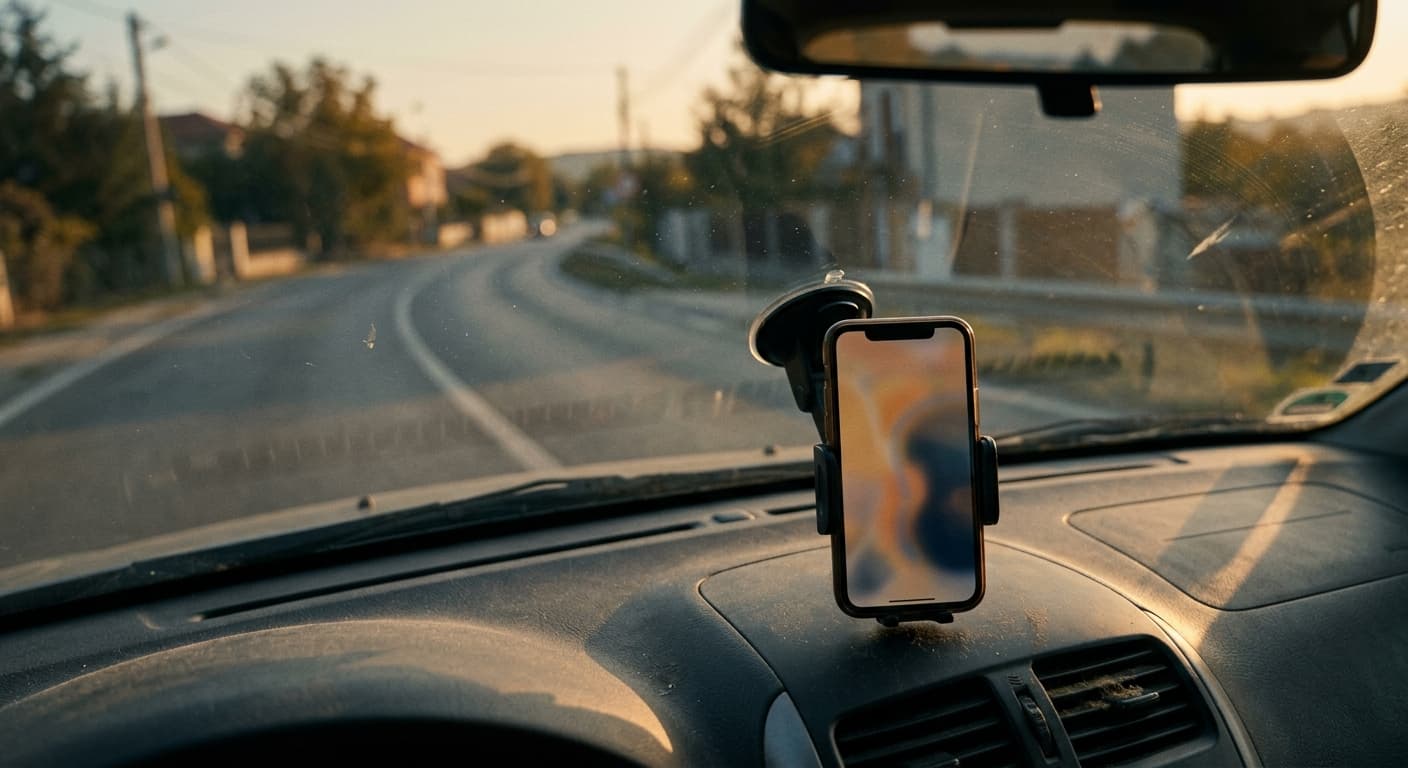
California law allows windshield-mounted GPS devices and dashcams, but only within specific size-restricted zones defined by Cal. Veh. Code 26708. Drivers may mount a GPS or dashcam in a 7-inch square on the lower passenger-side corner or a 5-inch square on the lower driver-side corner.
California has one of the most detailed windshield obstruction frameworks in the country. Vehicle Code Section 26708 (CVC 26708) sets the baseline rule that drivers cannot place objects or materials on windshields or windows that block their view. But the statute also carves out 14 specific exceptions covering everything from GPS devices and dashcams to toll transponders and medical sun screening.
Understanding these rules matters whether you are mounting a phone holder, installing a dash camera, or applying window tint. Getting it wrong can mean a traffic ticket, and California's penalty assessment system turns a small base fine into a bill that can exceed $200.
This guide breaks down every exception under CVC 26708, explains the 2026 changes from SB 506 for commercial vehicles, and covers fines, defenses, and practical tips for staying legal.
The General Rule: CVC 26708(a)
California Vehicle Code Section 26708(a) contains two prohibitions that work together to keep windshields and windows clear.
CVC 26708(a)(1) states that a person shall not drive any motor vehicle with any object or material placed, displayed, installed, affixed, or applied upon the windshield or side or rear windows.
CVC 26708(a)(2) adds that a person shall not drive any motor vehicle with any object or material placed, displayed, installed, affixed, or applied in or upon the vehicle that obstructs or reduces the driver's clear view through the windshield or side windows.
CVC 26708(a)(3) clarifies that this includes obstruction by snow or ice on the windshield, side windows, or rear windows.
These three subsections mean that California law prohibits both items physically attached to the glass and items placed anywhere in the vehicle (like on the dashboard) that block the driver's line of sight.
All 14 Exceptions Under CVC 26708(b)
The law would be unworkable without exceptions. Subdivision (b) lists 14 categories of items or conditions that are exempt from the general prohibition. Here is every one of them.
Exception 1: Rearview Mirrors
Standard interior rearview mirrors attached to the windshield are exempt. This is the most basic exception and applies to every vehicle with a factory-mounted mirror.
Exception 2: Adjustable Nontransparent Sun Visors
Adjustable nontransparent sun visors that are mounted forward of the side windows and are not attached to the glass are permitted. This covers the standard flip-down visors that come with every vehicle. The key requirements are that they must be adjustable and not attached directly to the glass.
Exception 3: Signs, Stickers, and Other Materials (Designated Zones)
This exception creates three specific zones where signs, stickers, or other materials may be displayed:
- A 7-inch square in the lower corner of the windshield farthest from the driver (passenger side)
- A 7-inch square in the lower corner of the rear window farthest from the driver
- A 5-inch square in the lower corner of the windshield nearest the driver (driver side)
These zones are where items such as registration stickers, parking permits, and inspection decals may be placed. The area limits are strictly enforced. Anything larger than the specified squares can result in a citation.
Exception 4: Rear Side Windows
Side windows that are to the rear of the driver are exempt. This means you can legally tint or cover the rear passenger windows and the rear windshield (subject to other tinting rules under CVC 26708.5), as long as the vehicle meets the mirror requirement in Exception 8.
Exception 5: Transit and School Bus Signs
Direction, destination, or terminus signs on passenger common carrier motor vehicles or schoolbuses are permitted, provided those signs do not interfere with the driver's clear view of approaching traffic.
Exception 6: Rear Window Wiper Motor
A rear window wiper motor and its associated hardware are exempt. Since these devices attach to the rear glass, they would otherwise violate subsection (a)(1).
Exception 7: Rear Trunk Lid Handle or Hinges
The rear trunk lid handle or hinges that may be visible through the rear window are exempt. This covers common vehicle designs where trunk hardware appears within the rear window area.
Exception 8: Rear Window Coverage With Dual Side Mirrors
The rear window or windows may be covered or obstructed if the motor vehicle is equipped with outside mirrors on both the left-hand and right-hand sides of the vehicle. Each mirror must be positioned to reflect a view of the highway for a distance of at least 200 feet to the rear of the vehicle.
This is the exception that allows SUVs, vans, and trucks to have fully tinted or obstructed rear windows, as long as both side mirrors provide adequate rearward visibility.
Exception 9: Wide-Angle Lens for Wide Vehicles
A clear, transparent lens affixed to the side window opposite the driver is permitted on vehicles greater than 80 inches in width. The lens must occupy an area not exceeding 50 square inches of the lowest corner toward the rear of that window and must provide the driver with a wide-angle view through the lens.
This exception primarily benefits commercial vehicles and large trucks that need supplemental visibility aids.
Exception 10: Medical Sun Screening Devices
Sun screening devices that meet the requirements of Section 26708.2 may be installed on the side windows on either side of the vehicle's front seat under specific medical conditions.
To qualify, the driver or a front-seat passenger must have in their possession:
- A letter signed by a licensed physician and surgeon certifying that the person must be shaded from the sun due to a medical condition, OR
- A letter signed by a licensed optometrist certifying that the person must be shaded from the sun due to a visual condition
Important restrictions:
- The devices must meet Section 26708.2 standards (green, gray, or neutral smoke color; minimum 35% luminous transmittance; held in place by frames or temporary fasteners allowing ready removal)
- They shall not be used during darkness
- The medical documentation must be in the vehicle at all times
Exception 11: Electronic Toll and CHP Communication Devices
An electronic communication device may be affixed to the center uppermost portion of the interior of the windshield within an area not greater than 5 inches square if the device provides either:
- (A) The capability for enforcement facilities of the Department of the California Highway Patrol to communicate with a vehicle equipped with the device, OR
- (B) The capability for electronic toll and traffic management on public or private roads or facilities
This is the exception that covers FasTrak transponders and similar electronic toll collection devices. The mounting location is restricted to the center-top area of the windshield, and the device must fit within a 5-inch square.
Exception 12: Portable GPS Navigation Devices
A portable Global Positioning System (GPS) may be mounted in one of two locations:
- A 7-inch square in the lower corner of the windshield farthest removed from the driver (passenger side), OR
- A 5-inch square in the lower corner of the windshield nearest to the driver (driver side), outside of an airbag deployment zone
The GPS must be used only for door-to-door navigation while the motor vehicle is being operated.
Key limitations:
- The device must be portable (not permanently installed)
- It must be used exclusively for navigation purposes
- It must fit within the designated square zones
- On the driver's side, it must be placed outside the airbag deployment zone
- This exception does not apply to phones used for navigation unless they are mounted within these zones
Exception 13: Video Event Recorders (Dashcams)
This is one of the most detailed exceptions in the statute. A video event recorder with the capability of monitoring driver performance to improve driver safety may be mounted in one of three locations:
- A 7-inch square in the lower corner of the windshield farthest from the driver (passenger side)
- A 5-inch square in the lower corner of the windshield nearest the driver, outside of an airbag deployment zone
- A 5-inch square mounted to the center uppermost portion of the interior of the windshield
Definition of Video Event Recorder
The statute defines a "video event recorder" as a video recorder that continuously records in a digital loop, recording audio, video, and G-force levels, but saves video only when triggered by an unusual motion or crash or when operated by the driver to monitor driver performance.
Mandatory Notice Requirement
A vehicle equipped with a video event recorder must have a notice posted in a visible location stating that a passenger's conversation may be recorded. This is not optional. Failing to post this notice can create legal issues separate from the windshield mounting rules, particularly given California's two-party consent recording laws.
Recording Storage Limits
Video event recorders shall store no more than 30 seconds before and after a triggering event. The data recorded is the property of the registered owner or lessee of the vehicle. The registered owner or lessee may disable the device.
Employer Obligations for Commercial Drivers
When a person is driving for hire as an employee in a vehicle equipped with a video event recorder, the employer must provide unedited copies of the recordings upon the request of the employee or the employee's representative. These copies must be provided free of charge and within five days of the request.
Exception 14: Vehicle Safety Technology on Commercial Vehicles (SB 506)
Effective January 1, 2026, Senate Bill 506 replaced the former commercial vehicle video event recorder exception with a broader provision for vehicle safety technology.
Under the updated law, vehicle safety technology as defined in Section 393.5 of Title 49 of the Code of Federal Regulations may be installed on any vehicle listed in Section 34500 and subject to Section 34500.7 that is otherwise in compliance with Section 393.60 of Title 49 of the Code of Federal Regulations.
Which Vehicles Qualify
The vehicles covered under CVC 34500 include:
- Motortrucks of three or more axles with a gross vehicle weight rating over 10,000 pounds
- Truck tractors
- Buses (including school buses and transit vehicles)
- Farm labor vehicles
- Certain other commercial motor vehicles
What Devices Are Permitted
Under the federal definition in 49 CFR 393.5, vehicle safety technology includes:
- Fleet incident management systems
- Driver performance and behavior management systems
- Forward collision warning or mitigation systems
- Lane departure warning systems
- Active cruise control systems
- Transponders
- Driver camera systems
- Braking warning and assist systems
- Attention assist warnings
- Global Positioning Systems
- Traffic sign recognition systems
- Systems containing cameras, lidar, radar, sensors, or video
Federal Mounting Rules (49 CFR 393.60)
Under the FMCSA final rule effective May 2022, approved vehicle safety technology devices may be mounted in either of two zones: not more than 216 mm (8.5 inches) below the upper edge of the area swept by the windshield wipers, or not more than 175 mm (7 inches) above the lower edge of the area swept by the windshield wipers. This is a significant expansion from the previous limit. In either position, the device must remain outside the driver's sight lines to the road and highway signs and signals.
Windshield Film and Tinting Rules
Beyond the 14 exceptions for mounted objects, CVC 26708 also addresses transparent materials that can be applied to windshields and windows.
Subdivision (c): Windshield Tinting
Transparent material may be installed, affixed, or applied to the windshield if all of these conditions are met:
- The material is installed along the top of the windshield and the bottom edge is at least 29 inches above the uncompressed front seat
- It is not red or amber in color
- It does not contain opaque lettering that affects the driver's vision
- It does not reflect more sunlight than a standard windshield
Subdivision (d): Front Side Window Film
Clear, colorless, and transparent material may be installed on the front side windows (driver and passenger doors) if:
- It has a minimum 88% visible light transmittance when combined with the glass
- It meets Federal Motor Vehicle Safety Standard No. 205 (49 CFR 571.205)
- It is designed to block ultraviolet A rays
- The installing company or manufacturer provides a signed certificate confirming compliance
- If the material tears, bubbles, or wears to prohibit clear vision, it must be removed or replaced
Subdivision (e): Medical UV Protection
Clear, colorless, and transparent film material may be installed on any window (including the windshield and front side windows) if:
- The driver has a certificate signed by a licensed dermatologist certifying the person should not be exposed to ultraviolet rays due to a medical condition
- The material meets the same 88% transmittance and Federal Motor Vehicle Safety Standard No. 205 requirements as subdivision (d)
Penalties for Violating CVC 26708
A violation of CVC 26708 is classified as an infraction under California law.
Fine Structure
| Component | Amount |
|---|---|
| Base fine | $35 |
| State and county penalty assessments | $162 to $215+ |
| Total fine | $197 to $250+ |
The base fine of $35 is multiplied by California's penalty assessment system, which adds surcharges for the state courthouse construction fund, DNA identification fund, state court facilities fund, and other programs. The exact total varies by county.
No DMV Points
A CVC 26708 conviction does not add points to your California DMV driving record. This means it will not trigger a negligent operator hearing or affect your driving privilege.
Correctable Violation (Fix-It Ticket)
In many cases, officers issue a CVC 26708 citation as a correctable violation. This means you can:
- Remove the offending material or object
- Have the correction verified by a law enforcement officer or authorized station
- Pay a reduced dismissal fee (typically $25) instead of the full fine
Not all CVC 26708 tickets are written as correctable. Whether you receive a fix-it ticket depends on the officer's discretion and the nature of the violation.
Insurance Impacts
While CVC 26708 does not add DMV points, a conviction can still appear on your driving record. Some insurance companies may factor equipment violations into premium calculations over time.
Practical Tips for Legal Windshield Mounting
Following these guidelines will help you stay within the law:
- Measure your mounting zones. Use a tape measure to confirm your GPS, dashcam, or other device fits within the designated 7-inch or 5-inch square areas.
- Check airbag locations. Devices mounted on the driver's side lower corner must be outside the airbag deployment zone. Consult your vehicle owner's manual.
- Post dashcam notices. If you use any type of video event recorder, post a clearly visible notice inside the vehicle stating that conversations may be recorded.
- Keep medical documents in the vehicle. If you rely on a medical exemption for sun screening, always carry the physician's or optometrist's signed letter.
- Remove devices when not in use. Suction-cup mounted GPS units and dashcams are easier to defend legally if they are portable and removable.
- Do not stack devices. Mounting a GPS and a dashcam in the same windshield zone may push you beyond the allowable area.
More California Laws
Looking for information about other California laws? Here are related guides:
- California Recording Laws covers consent requirements for audio and video recording.
- California Lemon Law explains your rights when a new vehicle has persistent defects.
- California Hit and Run Laws details penalties and reporting requirements after an accident.
Frequently Asked Questions
Can I mount a GPS on my windshield in California?
Yes, but only in designated zones. California Vehicle Code 26708(b)(12) allows a portable GPS in a 7-inch square on the lower passenger-side corner or a 5-inch square on the lower driver-side corner (outside the airbag deployment zone). The GPS must be used only for door-to-door navigation.
Are dashcams legal in California?
Yes. California permits video event recorders (dashcams) in three windshield zones: a 7-inch square on the lower passenger-side corner, a 5-inch square on the lower driver-side corner, or a 5-inch square at the center top of the windshield. You must post a visible notice that passengers' conversations may be recorded.
How much is a CVC 26708 ticket in California?
The base fine is $35, but California's penalty assessment system brings the total to approximately $197 to $250 depending on the county. No DMV points are assessed. The ticket may be issued as a correctable (fix-it) violation, which reduces the cost to around $25 if you remove the obstruction and get it verified.
Can I hang anything from my rearview mirror in California?
Objects hanging from the rearview mirror are not specifically exempted under CVC 26708(b). If an officer determines that a hanging object obstructs or reduces your clear view through the windshield, you can be cited under CVC 26708(a)(2). Small, lightweight items may be tolerated in practice, but there is legal risk.
What changed with SB 506 for commercial vehicles in 2026?
Senate Bill 506, effective January 1, 2026, replaced the narrow commercial vehicle dashcam exception with a broader exemption for vehicle safety technology. The exemption reaches only the commercial vehicles listed in CVC 34500, such as motortrucks of three or more axles rated over 10,000 lbs GVWR. Those vehicles can now mount devices like lane departure warnings, driver cameras, collision avoidance systems, and GPS units on the windshield in compliance with federal regulations (49 CFR 393.60), which allow mounting either up to 8.5 inches below the upper edge of the wiper-swept area or up to 7 inches above its lower edge.
Updates
Corrected the federal 49 CFR 393.60 windshield-mounting rule to state both permitted zones (8.5 inches below the upper edge or 7 inches above the lower edge of the wiper-swept area) and clarified that the SB 506 vehicle safety technology exemption covers only the commercial vehicles listed in Vehicle Code 34500, such as motortrucks of three or more axles.
Independently fact-checked against the cited primary sources; governing law re-checked for recent changes
Governing law re-checked for recent changes
Governing law re-checked for recent changes
Reviewed and approved by an editor
The Law Behind This Article
This article rests on the statutory provisions below, held in our own legal record and retrieved from the official source. Tap a section to read the operative text.
California Vehicle Code
§ 26708In forcecited in 4 of our articles
(a) (1) A person shall not drive any motor vehicle with any object or material placed, displayed, installed, affixed, or applied upon the windshield or side or rear windows. (2) A person shall not drive any motor vehicle with any object or material placed, displayed, installed, affixed, or applied in or upon the vehicle that obstructs or reduces the driver’s clear view through the windshield or side windows. (3) This subdivision applies to a person driving a motor vehicle with the driver’s clear vision through the windshield, or side or rear windows, obstructed by snow or ice. (b) This section does not apply to any of the following: (1) Rearview mirrors. (2) Adjustable nontransparent sunvisors that are mounted forward of the side windows and are not attached to the glass.
Official text (excerpt) · last checked 2026-09-07 · Read the full text in our law library · Verify at leginfo.legislature.ca.gov
Cited in 56 court opinions in our collectionLatest citing opinion in our collection: 2026
In the courts (editorial summary, independently checked):California courts read section 26708(a)(2) to require an objective basis that an object actually obstructed the driver's view. People v. White (2003) held an air freshener on a mirror did not justify a stop where the officer never said it blocked his view; People v. Colbert (2007) found such a basis on fuller testimony.
Opinions citing this section in our collection:
- People v. White (California Court of Appeal 2003, 132 Cal. Rptr. 2d 371)✓An officer stopped a car for a tree-shaped air freshener on the mirror; the court held section 26708(a)(1) does not reach an object not affixed on the windshield, and that with no testimony the view was obstructed there was no reasonable basis under subdivision (a)(2).
- People v. Colbert (California Court of Appeal 2007, 68 Cal. Rptr. 3d 912)✓An officer stopped a car for a 4.75-inch tree air freshener on the mirror and testified from his own experience how an object that size hides cars and pedestrians; the court held that testimony gave an objectively reasonable basis under section 26708(a)(2).
- Klarfeld v. State of California (California Court of Appeal 1983, 142 Cal. App. 3d 541)✓A tint installer and car owners challenged sections 26708 and 26708.5 as vague; the court held the terms are not unconstitutionally vague and declared applied tint may not go on the windshield or front side windows, but may go behind the driver if the car has required mirrors.
Identified automatically from the court opinions citing this section — not a ranking of which case controls.
Also relied on in: California Dashcam Laws: Mounting Rules, Audio Recording, and Evidence (2026), Window Tint Laws by State (2026): Legal VLT Limits, California Window Tint Laws (2026): Legal VLT Limits
§ 26708.2In force
Sun screening devices permitted by paragraph (10) of subdivision (b) of Section 26708 shall meet the following requirements: (a) The devices shall be held in place by means allowing ready removal from the window area, such as a frame, a rigid material with temporary fasteners, or a flexible roller shade. (b) Devices utilizing transparent material shall be green, gray, or a neutral smoke in color and shall have a luminous transmittance of not less than 35 percent. (c) Devices utilizing nontransparent louvers or other alternating patterns of opaque and open sections shall have an essentially uniform pattern over the entire surface, except for framing and supports. At least 35 percent of the device area shall be open and no individual louver or opaque section shall have a projected vertical dimension exceeding 3/16 inch. (d) The devices shall not have a reflective quality exceeding 35 percent on either the inner or outer surface.
Official text (excerpt) · last checked 2026-07-28 · Read the full text in our law library · Verify at leginfo.legislature.ca.gov
§ 26708.5In force
(a) No person shall place, install, affix, or apply any transparent material upon the windshield, or side or rear windows, of any motor vehicle if the material alters the color or reduces the light transmittance of the windshield or side or rear windows, except as provided in subdivision (b), (c), or (d) of Section 26708. (b) Tinted safety glass may be installed in a vehicle if (1) the glass complies with motor vehicle safety standards of the United States Department of Transportation for safety glazing materials, and (2) the glass is installed in a location permitted by those standards for the particular type of glass used.
Official text (excerpt) · last checked 2026-07-28 · Read the full text in our law library · Verify at leginfo.legislature.ca.gov
Cited in 10 court opinions in our collectionLatest citing opinion in our collection: 2025
Opinions citing this section in our collection:
- Klarfeld v. State of California (California Court of Appeal 1983, 142 Cal. App. 3d 541)“…at he was uncertain whether the term “factory-installed” in Vehicle Code section 26708.5 included his process and that, if it di…”
- People v. Roberts (California Court of Appeal 2010, 184 Cal. App. 4th 1149)“…from the windows was obstructed by the tint in violation of Vehicle Code section 26708.5, subdivision (a). The officers stopped…”
- People v. Butler (California Court of Appeal 1988, 202 Cal. App. 3d 602)“…tinted glass meeting the requirements of subdivision (b) of Vehicle Code section 26708.5, 1 there would have been n…”
Identified automatically from the court opinions citing this section — not a ranking of which case controls.
§ 34500In force
The department shall regulate the safe operation of the following vehicles: (a) Motortrucks of three or more axles that are more than 10,000 pounds gross vehicle weight rating. (b) Truck tractors. (c) Buses, schoolbuses, school pupil activity buses, youth buses, farm labor vehicles, modified limousines, and general public paratransit vehicles. (d) Trailers and semitrailers designed or used for the transportation of more than 10 persons, and the towing motor vehicle. (e) Trailers and semitrailers, pole or pipe dollies, auxiliary dollies, and logging dollies used in combination with vehicles listed in subdivision (a), (b), (c), (d), or (j). This subdivision does not include camp trailers, trailer coaches, and utility trailers. (f) A combination of a motortruck and a vehicle or vehicles set forth in subdivision (e) that exceeds 40 feet in length when coupled together. (g) A vehicle, or a combination of vehicles, transporting hazardous materials. (h) Manufactured homes that, when moved upon the highway, are required to be moved pursuant to a permit, as specified in Section 35780 or 35790.
Official text (excerpt) · last checked 2026-07-28 · Read the full text in our law library · Verify at leginfo.legislature.ca.gov
Cited in 6 court opinions in our collectionLatest citing opinion in our collection: 2024
Opinions citing this section in our collection:
- Franco v. Athens Disposal Co., Inc. (California Court of Appeal 2009, 171 Cal. App. 4th 1277)“…0, 1194). (See Cal. Code Regs., tit. 13, § 1200, subd. (a); Veh. Code, § 34500, subd. (a).) Rather, the operator is su…”
- Bowman v. Wyatt (California Court of Appeal 2010, 186 Cal. App. 4th 286)“…th three or more axles that weigh more than 10,000 pounds. (Veh. Code, § 34500, subd. (a).) The CHP complies with this…”
- Bell v. Superior Court (California Court of Appeal 2007, 69 Cal. Rptr. 3d 328)“…weight of the truck. (Cal.Code Regs., tit. 13, § 1200; see Veh.Code, § 34500.) In its answers to interrogatories, Co…”
Identified automatically from the court opinions citing this section — not a ranking of which case controls.
Code of Federal Regulations Title 49
§ 393.5Definitions.In forcecited in 2 of our articles
As used in this part, the following words and terms are construed to mean: Aggregate working load limit. The summation of the working load limits or restraining capacity of all devices used to secure an article of cargo on a vehicle. Agricultural commodity trailer. A trailer that is designed to transport bulk agricultural commodities in off-road harvesting sites and to a processing plant or storage location, as evidenced by skeletal construction that accommodates harvest containers, a maximum length of 28 feet, and an arrangement of air control lines and reservoirs that minimizes damage in field operations. Air brake system. A system, including an air-over-hydraulic brake subsystem, that uses air as a medium for transmitting pressure or force from the driver control to the service brake, but does not include a system that uses compressed air or vacuum only to assist the driver in applying muscular force to hydraulic or mechanical components. Air-over-hydraulic brake subsystem. A subsystem of the air brake system that uses compressed air to transmit a force from the driver control to a hydraulic brake system to actuate the service brakes. Anchor point.
Official text (excerpt) · last checked 2026-07-28 · Read the full text in our law library · Verify at ecfr.gov
Cited in 3 court opinions in our collectionLatest citing opinion in our collection: 2013
Opinions citing this section in our collection:
- Kozak v. Hillsborough Public Transportation Commission (District Court, M.D. Florida 2010, 695 F. Supp. 2d 1285)“…Turning to federal law, when Congress passed TEA-21, 49 C.F.R § 393.5 defined “bus” as “[a] vehicle designed…”
- Regency Transportation Group, Ltd. v. Pennsylvania Public Utility Commission (Commonwealth Court of Pennsylvania 2012, 44 A.3d 107)“…n Kozak relied upon the former version of 49 C.F.R. § 393.5 , which was in effect at the time of pa…”
- In re OPC Polymers v. Pub. Utilities Comm. of Ohio (Ohio Court of Appeals 2013, 2013 Ohio 5443)“…ng, that may also prevent it from shifting. 49 C.F.R. 393.5. {¶ 14} This section also defines…”
Identified automatically from the court opinions citing this section — not a ranking of which case controls.
Also relied on in: Ohio Windshield Mounting Laws (2026 Guide)
§ 393.60Glazing in specified openings.In forcecited in 15 of our articles
(a) Glazing material. Glazing material used in windshields, windows, and doors on a motor vehicle manufactured on or after December 25, 1968, shall at a minimum meet the requirements of Federal Motor Vehicle Safety Standard (FMVSS) No. 205 in effect on the date of manufacture of the motor vehicle. The glazing material shall be marked in accordance with FMVSS No. 205 (49 CFR 571.205, S6). (b) Windshields required. Each bus, truck and truck-tractor shall be equipped with a windshield. Each windshield or portion of a multi-piece windshield shall be mounted using the full periphery of the glazing material. (c) Windshield condition. With the exception of the conditions listed in paragraphs (c)(1), (c)(2), and (c)(3) of this section, each windshield shall be free of discoloration or damage in the area extending upward from the height of the top of the steering wheel (excluding a 51 mm (2 inch) border at the top of the windshield) and extending from a 25 mm (1 inch) border at each side of the windshield or windshield panel.
Official text (excerpt) · last checked 2026-07-28 · Read the full text in our law library · Verify at ecfr.gov
Cited in 3 court opinions in our collectionLatest citing opinion in our collection: 2021
In the courts (editorial summary, independently checked):The 70 percent light transmittance floor of 49 CFR 393.60(d) covers the windshield and the windows immediately right and left of the driver. Grooms Hauling, LLC v. Robinson (2020) applied it through Pennsylvania adoption and rejected racial profiling claims over tint citations; State v. Ford (2021) noted that Kansas adopts it too.
Opinions citing this section in our collection:
- United States of America, Government v. Robert L. Pierre, Defendant (District Court, D. New Hampshire 2015, 2015 DNH 083)“…rallel luminous transmittance of not less than 70 percent.” 49 C.F.R. 393.60(c). Neither the Government nor the defe…”
- GROOMS HAULING, LLC v. ROBINSON (District Court, E.D. Pennsylvania 2020)✓Officers repeatedly cited a Black-owned hauling company whose truck windows passed only 17 to 20 percent of light; treating 49 CFR 393.60's 70 percent transmittance standard as the governing rule, the court granted the officers summary judgment on the profiling claims.
- State v. Ford (Court of Appeals of Kansas 2021)“…Relevant to this appeal are regulations on window tinting (49 C.F.R. § 393.60[d]), medical examiner certificates (49…”
Identified automatically from the court opinions citing this section — not a ranking of which case controls.
Also relied on in: Connecticut Windshield Mounting Laws (2026 Guide), Idaho Windshield Mounting Laws (2026 Guide), Kansas Windshield Mounting Laws (2026 Guide)
§ 571.205Standard No. 205, Glazing materials.In forcecited in 8 of our articles
S1. Scope. This standard specifies requirements for glazing materials for use in motor vehicles and motor vehicle equipment. S2. Purpose. The purpose of this standard is to reduce injuries resulting from impact to glazing surfaces, to ensure a necessary degree of transparency in motor vehicle windows for driver visibility, and to minimize the possibility of occupants being thrown through the vehicle windows in collisions. S3. Application. This standard applies to passenger cars, multipurpose passenger vehicles, trucks designed to carry at least one person, buses, motorcycles, slide-in campers, pickup covers designed to carry persons while in motion and low speed vehicles, and to glazing materials for use in those vehicles. S4. Definitions. Bullet resistant shield means a shield or barrier that is installed completely inside a motor vehicle behind and separate from glazing materials that independently comply with the requirements of this standard. Camper means a structure designed to be mounted in the cargo area of a truck, or attached to an incomplete vehicle with motive power, for the purpose of providing shelter for persons.
Official text (excerpt) · last checked 2026-07-28 · Read the full text in our law library · Verify at ecfr.gov
Cited in 34 court opinions in our collectionLatest citing opinion in our collection: 2024
In the courts (editorial summary, independently checked):O'Hara Ex Rel. H.O. v. General Motors Corp. (2007) held FMVSS 205, 49 CFR 571.205, does not preempt a state design claim seeking advanced side glazing. McCracken v. Ford Motor Co. (2008) read the same standard as mandatory rather than a floor, so a conflicting claim would be preempted, and denied dismissal only on that open question.
Opinions citing this section in our collection:
- O'Hara Ex Rel. H.O. v. General Motors Corp. (Court of Appeals for the Fifth Circuit 2007, 508 F.3d 753)✓A child was partially ejected through a Tahoe's tempered-glass side window in a rollover, and her parents claimed GM should have used advanced glazing; the court held FMVSS 205 is a minimum safety standard that does not preempt their common law claims.
- United States v. Ruel Antonio Wallace (Court of Appeals for the Ninth Circuit 2000, 213 F.3d 1216)“…uirements of Federal Motor Vehicle Safety Standard No. 205 (49 C.F.R. 571.205), including the specified minimum light…”
- McCracken v. Ford Motor Co. (District Court, E.D. Pennsylvania 2008, 588 F. Supp. 2d 635)✓A buyer blaming his thyroid cancer on radiation through his Fords' windshields said Lucite or leaded glass should have been used; treating FMVSS 205 as a mandatory standard, the court refused to dismiss on preemption because the pleadings did not show Lucite was unapproved.
Identified automatically from the court opinions citing this section — not a ranking of which case controls.
Also relied on in: Iowa Windshield Mounting Laws (2026 Guide), Rhode Island Windshield Mounting Laws (2026 Guide), Louisiana Dashcam Laws: Mounting, Recording, and Evidence Rules
Search our full record of US law — 2.1 million sections, every state + federal →
Sources and References
- California Vehicle Code Section 26708(leginfo.legislature.ca.gov).gov
- SB 506 Transportation Omnibus Bill (2025-2026)(leginfo.legislature.ca.gov).gov
- FMCSA Final Rule: Vehicle Safety Technology Windshield Mounting (49 CFR 393.60)(federalregister.gov).gov
- California Vehicle Code Section 26708.2 (Sun Screening Standards)(leginfo.legislature.ca.gov).gov
- California Vehicle Code Section 26708.5 (Window Tinting)(leginfo.legislature.ca.gov).gov
- California Vehicle Code Section 34500 (Commercial Vehicle Definitions)(leginfo.legislature.ca.gov).gov
- 49 CFR 393.5 Vehicle Safety Technology Definition(ecfr.gov).gov
- California Judicial Council - Uniform Bail and Penalty Schedules(courts.ca.gov).gov
- 49 CFR 393.60 - Glazing in specified openings (authorized windshield mounting area for vehicle safety technology)(govinfo.gov)