
United Kingdom
UK Recording Laws: Consent, RIPA, UK GDPR, and 2025 Updates
UK recording questions depend on how the recording is made and used. The Investigatory Powers Act 2016, sections 3 and 4, sets the current telecommunications-interception framework. RIPA section 1 is no longer the operative provision, and its former text should not be treated as a general permission to record or share.
Quick Answer: Which Recording Rule Applies?
The current telecommunications question starts with IPA 2016 sections 3 and 4. Section 4 requires a relevant act involving the system and content being made available to someone other than the sender or intended recipient. A label such as personal use does not replace that statutory test.
| Question | Starting point |
|---|---|
| Was a telecommunications communication intercepted? | IPA 2016 section 4: system activity, access to content and relevant timing |
| Was the interception authorised? | IPA 2016 section 6 and the particular applicable authorisation |
| Is a business monitoring calls? | Applicable interception conditions and ICO worker-monitoring guidance |
| Is a public authority conducting covert surveillance? | RIPA or RIP(S)A, according to the power and jurisdiction |
For practical examples, see the UK phone-call recording guide and the guide to covert recordings as evidence.
What RIPA Covers Today
RIPA's current text retains powers concerning covert surveillance, covert human intelligence sources and protected information. Section 26 defines directed and intrusive surveillance; sections 28 and 32 contain distinct authorisation requirements. These provisions do not create a general personal-recording licence.
The former interception offence in RIPA section 1 is omitted from the current text. Telecommunications interception is addressed by the Investigatory Powers Act 2016. Section 44 also distinguishes consent by both sender and intended recipient from its separate route involving one party's consent and an applicable surveillance authorisation.
The RIPA 2000 guide explains the surviving powers, authorisation safeguards, Scotland's framework and Tribunal complaints.
The Investigatory Powers Act 2016
The Investigatory Powers Act 2016 supplies the current principal interception framework. Section 3 prohibits intentional interception in the United Kingdom through specified systems or services without lawful authority, subject to its private-system exception. Party status alone is not the complete statutory test.
What the IPA 2016 Criminalises
Under IPA 2016 section 3, it is an offence to intercept a communication without lawful authority. The Act covers:
- Modifying or interfering with a telecommunication system to obtain content.
- Monitoring transmissions on a system, including wireless telegraphy.
- Making the content of a transmission available to someone who was not the sender or intended recipient.
Telecommunication systems include phone networks, the internet, email, and encrypted messaging platforms.
Current Warrant Review and Urgent Issue
The current Investigatory Powers Act 2016 retains independent Judicial Commissioner review of decisions to issue interception warrants under Part 2, Chapter 1. Section 23 requires review of necessity and proportionality. Section 24 provides a separate urgent-issue procedure, with a Commissioner decision required by the end of the third working day after issue; refusal ends the warrant's effect and prevents renewal.
Penalties Under IPA 2016
| Conviction Route | Jurisdiction | Maximum Penalty |
|---|---|---|
| Summary conviction | England and Wales | Unlimited fine |
| Summary conviction | Scotland / Northern Ireland | Fine up to statutory maximum |
| Conviction on indictment | All UK jurisdictions | Up to 2 years imprisonment and/or fine |
Civil liability and regulatory action by the Information Commissioner's Office (ICO) can arise separately from criminal proceedings.
UK GDPR and the Data Protection Act 2018
Recording a conversation is only the first step. Once a recording captures identifiable information about another person, it becomes personal data under the UK General Data Protection Regulation (UK GDPR) and the Data Protection Act 2018. This overlay applies to organisations and individuals alike, with one important exception: purely personal or household activity is exempt.
The Household Exemption
Individuals recording for purely personal or household purposes are exempt from most UK GDPR obligations (Article 2(2)(c) UK GDPR). If you record a call with your bank for your own notes, you are not processing personal data in a regulated sense. The exemption disappears the moment you share, publish, or use the recording commercially.
Lawful Basis for Organisations
Any organisation recording calls or conversations must identify and document a lawful basis under Article 6 UK GDPR before processing begins. The most commonly relied-upon bases are:
- Legitimate interests (Article 6(1)(f)): The most widely used basis for business call recording. Requires a documented Legitimate Interest Assessment (LIA) demonstrating that the business interest is not overridden by the data subject's rights. The ICO's January 2026 guidance update requires this assessment to be formal and on file.
- Legal obligation (Article 6(1)(c)): Applies where recording is mandated by sector regulation, such as FCA rules for financial services firms.
- Contract (Article 6(1)(b)): Where recording is necessary to perform or verify a contract with the individual.
- Consent (Article 6(1)(a)): Valid in principle but rarely the right basis for employment contexts; must be freely given, specific, informed, and unambiguous.
ICO Guidance on Employee Monitoring (2025-2026)
The ICO updated its employee monitoring guidance in 2025-2026. Key requirements:
- Monitoring must be justified by a clear, documented business need.
- Workers must generally be informed that monitoring may occur, via a privacy notice.
- Covert monitoring is only permissible in exceptional circumstances such as investigating suspected criminal activity, and only after less intrusive methods have been considered.
- Data Protection Impact Assessments (DPIAs) are required for any systematic or large-scale monitoring programme.
- Organisations using AI-assisted call analysis must explicitly disclose this in their privacy notices (January 2026 ICO requirement).
- Recordings must be subject to defined retention policies and automatically deleted at the end of the retention period.

Workplace Call Recording and Business Monitoring
Business call monitoring needs separate analysis of interception authority and data protection. IPA 2016 section 46 provides a regulation-making route for specified business monitoring and record-keeping. Its existence does not authorise every recording labelled training or quality control.
The ICO's current worker-monitoring guidance explains that recording every call's content is not usually proportionate. It gives business transactions, training and quality control as possible contexts for necessary monitoring, with attention to less intrusive alternatives.
The guidance says callers must be told that recording is taking place and why. A recorded message is good practice; additional privacy information can be supplied separately. That is data-protection guidance, not a conclusion that an announcement satisfies every interception condition.
The UK workplace-recording guide and covert recordings as evidence cover the separate workplace and court-use questions.
Recording Phone Calls in the UK
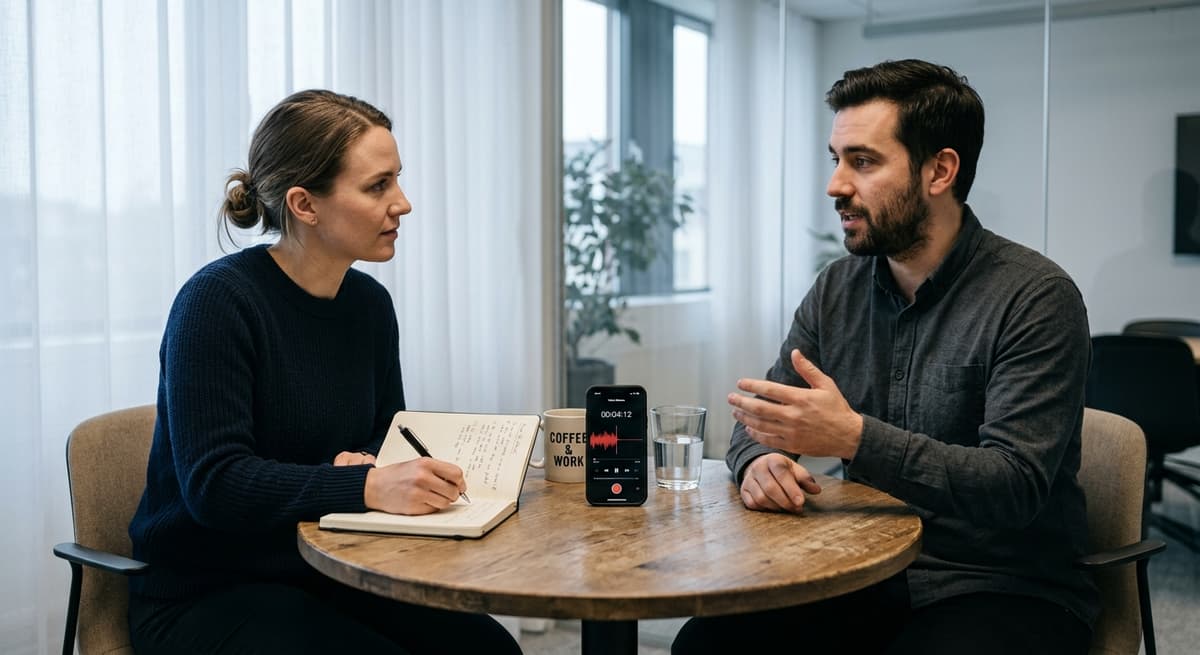
A participant recording a telephone call should not be analysed through the former RIPA section 1 as though it remained in force. The current IPA section 4 definition turns on the system activity and who can access the content. The applicable circumstances, rather than a blanket personal-use label, determine whether the interception provisions are engaged.
Recording and Later Use Are Separate Questions
The current IPA section 4 definition addresses a relevant act involving a telecommunications system, access to content and the statutory timing rules. It does not create the personal-use exemption described in older versions of this guide. The way a recording is later used needs its own analysis; it cannot be resolved by quoting the former RIPA interception provision.
Admissibility in Legal Proceedings
A covert recording you have made of your own conversation is generally admissible in civil and criminal proceedings, but admission is not guaranteed. Courts apply a balancing test:
- Civil proceedings: Under the Civil Procedure Rules, courts have discretion to admit or exclude evidence, weighing relevance, authenticity, and fairness.
- Family court: The Family Justice Council published comprehensive guidance in May 2025 on covert recordings in family proceedings. Courts may admit recordings with significant evidential weight. Recording children is strongly discouraged. Parties must disclose recordings early, produce unedited versions, and cannot share recordings with third parties without court permission.
- Criminal proceedings: Courts may exclude evidence obtained unlawfully under section 78 of the Police and Criminal Evidence Act 1984 (PACE) if admitting it would adversely affect the fairness of proceedings.
Recording In-Person Conversations
IPA section 4 concerns telecommunications systems. A face-to-face recording therefore needs analysis of the actual device, setting and use rather than an assumed exception in RIPA. For workplace and evidential questions, see the UK workplace-recording guide and covert recordings as evidence.
Potential issues arise under:
- Privacy law and the tort of misuse of private information: If you record someone in a context where they had a reasonable expectation of privacy (for example, in their home or a private medical consultation), you may face civil liability even if no criminal offence is committed.
- Harassment: Persistent, systematic covert recording of a particular person could constitute a course of conduct amounting to harassment under the Protection from Harassment Act 1997.
- Data protection: If you process the recording in a way that goes beyond personal household use, UK GDPR applies.
Recording the Police
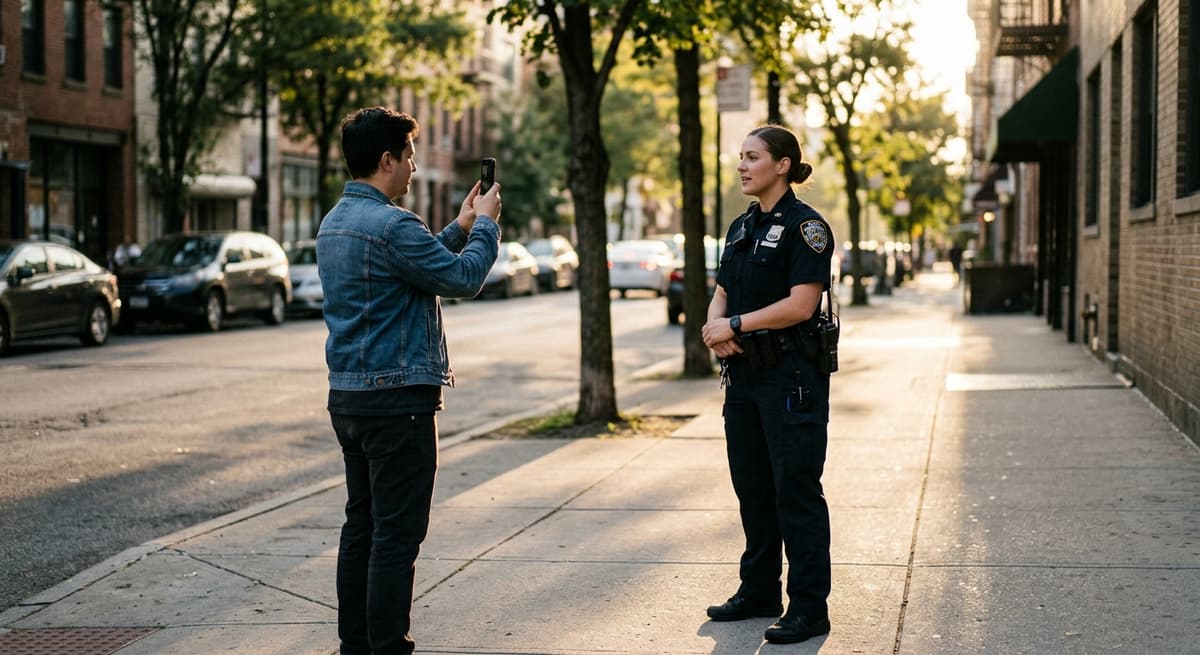
You have the right to film and record police officers carrying out their duties in a public place. There is no specific criminal offence of filming a police officer in the UK.
The Metropolitan Police states explicitly in its public guidance that members of the public and the press do not need a permit to film or photograph in public places, and police have no power to stop them filming police personnel. This reflects the right to receive and impart information under Article 10 of the European Convention on Human Rights, as incorporated into UK law by the Human Rights Act 1998.
What Police Cannot Do
Police officers cannot:
- Require you to stop filming without a specific legal power.
- Demand you delete footage from your phone without a court order or warrant.
- Seize your device purely because you filmed them.
What You Must Not Do
- Obstruct a police officer in the execution of duties (Police Act 1996 s.89).
- Film in a way that is likely to be useful to a person planning a terrorist act (Counter-Terrorism Act 2008 s.76; this requires the terrorist-assistance nexus, not mere filming of police activity).
- Film in premises where filming is restricted by a court order or security designation.
Bridges v South Wales Police [2020] EWCA Civ 1058
In August 2020, the Court of Appeal held that South Wales Police's use of live automated facial recognition technology was unlawful. The court found three grounds: the absence of an adequate legal framework breached Article 8 ECHR; the Data Protection Impact Assessment failed to properly address privacy implications; and the force had not complied with the public sector equality duty. Although the case concerned police surveillance technology rather than individual recording rights, it demonstrates the courts' willingness to scrutinise public-space surveillance programmes robustly.
The Voyeurism (Offences) Act 2019 and Image-Based Abuse
The Voyeurism (Offences) Act 2019 amended the Sexual Offences Act 2003 to create a specific upskirting offence. Under section 67A of the 2003 Act (as inserted), it is a criminal offence to operate equipment or record an image beneath another person's clothing for the purpose of obtaining sexual gratification or causing humiliation, alarm, or distress to the victim.
Maximum penalty: 2 years imprisonment. The most serious cases may result in the offender being placed on the sex offenders register.
The offence exists alongside section 67 of the Sexual Offences Act 2003, which covers voyeuristic recording more broadly (filming private acts for sexual gratification), and the Protection of Freedoms Act 2012 offence of installing equipment to observe or record private acts.
Domestic Abuse Act 2021: Non-Consensual Breastfeeding Photography
The Domestic Abuse Act 2021 extended voyeurism provisions to cover recording a person who is breastfeeding without their consent for the purpose of sexual gratification or causing humiliation, distress, or alarm. Maximum penalty: 2 years imprisonment.
Civil Tort: Misuse of Private Information
Even where no criminal offence is made out, recording someone in a context where they had a reasonable expectation of privacy can give rise to civil liability for misuse of private information, a tort developed by English courts under the influence of Article 8 ECHR. Damages are available; courts have awarded substantial sums in cases involving covert intimate recording.
The Online Safety Act 2023: Platform Duties and NCII
The Online Safety Act 2023 is primarily a platform regulatory statute. Its relevance to recording law is through new criminal offences and the priority offence regime.
The OSA created two offences in the Sexual Offences Act 2003:
- Cyberflashing (section 66A): Sending an image of genitals without consent for the purpose of sexual gratification or causing humiliation, alarm, or distress. The first conviction under this provision occurred in March 2024.
- Sharing intimate images without consent (section 66B): Sharing a real or AI-generated intimate image of an identifiable adult without consent. No requirement to prove intent to cause harm; the sharing itself is the offence.
Platforms that fail to remove non-consensual intimate imagery face fines of up to £18 million or 10% of global qualifying revenue under Ofcom's enforcement powers. Illegal content duties came into force on 17 March 2025. On 8 January 2026, the Online Safety Act 2023 (Priority Offences) (Amendment) Regulations 2025 came into force, formally designating cyberflashing and intimate image sharing as priority offences requiring proactive platform action.
AI, Deepfakes, and the Data (Use and Access) Act 2025
The Data (Use and Access) Act 2025 (DUAA) is the most significant recent development in UK recording-adjacent law. Section 138 inserts new sections 66E-H into the Sexual Offences Act 2003, creating criminal offences specifically targeting the creation of intimate deepfakes.
What Is Now Criminalised
From 6 February 2026, it is a criminal offence to intentionally:
- Create, or request the creation of, a "purported intimate image" of an identifiable adult without their consent or a reasonable belief in consent.
- A purported intimate image is any image that appears to show the person nude, partially nude, or engaged in a sexual act, whether the image is real, digitally altered, or entirely AI-generated.
Importantly, the offence does not require intent to share the image. Creating a deepfake for private use is already criminalised. If the deepfake is subsequently shared, the perpetrator may also face the separate section 66B sharing offence under the OSA 2023.
Crime and Policing Bill: Nudification Apps
The UK Government announced its intention to criminalise the supply of nudification tools (apps designed to generate non-consensual intimate images) through the Crime and Policing Bill, which was progressing through Parliament as of early 2026. Companies supplying such tools would face criminal liability.
The Combined Effect of OSA 2023 and DUAA 2025
Sharing AI-generated intimate images has been illegal under the OSA 2023 since 31 January 2024. The DUAA 2025 closes the creation gap. Together the two statutes mean that both creating and sharing non-consensual intimate deepfakes are criminal in the UK.

Scotland: The RIP(S)A Framework
The Regulation of Investigatory Powers (Scotland) Act 2000 provides a distinct framework for directed and intrusive surveillance and covert human intelligence sources. Its authorisations are not a general licence for private people to record conversations.
RIPA section 46 preserves specified UK-wide authorisation grounds and authorities in Scotland. Identifying the activity, authority and statutory ground matters more than treating the two Acts as interchangeable personal-recording rules.
Cross-Border Recordings: UK to US and EU
Recording laws vary by jurisdiction, and a UK caller recording a cross-border call must consider the law of the other jurisdiction.
UK Calling a US Number
The United States has both federal wiretapping law (18 U.S.C. § 2511, which permits one-party consent recording at the federal level) and state wiretapping statutes. Approximately 13 US states require the consent of all parties to a call, including California, Florida, Pennsylvania, and Washington. If a UK-based caller records a call with a person in California, they should obtain consent from the California party because California Penal Code § 632 applies to the party in California.
The safest approach for any cross-border business call recording programme is to apply the strictest applicable consent law to all calls, regardless of where the recording party is located.
UK Calling EU Numbers
EU member states implement the e-Privacy Directive alongside EU GDPR. Many EU jurisdictions require that all parties be informed before a call is recorded. Germany, for example, requires all-party consent in most contexts. The UK's post-Brexit UK GDPR is functionally equivalent to EU GDPR for most recording-related purposes, but businesses transferring recorded personal data from EU countries to UK-based systems must comply with GDPR Chapter V transfer rules. The EU adequacy decision for UK data transfers was extended to 2027.
Notable Enforcement Cases
News of the World Phone Hacking Scandal
The most significant UK case of illegal recording involved systematic interception of voicemail messages by staff at the News of the World between 2001 and 2011:
- Clive Goodman and Glenn Mulcaire were convicted under RIPA in January 2007 for intercepting royal household voicemails.
- Andy Coulson (former editor) was convicted of conspiracy to intercept communications in 2014 and sentenced to 18 months.
- The newspaper closed in July 2011 after 168 years of publication.
- News Corporation paid over £400 million in civil settlements to victims.
- The Leveson Inquiry produced wide-ranging recommendations on press ethics.
The scandal demonstrates that illegal interception of communications, including voicemail interception, is treated as serious criminality in the UK.
ICO Enforcement: Key Examples
- 2019: A care home fined for using CCTV in residents' bedrooms without a proper lawful basis.
- 2020: An employer reprimanded for covert monitoring of employee emails without adequate justification.
- 2023: A private landlord received an enforcement notice for CCTV covering neighbouring properties without a lawful basis or privacy notice.
- 2024: ICO issued enforcement notices to two organisations for deploying AI-powered call analysis without adequate disclosure to data subjects.
Bridges v South Wales Police (2020)
As noted above, the Court of Appeal held the police use of live automated facial recognition in public to be unlawful on three grounds: breach of Article 8 ECHR, failure to conduct a proper DPIA under the DPA 2018, and failure to comply with the public sector equality duty. The decision has shaped subsequent police AFR deployment policy.
CCTV and Surveillance Cameras
The UK has one of the highest concentrations of CCTV cameras in the world, estimated at between four and six million cameras. The regulatory framework is set by the Protection of Freedoms Act 2012, which created the Surveillance Camera Commissioner and the Surveillance Camera Code of Practice.
Who Must Follow the Code
The following bodies are required to have regard to the Surveillance Camera Code:
- Police forces and Police and Crime Commissioners.
- Local authorities and fire and rescue services.
- NHS trusts and foundation trusts.
- Public transport providers and other public authorities operating surveillance systems.
Domestic CCTV
Private homeowners operating cameras that capture images beyond their own property may be subject to UK GDPR. The ICO advises that domestic cameras should ideally cover only the homeowner's own property. Where cameras capture a neighbour's garden, driveway, or a public footpath, data protection obligations may apply, including the obligation to respond to subject access requests within one month.
ICO Video Surveillance Guidance (2023 Update)
The ICO updated its video surveillance guidance in 2023, emphasising that audio recording alongside CCTV video is "highly intrusive" and will require substantially greater justification than video-only surveillance. Organisations should switch off audio capture capability by default and enable it only in exceptional circumstances through a deliberate trigger.
Updates Log
| Date | Change |
|---|---|
| 2026-05-15 | Full refresh: added Investigatory Powers (Amendment) Act 2024; Data (Use and Access) Act 2025 deepfake offences (in force 6 Feb 2026); Online Safety Act 2023 priority offences (in force 8 Jan 2026); Family Justice Council covert recording guidance (May 2025); ICO January 2026 LIA and AI disclosure requirements; Bridges v South Wales Police 2020; updated cross-border US/EU section; Scotland RIP(S)A section added; rebuilt FAQ and SourcesList. Word count expanded from 3,532 to approximately 6,200. |
| 2026-03-28 | Minor edits; Investigatory Powers (Amendment) Act 2024 noted. |
| 2021-11-01 | Original publication. |
Related UK Recording Guides
- Recording Phone Calls in the UK
- Recording in the UK Workplace
- Filming the Police in Public
- Home CCTV and Video Doorbells
- Covert Recordings as Evidence
This guide is part of our United Kingdom law guides.
Frequently Asked Questions
Is it legal to record a phone call in the UK without telling the other person?
The answer depends on the recording method and circumstances. IPA 2016 section 4 defines telecommunications interception; former RIPA section 1 is not a current blanket personal-use permission. See the linked UK phone-call guide for the practical recording questions.
Can I record a conversation with my employer at work?
A workplace recording needs separate analysis of the recording method, monitoring arrangements and proposed use. RIPA authorisations are not a general personal-use licence. The linked UK workplace and evidence guides address those distinct questions.
What is the penalty for illegally intercepting someone else's communications?
Under the Investigatory Powers Act 2016, unlawful interception carries a maximum of two years imprisonment and/or an unlimited fine on indictment. Civil claims and ICO enforcement action can arise in addition to criminal proceedings.
Do businesses need to tell customers they are recording calls?
The ICO guidance says organisations monitoring calls must tell affected callers that calls are recorded and why. A recorded message is good practice, with further privacy information supplied by another appropriate route. That guidance does not establish that one announcement satisfies every interception or data-protection condition.
Can I film police officers in the UK?
Yes, generally. There is no specific UK law prohibiting filming police officers performing their duties in a public place. The Metropolitan Police confirms that members of the public do not need a permit to film in public places. You must not obstruct officers in the execution of their duties, and filming must not be done for the purpose of assisting terrorism.
Is it legal to share an intimate image of someone without their consent?
No. Sharing intimate images without consent is a criminal offence under the Sexual Offences Act 2003 (as amended by the Online Safety Act 2023). This applies whether the image is real or AI-generated. From 6 February 2026, creating (not just sharing) a non-consensual intimate deepfake is also a criminal offence under the Data (Use and Access) Act 2025, section 138.
Can covert recordings be used in family court proceedings?
Possibly, at the court's discretion. The Family Justice Council's May 2025 guidance states that courts may admit covert recordings if they have significant evidential weight and admitting them serves the interests of justice. However, parties must disclose recordings to the court early, provide unedited copies, and cannot share them with third parties without court permission. Recording children is strongly discouraged.
What laws apply if I record a call between the UK and the United States?
Start by identifying the locations and the recording method. IPA section 4 supplies the UK telecommunications definition; the linked US recording guides provide the separate federal and state context. A general one-party label does not decide a particular cross-border recording.
Does Scotland have different recording laws from England and Wales?
Scotland has RIP(S)A for specified covert-surveillance and human-source authorisations, alongside the UK-wide grounds preserved by RIPA section 46. Neither framework is a general private-recording licence. The relevant activity, authority and jurisdiction need to be identified.
What changed in UK deepfake law in 2025 and 2026?
Significant changes occurred in rapid succession. The Online Safety Act 2023 made sharing non-consensual intimate images (including deepfakes) illegal from 31 January 2024. The Data (Use and Access) Act 2025, section 138, which came into force on 6 February 2026, extended liability to creating or requesting the creation of a non-consensual intimate deepfake, even without intending to share it. The UK Government also announced plans in the Crime and Policing Bill to criminalise companies that supply nudification tools.
Updates
Corrected the description of Judicial Commissioner review of interception warrants and the separate urgent-approval procedure.
Corrected the RIPA and IPA recording framework, business-monitoring and Scotland summaries; added the detailed RIPA guide.
Governing law re-checked for recent changes
The Law Behind This Article
This article rests on the statutory provisions below, held in our own legal record and retrieved from the official source. Tap a section to read the operative text.
United States Code Title 18
§ 2511Interception and disclosure of wire, oral, or electronic communications prohibitedIn forcecited in 415 of our articles
Except as otherwise specifically provided in this chapter any person who— intentionally intercepts, endeavors to intercept, or procures any other person to intercept or endeavor to intercept, any wire, oral, or electronic communication; intentionally uses, endeavors to use, or procures any other person to use or endeavor to use any electronic, mechanical, or other device to intercept any oral communication when— such device is affixed to, or otherwise transmits a signal through, a wire, cable, or other like connection used in wire communication; or such device transmits communications by radio, or interferes with the transmission of such communication; or such person knows, or has reason to know, that such device or any component thereof has been sent through the mail or transported in interstate or foreign commerce; or such use or endeavor to use (A) takes place on the premises of any business or other commercial establishment the operations of which affect interstate or foreign commerce; or (B) obtains or is for the purpose of obtaining information relating to the operations of any business or other commercial establishment the operations of which affect interstate or foreign…
Official text (excerpt) · last checked 2026-08-28 · Read the full text in our law library · Verify at uscode.house.gov
Cited in 2,045 court opinions in our collectionLatest citing opinion in our collection: 2026
In the courts (editorial summary, independently checked):Griggs-Ryan v. Smith (1990) applied the Section 2511(2)(d) prior-consent exception, treating a tenant repeatedly told that all incoming calls were taped as having impliedly consented. United States v. United States District Court (1972) read the then-current Section 2511(3) as conferring no presidential surveillance power.
Opinions citing this section in our collection:
- Mitchell v. Forsyth (Supreme Court of the United States 1985, 472 U.S. 511)✓The Attorney General authorized a warrantless 1970 national security wiretap that caught the plaintiff's calls; the Court held the since-repealed Section 2511(3) disclaimer left the tap lawful under Title III, and that Mitchell had qualified immunity.
- United States v. United States District Court for the Eastern District of Michigan (Supreme Court of the United States 1972, 407 U.S. 297)✓The Attorney General approved warrantless wiretaps on members of a domestic group accused of bombing a CIA office; the Court read Section 2511(3) as a congressional disclaimer conferring no surveillance power, then held the Fourth Amendment required prior judicial approval.
- Forsyth v. Barr (Court of Appeals for the Fifth Circuit 1994, 19 F.3d 1527)✓Dallas police used, in an internal affairs probe of an officer, calls private parties allegedly intercepted illegally; assuming that was unlawful, the Fifth Circuit held Section 2517(1) and (2) allowed the disclosure and use, defeating the Section 2511(1)(c) and (d) claims.
Identified automatically from the court opinions citing this section — not a ranking of which case controls.
Also relied on in: Connecticut Recording Laws (2026): Hybrid Consent Rules Explained, Oregon Recording Laws (2026): Hybrid One-Party and All-Party Rules, US Recording Laws by State (2026): All 50 States Explained
Search our full record of US law — 2.1 million sections, every state + federal →
Sources and References
- Regulation of Investigatory Powers Act 2000(legislation.gov.uk).gov
- Investigatory Powers Act 2016(legislation.gov.uk).gov
- Investigatory Powers (Amendment) Act 2024(legislation.gov.uk).gov
- Telecommunications (Lawful Business Practice) Regulations 2000(legislation.gov.uk).gov
- Data Protection Act 2018(legislation.gov.uk).gov
- Online Safety Act 2023(legislation.gov.uk).gov
- Data (Use and Access) Act 2025(legislation.gov.uk).gov
- Voyeurism (Offences) Act 2019(legislation.gov.uk).gov
- Domestic Abuse Act 2021(legislation.gov.uk).gov
- Protection of Freedoms Act 2012(legislation.gov.uk).gov
- ICO UK GDPR Guidance and Resources(ico.org.uk).gov
- ICO Video Surveillance Guidance(ico.org.uk).gov
- Surveillance Camera Code of Practice(gov.uk).gov
- Family Justice Council Guidance on Covert Recordings (2025)(judiciary.uk).gov
- Bridges v South Wales Police - Surveillance Camera Commissioner Statement(gov.uk).gov
- Metropolitan Police Photography and Filming Advice(met.police.uk).gov
- Implementation of the Online Safety Act - House of Commons Library (2025)(commonslibrary.parliament.uk).gov
- Investigatory Powers (Amendment) Act 2024 - DLA Piper Analysis(privacymatters.dlapiper.com)
- Criminalising Deepfakes: UK New Offences - Herbert Smith Freehills(hsfkramer.com)
- Sexual Offences Act 2003 ss.66A-H (as amended)(legislation.gov.uk).gov
- Investigatory Powers Act 2016, section 23(legislation.gov.uk).gov
- Investigatory Powers Act 2016, section 24(legislation.gov.uk).gov
- Investigatory Powers Act 2016, section 4(www.legislation.gov.uk).gov
- ICO guidance on methods of worker monitoring(oruoonzwnyyjbemgcfwf.supabase.co).gov
- Regulation of Investigatory Powers Act 2000, section 26(www.legislation.gov.uk).gov
- Investigatory Powers Act 2016, section 3(www.legislation.gov.uk).gov
- Investigatory Powers Act 2016, section 46(www.legislation.gov.uk).gov
- ICO guidance on methods of worker monitoring(ico.org.uk).gov
- Regulation of Investigatory Powers (Scotland) Act 2000, section 1(www.legislation.gov.uk).gov
- Regulation of Investigatory Powers Act 2000, section 46(www.legislation.gov.uk).gov
- ICO guidance on methods of worker monitoring(oruoonzwnyyjbemgcfwf.supabase.co).gov