
Connecticut
Connecticut Windshield Mounting Laws (2026 Guide)
Independently fact-checked against primary sources (last audited August 17, 2026). · Reviewed by the RecordingLaw editorial team. · Law checked current as of August 17, 2026. · 10 primary sources cited on this page. How we verify our legal content
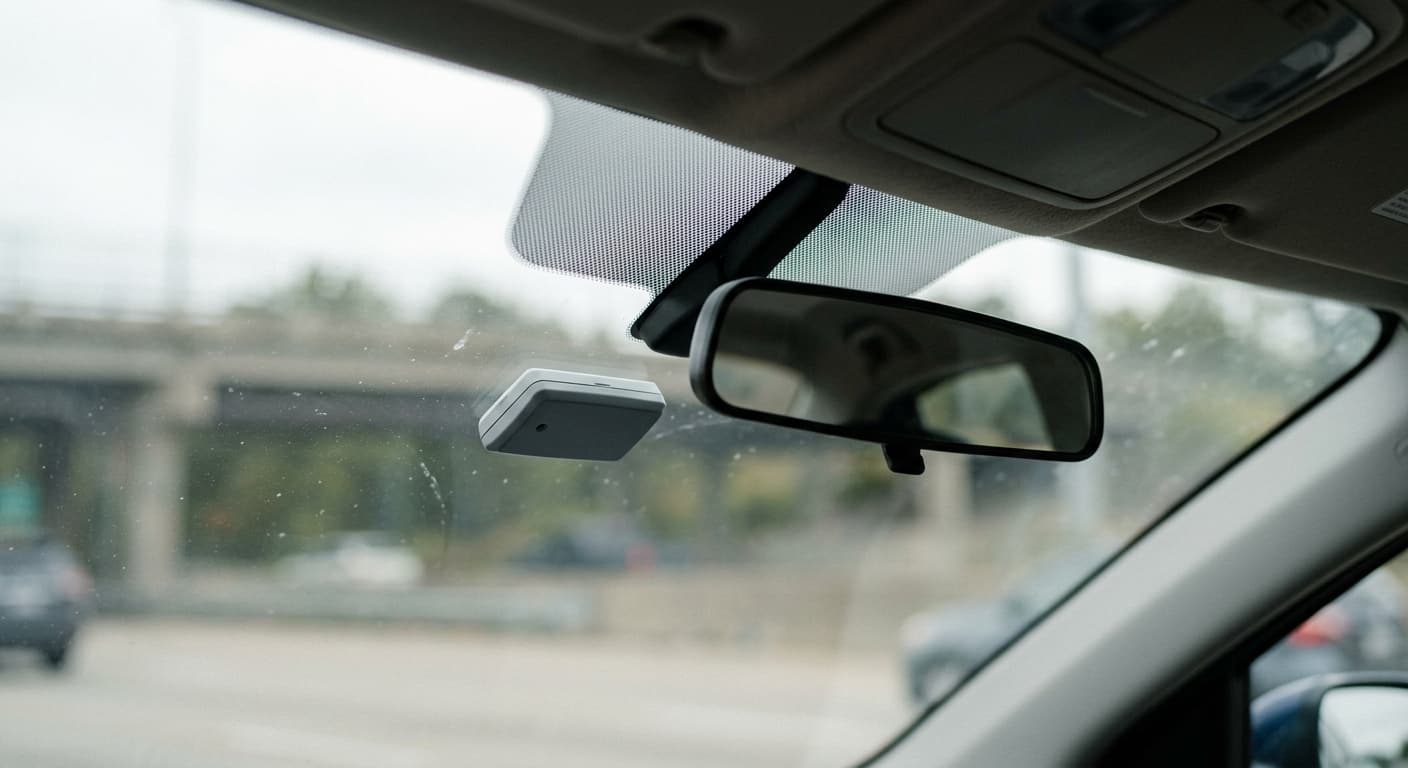
Connecticut allows dashcams, GPS units, and phone mounts on the windshield under Conn. Gen. Stat. Section 14-99f, provided the device does not interfere with the driver's view in a manner that significantly blocks or conceals it. Mounting behind the rearview mirror or in the lower windshield corners reduces obstruction risk.
Connecticut regulates what you can place on or attach to your windshield through two primary statutes. Connecticut General Statutes Section 14-99f covers windshield condition, obstruction of view, and device mounting. Section 14-99g governs window tinting, sticker placement zones, and light transmission requirements.
A major change took effect on October 1, 2025, when Public Act 25-19 narrowed what counts as a windshield obstruction violation in the first place. This guide explains the current rules for mounting devices on your windshield in Connecticut, the designated sticker zones, tinting restrictions, and the penalties for violations.
Connecticut Windshield Obstruction Law (Section 14-99f)
Section 14-99f of the Connecticut General Statutes is the primary law governing what can and cannot be on your windshield. The statute contains four subsections.
Subsection (a): Windshield and Wiper Requirements
Every motor vehicle must have a windshield that meets the safety glass standards set by Section 14-100. The vehicle must also have a windshield wiper in effective working order positioned directly in front of the operator.
The windshield must be reasonably free of defects and accumulations of snow, ice, condensation, and dirt on both the inside and outside surfaces. Motorcycles and vehicles designed by the manufacturer for off-highway use without a windshield are exempt from this requirement.
Subsection (b): Operating With an Obstructed Windshield
No person may operate a motor vehicle if the windshield is in a condition that interferes with an unobstructed view of the highway "in a manner that significantly blocks or conceals by use of an obstacle or obstruction to an extent that would prevent a reasonable person from viewing the highway." This applies to physical damage such as cracks, chips, or clouding.
Public Act 25-19 added that qualifying language to subsection (b) as well as subsection (c), effective October 1, 2025. Before then, subsection (b) prohibited any windshield condition that interfered with an unobstructed view, with no threshold attached. The statute still does not define specific crack sizes or locations, but the damage must now significantly block or conceal the view to the point that a reasonable person could not view the highway. Damage a driver can readily see past does not meet the statutory standard.
Subsection (c): Devices, Stickers, and Ornaments
No article, device, sticker, or ornament may be attached, affixed to, or hung on or in any motor vehicle in a manner or location that interferes with the operator's unobstructed view of the highway "in a manner that significantly blocks or conceals by use of an obstacle or obstruction to an extent that would prevent a reasonable person from viewing the highway," or that distracts the operator's attention.
This subsection applies to all items placed on the windshield, dashboard area, or hanging from the rearview mirror. GPS units, phone mounts, dashcams, air fresheners, parking placards, and decorative items all fall under this provision.
Court interpretation has clarified that hanging an object from the rearview mirror is not a per se violation of Section 14-99f. The state must prove that the specific item, as positioned in that particular vehicle, actually interfered with the driver's view or distracted the driver. A small air freshener on a rearview mirror does not automatically violate the statute.
Subsection (d): Penalties
Violation of any provision of Section 14-99f is classified as an infraction. The base fine is $92, with additional court costs, surcharges, and assessment fees that bring the total to approximately $184.
Public Act 25-19: The 2025 Enforcement Change
On June 9, 2025, Governor Ned Lamont signed Public Act 25-19 into law. The act, originally introduced as House Bill 7132, passed the Connecticut House 143-0 and the Senate 35-0. Its windshield-related provisions took effect on October 1, 2025.
What Changed
Before PA 25-19, subsections (b) and (c) of Section 14-99f prohibited any windshield condition, device, sticker, or ornament that interfered with the driver's unobstructed view, with no threshold attached. A hanging air freshener, a small sticker, a mounted device, or a chipped windshield could be cited if an officer concluded it interfered with the view.
Section 5 of PA 25-19 rewrote the violation itself. In both subsection (b) and subsection (c), the interference must now occur "in a manner that significantly blocks or conceals by use of an obstacle or obstruction to an extent that would prevent a reasonable person from viewing the highway." The official History note to Section 14-99f records the change as "P.A. 25-19 amended Subsecs. (b) and (c) to add language re a manner that significantly blocks, conceals or obstructs."
The act did not change stop authority for Section 14-99f. It raised what has to be shown to establish a violation at all, and an officer needs a violation to write a citation. The act's secondary-enforcement provisions, which bar a stop when the violation is the sole reason for it, were attached to the cannabis-in-a-vehicle offenses in Sections 53a-213a and 53a-213b, not to the windshield section.
What This Means in Practice
The change does not legalize obstructing your windshield. Placing a device or ornament that significantly blocks or conceals your view remains a violation of Section 14-99f and is still an infraction that carries the same $92 base fine.
The difference is in what counts as a violation in the first place. PA 25-19 redefined Sections 14-99f(b) and 14-99f(c) themselves: a windshield condition, device, sticker, or ornament is now a violation only if it significantly blocks or conceals the driver's view to an extent that would prevent a reasonable person from viewing the highway. A minor obstruction that does not meet this threshold is not a violation of the statute, so it cannot support a citation, whether the vehicle was stopped for that reason or for something else.
Substantial obstructions that significantly block or conceal the driver's view are still violations of Section 14-99f. A large device covering a significant portion of the windshield, or a collection of items that together impair forward visibility, still gives officers grounds to conduct a traffic stop.
Why the Law Changed
PA 25-19 grew out of recommendations from the Connecticut Police Transparency and Accountability Task Force. Research presented to the task force found that Black drivers in Connecticut were almost twice as likely to be stopped for equipment violations compared to white drivers, and Hispanic drivers were 1.5 times as likely to be stopped for these violations.
The legislation aims to focus traffic enforcement on safety-related violations while reducing disparities in how minor equipment infractions are enforced.
Windshield Sticker Zones (Section 14-99g)
Section 14-99g establishes specific zones on the windshield where stickers, signs, and other materials are permitted. These zones are exceptions to the general prohibition against placing non-transparent materials on the windshield.
Passenger Side: Seven-Inch Square
Signs, stickers, or other materials may be displayed within a seven-inch square area in the lower corner of the windshield farthest removed from the driver. On a standard left-hand-drive vehicle, this is the lower right corner of the windshield (passenger side).
This zone accommodates items such as parking permits, inspection stickers, registration decals, toll transponder stickers, and municipal permits.
Driver Side: Five-Inch Square
Signs, stickers, or other materials may be displayed within a five-inch square area in the lower corner of the windshield nearest the driver. On a standard left-hand-drive vehicle, this is the lower left corner of the windshield (driver side).
The driver-side zone is smaller because it is closer to the driver's direct line of sight. Connecticut law restricts this area to five inches to minimize the impact on the driver's peripheral vision.
Other Permitted Stickers
Section 14-99g also permits any sticker or certificate required by federal law, state statute, or municipal ordinance. This covers items such as emissions inspection stickers, vehicle registration certificates, and municipal parking permits that are mandated by law.
Window tint compliance stickers are also addressed by the statute. Vehicles with aftermarket window tinting must display a compliance sticker between the tint film and the glass on each tinted window. This sticker must be placed in the lower left corner of each tinted window, must not exceed one square inch, and must be pressure-sensitive and self-destructive upon removal.
GPS and Navigation Device Mounts
Connecticut law permits GPS and navigation devices to be mounted on the windshield. The device must comply with Section 14-99f(c), meaning it cannot interfere with the driver's unobstructed view of the highway in a manner that significantly blocks or conceals it, and cannot distract the driver.
Connecticut does not designate a specific windshield zone for electronic device mounting. Unlike states such as California, which specify a seven-inch square in the lower passenger corner and a five-inch square in the lower driver corner for GPS mounts, Connecticut relies on the general "unobstructed view" standard.
Recommended Mounting Locations
For the safest legal placement of a GPS or navigation device in Connecticut, consider these locations:
-
Behind the rearview mirror. If the device is small enough to fit within the mirror's profile, this location keeps it out of the driver's direct and peripheral line of sight.
-
Lower corner of the windshield (driver or passenger side), below the driver's normal line of sight. Staying within the seven-inch zone (passenger side) or five-inch zone (driver side) provides additional legal protection.
-
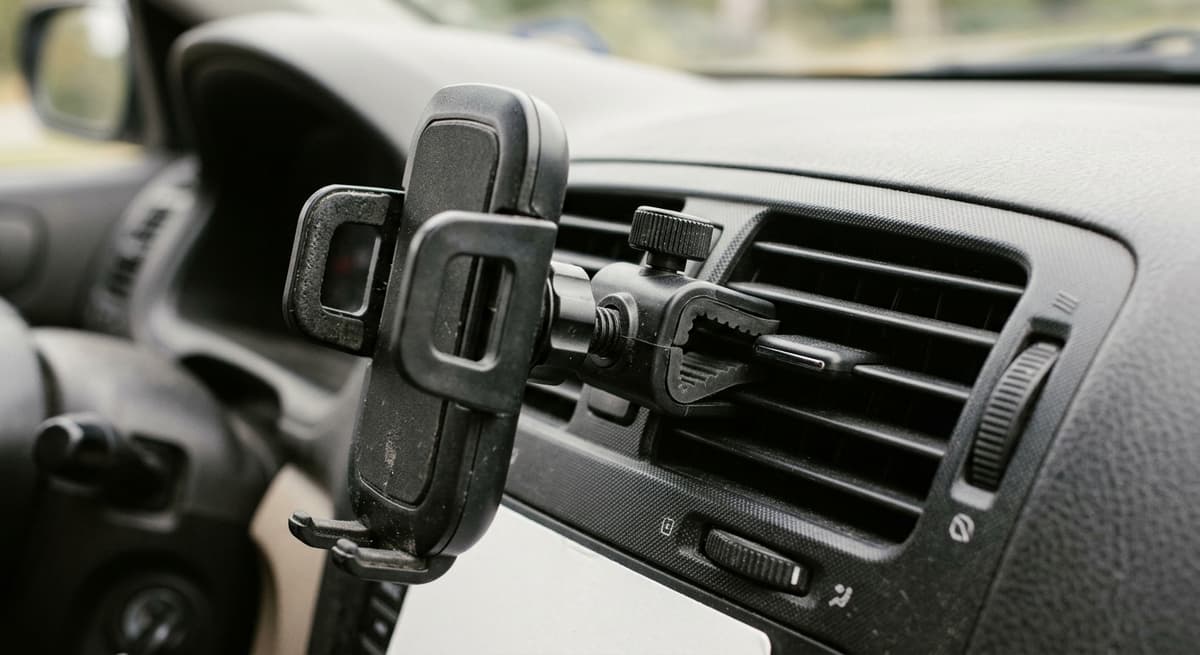
On the dashboard. A dashboard mount avoids the windshield entirely and eliminates any windshield obstruction concern.
Avoid mounting a GPS device in the center of the windshield at the driver's eye level. While not automatically illegal, this placement creates the strongest basis for an obstruction citation.
Suction Cup Mount Considerations
Suction cup mounts are widely used for GPS and phone holders. Connecticut law does not specifically ban suction cup mounts on the windshield. However, the mount and the device it holds must not obstruct the driver's view.
If a suction cup mount detaches while driving, the falling device could distract the driver and potentially create a safety hazard. Using a suction cup mount in combination with a secondary securing method (such as an adhesive backup or a tether) reduces this risk.
Phone Mounts and Connecticut's Hands-Free Law
Connecticut has had a hands-free driving law in effect since 2005, with penalties increased over time. Under Section 14-296aa, all drivers are prohibited from using a hand-held mobile telephone while operating a motor vehicle. A phone mount provides one of the approved hands-free methods.
What the Law Requires
Drivers 18 and older must use a hands-free device for phone calls while driving. This means the phone must be in a mount, connected to Bluetooth, or operated through the vehicle's integrated system. Holding the phone to your ear is prohibited.
All drivers, regardless of age, are prohibited from typing, sending, or reading text messages, emails, or internet content while operating a motor vehicle.
Drivers under 18 are prohibited from using a cell phone or mobile device at any time while driving, even with a hands-free accessory.
Penalties for Cell Phone Violations
| Offense | Fine |
|---|---|
| First offense | $200 |
| Second offense | $375 |
| Third and subsequent offenses | $625 |
These fines apply to hand-held phone use, texting, and other prohibited mobile device activities. The fines are significantly higher than windshield obstruction penalties, which makes a phone mount a practical investment.
How Phone Mounts Help You Comply
A windshield-mounted or dashboard-mounted phone holder allows you to:
- Take and make calls through Bluetooth or speakerphone while the phone stays in the mount
- Follow GPS navigation displayed on the phone screen
- Use voice-activated features such as voice texting and virtual assistants
You still cannot manually interact with the phone while driving. Setting a destination, scrolling through playlists, or reading messages must be done before you begin driving or while the vehicle is safely parked.
Dashcam Rules in Connecticut
Connecticut does not have a specific statute addressing dashcams or video event recorders. A dashcam is treated as a "device" under Section 14-99f(c) and must not obstruct the driver's view or distract the driver.
Recommended Dashcam Placement
The safest legal placement for a dashcam in Connecticut is behind the rearview mirror, where the camera has a clear view of the road ahead without blocking the driver's line of sight. Small, compact dashcams that fit within the profile of the rearview mirror housing are the least likely to draw attention from law enforcement.
Dashboard-mounted dashcams are also permitted and avoid windshield obstruction concerns entirely.
Audio Recording Considerations
Connecticut is widely treated as an all-party consent state for recording private conversations, under a separate civil recording law. Section 53a-187 defines "mechanical overhearing of a conversation" as recording without the consent of at least one party by someone not present at the conversation; because the driver is present in the vehicle, this specific provision does not by itself govern a driver's own dashcam audio.
If your dashcam records audio inside the vehicle, the safest approach is still to let everyone in the car know audio is being captured, given Connecticut's broader all-party consent expectations for recording private conversations. Many dashcam owners in Connecticut disable audio recording or inform passengers that audio is being captured. For recording that only captures video without audio, no consent from other parties is required.
Connecticut Windshield Tinting Rules
Window tinting is governed by Section 14-99g. The tinting rules for the windshield are stricter than for other windows.
Windshield Tint Requirements
| Rule | Requirement |
|---|---|
| Tint location | Non-reflective tint above the AS-1 line only |
| Below AS-1 line | No aftermarket tint permitted |
| Reflective tint | Not permitted on the windshield |
| Medical exemption | Connecticut does not allow medical exemptions for darker tint |
The AS-1 line is etched into the glass by the manufacturer, typically 5 to 6 inches from the top of the windshield. Non-reflective tint film may be applied above this line.
Other Window Tint Limits
| Window | Minimum VLT (Sedans) | Minimum VLT (SUVs/Vans) |
|---|---|---|
| Windshield (above AS-1 only) | Non-reflective | Non-reflective |
| Front side windows | 35% | 35% |
| Rear side windows | 35% | Any darkness |
| Rear window | Any darkness | Any darkness |
VLT stands for visible light transmittance. A 35% VLT means the window must allow at least 35% of outside light to pass through.
Reflectivity Limits
Front side windows may not reflect more than 21% of incoming light. Rear side windows may not reflect more than 27% of incoming light. Metallic or mirrored tint is prohibited.
Tint Compliance Stickers
Vehicles with aftermarket tinting on any window must display a compliance sticker between the tint film and the glass. The sticker must show the registration number, a certification of compliance, and any other information required by the Commissioner of Motor Vehicles. The sticker must not exceed one square inch, must be pressure-sensitive, and must be self-destructive upon removal.
Film manufacturers must certify the tinting products they sell in Connecticut.
Windshield Damage and Replacement
Connecticut law under Section 14-99f(a) requires the windshield to be "reasonably free of defects." Subsection (b) separately makes it a violation to operate with a windshield condition that interferes with the view "in a manner that significantly blocks or conceals by use of an obstacle or obstruction to an extent that would prevent a reasonable person from viewing the highway."
Since October 1, 2025, that significant-blocking threshold, rather than an officer's general judgment about visibility, is what a cracked-windshield citation under subsection (b) has to meet.
When Windshield Damage May Result in a Citation
Under the standard in effect since October 1, 2025, damage supports a citation under subsection (b) only where it rises to significant blocking or concealment:
- Cracks or chips in the driver's direct line of sight that significantly block or conceal the view of the highway
- Extensive spider-web cracking that distorts visibility to the point a reasonable person could not view the highway
- Multiple cracks or chips that together significantly block or conceal the driver's view
Damage that compromises the structural integrity of the windshield, or a windshield that is not reasonably free of defects, can separately implicate subsection (a) and the safety glass requirement in Section 14-100. Public Act 25-19 did not change either of those.
When Damage Is Typically Not Cited
- Small chips under three-quarters of an inch that are outside the driver's line of sight
- Minor cracks that do not extend into the driver's primary viewing area
- Damage on the far passenger side that does not affect the driver's vision
Insurance Coverage for Windshield Replacement
Connecticut has a favorable insurance provision for windshield damage. Under Section 38a-339, any automobile insurance policy that includes comprehensive coverage must offer the option of complete coverage for repair or replacement of all damaged safety glass without any deductible or minimum amount.
This means if you carry comprehensive coverage and elected the glass coverage option, your windshield replacement is covered with no out-of-pocket cost. This provision applies to all safety glass in the vehicle, not just the windshield.
Safety Glass Requirements
Under Section 14-100, all motor vehicles manufactured after July 1, 1937 must have windshields made of safety glass. Safety glass is glass that is treated or combined with other materials to afford a greater degree of protection to vehicle occupants than untreated glass. Replacement windshields must meet the same safety glass standards as the original.
The Ice and Snow Removal Law (Section 14-252a)
Connecticut's windshield laws work alongside the state's ice and snow removal requirement. Section 14-252a, commonly called the "ice missile" law, requires all drivers to remove accumulated ice and snow from their vehicles before driving.
What the Law Requires
Drivers must remove snow and ice from all surfaces of the vehicle, including the roof, hood, trunk, and windshield, so that the material does not pose a threat to persons or property while the vehicle is moving on any street or highway.
Penalties
| Situation | Fine |
|---|---|
| Basic violation (no injury or damage) | $75 |
| Injury or property damage (personal vehicle) | $200 to $1,000 |
| Injury or property damage (commercial vehicle) | $500 to $1,250 |
The law does not apply to drivers who were already on the road when snow, sleet, or freezing rain began falling.
Commercial Vehicle Windshield Rules
Commercial vehicles registered in Connecticut must comply with both state law and federal FMCSA regulations under 49 CFR 393.60. The federal standard applies to vehicles in interstate commerce.
Federal Mounting Zone
FMCSA regulations allow safety technology devices to be mounted on commercial vehicle windshields within specific zones. Devices must be positioned no more than 8.5 inches below the upper edge of the windshield wiper sweep area and no more than 7 inches above the lower edge of the wiper sweep area. The device must also be outside the driver's sight lines to the road and highway signs.
State vs. Federal Standards
For commercial vehicles operating solely within Connecticut, state law applies. For vehicles in interstate commerce, the federal standard applies. When both standards apply, the driver must comply with whichever standard is stricter for the specific situation.
Summary of Connecticut Windshield Laws
| Topic | Statute | Key Rule |
|---|---|---|
| Windshield condition | 14-99f(a) | Must be reasonably free of defects; wipers must work |
| Operating with obstruction | 14-99f(b) | Windshield condition must not interfere with the view in a manner that significantly blocks or conceals it |
| Devices, stickers, ornaments | 14-99f(c) | Must not significantly block or conceal the view, or distract the driver |
| Violation standard (since Oct. 1, 2025) | PA 25-19, Sec. 5 | Amended both 14-99f(b) and (c): interference must "significantly block or conceal" the view |
| Passenger-side sticker zone | 14-99g | Seven-inch square in lower corner farthest from driver |
| Driver-side sticker zone | 14-99g | Five-inch square in lower corner nearest driver |
| Windshield tint | 14-99g | Non-reflective tint above AS-1 line only |
| Front side window tint | 14-99g | Minimum 35% VLT |
| Hands-free phone law | 14-296aa | No hand-held phone use; mount or Bluetooth required |
| Snow/ice removal | 14-252a | All ice and snow must be cleared before driving |
| Obstruction penalty | 14-99f(d) | Infraction, $92 base fine plus surcharges |
| Safety glass | 14-100 | All windshields must be safety glass |
| Insurance coverage | 38a-339 | Optional zero-deductible glass replacement with comprehensive coverage |
More Connecticut Laws
Frequently Asked Questions
Can I mount a GPS or phone on my windshield in Connecticut?
Yes. Connecticut does not ban windshield-mounted GPS or phone devices. Under Section 14-99f(c), the device must not interfere with the driver's unobstructed view of the highway in a manner that significantly blocks or conceals it, and must not distract the driver. The safest legal placements are behind the rearview mirror, in the lower corners of the windshield within the designated sticker zones, or on the dashboard.
What changed with Public Act 25-19 in October 2025?
PA 25-19 raised the threshold for what counts as a windshield violation. Section 5 of the act amended both subsection (b) and subsection (c) of Section 14-99f, so the change covers windshield condition, such as cracks and chips, as well as devices, stickers, and ornaments. Since October 1, 2025, the interference must significantly block or conceal the view to an extent that would prevent a reasonable person from viewing the highway. Minor obstructions no longer violate the statute, regardless of why a vehicle was stopped. The act did not change stop authority for this section.
What are the sticker zones on a Connecticut windshield?
Section 14-99g allows stickers and signs in two areas: a seven-inch square in the lower corner of the windshield on the passenger side (farthest from the driver) and a five-inch square in the lower corner on the driver side (nearest the driver). Stickers required by federal, state, or municipal law are also permitted.
Is it legal to use a dashcam in Connecticut?
Yes. Connecticut does not have a specific dashcam statute. A dashcam is treated as a device under Section 14-99f(c) and is permitted as long as it does not obstruct the driver's view. Mount it behind the rearview mirror or on the dashboard. Connecticut is widely treated as an all-party consent state for recording private conversations, so it is good practice to let passengers know if your dashcam records audio inside the vehicle, even though the driver's own presence in the car limits how the specific eavesdropping definition in Section 53a-187 applies.
What is the fine for a windshield obstruction in Connecticut?
Violating Section 14-99f is an infraction with a base fine of $92 plus court costs, surcharges, and assessment fees that bring the total to approximately $184. If ice or snow on the windshield causes injury or property damage, fines under the separate ice missile law (Section 14-252a) range from $200 to $1,250 depending on whether the vehicle is commercial or personal.
Updates
Corrected the page to reflect that Public Act 25-19 amended both subsections (b) and (c) of Section 14-99f, rewrote the windshield-damage guidance to the current significant-blocking standard, removed the incorrect description of the act as a traffic-stop-authority change, and repointed the 14-99f citations to the current 2026 Supplement text.
Corrected how this page describes Connecticut's 2025 windshield-obstruction law change (PA 25-19): the law redefines what counts as a violation (only a device or sticker that significantly blocks or conceals the driver's view is a violation at all), not a primary/secondary traffic-stop enforcement rule as the page previously stated.
Independently fact-checked against the cited primary sources; governing law re-checked for recent changes
Corrected the audio-consent discussion: Section 53a-187 defines "mechanical overhearing" as recording without one party's consent by someone not present, so it does not by itself make Connecticut an all-party consent state for a driver's own dashcam; also fixed the commercial-vehicle ice/snow fine ceiling from $1,200 to $1,250 per Section 14-252a(d).
Corrected the KeyTakeaways summary and the windshield-fine FAQ answer, which both still cited a $1,200 ceiling for the ice-and-snow-removal law's commercial-vehicle injury/damage penalty; Conn. Gen. Stat. 14-252a(d) sets that ceiling at $1,250.
Governing law re-checked for recent changes
Reviewed and approved by an editor
The Law Behind This Article
This article rests on the statutory provisions below, held in our own legal record and retrieved from the official source. Tap a section to read the operative text.
Connecticut General Statutes, Title 14 (Motor Vehicles. Use of the Highway By Vehicles. Gasoline), Chapter 246
§ 14-99fWindshield. Obstruction of view.In forcecited in 2 of our articles
(a) Each motor vehicle shall be equipped with a windshield of a type prescribed by section 14-100 and a windshield cleaner or wiper in effective working order located directly in front of the operator while in use on the highway. The windshield shall be reasonably free of defects and accumulations, inside and out, of snow, ice, condensation and dirt. The provisions of this subsection shall not apply to a motorcycle or a vehicle designed by the manufacturer for nonhighway operation without a windshield. (b) No person shall operate a motor vehicle required to be equipped with such a windshield if the windshield is in a condition to interfere with an unobstructed view of the highway. (c) No article, device, sticker or ornament shall be attached or affixed to or hung on or in any motor vehicle in such a manner or location as to interfere with the operator's unobstructed view of the highway or to distract the attention of the operator. (d) Violation of any provision of this section shall be an infraction.
Official text (excerpt) · last checked 2026-09-07 · Read the full text in our law library · Verify at cga.ct.gov
Cited in 6 court opinions in our collectionLatest citing opinion in our collection: 2013
Opinions citing this section in our collection:
- State v. Cyrus (Supreme Court of Connecticut 2010, 297 Conn. 829)“…ing a motor vehicle with an obstructed view in violation of General Statutes § 14-99f(c). [2] State v. *61 Cyrus, 111…”
- Pinheiro v. Board of Education (Connecticut Appellate Court 1993, 30 Conn. App. 263)“…99; (4) it is not equipped with a windshield as required by General Statutes § 14-99f; (5) it is not equipped with fenders or…”
- HVT, INC. v. Law (Supreme Court of Connecticut 2011, 300 Conn. 623)“…tatutes § 14-80h (failure to satisfy braking requirements); General Statutes § 14-99f (operating vehicle with obstructed wind…”
Identified automatically from the court opinions citing this section — not a ranking of which case controls.
Also relied on in: Connecticut Dashcam Laws: Mounting Rules, Audio Recording, and Evidence (2026)
§ 14-99gDefinitions. Tinted or reflectorized windows. Obstruction of view prohibited. Exceptions. Sale or delivery of motor vehicles having tinted or reflectorized windows prohibited. Stickers required. Penalty. Window tinting businesses. Regulations.In forcecited in 2 of our articles
(a) As used in this section, unless the context otherwise requires: (1) “Light transmission” means the ratio of the amount of total light, expressed in percentages, which is allowed to pass through a product or material including the glazing to the amount of total light falling on the product or material and the glazing. (2) “Luminous reflectance” means the ratio of the amount of total light, expressed in percentages, which is reflected outward by a product or material to the amount of total light falling on the product or material. (3) “Manufacturer” means (A) a person who engages in the manufacturing or assembling of sun screening products or materials designed to be used in conjunction with vehicle glazing materials, or (B) a person who fabricates, laminates or tempers the glazing material incorporating the capacity to reflect or to reduce the transmittance of light during the manufacturing process.
Official text (excerpt) · last checked 2026-09-01 · Read the full text in our law library · Verify at cga.ct.gov
Cited in 1 court opinions in our collectionLatest citing opinion in our collection: 2025
Opinions citing this section in our collection:
- United States v. Poller (Court of Appeals for the Second Circuit 2025, 129 F.4th 169)“…than thirty-five per cent plus or minus three per cent.” Conn. Gen. Stat. Ann. § 14-99g(c)(1) & (5). Indeed, Poller conceded t…”
Identified automatically from the court opinions citing this section — not a ranking of which case controls.
Also relied on in: Connecticut Window Tint Laws (2026): Legal VLT Limits
§ 14-100Safety glass. Use of plastics.In force
(a) The commissioner shall not register any motor vehicle manufactured after July 1, 1937, unless the windshield, the doors, windows and glass partitions are equipped with safety glass, except that, in lieu of safety glass, the commissioner may permit the use of plastic materials manufactured and processed into transparent sheets, at such locations as he designates. The commissioner shall issue regulations, in accordance with nationally accepted standards, concerning the specifications for safety glass and plastic materials and the locations where they may be used. (b) The term “safety glass”, as used in this chapter, means glass so treated or combined with other materials that its use in motor vehicles will afford a greater degree of protection to occupants thereof than the use of glass not so treated or combined.
Official text (excerpt) · last checked 2026-07-29 · Read the full text in our law library · Verify at cga.ct.gov
Cited in 3 court opinions in our collectionLatest citing opinion in our collection: 2023
Opinions citing this section in our collection:
- American Leasing Corp. v. Automated Disposal Systems, Inc. (District Court, W.D. North Carolina 1974, 64 F.R.D. 576)“…s plus twelve pages of exhibits interpreting North Carolina General Statutes § 14-100. The written material will be produce…”
- Rocco v. United States (District Court, D. Connecticut 2023)“…on any highway,” subject to exceptions not applicable here. Conn. Gen. Stat. § 14-100(c)(1).…”
- Brown v. Ford Motor Company (Court of Appeals for the Fourth Circuit 2001, 10 F. App'x 39)“…ing inadmissibility on a "violation" of statute. See, e.g., Conn. Gen. Stat. Ann. § 14-100A ("Failure to wear a seat safety belt s…”
Identified automatically from the court opinions citing this section — not a ranking of which case controls.
Code of Federal Regulations Title 49
§ 393.60Glazing in specified openings.In forcecited in 15 of our articles
(a) Glazing material. Glazing material used in windshields, windows, and doors on a motor vehicle manufactured on or after December 25, 1968, shall at a minimum meet the requirements of Federal Motor Vehicle Safety Standard (FMVSS) No. 205 in effect on the date of manufacture of the motor vehicle. The glazing material shall be marked in accordance with FMVSS No. 205 (49 CFR 571.205, S6). (b) Windshields required. Each bus, truck and truck-tractor shall be equipped with a windshield. Each windshield or portion of a multi-piece windshield shall be mounted using the full periphery of the glazing material. (c) Windshield condition. With the exception of the conditions listed in paragraphs (c)(1), (c)(2), and (c)(3) of this section, each windshield shall be free of discoloration or damage in the area extending upward from the height of the top of the steering wheel (excluding a 51 mm (2 inch) border at the top of the windshield) and extending from a 25 mm (1 inch) border at each side of the windshield or windshield panel.
Official text (excerpt) · last checked 2026-07-28 · Read the full text in our law library · Verify at ecfr.gov
Cited in 3 court opinions in our collectionLatest citing opinion in our collection: 2021
In the courts (editorial summary, independently checked):The 70 percent light transmittance floor of 49 CFR 393.60(d) covers the windshield and the windows immediately right and left of the driver. Grooms Hauling, LLC v. Robinson (2020) applied it through Pennsylvania adoption and rejected racial profiling claims over tint citations; State v. Ford (2021) noted that Kansas adopts it too.
Opinions citing this section in our collection:
- United States of America, Government v. Robert L. Pierre, Defendant (District Court, D. New Hampshire 2015, 2015 DNH 083)“…rallel luminous transmittance of not less than 70 percent.” 49 C.F.R. 393.60(c). Neither the Government nor the defe…”
- GROOMS HAULING, LLC v. ROBINSON (District Court, E.D. Pennsylvania 2020)✓Officers repeatedly cited a Black-owned hauling company whose truck windows passed only 17 to 20 percent of light; treating 49 CFR 393.60's 70 percent transmittance standard as the governing rule, the court granted the officers summary judgment on the profiling claims.
- State v. Ford (Court of Appeals of Kansas 2021)“…Relevant to this appeal are regulations on window tinting (49 C.F.R. § 393.60[d]), medical examiner certificates (49…”
Identified automatically from the court opinions citing this section — not a ranking of which case controls.
Also relied on in: Idaho Windshield Mounting Laws (2026 Guide), Kansas Windshield Mounting Laws (2026 Guide), Ohio Windshield Mounting Laws (2026 Guide)
Connecticut General Statutes, Title 14 (Motor Vehicles. Use of the Highway By Vehicles. Gasoline), Chapter 248
§ 14-296aaUse of hand-held mobile telephones and mobile electronic devices by motor vehicle operators and school bus drivers prohibited or restricted. Exceptions. Penalties. Amounts remitted to municipality. Record of violation.In force
(a) For purposes of this section, the following terms have the following meanings: (1) “Mobile telephone” means a cellular, analog, wireless or digital telephone capable of sending or receiving telephone communications without an access line for service. (2) “Using” or “use” means holding a hand-held mobile telephone to, or in the immediate proximity of, the user's ear. (3) “Hand-held mobile telephone” means a mobile telephone with which a user engages in a call using at least one hand. (4) “Hands-free accessory” means an attachment, add-on, built-in feature, or addition to a mobile telephone, whether or not permanently installed in a motor vehicle, that, when used, allows the vehicle operator to maintain both hands on the steering wheel. (5) “Hands-free mobile telephone” means a hand-held mobile telephone that has an internal feature or function, or that is equipped with an attachment or addition, whether or not permanently part of such hand-held mobile telephone, by which a user engages in a call without the use of either hand, whether or not the use of either hand is necessary to activate, deactivate or initiate a function of such telephone.
Official text (excerpt) · last checked 2026-07-29 · Read the full text in our law library · Verify at cga.ct.gov
Cited in 5 court opinions in our collectionLatest citing opinion in our collection: 2025
Opinions citing this section in our collection:
- State v. JIMENEZ-JARAMILL (Connecticut Appellate Court 2012, 134 Conn. App. 346)“…peal from the judgment of dismissal. 2 General Statutes § 14-296aa prohibits the use of a hand-held cell p…”
- Gusan v. Commissioner of Correction (Connecticut Appellate Court 2025, 231 Conn. App. 429)“…a telephone or an electronic device in violation of General Statutes § 14-296aa (b) (1) and operating a motor Page 2…”
- State v. Dunbar (Connecticut Appellate Court 2016, 165 Conn. App. 93)“…magistrate, who also found that the defendant had violated General Statutes § 14-296aa (b). 2 General Statutes § 14-29…”
Identified automatically from the court opinions citing this section — not a ranking of which case controls.
§ 14-252aRemoval of ice and snow from motor vehicle required. Penalty.In force
(a) The operator of any noncommercial motor vehicle, as defined in section 14-1, shall remove any accumulated ice or snow from such motor vehicle, including the hood, trunk and roof of such motor vehicle, so that any ice or snow accumulated on such vehicle does not pose a threat to persons or property while the vehicle is being operated on any street or highway of this state. Any such operator who fails to remove accumulated ice or snow that poses such a threat shall be fined seventy-five dollars and shall be deemed to have committed an infraction. (b) If the operator of a noncommercial motor vehicle violates the provisions of subsection (a) of this section and snow or ice is dislodged from such vehicle and causes personal injury or property damage, such operator shall be fined not less than two hundred dollars but not more than one thousand dollars for each offense.
Official text (excerpt) · last checked 2026-07-29 · Read the full text in our law library · Verify at cga.ct.gov
Connecticut General Statutes, Title 38a (Insurance), Chapter 700
§ 38a-339(Formerly Sec. 38-175t). Comprehensive automobile coverage to include optional coverage for repair or replacement of damaged safety glass without deductible or minimum amount.In force
Each automobile insurance policy providing comprehensive coverage, whether designated as such or included in a policy providing broader coverage, shall provide at the option of the insured complete coverage for repair or replacement of all damaged safety glass without regard to any deductible or minimum amount.
Official text (excerpt) · last checked 2026-07-29 · Read the full text in our law library · Verify at cga.ct.gov
Connecticut General Statutes, Title 53a (Penal Code), Chapter 952
§ 53a-187Definitions. Applicability.In forcecited in 18 of our articles
(a) The following definitions are applicable to sections 53a-188 and 53a-189: (1) “Wiretapping” means the intentional overhearing or recording of a telephonic or telegraphic communication or a communication made by cellular radio telephone by a person other than a sender or receiver thereof, without the consent of either the sender or receiver, by means of any instrument, device or equipment. The normal operation of a telephone or telegraph corporation and the normal use of the services and facilities furnished by such corporation pursuant to its tariffs shall not be deemed “wiretapping”. (2) “Mechanical overhearing of a conversation” means the intentional overhearing or recording of a conversation or discussion, without the consent of at least one party thereto, by a person not present thereat, by means of any instrument, device or equipment. (3) “Unlawfully” means not specifically authorized by law. For purposes of this section, “cellular radio telephone” means a wireless telephone authorized by the Federal Communications Commission to operate in the frequency bandwidth reserved for cellular radio telephones.
Official text (excerpt) · last checked 2026-07-29 · Read the full text in our law library · Verify at cga.ct.gov
Cited in 12 court opinions in our collectionLatest citing opinion in our collection: 2021
In the courts (editorial summary, independently checked):Connecticut courts read section 53a-187's definitions to reach only surreptitious, nonconsensual monitoring. State v. Grullon (1989) applied it to place one-party-consent recordings outside the eavesdropping statutes, and Washington v. Meachum (1996) held those statutes are violated only when neither party knows the call is monitored.
Opinions citing this section in our collection:
- State v. Grullon (Supreme Court of Connecticut 1989, 212 Conn. 195)✓Police recorded the defendant's calls with his brother, who consented; the court held that replacing the older wiretap penal statute with section 53a-187, which reaches recording only when no party consents, gave no reason to exclude the transcripts.
- Washington v. Meachum (Supreme Court of Connecticut 1996, 238 Conn. 692)✓Inmates challenged prison rules allowing nonprivileged collect calls to be monitored after posted signs, signed forms and a recurring tone; reading section 53a-187's consent-based definitions, the court held the eavesdropping statutes are violated only when neither party knows.
- State v. McVeigh (Supreme Court of Connecticut 1993, 224 Conn. 593)✓Police used a scanner in a neighbor's apartment to record a couple's cordless phone calls; the court rejected the State's argument that a 1989 amendment adding cellular phones to section 53a-187's wiretapping definition left cordless calls unprotected, and ordered suppression.
Identified automatically from the court opinions citing this section — not a ranking of which case controls.
Also relied on in: Connecticut Audio Recording Laws: Mixed Consent Rules and Penalties (2026), Connecticut Landlord-Tenant Recording and Surveillance Laws (2026), Connecticut Medical Recording Laws: Patients, Doctors, and HIPAA Rules (2026)
Search our full record of US law — 2.1 million sections, every state + federal →
Sources and References
- Connecticut General Statutes Section 14-99f - Windshield. Obstruction of View(cga.ct.gov).gov
- Connecticut General Statutes Section 14-99g - Tinted Windows, Sticker Zones(cga.ct.gov).gov
- Public Act 25-19 - Windshield Obstruction Violation Standard Change(cga.ct.gov).gov
- Connecticut General Statutes Section 14-296aa - Hands-Free Phone Law(cga.ct.gov).gov
- Connecticut General Statutes Section 14-252a - Ice and Snow Removal(cga.ct.gov).gov
- Connecticut General Statutes Section 14-100 - Safety Glass Requirements(cga.ct.gov).gov
- Connecticut General Statutes Section 38a-339 - Insurance Glass Coverage(cga.ct.gov).gov
- Connecticut DMV - Cell Phone and Texting Laws(portal.ct.gov).gov
- 49 CFR 393.60 - Federal Glazing and Window Construction Standards(ecfr.gov).gov
- Connecticut General Statutes Section 53a-187 - Eavesdropping(cga.ct.gov).gov
- Connecticut General Statutes Section 14-99f (2026 Supplement, as amended by P.A. 25-19) - Windshield. Obstruction of View(cga.ct.gov)
- Connecticut House Roll Call Vote 84 on HB 7132 (143-0), May 8, 2025(cga.ct.gov)