
Kansas
Kansas Windshield Mounting Laws (2026 Guide)
Independently fact-checked against primary sources (last audited August 17, 2026). · Reviewed by the RecordingLaw editorial team. · Law checked current as of August 9, 2026. · 7 primary sources cited on this page. How we verify our legal content
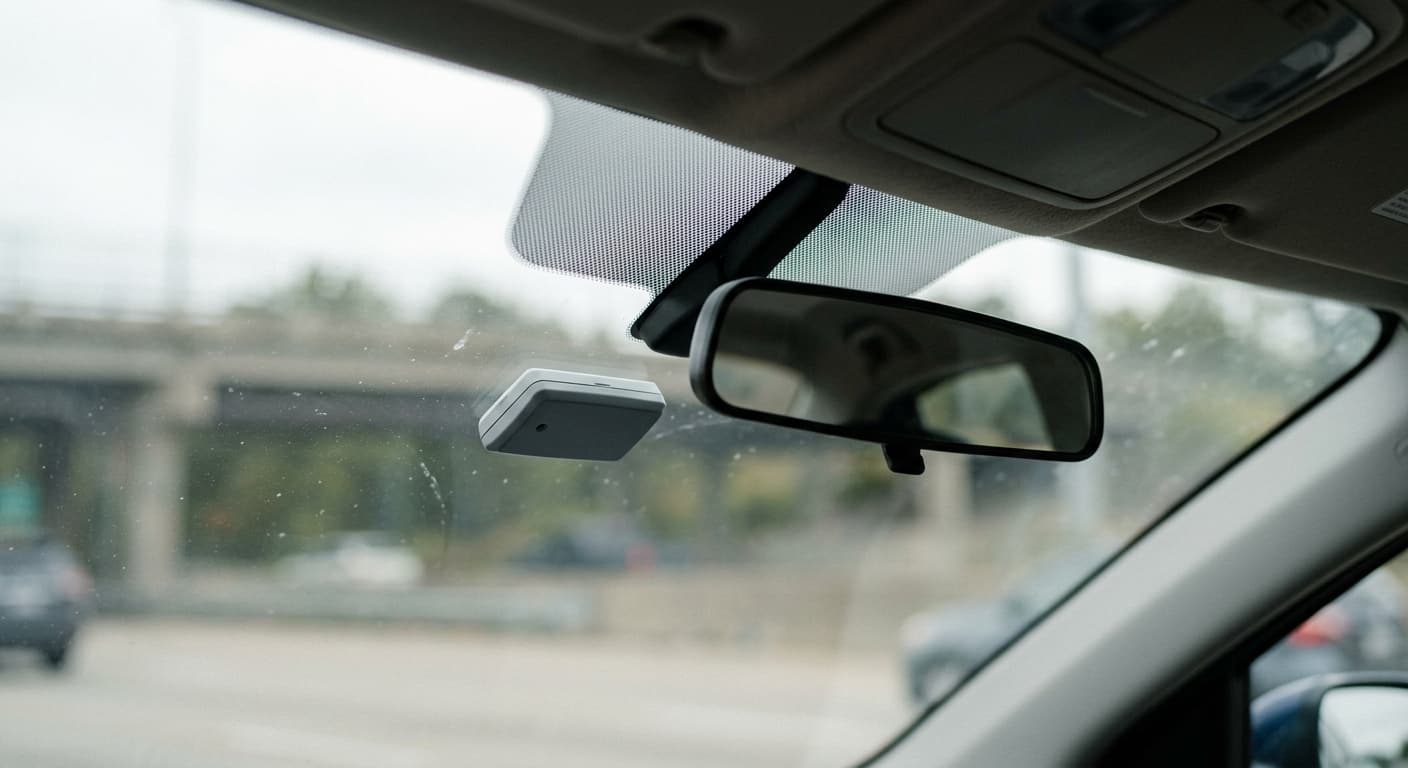
Kansas law permits dashcams, GPS units, and phone holders on the windshield as long as the device does not substantially obstruct the driver's view under KSA 8-1741. No specific size limit or placement zone is defined, so the safest approach is mounting devices in the lower corner of the windshield or on the dashboard.
Kansas does not ban all windshield-mounted devices outright. Instead, the state applies a flexible legal standard that focuses on whether a mounted object blocks the driver's view of the road. This approach gives drivers some latitude when placing GPS units, dashcams, and phone holders on the windshield, but it also means enforcement depends on an officer's judgment about what counts as a substantial obstruction.
This guide covers every statute that affects windshield mounting in Kansas, including the core obstruction law, tinting rules, damaged windshield restrictions, and the hands-free cellphone law (SB 366) that took effect July 1, 2026.
The Core Statute: KSA 8-1741
KSA 8-1741 is the primary Kansas law governing windshield obstructions. The statute contains four subsections that address different aspects of windshield and window compliance.
Nontransparent Material Prohibition
Subsection (a) of KSA 8-1741 states that no person shall drive any motor vehicle with any sign, poster, or other nontransparent material upon the front windshield, side wings, or side or rear windows of the vehicle that "substantially obstructs, obscures, or impairs the driver's clear view of the highway or any intersecting highway."
The word "substantially" is the key term. Kansas does not prohibit all materials on the windshield. It prohibits materials that create a meaningful obstruction. A small GPS mount tucked near the corner of the windshield is treated differently than a large poster covering half the glass.
Damaged Windshield Prohibition
Subsection (b) prohibits driving with a damaged front windshield or side or rear windows that "substantially obstructs the driver's clear view of the highway or any intersecting highway." This applies to cracks, chips, and other physical damage.
According to the Kansas Highway Patrol, a cracked windshield will not prevent a vehicle from passing the MVE/VIN inspection process. However, if a crack spreads across the driver's line of sight, it can result in a traffic stop and a citation.
Windshield Wiper Requirements
Subsection (c) requires every motor vehicle to have a windshield cleaning device (wipers) that can be controlled by the driver. Subsection (d) requires that every windshield wiper be maintained in good working order.
These wiper requirements are grouped under the same statute as the obstruction rules. A citation for defective wipers falls under the same fine schedule as a citation for an obstructed windshield.
What "Substantially Obstructs" Means in Practice
Kansas law does not define a specific size limit, measurement zone, or percentage of windshield coverage that triggers a violation. Unlike states such as Arkansas, which uses a 4.5-inch measurement from the bottom of the windshield, Kansas relies entirely on the "substantially obstructs" standard.
This means the legality of a windshield-mounted device depends on two factors:
-
The size and placement of the device. A compact dashcam mounted behind the rearview mirror is far less likely to be considered a substantial obstruction than a large tablet mounted in the center of the windshield.
-
The officer's assessment. Because "substantially" is a judgment call, two officers could reach different conclusions about the same device. If you receive a citation, you have the right to contest it in court, where a judge will decide whether the device met the statutory threshold.
To reduce legal risk, Kansas drivers should follow these best practices:
- Mount devices as close to the edge or corner of the windshield as possible
- Keep devices as small and compact as the use case allows
- Ensure the device does not block the driver's forward line of sight or the view of intersecting roads
- Consider dashboard mounting as an alternative to windshield mounting
GPS and Navigation Mounts
Kansas does not have a specific statute that addresses GPS devices or navigation mounts by name. GPS mounts are governed by the general obstruction standard in KSA 8-1741(a).
A GPS unit mounted on the windshield is legal as long as it does not substantially obstruct the driver's view. The safest placement is in the lower corner of the windshield on the passenger side or on the dashboard. Mounting a large GPS screen directly in front of the driver or at eye level creates the highest risk of a citation.
Suction cup mounts are not specifically prohibited in Kansas. The law focuses on the obstruction caused by the device, not the method of attachment.
Dashcam Rules
Kansas does not have a standalone dashcam statute. Dashcams are treated the same as any other windshield-mounted device under KSA 8-1741. A dashcam is legal as long as it does not substantially obstruct the driver's view.
The most legally secure placement for a dashcam in Kansas is behind the rearview mirror, where it occupies space that is already partially blocked by the mirror itself. Dashboard-mounted dashcams avoid the windshield obstruction question entirely.
Kansas is a one-party consent state for audio recording under KSA 21-6101. If your dashcam records audio inside the vehicle, you do not need the consent of passengers as long as you are a party to the conversation.
Phone Mounts and Holders
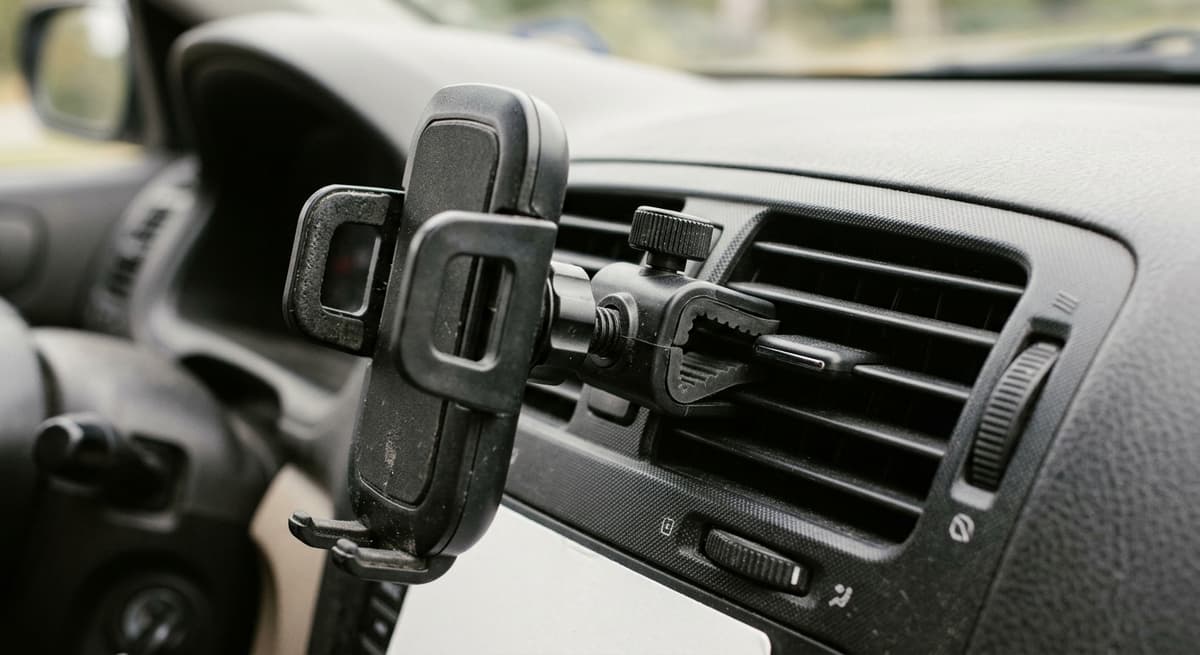
Phone mounts attached to the windshield are evaluated under the same "substantially obstructs" standard as GPS mounts and dashcams. A compact phone holder positioned near the lower corner of the windshield is generally compliant. A phone holder that places a large smartphone directly in the driver's line of sight may be considered a substantial obstruction.
With the enactment of SB 366 (discussed below), phone mounts have become more practically important for Kansas drivers. The hands-free law encourages the use of mounted devices, making a properly placed phone mount both a legal compliance tool and a safety measure.
Toll Transponders and Small Devices
Small devices such as toll transponders, parking passes, and registration stickers are the least likely to trigger an obstruction citation. Their compact size means they rarely meet the "substantially obstructs" threshold. Kansas law explicitly allows items required by law to be displayed on the windshield.
Windshield Tinting Rules (KSA 8-1749a)
KSA 8-1749a governs window tinting and sunscreening devices on Kansas-registered vehicles. These rules interact with windshield mounting because aftermarket tinting that reduces visibility can compound the obstruction caused by a mounted device.
Windshield Tint Strip
A sun screening device (tint strip) may be applied to the windshield, but it must meet these requirements:
- It must be nonreflective
- It must not be red, yellow, or amber in color
- It may only be applied along the top of the windshield and cannot extend below the manufacturer's AS-1 line
The AS-1 line is a marking etched into the windshield by the manufacturer, typically located about 5 to 6 inches below the top edge of the glass. Any tint strip that extends below this line violates Kansas law.
Side and Rear Window Requirements
All side windows and the rear window must allow at least 35% visible light transmittance (VLT). Sun screening devices on these windows must be nonreflective.
Clear Film Exception
KSA 8-1749a does not apply to clear, colorless, and transparent materials that have a minimum visible light transmittance of 78% and meet federal motor vehicle safety standards. This means clear protective films are permitted on all windows.
Penalties for Windshield Violations
Violations of KSA 8-1741 are classified as traffic infractions, not criminal offenses. The penalty is set by the uniform fine schedule under KSA 8-2118.
| Violation | Statute | Base Fine |
|---|---|---|
| Obstructed windshield or windows | KSA 8-1741 | $45 |
| Defective windshield wipers | KSA 8-1741 | $45 |
Illegal window tinting under KSA 8-1749a is not part of this fine schedule. KSA 8-1749a(h) makes a violation of that section a misdemeanor upon conviction, a criminal offense rather than a $45 traffic infraction.
Fine Multipliers
KSA 8-2118 contains two fine-doubling provisions, and neither one automatically doubles a windshield obstruction citation.
- School zones. KSA 8-2118(g) doubles only the scheduled fines "relating to exceeding the maximum speed limit," and only upon conviction of exceeding the maximum speed limit in a school zone. A $45 windshield obstruction fine is therefore not doubled in a school zone.
- Road construction zones. KSA 8-2118(e) doubles a scheduled fine only where the traffic infraction "is defined as a moving violation in accordance with rules and regulations adopted pursuant to K.S.A. 8-249." Whether an equipment offense such as an obstructed windshield falls inside that regulatory definition of a moving violation is what determines whether the $45 fine becomes $90 in a construction zone, so treat the doubled amount as conditional rather than automatic and ask the court handling the citation.
Court costs are assessed in addition to the fine amount. The total amount owed will be higher than the base fine listed in the schedule.
No Points on License
Kansas does not use a point system for traffic infractions. A windshield obstruction citation will not add points to your driving record. However, the citation will appear on your driving record and may affect insurance rates.
Repeat Offenses
Kansas law does not specify enhanced penalties for repeat windshield obstruction violations beyond the standard fine. Each violation is treated independently under the uniform fine schedule.
SB 366: Kansas Hands-Free Cellphone Law (Effective July 1, 2026)
An earlier bill, House Bill 2499 (2023-2024 session), would have banned handheld phone use in school and construction zones, but it died in the Senate after passing the House and was never signed into law. The law actually in force is Senate Bill 366, signed by Governor Laura Kelly. This law directly affects windshield mounting because it creates a strong incentive to use phone mounts.
What SB 366 Prohibits
Effective July 1, 2026, SB 366 makes it an offense to use a handheld mobile device while driving in:
- An active school zone (while a reduced speed limit is enforced)
- An active construction zone (while workers are present and warning signs are posted at the start of the zone)
"Handheld" means physically holding or manually operating the device. Drivers may still use phones through voice commands or devices that are mounted to the vehicle.
Enforcement Timeline
As of today, SB 366 is in its warning period. Law enforcement issues warning citations only from July 1, 2026 through June 30, 2027. Monetary penalties begin on July 1, 2027.
SB 366 Penalty
| Offense | Fine |
|---|---|
| Violation (beginning July 1, 2027) | $60 flat fine, plus court costs |
Exemptions Under SB 366
The following uses are exempt from the handheld ban:
- A person reporting illegal activity to a law enforcement agency
- A person acting to prevent imminent injury to a person or property
- A person seeking emergency assistance
- A person using a hands-free device
- A person using a device permanently affixed to the vehicle
Impact on Windshield Mounting
SB 366 makes windshield-mounted phone holders more relevant than ever for Kansas drivers. A phone placed in a mount and operated by voice commands complies with the hands-free requirement. However, the mount itself must still comply with KSA 8-1741. A phone mount that substantially obstructs the windshield could result in a separate citation under the obstruction statute, even if the driver is using the phone hands-free.
Existing Texting Ban (KSA 8-15,111)
Since May 24, 2010, Kansas has prohibited all drivers from manually typing, reading, or sending text messages while driving under KSA 8-15,111. The fine for a texting while driving violation is $60. This law applies statewide to all drivers, regardless of age.
SB 366 expanded these restrictions to cover all handheld phone use (not just texting) in active school zones and active construction zones.
Windshield Replacement and Insurance
Kansas does not have a zero-deductible windshield replacement law. Whether your insurance covers windshield replacement without a deductible depends on your policy. Comprehensive coverage typically covers windshield damage from road debris, weather, and vandalism, but a deductible may apply.
Insurance companies in Kansas may use aftermarket glass for windshield replacement as long as it meets quality standards comparable to the original equipment.
Commercial Vehicle Considerations
Commercial motor vehicles operating in Kansas must comply with both state law (KSA 8-1741) and federal regulations under 49 CFR 393.60, which prohibit obstructions to the driver's field of view. The federal standard generally applies to vehicles over 10,000 pounds GVWR.
For commercial vehicles, the federal regulation is stricter. It requires that the windshield provide an unobstructed view and prohibits stickers, decals, and other materials in the area cleaned by the windshield wipers, with limited exceptions for inspection stickers and toll transponders.
Comparison With Neighboring States
Kansas's approach differs from its neighbors in important ways:
| State | Legal Standard | Specific Measurement Rule |
|---|---|---|
| Kansas | "Substantially obstructs" | No |
| Missouri | "Nontransparent material" prohibition | No specific measurement |
| Nebraska | "Obstructs" the driver's view | No specific measurement |
| Colorado | 70% VLT required; material restrictions | No specific measurement |
| Oklahoma | "Substantially obstruct" | No specific measurement |
Kansas falls in line with most of its neighboring states by using a subjective standard rather than a specific measurement zone like the 4.5-inch rule used in Arkansas.
More Kansas Laws
Frequently Asked Questions
Can I mount a GPS or phone on my windshield in Kansas?
Yes, as long as the device does not substantially obstruct your view of the road. Kansas law (KSA 8-1741) does not set a specific size or placement rule. The safest option is to mount the device in the lower corner of the windshield on the passenger side or on the dashboard.
What is the fine for a windshield obstruction ticket in Kansas?
The base fine is $45 under the uniform fine schedule in KSA 8-2118. It does not double in a school zone, because KSA 8-2118(g) doubles only fines relating to exceeding the maximum speed limit. Construction zone doubling under KSA 8-2118(e) reaches only infractions defined as moving violations under the rules adopted pursuant to KSA 8-249, so a doubled $90 amount is not automatic for an equipment citation. Court costs are added on top of the base fine.
Are dashcams legal on the windshield in Kansas?
Yes. Kansas does not have a specific dashcam law. Dashcams are governed by the general obstruction statute KSA 8-1741 and are legal as long as they do not substantially obstruct the driver's view. The best placement is behind the rearview mirror.
Does Kansas have a hands-free cellphone law?
Yes. SB 366, signed by Governor Laura Kelly, bans handheld mobile device use in active school zones and active construction zones, effective July 1, 2026. Phones mounted to the vehicle and used with voice commands are exempt. Kansas is issuing warnings only through June 30, 2027; a $60 fine plus court costs begins July 1, 2027.
Can I get pulled over just for having a cracked windshield in Kansas?
Yes, if the crack substantially obstructs your view of the road. Kansas Highway Patrol notes that a cracked windshield will not fail a VIN inspection, but a crack in the driver's line of sight can result in a traffic stop and a $45 citation under KSA 8-1741.
Updates
Corrected the fine-doubling explanation: Kansas doubles school-zone fines only for speeding under KSA 8-2118(g), so a windshield obstruction citation is not doubled in a school zone, and construction-zone doubling under KSA 8-2118(e) applies only to infractions defined as moving violations.
Corrected the hands-free-phone section, which described a bill (HB 2499) that died in the legislature and never took effect, with the law actually in force: SB 366, signed by Gov. Laura Kelly, effective July 1, 2026, banning handheld device use in active school and construction zones, with warnings only through June 30, 2027 and a $60 fine plus court costs starting July 1, 2027.
Independently fact-checked against the cited primary sources
Governing law re-checked for recent changes
Corrected the penalties section: illegal window tinting under KSA 8-1749a is a misdemeanor per 8-1749a(h), not the $45 traffic infraction that applies to windshield obstruction and wiper violations under KSA 8-1741.
Governing law re-checked for recent changes
Reviewed and approved by an editor
The Law Behind This Article
This article rests on the statutory provisions below, held in our own legal record and retrieved from the official source. Tap a section to read the operative text.
Kansas Statutes Annotated, Chapter 8: AUTOMOBILES AND OTHER VEHICLES
§ 8-1741Windshields and windows; damaged windshields prohibited; obstruction or impairment prohibited; wipers.In forcecited in 2 of our articles
(a) No person shall drive any motor vehicle with any sign, poster or other nontransparent material upon the front windshield, side wings or side or rear windows of such vehicle which substantially obstructs, obscures or impairs the driver's clear view of the highway or any intersecting highway. (b) No person shall drive any motor vehicle with a damaged front windshield or side or rear windows which substantially obstructs the driver's clear view of the highway or any intersecting highway. (c) The windshield on every motor vehicle shall be equipped with a device for cleaning rain, snow or other moisture from the windshield, which device shall be so constructed as to be controlled or operated by the driver of the vehicle. (d) Every windshield wiper upon a motor vehicle shall be maintained in good working order.
Official text (excerpt) · last checked 2026-09-07 · Read the full text in our law library · Verify at ksrevisor.gov
Also relied on in: Kansas Dashcam Laws: Mounting Rules, Audio Recording, and Evidence (2026)
§ 8-2118Uniform fine schedule for traffic infraction violations; payment by mail with plea, when; full payment required; ordinance traffic infractions; doubling of fine in road construction zones and school zones; escalating fines for unlawful passing of a school bus.In force
(a) A person charged with a traffic infraction shall, except as provided in subsection (b), appear at the place and time specified in the notice to appear. If the person enters an appearance, waives right to trial, pleads guilty or no contest, the fine shall be no greater than that specified in the uniform fine schedule in subsection (c) and court costs shall be taxed as provided by law. (b) Prior to the time specified in the notice to appear, a person charged with a traffic infraction may enter a written appearance, waive right to trial, plead guilty or no contest and pay the fine for the violation as specified in the uniform fine schedule in subsection (c) and court costs provided by law. Payment may be made in any manner accepted by the court. The traffic citation shall not have been complied with if the payment is not honored for any reason, or if the fine and court costs are not paid in full. When a person charged with a traffic infraction makes payment without executing a written waiver of right to trial and plea of guilty or no contest, the payment shall be deemed such an appearance, waiver of right to trial and plea of no contest.
Official text (excerpt) · last checked 2026-07-29 · Read the full text in our law library · Verify at ksrevisor.gov
§ 8-1749aOne-way glass and sun screening devices; requirements; exceptions; penalties.In forcecited in 2 of our articles
(a) No motor vehicle required to be registered in this state and that is operated on the highways of this state shall be equipped with one-way glass or any sun screening device, as defined in K.S.A. 8-1749b, and amendments thereto, and used in conjunction with windshields, side wings, side windows or rear windows that do not meet the following requirements: (1) A sun screening device when used in conjunction with the windshield shall be nonreflective and shall not be red, yellow or amber in color. A sun screening device shall be used only along the top of the windshield and shall not extend downward beyond the AS1 line, which is clearly defined and marked; (2) a sun screening device when used in conjunction with the side wings or side windows located at the immediate right and left of the driver, the side windows behind the driver and the rear most window shall be nonreflective; and (3) the total light transmission shall not be less than 35% when a sun screening device is used in conjunction with other existing sun screening devices. (b) Subsection (a)(3) shall not apply to a window of a law enforcement motor vehicle.
Official text (excerpt) · last checked 2026-09-01 · Read the full text in our law library · Verify at ksrevisor.gov
Also relied on in: Kansas Window Tint Laws (2026): Legal VLT Limits
Code of Federal Regulations Title 49
§ 393.60Glazing in specified openings.In forcecited in 15 of our articles
(a) Glazing material. Glazing material used in windshields, windows, and doors on a motor vehicle manufactured on or after December 25, 1968, shall at a minimum meet the requirements of Federal Motor Vehicle Safety Standard (FMVSS) No. 205 in effect on the date of manufacture of the motor vehicle. The glazing material shall be marked in accordance with FMVSS No. 205 (49 CFR 571.205, S6). (b) Windshields required. Each bus, truck and truck-tractor shall be equipped with a windshield. Each windshield or portion of a multi-piece windshield shall be mounted using the full periphery of the glazing material. (c) Windshield condition. With the exception of the conditions listed in paragraphs (c)(1), (c)(2), and (c)(3) of this section, each windshield shall be free of discoloration or damage in the area extending upward from the height of the top of the steering wheel (excluding a 51 mm (2 inch) border at the top of the windshield) and extending from a 25 mm (1 inch) border at each side of the windshield or windshield panel.
Official text (excerpt) · last checked 2026-07-28 · Read the full text in our law library · Verify at ecfr.gov
Cited in 3 court opinions in our collectionLatest citing opinion in our collection: 2021
In the courts (editorial summary, independently checked):The 70 percent light transmittance floor of 49 CFR 393.60(d) covers the windshield and the windows immediately right and left of the driver. Grooms Hauling, LLC v. Robinson (2020) applied it through Pennsylvania adoption and rejected racial profiling claims over tint citations; State v. Ford (2021) noted that Kansas adopts it too.
Opinions citing this section in our collection:
- United States of America, Government v. Robert L. Pierre, Defendant (District Court, D. New Hampshire 2015, 2015 DNH 083)“…rallel luminous transmittance of not less than 70 percent.” 49 C.F.R. 393.60(c). Neither the Government nor the defe…”
- GROOMS HAULING, LLC v. ROBINSON (District Court, E.D. Pennsylvania 2020)✓Officers repeatedly cited a Black-owned hauling company whose truck windows passed only 17 to 20 percent of light; treating 49 CFR 393.60's 70 percent transmittance standard as the governing rule, the court granted the officers summary judgment on the profiling claims.
- State v. Ford (Court of Appeals of Kansas 2021)“…Relevant to this appeal are regulations on window tinting (49 C.F.R. § 393.60[d]), medical examiner certificates (49…”
Identified automatically from the court opinions citing this section — not a ranking of which case controls.
Also relied on in: Connecticut Windshield Mounting Laws (2026 Guide), Idaho Windshield Mounting Laws (2026 Guide), Ohio Windshield Mounting Laws (2026 Guide)
Kansas Statutes Annotated, Chapter 21: CRIMES AND PUNISHMENTS
§ 21-6101Breach of privacy.In forcecited in 26 of our articles
(a) Breach of privacy is knowingly and without lawful authority: (1) Intercepting, without the consent of the sender or receiver, a message by telephone, telegraph, letter or other means of private communication; (2) divulging, without the consent of the sender or receiver, the existence or contents of such message if such person knows that the message was illegally intercepted, or if such person illegally learned of the message in the course of employment with an agency in transmitting such message; (3) entering with intent to listen surreptitiously to private conversations in a private place or to observe the personal conduct of any other person or persons entitled to privacy therein; (4) installing or using outside or inside a private place any device for hearing, recording, amplifying or broadcasting sounds originating in such place, which sounds would not ordinarily be audible or comprehensible without the use of such device, without the consent of the person or persons entitled to privacy therein; (5) installing or using any device or equipment for the interception of any telephone, telegraph or other wire or wireless communication without the consent of the person in…
Official text (excerpt) · last checked 2026-08-31 · Read the full text in our law library · Verify at ksrevisor.gov
Cited in 8 court opinions in our collectionLatest citing opinion in our collection: 2026
In the courts (editorial summary, independently checked):Recent Kansas decisions construe the image-dissemination subsection, K.S.A. 21-6101(a)(8), not the interception subsections. State v. Ivy (2025) held a reasonable expectation of privacy under that subsection has a subjective and an objective component. State v. Jamil (2026), unpublished, found disseminating needs no jury definition.
Opinions citing this section in our collection:
- State v. Ivy (Court of Appeals of Kansas 2025)✓Ivy posted on Snapchat a sexual video his ex-girlfriend had recorded and texted him during their relationship; the court applied a subjective and objective two-part test and held a jury could find she kept a reasonable expectation of privacy, affirming the conviction.
- In re Belcher (Supreme Court of Kansas 2024, 552 P.3d 1213)“…deotape, photograph, film or image obtained in violation of K.S.A. 21-6101(a)(6) or (a)(8), and amendments…”
- State v. Jamil (Court of Appeals of Kansas 2026)✓Jamil secretly filmed a woman undressed and unconscious at his home, then sent the videos to her boyfriend; the court held that sharing with a single recipient can be disseminating under K.S.A. 21-6101(a)(8) and that intent to harass could be inferred from his conduct.
Identified automatically from the court opinions citing this section — not a ranking of which case controls.
Also relied on in: Kansas Audio Recording Laws, Kansas Phone Call Recording Laws, Kansas Laws on Recording Police
Search our full record of US law — 2.1 million sections, every state + federal →
Sources and References
- KSA 8-1741: Windshields and windows; damaged windshields prohibited; obstruction or impairment prohibited; wipers(ksrevisor.org).gov
- KSA 8-2118: Uniform fine schedule for traffic infraction violations(ksrevisor.org).gov
- KSA 8-1749a: Sunscreening devices and window tinting requirements(ksrevisor.org).gov
- SB 366: Prohibiting handheld mobile device use in active school and construction zones(kslegislature.gov).gov
- KSA 8-15,111: Unlawful text messaging while driving(kslegislature.gov).gov
- Kansas Highway Patrol: Do I need to fix my cracked windshield?(kansashighwaypatrol.gov).gov
- 49 CFR 393.60: Federal glazing and window construction requirements(ecfr.gov).gov