
Ohio
Ohio Windshield Mounting Laws (2026 Guide)
Independently fact-checked against primary sources (last audited August 17, 2026). · Reviewed by the RecordingLaw editorial team. · Law checked current as of August 9, 2026. · 9 primary sources cited on this page. How we verify our legal content
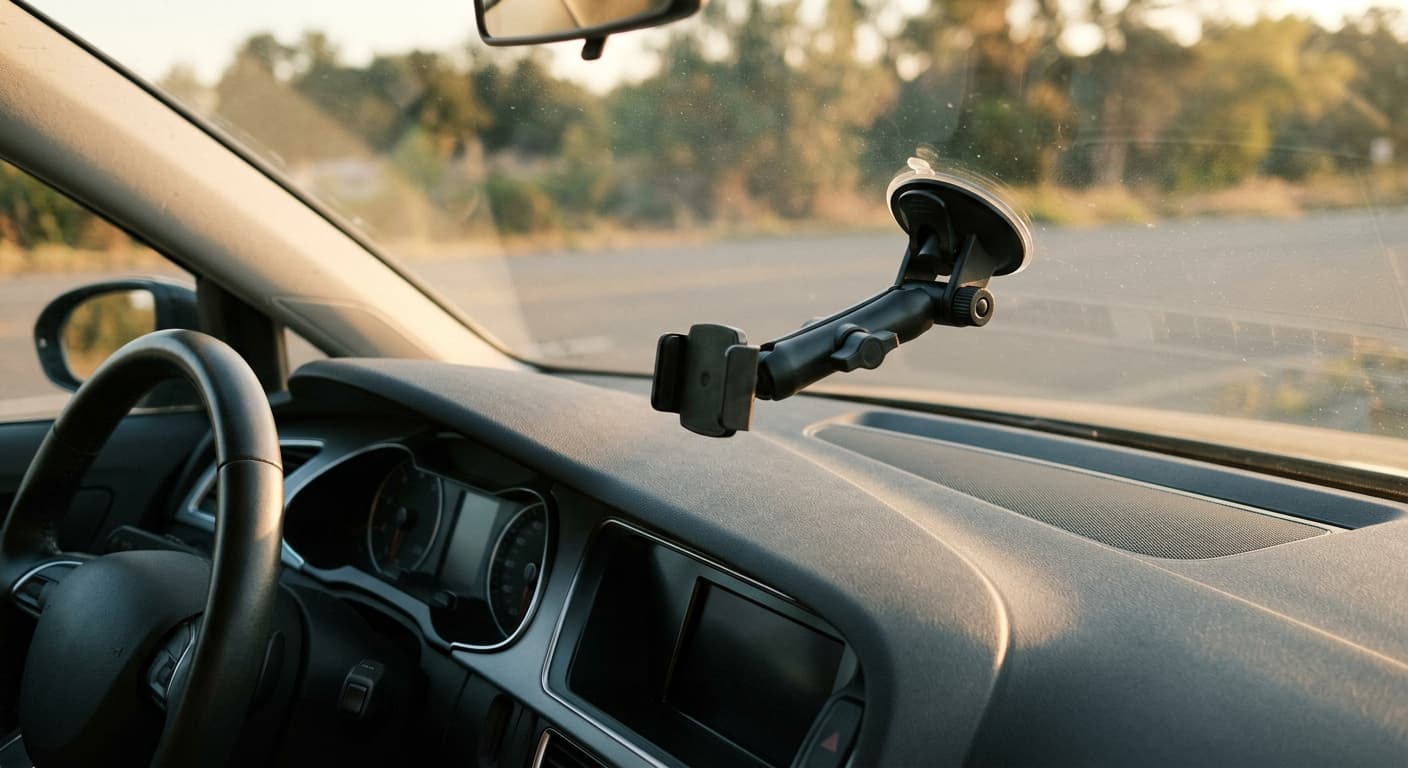
Ohio permits dashcams, GPS units, and phone mounts on passenger car windshields under Ohio Revised Code 4513.24(B)(2), provided the device does not block the driver's sight lines to the road or highway signs. Commercial vehicles must mount devices within 8.5 inches of the upper windshield edge.
Ohio law controls what drivers can attach to or mount on their windshields. The primary statute is Ohio Revised Code Section 4513.24, which sets out the rules for windshield obstructions, electronic device placement, and windshield wiper requirements. Additional regulations in ORC 4513.241 and Ohio Administrative Code 4501-41-03 govern window tinting and sun screening materials.
This guide covers the current law as of 2026, including the April 2023 amendments that added electronic device exemptions and Ohio's hands-free driving law that took effect the same year.
Ohio Windshield Obstruction Law (ORC 4513.24)
Ohio Revised Code 4513.24(A) requires every motor vehicle driven on Ohio roads to have a windshield. Motorcycles and motorized bicycles are the only exceptions.
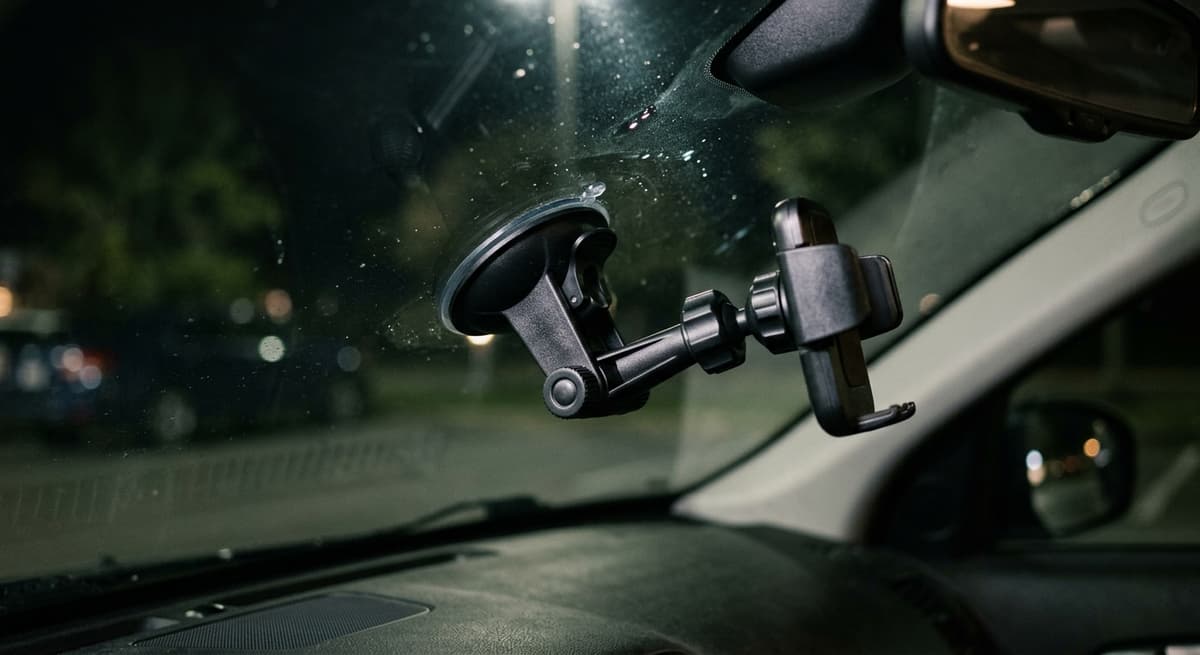
Division (B)(1) is the core obstruction rule. It prohibits driving any motor vehicle (other than a bus) with any "sign, poster, or other nontransparent material" on the front windshield, side wings, side windows, or rear windows. The law carves out two exceptions to this general ban:
- Legally required documents. Certificates or papers that the law requires you to display (such as inspection stickers or registration documents) are permitted.
- Small signs or decals. A sign, poster, or decal may be placed in the lower left or right corner of the windshield as long as it does not exceed 4 inches in height by 6 inches in width.
No sign, poster, or decal may be placed in the windshield in a way that conceals the vehicle identification number (VIN) when federal law requires the VIN to be readable through the windshield glass.
Electronic Device Exemptions
The April 2023 amendments to ORC 4513.24 added two subsections that specifically address electronic devices on the windshield. These provisions reflect the reality that modern drivers use GPS units, dashcams, toll transponders, and other technology that may need to be mounted on the windshield.
Passenger Vehicles (ORC 4513.24(B)(2))
For passenger cars, the obstruction ban in Division (B)(1) does not apply to an electronic device located in the front windshield, including an antenna, electronic tolling or other transponder, camera, directional navigation device, or other similar electronic device, if either of the following applies to the device:
-
Federal vehicle safety technology standard (Division (B)(2)(a)). The device is a "vehicle safety technology" as defined in 49 C.F.R. 393.5 and complies with 49 C.F.R. 393.60(e)(1)(ii).
-
General electronic device standard (Division (B)(2)(b)). The device does not restrict the vehicle operator's sight lines to the road and highway signs and signals, and it does not conceal the vehicle identification number.
The two branches are alternatives, not a checklist. A consumer GPS unit or dashcam ordinarily rests on the second branch, so the practical test for most drivers is whether the device blocks the view of the road or of traffic signs and signals and whether it covers the VIN. This exemption is broad: it covers GPS units, dashcams, E-ZPass transponders, radar detectors (to the extent they are windshield-mounted), and similar devices. There is no specific measurement requirement for passenger vehicles regarding where on the windshield the device must be placed.
Commercial Vehicles (ORC 4513.24(B)(3))
Division (B)(3) has the same two-branch structure as the passenger-car exemption. The obstruction ban does not apply to an electronic device in the front windshield of a commercial car if either of the following applies. The only substantive difference from (B)(2) is in the second branch, which adds an 8.5-inch mounting cap and drops the VIN condition.
-
Federal vehicle safety technology standard (Division (B)(3)(a)). The device qualifies as "vehicle safety technology" under 49 C.F.R. 393.5 and complies with the mounting requirements in 49 C.F.R. 393.60(e)(1)(ii). Under this federal rule, devices must be mounted no more than 8.5 inches (216 mm) below the upper edge of the windshield wiper sweep area and no more than 7 inches (175 mm) above the lower edge of the wiper sweep area. Vehicle safety technology includes fleet-related incident management systems, lane departure warning systems, forward collision warning systems, active cruise control systems, and transponders.
-
General electronic device standard (Division (B)(3)(b)). The device does not restrict the operator's sight lines to the road and highway signs and signals, and it is mounted not more than 8.5 inches below the upper edge of the windshield.
Commercial motor vehicle operators should mount devices in the upper portion of the windshield, within the 8.5-inch zone from the top, to stay clearly within the law.
GPS and Phone Mounts
Ohio law does not ban GPS units or phone mounts on the windshield by name. Under ORC 4513.24(B)(2), passenger vehicle drivers may mount a "directional navigation device" on the windshield as long as it does not obstruct their view of the road or highway signs and signals.
However, Ohio's hands-free driving law (ORC 4511.204), which took effect on April 4, 2023, adds an important layer of regulation. Under this law, drivers may not hold or physically support an electronic wireless communications device with any part of their body while operating a motor vehicle. The law permits using a device in a hands-free mode, including with technology that "physically or electronically integrates the device into the motor vehicle."
What This Means for Windshield Phone Mounts
A phone mounted in a cradle or holder on the windshield (or dashboard) satisfies the hands-free requirement because the driver is not holding the device. However, the driver may only interact with the phone using a single touch or swipe to activate, deactivate, or initiate a hands-free feature. Manually typing, scrolling, or entering information while driving is prohibited.
The safest approach is to mount your phone or GPS in a location that does not obstruct your forward view. Dashboard mounts are the most conservative option. If you use a windshield mount, position the device in a lower corner or near the rearview mirror where it minimizes obstruction.
Dashcam Rules
Ohio does not have a standalone dashcam statute. Dashcams fall under the electronic device exemption in ORC 4513.24(B)(2) for passenger vehicles and ORC 4513.24(B)(3) for commercial vehicles.
A dashcam is legal on the windshield of a passenger car in Ohio as long as it does not restrict the driver's sight lines to the road and highway signs and signals. For commercial vehicles, the dashcam must be mounted within 8.5 inches of the upper edge of the windshield.
The most common and legally safe mounting position for a dashcam is behind the rearview mirror, where the device captures the road ahead without entering the driver's primary field of vision.
Ohio is a one-party consent state for audio recording under ORC 2933.52. This means a dashcam that records audio inside the vehicle is legal as long as the person operating the dashcam is a party to the conversation being recorded. You do not need to notify passengers that audio is being recorded, though doing so is good practice.
Toll Transponders (E-ZPass)
E-ZPass transponders are explicitly covered by the electronic device exemption in ORC 4513.24(B)(2) and (B)(3), which list "electronic tolling or other transponder" as a permitted device. The Ohio Turnpike Authority requires E-ZPass transponders to be properly mounted on the windshield for the overhead antenna to read them. Holding the transponder up as you pass through a toll plaza will not reliably work.
Mount your E-ZPass transponder according to the manufacturer's instructions, typically on the inside of the windshield behind the rearview mirror or in the area the instructions specify. This placement complies with both the transponder's technical requirements and Ohio's windshield obstruction law.
Windshield Tinting Rules
Ohio Revised Code 4513.241 and Ohio Administrative Code 4501-41-03 set the rules for windshield tinting and sun screening materials.
Light Transmittance Requirements
| Window Location | Minimum Light Transmittance | Color Restrictions |
|---|---|---|
| Windshield (below AS-1 line) | 70% VLT (+/- 3%) | No red or yellow |
| Windshield (above AS-1 line / top 5 inches) | Not regulated by OAC 4501-41-03 | Not regulated by OAC 4501-41-03 |
| Front side windows | 50% VLT (+/- 3%) | No red or yellow |
| Rear side windows | No minimum | No color restriction |
| Rear window | No minimum, but outside left and right rearview mirrors are required if transmittance is under 50% (+/- 3%) | No color restriction |
The color condition is narrow: OAC 4501-41-03 bars red and yellow sunscreening only on the windshield (paragraph (A)(2)) and on the side windows immediately to the right or left of the driver (paragraph (A)(3)). Windows to the rear of the driver carry no color condition. Separately, paragraph (D) bars reflectorized (mirrored) materials on any window, including the windshield.
The AS-1 line is a marking on the windshield glass placed by the manufacturer, typically 5 to 6 inches from the top edge. Tinting above the AS-1 line is unrestricted, but tinting below it must allow at least 70% of light to pass through.
Labeling Requirements
All aftermarket sunscreening material installed on an Ohio vehicle must display a label in the lower left corner (as viewed from outside) showing the manufacturer's name and the percentage level of light transmission.
Medical Exemption
Ohio allows a medical exemption for darker window tinting under Ohio Administrative Code 4501-41-05. A physician licensed under ORC Chapter 4731 or an optometrist licensed under ORC Chapter 4725 must sign an affidavit stating that the driver has a physical condition requiring the installation of sunscreening material that would otherwise violate the law. The affidavit must be carried in the vehicle at all times. Qualifying conditions may include lupus, photosensitivity disorders, or other medical conditions that require protection from sunlight.
Windshield Condition Requirements
While Ohio does not have a statute specifically banning cracked or chipped windshields, ORC 4513.02 requires all motor vehicles to be maintained in "safe operating condition." Glass is among the items inspected under this statute.
A windshield crack or chip that impairs the driver's visibility can result in a citation under the general safety requirement. Law enforcement officers have discretion to determine whether windshield damage interferes with safe driving. Cracks in the driver's direct line of sight carry the highest enforcement risk.
Every motor vehicle must also be equipped with a windshield wiper system under ORC 4513.24(C). The wiper must be maintained in good working order and must be controllable by the vehicle operator.
Exemptions Summary
| Exemption | Authority |
|---|---|
| Legally required certificates and papers | ORC 4513.24(B)(1) |
| Small signs/decals (4" x 6" max) in lower corners | ORC 4513.24(B)(1) |
| Electronic devices on passenger cars (no view obstruction) | ORC 4513.24(B)(2) |
| Electronic devices on commercial cars (8.5" from top or federal safety tech) | ORC 4513.24(B)(3) |
| Factory-installed tinting (federal safety standard compliant) | ORC 4513.241 |
| Tinting above AS-1 line (top 5 inches) | OAC 4501-41-03 |
| Medical exemption for darker tint (physician or optometrist affidavit required) | OAC 4501-41-05 |
| Buses (exempt from nontransparent material ban) | ORC 4513.24(B)(1) |
Penalties
Violating Ohio's windshield mounting or obstruction laws under ORC 4513.24 is classified as a minor misdemeanor. Under ORC 2929.28, a minor misdemeanor carries:
| Penalty | Amount |
|---|---|
| Maximum fine | $150 |
| Jail time | None |
| Points on license | None |
Illegal window tinting under ORC 4513.241 is also a minor misdemeanor with the same penalty structure.
Ohio's hands-free driving law (ORC 4511.204) carries separate, escalating penalties for using a device while driving:
| Offense | Fine | License Points | Additional Penalty |
|---|---|---|---|
| First offense | Up to $150 | 2 points | May elect the distracted driving safety course under ORC 4511.991 in lieu of the fine and the points |
| Second offense | Up to $250 | 3 points | None |
| Third or subsequent offense | Up to $500 | 4 points | Possible 90-day license suspension |
Under ORC 4511.204(D)(2), a first-time offender may elect the distracted driving safety course instead of paying the fine and taking the two points, but written evidence of completion must reach the court within ninety days of the violation. Under ORC 4511.204(D)(1)(d), a violation committed in a posted construction zone carries a fine of two times the amount otherwise imposed.
A windshield-mounted device is not itself a violation, but interacting with that device beyond a single touch or swipe while driving could trigger a distracted driving citation.
Ohio's Hands-Free Law and Windshield Devices
Ohio's "Phones Down" law (ORC 4511.204) went into effect on April 4, 2023, with warnings issued through October 5, 2023, and full enforcement beginning after that date.
The law prohibits operating a motor vehicle while using, holding, or physically supporting an electronic wireless communications device with any part of your body. You may not hold your phone in your hand, place it in your lap, or prop it against any body part while driving.
What Is Still Allowed
- Using a device with a voice-operated or hands-free feature, activated with a single touch or swipe
- Using technology that physically or electronically integrates the device into the vehicle (such as a mount or cradle)
- Storing a device in a holster, harness, or article of clothing on your body
- Using a device while the vehicle is parked or stopped (such as at a red light, though the law's language on stopped vehicles is narrower than many drivers assume)
A windshield-mounted phone in a cradle is legal. Manually typing on that phone while driving is not.
Recent Changes (2023 to Present)
The most significant changes to Ohio's windshield-related laws occurred in 2023:
-
ORC 4513.24 amended (effective April 3, 2023). The legislature added Divisions (B)(2) and (B)(3), which created explicit exemptions for electronic devices on passenger and commercial vehicle windshields. Before this amendment, the statute did not specifically address electronic devices, creating uncertainty about GPS units, dashcams, and transponders.
-
ORC 4511.204 enacted (effective April 4, 2023). Ohio's hands-free driving law made distracted driving a primary offense. Officers may pull over a driver solely for using a handheld device, without needing to observe another traffic violation first.
No additional changes to ORC 4513.24, ORC 4513.241, or the related administrative code provisions have been enacted through the current 136th General Assembly session (2025-2026). HB 526, introduced in 2025, would require orange International Symbol of Access windshield placards but has not been enacted as of early 2026.
More Ohio Laws
Frequently Asked Questions
Can I mount a GPS or phone on my windshield in Ohio?
Yes. Under ORC 4513.24(B)(2), electronic devices including directional navigation devices and similar technology are permitted on passenger car windshields as long as they do not restrict the driver's sight lines to the road and highway signs and signals and do not conceal the VIN. A device that qualifies as federal vehicle safety technology under 49 C.F.R. 393.5 is exempt on that basis alone. You must use the device hands-free under Ohio's Phones Down law (ORC 4511.204), meaning no holding the device and no manual input beyond a single touch or swipe.
Are dashcams legal on windshields in Ohio?
Yes. Dashcams are covered by the electronic device exemption in ORC 4513.24(B)(2) for passenger vehicles. The dashcam must not obstruct the driver's view of the road or highway signs. For commercial vehicles, the dashcam must be mounted within 8.5 inches of the upper edge of the windshield under ORC 4513.24(B)(3). Ohio is a one-party consent state for recording, so audio captured by a dashcam is legal when the operator is a party to any conversation recorded.
What is the fine for a windshield obstruction in Ohio?
A violation of ORC 4513.24 is a minor misdemeanor, punishable by a fine of up to $150. There is no jail time and no points assessed on the driver's license for this offense. Illegal window tinting under ORC 4513.241 carries the same penalty.
How dark can I tint my windshield in Ohio?
Under Ohio Administrative Code 4501-41-03, any sunscreening material applied to the windshield below the AS-1 line must allow at least 70% of light to pass through (plus or minus 3%). Tinting above the AS-1 line, which is typically the top 5 inches of the windshield, is not restricted. Red and yellow sunscreening is barred on the windshield and on the side windows immediately to the right or left of the driver; windows behind the driver carry no color condition. No window may carry reflectorized material. A medical exemption is available under OAC 4501-41-05 with a physician's or optometrist's affidavit.
Does Ohio's hands-free law affect windshield-mounted phones?
A phone mounted in a windshield cradle or holder is legal under Ohio's Phones Down law (ORC 4511.204). The law prohibits holding or supporting a device with your body, not mounting it on the vehicle. However, you may only interact with the mounted phone using a single touch or swipe to activate a hands-free feature. Manually typing, scrolling, or entering information while driving is illegal and can result in fines up to $150 for a first offense, escalating to $500 for a third or subsequent offense. A first-time offender may elect the distracted driving safety course under ORC 4511.991 in lieu of the fine and points, and a violation in a posted construction zone carries double the fine.
Updates
Corrected the ORC 4513.24 electronic device exemption to show that passenger and commercial vehicles each satisfy one of two alternative standards rather than a single checklist, narrowed the window tint color and rear window rules to what OAC 4501-41-03 actually requires, reattributed the tint medical exemption to OAC 4501-41-05, and added the first offense safety course option and the construction zone fine doubling under ORC 4511.204.
Independently fact-checked against the cited primary sources
Governing law re-checked for recent changes
Governing law re-checked for recent changes
Reviewed and approved by an editor
The Law Behind This Article
This article rests on the statutory provisions below, held in our own legal record and retrieved from the official source. Tap a section to read the operative text.
Ohio Revised Code
§ 4513.24Windshield and windshield wipersIn forcecited in 2 of our articles
(A) No person shall drive any motor vehicle on a street or highway in this state, other than a motorcycle or motorized bicycle, that is not equipped with a windshield.
Official text (excerpt) · last checked 2026-09-08 · Read the full text in our law library · Verify at codes.ohio.gov
Cited in 2 court opinions in our collectionLatest citing opinion in our collection: 2003
Opinions citing this section in our collection:
- State v. Myers (Ohio Supreme Court 1983, 8 Ohio St. 3d 33)“…ppellee’s vehicle is “nontransparent” within the meaning of R.C. 4513.24. The state argues that darkly tinted gl…”
- State v. Reid, Unpublished Decision (11-26-2003) (Ohio Court of Appeals 2003, 2003 Ohio 6537)“…lic for vehicular travel or parking is a minor misdemeanor. R.C. 4513.24.1. Likewise, every vehicle must at all…”
Identified automatically from the court opinions citing this section — not a ranking of which case controls.
Also relied on in: Ohio Dashcam Laws: Mounting Rules, Audio Recording, and Evidence
§ 4513.241Using tinted glass and other vision obscuring materialsIn forcecited in 3 of our articles
(A) The director of public safety, in accordance with Chapter 119. of the Revised Code, shall adopt rules governing the use of tinted glass, and the use of transparent, nontransparent, translucent, and reflectorized materials in or on motor vehicle windshields, side windows, sidewings, and rear…
Official text (excerpt) · last checked 2026-07-31 · Read the full text in our law library · Verify at codes.ohio.gov
Cited in 37 court opinions in our collectionLatest citing opinion in our collection: 2026
In the courts (editorial summary, independently checked):Ohio courts separate the proof needed to stop from the proof needed to convict. State v. Scott (2022) held a conviction under R.C. 4513.241 requires proof the windows broke the light-transmittance limits in Adm.Code 4501-41-03; State v. Fleckinger (2024) held observed very dark tint supported a stop.
Opinions citing this section in our collection:
- State v. Scott (Ohio Court of Appeals 2022, 195 N.E.3d 244)✓Officers cited a driver for excessive tint on their testimony that they could not see into her Hyundai, never using a tint meter; the court reversed the conviction, holding that section 4513.241 requires proof the windows failed the administrative light-transmittance standards.
- State v. Fleckinger (Ohio Court of Appeals 2024, 2024 Ohio 5659)✓An agent stopped a car on I-75 because tint on the windshield and front windows was dark enough that he could not tell the driver's sex; the court held that observation gave reasonable suspicion of a section 4513.241 violation, though the tint was measured only afterward.
- State v. Johnson (Ohio Court of Appeals 2020, 154 N.E.3d 387)“…stigation of the tint violation. The State points out that R.C. 4513.241(C) prohibits operation of a vehicle tha…”
Identified automatically from the court opinions citing this section — not a ranking of which case controls.
Also relied on in: Illinois Law Bars Police From Stopping Drivers Solely for Windshield Obstructions Like Air Fresheners, Ohio Window Tint Laws (2026): Legal VLT Limits
§ 4511.204Driving while textingIn force
(A) No person shall operate a motor vehicle, trackless trolley, or streetcar on any street, highway, or property open to the public for vehicular traffic while using, holding, or physically supporting with any part of the person's body an electronic wireless communications device.
Official text (excerpt) · last checked 2026-07-31 · Read the full text in our law library · Verify at codes.ohio.gov
Cited in 10 court opinions in our collectionLatest citing opinion in our collection: 2026
Opinions citing this section in our collection:
- State v. Havens (Ohio Court of Appeals 2024, 2024 Ohio 2204)“…Havens was cited for texting while driving in violation of R.C. 4511.204. A bench trial commenced on November 15…”
- Columbus v. Catudal (Ohio Court of Appeals 2019, 2019 Ohio 1137)“…argues he was pulled over for texting in clear violation of R.C. 4511.204(C)(1) and that this was a violation of…”
- Linndale v. State (Ohio Court of Appeals 2014, 2014 Ohio 4024)“…the Ohio Constitution because it incorporated amendments to R.C. 4511.204 and 4511.205 regarding the use of handh…”
Identified automatically from the court opinions citing this section — not a ranking of which case controls.
§ 2933.52Interception of wire, oral or electronic communicationsIn forcecited in 19 of our articles
(A) No person purposely shall do any of the following: (1) Intercept, attempt to intercept, or procure another person to intercept or attempt to intercept a wire, oral, or electronic communication; (2) Use, attempt to use, or procure another person to use or attempt to use an interception device to…
Official text (excerpt) · last checked 2026-07-31 · Read the full text in our law library · Verify at codes.ohio.gov
Cited in 64 court opinions in our collectionLatest citing opinion in our collection: 2025
In the courts (editorial summary, independently checked):State v. Bidinost (1994) held R.C. 2933.52(A)'s ban on purposeful interception applies to cordless telephone conversations intercepted and recorded on a baby monitor, requiring suppression. State v. Childs (2000) held the party seeking to suppress bears the burden of proving a 2933.52(A)(1) violation.
Opinions citing this section in our collection:
- State v. Robb (Ohio Supreme Court 2000, 88 Ohio St. 3d 59)✓During a prison siege, FBI agents used tunnel microphones to record rioting inmates' conversations without a warrant; the court held those interceptions were exempt under former Section 2933.52(B)(1), Ohio's exception for interceptions made under federal wiretap law.
- State v. Childs (Ohio Supreme Court 2000, 88 Ohio St. 3d 558)✓A defendant sought to suppress tapes of her own conversations as intercepted in violation of Section 2933.52(A)(1), but no one proved whether the other party consented; the court held the party seeking suppression carries the burden of proof, so the motion failed.
- State v. Bidinost (Ohio Supreme Court 1994, 71 Ohio St. 3d 449)✓A neighbor's baby monitor began picking up the defendant's cordless phone calls, and at police direction she recorded them; the court held that was a purposeful interception barred by Section 2933.52(A) and that the recordings had to be suppressed.
Identified automatically from the court opinions citing this section — not a ranking of which case controls.
Also relied on in: Ohio Audio Recording Laws: Consent, Devices, and Penalties, Ohio Landlord-Tenant Recording Laws: Privacy, Cameras, and Rights, Ohio Medical Recording Laws: Patient Rights, HIPAA, and Consent
§ 4513.02Unsafe vehiclesIn force
(A) No person shall drive or move, or cause or knowingly permit to be driven or moved, on any highway any vehicle or combination of vehicles which is in such unsafe condition as to endanger any person.
Official text (excerpt) · last checked 2026-07-31 · Read the full text in our law library · Verify at codes.ohio.gov
Cited in 48 court opinions in our collectionLatest citing opinion in our collection: 2025
Opinions citing this section in our collection:
- State v. Taylor (Ohio Court of Appeals 1996, 114 Ohio App. 3d 416)“…concurring. I agree that because a violation of R.C. 4513.02(E) confers no authority on an officer t…”
- State v. Goines (Ohio Court of Appeals 1984, 16 Ohio App. 3d 168)“…arefully formulated standards and neutral criteria.” R.C. 4513.02 provides, in pertinent part: “(A…”
- State v. Reiger (Ohio Court of Appeals 1978, 63 Ohio App. 2d 135)“…the vehicles was pursuant to the authority vested in him by R. C. 4513.02(B) which provides in pertinent part:…”
Identified automatically from the court opinions citing this section — not a ranking of which case controls.
§ 2929.28Financial sanctions - misdemeanorIn force
(A) In addition to imposing court costs pursuant to section 2947.23 of the Revised Code, the court imposing a sentence upon an offender for a misdemeanor, including a minor misdemeanor, may sentence the offender to any financial sanction or combination of financial sanctions authorized under this…
Official text (excerpt) · last checked 2026-07-31 · Read the full text in our law library · Verify at codes.ohio.gov
Cited in 251 court opinions in our collectionLatest citing opinion in our collection: 2026
Opinions citing this section in our collection:
- State v. Aguirre (Slip Opinion) (Ohio Supreme Court 2014, 144 Ohio St. 3d 179)“…929.18(A)(1) for felonies) and 3922 (deleting language from R.C. 2929.28(A)(1) for nonfelonies). Give…”
- State v. Johnson (Ohio Court of Appeals 2005, 164 Ohio App. 3d 792)“…of financial sanctions in misdemeanor cases is governed by R.C. 2929.28. Nevertheless, defendant’s complaint ab…”
- State v. Yerkey (Ohio Supreme Court 2022, 171 Ohio St. 3d 367)“…ere statutes governing restitution. See R.C. 2929.18(A)(1); R.C. 2929.28(A)(1). In each of those provisions, the…”
Identified automatically from the court opinions citing this section — not a ranking of which case controls.
Code of Federal Regulations Title 49
§ 393.60Glazing in specified openings.In forcecited in 15 of our articles
(a) Glazing material. Glazing material used in windshields, windows, and doors on a motor vehicle manufactured on or after December 25, 1968, shall at a minimum meet the requirements of Federal Motor Vehicle Safety Standard (FMVSS) No. 205 in effect on the date of manufacture of the motor vehicle. The glazing material shall be marked in accordance with FMVSS No. 205 (49 CFR 571.205, S6). (b) Windshields required. Each bus, truck and truck-tractor shall be equipped with a windshield. Each windshield or portion of a multi-piece windshield shall be mounted using the full periphery of the glazing material. (c) Windshield condition. With the exception of the conditions listed in paragraphs (c)(1), (c)(2), and (c)(3) of this section, each windshield shall be free of discoloration or damage in the area extending upward from the height of the top of the steering wheel (excluding a 51 mm (2 inch) border at the top of the windshield) and extending from a 25 mm (1 inch) border at each side of the windshield or windshield panel.
Official text (excerpt) · last checked 2026-07-28 · Read the full text in our law library · Verify at ecfr.gov
Cited in 3 court opinions in our collectionLatest citing opinion in our collection: 2021
In the courts (editorial summary, independently checked):The 70 percent light transmittance floor of 49 CFR 393.60(d) covers the windshield and the windows immediately right and left of the driver. Grooms Hauling, LLC v. Robinson (2020) applied it through Pennsylvania adoption and rejected racial profiling claims over tint citations; State v. Ford (2021) noted that Kansas adopts it too.
Opinions citing this section in our collection:
- United States of America, Government v. Robert L. Pierre, Defendant (District Court, D. New Hampshire 2015, 2015 DNH 083)“…rallel luminous transmittance of not less than 70 percent.” 49 C.F.R. 393.60(c). Neither the Government nor the defe…”
- GROOMS HAULING, LLC v. ROBINSON (District Court, E.D. Pennsylvania 2020)✓Officers repeatedly cited a Black-owned hauling company whose truck windows passed only 17 to 20 percent of light; treating 49 CFR 393.60's 70 percent transmittance standard as the governing rule, the court granted the officers summary judgment on the profiling claims.
- State v. Ford (Court of Appeals of Kansas 2021)“…Relevant to this appeal are regulations on window tinting (49 C.F.R. § 393.60[d]), medical examiner certificates (49…”
Identified automatically from the court opinions citing this section — not a ranking of which case controls.
Also relied on in: Connecticut Windshield Mounting Laws (2026 Guide), Idaho Windshield Mounting Laws (2026 Guide), Kansas Windshield Mounting Laws (2026 Guide)
§ 393.5Definitions.In forcecited in 2 of our articles
As used in this part, the following words and terms are construed to mean: Aggregate working load limit. The summation of the working load limits or restraining capacity of all devices used to secure an article of cargo on a vehicle. Agricultural commodity trailer. A trailer that is designed to transport bulk agricultural commodities in off-road harvesting sites and to a processing plant or storage location, as evidenced by skeletal construction that accommodates harvest containers, a maximum length of 28 feet, and an arrangement of air control lines and reservoirs that minimizes damage in field operations. Air brake system. A system, including an air-over-hydraulic brake subsystem, that uses air as a medium for transmitting pressure or force from the driver control to the service brake, but does not include a system that uses compressed air or vacuum only to assist the driver in applying muscular force to hydraulic or mechanical components. Air-over-hydraulic brake subsystem. A subsystem of the air brake system that uses compressed air to transmit a force from the driver control to a hydraulic brake system to actuate the service brakes. Anchor point.
Official text (excerpt) · last checked 2026-07-28 · Read the full text in our law library · Verify at ecfr.gov
Cited in 3 court opinions in our collectionLatest citing opinion in our collection: 2013
Opinions citing this section in our collection:
- Kozak v. Hillsborough Public Transportation Commission (District Court, M.D. Florida 2010, 695 F. Supp. 2d 1285)“…Turning to federal law, when Congress passed TEA-21, 49 C.F.R § 393.5 defined “bus” as “[a] vehicle designed…”
- Regency Transportation Group, Ltd. v. Pennsylvania Public Utility Commission (Commonwealth Court of Pennsylvania 2012, 44 A.3d 107)“…n Kozak relied upon the former version of 49 C.F.R. § 393.5 , which was in effect at the time of pa…”
- In re OPC Polymers v. Pub. Utilities Comm. of Ohio (Ohio Court of Appeals 2013, 2013 Ohio 5443)“…ng, that may also prevent it from shifting. 49 C.F.R. 393.5. {¶ 14} This section also defines…”
Identified automatically from the court opinions citing this section — not a ranking of which case controls.
Also relied on in: California Windshield Mounting Laws (2026 Guide)
Search our full record of US law — 2.1 million sections, every state + federal →
Sources and References
- Ohio Revised Code 4513.24 - Windshield and Windshield Wipers(codes.ohio.gov).gov
- Ohio Revised Code 4513.241 - Using Tinted Glass and Other Vision Obscuring Materials(codes.ohio.gov).gov
- Ohio Administrative Code 4501-41-03 - Sun Screening Specifications(codes.ohio.gov).gov
- Ohio Revised Code 4511.204 - Driving While Texting (Hands-Free Law)(codes.ohio.gov).gov
- Ohio Revised Code 4513.02 - Unsafe Vehicles(codes.ohio.gov).gov
- Ohio Revised Code 2933.52 - Interception of Communications(codes.ohio.gov).gov
- 49 CFR 393.60 - Glazing in Specified Openings (Federal Commercial Vehicle Standard)(ecfr.gov).gov
- Ohio Turnpike Authority - E-ZPass FAQ(ohioturnpike.org).gov
- Ohio Revised Code 2929.28 - Financial Sanctions for Misdemeanor Offenses(codes.ohio.gov).gov
- Ohio Administrative Code 4501-41-05 - Medical Exemption for Sun Screening Materials(codes.ohio.gov)
- 49 CFR 393.5 - Definitions (Vehicle Safety Technology)(www.ecfr.gov)