
Maryland
Maryland Windshield Mounting Laws (2026 Guide)
Independently fact-checked against primary sources (last audited August 17, 2026). · Reviewed by the RecordingLaw editorial team. · Law checked current as of August 17, 2026. · 8 primary sources cited on this page. How we verify our legal content
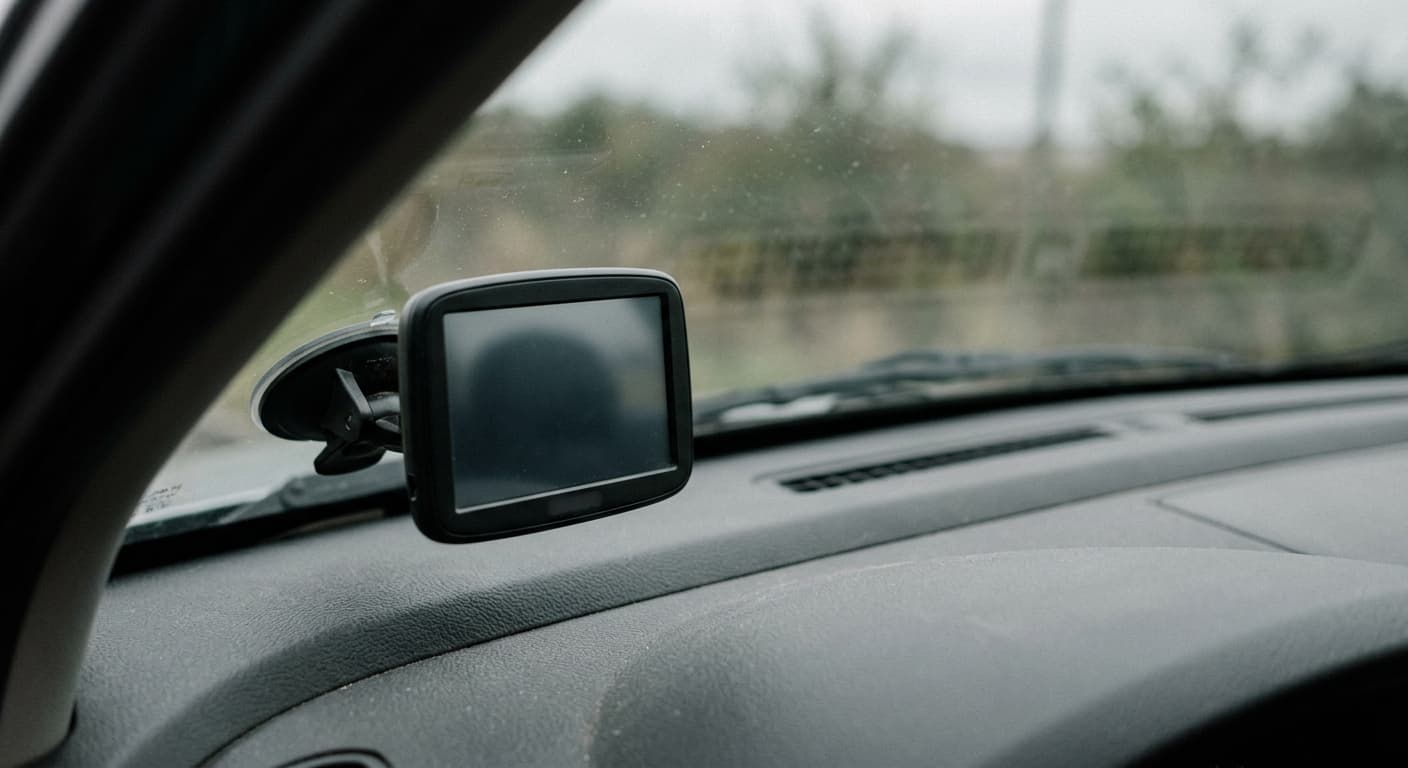
Maryland's windshield zone rules were written for flat nontransparent materials like stickers and cards, not electronic devices. Md. Transp. Code 22-404 lets nontransparent material sit above the AS-1 line (or the top 5 inches) or inside a 7-inch square area at the lower corners, but a mounted GPS unit, phone, or dashcam is separately reachable under Md. Transp. Code 21-1104(c), which bans any object that interferes with the driver's clear view and carries no zone safe harbor for devices.
Maryland law restricts what drivers can attach to their windshields under two overlapping statutes. Maryland Transportation Code 22-404 bans nontransparent materials on the windshield unless they fall within specific exemption zones. Maryland Transportation Code 21-1104 is broader: subsection (c) prohibits any object or material in or on the vehicle that interferes with the driver's clear view through the windshield, and subsection (d) repeats the nontransparent-material ban and its zone exceptions in nearly identical language to 22-404.
The overlap matters when you read a citation. Section 22-404's zones and the identical zones in 21-1104(d) apply to nontransparent materials like stickers and cards, not electronic devices. Section 21-1104(c) is the provision that actually reaches a windshield-mounted GPS unit, dashcam, or phone mount, and it carries no zone-based safe harbor for devices, only exceptions for vehicle equipment and non-glass sun visors. A sticker or decal citation in Maryland is commonly written under 21-1104(d) rather than 22-404, so do not assume 21-1104 is a device-only statute.
Maryland Windshield Obstruction Law (Transp. 22-404)
Section 22-404 of the Maryland Transportation Code states that a person may not drive any motor vehicle with any sign, poster, card, sticker, or other nontransparent material on the front windshield, sidewings, or side or rear windows of the vehicle. The only general exception is a certificate or other paper required by law or authorized by the Administrator.
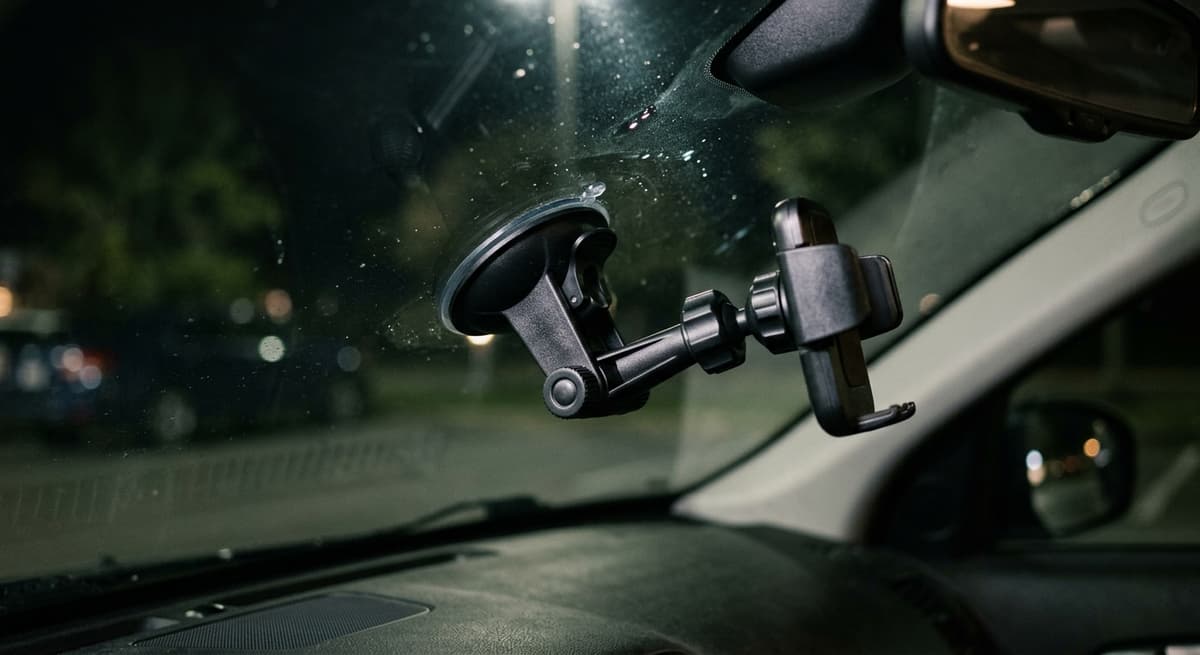
The statute then carves out specific zones where nontransparent materials are permitted.
The AS-1 Line Rule
Nontransparent material may be placed on the windshield above the AS-1 line or not lower than 5 inches from the top of the windshield, whichever measurement is less. The material must be placed so it does not interfere with the driver's clear view of traffic.
The AS-1 line is a marking etched into the glass by the manufacturer. It typically runs across the windshield about 5 to 6 inches below the top edge. Look for a small "AS-1" label near the edge of the glass. Any nontransparent material, such as a sticker, parking pass, or toll tag card, placed above this line is permitted as long as it does not block the driver's forward view. This zone applies to flat material, not mounted electronic devices, which are addressed separately below.
The 7-Inch Square Lower Corner Zone
Nontransparent material may also be placed on the windshield or rear window within a 7-inch square area in the lower corner. The material must be placed so it does not interfere with the driver's clear view of traffic.
This zone is written for flat nontransparent material, such as parking permits, toll tag cards, and stickers, not for 3-dimensional electronic devices. A GPS unit, phone mount, or dashcam sitting in this corner does not get a safe harbor the way a sticker does, and it remains separately exposed to citation under 21-1104(c)'s broader clear-view standard, which has no zone exception for devices. The statute does not specify whether the corner zone must be the driver's side or passenger's side, so either corner is permitted for the materials it actually covers.
To stay within the legal limit for a card, sticker, or similar flat item, measure 7 inches from the bottom edge of the windshield and 7 inches from the side edge and keep the material entirely within that square.
Driver's View Obstruction Law (Transp. 21-1104)
Section 21-1104 of the Maryland Transportation Code addresses obstructions to the driver's view or driving mechanism more broadly. This statute applies to objects inside the vehicle, not just items attached to the glass.
What the Law Prohibits
Under 21-1104(a), a person may not drive a vehicle that is so loaded, or that has so many passengers in the front seat, that it obstructs the driver's view to the front or sides or interferes with the driver's control over the driving mechanism. Subsection (a) contains no "on a highway" element, so it is not limited to public roads the way the windshield provision is.
Under 21-1104(c), a driver may not operate a vehicle on a highway with any object, material, or obstruction in or on the vehicle that interferes with a clear view of the driver through the windshield. This provision specifically excludes required or permitted vehicle equipment, adjustable non-transparent sun visors that are not attached to the glass, and direction or destination signs on passenger common carriers. Unlike the nontransparent-material zones, 21-1104(c) has no AS-1-line or 7-inch-square exception, so it is the provision that actually reaches a windshield-mounted GPS unit, phone mount, or dashcam regardless of where on the glass it sits.
Stickers and Decals Under 21-1104(d)
Section 21-1104 is not device-only. Subsection (d)(1) carries its own ban on driving with any sign, poster, card, sticker, or other nontransparent material on the windshield, sidewings, or side or rear windows, in language that closely tracks 22-404.
Subsection (d)(2) then reproduces the same exceptions: material above the AS-1 line or not lower than 5 inches from the top (d)(2)(i); material within a 7-inch square area in the lower corner of the windshield or rear window (d)(2)(ii); material on side windows to the rear of the driver on passenger vehicles (d)(2)(iii); material on side or rear windows of multipurpose or truck vehicles equipped with dual outside mirrors (d)(2)(iv); material required by a federal or State agency for security purposes (d)(2)(v); direction, destination, or route signs on passenger common carriers (d)(2)(vi); and electronic toll collection devices installed per Maryland Transportation Authority guidelines (d)(2)(vii).
The practical point for drivers: a sticker or decal citation in Maryland may be written under either statute, and the permitted zones are the same either way.
Rearview Mirror Objects
Section 21-1104(c)(3)(i) separately prohibits driving on a highway with any object, material, or obstruction hanging from the rearview mirror that interferes with the driver's clear view through the windshield. That covers air fresheners, parking passes, fuzzy dice, and similar items if they block the driver's line of sight.
Enforcement of that paragraph is limited by the statute itself, not merely by police practice. Under 21-1104(c)(3)(ii), a police officer may enforce the rearview-mirror paragraph only as a secondary action, when the officer has already detained the driver for a suspected violation of another provision of the Code. A hanging air freshener, by itself, is not a lawful basis for a Maryland traffic stop.
GPS and Phone Mount Placement
Maryland law does not specifically name GPS devices or phone mounts, and the nontransparent-material text in both 22-404 and 21-1104(d) is written for flat coverings (sign, poster, card, sticker), a category that does not describe a mounted electronic device. Placing a GPS unit or phone mount inside those two zones does not create the same safe harbor it creates for a sticker or parking pass.
Instead, a windshield-mounted device is governed by 21-1104(c)'s broader clear-view standard: a driver may not operate a vehicle on a highway with any object that interferes with the driver's clear view through the windshield, and the only exceptions are for required or permitted vehicle equipment, non-glass sun visors, and common carrier signs. There is no statutory zone, lower corner or otherwise, that shields a device from a citation if an officer decides it interferes with the driver's view.
In practice, drivers commonly mount devices near the lower corner or behind the rearview mirror because those positions are the least likely to actually obstruct forward vision, which is the standard an officer will apply. That is a practical safety choice, not a codified legal safe harbor the way it is for materials.
Drivers should also be aware that Maryland's hands-free law (Transp. 21-1124.2) prohibits using hands to operate a handheld telephone while driving. Mounting a phone on the windshield and using it hands-free is the legally compliant approach.
Dashcam Rules in Maryland
Maryland does not have a specific dashcam statute. A dashcam is governed by the 21-1104(c) clear-view standard that applies to any other windshield-mounted device, not by the nontransparent-material zones in 22-404 and 21-1104(d), since a dashcam is not nontransparent material within the meaning of those provisions.
The most common placement for a dashcam is behind the rearview mirror, where it generally does not interfere with the driver's clear view of traffic. Law enforcement officers typically do not cite dashcams mounted behind the mirror. There is no codified zone that guarantees a dashcam is exempt from citation, so the safest approach is a small, unobtrusive mount that a reasonable officer would not view as blocking the driver's forward vision.
Dashcam Audio Recording and Consent
This is where Maryland law creates a significant compliance requirement for dashcam users. Maryland is an all-party consent state under Courts and Judicial Proceedings Code 10-402.
Recording video with a dashcam is legal in Maryland without obtaining consent from passengers or other people. Video recording alone does not fall under the wiretapping statute.
Recording audio is a different matter. Under 10-402, it is unlawful to intercept any oral communication unless all parties to the communication have given prior consent. A dashcam that captures audio inside the vehicle records the conversations of everyone present. Without consent from every person in the vehicle, the audio recording violates Maryland law.
The penalties for illegal audio recording in Maryland are severe:
- Criminal penalty: Felony conviction with up to 5 years imprisonment and fines up to $10,000
- Civil liability: Victims can sue for actual damages, punitive damages, and attorney's fees
To comply with Maryland law, dashcam users should either disable the audio recording feature or obtain explicit consent from every person in the vehicle before recording. Posting a notice in the vehicle does not substitute for actual consent under Maryland's strict all-party consent standard.
Windshield Tinting Laws
Maryland Transportation Code 22-406 governs window tinting and sunscreening devices.
Windshield Tint Restrictions
Tinting materials may only be applied to the windshield above the AS-1 line or within 5 inches from the top of the windshield. No aftermarket tinting is permitted on the main viewing area of the windshield.
Side and Rear Window Standards
The 35% standard is not the same for every vehicle, and the difference turns on the vehicle's registration class.
Under 22-406(i)(1)(i), a vehicle registered as a Class A passenger vehicle (Transp. 13-912) may not have tinting material added after manufacture to any window if it allows less than 35% visible light transmittance (VLT).
Under 22-406(i)(1)(ii), a vehicle registered as Class B for hire (13-913), Class E truck (13-917), or Class M multipurpose (13-937) is subject to the 35% floor only on windows to the immediate right or left of the driver. Aftermarket tint on the rear glass or the rear side windows of those vehicles is not capped at 35% by this subsection.
Tinting darker than the standard that applies to your vehicle is prohibited without a medical exemption.
Medical Exemption for Darker Tinting
Maryland allows a medical exemption for drivers who need enhanced sun protection. Under 22-406, a vehicle owner may obtain a written certification from a physician licensed in Maryland stating the medical need for tinting below the 35% VLT standard.
The certification must follow the format required by the Automotive Safety Enforcement Division and must be carried in the vehicle at all times. Certifications are valid for up to 2 years, or indefinitely if the physician determines the condition is permanent.
Recent change: House Bill 436, signed by Governor Wes Moore on May 13, 2025, and effective October 1, 2025, eliminated the 2-year renewal requirement for permanent medical conditions. Drivers with permanent conditions certified by their physician now hold indefinite exemptions.
Pending legislation: Senate Bill 913 in the 2026 session proposes allowing out-of-state physicians to issue medical exemption certifications. The bill had a hearing on March 10, 2026, and has not yet been enacted.
Child Sun Protection Exception
Removable tinting materials may be applied to protect children under age 10 from sun exposure without a medical certification. The material must be easily removable and cannot extend below the AS-1 line on the windshield.
Maryland Hands-Free Driving Law
Maryland's hands-free law (Transp. 21-1124.2) directly affects how drivers use windshield-mounted devices. Under this statute, a driver of a motor vehicle that is in motion may not use the driver's hands to operate a handheld telephone, except to initiate or terminate a call or to turn the phone on or off.
This is a primary enforcement law, meaning police can pull you over solely for holding a phone while driving. The law has been a primary offense since October 1, 2013.
Penalties for Hands-Free Violations
| Offense | Maximum Fine | Points |
|---|---|---|
| First offense | $75 | None (unless accident) |
| Second offense | $125 | None (unless accident) |
| Third or subsequent | $175 | None (unless accident) |
| Violation contributing to accident | $175 | 1-3 points |
A first-time offender may have the fine waived by the court if they provide proof of purchasing a hands-free accessory.
Who Is Completely Prohibited From Phone Use
- Drivers of school buses (Class H vehicles) carrying passengers
- Holders of learner's instructional permits
- Provisional license holders under age 18
These drivers may not use a handheld phone at all while driving, even with a hands-free accessory for the phone itself.
Exemptions
The hands-free law does not apply to emergency calls to 911, hospitals, fire departments, law enforcement, or ambulance services. Law enforcement and emergency personnel acting in their official duties are also exempt.
Exemptions to Windshield Mounting Restrictions
| Exemption | Statute |
|---|---|
| Materials above the AS-1 line or within 5 inches of the top | Transp. 22-404(b)(1); 21-1104(d)(2)(i) |
| Materials in a 7-inch square in the lower corner | Transp. 22-404(b)(2); 21-1104(d)(2)(ii) |
| Side windows behind the driver on passenger vehicles | Transp. 22-404(b)(3); 21-1104(d)(2)(iii) |
| Side/rear windows on multipurpose or truck vehicles with dual mirrors | Transp. 22-404(b)(4); 21-1104(d)(2)(iv) |
| Federal or state security decals per agency guidelines | Transp. 22-404(b)(5); 21-1104(d)(2)(v) |
| Direction and destination signs on common carriers | Transp. 22-404(b)(6); 21-1104(d)(2)(vi) |
| Electronic toll collection devices per MdTA guidelines | Transp. 22-404(b)(7); 21-1104(d)(2)(vii) |
| Required or permitted equipment of the vehicle | Transp. 21-1104(c)(2)(i) |
| Non-transparent sun visors not attached to glass | Transp. 21-1104(c)(2)(ii) |
| Rearview-mirror hangings enforceable only as a secondary action | Transp. 21-1104(c)(3)(ii) |
| Medical tint exemption (physician certification) | Transp. 22-406 |
Penalties for Windshield Violations
Maryland treats windshield obstruction violations as equipment infractions under the Transportation Code.
| Violation | Fine | Points |
|---|---|---|
| Windshield obstruction (no accident) | $70 | 1 point |
| Windshield obstruction (contributing to accident) | $110 | 3 points |
| Equipment violation (general, Transp. 27-101) | Up to $500 | Varies |
| Illegal window tinting | Safety equipment repair order | 0 points |
The $70 preset fine for windshield obstruction is a payable fine, meaning drivers can pay without appearing in court if they choose not to contest the citation. If the violation contributes to an accident, penalties increase significantly.
Under Jake's Law, distracted driving that causes serious bodily injury carries a fine up to $5,000 and up to one year in jail. Distracted driving causing death carries a fine up to $5,000 and up to three years in prison. While Jake's Law primarily targets cell phone use, a windshield obstruction that contributes to a fatal accident could result in enhanced charges.
Windshield Wiper and Washer Requirements
Section 22-404 also establishes equipment requirements for windshield visibility:
- Every motor vehicle (except motorcycles) must have a device for clearing rain, snow, or other moisture from the windshield
- The clearing device must be controlled by the driver
- All windshield wipers must be maintained in good working order
- Windshield washers, if originally equipped on the vehicle, must be operational and capable of distributing cleaning fluid
A failed windshield wiper or washer can result in the same equipment violation fine as a mounting restriction violation.
Recent Legislative Changes
2025: HB 436 (Chapter 452) - Signed May 13, 2025, effective October 1, 2025. Eliminated the 2-year renewal requirement for medical window tinting exemptions when a physician certifies the condition as permanent.
2026: SB 913 (Pending) - Introduced in the 2026 session. Would allow out-of-state physicians to issue medical tinting exemption certifications. Hearing held March 10, 2026, in the Senate Judicial Proceedings Committee. Not yet enacted.
No changes to the core windshield obstruction statutes (22-404 and 21-1104) have been enacted in the 2025 or 2026 legislative sessions.
More Maryland Laws
Frequently Asked Questions
Can I mount a GPS or phone on my windshield in Maryland?
Yes, generally, if it does not block your view. The AS-1-line and 7-inch-square zones in Maryland Transportation Code 22-404 and 21-1104(d) apply to nontransparent material like stickers and cards, not to electronic devices. A GPS unit or phone mount is instead governed by Transp. Code 21-1104(c), which bans any object that interferes with the driver's clear view through the windshield and has no zone safe harbor. Mounting near the lower corner or behind the rearview mirror is the most practical way to avoid obstructing your own view, but it is not a statutory guarantee against a citation.
Is it legal to use a dashcam in Maryland?
Yes. Dashcam video recording is legal in Maryland. Mounting is governed by Transp. Code 21-1104(c)'s clear-view standard rather than the material-only zones in 22-404 and 21-1104(d), so choose a placement, such as behind the rearview mirror, that does not block your forward view. Maryland is also an all-party consent state under Courts and Judicial Proceedings Code 10-402. Recording audio inside the vehicle without consent from every person present is a felony punishable by up to 5 years in prison and fines up to $10,000. Disable the audio feature or get explicit consent from all passengers.
What is the fine for a windshield obstruction ticket in Maryland?
The preset fine for a windshield obstruction violation in Maryland is $70 with 1 point assessed on your driving record. If the obstruction contributes to an accident, the fine increases to $110 with 3 points. Under the general vehicle law penalty statute (Transp. 27-101), equipment violations can carry fines up to $500.
Can I get my windows tinted darker than 35% in Maryland?
It depends on your vehicle's registration class, and otherwise only with a medical exemption. Under Transportation Code 22-406(i)(1)(i), a Class A passenger vehicle may not have aftermarket tint on any window that allows less than 35% visible light transmittance. Under 22-406(i)(1)(ii), a Class B for hire, Class E truck, or Class M multipurpose vehicle is held to the 35% floor only on the windows immediately right or left of the driver, so darker rear glass on those vehicles is not capped by that subsection. Where the 35% standard does apply, a physician licensed in Maryland can certify a medical need for darker tinting, and as of October 1, 2025, permanent medical conditions qualify for an indefinite exemption (HB 436, Chapter 452).
Can I hang items from my rearview mirror in Maryland?
No, not if the item interferes with your clear view. Transportation Code 21-1104(c)(3)(i) prohibits driving on a highway with any object hanging from the rearview mirror that interferes with the driver's clear view through the windshield, which covers air fresheners, parking passes, and decorative items. But 21-1104(c)(3)(ii) limits how that paragraph can be enforced: a police officer may enforce it only as a secondary action, after detaining the driver for a suspected violation of another provision of the Code. In other words, a hanging air freshener alone is not a lawful reason for an officer to pull you over in Maryland.
Updates
Corrected the Maryland windshield page to state that hanging rearview-mirror objects are enforceable only as a secondary stop under Transp. 21-1104(c)(3)(ii), added the nontransparent-material ban in 21-1104(d), limited the 35% window tint floor to the vehicle classes it actually covers under 22-406(i)(1), and removed an on-a-highway element that 21-1104(a) does not contain.
Corrected this page's central claim about windshield-mounted devices in Maryland: the AS-1-line and 7-inch-square zones in Md. Transp. Code 22-404 apply to flat nontransparent materials like stickers, not to GPS units, phone mounts, or dashcams. Those devices are actually governed by the broader clear-view standard in Md. Transp. Code 21-1104(c), which has no zone safe harbor.
Independently fact-checked against the cited primary sources; governing law re-checked for recent changes
Governing law re-checked for recent changes
Reviewed and approved by an editor
The Law Behind This Article
This article rests on the statutory provisions below, held in our own legal record and retrieved from the official source. Tap a section to read the operative text.
Maryland Code, Transportation Article
§ 21-1104In force
§21–1104. (a) A person may not drive a vehicle if it is so loaded or there is in the front seat so many passengers as to: (1) Obstruct the view of the driver to the front or sides of the vehicle; or (2) Interfere with the control of the driver over the driving mechanism of the vehicle. (b) A passenger in a vehicle may not ride in any position where he: (1) Interferes with the view of the driver to the front or sides of the vehicle; or (2) Interferes with the control of the driver over the driving mechanism of the vehicle. (c) (1) Except as provided in paragraph (2) of this subsection and subject to paragraph (3) of this subsection, a person may not drive a vehicle on a highway with any object, material, or obstruction so located in or on the vehicle as to interfere with the clear view of the driver through the windshield. (2) This subsection does not apply to: (i) Required or permitted equipment of the vehicle; (ii) Adjustable, nontransparent sun visors that are not attached to glass; or (iii) Direction, destination, or termini signs on any passenger common carrier motor vehicle.
Official text (excerpt) · last checked 2026-09-07 · Read the full text in our law library · Verify at mgaleg.maryland.gov
§ 22-404In forcecited in 2 of our articles
§22–404. (a) (1) Except as provided in subsection (b) of this section, a person may not drive any motor vehicle with any sign, poster, card, sticker, or other nontransparent material on the front windshield, sidewings, or side or rear windows of the vehicle other than a certificate or other paper either required to be so displayed by law or authorized by the Administrator. (b) This section does not apply to: (1) Nontransparent material placed on the windshield of a motor vehicle above the AS1 line or not lower than 5 inches from the top of the windshield, whichever is less, if the materials are placed so as not to interfere with the driver’s clear view of traffic; (2) Materials placed on the windshield or rear window, within a 7 inch square area in the lower corner, if the materials are placed so as not to interfere with the driver’s clear view of traffic; (3) Materials placed on the side windows of a Class A (passenger) vehicle to the rear of the driver, if the materials are placed so as not to interfere with the driver’s clear view of traffic; (4) Materials placed on the side or rear windows of a Class M (multipurpose) vehicle or Class E (truck) vehicle provided that the…
Official text (excerpt) · last checked 2026-07-29 · Read the full text in our law library · Verify at mgaleg.maryland.gov
Also relied on in: Maryland Dashcam Laws: Legality, Audio Rules, and Evidence Use (2026)
§ 22-406In forcecited in 3 of our articles
§22–406. (a) (1) In this section the following words have the meanings indicated. (2) “Aftermarket safety glass replacement” means motor vehicle safety glass replacement services that occur after the original installation by a vehicle manufacturer. (3) “Safety glass” means: (i) Any glass product that is so made or treated as substantially to prevent the glass from shattering and flying when struck or broken; or (ii) Any similar or other product that the Administration approves. (b) A person may not drive on any highway in this State any motor vehicle manufactured or assembled after June 1, 1937, and registered in this State, unless the vehicle is equipped with safety glass wherever glass is used in the motor vehicle in doors, windows, windshields, and wings. (c) A person may not sell any motor vehicle manufactured or assembled after June 1, 1937, registered or intended to be registered in this State and driven or intended to be driven on any highway in this State, unless the vehicle is equipped with safety glass wherever glass is used in the motor vehicle in doors, windows, windshields, and wings. Each sale in violation of this provision is a separate offense.
Official text (excerpt) · last checked 2026-09-01 · Read the full text in our law library · Verify at mgaleg.maryland.gov
Cited in 3 court opinions in our collectionLatest citing opinion in our collection: 2026
Opinions citing this section in our collection:
- United States v. Antonio Walker-Bey, Jr. (Court of Appeals for the Fourth Circuit 2020)“…a light transmittance through the window of at least 35%.” Md. Code Ann., Transp. § 22-406(i)(1)(i) (LexisNexis 2009). A law enfor…”
- United States v. Michael Brandon (Court of Appeals for the Fourth Circuit 2026)“…believed violated Maryland’s window tint statute, Md. Code Ann., Transp. § 22-406(i). Stewart pulled behind the…”
- United States v. Daniel Taylor (Court of Appeals for the Fourth Circuit 2015, 601 F. App'x 212)“…and issue a safety equipment repair order. Md. Code Ann., Transp. § 22-406(i)(2) (2014). Taylor…”
Identified automatically from the court opinions citing this section — not a ranking of which case controls.
Also relied on in: Maryland Window Tint Laws (2026): Legal VLT Limits
§ 21-1124.2In force
§21–1124.2. (a) (1) In this section the following words have the meanings indicated. (2) “Handheld telephone” means a handheld device used to access wireless telephone service. (3) “9–1–1 system” has the meaning stated in § 1–301 of the Public Safety Article. (b) This section does not apply to: (1) Emergency use of a handheld telephone, including calls to: (i) A 9–1–1 system; (ii) A hospital; (iii) An ambulance service provider; (iv) A fire department; (v) A law enforcement agency; or (vi) A first aid squad; (2) Use of a handheld telephone by the following individuals when acting within the scope of official duty: (i) Law enforcement personnel; and (ii) Emergency personnel; (3) Use of a handheld telephone as a text messaging device as defined in § 21–1124.1 of this subtitle; and (4) Use of a handheld telephone as a communication device utilizing push–to–talk technology by an individual operating a commercial motor vehicle, as defined in 49 C.F.R. Part 390.5 of the Federal Motor Carrier Safety Regulations.
Official text (excerpt) · last checked 2026-07-29 · Read the full text in our law library · Verify at mgaleg.maryland.gov
Cited in 1 court opinions in our collectionLatest citing opinion in our collection: 2020
Opinions citing this section in our collection:
- Nathaniel Hicks v. Gerald Ferreyra (Court of Appeals for the Fourth Circuit 2020, 965 F.3d 302)“…to use their cellphones while driving. Id. at 580 (citing Md. Code Ann., Transp. § 21-1124.2(b)(2)(i))). Although Phillips concedes…”
Identified automatically from the court opinions citing this section — not a ranking of which case controls.
§ 27-101In force
§27–101. (a) A person who violates a provision of the Maryland Vehicle Law is guilty of a misdemeanor unless the violation: (1) Is a felony under the Maryland Vehicle Law; or (2) Is punishable by a civil penalty under the applicable provision of the Maryland Vehicle Law. (b) Except as otherwise provided in the Maryland Vehicle Law, a person convicted of a misdemeanor for a violation of a provision of the Maryland Vehicle Law is subject to a fine not exceeding $500.
Official text (excerpt) · last checked 2026-07-29 · Read the full text in our law library · Verify at mgaleg.maryland.gov
Cited in 2 court opinions in our collectionLatest citing opinion in our collection: 2021
Opinions citing this section in our collection:
- Stutzman v. Krenik (District Court, D. Maryland 2018, 350 F. Supp. 3d 366)“…s otherwise or a civil penalty is assessed as punishment. Md. Code Ann., Transp. § 27-101 . Since the provision prohibiting flee…”
- Adeyemi v. Office of General Counsel for Booth Police Officers, National Security Agency (District Court, D. Maryland 2021)“…law, driving without valid registration is a misdemeanor. Md. Code, Transp. § 27-101(a) (“It is a misdemeanor for any perso…”
Identified automatically from the court opinions citing this section — not a ranking of which case controls.
Maryland Code, Courts and Judicial Proceedings Article
§ 10-402In forcecited in 26 of our articles
§10–402. (a) Except as otherwise specifically provided in this subtitle it is unlawful for any person to: (1) Willfully intercept, endeavor to intercept, or procure any other person to intercept or endeavor to intercept, any wire, oral, or electronic communication; (2) Willfully disclose, or endeavor to disclose, to any other person the contents of any wire, oral, or electronic communication, knowing or having reason to know that the information was obtained through the interception of a wire, oral, or electronic communication in violation of this subtitle; or (3) Willfully use, or endeavor to use, the contents of any wire, oral, or electronic communication, knowing or having reason to know that the information was obtained through the interception of a wire, oral, or electronic communication in violation of this subtitle. (b) Any person who violates subsection (a) of this section is guilty of a felony and is subject to imprisonment for not more than 5 years or a fine of not more than $10,000, or both.
Official text (excerpt) · last checked 2026-08-31 · Read the full text in our law library · Verify at mgaleg.maryland.gov
Cited in 12 court opinions in our collectionLatest citing opinion in our collection: 2026
In the courts (editorial summary, independently checked):Applying section 10-402, Fearnow v. Chesapeake & Potomac Telephone Co. (1995) held that liability under the Maryland Wiretap Act requires proof the defendant acted willfully, an intentional violation or reckless disregard of a known legal duty; an employee's failure to check for a court order was only a jury factor on willfulness.
Opinions citing this section in our collection:
- Fearnow v. Chesapeake & Potomac Telephone Co. (Court of Special Appeals of Maryland 1995, 104 Md. App. 1)✓Police hid a tape recorder on an officer's headquarters phone line with a phone company employee's help and no court order; the court held a section 10-402(a) claim requires proof of willful interception, and failing to ask about a court order went only to willfulness.
- Maryland Attorney General Opinion 110OAG60 (Maryland Attorney General Reports 2025)“…or wire communications without the consent of all parties. Md. Code Ann., Cts. & Jud. Proc. § 10-402(a). However, the Wiretap Act contains e…”
- Boehner, John A. v. McDermott, James A. (Court of Appeals for the D.C. Circuit 1999, 191 F.3d 463)“…1992); Me.Rev.Stat. Ann. tit. 15, §§ 710, 711 (West 1998); Md.Code Ann., Cts & Jud. Proc. § 10-402 (1998); Mass. Gen. Laws Ann. ch. 272,…”
Identified automatically from the court opinions citing this section — not a ranking of which case controls.
Also relied on in: US Recording Laws by State (2026): All 50 States Explained, Is Plaud HIPAA Compliant? Kind Of. Here's What to Know (2026), Maryland Audio Recording Laws: Two-Party Consent Rules and Penalties (2026)
Search our full record of US law — 2.1 million sections, every state + federal →
Sources and References
- Md. Transp. Code 22-404 - Windshields Must Be Unobstructed and Equipped With Wipers(mgaleg.maryland.gov).gov
- Md. Transp. Code 21-1104 - Obstruction to Driver's View or Driving Mechanism(mgaleg.maryland.gov).gov
- Md. Transp. Code 22-406 - Safety Glass; Sunscreening and Window Tinting(mgaleg.maryland.gov).gov
- Md. Transp. Code 21-1124.2 - Use of Handheld Telephone While Driving(mgaleg.maryland.gov).gov
- Md. Cts. & Jud. Proc. Code 10-402 - Interception of Communications(mgaleg.maryland.gov).gov
- Md. Transp. Code 27-101 - Misdemeanor Penalties(mgaleg.maryland.gov).gov
- HB 436 (Chapter 452, 2025) - Medical Exemption for Enhanced Tinted Windows(mgaleg.maryland.gov).gov
- SB 913 (2026) - Out-of-State Physician Window Tinting Certification(mgaleg.maryland.gov).gov