
Kansas
Kansas Car Seat Laws: Requirements and Guidelines
Independently fact-checked against primary sources (last audited August 20, 2026). · Reviewed by the RecordingLaw editorial team. · Law checked current as of August 20, 2026. · 4 primary sources cited on this page. How we verify our legal content
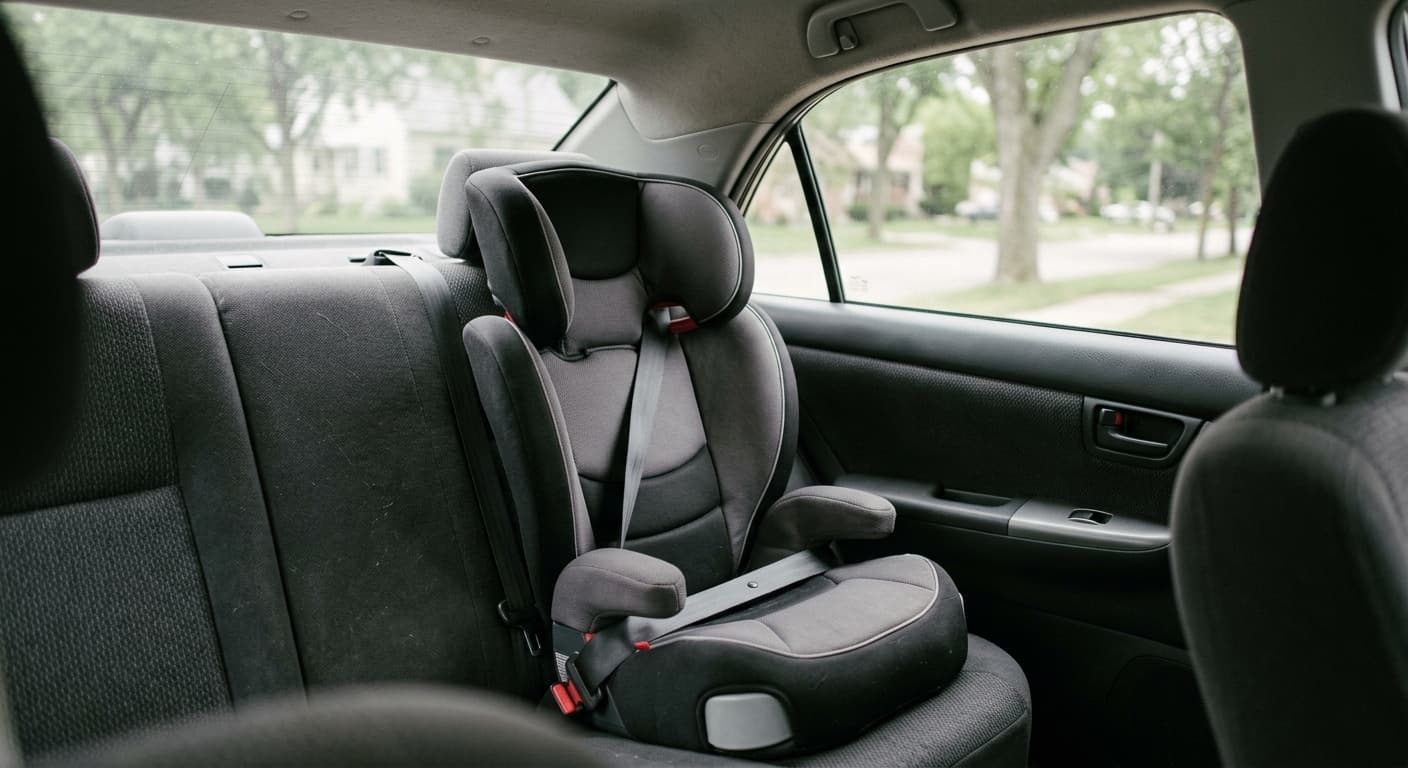
Kansas requires children under 4 to ride in a car seat under KSA 8-1344, and children ages 4 through 7 who weigh less than 80 pounds or stand shorter than 4 feet 9 inches to use a booster seat. All children under 14 must wear a seat belt.
Overview of Kansas Car Seat Laws
Kansas child passenger safety laws are governed by the Kansas Child Passenger Safety Act, found in KSA 8-1343 through 8-1345. These statutes require drivers to properly restrain children based on their age, weight, and height. The Kansas Highway Patrol enforces these laws and provides educational resources to help parents select the correct car seat.
Understanding these requirements matters because motor vehicle crashes remain a leading cause of injury and death for children. Proper car seat use reduces the risk of fatal injury by 71% for infants and 54% for toddlers ages 1 to 4, according to the National Highway Traffic Safety Administration (NHTSA).
Rear-Facing Car Seat Requirements in Kansas
Kansas law requires all children under 4 years old to ride in an appropriate child passenger safety restraining system that meets Federal Motor Vehicle Safety Standard No. 213. While the statute does not specify rear-facing by age, the Kansas Highway Patrol strongly recommends that infants remain rear-facing until at least age 1 and 20 pounds.
The American Academy of Pediatrics (AAP) goes further, recommending children stay rear-facing until at least age 2 or until they reach the maximum height and weight limits of their rear-facing car seat. Many convertible car seats now support rear-facing children up to 40 or even 50 pounds, which allows some children to remain rear-facing until age 3 or 4.
There are two main types of rear-facing seats.
| Seat Type | Weight Range | Best For |
|---|---|---|
| Infant-only seat | 4 to 35 lbs (varies by model) | Newborns and small infants |
| Convertible seat | 5 to 40-50 lbs rear-facing | Infants through toddlers |
Rear-facing seats protect a child's head, neck, and spine by distributing crash forces across the back of the seat. This is critical because a young child's neck muscles and vertebrae are not developed enough to withstand the forward motion of a crash.
All rear-facing seats should be installed in the back seat of the vehicle, away from active front airbags. Follow the manufacturer's instructions for proper recline angle and harness positioning.
Forward-Facing Car Seat Requirements in Kansas
Once a child outgrows the rear-facing seat's height or weight limits, Kansas law requires the child to continue riding in an appropriate child restraint system. For children between ages 1 and 3 (or those who have outgrown their rear-facing seat), the Kansas Highway Patrol recommends a forward-facing car seat with a five-point harness and top tether.
Forward-facing seats use the harness to hold the child in place and the tether strap to keep the seat from tipping forward during a crash. Most forward-facing seats support children up to 65 pounds, meaning some children can stay in a harnessed seat until age 6 or 7.
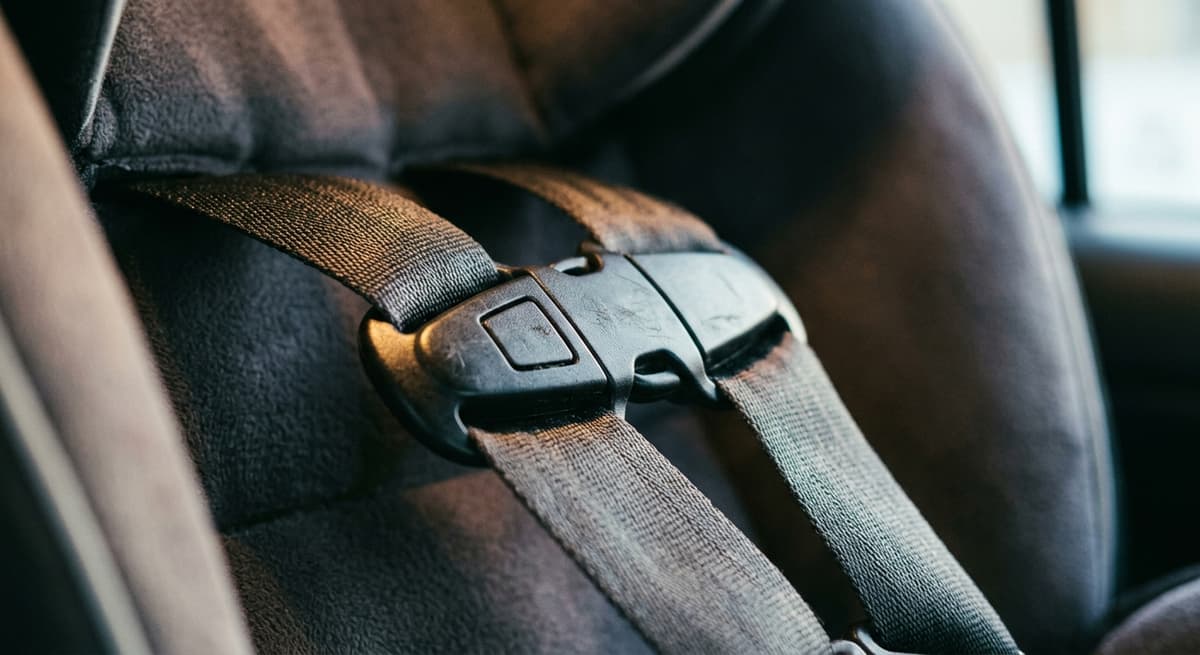
When installing a forward-facing seat, the harness straps should sit at or just above the child's shoulders. The chest clip should rest at armpit level. Perform the pinch test to check tightness: if you can pinch any harness webbing between your fingers at the child's collarbone, the harness needs to be tightened.
The seat should be secured in the rear of the vehicle using either the LATCH system or the vehicle seat belt, along with the top tether strap. Always use the top tether when the seat faces forward, as it reduces head movement during a crash by 4 to 6 inches.
Booster Seat Requirements in Kansas
The Kansas Child Passenger Safety Act requires children ages 4 through 7 who weigh less than 80 pounds or stand shorter than 4 feet 9 inches to ride in a booster seat while in the back seat. Booster seats must be secured with both a lap belt and a shoulder belt. Using a lap-only belt with a booster seat is not allowed.
A booster seat raises the child so that the vehicle's seat belt fits properly across the body. Correct positioning means the lap belt sits low and flat across the upper thighs and the shoulder belt crosses the center of the chest and shoulder.
Two types of booster seats are available.
High-back boosters provide head and neck support and work well in vehicles without adjustable headrests.
Backless boosters are lightweight and portable but should only be used in vehicles that have headrests that reach at least the top of the child's ears.
Even after a child turns 8, the Kansas Highway Patrol recommends keeping the child in a booster seat if the vehicle seat belt does not fit properly. A child is ready for a seat belt alone when he or she can sit with the back flat against the vehicle seat, knees bent comfortably over the edge, and the seat belt positioned correctly without slouching.
Seat Belt Requirements for Older Children
Kansas law requires all children under 14 years old to be properly restrained while riding in a passenger vehicle. Children 8 and older who have outgrown the booster seat requirements should wear a lap and shoulder seat belt.
Children under 14 are also prohibited from riding in portions of a vehicle not designed for passengers. This includes riding in the bed of a pickup truck during travel.
All front-seat passengers in Kansas must wear a seat belt regardless of age. Kansas enforces its adult seat belt law as a secondary offense, meaning an officer must have another reason to make the initial traffic stop.
Front Seat Rules for Children in Kansas
Kansas does not have a specific law prohibiting children of a certain age from sitting in the front seat. However, all children under 4 must be in a car seat, and safety experts strongly recommend that children ride in the back seat until at least age 13.
Front-seat airbags deploy at speeds of up to 200 miles per hour and are designed for adults. The force of an airbag can cause serious injuries to children, especially those in rear-facing car seats or those who are smaller than average.
If a child must ride in the front seat, push the vehicle seat as far back as possible and make sure the child is properly restrained. Never place a rear-facing car seat in front of an active airbag.
Penalties for Car Seat Violations in Kansas
Under KSA 8-1345, a violation of the Kansas Child Passenger Safety Act carries a fine of $60 plus court costs. Key details about enforcement include the following.
| Detail | Description |
|---|---|
| Fine amount | $60 plus court costs |
| Fine waiver | Available if driver shows proof of purchasing an approved car seat |
| Multiple children | Failing to restrain more than one child at the same time counts as a single violation |
| Moving violation | A child restraint violation is not classified as a moving traffic violation |
| Points | No points are assessed on the driver's license |
KSA 8-1344 and KSA 8-1345 do not specify whether the child restraint and booster seat requirement is enforced as a primary or secondary offense. That is different from Kansas's separate adult seat belt law, discussed below, which the statute expressly makes secondary.
Exemptions to Kansas Car Seat Laws
Kansas provides the following exemptions to its child restraint requirements.
Taxis and ride-for-hire vehicles are not required to comply with child car seat laws. However, parents should bring a portable car seat whenever practical.
Vehicles without seat belts manufactured before seat belt requirements took effect are exempt. This applies to certain older vehicles.
Medical exemptions may apply to children with physical conditions that prevent safe use of a standard car seat. A physician must provide documentation.
Leaving a Child Unattended in a Vehicle
Kansas does not have a specific statute that makes it illegal to leave a child unattended in a parked vehicle. However, if harm comes to a child left alone in a car, the driver could face charges under Kansas child endangerment laws.
Temperatures inside a parked vehicle can rise 20 degrees Fahrenheit in just 10 minutes, even with windows cracked. Never leave a child unattended in a vehicle for any length of time.
Smoking in a Vehicle with Children in Kansas
Kansas does not have a statewide law prohibiting smoking inside a vehicle when children are present. The Kansas Indoor Clean Air Act (K.S.A. 21-6109 et seq.) restricts smoking in taxis and certain public places, but it does not specifically address private vehicles with child passengers.
Some local jurisdictions in Kansas may have additional restrictions. Check with your local health department for any rules that apply in your area.
Car Seat Inspection and Replacement
Kansas does not require car seat replacement by law. However, NHTSA recommends replacing a car seat after any moderate or severe crash. Signs of a severe crash include airbag deployment, vehicle damage near the car seat, or a crash where the vehicle had to be towed.
Car seats have expiration dates, usually 6 to 10 years from the date of manufacture. Check the label on the bottom or back of your seat. Expired seats may have weakened materials or outdated safety features.
The Kansas Highway Patrol and local fire departments offer free car seat inspections. Certified Child Passenger Safety Technicians can verify proper installation and check for recalls. Find an inspection station near you at nhtsa.gov.
More Kansas Laws
Frequently Asked Questions
At what age can a child stop using a car seat in Kansas?
Kansas law requires children under 4 to ride in a car seat and children ages 4 to 7 who weigh under 80 pounds or are shorter than 4 feet 9 inches to use a booster seat. After meeting these thresholds, children must use a seat belt until age 14.
What is the fine for a car seat violation in Kansas?
The fine is $60 plus court costs. The fine can be waived if the driver provides proof of purchasing or acquiring an approved child safety seat before the court date.
Is the Kansas car seat law a primary or secondary enforcement law?
Kansas's child restraint statutes (KSA 8-1344 and 8-1345) do not state whether the child restraint or booster seat requirement is treated as primary or secondary enforcement. Kansas's separate adult seat belt law is expressly secondary enforcement.
Can a child ride in the front seat in Kansas?
Kansas does not have a law that specifically prohibits children of a certain age from sitting in the front seat. However, all children under 4 must be in a car seat, and safety experts recommend keeping children in the back seat until age 13.
Can children ride in the bed of a pickup truck in Kansas?
No. Kansas law prohibits children under 14 from riding in portions of a vehicle not intended for passengers. This includes the bed of a pickup truck. A violation carries a fine of up to $60 plus court costs.
Updates
Removed a fabricated claim that Kansas's child-restraint law is secondary enforcement for children under 4 and primary for the 4-7 booster requirement; neither KSA 8-1344 nor KSA 8-1345 contains any such distinction.
Independently fact-checked against the cited primary sources; governing law re-checked for recent changes
Updated the Kansas Indoor Clean Air Act citation from the superseded K.S.A. 21-4009 to its current codification at K.S.A. 21-6109 (2010 Kansas criminal-code recodification).
Governing law re-checked for recent changes
Corrected the booster-seat trigger under KSA 8-1344(a)(2): a child needs a booster if they weigh less than 80 pounds OR are shorter than 4 feet 9 inches (either condition), not only when both are true.
Governing law re-checked for recent changes
Reviewed and approved by an editor
The Law Behind This Article
This article rests on the statutory provisions below, held in our own legal record and retrieved from the official source. Tap a section to read the operative text.
Kansas Statutes Annotated, Chapter 8: AUTOMOBILES AND OTHER VEHICLES
§ 8-1344Child passenger safety; restraining systems for children under the age of four; use of booster seats, when; use of seat belts by children, when; exceptions.In force
(a) Every driver as defined in K.S.A. 8-1416, and amendments thereto, who transports a child under the age of 14 years in a passenger car as defined in K.S.A. 8-1343a, and amendments thereto, or an autocycle as defined in K.S.A. 8-1497, and amendments thereto, on a highway as defined in K.S.A. 8-1424, and amendments thereto, shall provide for the protection of such child by properly using: (1) For a child under the age of four years an appropriate child passenger safety restraining system that meets or exceeds the standards and specifications contained in federal motor vehicle safety standard no. 213; (2) for a child four years of age, but under the age of eight years and who weighs less than 80 pounds or is less than 4 feet 9 inches in height, an appropriate child passenger safety restraining system that meets or exceeds the standards and specifications contained in federal motor vehicle safety standard no. 213; or (3) for a child eight years of age but under the age of 14 years or who weighs more than 80 pounds or is more than 4 feet 9 inches in height, a safety belt manufactured in compliance with federal motor vehicle safety standard no. 208.
Official text (excerpt) · last checked 2026-09-10 · Read the full text in our law library · Verify at ksrevisor.gov
§ 8-1345Same; unlawful acts; penalties; fine waived, when; notification of waiver; defense to action.In force
(a) It shall be unlawful for any driver to violate the provisions of K.S.A. 8-1344, and amendments thereto, and upon conviction such driver shall be punished by a fine of $60. The failure to provide a child safety restraining system or safety belt for more than one child in the same passenger car, or autocycle as defined in K.S.A. 8-1497, and amendments thereto, at the same time shall be treated as a single violation. Any conviction under the provisions of this subsection shall not be construed as a moving traffic violation for the purpose of K.S.A. 8-255, and amendments thereto. (b) The $60 fine provided for in subsection (a) shall be waived if the driver convicted of violating K.S.A. 8-1344(a)(1) or (2), and amendments thereto, provides proof to the court that such driver has purchased or acquired the appropriate and approved child passenger safety restraining system. At the time of issuing the citation for a violation of K.S.A. 8-1344(a)(1) or (2), and amendments thereto, the law enforcement officer shall notify the driver of the waiver provisions of this subsection.
Official text (excerpt) · last checked 2026-07-29 · Read the full text in our law library · Verify at ksrevisor.gov
Kansas Statutes Annotated, Chapter 21: CRIMES AND PUNISHMENTS
§ 21-6109Kansas indoor clean air act; smoking in enclosed areas or public meetings; definitions.In force
As used in K.S.A. 21-6109 through 21-6116, and amendments thereto: (a) "Access point" means the area within a ten foot radius outside of any doorway, open window or air intake leading into a building or facility that is not exempted pursuant to K.S.A. 21-6110(d), and amendments thereto. (b) "Bar" means any indoor area that is operated and licensed for the sale and service of alcoholic beverages, including alcoholic liquor as defined in K.S.A. 41-102, and amendments thereto, or cereal malt beverages as defined in K.S.A. 41-2701, and amendments thereto, for on-premises consumption. (c) "Employee" means any person who is employed by an employer in consideration for direct or indirect monetary wages or profit and any person who volunteers their services for a nonprofit entity. (d) "Employer" means any person, partnership, corporation, association or organization, including municipal or nonprofit entities, that employs one or more individual persons.
Official text (excerpt) · last checked 2026-07-29 · Read the full text in our law library · Verify at ksrevisor.gov
Cited in 2 court opinions in our collectionLatest citing opinion in our collection: 2024
Opinions citing this section in our collection:
- Allen v. Bellendir (District Court, D. Kansas 2024)“…Id. at 5. 1 Kan. Stat. Ann. § 21-4009 was transferred to Kan. Stat. Ann. § 21-6109. Section 21-6109 is titled “Kansas ind…”
- Brooks v. Easter (District Court, D. Kansas 2021)“…rt this is a reference to the Kansas Indoor Clear Air Act, K.S.A. 21-6109 et seq., which they argue is inapplicab…”
Identified automatically from the court opinions citing this section — not a ranking of which case controls.
Search our full record of US law — 2.1 million sections, every state + federal →
Sources and References
- KSA 8-1344: Kansas Child Passenger Safety Restraining System(ksrevisor.gov).gov
- KSA 8-1345: Child Passenger Safety Act Penalties(ksrevisor.gov).gov
- Kansas Highway Patrol: Child Passenger Safety(kansashighwaypatrol.gov).gov
- NHTSA: Car Seats and Booster Seats(nhtsa.gov).gov
- GHSA: State Child Passenger Safety Laws(ghsa.org)