
Oregon
Oregon Knife Laws (2026): Concealed Carry, Intent Felony, Delgado
Independently fact-checked against primary sources (last audited September 24, 2026). · 5 primary sources cited on this page. How we verify our legal content

Oregon bans carrying a switchblade or gravity knife, dirk, dagger, or ice pick concealed, but does not restrict open carry of those same items, and sets no blade-length limit for general public carry. A separate statute makes it a felony to carry any knife with intent to use it unlawfully against another person, and a four-inch pocketknife exclusion governs the court-facility surrender rule specifically, though it is only one route out of that rule's "weapon" definition, not a clearance, since a knife can still qualify as a dangerous or deadly weapon under a separate paragraph of the same definition. A 1984 Oregon Supreme Court decision struck down a broader, since-repealed statute that had banned mere possession and carrying of a switchblade outright, a history worth knowing because it explains why today's law reaches only concealed carry.
Jurisdiction scope: This page covers Oregon state law only, principally ORS §§ 166.220, 166.240, 166.360, 166.370, and 166.170. It does not cover Oregon's concealed handgun license statutes in detail, since those govern handguns rather than knives.
Can you carry a knife openly or concealed in Oregon?
Open carry of an ordinary knife, and even of a switchblade or dirk carried openly, is not restricted by ORS 166.240, the state's core knife-carry statute, because that statute reaches only concealed carry. ORS 166.240(1) provides: "Except as provided in subsection (2) of this section, any person who carries concealed upon the person any knife having a blade that projects or swings into position by force of a spring or by centrifugal force, any dirk, dagger, ice pick, slungshot, metal knuckles, or any similar instrument by the use of which injury could be inflicted upon the person or property of any other person, commits a Class B misdemeanor." The statute's only exemption, at subsection (2), is for a peace officer, as defined in ORS 133.005, whose duty is to serve process or make arrests.
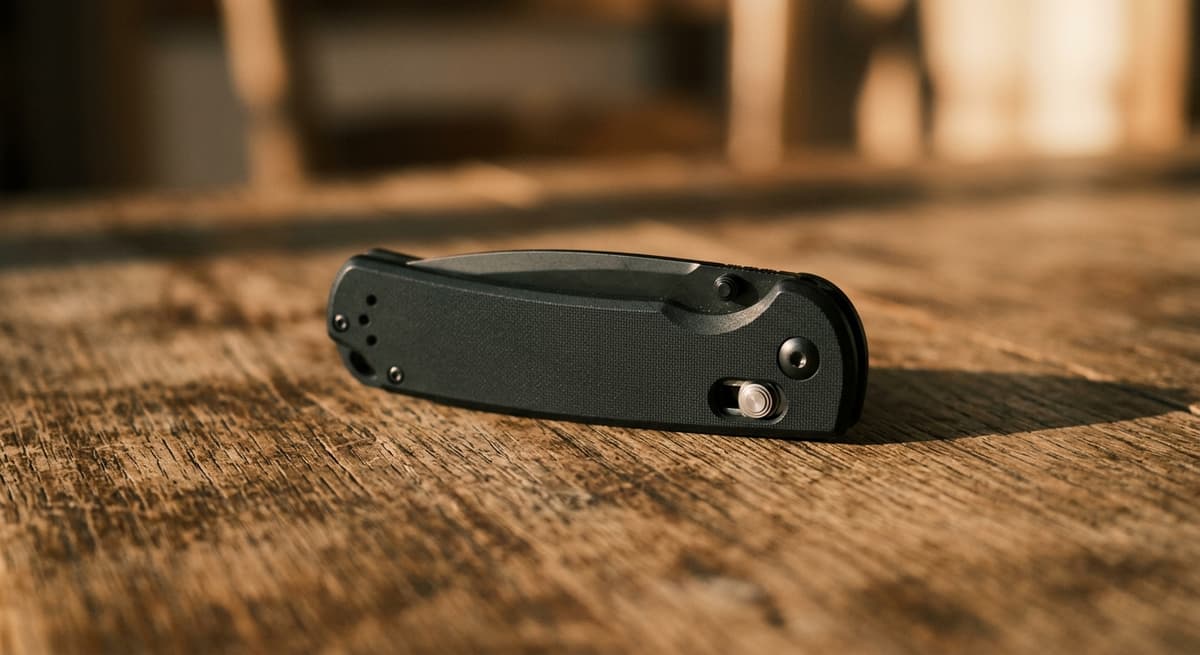
The statute reaches a functional definition, "any knife having a blade that projects or swings into position by force of a spring or by centrifugal force," which covers a switchblade and a gravity knife, plus the named items dirk, dagger, ice pick, slungshot, and metal knuckles, plus a catch-all for "any similar instrument by the use of which injury could be inflicted." An ordinary fixed-blade knife or a manually opened folding knife that does not open by spring or centrifugal force is not named by this statute and is not restricted by it regardless of blade length, whether carried openly or concealed.
Carrying a knife with intent to use it unlawfully
ORS 166.220 reaches beyond ORS 166.240's list of named items. It provides: "A person commits the crime of unlawful use of a weapon if the person: (a) Attempts to use unlawfully against another, or carries or possesses with intent to use unlawfully against another, any dangerous or deadly weapon as defined in ORS 161.015." ORS 161.015 supplies two definitions: a "dangerous weapon" is "any weapon, device, instrument, material or substance which under the circumstances in which it is used, attempted to be used or threatened to be used, is readily capable of causing death or serious physical injury," while a "deadly weapon" is "any instrument, article or substance specifically designed for and presently capable of causing death or serious physical injury." An ordinary knife is not a deadly weapon under the second, design-based definition, but it can be a dangerous weapon under the first, circumstance-dependent one, so a person who carries any knife, of any type or blade length, with intent to use it unlawfully against someone commits unlawful use of a weapon, a Class C felony under ORS 166.220(3). Subsection (2) lists exceptions, including police officers and military personnel in the lawful performance of official duties, a person lawfully defending life or property under ORS 161.219, lawful target shooting and hunting, and a USDA employee lawfully taking wildlife. This statute is the reason Oregon's lack of a blade-length limit on ordinary carry is not the whole answer to whether carrying a particular knife is lawful.
The 1984 Delgado decision and the statute it struck down
Oregon's current concealed-only rule has a specific history. Before 1985, a separate statute, ORS 166.510(1), went further: it provided that "any person who manufactures, causes to be manufactured, sells, keeps for sale, offers, gives, loans, carries or possesses an instrument or weapon having a blade which projects or swings into position by force of a spring or other device and commonly known as a switch-blade knife or an instrument or weapon commonly known as a blackjack, slung shot, sandclub, sandbag, sap glove or metal knuckles, or who carries a dirk, dagger or stiletto commits a Class A misdemeanor." Unlike ORS 166.240, this statute was not limited to concealed carry; it reached mere possession and carrying, openly or otherwise.
In State v. Delgado, 298 Or 396 (1984), the defendant was stopped by an officer while walking on a public street and was found carrying a switchblade knife in his back pocket, which he said he carried "for protection." He was convicted under ORS 166.510 despite no evidence that he had used or intended to use the knife unlawfully. The Oregon Supreme Court held that "the issue is whether ORS 166.510(1), insofar as it prohibits the mere possession and mere carrying of a switchblade knife, violates defendant's right to bear arms under Article I, section 27, of the Oregon Constitution," and concluded: "The problem here is that ORS 166.510(1) absolutely proscribes the mere possession or carrying of such arms. This the constitution does not permit." The court affirmed the Court of Appeals' reversal of the defendant's conviction, relying on its own earlier decisions in State v. Kessler, 289 Or 359 (1980), and State v. Blocker, 291 Or 255 (1981), which had extended the same state constitutional protection to other weapons. The court was careful to note that its holding did not give individuals "an unfettered right to possess or use constitutionally protected arms in any way they please," and that the legislature remained free to regulate possession and use short of an absolute ban.
ORS 166.510 was repealed the year after Delgado by 1985 Or. Laws ch. 709, § 4, and no longer appears in the current criminal code. Today's operative concealed-carry statute, ORS 166.240, was not the statute at issue in Delgado and has not been invalidated; it restricts concealed carry only, consistent with the narrower scope Delgado left open to the legislature.
Public buildings, schools, and court facilities
ORS 166.360 to 166.380 impose a separate restriction inside specific categories of buildings, but the four-inch pocketknife threshold that people associate with this restriction does not govern every provision in it. ORS 166.360(10)(b) defines "weapon," for purposes of these sections, to include "any dirk, dagger, ice pick, slingshot, metal knuckles or any similar instrument or a knife, other than an ordinary pocketknife with a blade less than four inches in length, the use of which could inflict injury upon a person or property." ORS 166.360(9) defines "public building": "A hospital, a capitol building, a public or private school, as defined in ORS 339.315, a college or university, a city hall or the residence of any state official elected by the state at large, and the grounds adjacent to each such building," plus "that portion of any other building occupied by an agency of the state or by a city, a county, a district as defined in ORS 198.010 or any other entity that falls within the definition of 'municipal corporation' in ORS 297.405, other than a court facility," and the passenger terminal of a commercial-service airport with more than one million passenger boardings a year. The "other than a court facility" clause keeps the public-building felony and the court-facility rule discussed below from overlapping: a courthouse is governed by the court-facility provisions, not this one. The "grounds adjacent" clause reaches a school parking lot or campus lawn, not only the building itself, and "capitol building" is its own defined term at ORS 166.360(1), covering seven named state buildings (the Capitol, the State Office Building, the State Library Building, the Labor and Industries Building, the State Transportation Building, the Agriculture Building, and the Public Service Building), not the Capitol alone.
ORS 166.370(1)(a) makes it a Class C felony to intentionally possess "a loaded or unloaded firearm or any other instrument used as a dangerous weapon" while in or on a public building, which includes a public or private school under the ORS 166.360(9) definition above. That phrase does not use the defined term "weapon" from ORS 166.360(10); ORS 166.370(8) instead provides that "as used in this section, 'dangerous weapon' means a dangerous weapon as that term is defined in ORS 161.015": "any weapon, device, instrument, material or substance which under the circumstances in which it is used, attempted to be used or threatened to be used, is readily capable of causing death or serious physical injury." Because the public-building offense does not route through the ORS 166.360(10)(b) definition, the four-inch pocketknife exclusion does not by itself exempt a knife from ORS 166.370(1)(a) in a public building or school; and because the ORS 161.015 definition is tied to the circumstances of use, attempted use, or threatened use rather than the object itself, an ordinary pocketknife carried without being used, attempted to be used, or threatened to be used as a weapon is not, on that definition's own terms, a dangerous weapon under this section. Subsection (3) lists categories the public-building felony does not apply to, including a person authorized by the officer or agency that controls the building to possess a firearm or dangerous weapon there, and subsection (4)(a) makes most of those listed categories affirmative defenses rather than elements the state must disprove. Any weapon carried in violation of this section is subject to forfeiture under ORS 166.279.
For court facilities specifically, ORS 166.370(2)(a)(B) uses the defined term directly: a person possessing "a weapon, other than a firearm," in a court facility "may be required to surrender the weapon to a law enforcement officer or to immediately remove it from the court facility," and failing to comply is a Class C felony. ORS 166.360(10) defines "weapon" in seven paragraphs; paragraph (b) is the one carrying the four-inch pocketknife exclusion, "any dirk, dagger, ice pick, slingshot, metal knuckles or any similar instrument or a knife, other than an ordinary pocketknife with a blade less than four inches in length, the use of which could inflict injury upon a person or property," but paragraph (g) is an independent route into the same defined term: "a dangerous or deadly weapon as those terms are defined in ORS 161.015." A pocketknife under four inches clears paragraph (b); it is not automatically outside the court-facility rule, because it can still qualify under paragraph (g) depending on how it is used, attempted to be used, or threatened to be used. The presiding judge of a judicial district or municipal court may enter an order permitting possession of specified weapons in a court facility under ORS 166.370(2)(b).
No statewide knife preemption
ORS 166.170, Oregon's state-preemption statute, is limited by its own terms to firearms. Subsection (1) provides that, except as expressly authorized by state statute, "the authority to regulate in any matter whatsoever the sale, acquisition, transfer, ownership, possession, storage, transportation or use of firearms or any element relating to firearms and components thereof, including ammunition, is vested solely in the Legislative Assembly." Subsection (2) bars a county, city, or other municipal corporation or district from enacting an ordinance that regulates the same list of firearm-related conduct. Neither subsection mentions a knife, so this statute does not preempt a local ordinance that separately regulates knives.

Federal law: what it does and does not reach
Federal law does not ban an individual from owning or carrying a switchblade. The Federal Switchblade Act, 15 U.S.C. §§ 1241 to 1245, restricts interstate commerce in switchblade knives, barring their manufacture for, or introduction, transport, and sale in, interstate commerce, and, in 15 U.S.C. § 1245, makes it a federal offense to knowingly possess, manufacture, sell, or import a ballistic knife in or affecting interstate commerce or within federal territorial jurisdiction. The two switchblade offense sections, §§ 1242 and 1243, do not apply to certain knives and people, listed as exemptions in 15 U.S.C. § 1244. A 2009 amendment, § 1244(5), exempts any knife with a spring, detent, or other closure-bias mechanism that requires hand, wrist, or arm exertion on the blade itself to overcome the bias and assist opening, the carve-out that keeps modern assisted-opening folding knives legal in interstate commerce. A separate exemption, § 1244(4), covers a person with only one arm possessing or carrying a switchblade with a blade three inches or less.
Disclaimer: This article provides general legal information about Oregon's knife laws as of September 2026. It is not legal advice. Consult a lawyer licensed in Oregon for advice about a specific situation.
For a state-by-state comparison, see knife laws by state. Oregon's self-defense statutes are covered separately on the Oregon self-defense laws page.
Statutes cited reflect their in-force version as of 2026-09-18. Last updated: 2026-09-18.
Frequently Asked Questions
Is it legal to carry a switchblade in Oregon?
Open carry, yes. ORS 166.240 bans only concealed carry of a knife that opens by spring or centrifugal force, a dirk, a dagger, an ice pick, a slungshot, or metal knuckles, a Class B misdemeanor. A prior statute that had banned mere possession or carrying of a switchblade outright, ORS 166.510, was struck down in part by the Oregon Supreme Court in State v. Delgado (1984) and repealed in 1985.
Does Oregon have a blade-length limit for knives?
Not for general public carry under ORS 166.240, and not inside a public building or school under ORS 166.370(1)(a), which turns on ORS 161.015's definition of a dangerous weapon (any instrument that, under the circumstances of its use, attempted use, or threatened use, is readily capable of causing death or serious physical injury) rather than a blade-length line. The four-inch threshold in ORS 166.360(10)(b), which excludes 'an ordinary pocketknife with a blade less than four inches in length' from one paragraph of the 'weapon' definition used in the court-facility rule, ORS 166.370(2)(a)(B), is not a full clearance there either: a separate paragraph of that same definition, (10)(g), independently reaches a dangerous or deadly weapon under ORS 161.015.
Can you carry a knife openly in Oregon?
For a switchblade, gravity knife, dirk, dagger, or ice pick, yes; ORS 166.240 restricts concealed carry only. A separate statute, ORS 166.220, makes it a felony to carry any knife with intent to use it unlawfully against someone, regardless of how it is carried. Inside a court facility, ORS 166.370(2)(a)(B) applies a surrender rule to a 'weapon,' a term with a four-inch pocketknife exclusion in one paragraph but a separate dangerous-or-deadly-weapon route in another; inside a public building or school more broadly, ORS 166.370(1)(a) applies the ORS 161.015 dangerous-weapon standard, which depends on the circumstances of use rather than blade length.
Does Oregon preempt local knife ordinances?
No. Oregon's statewide preemption statute, ORS 166.170, is expressly limited to firearms and does not mention knives, so a city or county ordinance regulating knives is not displaced by this statute.
Can carrying a knife be a felony in Oregon?
Yes. ORS 166.220 makes it a Class C felony to attempt to use a dangerous or deadly weapon, including a knife, unlawfully against another person, or to carry or possess one with intent to use it unlawfully against another. The statute exempts, among others, a person lawfully defending life or property under ORS 161.219.
Updates
Independently fact-checked against the cited primary sources
Independently fact-checked against the cited primary sources
The Law Behind This Article
This article rests on the statutory provisions below, held in our own legal record and retrieved from the official source. Tap a section to read the operative text.
Oregon Revised Statutes, Chapter 166
§ 166.240Carrying of concealed weaponsIn forcecited in 2 of our articles
(1) Except as provided in subsection (2) of this section, any person who carries concealed upon the person any knife having a blade that projects or swings into position by force of a spring or by centrifugal force, any dirk, dagger, ice pick, slungshot, metal knuckles, or any similar instrument by the use of which injury could be inflicted upon the person or property of any other person, commits a Class B misdemeanor. (2) Nothing in subsection (1) of this section applies to any peace officer as defined in ORS 133.005, whose duty it is to serve process or make arrests. Justice courts have concurrent jurisdiction to try any person charged with violating any of the provisions of subsection (1) of this section. [Amended by 1977 c.454 §1; 1985 c.543 §2; 1989 c.839 §21; 1999 c.1040 §15]
Official text (excerpt) · last checked 2026-09-24 · Read the full text in our law library · Verify at oregonlegislature.gov
Cited in 95 court opinions in our collectionLatest citing opinion in our collection: 2025
Opinions citing this section in our collection:
- State v. Brown (Oregon Supreme Court 1972, 262 Or. 442)“…ution and punishment under the other." A conviction under ORS 166.240(1) requires proof that the weapon was c…”
- City of Portland v. Lodi (Oregon Supreme Court 1989, 308 Or. 468)“…one-half inches was a dangerous weapon. Former ORS 166.240(1), a misdemeanor section which did not…”
- State v. Tucker (Court of Appeals of Oregon 1977, 28 Or. App. 29)“…murrer to a criminal complaint which charged a violation of ORS 166.240, 1 and stated that the def…”
Identified automatically from the court opinions citing this section — not a ranking of which case controls.
Also relied on in: Oregon Pepper Spray and Stun Gun Laws (2026)
§ 166.220Unlawful use of weaponIn force
(1) A person commits the crime of unlawful use of a weapon if the person: (a) Attempts to use unlawfully against another, or carries or possesses with intent to use unlawfully against another, any dangerous or deadly weapon as defined in ORS 161.015; or (b) Intentionally discharges a firearm, blowgun, bow and arrow, crossbow or explosive device within the city limits of any city or within residential areas within urban growth boundaries at or in the direction of any person, building, structure or vehicle within the range of the weapon without having legal authority for such discharge.
Official text (excerpt) · last checked 2026-07-29 · Read the full text in our law library · Verify at oregonlegislature.gov
Cited in 359 court opinions in our collectionLatest citing opinion in our collection: 2026
Opinions citing this section in our collection:
- State v. Linthwaite (Oregon Supreme Court 1983, 295 Or. 162)“…ourt with two issues to resolve. The first issue is whether ORS 166.220(1) prohibiting attempted use…”
- State v. Ziska / Garza (Oregon Supreme Court 2014)“…ilty of menacing, ORS 163.190 and unlawful use of a weapon, ORS 166.220(1)(a) as a result of two separate incid…”
- State v. Alvarez (Court of Appeals of Oregon 2010, 240 Or. App. 167)“…begin with the metal bat counts. Unlawful use of a weapon, ORS 166.220, provides, in part: "(1) A person com…”
Identified automatically from the court opinions citing this section — not a ranking of which case controls.
§ 166.370Possession of firearm or dangerous weapon in public building or court facility; exceptions; discharging firearm at schoolIn forcecited in 2 of our articles
(1)(a) Any person who intentionally possesses a loaded or unloaded firearm or any other instrument used as a dangerous weapon, while in or on a public building, shall upon conviction be guilty of a Class C felony. (b) Notwithstanding paragraph (a) of this subsection, in a prosecution under this section for the possession of a firearm within the Capitol, within the passenger terminal of a commercial service airport with over one million passenger boardings per year, within a building subject to a policy described in ORS 166.377 (3) or on school grounds subject to a policy described in ORS 166.377 (1), if the person proves by a preponderance of the evidence that, at the time of the possession, the person was licensed under ORS 166.291 and 166.292 to carry a concealed handgun, upon conviction the person is guilty of a Class A misdemeanor. (2)(a) Except as otherwise provided in paragraph (b) of this subsection, a person who intentionally possesses: (A) A firearm in a court facility is guilty, upon conviction, of a Class C felony. A person who intentionally possesses a firearm in a court facility shall surrender the firearm to a law enforcement officer.
Official text (excerpt) · last checked 2026-07-29 · Read the full text in our law library · Verify at oregonlegislature.gov
Cited in 21 court opinions in our collectionLatest citing opinion in our collection: 2025
Opinions citing this section in our collection:
- State v. Christian (Court of Appeals of Oregon 2012, 249 Or. App. 1)“…ess a loaded firearm while in or on a public building under ORS 166.370. "5. A government employee authorized…”
- State v. Snow (Court of Appeals of Oregon 2011, 247 Or. App. 497)“…or any law enforcement officer shall enforce UTCR 6.180 and ORS 166.370 by every lawful necessary means, includ…”
- Oregon Firearms Educational Foundation v. Board of Higher Education (Court of Appeals of Oregon 2011, 245 Or. App. 713)“…cause the rule is inconsistent with state law, specifically ORS 166.370, which petitioner contends expressly pe…”
Identified automatically from the court opinions citing this section — not a ranking of which case controls.
§ 166.360Definitions for ORS 166.360 to 166.380In forcecited in 2 of our articles
As used in ORS 166.360 to 166.380, unless the context requires otherwise: (1) “Capitol building” means the Capitol, the State Office Building, the State Library Building, the Labor and Industries Building, the State Transportation Building, the Agriculture Building or the Public Service Building and includes any new buildings which may be constructed on the same grounds as an addition to the group of buildings listed in this subsection. (2) “Court facility” means a courthouse or that portion of any other building occupied by a circuit court, the Court of Appeals, the Supreme Court or the Oregon Tax Court or occupied by personnel related to the operations of those courts, or in which activities related to the operations of those courts take place. (3) “Judge” means a judge of a circuit court, the Court of Appeals, the Supreme Court, the Oregon Tax Court, a municipal court, a probate court or a juvenile court or a justice of the peace. (4) “Judicial district” means a circuit court district established under ORS 3.012 or a justice of the peace district established under ORS 51.020. (5) “Juvenile court” has the meaning given that term in ORS 419A.004.
Official text (excerpt) · last checked 2026-07-29 · Read the full text in our law library · Verify at oregonlegislature.gov
Cited in 2 court opinions in our collectionLatest citing opinion in our collection: 2025
Opinions citing this section in our collection:
- Brundridge v. Board of Parole & Post-Prison Supervision (Court of Appeals of Oregon 2004, 192 Or. App. 648)“…or carries any “dirk, dagger or stiletto;” 3 ORS 166.360(5) defines “weapon,” for the purposes o…”
- State v. Cortes (Oregon Supreme Court 2025, 374 Or. 461)“…The state points to the definition of “weapon” in ORS 166.360 as relevant context. That statute defin…”
Identified automatically from the court opinions citing this section — not a ranking of which case controls.
§ 166.510Repealed
Official text (excerpt) · last checked 2026-07-29 · Read the full text in our law library · Verify at oregonlegislature.gov
Cited in 20 court opinions in our collectionLatest citing opinion in our collection: 2025
Opinions citing this section in our collection:
- State v. Kessler (Oregon Supreme Court 1980, 289 Or. 359)“…is case was convicted of "possession of a slugging weapon,” ORS 166.510(1). 1 We allowed review to…”
- State v. Blocker (Oregon Supreme Court 1981, 291 Or. 255)“…tried and convicted of possessing a “billy” in violation of ORS 166.510(1): “(1) Except as provided in O…”
- State v. Delgado (Oregon Supreme Court 1984, 298 Or. 395)“…397 LENT, J. The issue is whether ORS 166.510(1), insofar as it prohibits the mere po…”
Identified automatically from the court opinions citing this section — not a ranking of which case controls.
§ 166.279Forfeiture of deadly weaponsIn forcecited in 2 of our articles
(1) Except as provided in subsection (4) of this section, ORS 131.550 to 131.600 do not apply to the forfeiture of a firearm or other deadly weapon that was possessed, used or available for use to facilitate a criminal offense. (2) Except as provided in subsection (3) of this section, at the time of sentencing for any criminal offense in which a firearm or other deadly weapon was possessed, used or available for use to facilitate the offense, the court shall declare the weapon to be contraband and order that the weapon be forfeited. (3) If a firearm or other deadly weapon that was possessed, used or available for use to facilitate a criminal offense was stolen from its lawful owner and was recovered from a person other than the lawful owner, the court may not order that the weapon be forfeited but shall order that the weapon be restored to the lawful owner as soon as the weapon is no longer needed for evidentiary purposes. (4) The court shall release a firearm or other deadly weapon forfeited under subsection (2) of this section to the law enforcement agency that seized the weapon.
Official text (excerpt) · last checked 2026-07-29 · Read the full text in our law library · Verify at oregonlegislature.gov
Cited in 2 court opinions in our collectionLatest citing opinion in our collection: 2018
Opinions citing this section in our collection:
- State v. Fenton (Court of Appeals of Oregon 2018, 294 Or. App. 48)“…inally forfeited, but were forfeited as contraband under ORS 166.279 in Gann's case. The state asserts that…”
- State v. N.S.B. (In re N.S.B.) (Court of Appeals of Oregon 2018, 290 Or. App. 576)“…ssed, used or available for use to facilitate the offense." ORS 166.279(2). 1 The state, for its part, concede…”
Identified automatically from the court opinions citing this section — not a ranking of which case controls.
Oregon Revised Statutes, Chapter 161: General Provisions
§ 161.015General definitionsIn forcecited in 4 of our articles
As used in chapter 743, Oregon Laws 1971, and ORS 166.635, unless the context requires otherwise: (1) “Dangerous weapon” means any weapon, device, instrument, material or substance which under the circumstances in which it is used, attempted to be used or threatened to be used, is readily capable of causing death or serious physical injury. (2) “Deadly weapon” means any instrument, article or substance specifically designed for and presently capable of causing death or serious physical injury. (3) “Deadly physical force” means physical force that under the circumstances in which it is used is readily capable of causing death or serious physical injury.
Official text (excerpt) · last checked 2026-07-29 · Read the full text in our law library · Verify at oregonlegislature.gov
Cited in 332 court opinions in our collectionLatest citing opinion in our collection: 2026
Opinions citing this section in our collection:
- State v. Fries (Oregon Supreme Court 2008, 344 Or. 541)“…ly * * * to possess a controlled substance.” 3 ORS 161.015(9) in turn provides that “ £[p]ossess’…”
- State v. Clevenger (Oregon Supreme Court 1984, 297 Or. 234)“…jury was a necessary element of the crime as charged. See ORS 161.015 and 163.175. [3] The trial court made…”
- Doe v. Medford School District 549C (Court of Appeals of Oregon 2009, 232 Or. App. 38)“…ngerous or deadly weapon is a firearm. See ORS 161.015(1) (defining “dangerous weapon” as “any…”
Identified automatically from the court opinions citing this section — not a ranking of which case controls.
Also relied on in: Oregon Self-Defense Laws: Stand Your Ground & Castle Doctrine (2026), Oregon Hit and Run Laws: Penalties and What to Do
§ 161.219Limitations on use of deadly physical force in defense of a personIn forcecited in 6 of our articles
Notwithstanding the provisions of ORS 161.209, a person is not justified in using deadly physical force upon another person unless the person reasonably believes that the other person is: (1) Committing or attempting to commit a felony involving the use or threatened imminent use of physical force against a person; or (2) Committing or attempting to commit a burglary in a dwelling; or (3) Using or about to use unlawful deadly physical force against a person.
Official text (excerpt) · last checked 2026-09-01 · Read the full text in our law library · Verify at oregonlegislature.gov
Cited in 43 court opinions in our collectionLatest citing opinion in our collection: 2026
In the courts (editorial summary, independently checked):State v. Sandoval (2007) held ORS 161.219 imposes no duty to retreat before using deadly physical force, so a retreat instruction was error. State v. Gilmore (2024) held the statute conditions justification on a reasonable belief about the particular other person, so transferred intent does not extend it to a bystander.
Opinions citing this section in our collection:
- State v. Burns (Court of Appeals of Oregon 1973, 15 Or. App. 552)✓Burns shot a houseguest who refused to leave and grabbed at his rifle after threatening to beat him with it. The court read the triggers in ORS 161.219 as functionally equivalent to the case law's great bodily harm, so a self-defense instruction was required.
- State v. Sandoval (Oregon Supreme Court 2007, 342 Or. 506)✓Sandoval shot his ex-wife's domestic partner on a road both men used, saying the man had aimed a pistol at him first. The court held ORS 161.219 imposes no duty to retreat before using deadly force against an imminent deadly threat, and reversed his murder conviction.
- State v. Gilmore (Court of Appeals of Oregon 2024, 336 Or. App. 706)✓Gilmore fired at two men in his apartment, killing both; the trial court found one shooting justified and the other reckless. The court held justification under ORS 161.219 runs only against the particular other person reasonably believed to be doing the qualifying conduct.
Identified automatically from the court opinions citing this section — not a ranking of which case controls.
Also relied on in: Stand Your Ground States: Rules in All 50 States and DC, Castle Doctrine States: Rules in All 50 States and DC
Oregon Revised Statutes, Chapter 133: Arrest and Related Procedures; Search and Seizure; Extradition
§ 133.005Definitions for ORS 133.005 to 133.400 and 133.410 to 133.450In force
As used in ORS 133.005 to 133.400 and 133.410 to 133.450, unless the context requires otherwise: (1) “Arrest” means to place a person under actual or constructive restraint or to take a person into custody for the purpose of charging that person with an offense. A “stop” as authorized under ORS 131.605 to 131.625 is not an arrest. (2) “Federal officer” means a special agent or law enforcement officer employed by a federal agency who is empowered to effect an arrest with or without a warrant for violations of the United States Code and who is authorized to carry firearms in the performance of duty.
Official text (excerpt) · last checked 2026-07-29 · Read the full text in our law library · Verify at oregonlegislature.gov
Cited in 95 court opinions in our collectionLatest citing opinion in our collection: 2023
Opinions citing this section in our collection:
- State v. Flores (Court of Appeals of Oregon 1984, 68 Or. App. 617)“…defendant was in fact under arrest for that offense. [9] ORS 133.005(1). The search involved in Costanza tak…”
- State v. Milligan (Oregon Supreme Court 1988, 304 Or. 659)“…t and Related Procedures; Search and Seizure; Extradition." ORS 133.005 was enacted as part of that chapter and…”
- State v. Groda (Oregon Supreme Court 1979, 285 Or. 321)“…t was searched he was "arrested" as that word is defined in ORS 133.005(1), which provides: "`Arrest' means t…”
Identified automatically from the court opinions citing this section — not a ranking of which case controls.
Oregon Revised Statutes, Chapter 297: Audits of Public Funds and Financial Records
§ 297.405Definitions for ORS 297.020, 297.230, 297.405 to 297.740 and 297.990In force
As used in ORS 297.020, 297.230, 297.405 to 297.740 and 297.990: (1) “Accountants” means all accountants whose names are included in the roster prepared and maintained by the Oregon Board of Accountancy as required by ORS 297.670. (2) “Accounts” means all books, papers, files, letters and records of any nature or in any form used in conducting the affairs of the municipal corporation or in recording the transactions thereof. (3) “Board” means the Oregon Board of Accountancy. (4) “Fiscal affairs” means and includes all activities of any nature giving rise to or resulting from financial transactions, including compliance with legal requirements applicable to the operation of a municipal corporation. (5) “Municipal corporation” means a: (a) City; (b) County; (c) Special district; (d) School district or an education service district; (e) Corporation, except a municipal corporation established pursuant to ORS 441.525 to 441.595, upon which is conferred powers of the state for the purpose of local government; or (f) Public corporation, including a cooperative body formed between municipal corporations.
Official text (excerpt) · last checked 2026-07-29 · Read the full text in our law library · Verify at oregonlegislature.gov
Cited in 7 court opinions in our collectionLatest citing opinion in our collection: 2021
Opinions citing this section in our collection:
- Comeaux v. Water Wonderland Improvement District (Oregon Supreme Court 1993, 315 Or. 562)“…es other than the one contained in the Municipal Audit Law, ORS 297.405(6), which defines a “public corporation…”
- Miller v. Water Wonderland Improvement District (Court of Appeals of Oregon 1996, 141 Or. App. 403)“…purchasing laws (ORS 279.011(6)), or municipal audit laws (ORS 297.405(6)).” (Emphasis supplied.)…”
- Union Pacific Railroad v. Department of Revenue (Oregon Tax Court 1986, 10 Or. Tax 235)“…tary of State or to an accountant engaged by a county under ORS 297.405 to 297.555 for the purpose of auditing…”
Identified automatically from the court opinions citing this section — not a ranking of which case controls.
United States Code Title 15
§ 1241DefinitionsIn forcecited in 52 of our articles
As used in this chapter— The term “interstate commerce” means commerce between any State, Territory, possession of the United States, or the District of Columbia, and any place outside thereof. The term “switchblade knife” means any knife having a blade which opens automatically— by hand pressure applied to a button or other device in the handle of the knife, or by operation of inertia, gravity, or both.
Official text (excerpt) · last checked 2026-07-28 · Read the full text in our law library · Verify at uscode.house.gov
Cited in 15 court opinions in our collectionLatest citing opinion in our collection: 2014
Opinions citing this section in our collection:
- Stewart A. Taylor, D/B/A Taylor Cutlery Mfg. Co. v. United States of America (Court of Appeals for the Sixth Circuit 1988, 848 F.2d 715)“…Service, are not switchblade knives within the meaning of 15 U.S.C. § 1241 (b) and 19 C.F.R. § 1295 (a)(1). The d…”
- Crowley Cutlery Company v. United States of America and Commissioner of Customs of the United States Customs Service (Court of Appeals for the Seventh Circuit 1988, 849 F.2d 273)“…Illinois for a declaration that the Switchblade Knife Act, 15 U.S.C. §§ 1241 et seq., which forbids th…”
- Edna Fall, as Administratrix of the Estate of Phillip Fall, Deceased v. Esso Standard Oil Company (Court of Appeals for the Fifth Circuit 1962, 297 F.2d 411)“…25 S.Ct. 158 , 49 L.Ed. 363 . Section 1 of the Act, 15 U.S.C.A. § 1241 (b), defines the term “switchblade knif…”
Identified automatically from the court opinions citing this section — not a ranking of which case controls.
Also relied on in: Knife Laws by State (2026): Carry Rules, Blade Limits, Penalties, Alabama Knife Laws (2026): What Is Legal to Carry, Alaska Knife Laws (2026): Concealed Carry Rules Explained
§ 1244ExceptionsIn forcecited in 52 of our articles
Sections 1242 and 1243 of this title shall not apply to— any common carrier or contract carrier, with respect to any switchblade knife shipped, transported, or delivered for shipment in interstate commerce in the ordinary course of business; the manufacture, sale, transportation, distribution, possession, or introduction into interstate commerce, of switchblade knives pursuant to contract with the Armed Forces; the Armed Forces or any member or employee thereof acting in the performance of his duty; the possession, and transportation upon his person, of any switchblade knife with a blade three inches or less in length by any individual who has only one arm; or a knife that contains a spring, detent, or other mechanism designed to create a bias toward closure of the blade and that requires exertion applied to the blade by hand, wrist, or arm to overcome the bias toward closure to assist in opening the knife.
Official text (excerpt) · last checked 2026-07-28 · Read the full text in our law library · Verify at uscode.house.gov
Also relied on in: Arizona Knife Laws (2026): Carry Rules and Preemption, Arkansas Knife Laws (2026): Intent-Based Carry Rules, California Knife Laws (2026): Four Blade-Length Rules
§ 1245Ballistic knivesIn forcecited in 50 of our articles
Whoever in or affecting interstate commerce, within any Territory or possession of the United States, within Indian country (as defined in section 1151 of title 18), or within the special maritime and territorial jurisdiction of the United States (as defined in section 7 of title 18), knowingly possesses, manufactures, sells, or imports a ballistic knife shall be fined as provided in title 18, or imprisoned not more than ten years, or both. Whoever possesses or uses a ballistic knife in the commission of a Federal crime of violence shall be fined as provided in title 18, or imprisoned not less than five years and not more than ten years, or both. The exceptions provided in paragraphs (1), (2), and (3) of section 1244 of this title with respect to switchblade knives shall apply to ballistic knives under subsection (a) of this section. As used in this section, the term “ballistic knife” means a knife with a detachable blade that is propelled by a spring-operated mechanism.
Official text (excerpt) · last checked 2026-07-28 · Read the full text in our law library · Verify at uscode.house.gov
Cited in 2 court opinions in our collectionLatest citing opinion in our collection: 2008
Opinions citing this section in our collection:
- ALCANTAR (Board of Immigration Appeals 1994, 20 I. & N. Dec. 801)“…ed by an adult, would be felony and crime of violence); cf. 15 U.S.C. § 1245(b) (1988) (use of ballistic knife in co…”
- United States v. Polizzi (District Court, E.D. New York 2008, 549 F. Supp. 2d 308)“…8 Trust in l’estraint of import trade 3 months 15 U.S.C. § 1245 (b) Possession/use of a ballistic knife…”
Identified automatically from the court opinions citing this section — not a ranking of which case controls.
Also relied on in: Colorado Knife Laws (2026): Concealed Carry and Exceptions, Connecticut Knife Laws (2026): Open and Concealed Carry, Delaware Knife Laws (2026): Carry, Switchblades, and Bans
Search our full record of US law — 2.1 million sections, every state + federal →
Sources and References
- ORS 166.220 - Unlawful Use of a Weapon (ORS chapter 166 text)(oregonlegislature.gov).gov
- ORS 166.240 - Carrying of Concealed Weapons (ORS chapter 166 text)(oregonlegislature.gov).gov
- ORS 166.360 - Definitions for ORS 166.360 to 166.380 (ORS chapter 166 text)(oregonlegislature.gov).gov
- ORS 166.370 - Possession of Firearm or Dangerous Weapon in Public Building or Court Facility (ORS chapter 166 text)(oregonlegislature.gov).gov
- ORS 166.170 - State Preemption (ORS chapter 166 text)(oregonlegislature.gov).gov
- State v. Delgado, 298 Or 396 (1984)(courtlistener.com)
- 15 U.S.C. 1241-1245 - Federal Switchblade Act, interstate commerce and ballistic-knife scope(law.cornell.edu)
- 15 U.S.C. 1244 - exceptions, including the 2009 assisted-opening carve-out and the one-arm exception(law.cornell.edu)