
Oregon
Oregon Nursing Home Camera Laws: New Assisted Living Rule
Independently fact-checked against primary sources (last audited August 14, 2026). · 5 primary sources cited on this page. How we verify our legal content
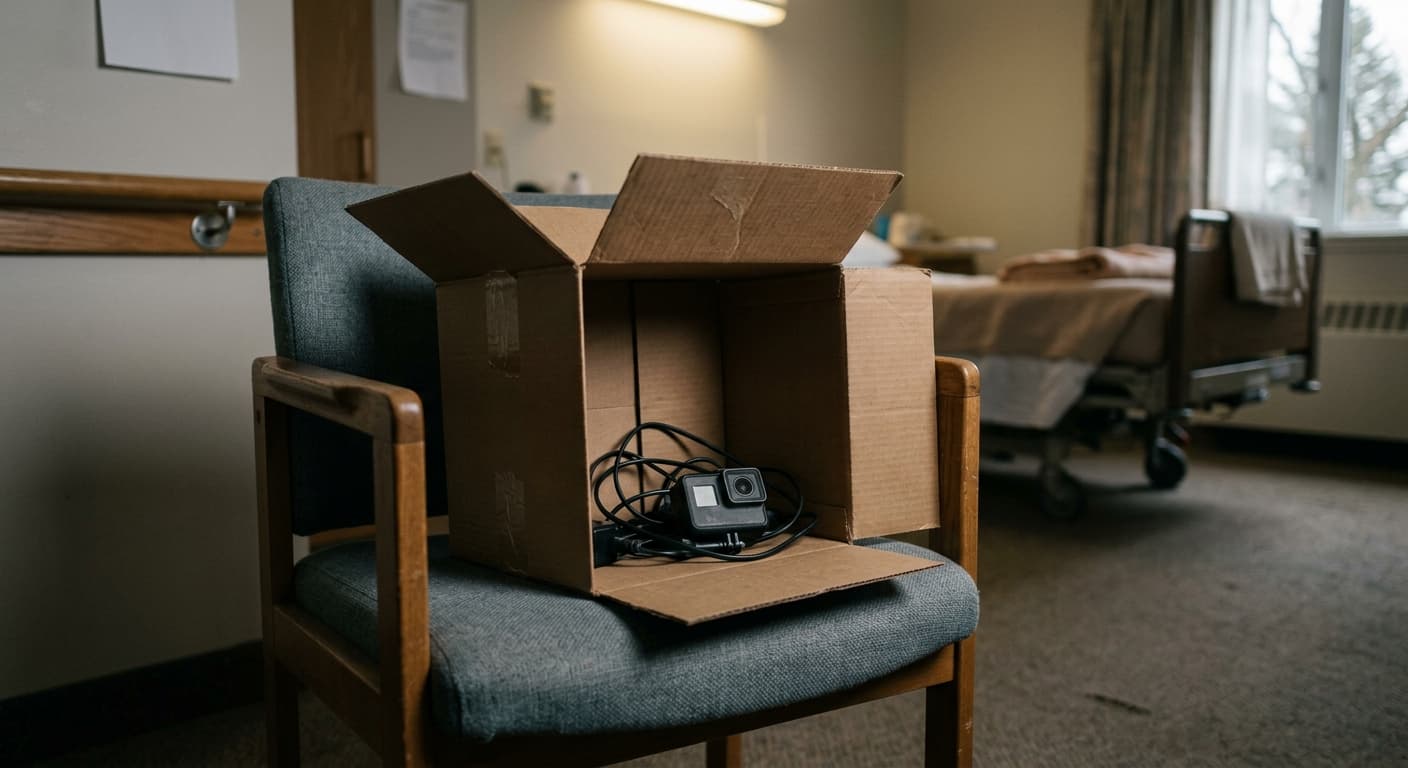
Oregon adopted a new rule on August 10, 2026 that requires a signed consent form before an electronic monitoring device goes into a resident's room, but it applies only to residential care and assisted living facilities, including a facility carrying a memory care endorsement. A skilled nursing facility resident in Oregon has no equivalent rule at all. This article covers both tracks, the split consent law that governs recording in either setting, and where to turn if a facility interferes.
This page addresses Oregon specifically. For the 18 states with a broader enacted electronic-monitoring statute, see the nursing home camera laws hub and the state-by-state comparison.
Oregon's New Assisted Living Camera Consent Rule
Oregon Administrative Rule 411-054-0025(10), part of the rule governing residential care and assisted living facility administration, states: "If a resident or their designated representative chooses to have a camera or electronic monitoring device in the resident's room, the resident or their designated representative must complete an Electronic Monitoring Consent form. The form is maintained on the Department's website for facilities to use. Facilities may develop and use their own forms. The signed form must be maintained in the resident's records."
This is a temporary rule, in effect from August 10, 2026 through February 5, 2027. It exists because the Legislature ordered it. Senate Bill 1532, enacted in the 2026 regular session as chapter 28, Oregon Laws 2026, provides in section 2 that "the Department of Human Services shall adopt by rule a model consent form for the use of a video camera or other electronic monitoring device in a resident's room at a residential care facility." The act carried an emergency clause and took effect on its passage, and OAR 411-054-0025(10) is the Department's implementation of that directive. Because temporary rules have a fixed expiration, a reader relying on this rule after early 2027 should confirm whether it has been renewed, replaced by a permanent rule, or allowed to lapse.
The rule sits in OAR chapter 411, division 54, which governs residential care and assisted living facilities. Section 2 of the 2026 act defines the covered class as a "residential care facility as defined in ORS 443.400, including an assisted living facility and a facility with a memory care endorsement under ORS 443.886," so a memory care unit carrying that endorsement is inside the requirement. The rule does not describe a roommate-consent process, a notice-posting requirement, or a tampering penalty the way most of the 18 states with a full statutory electronic-monitoring right do; its operative requirement is the signed consent form itself.
Skilled Nursing Facilities: No Rule at All
Oregon's skilled nursing rules, OAR chapter 411, division 86, were reviewed in full and contain no provision on cameras or electronic monitoring anywhere in the division. A resident in a standard nursing facility, as opposed to residential care or assisted living, has no state rule addressing a camera in their room either way. Oregon's underlying resident-rights statutes, Or. Rev. Stat. Sections 441.610 and 441.612, delegate the substance of resident rights to Department of Human Services rulemaking rather than enumerating them directly, which is why the real content lives in the OAR rules rather than in the statute itself.
The reason the new consent-form requirement did not extend to skilled nursing is narrower than that delegation structure, though. The 2026 directive in Senate Bill 1532 was written only for a "residential care facility as defined in ORS 443.400, including an assisted living facility and a facility with a memory care endorsement under ORS 443.886." A skilled nursing facility falls outside that definition, so the Department was never instructed to write a matching rule for division 86.

For a skilled nursing resident, the facility's own admission agreement and internal policy is what actually controls whether a camera is allowed, the same as in a state with no rule at all. Federal nursing home rules under 42 CFR 483.10 protect resident privacy and dignity broadly but say nothing about cameras, so no federal rule fills that gap either.
Oregon's Recording Law: A Split Consent Regime
Whether a resident is in assisted living or skilled nursing, Oregon's general recording-consent law governs the audio side of a camera. Phone and other electronic communications follow one-party consent under Or. Rev. Stat. Section 165.540(1)(a): a participant's own consent is enough. But an in-person, face-to-face conversation requires every participant to be "specifically informed" before it is recorded, a materially stricter rule than the phone-call baseline. A nursing home or assisted living room is an in-person space, so that stricter standard governs audio captured there, regardless of which facility type the resident is in. Video-only recording, with no audio, falls outside this statute entirely. See our Oregon recording laws guide for the full framework.
The Practical Risk of a Hidden or Undisclosed Camera
In assisted living, the new consent-form requirement makes disclosure the expected process rather than an optional precaution; installing a device without completing the form departs from the facility's own compliance obligation under the rule, even though the rule itself does not spell out a penalty for skipping it. In skilled nursing, where no equivalent rule exists, the same practical calculus as a no-statute state applies: an openly disclosed camera, with the facility and any roommate aware of it, is the more defensible path. Either way, an audio-capable device that captures a roommate's or staff member's conversation without their knowledge risks Oregon's all-party in-person consent rule independent of the camera question.

Using Camera Footage as Evidence of Abuse or Neglect
Footage that appears to show abuse or neglect can support a report to Adult Protective Services or the ombudsman, and it can support a civil claim, though it is typically reviewed alongside medical and staffing records rather than on its own. For a broader look at how a nursing home abuse or neglect claim works, see Nursing Home Abuse & Neglect.
Harmed by a product or exposure? Speak with an attorney about your options
If you or a loved one may have been harmed, you can speak with an attorney about your legal options at no cost. Whether you have a claim depends on the specific facts. This is attorney advertising, not a guarantee that you qualify or of any particular outcome.
Where to Turn: Oregon's Long-Term Care Ombudsman
The Oregon Office of the Long-Term Care Ombudsman investigates complaints affecting the health, safety, welfare, and rights of residents in both skilled nursing and assisted living, under authority tracing to the federal Older Americans Act. A camera dispute, a facility's refusal to use the consent form, or a suspected retaliation concern are all within its scope.

Information last verified on 2026-08-31, drawn from OAR 411-054-0025(10) as currently posted (temporary rule, effective 08/10/2026 through 02/05/2027), OAR 411-086, the enrolled text of Senate Bill 1532 (2026 Regular Session), chapter 28, Oregon Laws 2026, and Or. Rev. Stat. Sections 441.610, 441.612, and 165.540. This article has not yet been reviewed by a licensed lawyer and is general legal information, not legal advice for your specific situation. Because the assisted living rule is temporary, verify its current status before relying on it after February 5, 2027.
Related Resources
- Nursing Home Camera Laws by State covers every state's regime, including the 18 states with an enacted statute.
- Nursing Home Camera Laws: State-by-State Comparison breaks down the 18 states with a full statutory right.
- Oregon Recording Laws covers Oregon's split consent framework in full.
- Nursing Home Abuse & Neglect covers how an abuse or neglect claim works once evidence, including camera footage, is in hand.
- US Recording Laws by State covers the general consent framework nationwide.
Last updated: 2026-08-31.
Frequently Asked Questions
Is it legal to put a camera in an Oregon nursing home room?
It depends on the facility type. Assisted living and residential care facilities are covered by a temporary rule requiring a signed consent form. Skilled nursing facilities have no equivalent rule, so the facility's own policy controls there.
What is Oregon's Electronic Monitoring Consent form rule?
OAR 411-054-0025(10) requires a resident or their designated representative to complete a consent form before a camera or electronic monitoring device goes into the resident's room in a residential care or assisted living facility, including one with a memory care endorsement. It is a temporary rule effective August 10, 2026 through February 5, 2027.
What law required Oregon to create the consent form?
Senate Bill 1532, chapter 28, Oregon Laws 2026, directs in section 2 that the Department of Human Services adopt by rule a model consent form for the use of a video camera or other electronic monitoring device in a resident's room at a residential care facility. OAR 411-054-0025(10) is how the Department carried that out.
Does Oregon's camera consent rule apply to skilled nursing facilities?
No. The 2026 act defined its reach as a residential care facility under ORS 443.400, including assisted living and memory-care-endorsed facilities, and a skilled nursing facility falls outside that definition. A full-text review of Oregon's skilled nursing rules found no equivalent camera or monitoring provision.
Will Oregon's assisted living camera rule still be in effect later?
It is a temporary rule set to expire February 5, 2027. Confirm whether it has been renewed or replaced by a permanent rule before relying on it after that date.
Do I need everyone's consent to record audio in an Oregon nursing home?
Yes, for in-person conversation. Oregon requires every participant to be specifically informed before a face-to-face conversation is recorded, a stricter rule than the one-party consent standard that applies to phone calls.
What can I do if an Oregon facility refuses to use the consent form or allow a camera?
Contact the Oregon Office of the Long-Term Care Ombudsman, which investigates complaints affecting resident rights at both skilled nursing and assisted living facilities and covers monitoring disputes.
Updates
Corrected the origin of Oregon’s assisted living camera consent rule: it implements Senate Bill 1532 (chapter 28, Oregon Laws 2026), whose own definition of a residential care facility, including memory-care-endorsed facilities, is also why the requirement does not reach skilled nursing.
Independently fact-checked against the cited primary sources
The Law Behind This Article
This article rests on the statutory provisions below, held in our own legal record and retrieved from the official source. Tap a section to read the operative text.
Oregon Revised Statutes, Chapter 441: Health Care Facilities
§ 441.610Nursing home patients’ bill of rights; rulesIn force
(1) The Department of Human Services shall adopt a nursing home patients’ bill of rights consistent with the principles set forth in ORS 441.605. The rules shall be applicable to all residents and as far as practicable shall conform to any federal nursing home patients’ bill of rights. (2) The department shall periodically review the rules to assure that they meet the principles set forth in ORS 441.605 and that they are in conformity with federal standards but in no case shall the rules be less protective than required by ORS 441.605. (3) The department shall be guided by federal interpretative standards in its enforcement of the nursing home patients’ bill of rights.
Official text (excerpt) · last checked 2026-07-29 · Read the full text in our law library · Verify at oregonlegislature.gov
Oregon Revised Statutes, Chapter 165: Offenses Involving Fraud or Deception
§ 165.540Obtaining contents of communicationsIn forcecited in 19 of our articles
(1) Except as otherwise provided in ORS 133.724 or 133.726 or subsections (2) to (8) of this section, a person may not: (a) Obtain or attempt to obtain the whole or any part of a telecommunication or a radio communication to which the person is not a participant, by means of any device, contrivance, machine or apparatus, whether electrical, mechanical, manual or otherwise, unless consent is given by at least one participant. (b) Tamper with the wires, connections, boxes, fuses, circuits, lines or any other equipment or facilities of a telecommunication or radio communication company over which messages are transmitted, with the intent to obtain unlawfully the contents of a telecommunication or radio communication to which the person is not a participant. (c) Obtain or attempt to obtain the whole or any part of a conversation by means of any device, contrivance, machine or apparatus, whether electrical, mechanical, manual or otherwise, if not all participants in the conversation are specifically informed that their conversation is being obtained.
Official text (excerpt) · last checked 2026-08-31 · Read the full text in our law library · Verify at oregonlegislature.gov
Cited in 76 court opinions in our collectionLatest citing opinion in our collection: 2026
In the courts (editorial summary, independently checked):State v. Fleetwood (2000) applied ORS 165.540 to body wire evidence, holding that words spoken into a telephone are a telecommunication under subsection (1)(a) and that the (5)(a)(B) exception fails unless the officer or the officer's agent shares reciprocally in the conversation, so the recordings were inadmissible.
Opinions citing this section in our collection:
- State v. Klein (Oregon Supreme Court 2012, 352 Or. 302)“…eing 3 recorded. Conversations recorded in violation of ORS 165.540 are not admissible in 4 court excep…”
- North Pacific Lumber Co. v. Oliver (Oregon Supreme Court 1979, 286 Or. 639)✓A lumber wholesaler secretly monitored traders' calls; on de novo review the court said the practice may have violated ORS 165.540 but refused to rest unclean hands on it, since the ex-employee's calls were never monitored. The employer's noncompete suit failed on other grounds.
- State v. Fleetwood (Oregon Supreme Court 2000, 331 Or. 511)✓A detective wired an informant and recorded the suspect's side of a phone call and his talks with his mother and a juvenile seller; the court held those interceptions violated ORS 165.540(1)(a) and (1)(c) because the informant was not a participant, and upheld suppression.
Identified automatically from the court opinions citing this section — not a ranking of which case controls.
Also relied on in: Oregon Recording Laws (2026): Hybrid One-Party and All-Party Rules, Oregon Voyeurism and Hidden Camera Laws: Offenses, Penalties, and Protections, Oregon Audio Recording Laws: Split Consent Rules for Conversations and Calls
Code of Federal Regulations Title 42
§ 483.10Resident rights.In forcecited in 19 of our articles
(a) Residents rights. The resident has a right to a dignified existence, self-determination, and communication with and access to persons and services inside and outside the facility, including those specified in this section. (1) A facility must treat each resident with respect and dignity and care for each resident in a manner and in an environment that promotes maintenance or enhancement of his or her quality of life, recognizing each resident's individuality. The facility must protect and promote the rights of the resident. (2) The facility must provide equal access to quality care regardless of diagnosis, severity of condition, or payment source. A facility must establish and maintain identical policies and practices regarding transfer, discharge, and the provision of services under the State plan for all residents regardless of payment source. (b) Exercise of rights. The resident has the right to exercise his or her rights as a resident of the facility and as a citizen or resident of the United States.
Official text (excerpt) · last checked 2026-07-28 · Read the full text in our law library · Verify at ecfr.gov
Cited in 85 court opinions in our collectionLatest citing opinion in our collection: 2026
In the courts (editorial summary, independently checked):Courts reviewing CMS penalties have applied the notice duty then codified at section 483.10(b)(11). Claiborne-Hughes Health Center v. Sebelius (2010) upheld noncompliance where a facility did not promptly consult the physician or notify family after a resident's decline; Senior Rehabilitation (2010) sustained a similar finding.
Opinions citing this section in our collection:
- Roudachevski v. All-American Care Centers, Inc. (Court of Appeals for the Eighth Circuit 2011, 648 F.3d 701)✓A doctor cut off from his nursing home patients sought an injunction, arguing residents' right under Section 483.10(d)(1) to choose a physician made the public interest favor him; the Eighth Circuit affirmed the denial, finding that interest not presently ascertainable.
- CLAIBORNE-HUGHES HEALTH CENTER v. Sebelius (Court of Appeals for the Sixth Circuit 2010, 609 F.3d 839)✓A resident's food intake fell sharply for three weeks and he lost 18.5 pounds before the nursing home called his doctor or family; the Sixth Circuit upheld findings that it violated Section 483.10(b)(11)'s immediate-notification duty and that the lapse was immediate jeopardy.
- Gray Panthers Advocacy Committee v. Louis W. Sullivan, M.D., Secretary, Department of Health and Human Services (Court of Appeals for the D.C. Circuit 1991, 936 F.2d 1284)“…how to apply for and use Medicare and Medicaid benefits.” 42 C.F.R. § 483.10 (b)(9) (1990). On the topic of property…”
Identified automatically from the court opinions citing this section — not a ranking of which case controls.
Also relied on in: Alabama Nursing Home Camera Laws: No Statute, What Applies, Colorado Nursing Home Camera Laws: No Statute, What Applies, Massachusetts Nursing Home Camera Laws: All-Party Consent Risks
Search our full record of US law — 2.1 million sections, every state + federal →
Sources and References
- Or. Admin. R. 411-054-0025(10), Electronic Monitoring Consent Model Form (Temporary rule, effective 08/10/2026 through 02/05/2027)(oregon.gov).gov
- Or. Admin. R. 411-086, Nursing Facilities: Licensing, Administration and Services(oregon.gov).gov
- Or. Rev. Stat. § 441.610, Nursing Home Patients' Bill of Rights(oregonlegislature.gov).gov
- Or. Rev. Stat. § 165.540, Obtaining Contents of Communications(oregonlegislature.gov).gov
- 42 CFR § 483.10, Resident Rights(law.cornell.edu)
- Oregon Office of the Long-Term Care Ombudsman(oregon.gov).gov
- Enrolled Senate Bill 1532, 83rd Oregon Legislative Assembly (2026 Regular Session), section 2 (DHS model consent form for a video camera or electronic monitoring device in a resident’s room)(olis.oregonlegislature.gov)
- SB 1532 (2026 Regular Session) measure overview, chapter 28, Oregon Laws 2026(olis.oregonlegislature.gov)