
California
California Knife Laws (2026): Four Blade-Length Rules
Independently fact-checked against primary sources (last audited September 18, 2026). · 7 primary sources cited on this page. How we verify our legal content

California knife law is not one contested number, it is four different statutes setting four different thresholds for four different contexts, plus the state's single most common knife offense, which uses no numeric threshold at all. Carrying a switchblade with a blade of 2 or more inches is a misdemeanor under Penal Code § 21510. Bringing a knife with a blade longer than 2.5 inches onto K-12 school grounds is a separate offense under § 626.10, which also separately bans any locking folding knife on those grounds regardless of its blade length. Carrying a knife with a fixed, or fixable, blade over 4 inches into a state or local public building or a secured airport area is a separate offense again, under §§ 171b and 171.5. And California's actual workhorse knife offense, carrying a concealed dirk or dagger under § 21310, has no blade-length number in it whatsoever: it turns on whether the blade is exposed and locked into position, not on how long it is.
Jurisdiction scope: This page covers California state law only, principally Penal Code §§ 16470, 16590, 21310, 21510, 171b, 171.5, and 626.10. It does not cover city or county knife ordinances, which California does not preempt, or the state's separate assault-with-a-deadly-weapon statutes, which apply to a knife used as a weapon regardless of how it was carried.
The dirk/dagger trap: California's most common knife offense has no length threshold
Penal Code § 21310 makes it a crime to carry concealed upon the person "any dirk or dagger," punishable by up to one year in county jail or a felony-range sentence under Penal Code § 1170(h). Unlike the switchblade, school-grounds, and public-building rules below, this offense sets no blade-length number at all.
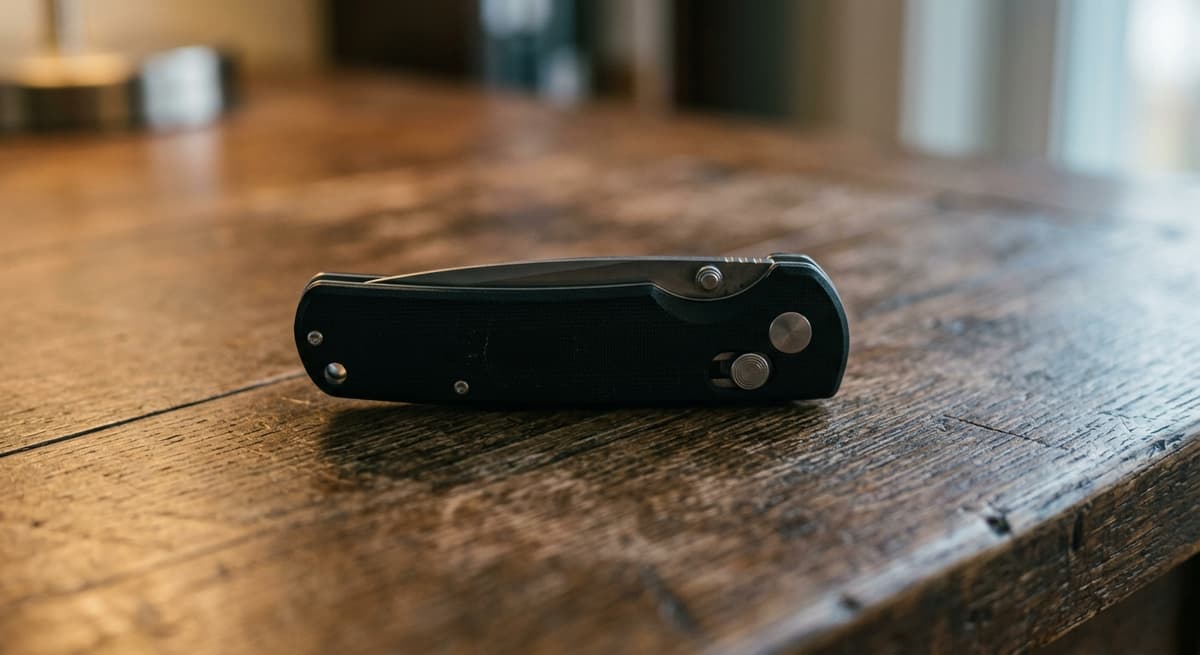
What makes something a "dirk" or "dagger" is defined in Penal Code § 16470, and the definition's limiting clause is the part most often left out of secondhand summaries:
"Dirk" or "dagger" means a knife or other instrument with or without a handguard that is capable of ready use as a stabbing weapon that may inflict great bodily injury or death. A nonlocking folding knife, a folding knife that is not prohibited by Section 21510, or a pocketknife is capable of ready use as a stabbing weapon that may inflict great bodily injury or death only if the blade of the knife is exposed and locked into position.
That second sentence is the whole trap. An ordinary folding pocketknife, closed or unlocked, is not a "dirk or dagger" no matter how sharp or long its blade is. It only becomes one for purposes of this statute if the blade is both exposed and locked into place. A fixed-blade knife has no such carve-out; it is judged only against the general "capable of ready use as a stabbing weapon" standard.
Switchblades: the 2-inch rule
Penal Code § 21510 is the one California knife statute with a genuinely simple numeric rule. It is a misdemeanor to possess a switchblade with a blade 2 or more inches long in the passenger or driver area of a vehicle in a public place, to carry one on the person, or to sell, offer for sale, expose for sale, loan, transfer, or give one to another person. A switchblade under 2 inches is not covered by this section.
School and college grounds: 2.5 inches
Penal Code § 626.10 sets a separate 2.5-inch threshold, and it applies differently depending on the campus. On the grounds of a K-12 public or private school, subsection (a) bars bringing or possessing "any dirk, dagger, ice pick, knife having a blade longer than 2½ inches, folding knife with a blade that locks into place, razor with an unguarded blade," a taser or stun gun, an air-pressure projectile device, or a spot marker gun, punishable by up to a year in county jail or a felony-range § 1170(h) sentence. A separate razor-blade or box-cutter clause under subsection (a)(2) carries the same jail exposure without the felony-range option.
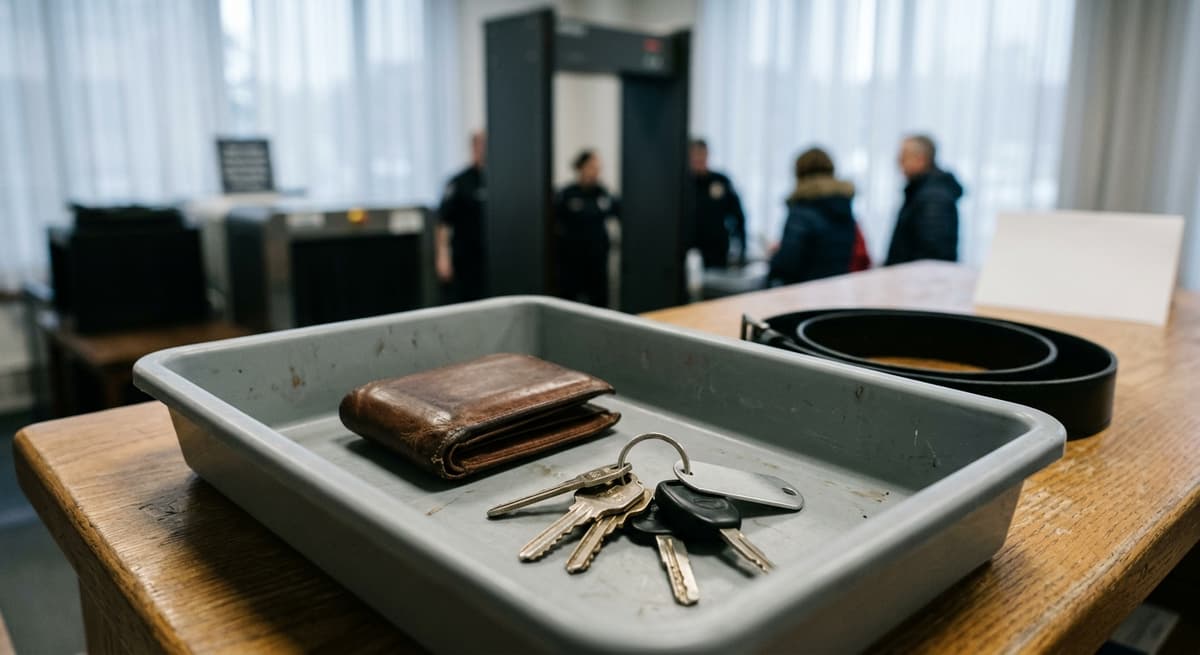
At a private university, the University of California, the California State University, or a California Community College, subsection (b) narrows the list to "any dirk, dagger, ice pick, or knife having a fixed blade longer than 2½ inches," a materially different rule than the K-12 version, which also reaches a locking folding knife. Both subsections carry exceptions for a person acting at a faculty member's or school employee's direction, for use in a school-sponsored activity or class, and, on college and university grounds only, for lawful use in or around on-campus housing or for food preparation or consumption.
Public buildings, meetings, and airports: 4 inches
A third, higher threshold governs a different set of places. Penal Code § 171b bars bringing or possessing, within a state or local public building or at a meeting required to be open to the public, "any knife with a blade length in excess of four inches, the blade of which is fixed or is capable of being fixed in an unguarded position by the use of one or two hands," alongside firearms, tasers, and several other listed weapons. A violation is punishable by up to a year in county jail or state prison. Exceptions apply to court evidence, on-duty peace officers, license holders in specific judicial roles, building residents, and licensed security personnel with the building's written permission.
Penal Code § 171.5 sets the same 4-inch fixed-or-fixable-blade threshold for airport sterile areas and passenger vessel terminals, alongside box cutters, straight razors, metal military practice or replica hand grenades, and other listed items. A violation of § 171.5 is a lower-level misdemeanor, punishable by up to six months in county jail, a fine of up to $1,000, or both.
Other knives banned outright: the "generally prohibited weapons" list
Separately from all four blade-length rules above, Penal Code § 16590 lists a set of "generally prohibited weapons" that California bans by category, regardless of where they are carried or how long the blade is. The knife-relevant entries are a ballistic knife (banned by § 21110), a cane sword (§ 20510), a belt buckle knife (§ 20410), a lipstick case knife (§ 20610), an air gauge knife (§ 20310), a writing pen knife, a device that looks like a pen but conceals a stabbing shaft (§ 20910), and a shobi-zue, a cane-style weapon (§ 20710). Manufacturing, importing, selling, or possessing any of these is a separate offense from the carry rules above.
Does California preempt local knife ordinances?
The Penal Code's weapons provisions (Part 6, Title 3) contain no section preempting local knife regulation. This stands in contrast to states like Arizona and Texas, which have express statewide knife preemption statutes voiding stricter local ordinances. Because California does not preempt the field, a city or county may adopt its own, stricter knife ordinance; this page does not attempt to catalog municipal codes, so readers in a specific California city or county should check that jurisdiction's own municipal code before assuming the state rules above are the only ones that apply.
Federal law: what it does and does not reach
Federal law does not generally ban an individual from owning or carrying a switchblade. The Federal Switchblade Act, 15 U.S.C. §§ 1241 to 1245, mainly regulates interstate commerce in switchblade knives, barring their manufacture, sale, transport, or introduction into interstate commerce. The exception is 15 U.S.C. § 1243, which makes it a federal crime to manufacture, sell, or possess any switchblade knife within a U.S. territory or possession, within Indian country, or within the special maritime and territorial jurisdiction of the United States, punishable by a fine of up to $2,000, up to five years in prison, or both. In addition, 15 U.S.C. § 1245 makes it a federal offense to knowingly possess, manufacture, sell, or import a ballistic knife in or affecting interstate commerce or within federal territorial jurisdiction, a category California independently bans as well under § 16590. Sections 1242 and 1243, the two federal switchblade offenses, do not apply to certain knives and people under 15 U.S.C. § 1244. A 2009 amendment, § 1244(5), exempts from those prohibitions any knife with a spring, detent, or other closure-bias mechanism that requires hand, wrist, or arm exertion on the blade itself to overcome the bias and assist opening, which is what keeps modern assisted-opening folding knives legal in interstate commerce. A separate exemption, § 1244(4), covers a person with only one arm possessing or carrying a switchblade with a blade three inches or less. Outside the federal areas § 1243 covers, none of this changes what California allows for ordinary carry; state law governs that question within California.
Disclaimer: This article provides general legal information about California's knife laws as of September 2026. It is not legal advice. Consult a lawyer licensed in California for advice about a specific situation. Because California is not a knife-preemption state, a local ordinance may impose a stricter rule than the statewide thresholds described here.
For a state-by-state comparison, see knife laws by state. California's self-defense statutes are covered separately on the California self-defense laws page.
Statutes cited reflect their in-force version as of 2026-09-18. Last updated: 2026-09-18.
Frequently Asked Questions
What is the legal blade length for a knife in California?
There is no single answer, because California sets different thresholds for different contexts: 2 inches for switchblade carry, 2.5 inches on K-12 school grounds (which also separately bars a locking folding knife of any blade length, or a fixed blade over 2.5 inches on college and university grounds), and over 4 inches in public buildings or airport sterile areas. The state's most commonly charged offense, concealed dirk or dagger carry, uses no length number at all, only a functional exposed-and-locked test for folding knives.
Is it illegal to carry a pocket knife in California?
An ordinary closed or nonlocking pocket knife is not a dirk or dagger under Penal Code section 16470, so carrying one concealed is not, by itself, the concealed dirk/dagger offense. A folding knife only becomes a dirk or dagger for that offense if its blade is exposed and locked into position.
Are switchblades illegal in California?
A switchblade with a blade 2 or more inches long may not be carried on the person, possessed in a vehicle's passenger area in public, or sold or transferred, under Penal Code section 21510. This is a misdemeanor.
Does California have knife preemption like some other states?
No. The Penal Code's weapons provisions contain no section preempting local knife regulation, so a city or county could adopt a rule stricter than the statewide thresholds described here. Check local ordinances for a specific jurisdiction.
Updates
Corrected the federal switchblade section to note that 15 U.S.C. 1243 bars switchblade possession in U.S. territories, Indian country, and federal enclaves, and corrected the list of items and the penalty under Penal Code 171.5.
Independently fact-checked against the cited primary sources
The Law Behind This Article
This article rests on the statutory provisions below, held in our own legal record and retrieved from the official source. Tap a section to read the operative text.
California Penal Code
§ 21310In force
Except as provided in Chapter 1 (commencing with Section 17700) of Division 2 of Title 2, any person in this state who carries concealed upon the person any dirk or dagger is punishable by imprisonment in a county jail not exceeding one year or imprisonment pursuant to subdivision (h) of Section 1170.
Official text (excerpt) · last checked 2026-09-23 · Read the full text in our law library · Verify at leginfo.legislature.ca.gov
§ 16470In force
As used in this part, “dirk” or “dagger” means a knife or other instrument with or without a handguard that is capable of ready use as a stabbing weapon that may inflict great bodily injury or death. A nonlocking folding knife, a folding knife that is not prohibited by Section 21510, or a pocketknife is capable of ready use as a stabbing weapon that may inflict great bodily injury or death only if the blade of the knife is exposed and locked into position.
Official text (excerpt) · last checked 2026-07-28 · Read the full text in our law library · Verify at leginfo.legislature.ca.gov
Cited in 8 court opinions in our collectionLatest citing opinion in our collection: 2024
Opinions citing this section in our collection:
- People v. Castillolopez (California Supreme Court 2016, 63 Cal. 4th 322)“…ed dirk or dagger in violation of Penal Code section 21310. Penal Code section 16470 defines a ― ‗dirk‘ or ‗dagger‘ ‖ as ―a…”
- People v. Hester (California Court of Appeal 2020)“…as a matter of law, a dirk or dagger, citing to language in Penal Code section 16470. He says both box cutters were closed a…”
- People v. Bermudez (California Court of Appeal 2020)“…appeal, defendant contends (1) the statute defining a dirk (Pen. Code, § 16470)1 is unconstitutionally vague; (2) the…”
Identified automatically from the court opinions citing this section — not a ranking of which case controls.
§ 21510In force
Every person who does any of the following with a switchblade knife having a blade two or more inches in length is guilty of a misdemeanor: (a) Possesses the knife in the passenger’s or driver’s area of any motor vehicle in any public place or place open to the public. (b) Carries the knife upon the person. (c) Sells, offers for sale, exposes for sale, loans, transfers, or gives the knife to any other person.
Official text (excerpt) · last checked 2026-07-28 · Read the full text in our law library · Verify at leginfo.legislature.ca.gov
Cited in 7 court opinions in our collectionLatest citing opinion in our collection: 2026
Opinions citing this section in our collection:
- People v. Castillolopez (California Supreme Court 2016, 63 Cal. 4th 322)“…rrying concealed on his person a pocketknife with 2 Penal Code section 21510 prohibits the possession, carrying, sal…”
- People v. Caldwell CA3 (California Court of Appeal 2014)“…th a blade two inches or more in length is now set forth in Penal Code section 21510 (with definitions in Penal Code section…”
- In re J.E. CA4/2 (California Court of Appeal 2014)“…1 carrying a switchblade knife (Pen. Code, § 21510, count 1),1 possession of tools to com…”
Identified automatically from the court opinions citing this section — not a ranking of which case controls.
§ 626.10In forcecited in 2 of our articles
(a) (1) Any person, except a duly appointed peace officer as defined in Chapter 4.5 (commencing with Section 830) of Title 3 of Part 2, a full-time paid peace officer of another state or the federal government who is carrying out official duties while in this state, a person summoned by any officer to assist in making arrests or preserving the peace while the person is actually engaged in assisting any officer, or a member of the military forces of this state or the United States who is engaged in the performance of his or her duties, who brings or possesses any dirk, dagger, ice pick, knife having a blade longer than 21/2 inches, folding knife with a blade that locks into place, razor with an unguarded blade, taser, or stun gun, as defined in subdivision (a) of Section 244.5, any instrument that expels a metallic projectile, such as a BB or a pellet, through the force of air pressure, CO2 pressure, or spring action, or any spot marker gun, upon the grounds of, or within, any public or private school providing instruction in kindergarten or any of grades 1 to 12, inclusive, is guilty of a public offense, punishable by imprisonment in a county jail not exceeding one year, or by…
Official text (excerpt) · last checked 2026-07-28 · Read the full text in our law library · Verify at leginfo.legislature.ca.gov
Cited in 100 court opinions in our collectionLatest citing opinion in our collection: 2026
Opinions citing this section in our collection:
- People v. Do Kyung K. (California Court of Appeal 2001, 106 Cal. Rptr. 2d 31)“…with an unguarded blade” on school grounds in violation of Penal Code section 626.10, subdivision (a). The court issued an o…”
- People v. Mark C. (In re Mark C.) (California Court of Appeal, 1st District 2016, 197 Cal. Rptr. 3d 865)“…two and one-half inches on school grounds, in violation of Penal Code section 626.10. Mark requested informal supervision…”
- People v. Arturo H. (California Court of Appeal 1996, 42 Cal. App. 4th 1694)“…ve possessed a pellet gun on school grounds in violation of Penal Code section 626.10, subdivision (a). The principal issue p…”
Identified automatically from the court opinions citing this section — not a ranking of which case controls.
Also relied on in: California Pepper Spray and Stun Gun Laws (2026)
§ 171bIn forcecited in 2 of our articles
(a) Any person who brings or possesses within any state or local public building or at any meeting required to be open to the public pursuant to Chapter 9 (commencing with Section 54950) of Part 1 of Division 2 of Title 5 of, or Article 9 (commencing with Section 11120) of Chapter 1 of Part 1 of Division 3 of Title 2 of, the Government Code, any of the following is guilty of a public offense punishable by imprisonment in a county jail for not more than one year, or in the state prison: (1) Any firearm. (2) Any deadly weapon described in Section 17235 or in any provision listed in Section 16590. (3) Any knife with a blade length in excess of four inches, the blade of which is fixed or is capable of being fixed in an unguarded position by the use of one or two hands. (4) Any unauthorized tear gas weapon. (5) Any taser or stun gun as defined in Section 244.5. (6) Any instrument that expels a metallic projectile, such as a BB or pellet, through the force of air pressure, CO2 pressure, or spring action, or any spot marker gun or paint gun.
Official text (excerpt) · last checked 2026-07-28 · Read the full text in our law library · Verify at leginfo.legislature.ca.gov
Cited in 10 court opinions in our collectionLatest citing opinion in our collection: 2021
Opinions citing this section in our collection:
- City of Riverside v. Inland Empire Patients Health & Wellness Center, Inc. (California Supreme Court 2013, 56 Cal. 4th 729)“…tr.2d 761 , 44 P.3d 133 ] (Nordyke), a state statute, Penal Code section 171b, made it a crime to possess firearms in…”
- Nordyke v. King (California Supreme Court 2002, 27 Cal. 4th 875)“…id not include any “ local public building’ ” as defined in Penal Code section 171b, subdivision (c). (Alameda County Gen.…”
- Untitled California Attorney General Opinion (California Attorney General Reports 1989)“…or in a vehicle in a public place? 2. Does Penal Code section 171b prohibit such officers from carrying a…”
Identified automatically from the court opinions citing this section — not a ranking of which case controls.
§ 171.5In forcecited in 2 of our articles
(a) For purposes of this section: (1) “Airport” means an airport, with a secured area, that regularly serves an air carrier holding a certificate issued by the United States Secretary of Transportation. (2) “Passenger vessel terminal” means only that portion of a harbor or port facility, as described in Section 105.105(a)(2) of Title 33 of the Code of Federal Regulations, with a secured area that regularly serves scheduled commuter or passenger operations. (3) “Sterile area” means a portion of an airport defined in the airport security program to which access generally is controlled through the screening of persons and property, as specified in Section 1540.5 of Title 49 of the Code of Federal Regulations, or a portion of any passenger vessel terminal to which, pursuant to the requirements set forth in Sections 105.255 and 105.260(a) of Title 33 of the Code of Federal Regulations, access is generally controlled in a manner consistent with the passenger vessel terminal’s security plan and the maritime security level in effect at the time.
Official text (excerpt) · last checked 2026-07-28 · Read the full text in our law library · Verify at leginfo.legislature.ca.gov
§ 16590In forcecited in 2 of our articles
As used in this part, “generally prohibited weapon” means any of the following: (a) An air gauge knife, as prohibited by Section 20310. (b) Ammunition that contains or consists of a flechette dart, as prohibited by Section 30210. (c) A ballistic knife, as prohibited by Section 21110. (d) A belt buckle knife, as prohibited by Section 20410. (e) A bullet containing or carrying an explosive agent, as prohibited by Section 30210. (f) A camouflaging firearm container, as prohibited by Section 24310. (g) A cane gun, as prohibited by Section 24410. (h) A cane sword, as prohibited by Section 20510. (i) A concealed dirk or dagger, as prohibited by Section 21310. (j) A concealed explosive substance, other than fixed ammunition, as prohibited by Section 19100. (k) A firearm that is not immediately recognizable as a firearm, as prohibited by Section 24510. (l) A large-capacity magazine, as prohibited by Section 32310. (m) A leaded cane or an instrument or weapon of the kind commonly known as a billy, blackjack, sandbag, sandclub, sap, or slungshot, as prohibited by Section 22210. (n) A lipstick case knife, as prohibited by Section 20610.
Official text (excerpt) · last checked 2026-07-28 · Read the full text in our law library · Verify at leginfo.legislature.ca.gov
Cited in 3 court opinions in our collectionLatest citing opinion in our collection: 2019
Opinions citing this section in our collection:
- In re I.G. CA6 (California Court of Appeal 2015)“…in which the minor personally used a weapon as described in Penal Code section 16590. Penal Code section 16590 lists 26 spec…”
- Juan Hernandez-Gonzalez v. Eric Holder, Jr. (Court of Appeals for the Ninth Circuit 2015, 778 F.3d 793)“…l weapons is listed under a separate statutory section. See Cal. Penal Code § 16590. To convict a person of this crime, “th…”
- Nicholas John Smit v. J. Lizarraga, Warden (District Court, C.D. California 2019)“…3 See Cal. Penal Code §§ 16590(z), 17360, 33600, 33690. 27…”
Identified automatically from the court opinions citing this section — not a ranking of which case controls.
Also relied on in: Knife Laws by State (2026): Carry Rules, Blade Limits, Penalties
United States Code Title 15
§ 1241DefinitionsIn forcecited in 52 of our articles
As used in this chapter— The term “interstate commerce” means commerce between any State, Territory, possession of the United States, or the District of Columbia, and any place outside thereof. The term “switchblade knife” means any knife having a blade which opens automatically— by hand pressure applied to a button or other device in the handle of the knife, or by operation of inertia, gravity, or both.
Official text (excerpt) · last checked 2026-07-28 · Read the full text in our law library · Verify at uscode.house.gov
Cited in 15 court opinions in our collectionLatest citing opinion in our collection: 2014
Opinions citing this section in our collection:
- Stewart A. Taylor, D/B/A Taylor Cutlery Mfg. Co. v. United States of America (Court of Appeals for the Sixth Circuit 1988, 848 F.2d 715)“…Service, are not switchblade knives within the meaning of 15 U.S.C. § 1241 (b) and 19 C.F.R. § 1295 (a)(1). The d…”
- Crowley Cutlery Company v. United States of America and Commissioner of Customs of the United States Customs Service (Court of Appeals for the Seventh Circuit 1988, 849 F.2d 273)“…Illinois for a declaration that the Switchblade Knife Act, 15 U.S.C. §§ 1241 et seq., which forbids th…”
- Edna Fall, as Administratrix of the Estate of Phillip Fall, Deceased v. Esso Standard Oil Company (Court of Appeals for the Fifth Circuit 1962, 297 F.2d 411)“…25 S.Ct. 158 , 49 L.Ed. 363 . Section 1 of the Act, 15 U.S.C.A. § 1241 (b), defines the term “switchblade knif…”
Identified automatically from the court opinions citing this section — not a ranking of which case controls.
Also relied on in: Alabama Knife Laws (2026): What Is Legal to Carry, Alaska Knife Laws (2026): Concealed Carry Rules Explained, Arizona Knife Laws (2026): Carry Rules and Preemption
§ 1243Manufacture, sale, or possession within specific jurisdictions; penaltyIn forcecited in 3 of our articles
Whoever, within any Territory or possession of the United States, within Indian country (as defined in section 1151 of title 18), or within the special maritime and territorial jurisdiction of the United States (as defined in section 7 of title 18), manufactures, sells, or possesses any switchblade knife, shall be fined not more than $2,000 or imprisoned not more than five years, or both.
Official text (excerpt) · last checked 2026-07-28 · Read the full text in our law library · Verify at uscode.house.gov
Cited in 1 court opinions in our collectionLatest citing opinion in our collection: 1962
Opinions citing this section in our collection:
- Edna Fall, as Administratrix of the Estate of Phillip Fall, Deceased v. Esso Standard Oil Company (Court of Appeals for the Fifth Circuit 1962, 297 F.2d 411)“…t more than five years, or both.” 5 . 15 U.S.C.A. § 1243 provides: “Whoever, within any Territo…”
Identified automatically from the court opinions citing this section — not a ranking of which case controls.
Also relied on in: Missouri Knife Laws (2026): Restricted Areas and the Switchblade Trap
§ 1244ExceptionsIn forcecited in 52 of our articles
Sections 1242 and 1243 of this title shall not apply to— any common carrier or contract carrier, with respect to any switchblade knife shipped, transported, or delivered for shipment in interstate commerce in the ordinary course of business; the manufacture, sale, transportation, distribution, possession, or introduction into interstate commerce, of switchblade knives pursuant to contract with the Armed Forces; the Armed Forces or any member or employee thereof acting in the performance of his duty; the possession, and transportation upon his person, of any switchblade knife with a blade three inches or less in length by any individual who has only one arm; or a knife that contains a spring, detent, or other mechanism designed to create a bias toward closure of the blade and that requires exertion applied to the blade by hand, wrist, or arm to overcome the bias toward closure to assist in opening the knife.
Official text (excerpt) · last checked 2026-07-28 · Read the full text in our law library · Verify at uscode.house.gov
Also relied on in: Arkansas Knife Laws (2026): Intent-Based Carry Rules, Colorado Knife Laws (2026): Concealed Carry and Exceptions, Connecticut Knife Laws (2026): Open and Concealed Carry
§ 1245Ballistic knivesIn forcecited in 50 of our articles
Whoever in or affecting interstate commerce, within any Territory or possession of the United States, within Indian country (as defined in section 1151 of title 18), or within the special maritime and territorial jurisdiction of the United States (as defined in section 7 of title 18), knowingly possesses, manufactures, sells, or imports a ballistic knife shall be fined as provided in title 18, or imprisoned not more than ten years, or both. Whoever possesses or uses a ballistic knife in the commission of a Federal crime of violence shall be fined as provided in title 18, or imprisoned not less than five years and not more than ten years, or both. The exceptions provided in paragraphs (1), (2), and (3) of section 1244 of this title with respect to switchblade knives shall apply to ballistic knives under subsection (a) of this section. As used in this section, the term “ballistic knife” means a knife with a detachable blade that is propelled by a spring-operated mechanism.
Official text (excerpt) · last checked 2026-07-28 · Read the full text in our law library · Verify at uscode.house.gov
Cited in 2 court opinions in our collectionLatest citing opinion in our collection: 2008
Opinions citing this section in our collection:
- ALCANTAR (Board of Immigration Appeals 1994, 20 I. & N. Dec. 801)“…ed by an adult, would be felony and crime of violence); cf. 15 U.S.C. § 1245(b) (1988) (use of ballistic knife in co…”
- United States v. Polizzi (District Court, E.D. New York 2008, 549 F. Supp. 2d 308)“…8 Trust in l’estraint of import trade 3 months 15 U.S.C. § 1245 (b) Possession/use of a ballistic knife…”
Identified automatically from the court opinions citing this section — not a ranking of which case controls.
Also relied on in: Delaware Knife Laws (2026): Carry, Switchblades, and Bans, D.C. Knife Laws (2026): Possession and Carry Rules, Florida Knife Laws (2026): Carry, Pocketknives, Schools
Search our full record of US law — 2.1 million sections, every state + federal →
Sources and References
- Cal. Penal Code 16470 - dirk/dagger definition, exposed-and-locked functional test for folding knives(leginfo.legislature.ca.gov).gov
- Cal. Penal Code 21310 - carrying a concealed dirk or dagger(leginfo.legislature.ca.gov).gov
- Cal. Penal Code 21510 - switchblade knife, 2-inch blade threshold(leginfo.legislature.ca.gov).gov
- Cal. Penal Code 626.10 - school and college grounds knife restrictions, 2.5-inch thresholds(leginfo.legislature.ca.gov).gov
- Cal. Penal Code 171b - state and local public buildings, 4-inch fixed-blade threshold(leginfo.legislature.ca.gov).gov
- Cal. Penal Code 171.5 - airport sterile areas and passenger vessel terminals, 4-inch fixed-blade threshold(leginfo.legislature.ca.gov).gov
- Cal. Penal Code 16590 - generally prohibited weapons (ballistic knife, cane sword, belt buckle knife, lipstick case knife, air gauge knife, writing pen knife, shobi-zue)(leginfo.legislature.ca.gov).gov
- 15 U.S.C. 1241-1245 - Federal Switchblade Act, interstate commerce and importation scope(law.cornell.edu)
- 15 U.S.C. 1244 - exceptions, including the 2009 assisted-opening carve-out and the one-arm exception(law.cornell.edu)
- 15 U.S.C. 1243 - switchblade manufacture, sale, or possession in U.S. territories, Indian country, and federal maritime and territorial jurisdiction(law.cornell.edu)