
Delaware
Delaware Knife Laws (2026): Carry, Switchblades, and Bans
Independently fact-checked against primary sources (last audited September 18, 2026). · 10 primary sources cited on this page. How we verify our legal content
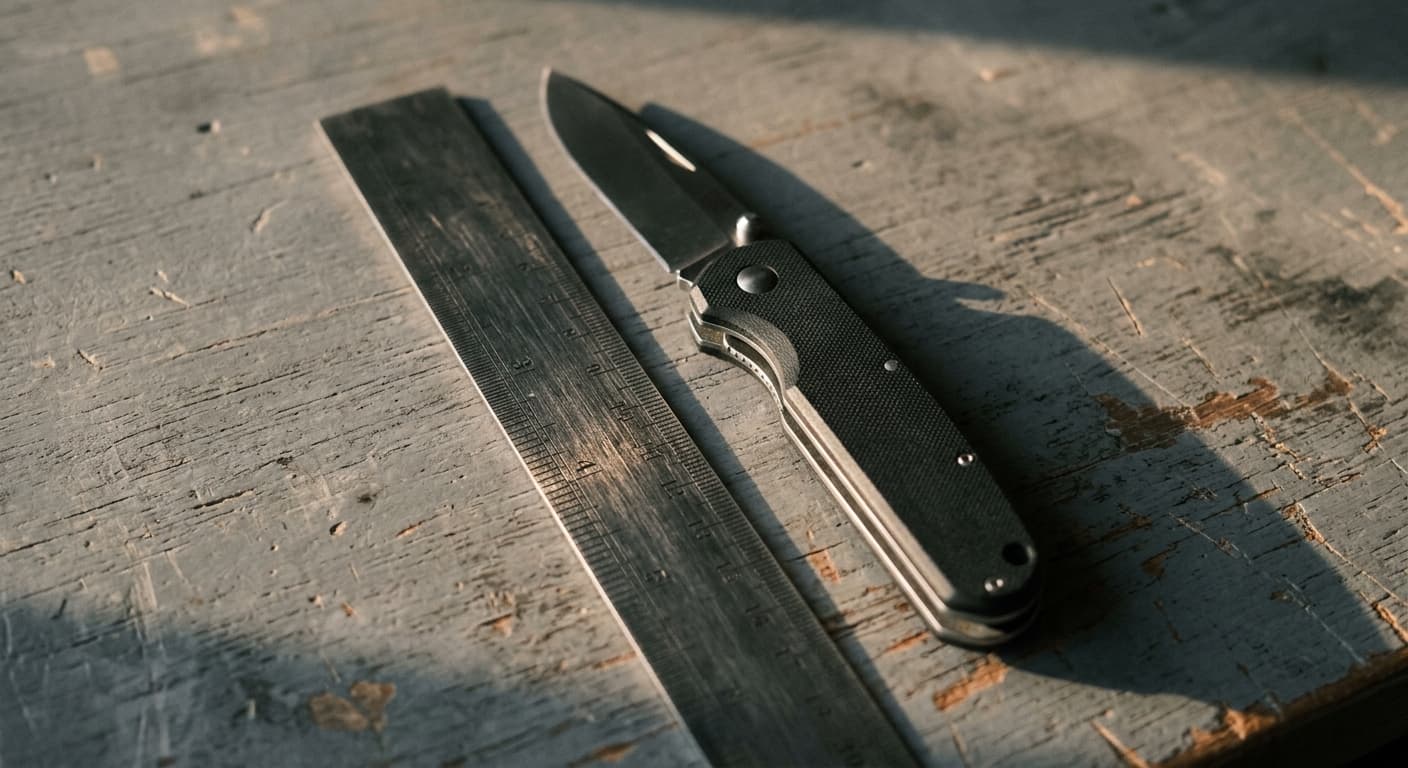
Delaware regulates knives through a patchwork of overlapping statutes rather than one general blade-length law. The state's core "deadly weapon" definition folds in most knives, a separate title bans switchblades outright regardless of how they are carried, and a repealed statute still shows up in cross-references even though it no longer does anything. Getting the current rule right means reading past the repeal notice, not stopping at it.
Jurisdiction scope: This page covers Delaware state law only, principally 11 Del. C. §§ 222, 1441, 1442, 1446A, 1452, 1453, 1457, 1457A, and 24 Del. C. § 901. It does not cover Delaware's assault or robbery statutes, which apply to a knife used as a weapon regardless of how it was carried or owned.
Can you own a knife in Delaware?
Most knives are legal to own. Delaware's general definitions section, 11 Del. C. § 222(6), lists the items that count as a "deadly weapon" throughout the Criminal Code:
"Deadly weapon" includes any of the following: 1. A firearm. 2. A bomb. 3. A knife of any sort, other than an ordinary pocketknife carried in a closed position. 4. A switchblade knife. 5. A billy. 6. A blackjack. 7. A bludgeon. 8. Metal knuckles. 9. A slingshot. 10. A razor. 11. A bicycle chain. 12. An ice pick. 13. A dangerous instrument, which is used, or attempted to be used, to cause death or serious physical injury. 14. A projectile weapon.
The definition's own carve-out matters: "'ordinary pocketknife' means a knife having a blade not more than 3.75 inches in length." A folding pocketknife with a blade of 3.75 inches or less, carried closed, falls outside the "deadly weapon" definition entirely. A switchblade knife is named on the list separately from the general knife entry, so it counts as a deadly weapon regardless of its blade length or whether it is closed.
Two categories are banned to own or sell outright, not just to carry: a switchblade knife, under 24 Del. C. § 901 (discussed below), and an "undetectable knife," one commercially manufactured, without a permanently affixed detectable component, to evade a metal detector or magnetometer, under 11 Del. C. § 1446A, a class G felony to commercially manufacture, import for commercial sale, or possess. Section 1446A carries exceptions for sales to law enforcement, the military, and historical societies, museums, and institutional collections that keep the knives properly secured. A knuckles-combination knife, a knife blade mounted on a knuckle-ring grip handle, is a class B misdemeanor to sell, offer for sale, or possess under 11 Del. C. § 1452. A martial arts throwing star (a sharp metal throwing star) is a class B misdemeanor to sell, offer for sale, or possess under 11 Del. C. § 1453.
Open carry
Delaware's weapons chapter contains no standalone open-carry knife statute. The practical restrictions on carrying a knife openly in Delaware come from the outright possession bans above (a switchblade may not be possessed at all, openly or concealed) and from the general "deadly weapon" and dangerous-instrument offenses that apply if a knife is actually used or brandished as a weapon.
Concealed carry
Carrying a covered knife concealed on or about the person, without a license, is a crime under 11 Del. C. § 1442:
A person is guilty of carrying a concealed deadly weapon when the person carries concealed a deadly weapon upon or about the person without a license to do so as provided by § 1441 of this title.
Carrying a concealed deadly weapon is a class G felony, "unless the deadly weapon is a firearm or a projectile weapon, in which case it is a class D felony." Because the deadly-weapon definition excludes an ordinary pocketknife carried closed (3.75 inches or less) but includes a switchblade regardless of length, a folding knife at or under that length carried closed is not a "deadly weapon" for this purpose, while a switchblade of any blade length is.
The offense requires the absence of a license: § 1442(a) applies only when the person carries the deadly weapon "without a license to do so as provided by § 1441 of this title," so a valid § 1441 license negates the offense rather than excusing it after the fact. Section 1441 sets out a demanding application process through the Superior Court: a written application, a certificate from five respectable citizens of the applicant's county, a criminal history background check, a completed firearms training course, a $65 fee, and court approval, with an initial license valid for three years and renewable for five-year terms after that. The training course requirement is written entirely around firearms, including live-fire range exercises, so a knife-only applicant must still complete it to be licensed. Section 1442 also sets out two narrow defenses: under § 1442(c), a defense for someone whose otherwise valid license expired while a timely renewal application was pending before the court, and under § 1442(d), a separate defense for anyone who complied with § 1456(b), the rule on leaving a firearm unattended in a vehicle stored in a locked box or container, a locked firearms rack, or a locked trunk. Because a switchblade is independently banned to possess under 24 Del. C. § 901 (see below), a § 1441 license to carry concealed does not override that separate possession ban for a switchblade specifically.
Where you can't carry at all: restricted places
11 Del. C. § 1457 raises the penalty grade for several weapons offenses, including carrying a concealed deadly weapon (§ 1442), the knuckles-combination-knife offense (§ 1452), and the martial arts throwing star offense (§ 1453), when committed in a "Safe Recreation Zone." The statute defines that term as "any building or structure owned, operated, leased or rented by any county or municipality, or by the State... or by any private organization, which is utilized as a recreation center, athletic field or sports stadium." A class B misdemeanor underlying offense becomes a class A misdemeanor in a Safe Recreation Zone; an unclassified misdemeanor becomes a class B misdemeanor; and a class E, F, or G felony is elevated one grade higher.
A separate statute, 11 Del. C. § 1457A, creates a "Safe School Zone" offense, but its own text scopes it to a "firearm or projectile weapon" only, defining a Safe School Zone as school buildings, grounds, athletic fields, and vehicles. Because the statute's possession offense in subsection (b) is written as "knowingly possesses a firearm or projectile weapon," it does not reach a knife. Carrying a knife onto Delaware school property is not itself a Safe School Zone offense; the general concealed-carry and outright-possession rules above still apply anywhere in the state, including on school grounds.
Does Delaware preempt local knife ordinances?
Delaware's weapons chapter contains no statewide knife preemption statute. A preemption provision in the same chapter, 11 Del. C. § 1127, sits in a different subchapter covering offenses relating to children and vulnerable adults and does not reach weapons or knives generally. Title 11 sets no minimum age for purchasing or possessing a knife.
The Delaware switchblade trap: one statute is repealed, the other is not
Delaware's code shows two switchblade statutes, and only one is still in force. 11 Del. C. § 1446, titled "Unlawfully dealing with a switchblade knife," was repealed effective July 30, 2025, by 85 Del. Laws, c. 119, § 2. Older cross-references to § 1446 still appear elsewhere in the code, including in the Safe Recreation Zone statute's list of underlying offenses, but the section itself no longer states an offense.
That repeal did not legalize switchblades in Delaware. A separate, independently operative statute, 24 Del. C. § 901, titled "License requirement" and located in the title governing deadly-weapons dealers, still bans switchblade possession and sale outright:
No person licensed or unlicensed shall possess, sell or offer for sale any switchblade knife. This section shall not apply to toy pistols, pocket knives or knives used for sporting purposes and in the domestic household, or surgical instruments or tools of any kind.
The section's own second sentence carves out "pocket knives or knives used for sporting purposes and in the domestic household." Nothing in the statute or the surrounding chapter defines how that carve-out interacts with the switchblade sentence that precedes it, whether it reaches a switchblade used for those purposes, or means something narrower. That leaves the practical reach of the carve-out unresolved on the face of the text; the switchblade ban itself, outside whatever the carve-out covers, remains in force under § 901, separate from and unaffected by § 1446's repeal.
Federal law: what it does and does not reach
Federal law does not ban an individual from owning or carrying a switchblade. The Federal Switchblade Act, 15 U.S.C. §§ 1241 to 1245, instead regulates interstate commerce in switchblade knives, barring their manufacture, sale, transport, or introduction into interstate commerce, and, in 15 U.S.C. § 1245 makes it a federal offense to knowingly possess, manufacture, sell, or import a ballistic knife in or affecting interstate commerce or within federal territorial jurisdiction. 15 U.S.C. § 1244, captioned "Exceptions," provides that §§ 1242 and 1243 "shall not apply to" a list of specific knives; it is an exemption from those two interstate-commerce and importation offenses, not a change to the switchblade definition itself, which sits in § 1241(b) and was not amended. A 2009 addition, § 1244(5), exempts from §§ 1242 and 1243 any knife with a spring, detent, or other closure-bias mechanism that requires hand, wrist, or arm exertion to overcome the bias and assist opening, the exception that keeps modern assisted-opening folding knives legal in interstate commerce. A separate exception, § 1244(4), exempts a person with only one arm from those same two offenses when possessing or carrying a switchblade with a blade three inches or less. None of this changes Delaware's own, independently operative switchblade possession ban under 24 Del. C. § 901.
Disclaimer: This article provides general legal information about Delaware's knife laws as of September 2026. It is not legal advice. Consult a lawyer licensed in Delaware for advice about a specific situation. Local police retain discretion in how these statutes are enforced, and a knife legal to carry under state law can still lead to a stop or questioning depending on the circumstances.
For a state-by-state comparison, see knife laws by state. Delaware's self-defense statutes are covered separately on the Delaware self-defense laws page.
Statutes cited reflect their in-force version as of 2026-09-18. Last updated: 2026-09-18.
Frequently Asked Questions
Are switchblades illegal in Delaware?
Generally yes. Possessing, selling, or offering to sell a switchblade knife is banned, licensed or not, under 24 Del. C. 901. The same sentence carves out 'pocket knives or knives used for sporting purposes and in the domestic household,' and the statute does not spell out how far that carve-out cuts against the switchblade ban. A separate switchblade statute, 11 Del. C. 1446, was repealed in 2025, but that repeal did not affect section 901.
What size knife is legal to carry in Delaware?
Delaware's deadly-weapon definition excludes an 'ordinary pocketknife,' defined as a knife with a blade of 3.75 inches or less, carried in a closed position. A switchblade is treated as a deadly weapon regardless of blade length. A knife at or under 3.75 inches, other than a switchblade, carried closed, falls outside the concealed-deadly-weapon offense.
Can I carry a knife openly in Delaware?
Delaware has no standalone statute banning open carry of a knife. The outright bans on switchblades, undetectable knives, knuckles-combination knives, and throwing stars apply regardless of how they are carried, and Delaware's concealed-carry felony applies only to concealed carry of a covered deadly weapon without a license.
Can I carry a knife at school in Delaware?
Delaware's Safe School Zone statute, 11 Del. C. 1457A, is written to cover only a firearm or projectile weapon, not a knife. A knife carried on school grounds is instead governed by the general concealed-carry and possession rules that apply statewide.
Does a concealed-carry license let you carry a switchblade in Delaware?
No. The 11 Del. C. 1441 license only concerns the concealed-deadly-weapon offense in 11 Del. C. 1442, part of Title 11. The switchblade possession and sale ban is a separate statute, 24 Del. C. 901, sitting outside Title 11 entirely, and it applies to a switchblade regardless of any license. A 1441 license does not authorize possessing a switchblade.
Updates
Corrected the description of the Delaware concealed-carry defenses so the § 1442(d) defense is described as a separate defense for compliance with the § 1456(b) vehicle firearm-storage rule rather than a license-holder defense.
Independently fact-checked against the cited primary sources
The Law Behind This Article
This article rests on the statutory provisions below, held in our own legal record and retrieved from the official source. Tap a section to read the operative text.
Delaware Code, Title 11 (Crimes and Criminal Procedure), Chapter 005 (SPECIFIC OFFENSES)
§ 1442Carrying a concealed deadly weapon; class G felony; class D felony.In forcecited in 2 of our articles
(a) A person is guilty of carrying a concealed deadly weapon when the person carries concealed a deadly weapon upon or about the person without a license to do so as provided by § 1441 of this title. (b) Carrying a concealed deadly weapon is a class G felony, unless the deadly weapon is a firearm or a projectile weapon, in which case it is a class D felony. (c) It shall be a defense that the defendant has been issued an otherwise valid license to carry a concealed deadly weapon pursuant to terms of § 1441 of this title, where: (1) The license has expired, (2) The person had applied for renewal of said license within the allotted time frame prior to expiration of the license, and (3) The offense is alleged to have occurred while the application for renewal of said license was pending before the court. (d) It shall be a defense that the defendant complied with § 1456(b) of this title.
Official text (excerpt) · last checked 2026-09-23 · Read the full text in our law library · Verify at delcode.delaware.gov
Cited in 58 court opinions in our collectionLatest citing opinion in our collection: 2025
Opinions citing this section in our collection:
- State v. Murray (Supreme Court of Delaware 2019, 213 A.3d 571)“…statute that prohibits carrying a concealed deadly weapon, 11 Del. C. § 1442, provides that: A person…”
- Buchanan v. State (Supreme Court of Delaware 2009, 981 A.2d 1098)“…ly attack against another by surprise.” 34 11 Del. C. § 1442 provides that “[a] person is guilty of…”
- Mullens v. Kilborne (Supreme Court of Delaware 2018)“…guilty in 1999 to carrying a concealed deadly weapon under 11 Del. C. § 1442, which was designated a class G felony…”
Identified automatically from the court opinions citing this section — not a ranking of which case controls.
Also relied on in: Delaware Pepper Spray and Stun Gun Laws (2026)
§ 1441License to carry concealed deadly weapons.In force
(a) A person of full age and good moral character desiring to be licensed to carry a concealed deadly weapon for personal protection or the protection of the person’s property may be licensed to do so when the following conditions have been strictly complied with: (1) The person shall make application therefor in writing and file the same with the Prothonotary of the proper county, at least 15 days before the then next term of the Superior Court, clearly stating that the person is of full age and that the person is desirous of being licensed to carry a concealed deadly weapon for personal protection or protection of the person’s property, or both, and also stating the person’s residence and occupation. The person shall submit together with such application all information necessary to conduct a criminal history background check. The Superior Court may conduct a criminal history background check pursuant to the procedures set forth in Chapter 85 of Title 11 for the purposes of licensing any person pursuant to this section.
Official text (excerpt) · last checked 2026-07-29 · Read the full text in our law library · Verify at delcode.delaware.gov
Cited in 20 court opinions in our collectionLatest citing opinion in our collection: 2025
Opinions citing this section in our collection:
- Doe v. Wilmington Housing Authority (Supreme Court of Delaware 2014, 88 A.3d 654)“…luding a license to carry a concealed weapon as required by 11 Del C. § 1441, upon request, when there is reasonable…”
- Bridgeville Rifle & Pistol Club, Ltd. v. Small (Supreme Court of Delaware 2017, 176 A.3d 632)“…of states that permits concealed carry with a license. See 11 Del. C. § 1441. By pointing to a thirty-year period in…”
- In re Buresch (Supreme Court of Delaware 1996, 672 A.2d 64)“…Court ruling on an application for a gun permit pursuant to 11 Del.C. § 1441. We adhere to our previous view that th…”
Identified automatically from the court opinions citing this section — not a ranking of which case controls.
§ 1446AUndetectable knives; commercial manufacture, import for commercial sale, or offers for commercial sale; or possession.In force
(a) Any person in this state who commercially manufactures or causes to be commercially manufactured, or who knowingly imports into the state for commercial sale, keeps for commercial sale, or offers or exposes for commercial sale, or who possesses any undetectable knife is guilty of a class G felony. As used in this section, an “undetectable knife” means any knife or other instrument with or without a handguard that is capable of ready use as a stabbing weapon that may inflict serious physical injury or death that is commercially manufactured to be used as a weapon and is not detectable by a metal detector or magnetometer because there is no material permanently affixed that would be detectable by a metal detector or magnetometer, either handheld or otherwise, that is set at standard calibration.
Official text (excerpt) · last checked 2026-07-29 · Read the full text in our law library · Verify at delcode.delaware.gov
§ 1452Unlawfully dealing with knuckles-combination knife; class B misdemeanor.In force
A person is guilty of unlawfully dealing with a knuckles-combination knife when the person sells, offers for sale or has in possession a knife, the blade of which is supported by a knuckle ring grip handle. Unlawfully dealing with a knuckles-combination knife is a class B misdemeanor.
Official text (excerpt) · last checked 2026-07-29 · Read the full text in our law library · Verify at delcode.delaware.gov
§ 1453Unlawfully dealing with martial arts throwing star; class B misdemeanor.In force
A person is guilty of unlawfully dealing with a martial arts throwing star when the person sells, offers for sale or has in possession a sharp metal throwing star. Unlawfully dealing with a martial arts throwing star is a class B misdemeanor.
Official text (excerpt) · last checked 2026-07-29 · Read the full text in our law library · Verify at delcode.delaware.gov
§ 1457Possession of a weapon in a Safe Recreation Zone; class D, E, or F felony; class A or B misdemeanor.In forcecited in 2 of our articles
(a) Any person who commits any of the offenses described in subsection (b) of this section, or any juvenile who possesses a firearm or projectile weapon and does so while in or on a “Safe Recreation Zone” shall be guilty of the crime of possession of a weapon in a Safe Recreation Zone. (b) The underlying offenses in Title 11 shall be: (1) Section 1442. — Carrying a concealed deadly weapon; class G felony; class D felony. (2) Section 1444. — Possessing a destructive weapon; class E felony. (3) Section 1446. — Unlawfully dealing with a switchblade knife; unclassified misdemeanor. (4) Section 1448. — Possession and purchase of deadly weapons by persons prohibited; class F felony. (5) Section 1452. — Unlawfully dealing with knuckles-combination knife; class B misdemeanor. (6) Section 1453. — Unlawfully dealing with martial arts throwing star; class B misdemeanor. (7) Section 1466. — Manufacture, sale, transport, transfer, purchase, receipt, and possession of assault weapons; class E or F felony. (c) For the purpose of this section: (1) “Constable” means an individual who licensed under Chapter 56 of Title 24.
Official text (excerpt) · last checked 2026-07-29 · Read the full text in our law library · Verify at delcode.delaware.gov
Cited in 4 court opinions in our collectionLatest citing opinion in our collection: 2025
Opinions citing this section in our collection:
- Bridgeville Rifle & Pistol Club, Ltd. v. Small (Supreme Court of Delaware 2017, 176 A.3d 632)“…firearms regulation statute enacted on a statewide basis is 11 Del. C. § 1457, which creates the crime of “possession…”
- State v. Howard (Superior Court of Delaware 2025)“…sion of a Weapon in a Safe Recreation Zone,8 which 8 11 Del. C. § 1457.…”
- State v. Schofield (Superior Court of Delaware 2023)“…1448), and Possession of a Weapon in a Safe School Zone (11 Del. C. §1457). On July 25, 2017, Defendant p…”
Identified automatically from the court opinions citing this section — not a ranking of which case controls.
§ 1457APossession of a firearm or projectile weapon in a Safe School Zone; class E felony.In force
(a) As used in this section: (1) “Constable” means as licensed under Chapter 56 of Title 24. (2) “Firearm” means as defined in § 222 of this title and includes a destructive weapon as defined in § 1444(a) and (c) of this title and includes BB guns. (3) “Police officer” means as defined in § 8401 of this title. (4) “Qualified retired law-enforcement officer” means as defined in § 1441B of this title. (5) “Safe School Zone” means all of the following: a. Any building, structure, athletic field, sports stadium, or real property owned, operated, leased, or rented by any public or private school including any kindergarten, elementary, secondary, or vocational-technical school. b. Any motor vehicle owned, operated, leased, or rented by any public or private school including any kindergarten, elementary, secondary, or vocational-technical school. (b) Any person who knowingly possesses a firearm or projectile weapon while in a Safe School Zone shall be guilty of the crime of possession of a firearm or projectile weapon in a Safe School Zone. (c) Subsection (b) of this section does not apply to any of the following: (1) A police officer.
Official text (excerpt) · last checked 2026-07-29 · Read the full text in our law library · Verify at delcode.delaware.gov
§ 1446Unlawfully dealing with a switchblade knife; unclassified misdemeanor [Repealed].Repealed
Official text (excerpt) · last checked 2026-07-29 · Read the full text in our law library · Verify at delcode.delaware.gov
§ 1127Preemption.In force
The provisions of this subpart shall preempt and supersede any provisions of any municipal or county ordinance or regulation on the subject of this subpart enacted after June 30, 1996.
Official text (excerpt) · last checked 2026-07-29 · Read the full text in our law library · Verify at delcode.delaware.gov
Delaware Code, Title 24 (Professions and Occupations), Chapter 009 (DEADLY WEAPONS DEALERS)
§ 901License requirement.In force
No person shall engage in the business of selling any pistol or revolver, or stiletto, steel or brass knuckles, or other deadly weapon made especially for the defense of one’s person without first having obtained a license therefor, which license shall be known as “special license to sell deadly weapons.” No person licensed or unlicensed shall possess, sell or offer for sale any switchblade knife. This section shall not apply to toy pistols, pocket knives or knives used for sporting purposes and in the domestic household, or surgical instruments or tools of any kind.
Official text (excerpt) · last checked 2026-07-29 · Read the full text in our law library · Verify at delcode.delaware.gov
Cited in 3 court opinions in our collectionLatest citing opinion in our collection: 2017
Opinions citing this section in our collection:
- Bridgeville Rifle & Pistol Club, Ltd. v. Small (Supreme Court of Delaware 2017, 176 A.3d 632)“…session of firearms in connection with a protective order); 24 Del. C. §§ 901, 902, 903, 904, 905 (regulating the sal…”
- James Hetherton and Carol Hetherton, His Wife v. Sears, Roebuck & Company, a New York Corporation (Court of Appeals for the Third Circuit 1979, 593 F.2d 526)“…ly weapon made especially for the defense of one’s person”. 24 Del.C. § 901 (emphasis added). The ammunition which…”
- Hetherton v. Sears, Roebuck and Co. (District Court, D. Delaware 1978, 445 F. Supp. 294)“…le of which a dealer must be licensed. See 24 Del.C. § 901. 6 . The Court has…”
Identified automatically from the court opinions citing this section — not a ranking of which case controls.
Delaware Code, Title 11 (Crimes and Criminal Procedure), Chapter 002 (GENERAL PROVISIONS CONCERNING OFFENSES)
§ 222General definitions.In forcecited in 3 of our articles
When used in this Criminal Code: (1) “Building,” in addition to its ordinary meaning, includes any structure, vehicle or watercraft. Where a building consists of 2 or more units separately secured or occupied, each unit shall be deemed a separate building. (2) “Controlled substance” or “counterfeit substance” shall have the same meaning as used in Chapter 47 of Title 16. (3) “Conviction” means a verdict of guilty by the trier of fact, whether judge or jury, or a plea of guilty or a plea of nolo contendere accepted by the court. (4) “Covert firearm” means any firearm that is constructed in a shape or configuration such that it does not resemble a firearm. (5) “Dangerous instrument” means all of the following: a. Any instrument, article, or substance which, under the circumstances in which it is used, attempted to be used, or threatened to be used, is readily capable of causing death or serious physical injury. b. Any disabling chemical spray. c. Any electronic control device, including a neuromuscular incapacitation device designed to incapacitate a person. (6) a. “Deadly weapon” includes any of the following: 1. A firearm. 2. A bomb. 3.
Official text (excerpt) · last checked 2026-07-29 · Read the full text in our law library · Verify at delcode.delaware.gov
Cited in 84 court opinions in our collectionLatest citing opinion in our collection: 2025
Opinions citing this section in our collection:
- Williamson v. State (Supreme Court of Delaware 2015, 113 A.3d 155)“…acts of the case. This Court has held that 11 Del. C. § 222(23) does not require the victim to see…”
- Key v. State (Supreme Court of Delaware 1983, 463 A.2d 633)“…pra. 5 . “Conviction” is defined by 11 Del.C. § 222(3) as “a verdict of guilty by the trier…”
- Zimmerman v. State (Supreme Court of Delaware 1997, 693 A.2d 311)“…ure could have utilized the term ‘conviction’ as defined in 11 DelC. § 222(4), 25 rather than the sta…”
Identified automatically from the court opinions citing this section — not a ranking of which case controls.
Also relied on in: Pepper Spray and Stun Gun Laws by State (2026)
United States Code Title 15
§ 1241DefinitionsIn forcecited in 52 of our articles
As used in this chapter— The term “interstate commerce” means commerce between any State, Territory, possession of the United States, or the District of Columbia, and any place outside thereof. The term “switchblade knife” means any knife having a blade which opens automatically— by hand pressure applied to a button or other device in the handle of the knife, or by operation of inertia, gravity, or both.
Official text (excerpt) · last checked 2026-07-28 · Read the full text in our law library · Verify at uscode.house.gov
Cited in 15 court opinions in our collectionLatest citing opinion in our collection: 2014
Opinions citing this section in our collection:
- Stewart A. Taylor, D/B/A Taylor Cutlery Mfg. Co. v. United States of America (Court of Appeals for the Sixth Circuit 1988, 848 F.2d 715)“…Service, are not switchblade knives within the meaning of 15 U.S.C. § 1241 (b) and 19 C.F.R. § 1295 (a)(1). The d…”
- Crowley Cutlery Company v. United States of America and Commissioner of Customs of the United States Customs Service (Court of Appeals for the Seventh Circuit 1988, 849 F.2d 273)“…Illinois for a declaration that the Switchblade Knife Act, 15 U.S.C. §§ 1241 et seq., which forbids th…”
- Edna Fall, as Administratrix of the Estate of Phillip Fall, Deceased v. Esso Standard Oil Company (Court of Appeals for the Fifth Circuit 1962, 297 F.2d 411)“…25 S.Ct. 158 , 49 L.Ed. 363 . Section 1 of the Act, 15 U.S.C.A. § 1241 (b), defines the term “switchblade knif…”
Identified automatically from the court opinions citing this section — not a ranking of which case controls.
Also relied on in: Knife Laws by State (2026): Carry Rules, Blade Limits, Penalties, Alabama Knife Laws (2026): What Is Legal to Carry, Alaska Knife Laws (2026): Concealed Carry Rules Explained
§ 1244ExceptionsIn forcecited in 52 of our articles
Sections 1242 and 1243 of this title shall not apply to— any common carrier or contract carrier, with respect to any switchblade knife shipped, transported, or delivered for shipment in interstate commerce in the ordinary course of business; the manufacture, sale, transportation, distribution, possession, or introduction into interstate commerce, of switchblade knives pursuant to contract with the Armed Forces; the Armed Forces or any member or employee thereof acting in the performance of his duty; the possession, and transportation upon his person, of any switchblade knife with a blade three inches or less in length by any individual who has only one arm; or a knife that contains a spring, detent, or other mechanism designed to create a bias toward closure of the blade and that requires exertion applied to the blade by hand, wrist, or arm to overcome the bias toward closure to assist in opening the knife.
Official text (excerpt) · last checked 2026-07-28 · Read the full text in our law library · Verify at uscode.house.gov
Also relied on in: Arizona Knife Laws (2026): Carry Rules and Preemption, Arkansas Knife Laws (2026): Intent-Based Carry Rules, California Knife Laws (2026): Four Blade-Length Rules
§ 1245Ballistic knivesIn forcecited in 50 of our articles
Whoever in or affecting interstate commerce, within any Territory or possession of the United States, within Indian country (as defined in section 1151 of title 18), or within the special maritime and territorial jurisdiction of the United States (as defined in section 7 of title 18), knowingly possesses, manufactures, sells, or imports a ballistic knife shall be fined as provided in title 18, or imprisoned not more than ten years, or both. Whoever possesses or uses a ballistic knife in the commission of a Federal crime of violence shall be fined as provided in title 18, or imprisoned not less than five years and not more than ten years, or both. The exceptions provided in paragraphs (1), (2), and (3) of section 1244 of this title with respect to switchblade knives shall apply to ballistic knives under subsection (a) of this section. As used in this section, the term “ballistic knife” means a knife with a detachable blade that is propelled by a spring-operated mechanism.
Official text (excerpt) · last checked 2026-07-28 · Read the full text in our law library · Verify at uscode.house.gov
Cited in 2 court opinions in our collectionLatest citing opinion in our collection: 2008
Opinions citing this section in our collection:
- ALCANTAR (Board of Immigration Appeals 1994, 20 I. & N. Dec. 801)“…ed by an adult, would be felony and crime of violence); cf. 15 U.S.C. § 1245(b) (1988) (use of ballistic knife in co…”
- United States v. Polizzi (District Court, E.D. New York 2008, 549 F. Supp. 2d 308)“…8 Trust in l’estraint of import trade 3 months 15 U.S.C. § 1245 (b) Possession/use of a ballistic knife…”
Identified automatically from the court opinions citing this section — not a ranking of which case controls.
Also relied on in: Colorado Knife Laws (2026): Concealed Carry and Exceptions, Connecticut Knife Laws (2026): Open and Concealed Carry, D.C. Knife Laws (2026): Possession and Carry Rules
Search our full record of US law — 2.1 million sections, every state + federal →
Sources and References
- 11 Del. C. 222(6) - General definitions: 'deadly weapon' includes any knife other than an ordinary pocketknife (blade 3.75 inches or less) carried closed, plus a switchblade knife named separately(delcode.delaware.gov).gov
- 11 Del. C. 1442 - Carrying a concealed deadly weapon; class G felony (class D if firearm/projectile weapon)(delcode.delaware.gov).gov
- 11 Del. C. 1441 - License to carry concealed deadly weapons: application, training, fee, and term requirements(delcode.delaware.gov).gov
- 24 Del. C. 901 - License requirement (deadly weapons dealers): switchblade possession/sale banned outright, verbatim carve-out for pocket knives and sporting/domestic-household knives(delcode.delaware.gov).gov
- 11 Del. C. 1446 - Unlawfully dealing with a switchblade knife (repealed effective July 30, 2025, by 85 Del. Laws c. 119 section 2)(delcode.delaware.gov).gov
- 11 Del. C. 1446A - Undetectable knives; commercial manufacture, import, or possession; class G felony(delcode.delaware.gov).gov
- 11 Del. C. 1452 - Unlawfully dealing with knuckles-combination knife; class B misdemeanor(delcode.delaware.gov).gov
- 11 Del. C. 1453 - Unlawfully dealing with martial arts throwing star; class B misdemeanor(delcode.delaware.gov).gov
- 11 Del. C. 1457 - Possession of a weapon in a Safe Recreation Zone; grade-elevation of concealed-carry, knuckles-knife, and throwing-star offenses(delcode.delaware.gov).gov
- 11 Del. C. 1457A - Possession of a firearm or projectile weapon in a Safe School Zone; class E felony (scoped to firearm/projectile weapon only, not knives)(delcode.delaware.gov).gov
- 15 U.S.C. 1241-1245 - Federal Switchblade Act, interstate commerce and importation scope(law.cornell.edu)
- 15 U.S.C. 1244 - exceptions, including the 2009 assisted-opening carve-out and the one-arm exception(law.cornell.edu)