
Connecticut
Connecticut Video Recording Laws: Consent, Surveillance, and Privacy Rules (2026)
Independently fact-checked against primary sources (last audited August 22, 2026). · Reviewed by the RecordingLaw editorial team. · Law checked current as of August 22, 2026. · 10 primary sources cited on this page. How we verify our legal content

Connecticut permits silent video recording in public spaces and areas without a reasonable expectation of privacy. Adding audio brings in Connecticut's eavesdropping law for in-person recordings, CGS 53a-189 (built on the definitions in CGS 53a-187), while phone and video calls are governed by CGS 52-570d, which is satisfied by all-party consent, a recorded verbal notice at the start of the call, or a repeating audible tone warning. Recording in private spaces without consent violates voyeurism law CGS 53a-189a.
Connecticut does not have a single statute dedicated exclusively to video recording. Instead, the legality of video recording depends on several factors: whether the recording captures audio, where the recording takes place, and whether the people being recorded have a reasonable expectation of privacy. Understanding how these factors interact is essential for anyone using video cameras, security systems, body cameras, or smartphone video in the state.
This guide covers Connecticut's video recording legal framework as of 2026, including silent video rules, audio-enabled video, voyeurism laws, workplace surveillance requirements, and your rights to record in public spaces.
Silent Video Recording in Connecticut
General Rule: No Specific Prohibition
Connecticut's recording statutes, the eavesdropping offense in CGS 53a-189 and the definitions in CGS 53a-187, primarily target audio recordings. The definitions of "wiretapping" and "mechanical overhearing of a conversation" both refer to overhearing or recording communications, which means spoken words. Pure video recording without any audio capture falls outside the scope of these audio-focused eavesdropping statutes.
This means that recording video without audio is generally permitted in Connecticut, provided the recording occurs in a location where the subjects do not have a reasonable expectation of privacy.
Where Silent Video Is Legal
- Public streets, sidewalks, and parks: No expectation of privacy exists in these open areas
- Business establishments open to the public: Stores, restaurants, and other public-facing businesses
- Your own property: You may install video cameras on and around your home
- Common areas of commercial buildings: Lobbies, hallways, and parking areas
Where Silent Video Is Restricted
Even without audio, video recording violates Connecticut law when it intrudes on a person's reasonable expectation of privacy. This includes:
- Restrooms and changing rooms: Recording in these areas constitutes voyeurism under CGS 53a-189a
- Private bedrooms and hotel rooms: Areas where privacy expectations are highest
- Locker rooms: Protected under both voyeurism statutes and workplace monitoring laws
- Any location where a person would reasonably expect not to be observed
Video Recording with Audio

When Audio Changes Everything
The moment a video recording captures audio of a conversation, Connecticut's consent rules apply. This distinction is critical because most modern video recording devices, including smartphones, security cameras, body cameras, and smart glasses, record audio by default.
For in-person video recordings that capture audio, Connecticut's eavesdropping law applies: CGS 53a-189 reaches only "mechanical overhearing of a conversation," which CGS 53a-187 defines as recording without the consent of at least one party AND by a person not present. If you are a participant in the conversation being recorded, both your presence and your consent take the recording outside that definition.
For video calls or recordings of telephone conversations, the all-party consent rule under CGS 52-570d applies. Every person on the call must either consent to the recording, be given a recorded verbal notification at the start of the call, or hear an automatic tone that repeats roughly every 15 seconds while the recording device is in use.
Practical Impact
This means that a security camera recording only video is subject to different legal analysis than the same camera with its microphone enabled. A homeowner who installs a video doorbell that captures audio of conversations on their porch needs to consider the audio recording implications, not just the video component.
Connecticut Voyeurism Law: CGS 53a-189a

What the Statute Prohibits
CGS 53a-189a specifically criminalizes voyeurism in Connecticut. The statute prohibits knowingly recording another person without their knowledge or consent in a place where they have a reasonable expectation of privacy. This covers:
- Using hidden cameras in bathrooms, bedrooms, changing rooms, or locker rooms
- Recording intimate images of a person without their consent
- Distributing intimate images that were recorded without consent
- Any video recording that captures a person in a state of undress in a private setting
Penalties for Voyeurism
Connecticut imposes severe penalties for voyeurism offenses:
| Offense | Classification | Maximum Prison | Maximum Fine |
|---|---|---|---|
| First offense | Class D Felony | 5 years | $5,000 |
| Subsequent offense | Class C Felony | 10 years | $10,000 |
| First offense involving a minor under 16 | Class C Felony | 10 years | $10,000 |
The escalation to a Class C felony for repeat offenses and cases involving minors reflects the seriousness with which Connecticut treats these violations. A person convicted of voyeurism may also face sex offender registration requirements depending on the circumstances.
Hidden Cameras
Installing a hidden camera in a location where someone has a reasonable expectation of privacy is illegal regardless of whether the camera records audio. This applies to landlords who place hidden cameras in rental properties, employers who install covert surveillance in private areas, and individuals who use hidden cameras to record intimate partners or others without consent.
Workplace Video Surveillance
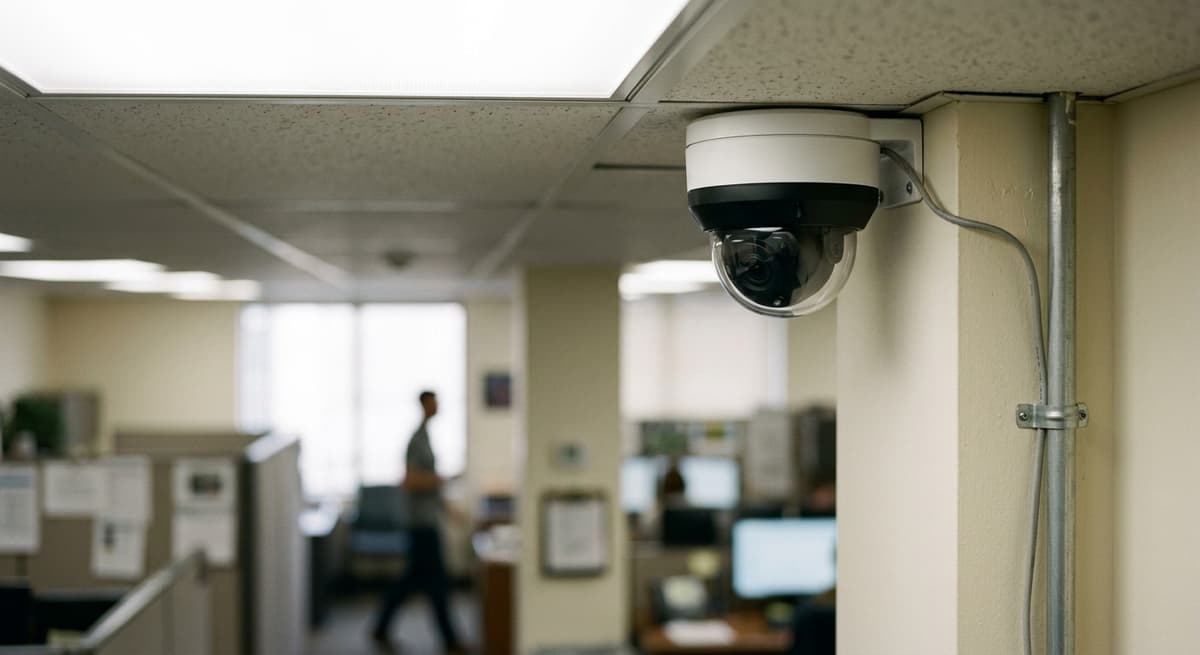
Employer Notice Requirements Under CGS 31-48d
Connecticut is one of the few states with a specific statute requiring employers to notify employees about electronic monitoring, including video surveillance. Under CGS 31-48d, employers must:
- Provide prior written notice to each employee before engaging in any form of electronic monitoring, including video surveillance
- Post a notice in a conspicuous location visible to all affected employees describing the types of monitoring that may occur
The statute does not tie this notice to an employee's hire date, only that it precede the monitoring, and its own text states that a conspicuously posted notice constitutes the required written notice.
Prohibited Monitoring Areas Under CGS 31-48b
CGS 31-48b prohibits employers from conducting any form of electronic monitoring in areas designated for employee health or personal comfort. The statute's own examples are:
- Restrooms
- Locker rooms
- Lounges designated for personal comfort
Connecticut's separate breastfeeding-in-the-workplace statute, CGS 31-40w, independently protects a private lactation space. Video cameras are absolutely prohibited in the areas 31-48b covers, regardless of whether the employer has provided notice or obtained consent.
Employer Monitoring Penalties
Employers who violate the monitoring notice requirements of CGS 31-48d face escalating fines:
| Violation | Penalty |
|---|---|
| First offense | $500 |
| Second offense | $1,000 |
| Each subsequent offense | $3,000 |
Placing a camera in a CGS 31-48b prohibited area carries a separate, harsher penalty: $500 for a first offense, $1,000 for a second, and $1,000 plus 30 days imprisonment for a third or subsequent offense.
Exception for Investigating Misconduct
CGS 31-48d includes an exception that allows employers to conduct monitoring without prior written notice when the employer has reasonable grounds to believe that employees are engaged in conduct that violates the law, violates the legal rights of the employer or another employee, or creates a hostile work environment. This exception is narrow and requires a documented, good-faith basis for the investigation.
Audio on Workplace Cameras
If workplace security cameras have audio recording capability, enabling that audio triggers additional legal requirements. In-person conversations captured by workplace cameras fall under the one-party consent rule, but since no participant in the conversation is likely consenting to the camera's audio capture, this could constitute illegal mechanical overhearing. Employers should disable audio on workplace surveillance cameras or ensure proper notice and consent procedures are in place.
Recording in Public Spaces
First Amendment Protections
The First Amendment protects the right to record in public spaces where there is no reasonable expectation of privacy. This right extends to video recording on public sidewalks, in parks, at public events, and in other areas open to the general public.
Connecticut does not have a specific statute addressing public video recording, but courts have consistently recognized the First Amendment right to record matters of public interest in public places.
Public Events and Meetings
Connecticut's Freedom of Information Act (FOIA) guarantees the public's right to attend and record open meetings of government bodies. This includes town council meetings, board of education sessions, planning and zoning hearings, and other official proceedings. Video recording of these public meetings is permitted.
Private Property Open to the Public
Businesses and organizations that open their premises to the public may set their own rules about video recording. A store owner can prohibit customers from recording inside the store. A theater can ban video recording during performances. These are private property rules, not state recording laws, and the penalty for violation is typically being asked to leave or being charged with trespass if you refuse.
Home Security Video Systems
Recording Your Own Property
Homeowners in Connecticut have broad rights to install video surveillance on their own property. You may place cameras on your home, pointed at your driveway, yard, front door, and other areas of your property. These cameras may also capture public areas like sidewalks and streets visible from your property.
Pointing Cameras at Neighbors
While you may record areas visible from your own property, deliberately pointing cameras to record a neighbor's private areas, such as bedroom windows or enclosed backyards, can constitute an invasion of privacy. Connecticut courts apply a reasonableness standard: cameras that capture incidental views of neighboring property are generally acceptable, while cameras deliberately aimed at private spaces may be actionable.
Audio on Home Security Cameras
Many home security cameras and video doorbells record audio by default. When these devices capture conversations, the audio recording rules apply. For in-person conversations picked up by the device, one-party consent applies, but since the homeowner may not be participating in every conversation captured, there is a risk of recording without any party's consent. Consider disabling audio on outdoor cameras or posting clear signage indicating that audio and video recording is in progress.
Video Recording and Drones
FAA Regulations
Drone operators in Connecticut must comply with Federal Aviation Administration (FAA) regulations, which require registration for drones weighing more than 0.55 pounds and compliance with airspace restrictions. The FAA sets the baseline rules for where and how drones can fly.
Connecticut Drone Privacy
Using a drone equipped with a camera to record video of people in areas where they have a reasonable expectation of privacy can violate Connecticut's voyeurism and privacy laws. Flying a drone to peer into windows, record people in fenced backyards, or capture images of people in private settings is not protected simply because the recording happens from the air.
Municipal Regulations
Several Connecticut municipalities have adopted their own drone regulations that may impose additional restrictions on aerial video recording. Operators should check local ordinances before flying drones with cameras in residential areas.
Video Calls and Virtual Meetings
Recording Zoom, Teams, and Other Platforms
Video calls conducted through Zoom, Microsoft Teams, Google Meet, FaceTime, and similar platforms are subject to Connecticut's telephone recording rules under CGS 52-570d. Because these are electronic communications rather than in-person conversations, the recording party must either get consent from every participant, give a recorded verbal notification at the start of the call, or use a device that emits an automatic tone approximately every 15 seconds during the recording.
Most platforms provide built-in recording notifications that alert participants when someone starts recording. While these notifications are helpful, the safest practice is to verbally announce the recording and confirm that all participants consent.
Screen Recording
Screen recording tools that capture video of a meeting or call are also subject to CGS 52-570d's consent/notice/tone-warning requirements when they capture audio. A screen recording that captures only visual content without audio is treated differently, but most screen recordings of video calls include audio.
Body Cameras and Wearable Video Devices
Private Citizens
Connecticut residents who wear body cameras or use wearable video devices in public may do so legally, as there is no general prohibition on video recording in public spaces. However, if the device captures audio, the one-party consent rule applies to in-person interactions. The wearer must be a participant in any conversation the device records.
Law Enforcement Body Cameras
Connecticut police departments have increasingly adopted body-worn cameras under Connecticut's Police Accountability Act (P.A. 20-1, Special Session). Body-worn camera programs are codified in Conn. Gen. Stat. § 29-6d, which sets requirements for when cameras must be activated, how footage is stored, and when the public can access recordings through FOIA requests.
Employer-Issued Wearable Devices
Employers who provide wearable video devices to employees must comply with the notice requirements of CGS 31-48d. Written notice must be provided before employees begin using the devices, and the notice must describe the types of monitoring involved.
More Connecticut Recording Laws
Audio Recording | Video Recording | Voyeurism & Hidden Cameras | Workplace Recording | Recording Police | Phone Call Recording | Security Cameras | Recording in Public | Landlord-Tenant | Dashcam Laws | Schools | Medical Recording
Back to Connecticut Recording Laws
More Connecticut Recording Topics
More Connecticut Laws
Frequently Asked Questions
Is it legal to record video in Connecticut without someone's consent?
It depends on the circumstances. Silent video recording (without audio) is generally legal in areas where the subject has no reasonable expectation of privacy, such as public streets, parks, and businesses. However, recording video in private areas like bathrooms, locker rooms, or bedrooms without consent is illegal voyeurism under CGS 53a-189a, a Class D felony. If the video captures audio, Connecticut's recording consent rules also apply.
Do I need consent to have security cameras at my Connecticut business?
You do not need employee consent to install video-only security cameras in common work areas, but you must provide prior written notice to employees under CGS 31-48d (a conspicuously posted notice satisfies this) before the monitoring begins. Cameras are prohibited in restrooms, locker rooms, and lounges under CGS 31-48b, with escalating penalties up to a fine plus 30 days imprisonment for repeat violations; lactation spaces are also separately protected under CGS 31-40w. If cameras capture audio, additional consent requirements apply under the eavesdropping statutes.
What are the penalties for hidden cameras in Connecticut?
Installing hidden cameras in areas where someone has a reasonable expectation of privacy constitutes voyeurism under CGS 53a-189a. A first offense is a Class D felony punishable by up to 5 years in prison and a $5,000 fine. A subsequent offense is a Class C felony with up to 10 years in prison and a $10,000 fine. If the victim is a minor under 16, even a first offense is a Class C felony.
Can I record video at a Connecticut town meeting?
Yes. Connecticut's Freedom of Information Act guarantees the public's right to attend and record open meetings of government bodies. This includes video recording of town council meetings, board of education sessions, and other official public proceedings. You may use your smartphone or camera to record these meetings.
Does my video doorbell comply with Connecticut law?
A video doorbell that records only video of your property and public areas is generally legal. However, most video doorbells also record audio. When the device captures audio of conversations, Connecticut's recording laws apply. Since you may not be participating in every conversation your doorbell records, consider posting visible signage that audio and video recording is in progress, or disable the audio feature.
Updates
Fixed a fabricated 'notice at time of hiring' requirement for employer video monitoring (posting alone satisfies CGS 31-48d), corrected an overstated 'lactation rooms' entry in CGS 31-48b's prohibited-areas list (a separate statute, CGS 31-40w, protects lactation spaces), added CGS 31-48b's own escalating penalty (up to a fine plus 30 days imprisonment) for cameras in prohibited areas, completed a partial quote of the 'mechanical overhearing' definition, and corrected the citation for the in-person recording rule (the eavesdropping offense is CGS 53a-189, not the definitions-only CGS 53a-187).
Independently fact-checked against the cited primary sources; governing law re-checked for recent changes
Corrected the description of Connecticut's telephone/video-call recording statute (CGS 52-570d): the law offers a recorded verbal notice or a periodic audible tone as alternatives to obtaining every participant's actual consent, not pure all-party consent.
Corrected the intro sentence, a KeyTakeaways bullet, and the Screen Recording section, which restated Connecticut's phone/video-call recording rule as flat all-party consent even though the statute is also satisfied by a recorded verbal notice or a repeating tone warning.
Governing law re-checked for recent changes
Reviewed and approved by an editor
The Law Behind This Article
This article rests on the statutory provisions below, held in our own legal record and retrieved from the official source. Tap a section to read the operative text.
Connecticut General Statutes, Title 53a (Penal Code), Chapter 952
§ 53a-189aVoyeurism: Class D or C felony.In forcecited in 13 of our articles
(a) A person is guilty of voyeurism when, (1) with malice, such person knowingly photographs, films, videotapes or otherwise records the image of another person (A) without the knowledge and consent of such other person, (B) while such other person is not in plain view, and (C) under circumstances where such other person has a reasonable expectation of privacy, (2) with intent to arouse or satisfy the sexual desire of such person or any other person, such person knowingly photographs, films, videotapes or otherwise records the image of another person (A) without the knowledge and consent of such other person, (B) while such other person is not in plain view, and (C) under circumstances where such other person has a reasonable expectation of privacy, (3) with the intent to arouse or satisfy the sexual desire of such person, commits simple trespass, as provided in section 53a-110a, and observes, in other than a casual or cursory manner, another person (A) without the knowledge or consent of such other person, (B) while such other person is inside a dwelling, as defined in section 53a-100, and not in plain view, and (C) under circumstances where such other person has a reasonable…
Official text (excerpt) · last checked 2026-08-31 · Read the full text in our law library · Verify at cga.ct.gov
Cited in 6 court opinions in our collectionLatest citing opinion in our collection: 2026
In the courts (editorial summary, independently checked):In State v. Panek (2018) the Connecticut Supreme Court held that the 'not in plain view' element of section 53a-189a refers to the view of the general public, not of the person recording, and that the statute reaches a nonconsensual recording made in the victim's immediate presence. It rejected a vagueness challenge.
Opinions citing this section in our collection:
- State v. Panek (Supreme Court of Connecticut 2018, 328 Conn. 219)✓A man secretly recorded women during sexual encounters in his own home and argued they were in his plain view, so the voyeurism statute did not reach him; the Connecticut Supreme Court held the 'not in plain view' element refers to the public's view, reversing the dismissal.
- Middlesex Insurance v. Mara (District Court, D. Connecticut 2010, 699 F. Supp. 2d 439)✓Neighbors sued a homeowner for a campaign of harassment, including a voyeurism count under the statute for videotaping a woman; the federal court found every count alleged intentional acts excluded from his homeowner's policy and declared the insurer had no duty to defend.
- Project Veritas v. Michael Schmidt (Court of Appeals for the Ninth Circuit 2023, 72 F.4th 1043)“…ev. Stat. Ann. §§ 18-9-301(8), 18-9- 304(1)(a) Connecticut: Conn. Gen. Stat. Ann. § 53a-189a(a)(1); Connecticut v. Panek, 177 A.3d 1…”
Identified automatically from the court opinions citing this section — not a ranking of which case controls.
Also relied on in: Connecticut Landlord-Tenant Recording and Surveillance Laws (2026), Connecticut Medical Recording Laws: Patients, Doctors, and HIPAA Rules (2026), Connecticut Laws on Recording in Public: What Is Legal (2026)
§ 53a-187Definitions. Applicability.In forcecited in 18 of our articles
(a) The following definitions are applicable to sections 53a-188 and 53a-189: (1) “Wiretapping” means the intentional overhearing or recording of a telephonic or telegraphic communication or a communication made by cellular radio telephone by a person other than a sender or receiver thereof, without the consent of either the sender or receiver, by means of any instrument, device or equipment. The normal operation of a telephone or telegraph corporation and the normal use of the services and facilities furnished by such corporation pursuant to its tariffs shall not be deemed “wiretapping”. (2) “Mechanical overhearing of a conversation” means the intentional overhearing or recording of a conversation or discussion, without the consent of at least one party thereto, by a person not present thereat, by means of any instrument, device or equipment. (3) “Unlawfully” means not specifically authorized by law. For purposes of this section, “cellular radio telephone” means a wireless telephone authorized by the Federal Communications Commission to operate in the frequency bandwidth reserved for cellular radio telephones.
Official text (excerpt) · last checked 2026-07-29 · Read the full text in our law library · Verify at cga.ct.gov
Cited in 12 court opinions in our collectionLatest citing opinion in our collection: 2021
In the courts (editorial summary, independently checked):Connecticut courts read section 53a-187's definitions to reach only surreptitious, nonconsensual monitoring. State v. Grullon (1989) applied it to place one-party-consent recordings outside the eavesdropping statutes, and Washington v. Meachum (1996) held those statutes are violated only when neither party knows the call is monitored.
Opinions citing this section in our collection:
- State v. Grullon (Supreme Court of Connecticut 1989, 212 Conn. 195)✓Police recorded the defendant's calls with his brother, who consented; the court held that replacing the older wiretap penal statute with section 53a-187, which reaches recording only when no party consents, gave no reason to exclude the transcripts.
- Washington v. Meachum (Supreme Court of Connecticut 1996, 238 Conn. 692)✓Inmates challenged prison rules allowing nonprivileged collect calls to be monitored after posted signs, signed forms and a recurring tone; reading section 53a-187's consent-based definitions, the court held the eavesdropping statutes are violated only when neither party knows.
- State v. McVeigh (Supreme Court of Connecticut 1993, 224 Conn. 593)✓Police used a scanner in a neighbor's apartment to record a couple's cordless phone calls; the court rejected the State's argument that a 1989 amendment adding cellular phones to section 53a-187's wiretapping definition left cordless calls unprotected, and ordered suppression.
Identified automatically from the court opinions citing this section — not a ranking of which case controls.
Also relied on in: Connecticut Phone Call Recording Laws: All-Party Consent Rules and Penalties (2026), Connecticut Windshield Mounting Laws (2026 Guide), Federal Wiretap Act and ECPA: The Complete Guide (2026)
§ 53a-189Eavesdropping: Class D felony.In forcecited in 16 of our articles
(a) A person is guilty of eavesdropping when he unlawfully engages in wiretapping or mechanical overhearing of a conversation. (b) Eavesdropping is a class D felony.
Official text (excerpt) · last checked 2026-08-31 · Read the full text in our law library · Verify at cga.ct.gov
Cited in 14 court opinions in our collectionLatest citing opinion in our collection: 2020
In the courts (editorial summary, independently checked):Washington v. Meachum (1996) held the eavesdropping statutes, section 53a-189 among them, are violated only when neither party to a call knows it is being monitored. State v. McLoughlin (1998), a trial court ruling on a scanner intercept, read 53a-189 to cover cordless calls, a question no Connecticut appellate court had decided.
Opinions citing this section in our collection:
- State v. McLoughlin (Connecticut Superior Court 1998, 45 Conn. Super. Ct. 497)“…on. Subsequently, the defendant was charged in violation of General Statutes § 53a-189, eavesdropping, which is a class D felo…”
- Rado v. Board of Education of the Borough of Naugatuck (Supreme Court of Connecticut 1990, 216 Conn. 541)✓A tenured teacher acquitted of eavesdropping was fired after a panel found he tampered with the school phone system to overhear staff calls; the court treated that conduct as proscribed by section 53a-189 and upheld the moral-misconduct finding.
- Washington v. Meachum (Supreme Court of Connecticut 1996, 238 Conn. 692)✓Inmates challenged prison rules allowing officials to monitor and record their nonprivileged phone calls; the Connecticut Supreme Court held the eavesdropping statutes are violated only when neither party knows the call is being monitored, so the noticed recording was lawful.
Identified automatically from the court opinions citing this section — not a ranking of which case controls.
Also relied on in: Connecticut Recording Laws (2026): Hybrid Consent Rules Explained, Connecticut AI Meeting Recording Laws (2026), Connecticut Ring Doorbell Laws: What You Need to Know in 2026
Connecticut General Statutes, Title 29 (Public Safety and State Police), Chapter 529
§ 29-6dUse of body-worn recording equipment and dashboard cameras. When recording prohibited. Retention of data.In forcecited in 4 of our articles
(a) For purposes of this section and section 7-277b: (1) “Law enforcement unit” has the same meaning as provided in section 7-294a; (2) “Police officer” means a sworn member of a law enforcement unit or any member of a law enforcement unit who performs police duties; (3) “Body-worn recording equipment” means an electronic recording device that is capable of recording audio and video; (4) “Dashboard camera” means a dashboard camera with a remote recorder, as defined in section 7-277b; (5) “Digital data storage device or service” means a device or service that retains the data from the recordings made by body-worn recording equipment using computer data storage; and (6) “Police patrol vehicle” means any state or local police vehicle other than an administrative vehicle in which an occupant is wearing body-worn camera equipment, a bicycle, a motor scooter, an all-terrain vehicle, an electric personal assistive mobility device, as defined in subsection (a) of section 14-289h, or an animal control vehicle.
Official text (excerpt) · last checked 2026-08-31 · Read the full text in our law library · Verify at cga.ct.gov
Cited in 1 court opinions in our collectionLatest citing opinion in our collection: 2021
Opinions citing this section in our collection:
- State v. Bouvier (Connecticut Appellate Court 2021, 209 Conn. App. 9)“…royed it must be preexisting. 16 We are aware that General Statutes § 29-6d contains various provisions discussing…”
Identified automatically from the court opinions citing this section — not a ranking of which case controls.
Also relied on in: Connecticut Laws on Recording Police: Your Rights and Limits (2026), Connecticut Police Body Camera Laws: Rules & Public Access (2026), How to Get a Police Report in Connecticut (2026): Crash & Incident Reports
Connecticut General Statutes, Title 31 (Labor), Chapter 557
§ 31-40wBreastfeeding in the workplace.In forcecited in 3 of our articles
(a) Any employee may, at her discretion, express breast milk or breastfeed on site at her workplace during her meal or break period. (b) An employer shall make reasonable efforts to provide a room or other location, in close proximity to the work area, other than a toilet stall, where the employee can express her milk in private, and provided there is no undue hardship, such room or other location shall (1) be free from intrusion and shielded from the public while such employee expresses breast milk, (2) include or be situated near a refrigerator or employee-provided portable cold storage device in which the employee can store her breast milk, and (3) include access to an electrical outlet. (c) An employer shall not discriminate against, discipline or take any adverse employment action against any employee because such employee has elected to exercise her rights under subsection (a) of this section.
Official text (excerpt) · last checked 2026-07-29 · Read the full text in our law library · Verify at cga.ct.gov
Cited in 1 court opinions in our collectionLatest citing opinion in our collection: 2015
Opinions citing this section in our collection:
- Katherine Frederick v. NH (District Court, D. New Hampshire 2015, 2015 DNH 187)“…me to employees who need “to breastfeed or express milk”); Conn. Gen. Stat. § 31-40w (providing that an “employee may . . .…”
Identified automatically from the court opinions citing this section — not a ranking of which case controls.
Also relied on in: Connecticut Security Camera Laws: Home, Business, and Workplace Rules (2026), Connecticut Workplace Recording Laws: Employee Rights and Employer Rules (2026)
§ 31-48bUse of electronic surveillance devices by employers limited. Prohibition on recording negotiations between employers and employees.In forcecited in 4 of our articles
(a) For purposes of this section, “employer” means the owner or owners in the case of an unincorporated business, the partners in the case of a partnership, the officers in the case of a corporation or in the case of the state, any town, city or borough, or district, local or regional board of education, or housing authority or district department of health, the chief executive officer thereof. (b) No employer or agent or representative of an employer shall operate any electronic surveillance device or system, including but not limited to the recording of sound or voice or a closed circuit television system, or any combination thereof, for the purpose of recording or monitoring the activities of his employees in areas designed for the health or personal comfort of the employees or for safeguarding of their possessions, such as rest rooms, locker rooms or lounges. (c) Any employer who violates any provision of subsection (b) of this section shall, for the first offense, be fined five hundred dollars, for the second offense, be fined one thousand dollars and, for the third and any subsequent offense, be fined one thousand dollars and imprisoned thirty days.
Official text (excerpt) · last checked 2026-07-29 · Read the full text in our law library · Verify at cga.ct.gov
Cited in 5 court opinions in our collectionLatest citing opinion in our collection: 2010
Opinions citing this section in our collection:
- Cotto v. United Technologies Corp. (Supreme Court of Connecticut 1999, 251 Conn. 1)“…g information about toxic substances used at the workplace; General Statutes § 31-48b, which provides criminal sanctions agai…”
- Gerardi v. City of Bridgeport (Supreme Court of Connecticut 2010, 294 Conn. 461)“…he plaintiffs also alleged that the defendants had violated General Statutes § 31-48b (b) regarding the prohibition of monito…”
- Saloomey v. a Child's Garden, Inc., No. 324092 (Apr. 24, 1996) (Connecticut Superior Court 1996, 1996 Conn. Super. Ct. 3220)“…s §§ 31-71c , 31-76k (wage statutes), and a violation of General Statutes § 31-48b (d) (electronic surveillance). 1 T…”
Identified automatically from the court opinions citing this section — not a ranking of which case controls.
Also relied on in: Connecticut Voyeurism and Hidden Camera Laws: Penalties and Protections (2026)
§ 31-48dEmployers engaged in electronic monitoring required to give prior notice to employees. Exceptions. Civil penalty.In forcecited in 20 of our articles
(a) As used in this section: (1) “Employer” means any person, firm or corporation, including the state and any political subdivision of the state which has employees; (2) “Employee” means any person who performs services for an employer in a business of the employer, if the employer has the right to control and direct the person as to (A) the result to be accomplished by the services, and (B) the details and means by which such result is accomplished; and (3) “Electronic monitoring” means the collection of information on an employer's premises concerning employees' activities or communications by any means other than direct observation, including the use of a computer, telephone, wire, radio, camera, electromagnetic, photoelectronic or photo-optical systems, but not including the collection of information (A) for security purposes in common areas of the employer's premises which are held out for use by the public, or (B) which is prohibited under state or federal law.
Official text (excerpt) · last checked 2026-08-31 · Read the full text in our law library · Verify at cga.ct.gov
Cited in 4 court opinions in our collectionLatest citing opinion in our collection: 2021
In the courts (editorial summary, independently checked):Gerardi v. City of Bridgeport (2010) held that section 31-48d creates no private right of action, reading subsection (c) to delegate all enforcement of the electronic monitoring notice duty to the labor commissioner. J.P. Alexandre, LLC v. Egbuna (2012) cited that reading when rejecting an implied right of action under a tax statute.
Opinions citing this section in our collection:
- Gerardi v. City of Bridgeport (Supreme Court of Connecticut 2010, 294 Conn. 461)✓Bridgeport put GPS units in fire inspectors' city vehicles without telling them, then disciplined them; the Connecticut Supreme Court held section 31-48d creates no private right of action because subsection (c) leaves enforcement to the labor commissioner.
- Borelli v. Renaldi (Supreme Court of Connecticut 2020, 336 Conn. 1)“…(2010) (comparing electronic monitoring statute, General Statutes § 31-48d, to other employment statutes…”
- J.P. Alexandre, LLC v. Egbuna (Connecticut Appellate Court 2012, 137 Conn. App. 340)“…idgeport, supra, 294 Conn. 472 (rejecting claim that General Statutes § 31-48d [c] provided private right of action wh…”
Identified automatically from the court opinions citing this section — not a ranking of which case controls.
Also relied on in: Employer Guide to Wearable Recording Device Policies (2026), Connecticut Audio Recording Laws: Mixed Consent Rules and Penalties (2026), Connecticut Dashcam Laws: Mounting Rules, Audio Recording, and Evidence (2026)
Connecticut General Statutes, Title 52 (Civil Actions), Chapter 925
§ 52-570dAction for illegal recording of private telephonic communications.In forcecited in 21 of our articles
(a) No person shall use any instrument, device or equipment to record an oral private telephonic communication unless the use of such instrument, device or equipment (1) is preceded by consent of all parties to the communication and such prior consent either is obtained in writing or is part of, and obtained at the start of, the recording, or (2) is preceded by verbal notification which is recorded at the beginning and is part of the communication by the recording party, or (3) is accompanied by an automatic tone warning device which automatically produces a distinct signal that is repeated at intervals of approximately fifteen seconds during the communication while such instrument, device or equipment is in use.
Official text (excerpt) · last checked 2026-08-28 · Read the full text in our law library · Verify at cga.ct.gov
Cited in 22 court opinions in our collectionLatest citing opinion in our collection: 2024
In the courts (editorial summary, independently checked):Holler v. Buckley Broadcasting Corp. (1998) held section 52-570d creates a cause of action unknown at common law that is strictly construed, and does not reach a third party's rerecording of an already illegal tape. Jezouit v. Malloy (2019) held the statute does not waive the state's sovereign immunity from suit.
Opinions citing this section in our collection:
- Holler v. Buckley Broadcasting Corp. (Connecticut Appellate Court 1998, 47 Conn. App. 764)✓A girlfriend secretly taped a radio employee's call, and a coworker re-recorded that tape and used it to get him fired. The court held section 52-570d, strictly construed, bars taping a private call but not a third party's re-recording of an already illegal tape.
- Jezouit v. Malloy (Connecticut Appellate Court 2019, 193 Conn. App. 576)“…his complaint because (1) he brought his claim pursuant to General Statutes § 52-570d, which he contends waives sovereign imm…”
- State v. Skok (Supreme Court of Connecticut 2015)“…on without the consent of all parties to the communication. General Statutes § 52-570d (a) prohibits the use of ‘‘any instrume…”
Identified automatically from the court opinions citing this section — not a ranking of which case controls.
Also relied on in: Can I Sue Someone for Recording Me on Private or Public Property?, Connecticut School Recording Laws: Students, Teachers, and Campus Rules (2026), Can an Employer Record Conversations Without Consent? (2026)
Search our full record of US law — 2.1 million sections, every state + federal →
Sources and References
- Conn. Gen. Stat. 53a-187 - Eavesdropping Definitions(cga.ct.gov).gov
- Conn. Gen. Stat. 53a-189a - Voyeurism(cga.ct.gov).gov
- Conn. Gen. Stat. 52-570d - Recording of Telephone Communications(cga.ct.gov).gov
- Conn. Gen. Stat. 31-48d - Employer Electronic Monitoring(cga.ct.gov).gov
- Conn. Gen. Stat. 31-48b - Restrictions on Employer Monitoring(cga.ct.gov).gov
- FAA - Unmanned Aircraft Systems(faa.gov).gov
- Conn. Gen. Stat. 29-6d - Body-Worn Cameras(cga.ct.gov).gov
- Connecticut Freedom of Information Commission(portal.ct.gov).gov
- Conn. Gen. Stat. 53a-189 - Eavesdropping: Class D Felony(cga.ct.gov).gov
- Conn. Gen. Stat. 31-40w - Breastfeeding in the Workplace(cga.ct.gov).gov