
Connecticut
Connecticut School Recording Laws: Students, Teachers, and Campus Rules (2026)
Independently fact-checked against primary sources (last audited August 22, 2026). · Reviewed by the RecordingLaw editorial team. · Law checked current as of August 22, 2026. · 8 primary sources cited on this page. How we verify our legal content
In Connecticut schools, students and parents may record in-person meetings they participate in, including IEP conferences, without notifying the school, because a participant who is present falls outside the criminal eavesdropping offense (Conn. Gen. Stat. 53a-189, which incorporates the "mechanical overhearing of a conversation" definition in 53a-187). Phone calls with school staff fall under CGS 52-570d, which is satisfied by all-party consent, a recorded verbal notice at the start of the call, or a repeating audible tone warning, and recordings capturing other students' information may implicate FERPA.
Recording in Connecticut schools involves a complex interaction between state recording laws, school district policies, federal student privacy regulations, and the practical realities of modern education. Whether you are a parent who wants to record an IEP meeting, a student documenting a classroom incident, or a school administrator implementing security cameras, Connecticut law establishes clear rules and important limitations.
This guide covers Connecticut's school recording legal framework as of 2026, including student and parent recording rights, teacher and staff privacy, school surveillance systems, special education meeting recordings, and federal privacy considerations.
Connecticut Recording Laws in Schools
One-Party Consent Applies to In-Person School Interactions
Connecticut's criminal eavesdropping offense, CGS 53a-189, reaches only wiretapping or "mechanical overhearing of a conversation" as defined in CGS 53a-187, and that definition excludes a recorder who is present. This one-party consent outcome applies in school settings just as it does everywhere else: if you are a participant in an in-person conversation at school, you may record that conversation without notifying the other parties. This applies to:
- Parent-teacher conferences held in person
- IEP and Section 504 meetings attended by the parent
- Conversations with school administrators about disciplinary actions, academic issues, or other concerns
- Student interactions with teachers and staff during school hours
Phone Calls Are Governed by CGS 52-570d
When parents call the school, or teachers call parents, CGS 52-570d applies. The statute is satisfied by consent of all parties to the call, a recorded verbal notice given at the start of the call, or an automatic tone warning that repeats roughly every fifteen seconds while recording; most personal calls cannot deliver a mid-call notice or tone warning, so getting the other party's consent is typically the practical option. This means:
- A parent should not secretly record a phone call with a teacher or principal without satisfying one of these methods
- A school should not record parent phone calls without satisfying one of these methods
- Virtual meetings (Zoom, Google Meet) are treated as electronic communications subject to the same requirements
School Policies May Restrict Recording
Individual school districts in Connecticut can adopt their own policies regarding recording on school property. These policies may prohibit or restrict recording by students, parents, or visitors, even when state law would otherwise permit it. Violating a school recording policy can result in:
- Student disciplinary action
- Being asked to leave school property
- Trespass charges if you refuse to leave after being asked
Before recording at school, check the district's policies, which are typically available in student handbooks or on the school district's website.
Student Recording Rights
During School Hours
Students in Connecticut who participate in conversations at school may record those conversations under the one-party consent rule. A student can record:
- A conversation with a teacher about a grade or assignment
- An interaction with an administrator during a disciplinary meeting
- Conversations with other students (as long as the recording student is a participant)
However, school policies may prohibit student recording on campus. Students who violate these policies face disciplinary consequences, even if the recording was legal under state law.
Cell Phone Policies
Many Connecticut schools restrict cell phone use during school hours. Some require phones to be stored in lockers or phone pouches. These policies can effectively prevent recording by limiting access to recording devices. Students should understand their school's phone policy and the consequences of violating it.
Recording Bullying and Harassment
Students who are experiencing bullying may want to record incidents for evidence. Under the one-party consent rule, a student can record an in-person confrontation they are part of. This recording could support a complaint to school administrators, a report to the Connecticut State Department of Education, or even a police report if the behavior constitutes criminal harassment.
However, students should be cautious about recording in ways that violate school policy, as this could result in disciplinary action against the recording student.
Parent Recording Rights
Parent-Teacher Conferences
Parents attending in-person parent-teacher conferences in Connecticut may record the meeting under the one-party consent rule. No notification to the teacher or other participants is required by state law. These recordings can be useful for:
- Reviewing what was discussed at a later time
- Ensuring accuracy when following up on commitments made during the meeting
- Documenting concerns about a child's education or treatment
IEP and Special Education Meetings
Recording Individualized Education Program (IEP) meetings is one of the most important recording rights for parents of children with disabilities. Connecticut law does not require schools to record IEP meetings, and schools are not required to allow recording under federal law. However:
- Under Connecticut's one-party consent rule, a parent who attends an IEP meeting in person may record it
- School district policies may address IEP meeting recording, and some districts prohibit it
- If a district's policy prohibits recording but a parent insists, the situation may escalate to a dispute between state recording law and school policy
The Connecticut State Department of Education provides guidance on special education processes. Parents who anticipate disputes about recording at IEP meetings should consult with a special education advocate or attorney.
Section 504 Meetings
The same recording principles apply to Section 504 accommodation meetings. Parents who attend in person may record under the one-party consent rule, subject to school district policies.
Recording Phone Calls with Schools
Parents who want to record phone calls with teachers, principals, or other school staff must satisfy CGS 52-570d, typically through the other party's consent, since a recorded verbal notice or repeating tone warning is rarely practical for a personal call. If the school refuses consent, alternatives include:
- Requesting in-person meetings (where one-party consent applies)
- Following up phone conversations with email summaries
- Requesting that important information be provided in writing
- Keeping detailed written notes immediately after calls
Teacher and Staff Recording Rights
Teacher Recording in the Classroom
Teachers who participate in conversations with students, parents, or colleagues may record those in-person interactions under the one-party consent rule. However, teachers should consider:
- School district policies about recording in classrooms
- FERPA implications of recordings that capture student information
- Professional ethical standards regarding student privacy
- Union contract provisions that may address recording
Staff Recording of Meetings
School staff who attend meetings, including evaluation conferences, faculty meetings, and meetings with administrators, may record those in-person meetings under the one-party consent rule, subject to school policy.
School Surveillance Systems
Security Cameras in Schools
Connecticut schools may install video surveillance cameras in common areas to protect student safety, prevent vandalism, and monitor school grounds. Common legal camera placements include:
- Hallways and corridors
- Cafeterias and lunchrooms
- School entrances and exits
- Parking lots and exterior areas
- Gymnasiums (during events, not during changing)
- Bus loading and unloading zones
Prohibited Camera Locations
Cameras are prohibited in areas where students and staff have a reasonable expectation of privacy:
- Restrooms and bathrooms
- Locker rooms and changing areas
- Nurse's offices (during examinations)
- Counselor offices during private sessions
Installing cameras in these areas can violate CGS 53a-189a (voyeurism), which requires the camera be used with malice or with intent to arouse or satisfy sexual desire, and can result in felony charges when those elements are met.
Audio on School Cameras
Audio recording on school security cameras creates significant legal complications. If cameras capture student and teacher conversations, the recording consent rules apply. Since the camera is not a participant in any conversation, audio capture without consent from at least one participant in the conversation could violate Connecticut's eavesdropping law, CGS 53a-189, under the "mechanical overhearing of a conversation" definition in CGS 53a-187.
Most school districts disable audio on security cameras to avoid these issues.
School Bus Cameras
Many Connecticut school districts equip school buses with video surveillance cameras. These cameras monitor student behavior during transportation and can provide evidence in accident investigations. Connecticut law permits video recording on school buses. Audio recording on school buses may require notice to students and parents.
FERPA and Student Privacy
What FERPA Requires
The Family Educational Rights and Privacy Act (FERPA), a federal law administered by the U.S. Department of Education, protects the privacy of student education records. FERPA applies to all schools that receive federal funding, which includes virtually all public schools in Connecticut.
Under FERPA:
- Schools cannot disclose student education records without parental consent (or the student's consent if the student is over 18)
- Parents have the right to review their child's education records
- Education records include any records directly related to a student that are maintained by the school
FERPA and Recordings
Recordings made in school settings can implicate FERPA in several ways:
- Recordings that become education records: If a school makes a recording that is directly related to a student and maintained by the school, it becomes an education record protected by FERPA
- Recordings that capture other students' information: A parent recording an IEP meeting may inadvertently capture information about other students, which raises FERPA concerns
- Surveillance footage: School security camera footage that identifies individual students may be subject to FERPA if it is maintained as an education record
Practical FERPA Considerations
When recording in school settings:
- Be aware that recordings of school meetings may capture protected student information about children other than your own
- Do not share recordings that contain other students' educational information
- Schools may cite FERPA as a reason to restrict recording, particularly during meetings where multiple students' information is discussed
- The U.S. Department of Education's Family Policy Compliance Office (FPCO) provides guidance on FERPA compliance
Recording School Board Meetings

Public Meeting Rights
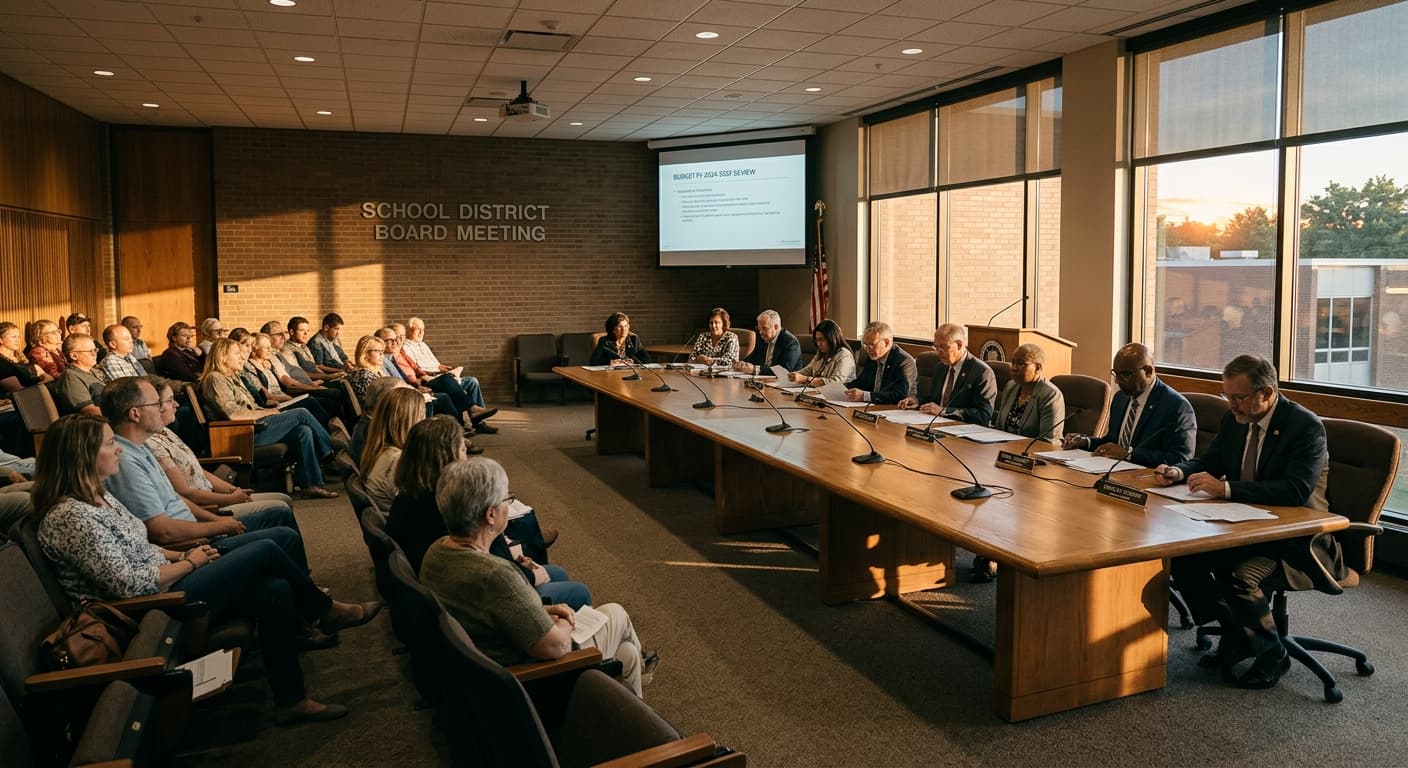
School board meetings in Connecticut are subject to the state's Freedom of Information Act (FOIA). As public meetings, they must be open to the public, and the public has the right to record them. This includes:
- Regular board of education meetings
- Special meetings
- Committee meetings where a quorum is present
The Connecticut Freedom of Information Commission enforces these rights.
Executive Sessions
School boards may enter executive session (closed meeting) for specific purposes defined by the FOIA, such as discussing personnel matters, student disciplinary hearings, or pending litigation. Recording is not permitted during executive sessions.
Virtual Learning and Remote Classroom Recording
Recording Virtual Classes
Virtual learning sessions conducted through Zoom, Google Meet, or similar platforms are treated as electronic communications under Connecticut law. CGS 52-570d applies, which is satisfied by consent of all participants, a recorded verbal notice at the start of the session, or a repeating audible tone warning.
Schools that record virtual classes must notify all participants and obtain consent. Most platforms provide a recording notification feature that alerts all participants when recording begins.
Teacher Recording of Virtual Sessions
Teachers who wish to record their own virtual classes for educational purposes must notify students and obtain consent. School district policies should address virtual class recording procedures and parental notification.
Practical Tips for Parents
- Check your school district's recording policy before recording at school
- For in-person meetings you attend, you have one-party consent rights under Connecticut law
- For phone calls with school staff, ask for consent before recording or follow up in writing
- For IEP meetings, consider informing the school you plan to record (to avoid disruption) even though you are not legally required to
- Be aware of FERPA when recordings may capture other students' information
- Back up important recordings immediately
- If your school has a no-recording policy that conflicts with your needs, consult with an education attorney
Practical Tips for Schools
- Develop clear recording policies that address students, parents, staff, and visitors
- Communicate policies in student handbooks, on the website, and at the start of each school year
- Install security cameras only in appropriate common areas
- Disable audio on all school surveillance cameras
- Ensure all camera systems comply with FERPA requirements
- Train staff on the interaction between state recording law and school policy
- Develop procedures for handling requests to record IEP and other meetings
- Comply with FOIA requirements for public school board meetings
More Connecticut Recording Laws
Audio Recording | Video Recording | Voyeurism & Hidden Cameras | Workplace Recording | Recording Police | Phone Call Recording | Security Cameras | Recording in Public | Landlord-Tenant | Dashcam Laws | Schools | Medical Recording
Back to Connecticut Recording Laws
More Connecticut Recording Topics
More Connecticut Laws
Frequently Asked Questions
Can parents record IEP meetings in Connecticut?
Because a present participant falls outside Connecticut's criminal eavesdropping offense (CGS 53a-189, which incorporates the definitions in CGS 53a-187), parents who attend IEP meetings in person may legally record them without notifying the school. However, individual school district policies may restrict or prohibit recording at IEP meetings. If a conflict arises between your state law right and school policy, consult with a special education advocate or attorney before the meeting.
Can students record teachers in Connecticut?
Students who participate in conversations with teachers may record those in-person interactions under the one-party consent rule. However, most Connecticut schools have policies restricting or prohibiting student recording on campus. Violating a school recording policy can result in disciplinary action, even if the recording was legal under state law. Check your school's student handbook for specific rules.
Can schools have security cameras in Connecticut?
Yes. Connecticut schools may install video surveillance cameras in common areas such as hallways, cafeterias, entrances, parking lots, and exterior areas. Installing a camera in a restroom, locker room, or changing area to secretly capture people can violate the voyeurism statute (CGS 53a-189a), which requires the camera be used with malice or with intent to arouse or satisfy sexual desire. Most schools disable audio on surveillance cameras to avoid recording consent issues.
Can I record a phone call with my child's teacher in Connecticut?
CGS 52-570d governs phone call recording in Connecticut and is satisfied by consent of all parties, a recorded verbal notice at the start of the call, or a repeating audible tone warning; for a personal call, getting the teacher's consent is typically the only practical option. If the teacher declines, alternatives include requesting an in-person meeting (where one-party consent applies), following up the call with a written email summary, or asking for important information in writing.
Does FERPA affect recording in Connecticut schools?
Yes. FERPA protects student education records, and recordings made in school settings that capture other students' educational information are subject to federal privacy rules. Parents should be careful not to share recordings from IEP meetings or other school interactions that may contain protected information about children other than their own. Schools may cite FERPA as a reason to restrict recording in certain settings.
Updates
Corrected the citation for Connecticut's in-person school-recording rule: the criminal eavesdropping offense is CGS 53a-189, and CGS 53a-187 is only the definitions section it relies on.
Independently fact-checked against the cited primary sources; governing law re-checked for recent changes
Corrected two claims: (1) phone calls with school staff are governed by CGS 52-570d's three compliance methods (consent, recorded notice, or tone warning), not consent alone; (2) the voyeurism statute (CGS 53a-189a) requires the camera be used with malice or intent to arouse/satisfy sexual desire, not mere camera placement in a sensitive area.
Corrected the intro sentence, a KeyTakeaways bullet, and a section heading that restated Connecticut's phone-call and school-camera consent rules in flat, overbroad terms after the body text and FAQ were already fixed to reflect the statutes' actual notice/tone-warning alternative and required intent element.
Governing law re-checked for recent changes
Reviewed and approved by an editor
The Law Behind This Article
This article rests on the statutory provisions below, held in our own legal record and retrieved from the official source. Tap a section to read the operative text.
Connecticut General Statutes, Title 53a (Penal Code), Chapter 952
§ 53a-189Eavesdropping: Class D felony.In forcecited in 16 of our articles
(a) A person is guilty of eavesdropping when he unlawfully engages in wiretapping or mechanical overhearing of a conversation. (b) Eavesdropping is a class D felony.
Official text (excerpt) · last checked 2026-08-31 · Read the full text in our law library · Verify at cga.ct.gov
Cited in 14 court opinions in our collectionLatest citing opinion in our collection: 2020
In the courts (editorial summary, independently checked):Washington v. Meachum (1996) held the eavesdropping statutes, section 53a-189 among them, are violated only when neither party to a call knows it is being monitored. State v. McLoughlin (1998), a trial court ruling on a scanner intercept, read 53a-189 to cover cordless calls, a question no Connecticut appellate court had decided.
Opinions citing this section in our collection:
- State v. McLoughlin (Connecticut Superior Court 1998, 45 Conn. Super. Ct. 497)“…on. Subsequently, the defendant was charged in violation of General Statutes § 53a-189, eavesdropping, which is a class D felo…”
- Rado v. Board of Education of the Borough of Naugatuck (Supreme Court of Connecticut 1990, 216 Conn. 541)✓A tenured teacher acquitted of eavesdropping was fired after a panel found he tampered with the school phone system to overhear staff calls; the court treated that conduct as proscribed by section 53a-189 and upheld the moral-misconduct finding.
- Washington v. Meachum (Supreme Court of Connecticut 1996, 238 Conn. 692)✓Inmates challenged prison rules allowing officials to monitor and record their nonprivileged phone calls; the Connecticut Supreme Court held the eavesdropping statutes are violated only when neither party knows the call is being monitored, so the noticed recording was lawful.
Identified automatically from the court opinions citing this section — not a ranking of which case controls.
Also relied on in: Connecticut Recording Laws (2026): Hybrid Consent Rules Explained, Connecticut Phone Call Recording Laws: All-Party Consent Rules and Penalties (2026), Connecticut Audio Recording Laws: Mixed Consent Rules and Penalties (2026)
§ 53a-187Definitions. Applicability.In forcecited in 18 of our articles
(a) The following definitions are applicable to sections 53a-188 and 53a-189: (1) “Wiretapping” means the intentional overhearing or recording of a telephonic or telegraphic communication or a communication made by cellular radio telephone by a person other than a sender or receiver thereof, without the consent of either the sender or receiver, by means of any instrument, device or equipment. The normal operation of a telephone or telegraph corporation and the normal use of the services and facilities furnished by such corporation pursuant to its tariffs shall not be deemed “wiretapping”. (2) “Mechanical overhearing of a conversation” means the intentional overhearing or recording of a conversation or discussion, without the consent of at least one party thereto, by a person not present thereat, by means of any instrument, device or equipment. (3) “Unlawfully” means not specifically authorized by law. For purposes of this section, “cellular radio telephone” means a wireless telephone authorized by the Federal Communications Commission to operate in the frequency bandwidth reserved for cellular radio telephones.
Official text (excerpt) · last checked 2026-07-29 · Read the full text in our law library · Verify at cga.ct.gov
Cited in 12 court opinions in our collectionLatest citing opinion in our collection: 2021
In the courts (editorial summary, independently checked):Connecticut courts read section 53a-187's definitions to reach only surreptitious, nonconsensual monitoring. State v. Grullon (1989) applied it to place one-party-consent recordings outside the eavesdropping statutes, and Washington v. Meachum (1996) held those statutes are violated only when neither party knows the call is monitored.
Opinions citing this section in our collection:
- State v. Grullon (Supreme Court of Connecticut 1989, 212 Conn. 195)✓Police recorded the defendant's calls with his brother, who consented; the court held that replacing the older wiretap penal statute with section 53a-187, which reaches recording only when no party consents, gave no reason to exclude the transcripts.
- Washington v. Meachum (Supreme Court of Connecticut 1996, 238 Conn. 692)✓Inmates challenged prison rules allowing nonprivileged collect calls to be monitored after posted signs, signed forms and a recurring tone; reading section 53a-187's consent-based definitions, the court held the eavesdropping statutes are violated only when neither party knows.
- State v. McVeigh (Supreme Court of Connecticut 1993, 224 Conn. 593)✓Police used a scanner in a neighbor's apartment to record a couple's cordless phone calls; the court rejected the State's argument that a 1989 amendment adding cellular phones to section 53a-187's wiretapping definition left cordless calls unprotected, and ordered suppression.
Identified automatically from the court opinions citing this section — not a ranking of which case controls.
Also relied on in: Connecticut Medical Recording Laws: Patients, Doctors, and HIPAA Rules (2026), Connecticut Laws on Recording Police: Your Rights and Limits (2026), Connecticut Laws on Recording in Public: What Is Legal (2026)
§ 53a-189aVoyeurism: Class D or C felony.In forcecited in 13 of our articles
(a) A person is guilty of voyeurism when, (1) with malice, such person knowingly photographs, films, videotapes or otherwise records the image of another person (A) without the knowledge and consent of such other person, (B) while such other person is not in plain view, and (C) under circumstances where such other person has a reasonable expectation of privacy, (2) with intent to arouse or satisfy the sexual desire of such person or any other person, such person knowingly photographs, films, videotapes or otherwise records the image of another person (A) without the knowledge and consent of such other person, (B) while such other person is not in plain view, and (C) under circumstances where such other person has a reasonable expectation of privacy, (3) with the intent to arouse or satisfy the sexual desire of such person, commits simple trespass, as provided in section 53a-110a, and observes, in other than a casual or cursory manner, another person (A) without the knowledge or consent of such other person, (B) while such other person is inside a dwelling, as defined in section 53a-100, and not in plain view, and (C) under circumstances where such other person has a reasonable…
Official text (excerpt) · last checked 2026-08-31 · Read the full text in our law library · Verify at cga.ct.gov
Cited in 6 court opinions in our collectionLatest citing opinion in our collection: 2026
In the courts (editorial summary, independently checked):In State v. Panek (2018) the Connecticut Supreme Court held that the 'not in plain view' element of section 53a-189a refers to the view of the general public, not of the person recording, and that the statute reaches a nonconsensual recording made in the victim's immediate presence. It rejected a vagueness challenge.
Opinions citing this section in our collection:
- State v. Panek (Supreme Court of Connecticut 2018, 328 Conn. 219)✓A man secretly recorded women during sexual encounters in his own home and argued they were in his plain view, so the voyeurism statute did not reach him; the Connecticut Supreme Court held the 'not in plain view' element refers to the public's view, reversing the dismissal.
- Middlesex Insurance v. Mara (District Court, D. Connecticut 2010, 699 F. Supp. 2d 439)✓Neighbors sued a homeowner for a campaign of harassment, including a voyeurism count under the statute for videotaping a woman; the federal court found every count alleged intentional acts excluded from his homeowner's policy and declared the insurer had no duty to defend.
- Project Veritas v. Michael Schmidt (Court of Appeals for the Ninth Circuit 2023, 72 F.4th 1043)“…ev. Stat. Ann. §§ 18-9-301(8), 18-9- 304(1)(a) Connecticut: Conn. Gen. Stat. Ann. § 53a-189a(a)(1); Connecticut v. Panek, 177 A.3d 1…”
Identified automatically from the court opinions citing this section — not a ranking of which case controls.
Also relied on in: Connecticut Security Camera Laws: Home, Business, and Workplace Rules (2026), Connecticut Video Recording Laws: Consent, Surveillance, and Privacy Rules (2026), Connecticut Voyeurism and Hidden Camera Laws: Penalties and Protections (2026)
Connecticut General Statutes, Title 52 (Civil Actions), Chapter 925
§ 52-570dAction for illegal recording of private telephonic communications.In forcecited in 21 of our articles
(a) No person shall use any instrument, device or equipment to record an oral private telephonic communication unless the use of such instrument, device or equipment (1) is preceded by consent of all parties to the communication and such prior consent either is obtained in writing or is part of, and obtained at the start of, the recording, or (2) is preceded by verbal notification which is recorded at the beginning and is part of the communication by the recording party, or (3) is accompanied by an automatic tone warning device which automatically produces a distinct signal that is repeated at intervals of approximately fifteen seconds during the communication while such instrument, device or equipment is in use.
Official text (excerpt) · last checked 2026-08-28 · Read the full text in our law library · Verify at cga.ct.gov
Cited in 22 court opinions in our collectionLatest citing opinion in our collection: 2024
In the courts (editorial summary, independently checked):Holler v. Buckley Broadcasting Corp. (1998) held section 52-570d creates a cause of action unknown at common law that is strictly construed, and does not reach a third party's rerecording of an already illegal tape. Jezouit v. Malloy (2019) held the statute does not waive the state's sovereign immunity from suit.
Opinions citing this section in our collection:
- Holler v. Buckley Broadcasting Corp. (Connecticut Appellate Court 1998, 47 Conn. App. 764)✓A girlfriend secretly taped a radio employee's call, and a coworker re-recorded that tape and used it to get him fired. The court held section 52-570d, strictly construed, bars taping a private call but not a third party's re-recording of an already illegal tape.
- Jezouit v. Malloy (Connecticut Appellate Court 2019, 193 Conn. App. 576)“…his complaint because (1) he brought his claim pursuant to General Statutes § 52-570d, which he contends waives sovereign imm…”
- State v. Skok (Supreme Court of Connecticut 2015)“…on without the consent of all parties to the communication. General Statutes § 52-570d (a) prohibits the use of ‘‘any instrume…”
Identified automatically from the court opinions citing this section — not a ranking of which case controls.
Also relied on in: Can I Sue Someone for Recording Me on Private or Public Property?, Connecticut Dashcam Laws: Mounting Rules, Audio Recording, and Evidence (2026), Connecticut Landlord-Tenant Recording and Surveillance Laws (2026)
Search our full record of US law — 2.1 million sections, every state + federal →
Sources and References
- Conn. Gen. Stat. 53a-187 - Eavesdropping Definitions(cga.ct.gov).gov
- Conn. Gen. Stat. 52-570d - Recording of Telephone Communications(cga.ct.gov).gov
- Conn. Gen. Stat. 53a-189a - Voyeurism(cga.ct.gov).gov
- Connecticut State Department of Education(portal.ct.gov).gov
- Connecticut Freedom of Information Commission(portal.ct.gov).gov
- FERPA - U.S. Department of Education(www2.ed.gov).gov
- Student Privacy Policy Office(studentprivacy.ed.gov).gov
- Conn. Gen. Stat. 53a-189 - Eavesdropping: Class D Felony(cga.ct.gov).gov