
Iowa
Iowa Windshield Mounting Laws (2026 Guide)
Independently fact-checked against primary sources (last audited August 17, 2026). · Reviewed by the RecordingLaw editorial team. · Law checked current as of August 7, 2026. · 13 primary sources cited on this page. How we verify our legal content
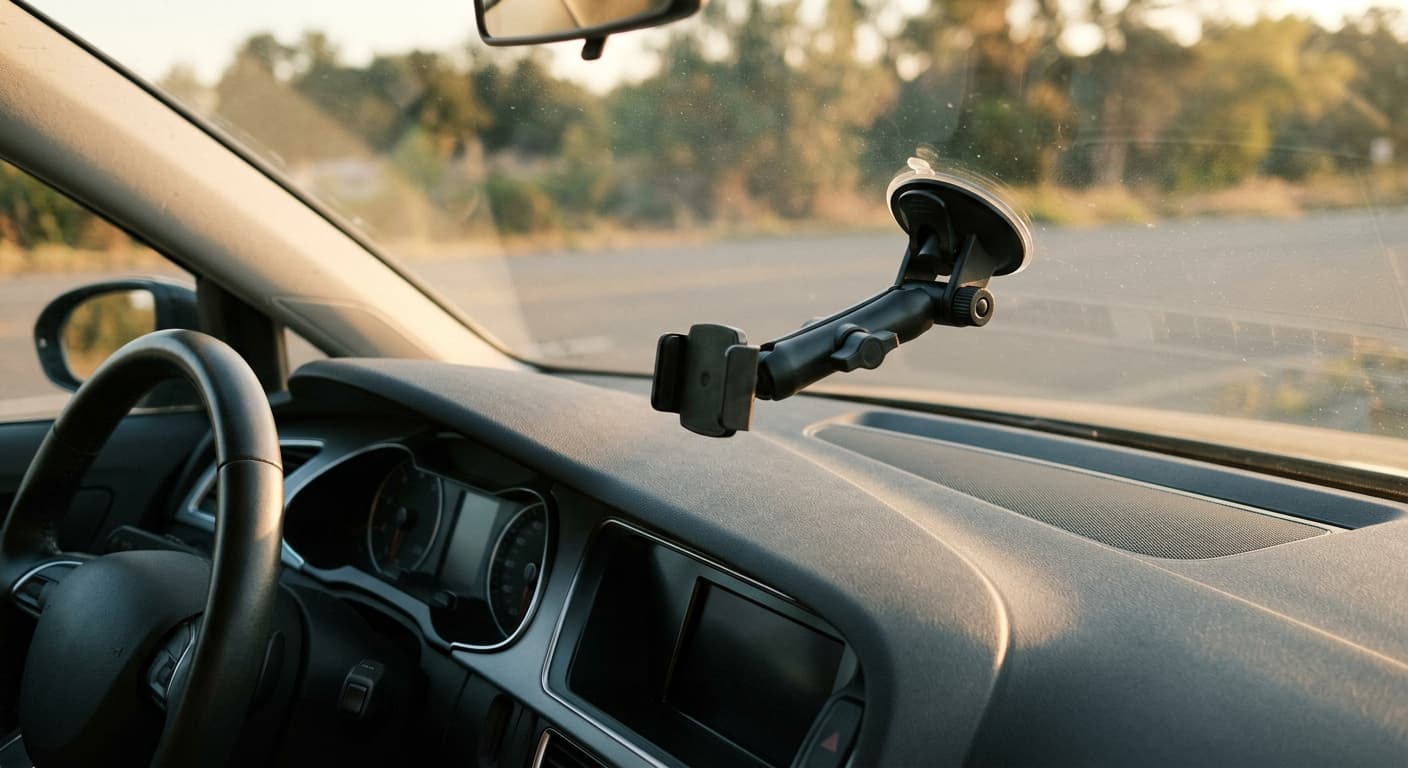
Iowa law does not ban dashcams, GPS units, or phone mounts from the windshield. Under Iowa Code 321.438, any windshield-mounted device is legal as long as it does not obstruct the driver's clear view of the road. Mount devices low and to the side to stay compliant.
Iowa does not have a specific statute that bans suction cup mounts or GPS devices on the windshield. Instead, Iowa uses a broad "clear vision" standard under Iowa Code 321.438 that applies to all windshield obstructions. Combined with the state's new hands-free driving law that took effect in 2025, Iowa drivers need to understand how both statutes interact when mounting phones, GPS units, and dashcams.
This guide covers the exact statutory language, penalties, exemptions, and practical advice for staying compliant with Iowa's windshield mounting and distracted driving laws.
Iowa Code 321.438: The Windshield Obstruction Statute
Iowa's primary windshield law is found in Iowa Code Section 321.438, titled "Windshields and windows." The statute has three subsections that govern what can and cannot appear on a vehicle's windshield.
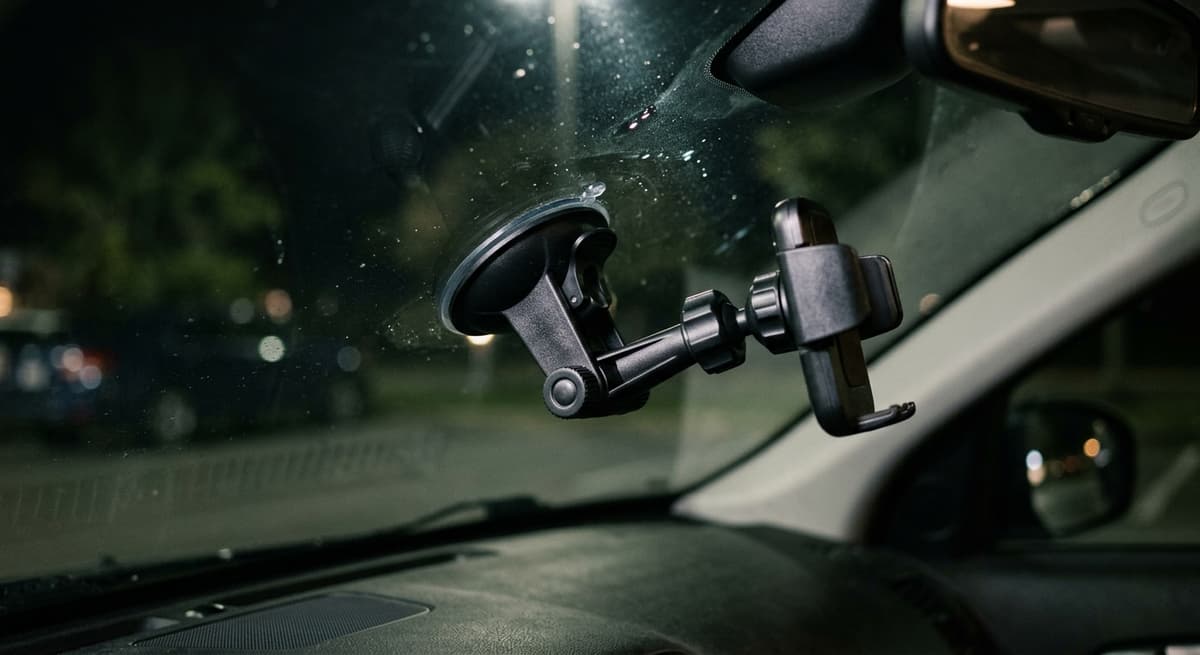
Subsection 1: The Clear Vision Requirement
The core provision states: "A person shall not drive a motor vehicle equipped with a windshield, sidewings, or side or rear windows which do not permit clear vision."
This language does not mention GPS units, phone mounts, dashcams, or suction cups by name. Instead, it establishes a general "clear vision" test. Any object mounted on the windshield is legal as long as it does not prevent the driver from having a clear view of the road.
This means the legality of a windshield-mounted device in Iowa depends on its placement and size. A small GPS unit mounted near the bottom corner of the windshield is far less likely to cause a problem than a large tablet mounted in the center of the windshield.
Subsection 2: Window Darkness and Reflectivity
The second subsection addresses tinting and reflective materials. It states that a person shall not operate a motor vehicle with a front windshield, a side window next to the driver, or a forward-facing sidewing that is "excessively dark or reflective so that it is difficult for a person outside the motor vehicle to see into the motor vehicle."
The Iowa Department of Transportation has adopted rules establishing a minimum measurable standard of transparency. For the front windshield and front side windows, the standard is 70% visible light transmittance (VLT). Back side windows and the rear window may use any level of darkness.
Law enforcement vehicles are exempt from this subsection when operation is part of official duties.
Subsection 3: Windshield Equipment Requirement
The third subsection requires that nearly all motor vehicles be equipped with a windshield that meets the safety glass specifications in Iowa Code 321.444. Motorcycles and certain other vehicles are exempt from this requirement.
Safety glass used in Iowa windshields must comply with federal motor vehicle safety standard number 205 as published in 49 C.F.R. Section 571.205.
GPS and Phone Mounts on the Windshield
Iowa law does not explicitly prohibit or allow GPS units and phone mounts on the windshield. The determination comes down to whether the device obstructs the driver's clear vision.
Several sources, including ProClip USA, classify Iowa as a state where suction cup windshield mounts are legal. This is because the statute does not contain an outright ban on nontransparent materials attached to the windshield. Other states, such as Illinois and Pennsylvania, have more restrictive language that specifically prohibits objects on the windshield.
Best Practices for Windshield Mounting in Iowa
To minimize the risk of a citation under Section 321.438:
- Mount devices as low and as far to the passenger side as possible
- Use the smallest mount that fits your device securely
- Keep the device out of the direct line of sight between the driver and the road ahead
- Consider dashboard or vent-clip mounts as alternatives to suction cup mounts
- Make sure the device does not block the view of traffic signals, signs, or pedestrians
- Remove the mount when it is not in use to avoid any question about obstruction
While suction cup mounts are not specifically banned, dashboard mounts and vent-clip mounts eliminate any legal risk under Section 321.438 entirely.
Dashcam Mounting Rules
Dashcams are legal in Iowa. The state does not have a separate statute addressing dashboard cameras. Dashcam legality falls under the same "clear vision" standard in Section 321.438.
The safest mounting location for a dashcam in Iowa is behind the rearview mirror. This position keeps the camera out of the driver's forward line of sight and captures a wide view of the road. Dashboard mounting is another option that avoids any windshield obstruction issue.
Iowa does not place size restrictions on windshield-mounted devices like some states do. For example, California limits devices to a 5-inch square in the lower driver-side corner or a 7-inch square in the lower passenger-side corner. Iowa has no such specific measurement. The standard remains whether the device blocks clear vision.
Iowa's Hands-Free Driving Law (SF 22)
Governor Kim Reynolds signed Senate File 22 into law on April 2, 2025, making Iowa the 31st state to enact hands-free legislation. The law took effect on July 1, 2025, with an educational warning period through December 31, 2025. Fines began on January 1, 2026.
What the Hands-Free Law Prohibits
Under the updated Iowa Code 321.276, drivers cannot:
- Hold a phone or electronic device while driving
- Manually type, scroll, or enter information (including GPS coordinates) while the vehicle is in motion
- Make calls without hands-free or voice-activated mode
- View or stream video content
- Read electronic messages or notifications
- Use a device even when stopped at a traffic light (unless the vehicle is completely off the traveled roadway)
What the Hands-Free Law Allows
Drivers may still:
- Make hands-free calls using Bluetooth, speakerphone, or voice commands
- Use a single touch to activate or deactivate a device or application
- Use voice commands to enter a GPS destination
- Use devices physically or electronically integrated into the vehicle (such as a built-in navigation system, provided the destination is entered before the vehicle is in motion)
- Use a phone mount, auxiliary cable, or wireless connection for hands-free operation
Key Definition: Voice-Activated or Hands-Free Mode
The law defines "voice-activated or hands-free mode" as "an attachment, accessory, application, wireless connection, or built-in feature of an electronic device or motor vehicle that allows a person to use verbal commands or a single touch to activate or deactivate the device."
This definition is important for phone mount users. A mounted phone that the driver operates using voice commands or a single tap is compliant. A mounted phone that the driver scrolls through or types on is not.
Hands-Free Law Exemptions
The following persons are exempt from the hands-free requirement:
- Members of a public safety agency performing official duties
- Healthcare professionals responding to an emergency situation
- Persons reporting an emergency, including continued communication with emergency personnel
- Operators of an implement of husbandry (farm equipment)
- Utility maintenance workers using devices in the course of their duties
- Persons receiving safety-related information including emergency, traffic, or weather alerts
Devices That Are Not Covered
The law excludes devices that are "physically or electronically integrated into a motor vehicle, including but not limited to an integrated global positioning system or navigation system when the destination is entered into such system before the vehicle is in motion."
This means factory-installed GPS systems are not subject to the hands-free law, provided the driver enters the destination before driving.
Penalties and Fines
Iowa has two separate penalty structures that may apply to windshield mounting situations.
Windshield Obstruction Penalties (Section 321.438)
A violation of Section 321.438 is a simple misdemeanor under Iowa Code 321.482, and it is a scheduled violation. Iowa Code 805.8A(3)(ai) sets the scheduled fine for Section 321.438 at $70, listing it under subsection 3, "Equipment violations."
Two statutory add-ons apply on top of that fine. Iowa Code 911.1(1) imposes a crime services surcharge "equal to fifteen percent of the fine," which is $10.50 on a $70 fine. Iowa Code 602.8106(1) sets court costs in scheduled violation cases at fifty-five dollars, whether or not a court appearance is required.
| Violation | Scheduled Fine | 15% Surcharge | Court Costs | Total |
|---|---|---|---|---|
| 321.438(1) Obstructed vision | $70 | $10.50 | $55 | $135.50 |
| 321.438(2) Dark window/windshield | $70 | $10.50 | $55 | $135.50 |
| 321.438(3) Windshield requirements | $70 | $10.50 | $55 | $135.50 |
Iowa does double some scheduled fines committed in road work zones, but that provision is narrower than it is often described. Iowa Code 805.8A(14)(i) doubles "the scheduled fine for any moving traffic violation under chapter 321." Section 321.438 is scheduled under subsection 3 as an equipment violation, alongside mufflers, wipers, tires, and safety glass, so a windshield obstruction citation is not a moving traffic violation and the doubling provision does not by its terms reach it. Local charging practice can vary, so ask the clerk of court what was actually assessed on a specific citation.
Hands-Free Law Penalties (Section 321.276)
The hands-free law carries a tiered penalty structure:
| Violation Type | Fine |
|---|---|
| Basic handheld device violation | $100 |
| Violation resulting in injury | $500 |
| Violation resulting in death | $1,000 |
The warning period ended on December 31, 2025. Since January 1, 2026, law enforcement issues fines rather than warnings.
Window Tinting Regulations
Iowa's window tinting standards are part of the same Section 321.438 framework. The Iowa DOT window tinting standards specify:
| Window Location | Minimum VLT |
|---|---|
| Front windshield | 70% |
| Front side windows | 70% |
| Back side windows | Any darkness |
| Rear window | Any darkness |
Reflective tint is allowed but must not be "excessively" reflective. Iowa law does not specify a numeric reflectivity limit. No specific tint film colors are banned.
Iowa does not require tint film manufacturers to certify their products for sale in the state. There is no sticker or marking requirement to identify legal tinting.
Medical Exemptions for Tinting
Iowa eliminated medical exemptions for darker window tinting in July 2012. The Iowa Department of Transportation stopped granting new medical exemptions at that time. Drivers who received an approved medical exemption before July 4, 2012, may continue to rely on that exemption.
Vehicle Inspection Stickers
Iowa does not require periodic safety inspections or emissions testing for most passenger vehicles. There is no inspection sticker to display on the windshield. Vehicle registration validation stickers are placed on the license plate, not the windshield.
This means Iowa drivers do not need to worry about accommodating an inspection sticker when choosing where to mount a device on the windshield.
How Iowa Compares to Neighboring States
Iowa's "clear vision" standard is less restrictive than some neighboring states. Illinois, for example, specifically prohibits objects on the windshield and has enacted explicit GPS mount placement rules. Minnesota and Nebraska use similar "clear vision" standards to Iowa.
The passage of the hands-free law in 2025 brought Iowa in line with the growing number of states that require hands-free device operation. As of 2026, 31 states plus the District of Columbia have enacted similar legislation.
More Iowa Laws
Frequently Asked Questions
Can I mount a GPS on my windshield in Iowa?
Iowa does not ban GPS mounts on the windshield. Under Iowa Code 321.438, the legal standard is whether the device obstructs the driver's clear vision. A GPS unit mounted in the lower corner of the windshield, away from the driver's direct line of sight, is generally considered compliant. Dashboard mounts are the safest alternative and eliminate any legal gray area.
Are dashcams legal on the windshield in Iowa?
Yes, dashcams are legal in Iowa. There is no separate statute addressing dashcams. The same clear vision standard under Iowa Code 321.438 applies. Mount the dashcam behind the rearview mirror or on the dashboard to avoid any obstruction issue.
What is the fine for a windshield obstruction in Iowa?
Iowa Code 805.8A(3)(ai) sets the scheduled fine for a Section 321.438 violation at $70. Adding the 15% crime services surcharge under Iowa Code 911.1 ($10.50) and the $55 court costs for a scheduled violation under Iowa Code 602.8106(1) brings the total to $135.50. Iowa's road work zone doubling applies to moving traffic violations under chapter 321, and 321.438 is scheduled as an equipment violation, so it does not by its terms apply here. Starting in 2026, a separate hands-free law violation for using a handheld device while driving carries a $100 fine.
Does Iowa's hands-free law affect how I use a mounted phone?
Yes. Under Iowa Code 321.276, effective July 1, 2025, drivers cannot hold, type on, scroll through, or manually enter GPS coordinates on a phone while driving. However, a phone in a mount used through voice commands or a single touch to activate hands-free features is compliant. Fines of $100 apply starting January 1, 2026.
Does Iowa allow aftermarket window tint on the windshield?
Iowa requires the front windshield and front side windows to allow at least 70% visible light transmittance. Tinting that meets this standard is legal. Back side windows and the rear window may use any darkness level. Iowa eliminated medical exemptions for darker tinting in July 2012.
Updates
Corrected the windshield obstruction penalty total to $135.50, itemized from the $70 scheduled fine, the 15% crime services surcharge and $55 court costs, and removed an unsupported claim that the fine doubles in road work zones.
Independently fact-checked against the cited primary sources
Governing law re-checked for recent changes
Reviewed and approved by an editor
The Law Behind This Article
This article rests on the statutory provisions below, held in our own legal record and retrieved from the official source. Tap a section to read the operative text.
Iowa Code, Chapter 321: MOTOR VEHICLES AND LAW OF THE ROAD
§ 321.438Windshields and windows.In forcecited in 4 of our articles
1. A person shall not drive a motor vehicle equipped with a windshield, sidewings, or side or rear windows which do not permit clear vision. 2. A person shall not operate on the highway a motor vehicle equipped with a front windshield, a side window to the immediate right or left of the driver, or a sidewing forward of and to the left or right of the driver which is excessively dark or reflective so that it is difficult for a person outside the motor vehicle to see into the motor vehicle through the windshield, window, or sidewing. a. The department shall adopt rules establishing a minimum measurable standard of transparency which shall apply to violations of this subsection. b. This subsection does not apply to a person who operates a motor vehicle owned or leased by a federal, state, or local law enforcement agency if the operation is part of the person’s official duties. 3. Every motor vehicle except a motorcycle, or a vehicle included in the provisions of section 321.383 or section 321.115 shall be equipped with a windshield in accordance with section 321.444.
Official text (excerpt) · last checked 2026-09-07 · Read the full text in our law library · Verify at legis.iowa.gov
Cited in 14 court opinions in our collectionLatest citing opinion in our collection: 2025
In the courts (editorial summary, independently checked):Iowa courts have applied section 321.438 mainly to validate traffic stops. State v. Aderholdt (1996) found an officer had reasonable cause to believe windows were tinted beyond subsection 2, and State of Iowa v. Gatkek Dual Lieth (2025) held a trooper's observation of a cracked windshield under subsection 1 gave probable cause to stop.
Opinions citing this section in our collection:
- State v. Aderholdt (Supreme Court of Iowa 1996, 545 N.W.2d 559)✓A trooper stopped a car whose occupants were unbelted and whose windows later metered at six percent light transmission; the court held he had reasonable cause to believe the tint exceeded what Iowa Code 321.438(2) permits, which helped justify the stop.
- State of Iowa v. Cassidy Jo Poage (Court of Appeals of Iowa 2025)“…his observation of the window-tint traffic violation. See Iowa Code §§ 321.438(2), 321.482 (2024). He also planned to…”
- State of Iowa v. Gatkek Dual Lieth (Court of Appeals of Iowa 2025)✓A trooper stopped the car Lieth rode in after seeing two windshield cracks, one in front of the driver's view; the court agreed that observing a violation of Iowa Code 321.438(1) gave probable cause for the stop, and treated his mistake-of-law argument as unpreserved.
Identified automatically from the court opinions citing this section — not a ranking of which case controls.
Also relied on in: Iowa Dashcam Laws: Recording Rules, Windshield Mounting, and Legal Limits (2026), Iowa Locks In 50% Front-Side Tint Floor: HF 766 Takes Effect July 1, Iowa Window Tint Laws (2026): Legal VLT Limits
§ 321.276Use of electronic device while driving.In force
1. For purposes of this section: a. “Electronic device” means a device that is powered by electricity, including by a battery, and that is capable of being used to compose, send, receive, or read an electronic message, or that is capable of storing, retrieving on-demand, or displaying videos, movies, broadcast television images, visual images, or audio or video data files. “Electronic device” includes but is not limited to a telephone including a cellular telephone, personal digital assistant, portable or mobile computer including a tablet, two-way messaging device, electronic gaming device, and any substantially similar portable device that is used to initiate, store, or receive electronic communication, information, or data. “Electronic device” does not include a device that is physically or electronically integrated into a motor vehicle, including but not limited to an integrated global positioning system or navigation system when the destination is entered into such system before the vehicle is in motion. b. “Use” includes but is not limited to holding, viewing, or manipulating an electronic device. c.
Official text (excerpt) · last checked 2026-07-29 · Read the full text in our law library · Verify at legis.iowa.gov
Cited in 1 court opinions in our collectionLatest citing opinion in our collection: 2021
Opinions citing this section in our collection:
- State of Iowa v. Steven Edward Struve (Supreme Court of Iowa 2021)“…of prohibiting all hands-on use of a cell phone. Instead, Iowa Code section 321.276 allows drivers to use cell phones for s…”
Identified automatically from the court opinions citing this section — not a ranking of which case controls.
§ 321.482Violations — simple misdemeanors unless otherwise provided.In force
It is a simple misdemeanor for a person to do an act forbidden or to fail to perform an act required by this chapter unless the violation is by this chapter or other law of this state declared to be a serious or aggravated misdemeanor or a felony. Chapter 232 has no application in the prosecution of offenses committed in violation of this chapter which are simple misdemeanors.
Official text (excerpt) · last checked 2026-07-29 · Read the full text in our law library · Verify at legis.iowa.gov
Cited in 12 court opinions in our collectionLatest citing opinion in our collection: 2021
Opinions citing this section in our collection:
- Iowa Supreme Court Attorney Disciplinary Board v. Howe (Supreme Court of Iowa 2005, 706 N.W.2d 360)“…d plead guilty to the amended citation. 2 See generally Iowa Code § 321.482 (2005) (stating violations of chapter…”
- State v. Cooley (Supreme Court of Iowa 1998, 587 N.W.2d 752)“…ode section 321.25, a simple misdemeanor. See Iowa Code § 321.482 (violation of any act governed by chap…”
- State v. Hartog (Supreme Court of Iowa 1989, 440 N.W.2d 852)“…provisions of Iowa Code section 321.555. See Iowa Code §§ 321.482 , 321.555(2), 805.-8(2)(c). Befo…”
Identified automatically from the court opinions citing this section — not a ranking of which case controls.
§ 321.444Safety glass.In force
1. No person shall sell any new motor vehicle nor shall any motor vehicle, manufactured since July 1, 1935, be registered, or operated unless such vehicle is equipped with safety glass wherever glass is used in doors, windows, and windshields. Replacements of glass in doors, windows, or windshields shall be of safety glass. 2. “Safety glass” means any product composed of glass, so manufactured, fabricated, or treated as substantially to prevent shattering and flying of the glass when struck or broken. Safety glass and glazing materials shall comply with federal motor vehicle safety standard number 205 as published in 49 C.F.R. §571.205.
Official text (excerpt) · last checked 2026-07-29 · Read the full text in our law library · Verify at legis.iowa.gov
Code of Federal Regulations Title 49
§ 571.205Standard No. 205, Glazing materials.In forcecited in 8 of our articles
S1. Scope. This standard specifies requirements for glazing materials for use in motor vehicles and motor vehicle equipment. S2. Purpose. The purpose of this standard is to reduce injuries resulting from impact to glazing surfaces, to ensure a necessary degree of transparency in motor vehicle windows for driver visibility, and to minimize the possibility of occupants being thrown through the vehicle windows in collisions. S3. Application. This standard applies to passenger cars, multipurpose passenger vehicles, trucks designed to carry at least one person, buses, motorcycles, slide-in campers, pickup covers designed to carry persons while in motion and low speed vehicles, and to glazing materials for use in those vehicles. S4. Definitions. Bullet resistant shield means a shield or barrier that is installed completely inside a motor vehicle behind and separate from glazing materials that independently comply with the requirements of this standard. Camper means a structure designed to be mounted in the cargo area of a truck, or attached to an incomplete vehicle with motive power, for the purpose of providing shelter for persons.
Official text (excerpt) · last checked 2026-07-28 · Read the full text in our law library · Verify at ecfr.gov
Cited in 34 court opinions in our collectionLatest citing opinion in our collection: 2024
In the courts (editorial summary, independently checked):O'Hara Ex Rel. H.O. v. General Motors Corp. (2007) held FMVSS 205, 49 CFR 571.205, does not preempt a state design claim seeking advanced side glazing. McCracken v. Ford Motor Co. (2008) read the same standard as mandatory rather than a floor, so a conflicting claim would be preempted, and denied dismissal only on that open question.
Opinions citing this section in our collection:
- O'Hara Ex Rel. H.O. v. General Motors Corp. (Court of Appeals for the Fifth Circuit 2007, 508 F.3d 753)✓A child was partially ejected through a Tahoe's tempered-glass side window in a rollover, and her parents claimed GM should have used advanced glazing; the court held FMVSS 205 is a minimum safety standard that does not preempt their common law claims.
- United States v. Ruel Antonio Wallace (Court of Appeals for the Ninth Circuit 2000, 213 F.3d 1216)“…uirements of Federal Motor Vehicle Safety Standard No. 205 (49 C.F.R. 571.205), including the specified minimum light…”
- McCracken v. Ford Motor Co. (District Court, E.D. Pennsylvania 2008, 588 F. Supp. 2d 635)✓A buyer blaming his thyroid cancer on radiation through his Fords' windshields said Lucite or leaded glass should have been used; treating FMVSS 205 as a mandatory standard, the court refused to dismiss on preemption because the pleadings did not show Lucite was unapproved.
Identified automatically from the court opinions citing this section — not a ranking of which case controls.
Also relied on in: California Windshield Mounting Laws (2026 Guide), Rhode Island Windshield Mounting Laws (2026 Guide), Louisiana Dashcam Laws: Mounting, Recording, and Evidence Rules
Search our full record of US law — 2.1 million sections, every state + federal →
Sources and References
- Iowa Code 321.438 - Windshields and windows(legis.iowa.gov).gov
- Iowa Code 321.276 - Use of electronic device while driving(legis.iowa.gov).gov
- Senate File 22 enrolled text(legis.iowa.gov).gov
- Governor Reynolds signs hands-free bill(governor.iowa.gov).gov
- Iowa DPS - Hands-Free Law announcement(dps.iowa.gov).gov
- Iowa Code 321.482 - Violations(legis.iowa.gov).gov
- Iowa Courts Compendium of Scheduled Violations 2024(iowacourts.gov).gov
- Iowa Code 321.444 - Safety glass(legis.iowa.gov).gov
- Iowa DOT window tinting standards(ia.iowadot.gov).gov
- Iowa DOT - Medical exemption for window tinting no longer granted(news.iowadot.gov).gov
- Iowa DOT vehicle registration(iowataxandtags.org).gov
- 49 CFR 571.205 - Federal safety glass standard(ecfr.gov).gov
- Iowa Capital Dispatch - Hands-free fines begin 2026(iowacapitaldispatch.com)
- SF 22 Chapter 14 Acts 91st GA(legis.iowa.gov).gov
- Iowa Code 805.8A - Motor vehicle and transportation scheduled violations(legis.iowa.gov)
- Iowa Code 911.1 - Crime services surcharge(legis.iowa.gov)
- Iowa Code 602.8106 - Collection of fees in criminal cases(legis.iowa.gov)