
Rhode Island
Rhode Island Windshield Mounting Laws (2026 Guide)
Independently fact-checked against primary sources (last audited August 17, 2026). · Reviewed by the RecordingLaw editorial team. · Law checked current as of August 9, 2026. · 12 primary sources cited on this page. How we verify our legal content
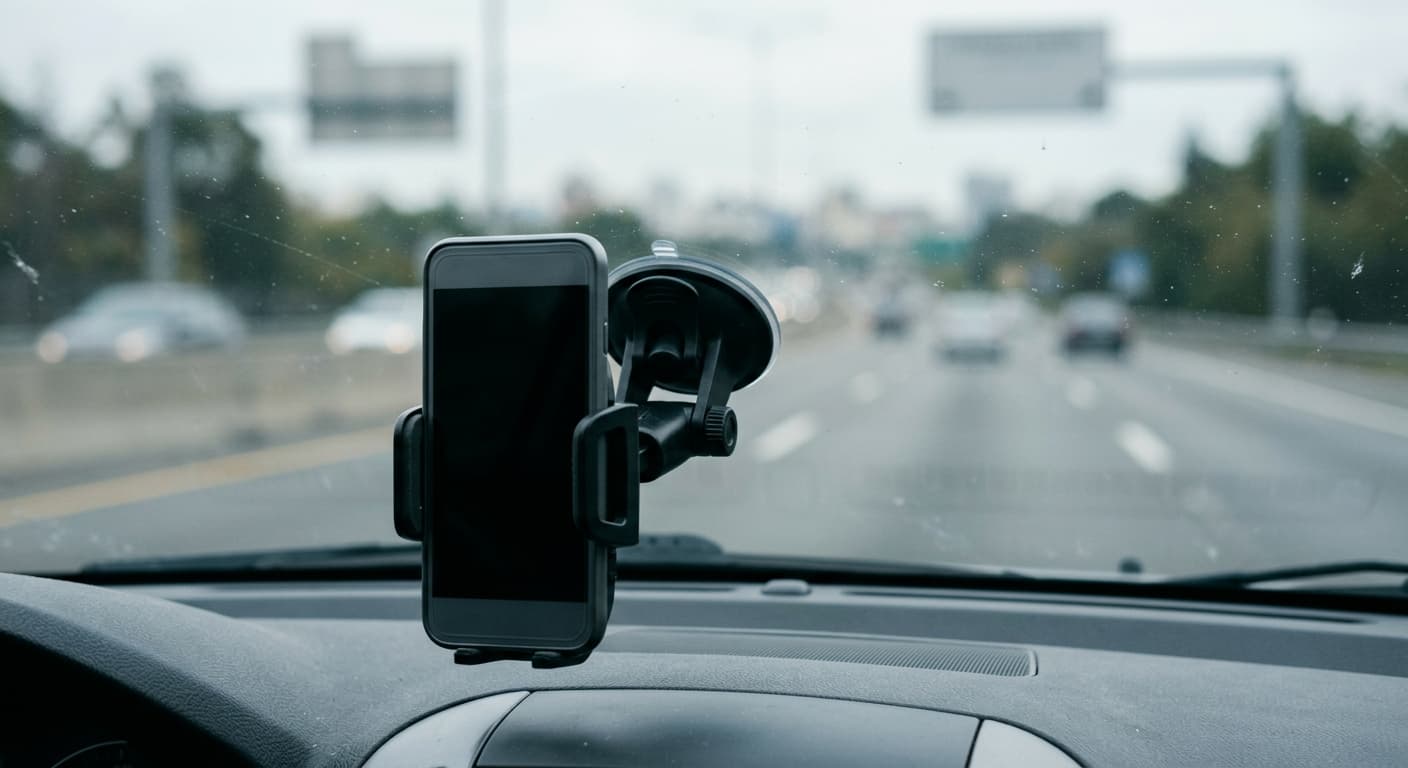
Rhode Island prohibits mounting GPS devices, phones, and dashcams on the windshield under R.I. Gen. Laws 31-23-16, which bars any nontransparent material that obstructs the driver's view. Dashboard mounts, vent clips, and console mounts are the legal alternatives for device placement in the state.
Rhode Island takes a strict approach to windshield clarity and device mounting. Unlike many states that carve out specific zones where drivers can attach GPS units, phones, or dashcams to the windshield glass, Rhode Island law broadly prohibits any nontransparent material on the windshield that blocks the driver's view.
This guide covers every statute that affects what you can and cannot mount on your windshield in Rhode Island, including device placement rules, window tint limits, the hands-free phone law, inspection requirements, and penalties.
Rhode Island Windshield Obstruction Law (R.I. Gen. Laws 31-23-16)
The primary statute governing windshield mounting in Rhode Island is R.I. Gen. Laws 31-23-16, titled "Windshield and window stickers -- Obstructions to clear view -- Snow and ice on vehicle."
What the Law Says
Section 31-23-16(a) states: "No person shall drive any motor vehicle with any sign, poster, or other nontransparent material, or dirt, snow, or ice upon the front windshield, side wings, or side or rear windows of the vehicle which obstructs the driver's clear view of the highway or any intersecting highway."
The phrase "other nontransparent material" is broad. It covers GPS mounts, phone holders, dashcams, suction cup devices, air fresheners, parking placards improperly placed, and any other object affixed to the windshield that is not transparent.
Authorized Stickers and Exceptions
The statute includes one exception: the administrator of the Division of Motor Vehicles may permit the placement of special stickers on the windshield or windows "in the manner specified by the administrator." Under Rhode Island's equipment inspection standards (280-RICR-30-15-3.5), the following items are authorized on the windshield:
| Authorized Item | Placement Rule |
|---|---|
| Current inspection approval sticker | Designated location per DMV rules |
| Emergency vehicle permit | As specified by the administrator |
| Utility stickers | Maximum 3 x 3.5 inches, placed in lower corners |
No provision in the statute or regulations authorizes GPS mounts, phone cradles, or dashcam suction cups on the windshield.
Snow and Ice Rule
Section 31-23-16(b) adds a separate requirement: no person shall drive with "significant amounts of snow or ice upon the vehicle." The term "significant" means any accumulation that could reasonably blow off the vehicle while driving and obscure another driver's vision. Natural snow accumulation during active adverse weather is exempted.
Can You Mount a GPS or Phone on the Windshield in Rhode Island?
No. Rhode Island does not provide a specific exemption for GPS devices, smartphones, or navigation units mounted to the windshield. The broad language of Section 31-23-16 treating any nontransparent material as a potential obstruction means that suction cup windshield mounts are effectively prohibited.
Legal Alternatives for Device Mounting
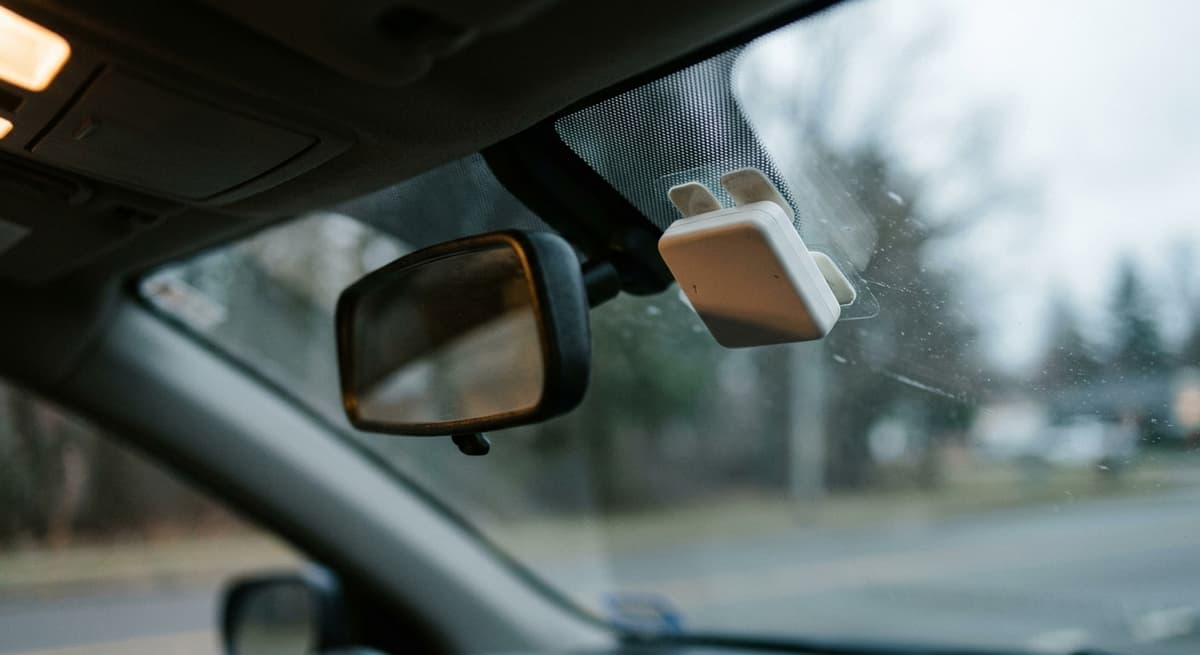
Since windshield mounting is restricted, Rhode Island drivers should use one of these alternatives:
- Dashboard mount: A vent clip, friction pad, or adhesive mount on the dashboard avoids the windshield entirely and keeps the device accessible for hands-free navigation
- Console mount: CD slot mounts or cup holder mounts position the device within easy view without touching the windshield
- Built-in vehicle systems: Factory-installed or aftermarket head unit navigation systems are not subject to windshield mounting rules
- Vent mount: Attaching a phone cradle to an air vent keeps the device at eye level without obstructing the windshield
Dashboard mounting is the most practical option for most drivers. It keeps the device in the driver's line of sight while fully complying with Rhode Island law.
Dashcam Laws in Rhode Island
Dashcams are legal to own and operate in Rhode Island, but how you mount them matters.
Mounting Requirements
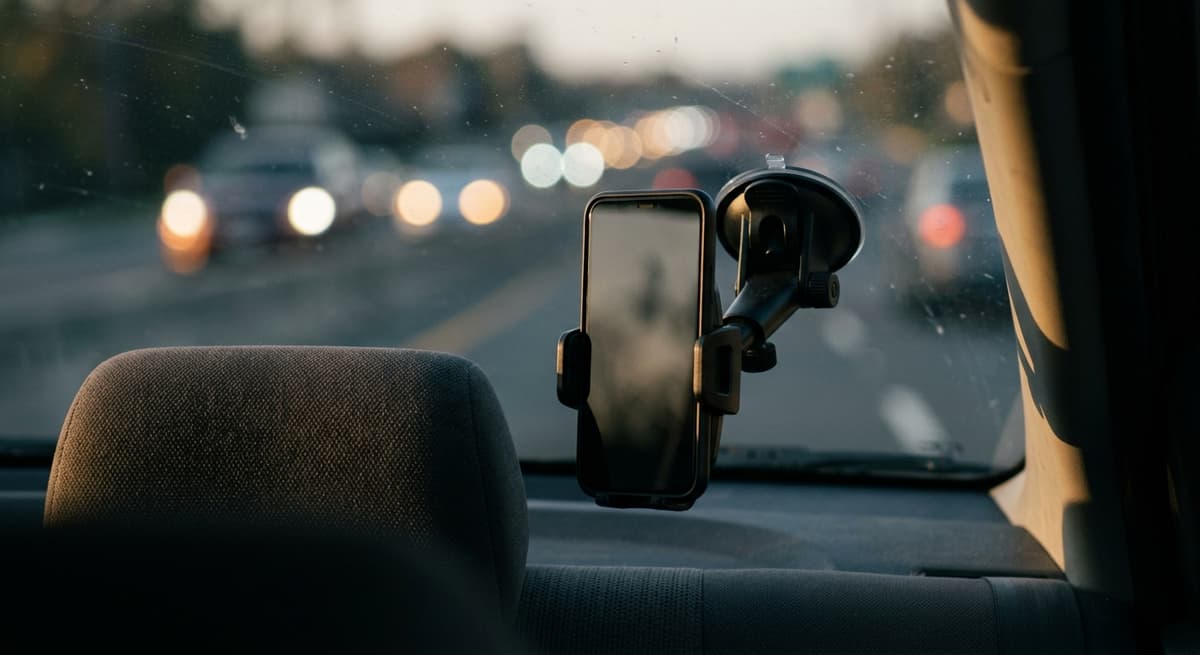
Because Rhode Island does not include an exemption for safety monitoring equipment on the windshield (unlike states such as Arizona or California), dashcam placement follows the same rules as any other device. A dashcam mounted with a suction cup on the windshield glass could be cited as a nontransparent obstruction under Section 31-23-16.
Legal dashcam mounting options include:
- Behind the rearview mirror, minimizing any view obstruction (this is the most common position, though it technically remains on the windshield)
- On the dashboard, using an adhesive or friction mount
- Hardwired into the vehicle with a discreet mounting location
Many Rhode Island drivers mount compact dashcams directly behind the rearview mirror, where the camera does not add any additional obstruction beyond what the mirror already creates. While this position is on the windshield glass, enforcement is focused on whether the device actually obstructs the driver's clear view.
Audio Recording Consent
Rhode Island is a one-party consent state for audio recording under R.I. Gen. Laws 11-35-21. This means you can legally record audio in your vehicle as long as you, the driver, are a party to the conversation.
If your dashcam records audio, it is legal to use in Rhode Island as long as you are present in the vehicle. Recording conversations between passengers without the consent of at least one participant would violate the wiretapping statute.
Video Recording on Public Roads
Video recording on public roads does not require consent from other drivers or pedestrians. People do not have a reasonable expectation of privacy on public highways. Dashcam video footage captured on Rhode Island roads is legal to record and can be used as evidence in insurance claims, accident investigations, and court proceedings.
Rhode Island Window Tint Laws (Chapter 31-23.3)
Rhode Island regulates window tinting under Chapter 31-23.3 of the General Laws, titled "Nontransparent Windshields and Windows." The state requires a minimum of 70% visible light transmittance (VLT) on nearly all windows, which is among the strictest standards in the United States.
VLT Requirements by Window
R.I. Gen. Laws 31-23.3-2 prohibits operating a vehicle with nontransparent or sunscreen material on the windshield, front side windows, rear side windows, or rear window unless the material meets the standards set by the DMV administrator.
| Window Position | Minimum VLT Required | Notes |
|---|---|---|
| Windshield | 70% VLT | Sunscreen material of at least 70% VLT is exempt under 31-23.3-4(3); a transparent strip may also cover the uppermost 6 inches under 31-23.3-4(4) |
| Front side windows (driver and passenger) | 70% VLT | Must allow at least 70% of visible light through |
| Rear side windows | 70% VLT for passenger vehicles | SUVs, trucks, and vans have different rules (see below) |
| Rear window | 70% VLT for passenger vehicles | SUVs, trucks, and vans have different rules (see below) |
Commercial and Multipurpose Vehicle Exception
Under R.I. Gen. Laws 31-23.3-4, sunscreen material may be used on the rear windows of trucks, buses, trailers, mobile homes, campers, and limousines without meeting the 70% VLT standard, provided the vehicle is equipped with dual side mirrors that offer a clear view to the rear.
This exemption applies only to rear and rear side windows. The windshield and front side windows must still meet the 70% VLT requirement regardless of vehicle type.
Windshield Tint Strip
Section 31-23.3-4(4) permits transparent material limited to the uppermost six inches of the windshield, provided the strip does not encroach upon the driver's direct forward viewing area as defined in the Federal Motor Vehicle Safety Standards. This allows for a standard tint strip (sometimes called a visor strip or "eyebrow") at the top of the windshield. A darker strip that is not transparent cannot rely on this exemption; below the top six inches, any sunscreen material on the windshield must meet the 70% VLT standard under Section 31-23.3-4(3).
Installer Label Requirement
Under R.I. Gen. Laws 31-23.3-3, any person who installs sunscreen material must affix a label on the front window that is no larger than 1.5 square inches. The label must include the installer's name and the light transmittance percentage. It must be placed in the lower left corner of the front window and be visible from outside the vehicle.
Reflectance Standards
The DMV administrator establishes rules and tests to measure both reflective and transmittance properties of window materials. Rhode Island does not publish a specific maximum reflectance percentage in the statute, but overly reflective or mirrored film that reduces visibility or creates glare for other drivers is prohibited.
Medical Exemptions for Window Tint
Rhode Island allows a medical exemption from the 70% VLT requirement under R.I. Gen. Laws 31-23.3-4. To qualify, you must:
- Have a physical condition that requires protection from direct sunlight
- Obtain an affidavit signed by a physician or optometrist licensed in Rhode Island
- Submit the Application for Medical Exemption (Window Tint) to the Division of Motor Vehicles
The original application must be submitted within 30 days of the physician's affidavit. Faxed copies are not accepted. Applications can be mailed or dropped off at the Cranston DMV at 600 New London Avenue, Cranston, RI 02920.
Upon approval, the DMV issues a sticker for the driver's side window or a certificate identifying the exemption.
The medical exemption does not apply to the windshield. Even with an approved exemption, the windshield must remain clear below the AS-1 line or the top six-inch tint strip.
Grandfathered Vehicles
Under R.I. Gen. Laws 31-23.3-6, vehicles with sunscreening material installed by the manufacturer before December 1, 1993, are not required to remove it, even if the tint would violate current standards.
Rhode Island Hands-Free Driving Law
Rhode Island's hands-free law directly affects how drivers use phones and devices in their vehicles, including how those devices are mounted.
Mobile Phone Use (R.I. Gen. Laws 31-22-31)
R.I. Gen. Laws 31-22-31 prohibits operating a motor vehicle while using a hand-held personal wireless communication device to engage in a call while the vehicle is in motion. The law took effect on June 1, 2018.
Under this statute, "using" means holding the device to or in the immediate proximity of the user's ear. An operator who holds a phone near their ear while the vehicle is in motion is presumed to be in violation.
Permitted activities include:
- Using a hands-free device (Bluetooth, speakerphone, earpiece using only one ear)
- Using a device that allows the operator to maintain both hands on the steering wheel
- Emergency calls to 911, hospitals, fire departments, or police
Exceptions apply to:
- On-duty peace officers, firefighters, and ambulance operators
- Taxi, tow truck, and bus drivers performing official duties
- Utility employees responding to emergencies
Text Messaging (R.I. Gen. Laws 31-22-30)
R.I. Gen. Laws 31-22-30 separately prohibits composing, reading, or sending text messages while driving. This law is broader than the phone call statute because it covers any use of the device for messaging purposes.
The texting law includes a specific exemption for GPS and navigation: activating GPS or navigation applications is permitted when the device is mounted for hands-free operation. This exemption confirms that using a properly mounted navigation device is legal, but the device must be mounted somewhere other than the windshield to comply with Section 31-23-16.
Hands-Free Law Penalties
| Offense | Fine | Additional Consequences |
|---|---|---|
| Hand-held phone call (any offense) | Up to $100 | First offense may be waived with proof of hands-free device purchase |
| Texting while driving (first offense) | $100 | Fine only; R.I. Gen. Laws 31-22-30 has no license-suspension provision |
| Texting while driving (second offense) | $150 | Fine only; R.I. Gen. Laws 31-22-30 has no license-suspension provision |
| Texting while driving (third+ offense) | $250 | Fine only; R.I. Gen. Laws 31-22-30 has no license-suspension provision |
Windshield Condition and Inspection Requirements
Rhode Island requires annual safety inspections for registered vehicles, and the condition of the windshield is a specific inspection item.
Safety Inspection Standards
Under 280-RICR-30-15-3.5, inspectors evaluate the windshield for damage that could impair visibility:
| Condition | Pass or Fail |
|---|---|
| Minor crack with no separation | Pass (if not in the driver's critical vision area) |
| Crack in the AS-1 area in front of the driver, within the wiper sweep | Fail |
| Loose crack where glass can move | Fail |
| Compromised inner safety seal | Fail |
| Chip or crack smaller than 3/4 inch, not within 3 inches of another crack | Pass |
| Multiple connected cracks or spidering in the center area | Fail |
All windshield glass must be approved safety glass meeting federal standards under 49 CFR 571.205. Glass marked "AS-1" may be used for windshields, while "AS-2" glass cannot.
Windshield Wiper Requirements
Under R.I. Gen. Laws 31-23-17, every motor vehicle must have functioning windshield wipers that the driver can control and that are capable of removing rain, snow, and other moisture from the windshield.
Failed Inspection Process
If your vehicle fails inspection due to a windshield issue, you have 30 days to return to the same station for a free retest after making repairs. Vehicles that fail and are driven on public roads can be subject to additional fines. A minimum of $35 in court costs plus a $25 fee may apply even if a citation is dismissed.
Commercial Vehicle Windshield Rules
Commercial motor vehicles operating in Rhode Island must comply with both state law and federal regulations from the Federal Motor Carrier Safety Administration (FMCSA).
The FMCSA final rule effective May 6, 2022, amended 49 CFR 393.60(e) to expand the authorized mounting area for vehicle safety technology on commercial motor vehicle windshields. Under the federal rule, devices may be mounted within an area up to 8.5 inches below the upper edge of the windshield wiper sweep area.
Covered devices under the federal rule include:
- Driver camera systems (dashcams)
- Braking warning and assist systems
- Lane departure warning systems
- GPS and navigation systems
- Traffic sign recognition systems
For commercial vehicles, federal preemption means the FMCSA rule may override the state restriction for qualifying safety technology. However, the device still must not obstruct the driver's field of view, and drivers should be aware that Rhode Island state police may interpret the laws differently for non-safety commercial devices.
Penalties for Windshield Violations
Rhode Island imposes the following penalties for windshield-related violations:
| Violation | Statute | Fine |
|---|---|---|
| Windshield obstruction (nontransparent material, stickers) | R.I. Gen. Laws 31-23-16 | $100 |
| Window tint violation (installer) | R.I. Gen. Laws 31-23.3-5 | Up to $250 |
| Window tint violation (vehicle owner) | R.I. Gen. Laws 31-23.3-5 | Up to $250 |
| Snow/ice on vehicle | R.I. Gen. Laws 31-23-16(b) | $100 |
| Hand-held phone use while driving | R.I. Gen. Laws 31-22-31 | Up to $100 |
Windshield obstruction fines are set by the Schedule of Violations under R.I. Gen. Laws 31-41.1-4. Violations are handled by the Rhode Island Traffic Tribunal or municipal court.
Window tint violations carry penalties for both the installer and the vehicle owner. Under Section 31-23.3-5, any person, firm, corporation, or business entity that installs non-compliant sunscreening material faces fines up to $250. Vehicle owners operating with non-compliant tint also face fines up to $250.
Summary of Rhode Island Windshield Mounting Rules
| Device Type | Windshield Mounting | Legal Alternative | Key Statute |
|---|---|---|---|
| GPS / Navigation | Not permitted | Dashboard mount, vent mount, console mount | R.I. Gen. Laws 31-23-16 |
| Phone mount (hands-free) | Not permitted | Dashboard mount, vent mount | R.I. Gen. Laws 31-23-16, 31-22-31 |
| Dashcam | Not recommended (risk of citation) | Behind rearview mirror (minimized obstruction), dashboard | R.I. Gen. Laws 31-23-16 |
| Toll transponder | Only authorized stickers in lower corners | Follow DMV-specified placement | R.I. Gen. Laws 31-23-16 |
| Tint strip | Top 6 inches or above AS-1 line only | Transparent material only | R.I. Gen. Laws 31-23.3-4 |
| Parking sticker | Only authorized stickers per DMV rules | Lower corner utility sticker placement | 280-RICR-30-15-3.5 |
More Rhode Island Laws
Frequently Asked Questions
Can I mount a GPS or phone on my windshield in Rhode Island?
No. Rhode Island law (R.I. Gen. Laws 31-23-16) prohibits any nontransparent material on the windshield that obstructs the driver's clear view. Unlike states such as Arizona or California, Rhode Island does not designate specific zones on the windshield where devices may be placed. The legal alternatives are dashboard mounts, vent clips, or console mounts.
Is it legal to use a dashcam in Rhode Island?
Yes, dashcams are legal in Rhode Island. However, mounting one on the windshield with a suction cup carries the risk of a citation under the windshield obstruction law. The safest approach is to mount a compact dashcam behind the rearview mirror where it adds minimal obstruction, or on the dashboard. Rhode Island is a one-party consent state, so audio recording with a dashcam is legal as long as you are present.
What is the window tint limit in Rhode Island?
Rhode Island requires a minimum of 70% visible light transmittance (VLT) on all windows for passenger vehicles, including the windshield, which is one of the strictest standards in the country. Under R.I. Gen. Laws 31-23.3-4, sunscreen material of at least 70% VLT is exempt on the windshield and front side windows, and a transparent strip may additionally cover the uppermost 6 inches of the windshield. Trucks, SUVs, buses, and limousines may have darker tint on rear windows if the vehicle has dual side mirrors.
What is the penalty for a windshield obstruction ticket in Rhode Island?
A violation of R.I. Gen. Laws 31-23-16 (windshield obstruction) carries a $100 fine under the Rhode Island traffic violation schedule. Window tint violations under Chapter 31-23.3 carry separate fines of up to $250 for both the vehicle owner and the installer of non-compliant material.
Can I get a medical exemption for darker window tint in Rhode Island?
Yes, but not for the windshield. Under R.I. Gen. Laws 31-23.3-4, a physician or optometrist must sign an affidavit confirming you have a medical condition requiring protection from sunlight. You submit the Application for Medical Exemption to the DMV within 30 days of the affidavit. The DMV issues an identification sticker for the driver's side window. The exemption covers side and rear windows only.
Updates
Removed an unsupported statement that drivers under 18 face a total mobile-device ban, and corrected the windshield tint entry to reflect the 70 percent VLT exemption in R.I. Gen. Laws 31-23.3-4.
Independently fact-checked against the cited primary sources
Removed fabricated license-suspension penalties (up to 30 days/3 months/6 months) for R.I. Gen. Laws 31-22-30 texting-while-driving violations; the statute's penalty clause is fines only ($100/$150/$250 for 1st/2nd/3rd+ offense) with no suspension provision.
Governing law re-checked for recent changes
Reviewed and approved by an editor
The Law Behind This Article
This article rests on the statutory provisions below, held in our own legal record and retrieved from the official source. Tap a section to read the operative text.
Rhode Island General Laws, Title 31: Motor and Other Vehicles, Chapter 31-23: Equipment and Accessories Generally
§ 31-23-16Windshield and window stickers — Obstructions to clear view — Snow and ice on vehicleIn force
(a) No person shall drive any motor vehicle with any sign, poster, or other nontransparent material, or dirt, snow, or ice upon the front windshield, side wings, or side or rear windows of the vehicle which obstructs the driver’s clear view of the highway or any intersecting highway; provided, that the administrator of the division of motor vehicles may permit the placing of special stickers upon the windshield or any of the windows of a motor vehicle in the manner specified by the administrator of the division of motor vehicles. (b) No person shall drive any motor vehicle with any significant amounts of snow or ice upon the vehicle. The term “significant” is construed as any amount of accumulation which might reasonably be expected, when blowing off the vehicle while driving, to obscure the vision of an operator of another vehicle. However, the natural accumulation of snow while driving during adverse weather conditions shall not constitute a violation of this section. Violations of this section are subject to fines enumerated in § 31-41.1-4.
Official text (excerpt) · last checked 2026-09-08 · Read the full text in our law library · Verify at webserver.rilegislature.gov
Rhode Island General Laws, Title 31: Motor and Other Vehicles, Chapter 31-23.3: Nontransparent Windshields and Windows
§ 31-23.3-2Windshields and windows obscured by nontransparent materialsIn forcecited in 2 of our articles
No person shall own and operate any motor vehicle upon any public highway, road or street with nontransparent or sunscreen material, window application, reflective film or non-reflective film used in any way to cover or treat the front windshield, the side windows immediately adjacent to the right and left of the operator’s seat, the side windows immediately to the rear of the operator’s seat and the front passenger seat and the rear window unless this vehicle meets one of the criteria set forth in § 31-23.3-3.
Official text (excerpt) · last checked 2026-09-01 · Read the full text in our law library · Verify at webserver.rilegislature.gov
Also relied on in: Rhode Island Window Tint Laws (2026): Legal VLT Limits
§ 31-23.3-4ExemptionsIn force
The provisions of this chapter shall not apply to: (1) Motor vehicles manufactured with windshields and window glass areas equipped in accordance with specifications of 49 CFR 571.205 as authorized by 15 U.S.C. § 1407. (2) Motor vehicles owned or leased by federal, state and local law enforcement agencies. (3) The use of nontransparent or sunscreen material or window application on motor vehicles which has a total visible light transmittance of not less than seventy percent (70%) measured perpendicular to the surface of the glass on the windshield and side windows immediately adjacent to the right and left of the operator’s seat, the side windows immediately to the rear of the operator’s seat and the front passenger seat or on the rear window if the vehicle is equipped with two (2) outside mirrors, one on each side, adjusted so that the driver has a clear view of the highway behind the vehicle.
Official text (excerpt) · last checked 2026-07-30 · Read the full text in our law library · Verify at webserver.rilegislature.gov
§ 31-23.3-3Rules and regulations authorized — Administrator of the division of motor vehiclesIn force
(a) The administrator of the division of motor vehicles shall establish rules and regulations to provide standards and tests to measure the percentage of reflective and transmittance of light. (b) Any person, firm, corporation, or other entity installing such a sunscreen device on a motor vehicle shall provide and affix a label to the front window not to exceed one and one-half (1½) square inches in size, which contains the installer’s name and the percentage of light transmittance. Facing the motor vehicle from the outside, the label shall be placed in the lower left corner of the front window.
Official text (excerpt) · last checked 2026-07-30 · Read the full text in our law library · Verify at webserver.rilegislature.gov
§ 31-23.3-5PenaltiesIn force
(a) Any person, firm, corporation, or other business entity that installs any sunscreening material which is not in compliance with the provisions of this chapter shall be fined not more than two hundred fifty dollars ($250) for each offense. (b) Any person who owns a motor vehicle which has installed on it any sunscreening device or material in violation of this chapter shall be fined not more than two hundred fifty dollars ($250).
Official text (excerpt) · last checked 2026-07-30 · Read the full text in our law library · Verify at webserver.rilegislature.gov
§ 31-23.3-6Vehicles with existing sunscreening materialsIn force
The owners of all motor vehicles who have sunscreening material in their motor vehicle in violation of the provisions of this chapter may be found in violation of the provisions of this chapter; provided, an owner of a motor vehicle shall not be required to remove any sunscreening material if that material was initially installed by the motor vehicle manufacturer and was purchased prior to December 1, 1993.
Official text (excerpt) · last checked 2026-07-30 · Read the full text in our law library · Verify at webserver.rilegislature.gov
Rhode Island General Laws, Title 31: Motor and Other Vehicles, Chapter 31-22: Miscellaneous Rules
§ 31-22-31Mobile telephone usage by motor vehicle operatorsIn force
(a) For purposes of this section, the following terms shall have the following meanings: (1) “Engage in a call” means talking into or listening on a hand-held personal wireless communication device, but does not include holding a hand-held personal wireless communication device to activate, deactivate, or initiate a function of such telephone. (2) “Hand-held personal wireless communication device” means a personal wireless communication device with which a user engages in a call using at least one hand. (3) “Hands-free accessory” means an attachment, add-on, built-in feature, or addition to a personal wireless communication device, whether or not permanently installed in a motor vehicle, that, when used, allows the vehicle operator to maintain both hands on the steering wheel.
Official text (excerpt) · last checked 2026-07-30 · Read the full text in our law library · Verify at webserver.rilegislature.gov
§ 31-22-30Distracted driving prohibited while operating a motor vehicleIn force
(a) For purposes of this section, the following terms shall have the following meanings: (1) “Driving” means operating a motor vehicle on a public road, including operation while temporarily stationary because of traffic, a traffic light or stop sign, or otherwise, but does not include operating a motor vehicle when the vehicle has pulled over to the side of, or off, an active roadway and has stopped in a location where it can safely remain stationary. (2) “Hands free” means the manner in which a wireless handset is operated by using an internal feature or function, or through an attachment or addition, including, but not limited to, an earpiece, headset, remote microphone, or short-range wireless connection, thereby allowing the user to operate said device without the use of hands, except to activate, deactivate, or initiate a feature or function thereof. (3) “Inoperability” means a motor vehicle that is incapable of being operated or being operated in a safe and prudent manner due to mechanical failure, including, but not limited to, engine overheating or tire failure.
Official text (excerpt) · last checked 2026-07-30 · Read the full text in our law library · Verify at webserver.rilegislature.gov
Code of Federal Regulations Title 49
§ 393.60Glazing in specified openings.In forcecited in 15 of our articles
(a) Glazing material. Glazing material used in windshields, windows, and doors on a motor vehicle manufactured on or after December 25, 1968, shall at a minimum meet the requirements of Federal Motor Vehicle Safety Standard (FMVSS) No. 205 in effect on the date of manufacture of the motor vehicle. The glazing material shall be marked in accordance with FMVSS No. 205 (49 CFR 571.205, S6). (b) Windshields required. Each bus, truck and truck-tractor shall be equipped with a windshield. Each windshield or portion of a multi-piece windshield shall be mounted using the full periphery of the glazing material. (c) Windshield condition. With the exception of the conditions listed in paragraphs (c)(1), (c)(2), and (c)(3) of this section, each windshield shall be free of discoloration or damage in the area extending upward from the height of the top of the steering wheel (excluding a 51 mm (2 inch) border at the top of the windshield) and extending from a 25 mm (1 inch) border at each side of the windshield or windshield panel.
Official text (excerpt) · last checked 2026-07-28 · Read the full text in our law library · Verify at ecfr.gov
Cited in 3 court opinions in our collectionLatest citing opinion in our collection: 2021
In the courts (editorial summary, independently checked):The 70 percent light transmittance floor of 49 CFR 393.60(d) covers the windshield and the windows immediately right and left of the driver. Grooms Hauling, LLC v. Robinson (2020) applied it through Pennsylvania adoption and rejected racial profiling claims over tint citations; State v. Ford (2021) noted that Kansas adopts it too.
Opinions citing this section in our collection:
- United States of America, Government v. Robert L. Pierre, Defendant (District Court, D. New Hampshire 2015, 2015 DNH 083)“…rallel luminous transmittance of not less than 70 percent.” 49 C.F.R. 393.60(c). Neither the Government nor the defe…”
- GROOMS HAULING, LLC v. ROBINSON (District Court, E.D. Pennsylvania 2020)✓Officers repeatedly cited a Black-owned hauling company whose truck windows passed only 17 to 20 percent of light; treating 49 CFR 393.60's 70 percent transmittance standard as the governing rule, the court granted the officers summary judgment on the profiling claims.
- State v. Ford (Court of Appeals of Kansas 2021)“…Relevant to this appeal are regulations on window tinting (49 C.F.R. § 393.60[d]), medical examiner certificates (49…”
Identified automatically from the court opinions citing this section — not a ranking of which case controls.
Also relied on in: Connecticut Windshield Mounting Laws (2026 Guide), Idaho Windshield Mounting Laws (2026 Guide), Kansas Windshield Mounting Laws (2026 Guide)
§ 571.205Standard No. 205, Glazing materials.In forcecited in 8 of our articles
S1. Scope. This standard specifies requirements for glazing materials for use in motor vehicles and motor vehicle equipment. S2. Purpose. The purpose of this standard is to reduce injuries resulting from impact to glazing surfaces, to ensure a necessary degree of transparency in motor vehicle windows for driver visibility, and to minimize the possibility of occupants being thrown through the vehicle windows in collisions. S3. Application. This standard applies to passenger cars, multipurpose passenger vehicles, trucks designed to carry at least one person, buses, motorcycles, slide-in campers, pickup covers designed to carry persons while in motion and low speed vehicles, and to glazing materials for use in those vehicles. S4. Definitions. Bullet resistant shield means a shield or barrier that is installed completely inside a motor vehicle behind and separate from glazing materials that independently comply with the requirements of this standard. Camper means a structure designed to be mounted in the cargo area of a truck, or attached to an incomplete vehicle with motive power, for the purpose of providing shelter for persons.
Official text (excerpt) · last checked 2026-07-28 · Read the full text in our law library · Verify at ecfr.gov
Cited in 34 court opinions in our collectionLatest citing opinion in our collection: 2024
In the courts (editorial summary, independently checked):O'Hara Ex Rel. H.O. v. General Motors Corp. (2007) held FMVSS 205, 49 CFR 571.205, does not preempt a state design claim seeking advanced side glazing. McCracken v. Ford Motor Co. (2008) read the same standard as mandatory rather than a floor, so a conflicting claim would be preempted, and denied dismissal only on that open question.
Opinions citing this section in our collection:
- O'Hara Ex Rel. H.O. v. General Motors Corp. (Court of Appeals for the Fifth Circuit 2007, 508 F.3d 753)✓A child was partially ejected through a Tahoe's tempered-glass side window in a rollover, and her parents claimed GM should have used advanced glazing; the court held FMVSS 205 is a minimum safety standard that does not preempt their common law claims.
- United States v. Ruel Antonio Wallace (Court of Appeals for the Ninth Circuit 2000, 213 F.3d 1216)“…uirements of Federal Motor Vehicle Safety Standard No. 205 (49 C.F.R. 571.205), including the specified minimum light…”
- McCracken v. Ford Motor Co. (District Court, E.D. Pennsylvania 2008, 588 F. Supp. 2d 635)✓A buyer blaming his thyroid cancer on radiation through his Fords' windshields said Lucite or leaded glass should have been used; treating FMVSS 205 as a mandatory standard, the court refused to dismiss on preemption because the pleadings did not show Lucite was unapproved.
Identified automatically from the court opinions citing this section — not a ranking of which case controls.
Also relied on in: Iowa Windshield Mounting Laws (2026 Guide), California Windshield Mounting Laws (2026 Guide), Louisiana Dashcam Laws: Mounting, Recording, and Evidence Rules
Rhode Island General Laws, Title 31: Motor and Other Vehicles, Chapter 31-41.1: Adjudication of Traffic Offenses
§ 31-41.1-4Schedule of violationsIn force
(a) The penalties for violations of the enumerated sections, listed in numerical order, correspond to the fines described. However, those offenses for which punishments may vary according to the severity of the offense, or punishment that requires the violator to perform a service, shall be heard and decided by the traffic tribunal or municipal court. The following violations may be handled administratively through the method prescribed in this chapter. This list is not exclusive and jurisdiction may be conferred on the traffic tribunal with regard to other violations.
Official text (excerpt) · last checked 2026-07-30 · Read the full text in our law library · Verify at webserver.rilegislature.gov
Search our full record of US law — 2.1 million sections, every state + federal →
Sources and References
- R.I. Gen. Laws 31-23-16 - Windshield and window stickers; Obstructions to clear view; Snow and ice on vehicle(webserver.rilegislature.gov).gov
- R.I. Gen. Laws 31-23.3-2 - Windshields and windows obscured by nontransparent materials(webserver.rilegislature.gov).gov
- R.I. Gen. Laws 31-23.3-3 - Rules and regulations authorized; Administrator of the division of motor vehicles(webserver.rilegislature.gov).gov
- R.I. Gen. Laws 31-23.3-4 - Exemptions (including medical exemption)(webserver.rilegislature.gov).gov
- R.I. Gen. Laws 31-23.3-5 - Penalties for nontransparent windshield and window violations(webserver.rilegislature.gov).gov
- R.I. Gen. Laws 31-23.3-6 - Vehicles with existing sunscreening materials (grandfathered)(webserver.rilegislature.gov).gov
- R.I. Gen. Laws 31-22-31 - Mobile telephone usage by motor vehicle operators (hands-free law)(webserver.rilegislature.gov).gov
- R.I. Gen. Laws 31-22-30 - Text messaging while operating a motor vehicle(webserver.rilegislature.gov).gov
- R.I. Gen. Laws 31-41.1-4 - Schedule of violations (traffic fine amounts)(webserver.rilegislature.gov).gov
- 280-RICR-30-15-3.5 - Rhode Island Equipment Inspection Standards(law.cornell.edu)
- Rhode Island Department of Transportation - Hands-Free Law Information(dot.ri.gov).gov
- Rhode Island DMV - Application for Medical Exemption (Window Tint)(dmv.ri.gov).gov
- FMCSA Final Rule - Authorized Windshield Area for Vehicle Safety Technology (49 CFR 393.60)(federalregister.gov).gov