
Florida
Florida Workplace Recording Laws: Employee and Employer Rules (2026)
Independently fact-checked against primary sources (last audited August 22, 2026). · Reviewed by the RecordingLaw editorial team. · Law checked current as of August 22, 2026. · 7 primary sources cited on this page. How we verify our legal content
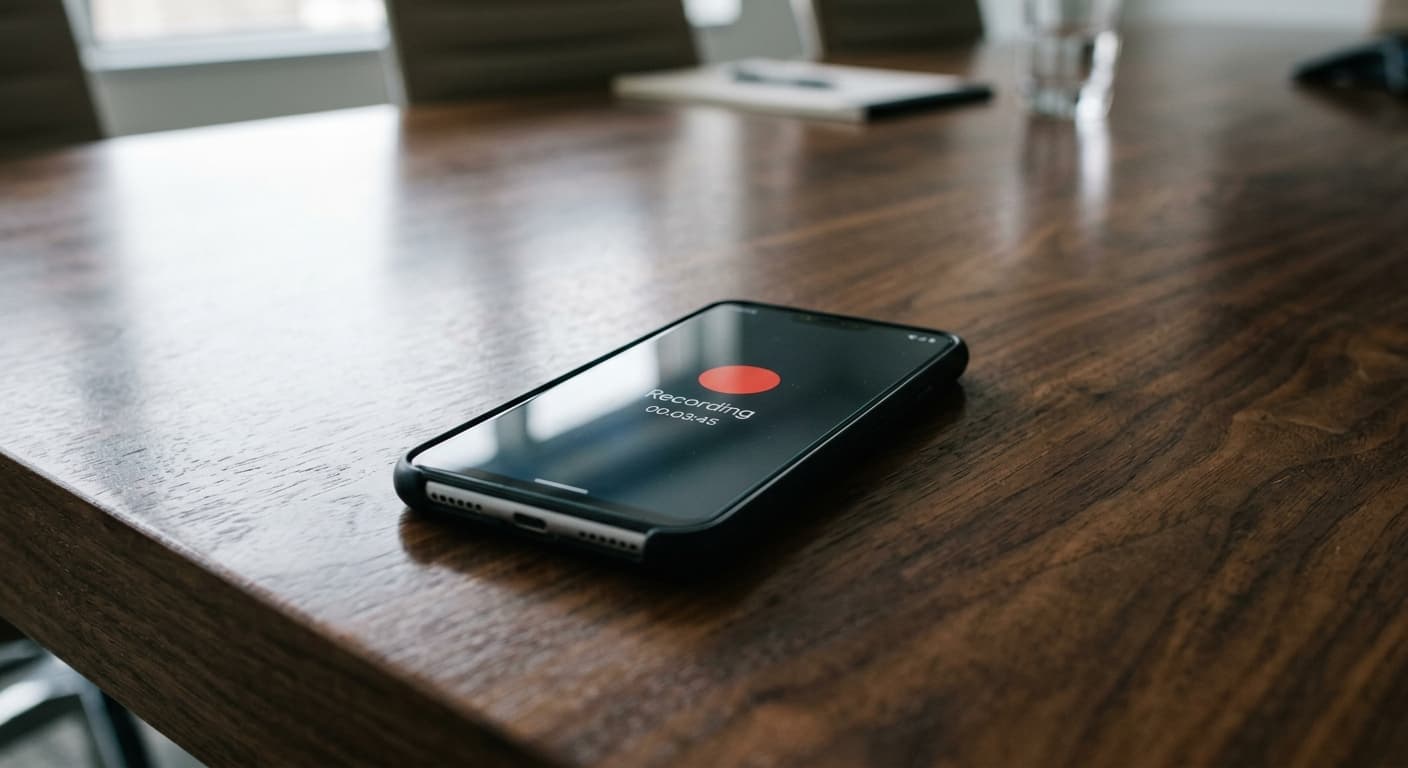
Florida requires all-party consent to record conversations, and that rule applies fully in the workplace under Fla. Stat. 934.03. Employees and employers alike cannot secretly record audio of workplace conversations. Doing so is a third-degree felony with no exception for documenting harassment or misconduct.
Florida's strict all-party consent requirement under Florida Statute 934.03 applies with full force in the workplace. Employees cannot secretly record conversations with coworkers, supervisors, or clients. Employers cannot secretly record employee conversations. The law makes no distinction between personal and professional settings when it comes to audio recording: if a conversation is private and the parties have not all consented, recording it is a third-degree felony.
This creates a challenging landscape for both employers who want to monitor workplace activity and employees who want to document misconduct. Understanding the specific rules for audio recording, video surveillance, and whistleblower protections is essential for anyone working in Florida.
Can Employees Record at Work in Florida?
Audio Recording by Employees
Under F.S. 934.03, employees in Florida cannot secretly record:
- Private conversations with coworkers
- Meetings with supervisors or managers
- Performance reviews or disciplinary sessions
- Phone calls with clients, customers, or vendors
- Any private workplace communication
The all-party consent rule means that every person participating in a conversation must agree before any recording takes place. An employee who uses a smartphone, voice recorder, or any other device to secretly capture a workplace conversation commits a third-degree felony punishable by up to 5 years in prison and a $5,000 fine.
No Exception for Documenting Misconduct
Unlike states such as California, which provides a crime-evidence exception allowing private citizens to record without consent when gathering evidence of serious crimes, Florida provides no such exception for private citizens. Only law enforcement officers acting under F.S. 934.03(2)(c) may conduct one-party consent recordings to obtain evidence of criminal activity.
An employee who secretly records a supervisor making harassing or discriminatory comments faces felony charges for the recording itself, and the recording will likely be inadmissible in court. If you need to preserve evidence of workplace misconduct in Florida, consult an employment attorney about legal options before recording anything.
When Employee Recording Is Legal
Employees can legally record workplace conversations when:
- All participants consent before the recording starts
- The conversation takes place in a public area where no party has a reasonable expectation of privacy (such as a loud conversation in a busy public cafeteria)
- The recording is authorized by law enforcement as part of an investigation
Can Employers Record Employees in Florida?

Employer Video Surveillance
Florida employers may install video surveillance cameras in workplace common areas, provided they follow certain guidelines:
Where video cameras are permitted:
- Lobbies and reception areas
- Hallways and corridors
- Production floors and warehouse spaces
- Parking lots and garages
- Building entrances and exits
- Common break rooms (video only, no audio)
Where video cameras are prohibited:
- Restrooms and bathrooms
- Locker rooms and changing areas
- Private offices where employees have a reasonable expectation of privacy (without notice)
- Any area designated for medical examinations or private conversations
Requirements for employer video surveillance:
- Employees must receive advance written notice that video surveillance is in use
- The notice should specify which areas are monitored
- Surveillance policies should be included in employee handbooks
- A legitimate business purpose must exist for the monitoring (security, loss prevention, safety)
An employer who violates these placement rules by installing a hidden camera in a restroom, locker room, or other area where employees expect privacy faces more than the base third-degree felony under F.S. 810.145: because an employer is a statutorily defined "position of authority or trust" over an employee, F.S. 810.145(7)(b) requires the court to reclassify the offense to the next higher felony degree, even on a first offense with no prior conviction. For a 19-or-older employer, that means a second-degree felony (up to 15 years in prison, $10,000 fine) rather than the base third-degree exposure.
Employer Audio Recording
Adding audio recording capabilities to workplace surveillance systems dramatically changes the legal requirements. Under F.S. 934.03, employers who capture audio of employee conversations must:
- Inform every employee that audio recording is taking place
- Obtain consent from every person whose conversations may be captured
- Post clear signage indicating audio monitoring is in effect
- Include audio monitoring policies in employee handbooks and onboarding materials
An employer who records audio of employee conversations without obtaining all-party consent faces the same criminal and civil penalties as any other person who violates Section 934.03: up to 5 years in prison, $5,000 in fines, and civil liability under F.S. 934.10.
Employer Monitoring of Electronic Communications
Florida employers may monitor electronic communications on company-owned devices and networks, but with certain restrictions:
- Company email on company devices: Employers generally have broad authority to monitor email on company-owned systems, especially when employees have been notified of the monitoring policy
- Personal devices: Employers have limited authority to monitor personal devices, even when they are used on company networks
- Telephone monitoring: Recording business phone calls requires compliance with F.S. 934.03. The common practice is to use an automated announcement ("This call may be recorded for quality assurance") at the start of each call
Workplace Recording and Florida Employment Law

Wrongful Termination Concerns
Florida is an at-will employment state, meaning employers can generally terminate employees for any lawful reason. An employer can fire an employee for recording workplace conversations, even if the recording was consensual. The at-will doctrine gives employers broad discretion in termination decisions.
However, termination for recording may be challenged if:
- The employee was recording in compliance with a law enforcement investigation
- The recording was related to reporting illegal activity through proper channels (whistleblower protection)
- The termination violates a specific employment contract provision
Hostile Work Environment and Harassment Documentation
Employees who experience workplace harassment or discrimination face a difficult situation in Florida. While secretly recording the harassment would be illegal, there are legal alternatives:
- Contemporaneous written notes: Document incidents immediately after they occur, including dates, times, locations, and witnesses
- Email follow-ups: Send an email to the harasser or supervisor summarizing what was said, creating a written record
- Report to HR: File formal complaints through the company's human resources department
- File a charge with the EEOC or FCHR: The Equal Employment Opportunity Commission and the Florida Commission on Human Relations investigate workplace discrimination complaints
- Consult an employment attorney: An attorney can advise on legal methods to preserve evidence
Florida Whistleblower Protections
Public Employee Whistleblower Act (F.S. 112.3187)
Florida Statute 112.3187 protects public employees who report violations of law, rule, or regulation that create a substantial and specific danger to public health, safety, or welfare, or that constitute acts of gross mismanagement, malfeasance, misfeasance, gross waste of public funds, or gross neglect of duty.
Protected activities include:
- Disclosing information about violations to an appropriate agency
- Being requested to participate in an investigation, hearing, or inquiry
- Refusing to participate in an activity that violates law
Important: This statute protects employees who report through proper channels. It does not authorize secret audio or video recording in the workplace. An employee who secretly records a conversation to support a whistleblower complaint still violates F.S. 934.03.
Private Sector Whistleblower Protection (F.S. 448.102)
Florida Statute 448.102 provides parallel protections for private sector employees who:
- Disclose or threaten to disclose an employer practice that violates a law, rule, or regulation
- Provide information or testimony in an investigation or proceeding
- Object to or refuse to participate in activity that violates a law, rule, or regulation
Like the public sector statute, this law protects reporting through proper channels but does not create an exception to Florida's wiretapping law.
Workplace Recording and Union Activity
The National Labor Relations Act (NLRA) protects employees' right to engage in concerted activity, including discussing wages, working conditions, and other employment terms.
Stericycle standard (controlling): In Stericycle, Inc., 372 NLRB 113 (2023), the NLRB established the current framework for evaluating employer work rules: a facially neutral employer policy that an employee could reasonably interpret as restricting NLRA-protected activity is presumptively unlawful unless the employer can show it advances a legitimate and substantial business interest that cannot be achieved through a more narrowly tailored rule. This standard applies to employer no-recording policies. A blanket prohibition on all workplace recording may fail this test if it chills employees from documenting safety hazards or organizing activity.
NLRB GC Memo 25-07 (June 26, 2025): NLRB Acting General Counsel William B. Cowen issued GC Memo 25-07 directing regional offices to treat the surreptitious recording of collective bargaining sessions as a per se unfair labor practice -- a violation of the duty to bargain in good faith under NLRA Section 8(a)(5). This is prosecutorial guidance, not a Board decision or binding court precedent, but Florida employers who record collective bargaining sessions without union consent now face both NLRB exposure and criminal liability under F.S. 934.03.
NLRB GC Memo 25-05 (context): GC Memo 25-05 was a housekeeping rescission memo that withdrew certain prior GC policy memos. It did not restore the Boeing standard or signal a substantive rollback of Stericycle. The Stericycle balancing test remains the operative Board standard for evaluating employer work rules.
Even if an employer's blanket no-recording policy is found to violate the NLRA, Florida's wiretapping statute still applies independently. An employee cannot secretly record audio of a conversation in Florida even if the employer's internal policy against recording is unenforceable under the NLRA.
Remote Work and Recording
With the growth of remote work, new recording issues have emerged:
Video Conferences
Recording a Zoom, Teams, or other video conference call requires consent from all participants under Florida law. If any participant is in Florida, the all-party consent rule applies. Most video conferencing platforms provide notification when recording begins, but the host should explicitly announce the recording and obtain verbal consent.
Virtual Interviews
Employers conducting virtual job interviews with Florida candidates must follow the same consent rules. Recording a video interview without the candidate's consent violates F.S. 934.03.
Monitoring Remote Employees
Employers who monitor remote employees' activities on company-provided equipment should:
- Disclose all monitoring practices in writing before monitoring begins
- Specify what activities are monitored (keystrokes, screen captures, audio, video)
- Limit monitoring to company-owned devices and work-related activities
- Avoid capturing audio of personal conversations that take place in the employee's home
Penalties for Workplace Recording Violations
| Violation | Penalty | Statute |
|---|---|---|
| Secret audio recording of workplace conversations | Third-degree felony: up to 5 years prison, $5,000 fine | F.S. 934.03 |
| Hidden cameras in restrooms or changing areas | Third-degree felony (19+): up to 5 years prison, $5,000 fine; reclassified to second-degree (15 years, $10,000 fine) if the offender is the employer or otherwise holds a position of authority or trust over the victim | F.S. 810.145 |
| Civil damages for illegal recording | $100/day or $1,000 (whichever is higher), plus actual and punitive damages | F.S. 934.10 |
| Retaliation against whistleblower | Civil remedies including reinstatement, back pay, and compensatory damages | F.S. 112.3187 / 448.102 |
More Florida Recording Laws
Audio Recording | Video Recording | Voyeurism & Hidden Cameras | Workplace Recording | Recording Police | Phone Call Recording | Security Cameras | Recording in Public | Landlord-Tenant | Dashcam Laws | Schools | Medical Recording
Back to Florida Recording Laws
More Florida Recording Topics
More Florida Laws
Frequently Asked Questions
Can I secretly record my boss in Florida to document harassment?
No. Florida's all-party consent law (F.S. 934.03) applies in the workplace with no exception for documenting harassment. Secretly recording a conversation is a third-degree felony, and the recording would likely be inadmissible in court. Instead, document incidents in writing, report through HR, file complaints with the EEOC or Florida Commission on Human Relations, and consult an employment attorney.
Can my employer install cameras in the workplace in Florida?
Employers may install video-only cameras in common work areas (lobbies, hallways, production floors) with advance notice to employees. Cameras are prohibited in restrooms, locker rooms, and changing areas. If cameras also record audio, the employer must obtain consent from every person whose conversations may be captured, per F.S. 934.03.
Can my employer record my phone calls at work in Florida?
Only with proper notice and consent. Florida's all-party consent law requires that all participants on a call agree to the recording. Employers commonly satisfy this requirement by playing an automated announcement at the start of business calls stating the call may be recorded. Employees should receive written notice of call recording policies.
Does Florida's Whistleblower Act protect me if I record workplace violations?
The Whistleblower Act (F.S. 112.3187 for public employees, F.S. 448.102 for private employees) protects employees who report violations through proper channels. It does not authorize or protect secret recording. An employee who secretly records conversations to support a whistleblower complaint still faces felony charges under F.S. 934.03 for the recording itself.
Can my employer fire me for recording a conversation at work in Florida?
Yes. Florida is an at-will employment state, and employers can terminate employees for recording workplace conversations. If the recording was made without all-party consent, the employee also faces criminal liability under F.S. 934.03. Even consensual recording may violate an employer's internal workplace policies and result in disciplinary action.
Updates
Added the F.S. 810.145(7)(b) enhanced penalty (second-degree felony) that applies when an employer installs a hidden camera in a restroom or changing area, since an employer counts as a position of authority or trust under the statute, and corrected the NLRB GC Memo 25-07 date from June 25 to June 26, 2025.
Independently fact-checked against the cited primary sources; governing law re-checked for recent changes
Governing law re-checked for recent changes
Title updated to 2026. Added NLRB GC Memo 25-07 (June 26, 2025) on surreptitious recording of collective bargaining sessions. Added Stericycle (372 NLRB 113, 2023) as the controlling NLRB standard for evaluating employer no-recording policies. Noted NLRB GC 25-05 was a housekeeping rescission memo, not a substantive policy change affecting recording rights. Fixed California comparison link.
Reviewed and approved by an editor
The Law Behind This Article
This article rests on the statutory provisions below, held in our own legal record and retrieved from the official source. Tap a section to read the operative text.
Florida Statutes
§ 934.03Interception and disclosure of wire, oral, or electronic communications prohibited.In forcecited in 51 of our articles
(1) Except as otherwise specifically provided in this chapter, any person who:(a) Intentionally intercepts, endeavors to intercept, or procures any other person to intercept or endeavor to intercept any wire, oral, or electronic communication; (b) Intentionally uses, endeavors to use, or procures any other person to use or endeavor to use any electronic, mechanical, or other device to intercept any oral communication when:1. Such device is affixed to, or otherwise transmits a signal through, a wire, cable, or other like connection used in wire communication; or 2.
Official text (excerpt) · last checked 2026-08-31 · Read the full text in our law library · Verify at leg.state.fl.us
Cited in 74 court opinions in our collectionLatest citing opinion in our collection: 2026
In the courts (editorial summary, independently checked):State v. Walls (1978) held that recording an in-home oral communication without the consent of all parties violated section 934.03 and required suppression, and State v. Inciarrano (1985) held the statute protects only communications uttered with a reasonable expectation of privacy.
Opinions citing this section in our collection:
- State v. Walls (Supreme Court of Florida 1978, 356 So. 2d 294)✓An extortion victim secretly recorded threats made to him in his own home; the court held that was a protected oral communication, that recording it without every party's consent violated Section 934.03, and that Section 934.06 barred using the tape as evidence.
- SHARRON TASHA FORD v. CITY OF BOYNTON BEACH (District Court of Appeal of Florida 2021)“…ng oral communications in violation of the wiretap statute, section 934.03, Florida Statutes (2009), and for obstructing without vio…”
- State v. Calhoun (Circuit Court for the Judicial Circuits of Florida 1984, 7 Fla. Supp. 2d 3)“…hall not be violated” . . . (emphasis mine) Furthermore, section 934.03, Florida Statutes, makes it unlawful for *6 any person (…”
Identified automatically from the court opinions citing this section — not a ranking of which case controls.
Also relied on in: Florida Recording Laws (2026): All-Party Consent Rules, Florida Dashcam Laws: Rules for Dashboard Cameras (2026), Can an Employer Record Conversations Without Consent? (2026)
§ 112.3187Adverse action against employee for disclosing information of specified nature prohibited; employee remedy and relief.In forcecited in 3 of our articles
(1) SHORT TITLE.—Sections 112.3187-112.31895 may be cited as the “Whistle-blower’s Act.” (2) LEGISLATIVE INTENT.—It is the intent of the Legislature to prevent agencies or independent contractors from taking retaliatory action against an employee who reports to an appropriate agency violations of law on the part of a public employer or independent contractor that create a substantial and specific danger to the public’s health, safety, or welfare. It is further the intent of the Legislature to prevent agencies or independent contractors from taking retaliatory action against any person who discloses information to an appropriate agency alleging improper use of governmental office, gross waste of funds, or any other abuse or gross neglect of duty on the part of an agency, public officer, or employee.
Official text (excerpt) · last checked 2026-09-09 · Read the full text in our law library · Verify at leg.state.fl.us
Cited in 94 court opinions in our collectionLatest citing opinion in our collection: 2026
Opinions citing this section in our collection:
- Arrow Air, Inc. v. Walsh (Supreme Court of Florida 1994, 19 Fla. L. Weekly Supp. 592)“…court that he was discharged in Florida. [6] Codified at section 112.3187, Florida Statutes (1993). [7] The relevant provisions,…”
- Rice-Lamar v. City of Fort Lauderdale (District Court of Appeal of Florida 2003, 853 So. 2d 1125)“…auderdale (City) pursuant to the Florida Whistleblower Act, section 112.3187, Florida Statutes (Supp.1996). Lamar alleged that she was…”
- Hastings v. Demming (District Court of Appeal of Florida 1996, 682 So. 2d 1107)“…of a statutory defense to a cause of action brought under section 112.3187, Florida Statutes (1989), Florida's "Whistle-blower's Act…”
Identified automatically from the court opinions citing this section — not a ranking of which case controls.
Also relied on in: Florida Whistleblower Ruling: Gessner Raises the Bar (2026), Florida Whistleblower Laws: Protections and How to Report
§ 448.102Prohibitions.In forcecited in 4 of our articles
An employer may not take any retaliatory personnel action against an employee because the employee has:(1) Disclosed, or threatened to disclose, to any appropriate governmental agency, under oath, in writing, an activity, policy, or practice of the employer that is in violation of a law, rule, or regulation. However, this subsection does not apply unless the employee has, in writing, brought the activity, policy, or practice to the attention of a supervisor or the employer and has afforded the employer a reasonable opportunity to correct the activity, policy, or practice. (2) Provided information to, or testified before, any appropriate governmental agency, person, or entity conducting an investigation, hearing, or inquiry into an alleged violation of a law, rule, or regulation by the employer. (3) Objected to, or refused to participate in, any activity, policy, or practice of the employer which is in violation of a law, rule, or regulation.
Official text (excerpt) · last checked 2026-07-28 · Read the full text in our law library · Verify at leg.state.fl.us
Cited in 112 court opinions in our collectionLatest citing opinion in our collection: 2026
Opinions citing this section in our collection:
- Walsh v. Arrow Air, Inc. (District Court of Appeal of Florida 1993, 629 So. 2d 144)“…(Fla. 1980). The majority now erroneously concludes that section 448.102, Florida Statutes (1991), which was enacted after the o…”
- Arrow Air, Inc. v. Walsh (Supreme Court of Florida 1994, 19 Fla. L. Weekly Supp. 592)“…employee in the terms and conditions of employment." [3] Section 448.102, Florida Statutes (1993), provides: Prohibitions. An…”
- Diaz v. Impex of Doral, Inc. (District Court of Appeal of Florida 2009, 7 So. 3d 591)“…gistics) for the violation of Florida’s Whistle Blower Act, section 448.102, Florida Statutes, et seq. (2002). Impex and Impex Logist…”
Identified automatically from the court opinions citing this section — not a ranking of which case controls.
Also relied on in: Florida At-Will Employment Laws: Exceptions and Your Rights
§ 810.145Digital voyeurism.In forcecited in 15 of our articles
(1) As used in this section, the term:(a) “Broadcast” means electronically transmitting a visual image or visual recording with the intent that it be viewed by another person. (b) “Family or household member” has the same meaning as in s. 741.28. (c) “Imaging device” means any mechanical, digital, or electronic viewing device; still camera; camcorder; motion picture camera; or any other instrument, equipment, or format capable of recording, storing, or transmitting visual images of another person. (d) “Position of authority or trust” means a position occupied by a person 18 years of age or older who is a relative, caregiver, coach, employer, or other person who, by reason of his or her relationship with the victim, is able to exercise undue influence over him or her or exploit his or her trust. (e) “Privately exposing the body” means exposing a sexual organ.
Official text (excerpt) · last checked 2026-08-31 · Read the full text in our law library · Verify at leg.state.fl.us
Cited in 3 court opinions in our collectionLatest citing opinion in our collection: 2024
In the courts (editorial summary, independently checked):Kenneth Isaac Parkerson v. State of Florida (2015) rejected a facial overbreadth challenge to section 810.145, holding the video voyeurism statute regulates conduct, not pure speech. Clemen v. Surterra Holdings, Inc. (2024) drew on its privacy definition and exemption for clearly visible cameras when dismissing an intrusion claim.
Opinions citing this section in our collection:
- Kenneth Isaac Parkerson v. State of Florida (District Court of Appeal of Florida 2015, 163 So. 3d 683)✓A man caught watching people inside their homes, once carrying a camera, argued Florida's video voyeurism statute was facially overbroad because it could reach journalists and investigators; the court held section 810.145 is not overbroad and affirmed his convictions.
- Clemen v. Surterra Holdings, Inc. (District Court, M.D. Florida 2024)✓A worker sued over cameras aimed at a workplace changing area; dismissing her intrusion on seclusion claim, the court drew on section 810.145's privacy definition and its exclusion for obvious cameras, and found no authority making an alleged violation outrageous per se.
- Keith Taig v. City of Vero Beach (Court of Appeals for the Eleventh Circuit 2023)✓A spa customer recorded by covert police cameras installed under a court order argued Florida statutes including section 810.145 gave officers clear notice of customers' privacy rights; the court held those state statutes do not clearly establish a federal constitutional right.
Identified automatically from the court opinions citing this section — not a ranking of which case controls.
Also relied on in: Is It Illegal to Video Record Someone Without Their Consent? (2026), Florida Landlord-Tenant Recording Laws: Cameras and Privacy Rules (2026), Florida School Recording Laws: Classroom, Campus, and Student Privacy (2026)
§ 934.10Civil remedies.In forcecited in 12 of our articles
(1) Any person whose wire, oral, or electronic communication is intercepted, disclosed, or used in violation of ss. 934.03-934.09 shall have a civil cause of action against any person or entity who intercepts, discloses, or uses, or procures any other person or entity to intercept, disclose, or use, such communications and shall be entitled to recover from any such person or entity which engaged in that violation such relief as may be appropriate, including:(a) Preliminary or equitable or declaratory relief as may be appropriate; (b) Actual damages, but not less than liquidated damages computed at the rate of $100 a day for each day of violation or $1,000, whichever is higher; (c) Punitive damages; and (d) A reasonable attorney’s fee and other litigation costs reasonably incurred. (2) A good faith reliance on:(a) A court order, subpoena, or legislative authorization as provided in ss. 934.03-934.09, (b) A request of an investigative or law enforcement officer under s. 934.09(7), or (c) A good faith determination that Florida or federal law, other than 18 U.S.C. s.
Official text (excerpt) · last checked 2026-07-28 · Read the full text in our law library · Verify at leg.state.fl.us
Cited in 33 court opinions in our collectionLatest citing opinion in our collection: 2026
In the courts (editorial summary, independently checked):Minotty v. Baudo (2010) held the civil action reaches only actual interception, not attempts, and does not cover silent video surveillance. Jatar v. Lamaletto (2000) affirmed summary judgment where the plaintiff had no reasonable expectation of privacy. Burgess v. Burgess (1984) held interspousal immunity does not bar the action.
Opinions citing this section in our collection:
- Burgess v. Burgess (Supreme Court of Florida 1984, 447 So. 2d 220)“…mages brought by one spouse against the other spouse, under Section 934.10, Florida Statutes (1979)? Burgess v. Burgess, 417 S…”
- Minotty v. Baudo (District Court of Appeal of Florida 2010, 42 So. 3d 824)✓A doctor hid cameras in colleagues' offices, but the microphones never worked, so only silent video was captured. The court held section 934.10 gives a civil claim only for actual interception of oral communications, not attempts or silent video, and reversed those judgments.
- Roberts v. Jardine (District Court of Appeal of Florida 1978, 358 So. 2d 588)✓Sued under section 934.10 for secretly taping a phone call, the defendant refused to answer interrogatories. The court held she could invoke the Fifth Amendment, since interception is also a crime, and could not be defaulted for it, but had to produce the tape already played.
Identified automatically from the court opinions citing this section — not a ranking of which case controls.
Also relied on in: Florida Audio Recording Laws: All-Party Consent Rules and Penalties (2026), Florida Medical Recording Laws: Patient Rights and HIPAA Rules (2026), Florida Phone Call Recording Laws: Consent Rules for Calls (2026)
Search our full record of US law — 2.1 million sections, every state + federal →
Sources and References
- Florida Statute 934.03(flsenate.gov).gov
- Florida Statute 934.10(flsenate.gov).gov
- Florida Statute 112.3187 - Whistleblower Act(flsenate.gov).gov
- Florida Statute 448.102 - Private Sector Whistleblower(flsenate.gov).gov
- Florida Statute 810.145 - Digital Voyeurism(flsenate.gov).gov
- Florida Commission on Human Relations(fchr.myflorida.com).gov
- U.S. Equal Employment Opportunity Commission(eeoc.gov).gov