
Florida
Florida Security Camera Laws: Home, Business, and HOA Rules (2026)
Independently fact-checked against primary sources (last audited August 22, 2026). · Reviewed by the RecordingLaw editorial team. · Law checked current as of August 22, 2026. · 5 primary sources cited on this page. How we verify our legal content
In Florida, video-only security cameras are generally legal on your own property and in public-facing areas. Audio-capable cameras require all-party consent under Fla. Stat. 934.03. Placing cameras in bathrooms, bedrooms, or changing rooms violates the digital voyeurism statute, Fla. Stat. 810.145.
Florida does not have a single comprehensive "security camera law." Instead, the legality of security cameras depends on the interaction of several statutes: Florida Statute 934.03 (wiretapping and audio interception), Florida Statute 810.145 (digital voyeurism), and common law privacy protections. Understanding how these laws work together is essential for homeowners, businesses, landlords, and anyone who installs or operates security cameras in Florida.
The general rule is straightforward: video-only cameras in non-private areas are usually legal, while audio-capable cameras and cameras aimed at private spaces create legal risks.
Residential Security Cameras
What Homeowners Can Do
Florida homeowners have broad rights to install security cameras on their own property for legitimate security purposes. Permitted uses include:
- Cameras pointed at your own front door, driveway, and garage
- Cameras monitoring your own yard and exterior property boundaries
- Cameras in common interior areas of your own home (living rooms, kitchens, hallways)
- Doorbell cameras (Ring, Nest Hello, etc.) aimed at your porch and front entrance
- Cameras monitoring public areas visible from your property (the street, sidewalk)
Restrictions for Homeowners
Even on your own property, certain camera placements are illegal:
Privacy-sensitive areas: You cannot place cameras in bathrooms, bedrooms occupied by others, guest rooms, changing areas, or any space where another person in your household has a reasonable expectation of privacy. Doing so may violate F.S. 810.145 (digital voyeurism).
Audio recording: If your security cameras have microphones that record audio, the all-party consent requirement of F.S. 934.03 applies. Capturing private conversations of visitors, neighbors, or household members without their consent is a third-degree felony. Many homeowners unknowingly violate this law by leaving audio recording enabled on outdoor cameras.
Neighbor's private spaces: Pointing cameras directly into a neighbor's windows, fenced backyard, or other private areas may violate F.S. 810.145 and Florida common law privacy rights. Cameras should be positioned to monitor your own property and public areas, not to surveil your neighbors' private activities.
Nanny Cameras and In-Home Monitoring
Florida homeowners may use nanny cameras to monitor caregivers in common areas of their home. However:
- Cameras in bathrooms or areas where the caregiver changes clothes violate F.S. 810.145
- Audio-capable nanny cameras require all-party consent under F.S. 934.03. In practice, this means you should inform your caregiver about the camera and its audio capabilities and obtain their consent.
- Video-only nanny cameras in common areas (living room, kitchen, playroom) are generally legal, though best practice is to disclose their presence
Business Security Cameras
Permitted Locations
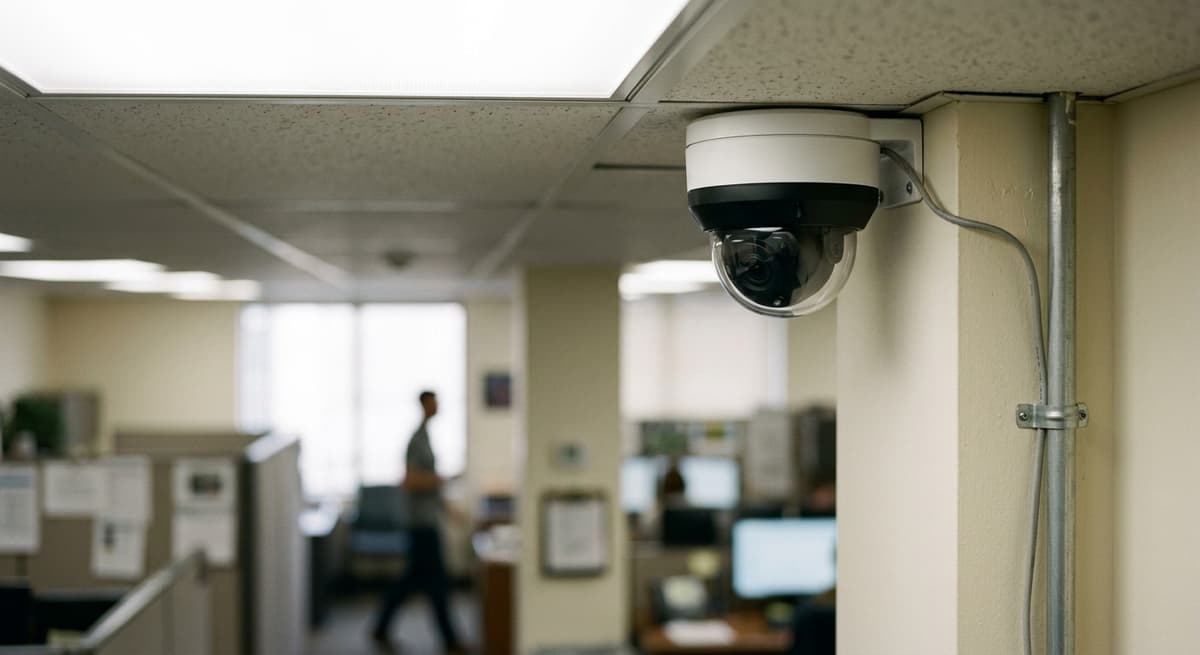
Florida businesses may install video surveillance cameras in:
- Retail sales floors and showrooms
- Lobbies, reception areas, and waiting rooms
- Warehouses, storage areas, and loading docks
- Parking lots and garages
- Entrances, exits, and hallways
- Cash register areas and point-of-sale locations
Prohibited Locations
Businesses should not place hidden or undisclosed cameras in:
- Employee restrooms and bathrooms
- Locker rooms and changing areas
- Private break rooms or nursing rooms where employees expect privacy
- Fitting rooms and dressing rooms in retail stores
- Any area where customers or employees reasonably expect privacy
Cameras in fitting rooms or dressing rooms can constitute digital voyeurism under F.S. 810.145 and carry felony penalties, unless the camera qualifies for the statute's exemption for a security system with conspicuously posted written notice or a device whose presence is clearly and immediately obvious.
Audio Recording in Business Settings
Adding audio to business security systems requires compliance with F.S. 934.03. Businesses that record audio must:
- Post conspicuous signage informing all people on the premises that audio recording is in effect
- Obtain consent from employees through written notice in employment agreements or handbooks
- Ensure visitors and customers are aware that audio recording is taking place
- Disable audio recording in areas where private conversations occur (break rooms, private offices)
Notice Requirements
While Florida does not have a specific statute requiring businesses to post signs about video surveillance, best practices include:
- Posting visible signs at entrances stating that video surveillance is in use
- Including surveillance policies in employee handbooks
- Providing written notice to employees about which areas are monitored
- Informing customers through posted signage in monitored areas
Failure to provide notice does not automatically make video-only surveillance illegal, but it can affect claims related to reasonable expectation of privacy and strengthen any legal challenges to the surveillance.
HOA and Condominium Security Cameras
HOA Authority Over Cameras
Homeowners' associations (HOAs) in Florida have significant authority to regulate security camera placement within their communities. Common HOA regulations include:
- Requiring board approval before installing exterior cameras
- Restricting camera placement to prevent them from recording neighbors' properties
- Establishing architectural standards for camera appearance and visibility
- Prohibiting cameras that create an unreasonable invasion of other residents' privacy
Florida's HOA statutes (Chapter 720) give associations the power to adopt and enforce rules governing the use and appearance of property within the community.
Condominium Association Cameras
Condominium associations operating under Florida Statute Chapter 718 may install security cameras in common elements (lobbies, elevators, hallways, parking areas, pool decks) for security purposes. Key considerations include:
- Board approval is typically required for camera installation
- Cameras should be positioned to monitor common areas, not individual units
- Audio recording in common areas requires compliance with F.S. 934.03
- Camera footage is generally an association record accessible to unit owners
- Associations should adopt a written surveillance policy addressing camera placement, footage retention, and access rights
Disputes Between Homeowners and HOAs
Common disputes include:
- Homeowners wanting to install cameras that HOA rules prohibit
- Neighbors objecting to cameras they believe are aimed at their property
- HOA-installed cameras capturing footage of unit owners in private areas
These disputes are typically resolved through the association's internal dispute resolution process or, if necessary, through mediation or litigation. Florida's condominium and HOA arbitration program, administered by the Department of Business and Professional Regulation's Division of Condominiums, Timeshares & Mobile Homes (not the Attorney General's office), provides an alternative dispute resolution option.
Security Camera Footage and Privacy
Retention and Storage
Florida does not mandate specific retention periods for private security camera footage. However, businesses and homeowners should establish retention policies based on:
- The purpose of the surveillance (security, loss prevention, liability protection)
- Insurance company requirements
- The practical storage capacity of the system
- The potential need for footage as evidence in legal proceedings
Sharing Security Camera Footage
Sharing security camera footage with law enforcement is generally permitted and often encouraged when the footage captures criminal activity. However:
- Law enforcement generally needs a warrant or the owner's consent to obtain private surveillance footage
- Sharing footage on social media or publicly that identifies individuals may create liability for invasion of privacy
- Footage containing audio obtained without consent should not be shared, as doing so constitutes a separate felony under F.S. 934.03
Security Camera Footage as Evidence
Video footage from security cameras is frequently used as evidence in Florida courts. For admissibility:
- The footage must be properly authenticated by a witness familiar with the camera system
- The footage must not have been altered or tampered with
- If the footage contains audio, the audio must have been captured with all-party consent to be admissible
- Chain of custody should be documented from capture to presentation in court
Smart Home Devices and Recording
Modern smart home devices blur the line between security cameras and general recording devices:
Video doorbells (Ring, Nest): Legal for video, but audio capture of visitors' private conversations may violate F.S. 934.03. Consider disabling audio recording or posting notice.
Indoor smart displays (Echo Show, Google Nest Hub): Devices with cameras should not be placed in guest areas where visitors expect privacy. Audio recording capabilities trigger the all-party consent rule.
Baby monitors: Using a baby monitor to watch your own child is legal. However, if the monitor records audio of conversations between other household members or caregivers, consent issues arise under F.S. 934.03.
Pet cameras: Video-only pet cameras in common areas of your own home are legal. Audio-capable pet cameras that capture conversations require consent from anyone whose conversations are recorded.
Security Camera Installation Best Practices
To stay compliant with Florida law:
- Use video-only cameras whenever possible, or disable audio recording features
- Position cameras to monitor your own property and public areas, not neighbors' private spaces
- Post signage indicating that video surveillance is in use
- Inform household members and regular visitors about camera locations
- Comply with HOA rules if applicable
- Avoid placing cameras in bathrooms, bedrooms, or other privacy-sensitive areas
- If recording audio, obtain written consent from all persons whose conversations may be captured
- Review and update camera positions seasonally, especially if landscaping changes expose previously blocked views
More Florida Recording Laws
Audio Recording | Video Recording | Voyeurism & Hidden Cameras | Workplace Recording | Recording Police | Phone Call Recording | Security Cameras | Recording in Public | Landlord-Tenant | Dashcam Laws | Schools | Medical Recording
Back to Florida Recording Laws
More Florida Recording Topics
See Also
- Florida Surveillance Camera Laws covers home, HOA, neighbor, workplace, and landlord camera rules in Florida.
More Florida Laws
Frequently Asked Questions
Are home security cameras legal in Florida?
Yes, video-only home security cameras are generally legal when positioned to monitor your own property and public areas. You cannot place cameras in areas where others expect privacy (bathrooms, guest bedrooms) or aim them at neighbors' private spaces. If your cameras record audio, all-party consent is required under F.S. 934.03.
Can my security camera record audio in Florida?
Only with consent from every person whose conversations are captured. Florida is an all-party consent state under F.S. 934.03. Recording audio without consent is a third-degree felony. Many security camera owners disable audio recording to avoid legal issues, especially for outdoor cameras that might pick up neighbors' conversations.
Can my neighbor point a security camera at my house in Florida?
A neighbor can position cameras to monitor their own property, which may incidentally capture views of your property from public vantage points. However, pointing cameras directly into your windows, fenced yard, or other private areas may violate F.S. 810.145 (digital voyeurism) and common law privacy protections. If a neighbor's camera records audio of your private conversations, it violates F.S. 934.03.
Does my HOA have authority over my security cameras in Florida?
Yes. Florida HOAs have the authority to regulate security camera placement through community rules and architectural standards. Common restrictions include requiring board approval, limiting camera placement to prevent recording neighbors, and establishing standards for camera appearance. Check your HOA's governing documents before installing cameras.
Can a business use hidden security cameras in Florida?
Businesses may use security cameras in common areas, but cameras in restrooms, locker rooms, changing rooms, or fitting rooms risk violating F.S. 810.145 when they secretly capture people undressing or exposing their bodies. The statute itself exempts a security system when a written notice is conspicuously posted, or when the camera's presence is clearly and immediately obvious, so a disclosed or visible camera in these areas is less likely to trigger the statute; a hidden, undisclosed one is squarely covered. Posting notice is not just a best practice here, it is the specific exemption the law provides.
Updates
Fixed a dead, misattributed citation for Florida's condo/HOA arbitration program: it is run by DBPR's Division of Condominiums, Timeshares & Mobile Homes, not the Attorney General's office, and now links to the correct live page.
Independently fact-checked against the cited primary sources; governing law re-checked for recent changes
Corrected the fitting-room/restroom camera claim to reflect F.S. 810.145(5)(b)-(c)'s own exemption for a security system with posted written notice or an obviously visible device; a disclosed, visible camera is not automatically felony digital voyeurism.
Governing law re-checked for recent changes
Title updated to 2026. No substantive security camera law changes; F.S. 810.145 digital voyeurism and F.S. 934.03 audio consent rules unchanged.
Reviewed and approved by an editor
The Law Behind This Article
This article rests on the statutory provisions below, held in our own legal record and retrieved from the official source. Tap a section to read the operative text.
Florida Statutes
§ 934.03Interception and disclosure of wire, oral, or electronic communications prohibited.In forcecited in 51 of our articles
(1) Except as otherwise specifically provided in this chapter, any person who:(a) Intentionally intercepts, endeavors to intercept, or procures any other person to intercept or endeavor to intercept any wire, oral, or electronic communication; (b) Intentionally uses, endeavors to use, or procures any other person to use or endeavor to use any electronic, mechanical, or other device to intercept any oral communication when:1. Such device is affixed to, or otherwise transmits a signal through, a wire, cable, or other like connection used in wire communication; or 2.
Official text (excerpt) · last checked 2026-08-31 · Read the full text in our law library · Verify at leg.state.fl.us
Cited in 74 court opinions in our collectionLatest citing opinion in our collection: 2026
In the courts (editorial summary, independently checked):State v. Walls (1978) held that recording an in-home oral communication without the consent of all parties violated section 934.03 and required suppression, and State v. Inciarrano (1985) held the statute protects only communications uttered with a reasonable expectation of privacy.
Opinions citing this section in our collection:
- State v. Walls (Supreme Court of Florida 1978, 356 So. 2d 294)✓An extortion victim secretly recorded threats made to him in his own home; the court held that was a protected oral communication, that recording it without every party's consent violated Section 934.03, and that Section 934.06 barred using the tape as evidence.
- SHARRON TASHA FORD v. CITY OF BOYNTON BEACH (District Court of Appeal of Florida 2021)“…ng oral communications in violation of the wiretap statute, section 934.03, Florida Statutes (2009), and for obstructing without vio…”
- State v. Calhoun (Circuit Court for the Judicial Circuits of Florida 1984, 7 Fla. Supp. 2d 3)“…hall not be violated” . . . (emphasis mine) Furthermore, section 934.03, Florida Statutes, makes it unlawful for *6 any person (…”
Identified automatically from the court opinions citing this section — not a ranking of which case controls.
Also relied on in: Florida Recording Laws (2026): All-Party Consent Rules, Florida Dashcam Laws: Rules for Dashboard Cameras (2026), Can an Employer Record Conversations Without Consent? (2026)
§ 810.145Digital voyeurism.In forcecited in 15 of our articles
(1) As used in this section, the term:(a) “Broadcast” means electronically transmitting a visual image or visual recording with the intent that it be viewed by another person. (b) “Family or household member” has the same meaning as in s. 741.28. (c) “Imaging device” means any mechanical, digital, or electronic viewing device; still camera; camcorder; motion picture camera; or any other instrument, equipment, or format capable of recording, storing, or transmitting visual images of another person. (d) “Position of authority or trust” means a position occupied by a person 18 years of age or older who is a relative, caregiver, coach, employer, or other person who, by reason of his or her relationship with the victim, is able to exercise undue influence over him or her or exploit his or her trust. (e) “Privately exposing the body” means exposing a sexual organ.
Official text (excerpt) · last checked 2026-08-31 · Read the full text in our law library · Verify at leg.state.fl.us
Cited in 3 court opinions in our collectionLatest citing opinion in our collection: 2024
In the courts (editorial summary, independently checked):Kenneth Isaac Parkerson v. State of Florida (2015) rejected a facial overbreadth challenge to section 810.145, holding the video voyeurism statute regulates conduct, not pure speech. Clemen v. Surterra Holdings, Inc. (2024) drew on its privacy definition and exemption for clearly visible cameras when dismissing an intrusion claim.
Opinions citing this section in our collection:
- Kenneth Isaac Parkerson v. State of Florida (District Court of Appeal of Florida 2015, 163 So. 3d 683)✓A man caught watching people inside their homes, once carrying a camera, argued Florida's video voyeurism statute was facially overbroad because it could reach journalists and investigators; the court held section 810.145 is not overbroad and affirmed his convictions.
- Clemen v. Surterra Holdings, Inc. (District Court, M.D. Florida 2024)✓A worker sued over cameras aimed at a workplace changing area; dismissing her intrusion on seclusion claim, the court drew on section 810.145's privacy definition and its exclusion for obvious cameras, and found no authority making an alleged violation outrageous per se.
- Keith Taig v. City of Vero Beach (Court of Appeals for the Eleventh Circuit 2023)✓A spa customer recorded by covert police cameras installed under a court order argued Florida statutes including section 810.145 gave officers clear notice of customers' privacy rights; the court held those state statutes do not clearly establish a federal constitutional right.
Identified automatically from the court opinions citing this section — not a ranking of which case controls.
Also relied on in: Is It Illegal to Video Record Someone Without Their Consent? (2026), Florida Landlord-Tenant Recording Laws: Cameras and Privacy Rules (2026), Florida School Recording Laws: Classroom, Campus, and Student Privacy (2026)
§ 934.10Civil remedies.In forcecited in 12 of our articles
(1) Any person whose wire, oral, or electronic communication is intercepted, disclosed, or used in violation of ss. 934.03-934.09 shall have a civil cause of action against any person or entity who intercepts, discloses, or uses, or procures any other person or entity to intercept, disclose, or use, such communications and shall be entitled to recover from any such person or entity which engaged in that violation such relief as may be appropriate, including:(a) Preliminary or equitable or declaratory relief as may be appropriate; (b) Actual damages, but not less than liquidated damages computed at the rate of $100 a day for each day of violation or $1,000, whichever is higher; (c) Punitive damages; and (d) A reasonable attorney’s fee and other litigation costs reasonably incurred. (2) A good faith reliance on:(a) A court order, subpoena, or legislative authorization as provided in ss. 934.03-934.09, (b) A request of an investigative or law enforcement officer under s. 934.09(7), or (c) A good faith determination that Florida or federal law, other than 18 U.S.C. s.
Official text (excerpt) · last checked 2026-07-28 · Read the full text in our law library · Verify at leg.state.fl.us
Cited in 33 court opinions in our collectionLatest citing opinion in our collection: 2026
In the courts (editorial summary, independently checked):Minotty v. Baudo (2010) held the civil action reaches only actual interception, not attempts, and does not cover silent video surveillance. Jatar v. Lamaletto (2000) affirmed summary judgment where the plaintiff had no reasonable expectation of privacy. Burgess v. Burgess (1984) held interspousal immunity does not bar the action.
Opinions citing this section in our collection:
- Burgess v. Burgess (Supreme Court of Florida 1984, 447 So. 2d 220)“…mages brought by one spouse against the other spouse, under Section 934.10, Florida Statutes (1979)? Burgess v. Burgess, 417 S…”
- Minotty v. Baudo (District Court of Appeal of Florida 2010, 42 So. 3d 824)✓A doctor hid cameras in colleagues' offices, but the microphones never worked, so only silent video was captured. The court held section 934.10 gives a civil claim only for actual interception of oral communications, not attempts or silent video, and reversed those judgments.
- Roberts v. Jardine (District Court of Appeal of Florida 1978, 358 So. 2d 588)✓Sued under section 934.10 for secretly taping a phone call, the defendant refused to answer interrogatories. The court held she could invoke the Fifth Amendment, since interception is also a crime, and could not be defaulted for it, but had to produce the tape already played.
Identified automatically from the court opinions citing this section — not a ranking of which case controls.
Also relied on in: Florida Audio Recording Laws: All-Party Consent Rules and Penalties (2026), Florida Medical Recording Laws: Patient Rights and HIPAA Rules (2026), Florida Phone Call Recording Laws: Consent Rules for Calls (2026)
Search our full record of US law — 2.1 million sections, every state + federal →
Sources and References
- Florida Statute 934.03(flsenate.gov).gov
- Florida Statute 810.145 - Digital Voyeurism(flsenate.gov).gov
- Florida Statute 934.10 - Civil Remedies(flsenate.gov).gov
- Florida HOA Statute - Chapter 720(leg.state.fl.us).gov
- Florida Condominium Act - Chapter 718(leg.state.fl.us).gov
- DBPR Division of Condominiums, Timeshares & Mobile Homes - Arbitration Program(www2.myfloridalicense.com)