
Florida
Florida Voyeurism and Hidden Camera Laws: Digital Voyeurism Penalties (2026)
Independently fact-checked against primary sources (last audited August 22, 2026). · Reviewed by the RecordingLaw editorial team. · Law checked current as of August 22, 2026. · 7 primary sources cited on this page. How we verify our legal content
Florida criminalizes secret recording of people in private locations under Fla. Stat. 810.145, the Digital Voyeurism statute. Offenders aged 19 and older commit a third-degree felony, punishable by up to five years in prison and a $5,000 fine. Distributing voyeuristic recordings is a separate third-degree felony at any age.
Florida takes voyeurism and hidden camera offenses seriously, treating most violations as felonies rather than misdemeanors. Two separate statutes address these crimes: Florida Statute 810.145, which covers digital voyeurism involving cameras and recording devices, and Florida Statute 810.14, which addresses traditional voyeurism (secretly observing someone without necessarily using a device).
In 2024, the Florida Legislature significantly updated Section 810.145, renaming the offense from "video voyeurism" to "digital voyeurism," expanding the scope of prohibited conduct, and increasing penalties. These changes reflect the growing threat posed by small, easily concealed cameras, drones, and other modern imaging technology.
Florida's Digital Voyeurism Law (F.S. 810.145)
What the Statute Prohibits
Florida Statute 810.145 targets four categories of conduct:
1. Secret Recording in Private Locations
It is illegal to use an imaging device to secretly view, broadcast, or record a person at a place and time when the person has a reasonable expectation of privacy. This includes recording someone:
- In a bathroom, shower, or restroom
- In a bedroom or sleeping area
- In a changing room, fitting room, or dressing room
- In any enclosed space where a reasonable person would believe they can fully disrobe in privacy
2. Recording Under or Through Clothing
It is illegal to use an imaging device to view, broadcast, or record under or through the clothing of another person without that person's knowledge and consent. This targets "upskirting" and similar invasive practices regardless of whether the victim is in a public or private location.
3. Dissemination of Voyeuristic Images
A person who knows or has reason to believe that an image or recording was created through digital voyeurism commits a separate offense by intentionally disseminating, distributing, or transferring that image or recording to another person. The purpose element requires that the sharing be for amusement, entertainment, sexual arousal, gratification, or for the purpose of degrading, exploiting, or abusing another person.
4. Commercial Distribution
Selling voyeuristic images or recordings for consideration constitutes commercial digital voyeurism dissemination, which carries its own set of penalties.
Key Definitions
Imaging device: Any mechanical, digital, or electronic viewing device; still camera; camcorder; motion picture camera; or any other instrument, equipment, or format capable of recording, storing, or transmitting visual images of another person. This includes smartphones, smart glasses, drones with cameras, spy cameras, and any other visual recording technology.
Place and time when a person has a reasonable expectation of privacy: A place and time when a reasonable person would believe that they can fully disrobe in privacy. The statute specifically targets locations where people are vulnerable because they expect to be unobserved.
Broadcast: Electronically transmitting a visual image or visual recording with the intent that it be viewed by another person. This covers live-streaming voyeuristic recordings in addition to sharing saved files.
Criminal Penalties for Digital Voyeurism
The penalties under F.S. 810.145 turn on several factors that can each independently raise the offense level: the offender's age, the specific offense, prior conviction history, and (separately) the offender's relationship to the victim or the victim's age:
| Offense | Offender Age | Classification | Maximum Penalty |
|---|---|---|---|
| Digital voyeurism (recording) | Under 19 | First-degree misdemeanor | 1 year jail, $1,000 fine |
| Digital voyeurism (recording) | 19 or older | Third-degree felony | 5 years prison, $5,000 fine |
| Dissemination of voyeuristic images | Any age | Third-degree felony | 5 years prison, $5,000 fine |
| Commercial dissemination (selling) | Any age | Third-degree felony | 5 years prison, $5,000 fine |
| Any offense with prior conviction | Any age | Second-degree felony | 15 years prison, $10,000 fine |
| Offender is a family/household member or holds a position of authority or trust with the victim (F.S. 810.145(7)(b)) | 19 or older | Reclassified to next higher felony degree | Third-degree becomes second-degree (15 years, $10,000 fine); second-degree becomes first-degree (30 years) |
| Offense against a victim under 16 by a caregiver, school employee, or offender 24+ (F.S. 810.145(8)) | Any offender age (victim under 16) | Second-degree felony | 15 years prison, $10,000 fine |
The age distinction for the base recording offense (under 19 vs. 19 or older) reflects a legislative judgment that juvenile first-time offenders should face reduced penalties. However, disseminating or selling the recordings is a felony at any age.
Repeat Offender Enhancement
A person who has been previously convicted of, or adjudicated delinquent for, any violation of Section 810.145 faces enhanced penalties. The offense is reclassified as a second-degree felony under Fla. Stat. 775.082, punishable by up to 15 years in prison and $10,000 in fines. This enhancement applies regardless of the specific subsection violated in the prior conviction.
Relationship-Based and Crimes-Against-Children Enhancements
Two more enhancements apply independent of any prior conviction. Under F.S. 810.145(7)(b), if the offender is 19 or older and is a family or household member of the victim, or holds a "position of authority or trust" with the victim (a term the statute defines to include a relative, caregiver, coach, employer, or similar relationship of exercised influence or exploited trust), the court must reclassify the felony to the next higher degree: a third-degree felony becomes second-degree, and a second-degree felony becomes first-degree. Under F.S. 810.145(8), an offense against a victim younger than 16 committed by a person 18 or older responsible for the child's welfare, a school employee, or a person 24 or older is a second-degree felony (up to 15 years, $10,000 fine), regardless of prior record. These enhancements can stack with, but do not depend on, the repeat-offender enhancement above.
Traditional Voyeurism (F.S. 810.14)

Florida Statute 810.14 addresses the act of secretly observing another person, even without a camera or recording device. A person commits voyeurism when they, with lewd, lascivious, or indecent intent:
- Secretly observe another person in a dwelling, structure, or conveyance where that person has a reasonable expectation of privacy
- Secretly observe another person's intimate areas (body parts or undergarments covered by clothing and intended to be protected from public view) in any location where the person has a reasonable expectation of privacy
Penalties for Traditional Voyeurism
| Offense | Classification | Maximum Penalty |
|---|---|---|
| First violation | First-degree misdemeanor | 1 year jail, $1,000 fine |
| Second violation | First-degree misdemeanor | 1 year jail, $1,000 fine |
| Third or subsequent violation | Third-degree felony | 5 years prison, $5,000 fine |
The escalating penalty structure means that a person with two or more prior voyeurism convictions faces felony charges for any subsequent offense.
Hidden Cameras: Common Scenarios and Legal Analysis
Hidden Cameras in Homes
Placing a hidden camera inside your own home is generally legal for security purposes, with important exceptions:
- You cannot place hidden cameras in areas where guests or household members expect privacy (bathrooms, guest bedrooms)
- If you share your home with a roommate or partner, placing a hidden camera in their private space may violate F.S. 810.145
- Nanny cameras in common living areas are generally legal, though Florida's all-party consent rule under F.S. 934.03 applies if the camera records audio
Hidden Cameras in Rental Properties
Landlords are strictly prohibited from placing cameras inside rental units. Tenants have a reasonable expectation of privacy in their rented space. Hidden cameras in a tenant's apartment or house violate F.S. 810.145 and potentially constitute digital voyeurism.
Landlords may place visible security cameras in common areas of multi-unit buildings (lobbies, hallways, parking garages) with proper notice to tenants. See the full guide on landlord-tenant recording laws.
Hidden Cameras in Hotels and Vacation Rentals
Hotel guests and vacation rental occupants have a reasonable expectation of privacy inside their rooms. Placing hidden cameras in hotel rooms, Airbnb units, or other short-term rental accommodations is a clear violation of F.S. 810.145 and constitutes digital voyeurism.
Guests who discover hidden cameras should:
- Document the camera's location with photos
- Contact local law enforcement immediately
- Contact the hotel management or rental platform
- Preserve any evidence of the recording
Hidden Cameras in the Workplace
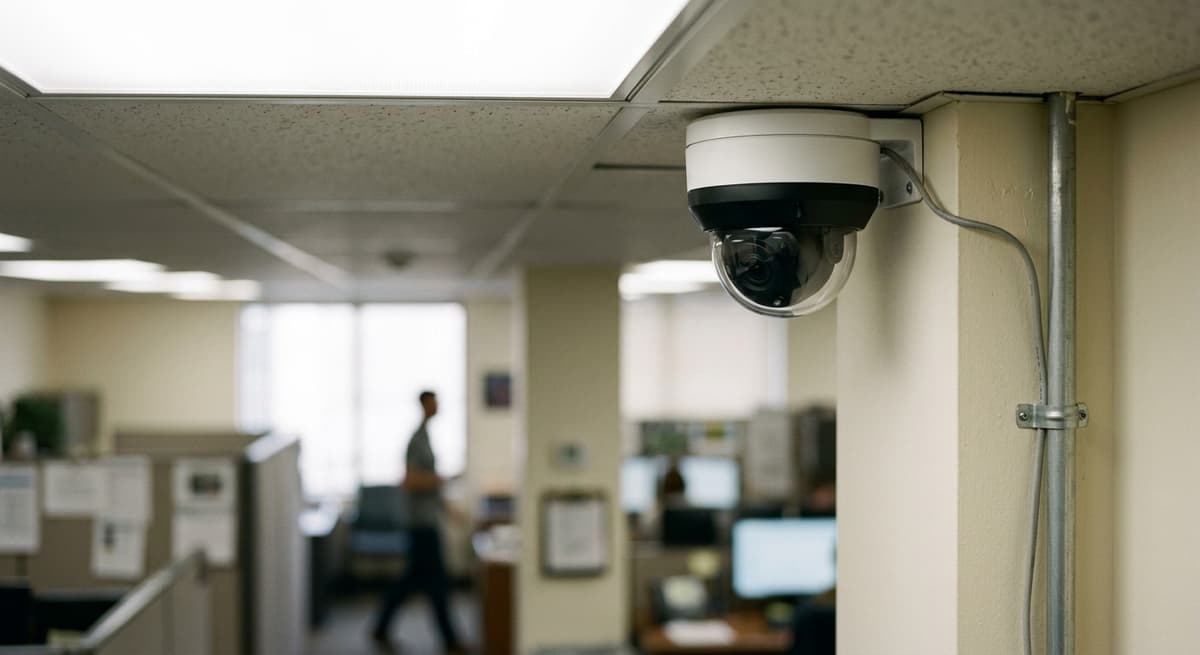
Employers cannot place hidden cameras in restrooms, locker rooms, changing areas, or any workplace location where employees have a reasonable expectation of privacy. Video surveillance in common work areas (production floors, lobbies, hallways) is permissible with proper employee notice.
Employees who secretly install hidden cameras in the workplace may face both criminal charges under F.S. 810.145 and disciplinary action. See the full guide on workplace recording laws.
Hidden Cameras in Public Restrooms and Changing Rooms
Recording in public restrooms, fitting rooms, changing areas, and similar spaces is among the most serious applications of F.S. 810.145. These locations are where people have the clearest expectation of privacy, and courts apply the statute aggressively to protect victims in these settings.
Drones and Voyeurism
The proliferation of camera-equipped drones has created new voyeurism risks. Using a drone to:
- Peer into windows of private homes
- Record people in fenced backyards
- Capture images of people in locations with privacy expectations
can constitute digital voyeurism under F.S. 810.145. Florida also has specific drone regulations under Fla. Stat. 934.50, the "Freedom from Unwarranted Surveillance Act," which restricts the use of drones by law enforcement and others to conduct surveillance.
Federal Overlay: TAKE IT DOWN Act (2025)
President Trump signed the TAKE IT DOWN Act on May 19, 2025. The federal law creates a right for victims of non-consensual intimate imagery (NCII) -- including AI-generated deepfake images -- to demand removal from online platforms within 48 hours. The Act applies nationwide and provides a federal civil cause of action against individuals who knowingly publish NCII.
In Florida, this federal overlay supplements (but does not replace) the protections under F.S. 810.145. A person who records, distributes, or sells voyeuristic images may face:
- State criminal charges under F.S. 810.145 (third-degree felony for dissemination)
- Federal civil liability under the TAKE IT DOWN Act if the imagery was shared online
- Sex offender registration requirements under F.S. 943.0435 in qualifying circumstances
The TAKE IT DOWN Act applies to AI-generated deepfake NCII as well as real recordings, meaning digitally altered voyeuristic images are covered under both federal and Florida law.
Relationship to Florida's Wiretapping Law
Digital voyeurism under F.S. 810.145 and illegal interception under F.S. 934.03 are separate offenses that can both apply to the same recording. If a hidden camera captures both video of a person in a private location and audio of their conversations, the offender can be charged under both statutes:
- F.S. 810.145 for the visual recording in a private location
- F.S. 934.03 for intercepting oral communications without all-party consent
Each statute carries its own set of penalties, and charges can be brought simultaneously.
Sex Offender Registration
Convictions for digital voyeurism under certain circumstances may require registration as a sex offender in Florida. Under Fla. Stat. 943.0435, a conviction for digital voyeurism involving a minor victim or other qualifying circumstances can trigger sex offender registration requirements. The specific registration requirements depend on the facts of the case and the victim's age.
Civil Remedies for Voyeurism Victims
In addition to criminal prosecution, victims of voyeurism and hidden camera recording may pursue civil remedies including:
- Invasion of privacy lawsuits: Florida recognizes the tort of intrusion upon seclusion, which allows victims to recover damages for unreasonable invasions of their private affairs
- Intentional infliction of emotional distress: Voyeuristic conduct can support claims for emotional distress damages
- Injunctive relief: Courts can order the destruction of voyeuristic recordings and prohibit further conduct
- Civil damages under F.S. 934.10: If audio was also illegally captured, the victim can recover statutory damages of $100 per day or $1,000 (whichever is higher), plus actual damages, punitive damages, and attorney's fees
How to Protect Yourself from Hidden Cameras
While this guide focuses on the law, practical protective measures include:
- Inspect unfamiliar rooms (hotels, Airbnbs, locker rooms) for unusual objects or devices
- Check for small pinholes in walls, mirrors, smoke detectors, or electrical outlets
- Use a flashlight to look for camera lens reflections
- Consider using an RF detector or camera finder device in sensitive locations
- Report any suspicious devices to management and law enforcement
More Florida Recording Laws
Audio Recording | Video Recording | Voyeurism & Hidden Cameras | Workplace Recording | Recording Police | Phone Call Recording | Security Cameras | Recording in Public | Landlord-Tenant | Dashcam Laws | Schools | Medical Recording
Back to Florida Recording Laws
More Florida Recording Topics
More Florida Laws
Frequently Asked Questions
What is digital voyeurism in Florida?
Digital voyeurism under Florida Statute 810.145 involves using any imaging device (camera, smartphone, drone, smart glasses, etc.) to secretly record a person in a location where they have a reasonable expectation of privacy, or to record under or through their clothing without consent. The 2024 update expanded the law from 'video voyeurism' to 'digital voyeurism' to cover modern technology. For offenders aged 19 and older, this is a third-degree felony with up to 5 years in prison.
Is it illegal to put a hidden camera in my own home in Florida?
You can generally place cameras in common areas of your own home for security purposes. However, you cannot place hidden cameras in locations where other people in your household (roommates, guests, partners) have a reasonable expectation of privacy, such as bathrooms, guest bedrooms, or changing areas. If the camera records audio, Florida's all-party consent law (F.S. 934.03) also applies.
What are the penalties for hidden camera voyeurism in Florida?
For offenders aged 19 and older, digital voyeurism is a third-degree felony punishable by up to 5 years in prison and a $5,000 fine. Distributing voyeuristic recordings is also a third-degree felony at any age. Repeat offenders face second-degree felony charges with up to 15 years in prison and $10,000 in fines. Offenders under 19 face first-degree misdemeanor charges for a first offense. Separately, an offender 19 or older who is a family/household member or holds a position of authority or trust with the victim faces reclassification to the next higher felony degree, and an offense against a victim under 16 by a caregiver, school employee, or offender 24+ is a second-degree felony, regardless of prior record.
Can I use a drone to record my neighbor in Florida?
Using a drone to record someone in a location where they have a reasonable expectation of privacy (inside their home, in a fenced backyard, through windows) can constitute digital voyeurism under F.S. 810.145. Florida also has the Freedom from Unwarranted Surveillance Act (F.S. 934.50), which restricts drone surveillance. Recording your neighbor in a clearly public area may be legal, but pointing a drone camera at their private spaces is not.
What should I do if I find a hidden camera in a hotel room or Airbnb in Florida?
Document the camera's location with photos without touching or moving it. Contact local law enforcement immediately to file a report. Notify the hotel management or rental platform. Preserve any evidence. The person who placed the camera faces third-degree felony charges under F.S. 810.145, and you may have grounds for a civil lawsuit for invasion of privacy and emotional distress.
Updates
Rebuilt the F.S. 810.145 penalty ladder to include two enhancements the page previously omitted: reclassification to the next higher felony degree when the offender holds a position of authority or trust over the victim, and a standalone second-degree felony for offenses against a victim under 16 by a caregiver, school employee, or offender 24 or older.
Independently fact-checked against the cited primary sources; governing law re-checked for recent changes
Corrected the TAKE IT DOWN Act's signer and date (President Trump, May 19, 2025, not President Biden/2026) in the body text, section heading, and UpdatesLog entry; and fixed the repeat-offender enhancement to track F.S. 810.145(9)'s actual standard (prior conviction or juvenile delinquency adjudication), removing a fabricated 'adjudication withheld' trigger.
Governing law re-checked for recent changes
Title updated to 2026. Added [TAKE IT DOWN Act](/us-laws/take-it-down-act) (federal, signed by President Trump on May 19, 2025) creating a federal right of removal for non-consensual intimate imagery (NCII) including AI-generated deepfakes, providing a federal overlay to F.S. 810.145 digital voyeurism protections.
Reviewed and approved by an editor
The Law Behind This Article
This article rests on the statutory provisions below, held in our own legal record and retrieved from the official source. Tap a section to read the operative text.
Florida Statutes
§ 810.145Digital voyeurism.In forcecited in 15 of our articles
(1) As used in this section, the term:(a) “Broadcast” means electronically transmitting a visual image or visual recording with the intent that it be viewed by another person. (b) “Family or household member” has the same meaning as in s. 741.28. (c) “Imaging device” means any mechanical, digital, or electronic viewing device; still camera; camcorder; motion picture camera; or any other instrument, equipment, or format capable of recording, storing, or transmitting visual images of another person. (d) “Position of authority or trust” means a position occupied by a person 18 years of age or older who is a relative, caregiver, coach, employer, or other person who, by reason of his or her relationship with the victim, is able to exercise undue influence over him or her or exploit his or her trust. (e) “Privately exposing the body” means exposing a sexual organ.
Official text (excerpt) · last checked 2026-08-31 · Read the full text in our law library · Verify at leg.state.fl.us
Cited in 3 court opinions in our collectionLatest citing opinion in our collection: 2024
In the courts (editorial summary, independently checked):Kenneth Isaac Parkerson v. State of Florida (2015) rejected a facial overbreadth challenge to section 810.145, holding the video voyeurism statute regulates conduct, not pure speech. Clemen v. Surterra Holdings, Inc. (2024) drew on its privacy definition and exemption for clearly visible cameras when dismissing an intrusion claim.
Opinions citing this section in our collection:
- Kenneth Isaac Parkerson v. State of Florida (District Court of Appeal of Florida 2015, 163 So. 3d 683)✓A man caught watching people inside their homes, once carrying a camera, argued Florida's video voyeurism statute was facially overbroad because it could reach journalists and investigators; the court held section 810.145 is not overbroad and affirmed his convictions.
- Clemen v. Surterra Holdings, Inc. (District Court, M.D. Florida 2024)✓A worker sued over cameras aimed at a workplace changing area; dismissing her intrusion on seclusion claim, the court drew on section 810.145's privacy definition and its exclusion for obvious cameras, and found no authority making an alleged violation outrageous per se.
- Keith Taig v. City of Vero Beach (Court of Appeals for the Eleventh Circuit 2023)✓A spa customer recorded by covert police cameras installed under a court order argued Florida statutes including section 810.145 gave officers clear notice of customers' privacy rights; the court held those state statutes do not clearly establish a federal constitutional right.
Identified automatically from the court opinions citing this section — not a ranking of which case controls.
Also relied on in: Florida Recording Laws (2026): All-Party Consent Rules, Is It Illegal to Video Record Someone Without Their Consent? (2026), Florida Landlord-Tenant Recording Laws: Cameras and Privacy Rules (2026)
§ 775.082Penalties; applicability of sentencing structures; mandatory minimum sentences for certain reoffenders previously released from prison.In forcecited in 8 of our articles
(1)(a) Except as provided in paragraph (b), a person who has been convicted of a capital felony shall be punished by death if the proceeding held to determine sentence according to the procedure set forth in s. 921.141 results in a determination that such person shall be punished by death, otherwise such person shall be punished by life imprisonment and shall be ineligible for parole. (b)1. A person who actually killed, intended to kill, or attempted to kill the victim and who is convicted under s. 782.04 of a capital felony, or an offense that was reclassified as a capital felony, which was committed before the person attained 18 years of age shall be punished by a term of imprisonment for life if, after a sentencing hearing conducted by the court in accordance with s. 921.1401, the court finds that life imprisonment is an appropriate sentence. If the court finds that life imprisonment is not an appropriate sentence, such person shall be punished by a term of imprisonment of at least 40 years. A person sentenced pursuant to this subparagraph is entitled to a review of his or her sentence in accordance with s. 921.1402(2)(a). 2.
Official text (excerpt) · last checked 2026-07-28 · Read the full text in our law library · Verify at leg.state.fl.us
Cited in 291 court opinions in our collectionLatest citing opinion in our collection: 2026
In the courts (editorial summary, independently checked):State v. Dixon (1973) held Section 775.082, with sections 782.04 and 921.141, constitutional under the test of Furman v. Georgia. Kenneth R. Jackson v. State of Florida (2017) held that Section 775.082(2)'s automatic life-sentence remedy did not apply after Hurst v. Florida, which invalidated only certain sentencing procedures.
Opinions citing this section in our collection:
- State v. Dixon (Supreme Court of Florida 1973, 283 So. 2d 1)✓Four consolidated murder cases challenged Florida's post-Furman capital scheme; the Florida Supreme Court held sections 775.082, 782.04 and 921.141 constitutional, reading the listed aggravating and mitigating circumstances as definite enough to channel sentencing discretion.
- Woods v. State (District Court of Appeal of Florida 1999, 740 So. 2d 20)✓Woods committed an unarmed robbery about a month after release from prison and was sentenced to 15 years as a prison releasee reoffender under section 775.082(8); the court affirmed, rejecting separation of powers, vagueness and equal protection challenges.
- Kenneth R. Jackson v. State of Florida (Supreme Court of Florida 2017, 42 Fla. L. Weekly Supp. 361)✓Jackson was sentenced to death for a murder during a sexual battery on an 11-1 jury recommendation; the court found Hurst error but held section 775.082(2)'s life-sentence remedy inapplicable, since Hurst voided only part of section 921.141, and ordered a new penalty phase.
Identified automatically from the court opinions citing this section — not a ranking of which case controls.
Also relied on in: Hit and Run Laws in the United States (2026 Guide), How Long Is a Life Sentence in Florida? (2026 Guide), Florida's New Hit-and-Run Law Lets Courts Order Restitution for Property Damage
§ 810.14Voyeurism prohibited; penalties.In forcecited in 3 of our articles
(1) A person commits the offense of voyeurism when he or she, with lewd, lascivious, or indecent intent:(a) Secretly observes another person when the other person is located in a dwelling, structure, or conveyance and such location provides a reasonable expectation of privacy. (b) Secretly observes another person’s intimate areas in which the person has a reasonable expectation of privacy, when the other person is located in a public or private dwelling, structure, or conveyance. As used in this paragraph, the term “intimate area” means any portion of a person’s body or undergarments that is covered by clothing and intended to be protected from public view. (2) A person who violates this section commits a misdemeanor of the first degree for the first violation, punishable as provided in s. 775.082 or s. 775.083. (3) A person who violates this section and who has been previously convicted or adjudicated delinquent two or more times of any violation of this section commits a felony of the third degree, punishable as provided in s. 775.082, s. 775.083, or s. 775.084.
Official text (excerpt) · last checked 2026-07-28 · Read the full text in our law library · Verify at leg.state.fl.us
Cited in 3 court opinions in our collectionLatest citing opinion in our collection: 2026
Opinions citing this section in our collection:
- In Re Standard Jury Inst.-Criminal Cases (Supreme Court of Florida 2000, 765 So. 2d 692)“…Comment This instruction is based on section 810.14, Florida Statutes (Supp.1998). It is error to inform the…”
- Kenneth Isaac Parkerson v. State of Florida (District Court of Appeal of Florida 2015, 163 So. 3d 683)“…allenge to the Voyeurism Statute The voyeurism statute, section 810.14, Florida Statutes (2011), provides, in pertinent part:…”
- United States v. Watkins (Court of Appeals for the Tenth Circuit 2026)“…20;1 Del. Code Ann. tit. 11, § 1335;1 D.C. Code § 22-3531;3 Fla. Stat. Ann. § 810.14;2 Ga. Code Ann. § 16-11-61; Haw. Rev. S…”
Identified automatically from the court opinions citing this section — not a ranking of which case controls.
Also relied on in: Florida Video Recording Laws: What You Can and Cannot Record (2026), Florida Surveillance Camera Laws (2026 Guide)
§ 934.03Interception and disclosure of wire, oral, or electronic communications prohibited.In forcecited in 51 of our articles
(1) Except as otherwise specifically provided in this chapter, any person who:(a) Intentionally intercepts, endeavors to intercept, or procures any other person to intercept or endeavor to intercept any wire, oral, or electronic communication; (b) Intentionally uses, endeavors to use, or procures any other person to use or endeavor to use any electronic, mechanical, or other device to intercept any oral communication when:1. Such device is affixed to, or otherwise transmits a signal through, a wire, cable, or other like connection used in wire communication; or 2.
Official text (excerpt) · last checked 2026-08-31 · Read the full text in our law library · Verify at leg.state.fl.us
Cited in 74 court opinions in our collectionLatest citing opinion in our collection: 2026
In the courts (editorial summary, independently checked):State v. Walls (1978) held that recording an in-home oral communication without the consent of all parties violated section 934.03 and required suppression, and State v. Inciarrano (1985) held the statute protects only communications uttered with a reasonable expectation of privacy.
Opinions citing this section in our collection:
- State v. Walls (Supreme Court of Florida 1978, 356 So. 2d 294)✓An extortion victim secretly recorded threats made to him in his own home; the court held that was a protected oral communication, that recording it without every party's consent violated Section 934.03, and that Section 934.06 barred using the tape as evidence.
- SHARRON TASHA FORD v. CITY OF BOYNTON BEACH (District Court of Appeal of Florida 2021)“…ng oral communications in violation of the wiretap statute, section 934.03, Florida Statutes (2009), and for obstructing without vio…”
- State v. Calhoun (Circuit Court for the Judicial Circuits of Florida 1984, 7 Fla. Supp. 2d 3)“…hall not be violated” . . . (emphasis mine) Furthermore, section 934.03, Florida Statutes, makes it unlawful for *6 any person (…”
Identified automatically from the court opinions citing this section — not a ranking of which case controls.
Also relied on in: Florida Dashcam Laws: Rules for Dashboard Cameras (2026), Can an Employer Record Conversations Without Consent? (2026), Can You Record ICE Agents? Know Your Rights by State (2026)
§ 934.50Searches and seizure using a drone.In forcecited in 3 of our articles
(1) SHORT TITLE.—This act may be cited as the “Freedom from Unwarranted Surveillance Act.” (2) DEFINITIONS.—As used in this act, the term:(a) “Drone” means a powered, aerial vehicle that:1. Does not carry a human operator; 2. Uses aerodynamic forces to provide vehicle lift; 3. Can fly autonomously or be piloted remotely; 4. Can be expendable or recoverable; and 5. Can carry a lethal or nonlethal payload. (b) “Image” means a record of thermal, infrared, ultraviolet, visible light, or other electromagnetic waves; sound waves; odors; or other physical phenomena which captures conditions existing on or about real property or an individual located on that property. (c) “Imaging device” means a mechanical, digital, or electronic viewing device; still camera; camcorder; motion picture camera; or any other instrument, equipment, or format capable of recording, storing, or transmitting an image. (d) “Law enforcement agency” means a lawfully established state or local public agency that is responsible for the prevention and detection of crime, local government code enforcement, and the enforcement of penal, traffic, regulatory, game, or controlled substance laws.
Official text (excerpt) · last checked 2026-08-31 · Read the full text in our law library · Verify at leg.state.fl.us
Cited in 1 court opinions in our collectionLatest citing opinion in our collection: 2022
Opinions citing this section in our collection:
- CHARLES LEE ROSALY v. VERONIKA KONECNY (District Court of Appeal of Florida 2022)“…section 784.048(1)(a). The Florida legislature amended section 934.50, Florida Statutes, in 2015 to prohibit certain conduct in…”
Identified automatically from the court opinions citing this section — not a ranking of which case controls.
Also relied on in: Florida Drone Laws 2026: Privacy, Warrants & Penalties
§ 943.0435Sexual offenders required to register with the department; penalty.In force
(1) As used in this section, the term:(a) “Change in status at an institution of higher education” has the same meaning as provided in s. 775.21. (b) “Convicted” means that there has been a determination of guilt as a result of a trial or the entry of a plea of guilty or nolo contendere, regardless of whether adjudication is withheld, and includes an adjudication of delinquency of a juvenile as specified in this section. Conviction of a similar offense includes, but is not limited to, a conviction by a federal or military tribunal, including courts-martial conducted by the Armed Forces of the United States, and includes a conviction or entry of a plea of guilty or nolo contendere in any state of the United States or other jurisdiction. (c) “Electronic mail address” has the same meaning as provided in s. 668.602. (d) “Institution of higher education” has the same meaning as provided in s. 775.21. (e) “Internet identifier” has the same meaning as provided in s. 775.21. (f) “Permanent residence,” “temporary residence,” and “transient residence” have the same meaning as provided in s. 775.21. (g) “Professional license” has the same meaning as provided in s. 775.21. (h)1.
Official text (excerpt) · last checked 2026-07-28 · Read the full text in our law library · Verify at leg.state.fl.us
Cited in 110 court opinions in our collectionLatest citing opinion in our collection: 2026
Opinions citing this section in our collection:
- State v. Erickson (District Court of Appeal of Florida 2003, 852 So. 2d 289)“…ith failure to register as a sexual offender as required by section 943.0435, Florida Statutes (2002). Erickson subsequently filed a p…”
- Grumet v. State (District Court of Appeal of Florida 2000, 771 So. 2d 39)“…idavit, appellant violated the registration requirements of section 943.0435, Florida Statutes (1999), by failing to notify the DMV of…”
- State v. Whitt (District Court of Appeal of Florida 2012, 96 So. 3d 1125)“…s a sexual offender and is required to register pursuant to section 943.0435, Florida Statutes. FDLE also informed him that the regist…”
Identified automatically from the court opinions citing this section — not a ranking of which case controls.
Explore the law
This article also draws on these acts and chapters (opening at their first section): Florida Statutes § 810.02 (Burglary.)
Related law for further reading — not part of this article’s citations.
Search our full record of US law — 2.1 million sections, every state + federal →
Sources and References
- Florida Statute 810.145 - Digital Voyeurism(flsenate.gov).gov
- Florida Statute 810.14 - Voyeurism(leg.state.fl.us).gov
- Florida Statute 934.03 - Interception and Disclosure of Communications(flsenate.gov).gov
- Florida Statute 934.50 - Freedom from Unwarranted Surveillance Act(flsenate.gov).gov
- Florida Statute 775.082 - Penalties and Sentencing(flsenate.gov).gov
- Florida Statute 943.0435 - Sexual Offender Registration(flsenate.gov).gov
- Florida Chapter 810 - Burglary and Trespass(flsenate.gov).gov