
Missouri
Missouri Windshield Mounting Laws (2026 Guide)
Independently fact-checked against primary sources (last audited August 17, 2026). · Reviewed by the RecordingLaw editorial team. · Law checked current as of August 17, 2026. · 5 primary sources cited on this page. How we verify our legal content
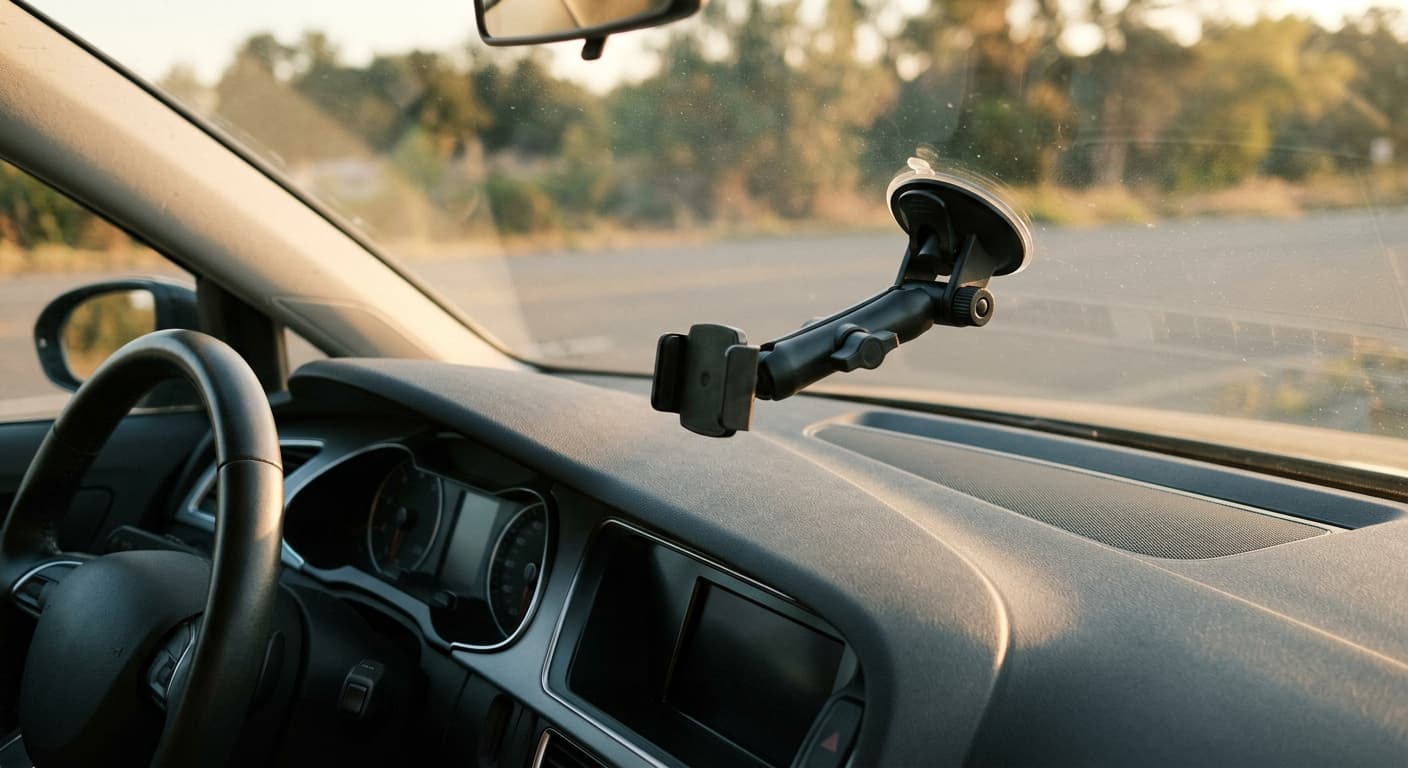
Missouri law permits windshield-mounted dashcams, GPS units, and phones as long as the mount does not obstruct the driver's normal view of the road. RSMo 307.173 applies that normal-view standard to labels, stickers, and similar material applied to the glass, and no statute specifically bans suction cup mounts. Position the device in a corner or near the edge to stay legal.
Missouri drivers who want to mount a GPS unit, smartphone, or dashcam on their windshield need to understand two areas of state law. The first is RSMo 307.173, which regulates what can be placed on or applied to a vehicle's windshield and windows. The second is the Siddens Bening Hands-Free Law (RSMo 304.822), which controls how drivers may interact with electronic devices while operating a vehicle.
Together, these statutes determine where you can place a mount, what devices you can attach, and how you are allowed to use them behind the wheel. This guide covers both laws in detail, along with penalties, exemptions, and practical tips for staying legal on Missouri roads.
Does Missouri Allow Windshield-Mounted Devices?
Missouri is one of the states that does not explicitly prohibit mounting a GPS, smartphone, or other device on the windshield. There is no standalone statute that bans suction cup mounts or similar accessories from being attached to the windshield glass.
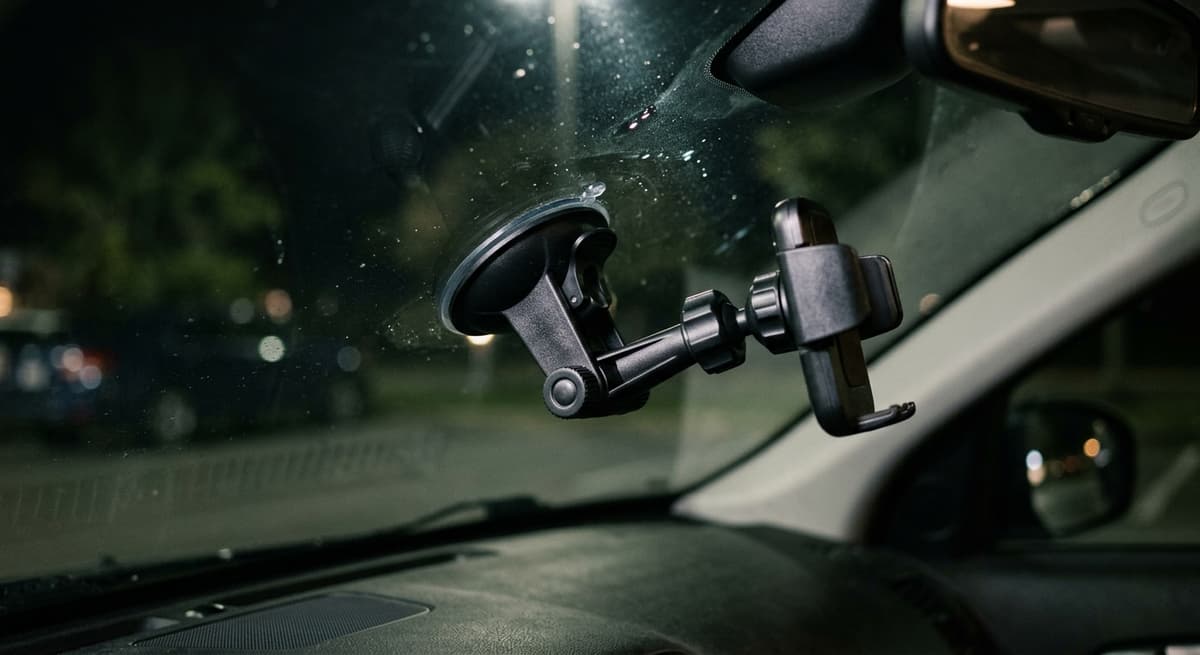
However, this does not mean there are zero restrictions. Missouri law requires that nothing on the windshield interfere with the driver's ability to see the road clearly. The relevant statute is RSMo 307.173, which addresses sun-screening devices, tinting, and obstructions applied to vehicle glass.
Under this statute, labels, stickers, decalcomania, and informational signs are permitted on motor vehicles as long as they do not interfere with the driver's normal view of the road. The same principle applies to mounted devices. A GPS or phone mount is legal in Missouri, but it must be positioned so it does not block the driver's line of sight.
RSMo 307.173: Windshield Obstruction Rules
The primary statute governing windshield obstructions in Missouri is Section 307.173 of the Revised Statutes of Missouri. While this law focuses mainly on window tinting and sun-screening devices, it establishes the legal standard for anything placed on vehicle glass.
Key Provisions
The statute sets specific requirements for window tinting and applied materials:
- Front side windows must allow at least 35% light transmission (plus or minus 3%)
- Luminous reflectance on front side windows must be 35% or less (plus or minus 3%)
- All sun-screening devices applied to the windshield are prohibited except as provided in subsection 2
- The only windshield tinting subsection 2 allows is factory-installed tinted glass, an equivalent replacement, or tinting material applied to the upper portion of the windshield that is normally tinted by the manufacturer. The statute states no measurement in inches for that upper band
- Labels, stickers, and informational signs are allowed as long as they do not interfere with the driver's normal view of the road
How This Applies to Mounts
Although RSMo 307.173 does not specifically mention GPS mounts or phone holders, the general obstruction standard applies. Any device or accessory attached to the windshield must not interfere with the driver's normal view of the road. A mount placed in the center of the windshield directly in the driver's line of sight could be considered a violation, while a mount positioned in the lower corner or near the edge of the windshield is generally acceptable.
Penalties for Windshield Violations
A violation of RSMo 307.173 is a Class C misdemeanor under Missouri law. Class C misdemeanors in Missouri can carry a fine of up to $750. While enforcement of this statute for device mounts is uncommon, a poorly placed mount that clearly obstructs the driver's view could result in a traffic stop and citation.
The Siddens Bening Hands-Free Law (RSMo 304.822)
The more impactful law for Missouri drivers who mount devices on their windshield is the Siddens Bening Hands-Free Law, codified in RSMo 304.822. Governor Mike Parson signed this law on July 7, 2023. A warning-only period ran from August 28, 2023, through December 31, 2024. Full enforcement with fines began on January 1, 2025.
What the Law Prohibits
Under RSMo 304.822, no driver may:
- Physically hold or support an electronic communication device with any part of their body while operating a motor vehicle
- Write, send, or read any text-based communication on an electronic communication device while driving
- Make video calls or use FaceTime
- Manually type or dial a phone number
- Browse the internet, watch videos, or play games
- Take photos or record videos by hand
The law applies on any highway or property open to the public for vehicular traffic in Missouri.
What the Law Allows
Drivers may still use electronic devices in the following ways:
- Voice commands: Making calls, sending texts, or getting directions through voice-activated features
- Single touch or swipe: Answering or ending a call, starting navigation, or changing music with one quick tap or swipe on a mounted device
- Hands-free calling: Using Bluetooth, speakerphone, or the vehicle's built-in communication system
- Mounted navigation: Viewing a map or GPS directions on a device that is properly mounted in the vehicle
- Audio controls: Accessing music or podcasts through a single touch on a mounted device
The critical requirement is that the device must be mounted, not held, and interaction must be limited to a single touch or swipe that does not divert attention from driving.
Definition of "Electronic Communication Device"
Under the statute, an "electronic communication device" is defined as any portable device used to initiate, receive, store, or view communication, information, images, or data electronically. This includes:
- Cell phones and smartphones
- Tablets and portable computers
- GPS navigation units
- Portable media players
- Smartwatches with communication capabilities
- Any similar portable electronic device
Definition of "Hands-Free Feature"
The law defines a "voice-operated or hands-free feature or function" as any feature, whether internally installed or externally attached to the device, that allows a person to use an electronic communication device without the use of either hand. The only manual interaction allowed is a single touch or single swipe to activate, deactivate, or initiate the feature.
Penalties for Hands-Free Law Violations
The Siddens Bening Hands-Free Law carries escalating penalties based on the number of offenses and the consequences of the violation.
Standard Fines
| Offense | Timeframe | Maximum Fine |
|---|---|---|
| First violation | No prior conviction in 24 months | $150 |
| Second violation | One prior conviction within 24 months | $250 |
| Third or subsequent violation | Two or more prior convictions within 24 months | $500 |
Enhanced Penalties in Special Zones
Violations that occur in certain designated areas carry enhanced fines of up to $500 regardless of whether it is a first offense:
- Work zones: When workers are present
- School zones: Areas designated and marked to alert drivers to the presence of a school zone
Penalties When Violations Cause Harm
The consequences increase significantly when a hands-free violation leads to an accident:
| Outcome | Charge | Potential Penalty |
|---|---|---|
| Property damage exceeding $5,000 | Class D misdemeanor | Fine up to $500 |
| Serious physical injury to another person | Class B misdemeanor | Up to 6 months in jail and up to $1,000 fine |
| Death of another person | Class D felony | Up to 7 years in prison and up to $10,000 fine |
Points on Your License
A standard hands-free violation is classified as an infraction under Missouri law. The Missouri Department of Revenue has indicated that no points are assessed on a driver's license for a basic infraction under this statute. However, if the violation escalates to a misdemeanor or felony due to an accident causing injury or death, additional consequences including points and license suspension may apply.
Exemptions to the Hands-Free Law
RSMo 304.822 includes several exemptions for specific situations and categories of drivers.
Emergency Situations
The law does not apply to an operator using an electronic communication device for the sole purpose of reporting an emergency situation and continuing communication with emergency personnel during that emergency situation.
Missouri's exemption list does not cover passively receiving emergency alerts or notifications. Some other states carve that out; Missouri does not, so picking up a phone to read an alert is not protected by this exemption.
Emergency Personnel
Law enforcement officers and operators of emergency vehicles (as defined in RSMo 304.022) are exempt when they are using the device in the performance of their official duties and actively operating an emergency vehicle.
Commercial Motor Vehicle Operators
Operators of commercial motor vehicles have specific exemptions:
- They may use a voice-operated or hands-free feature as long as they remain seated and restrained by a seat belt
- They may read a message displayed on a permanently installed communication device designed for a commercial motor vehicle, provided the screen does not exceed ten inches tall by ten inches wide. Both dimensions have to be inside that limit, so a screen 10 inches tall but wider than 10 inches does not qualify
Parked or Stopped Vehicles
The law does not apply to operators using electronic communication devices while the vehicle is lawfully stopped or parked. The statute states that exemption without any further condition. If you pull over to the side of the road or are parked in a parking lot, you may use your device normally.
Best Practices for Windshield Mounting in Missouri
While Missouri law permits windshield mounts, following these guidelines will help you stay within the law and avoid unnecessary attention from law enforcement.
Recommended Mount Placement
- Lower right corner: Mounting near the lower passenger-side corner of the windshield keeps the device accessible while minimizing obstruction of the driver's view
- Dashboard mount: Using a dashboard-mounted holder avoids windshield placement entirely and eliminates any concern about windshield obstruction
- Vent or CD slot mount: Clip-on mounts that attach to air vents or the CD slot keep the device at eye level without touching the windshield
- Avoid the center: Never mount a device directly in the center of the windshield in the driver's primary line of sight
Device Setup Tips
- Program your destination before you start driving
- Enable voice commands for navigation, calls, and messages
- Set your phone to "Do Not Disturb" mode to reduce the temptation to interact with notifications
- Adjust the screen brightness so it does not cause glare or distraction at night
- Secure the device firmly so it does not fall or shift while driving
What to Avoid
- Holding your phone against the steering wheel, even briefly
- Resting your phone on your lap or thigh while driving
- Using two hands to interact with a mounted device
- Typing an address into GPS while the vehicle is in motion
- Watching any video content while driving, even on a mounted screen
Missouri Windshield Tint Rules
Understanding Missouri's windshield tint laws is also important for drivers who mount devices, because tint placement and mount placement both affect visibility.
Under RSMo 307.173:
- Sun-screening devices applied to the windshield are prohibited, apart from factory-installed tinted glass, its equivalent replacement, and tinting material on the upper portion of the windshield that is normally tinted by the manufacturer
- The statute does not use the AS-1 line or give a depth in inches for that upper band, and aftermarket tint below the manufacturer's tinted strip is prohibited whether or not it obstructs the view
- Front side windows must allow at least 35% visible light transmission
- Rear side windows and rear windshield may have any level of tint
- Medical exemptions are available through the Missouri Department of Public Safety for individuals whose physicians prescribe darker tinting due to a serious medical condition
A medical exemption requires a sticker affixed to the lower left corner of the windshield and a decal on the rear glass or bumper.
How Missouri Compares to Neighboring States
Missouri's approach to windshield mounts is relatively permissive compared to some neighboring states. Here is a quick comparison:
| State | Windshield Mount Allowed? | Hands-Free Law? |
|---|---|---|
| Missouri | Yes, if it does not obstruct the view | Yes, fully enforced since January 1, 2025 |
| Kansas | Restrictions on windshield placement | No, texting ban only (K.S.A. 8-15,111) |
| Illinois | Limited to specific windshield areas | Yes |
| Iowa | Yes, with obstruction restrictions | Yes, full hands-free; the warning-only period was repealed January 1, 2026 |
| Arkansas | Yes, with obstruction restrictions | Partial restrictions |
| Oklahoma | Yes, with obstruction restrictions | Partial restrictions |
Drivers who frequently cross state lines should check the specific windshield mounting rules in each state they visit, as laws vary significantly.
More Missouri Laws
If you are researching Missouri traffic and vehicle laws, these related guides may help:
Frequently Asked Questions
Can I mount my phone on the windshield in Missouri?
Yes. Missouri does not have a specific law banning windshield-mounted phones or GPS devices. However, under RSMo 307.173, the mount must not interfere with the driver's normal view of the road. Place the mount in a location that does not block your line of sight, such as the lower corner of the windshield or on the dashboard.
Is it legal to use a GPS mounted on my windshield while driving in Missouri?
Yes, using a GPS or navigation app on a mounted device is legal in Missouri. Under the Siddens Bening Hands-Free Law (RSMo 304.822), you may view a map on a mounted device and interact with it using a single touch or swipe. You may not hold the device in your hand or type an address while driving.
What are the fines for violating Missouri's hands-free law?
A first offense carries a fine of up to $150. A second offense within 24 months can result in a fine of up to $250. A third or subsequent offense within 24 months carries a fine of up to $500. Violations in school zones or work zones are subject to enhanced fines of up to $500 on the first offense.
Can I touch my phone while driving in Missouri if it is mounted?
You may use a single touch or single swipe to activate a hands-free feature on a mounted device. Examples include tapping to answer a call, starting navigation, or changing a song. Extended interaction such as typing, scrolling, or browsing is not permitted while driving.
Are there exceptions to Missouri's hands-free driving law?
Yes. Exemptions include operators using a device for the sole purpose of reporting an emergency and continuing communication with emergency personnel, law enforcement officers and emergency vehicle operators performing official duties, commercial vehicle operators reading a permanently installed device with a screen no larger than ten inches tall by ten inches wide, and operators using a device while the vehicle is lawfully stopped or parked.
Does Missouri's hands-free law apply at red lights and stop signs?
RSMo 304.822 applies to anyone operating a motor vehicle on any highway or property open to public vehicular traffic, and its exemption list covers operators using a device while the vehicle is lawfully stopped or parked, stated without further qualification. The statute does not define what counts as lawfully stopped, so the safest practice is to wait until you are parked before picking up a handheld device.
Will I get points on my license for a hands-free violation in Missouri?
A standard hands-free violation is classified as an infraction, and the Missouri Department of Revenue has indicated that no points are assessed for basic infractions under this statute. However, if the violation results in an accident causing serious injury or death, the charge escalates to a misdemeanor or felony, which may carry additional license consequences.
Updates
Corrected the article against the enacted text of RSMo 304.822 and 307.173: the commercial-vehicle screen limit is ten inches tall by ten inches wide rather than ten inches in height, Missouri has no exemption for receiving emergency alerts, the lawfully stopped or parked exemption carries no 'active traffic' condition, the windshield tint rules follow the manufacturer's tinted upper band rather than an AS-1 line, and the Kansas and Iowa rows in the neighboring-states table were updated.
Independently fact-checked against the cited primary sources; governing law re-checked for recent changes
Governing law re-checked for recent changes
Reviewed and approved by an editor
The Law Behind This Article
This article rests on the statutory provisions below, held in our own legal record and retrieved from the official source. Tap a section to read the operative text.
Revised Statutes of Missouri, Title XIX (MOTOR VEHICLES, WATERCRAFT AND AVIATION), Chapter 307
§ 307.173Specifications for sun-screening device applied to windshield or windows — permit required, when — exceptions — rules, procedure — violations, penalty.In forcecited in 2 of our articles
1. Any person may operate a motor vehicle with front sidewing vents or windows located immediately to the left and right of the driver that have a sun-screening device, in conjunction with safety glazing material, that has a light transmission of thirty-five percent or more plus or minus three percent and a luminous reflectance of thirty-five percent or less plus or minus three percent. Except as provided in subsection 5 of this section, any sun-screening device applied to front sidewing vents or windows located immediately to the left and right of the driver in excess of the requirements of this section shall be prohibited without a permit pursuant to a physician's prescription as described below. A permit to operate a motor vehicle with front sidewing vents or windows located immediately to the left and right of the driver that have a sun-screening device, in conjunction with safety glazing material, which permits less light transmission and luminous reflectance than allowed under the requirements of this subsection, may be issued by the department of public safety to a person having a serious medical condition which requires the use of a sun-screening device if the…
Official text (excerpt) · last checked 2026-09-08 · Read the full text in our law library · Verify at revisor.mo.gov
Cited in 2 court opinions in our collectionLatest citing opinion in our collection: 2024
Opinions citing this section in our collection:
- State v. Lorenzo (Missouri Court of Appeals 1987, 743 S.W.2d 529)“…Interstate 70 Highway in Lafayette County for violation of § 307.173, RSMo 1978. Section 307.173 proscribes the op…”
- Fred Watson v. Eddie Boyd, III (Court of Appeals for the Eighth Circuit 2024, 119 F.4th 539)“…2022 WL 16569365, at *5 (E.D. Mo. Sept. 26, 2022) (citing Mo. Rev. Stat. § 307.173; City Code § 44-404). Missouri law also…”
Identified automatically from the court opinions citing this section — not a ranking of which case controls.
Also relied on in: Missouri Window Tint Laws (2026): Legal VLT Limits
Revised Statutes of Missouri, Title XIX (MOTOR VEHICLES, WATERCRAFT AND AVIATION), Chapter 304
§ 304.822Electronic communication device, use of while driving prohibited, when — citation of law — definitions — school bus operations, prohibited acts — inapplicability, when — penalties for violations — search of device, right to decline — preemption.In force
1. This section shall be known as the "Siddens Bening Hands Free Law". 2. As used in this section, the following terms shall mean: (1) "Commercial motor vehicle", the same meaning as is ascribed to such term in section 302.700; (2) "Electronic communication device", a portable device that is used to initiate, receive, store, or view communication, information, images, or data electronically. (a) Such term shall include but not be limited to: cellular telephones; portable telephones; text-messaging devices; personal digital assistants; pagers; broadband personal communication devices; electronic devices with mobile data access; computers, including but not limited to tablets, laptops, notebook computers, and electronic or video game systems; devices capable of transmitting, retrieving, or displaying a video, movie, broadcast television image, or visual image; and any substantially similar device that is used to initiate or receive communication or store and review information, videos, images, or data.
Official text (excerpt) · last checked 2026-07-31 · Read the full text in our law library · Verify at revisor.mo.gov
§ 304.022Emergency and stationary vehicles — use of lights and sirens — right-of-way — procedure — penalty.In force
1. Upon the immediate approach of an emergency vehicle giving audible signal by siren or while having at least one lighted lamp exhibiting red light visible under normal atmospheric conditions from a distance of five hundred feet to the front of such vehicle or a flashing blue light authorized by section 307.175, the driver of every other vehicle shall yield the right-of-way and shall immediately drive to a position parallel to, and as far as possible to the right of, the traveled portion of the highway and thereupon stop and remain in such position until such emergency vehicle has passed, except when otherwise directed by a police or traffic officer.
Official text (excerpt) · last checked 2026-07-31 · Read the full text in our law library · Verify at revisor.mo.gov
Cited in 31 court opinions in our collectionLatest citing opinion in our collection: 2017
Opinions citing this section in our collection:
- Webb v. State (Supreme Court of Missouri 2011, 334 S.W.3d 126)“…4) Operates a motor vehicle in violation of subsection 2 of section 304.022, RSMo, and when so operating, acts with crimi…”
- McGuckin v. City of St. Louis (Missouri Court of Appeals 1995, 910 S.W.2d 842)“…is general rule, however, in the emergency vehicle statute, RSMo § 304.022. The statute outlines the situations wh…”
- Southers v. City of Farmington (Supreme Court of Missouri 2008, 263 S.W.3d 603)“…ssed whether the language of the emergency vehicle statute, section 304.022, RSMo Supp.2007, 17 modified the…”
Identified automatically from the court opinions citing this section — not a ranking of which case controls.
Search our full record of US law — 2.1 million sections, every state + federal →
Sources and References
- RSMo 307.173 - Specifications for sun-screening device applied to windshield or windows(revisor.mo.gov).gov
- RSMo 304.822 - Siddens Bening Hands-Free Law(revisor.mo.gov).gov
- RSMo 304.820 - Electronic communication device definitions(revisor.mo.gov).gov
- RSMo 304.022 - Emergency vehicle definitions(revisor.mo.gov).gov
- Phone's Down, It's the Law - Missouri Department of Transportation(savemolives.com).gov
- Missouri Revised Statutes Chapter 307 - Vehicle Equipment Regulations(law.justia.com)
- RSMo 304.822 Full Text - Justia(law.justia.com)
- K.S.A. 8-15,111 - Kansas prohibition on using a wireless communications device to write, send or read a written communication(ksrevisor.gov)
- Iowa Code 2026 section 321.276 - Use of electronic device while driving(legis.iowa.gov)