
Nevada
Nevada Knife Laws (2026): Machete, Concealed Carry, and Preemption
Independently fact-checked against primary sources (last audited September 24, 2026). · 8 primary sources cited on this page. How we verify our legal content

Nevada's general weapons statute sets no blade-length threshold and bans no knife type by name for ordinary carry outside a school or correctional setting, but it treats different items differently within the same section: some are banned outright, some only with intent to harm, and one, the machete, only when carried concealed. A separate catch-all in that same statute reaches an undefined "other dangerous or deadly weapon," which the Nevada Supreme Court has held can include an ordinary knife depending on how it was carried. Other statutes reach schools, threatening display, and jails.
Jurisdiction scope: This page covers Nevada state law only, principally NRS 202.350, 202.265, 202.320, 393.410, 212.185, 268.418, 244.364, and 269.222. It does not cover Nevada's firearm-specific concealed-carry permit statutes (NRS 202.3653 to 202.369) in detail, or local city, county, and town ordinances, which are not preempted for knives as explained below.
Can you carry a knife openly or concealed in Nevada?
Open carry of an ordinary knife is not restricted by Nevada's general weapons statute, NRS 202.350, at all; even the machete, the one blade the statute names specifically, is only banned when carried concealed, not openly. Concealed carry is a different question. NRS 202.350 does not set a blade-length limit or name most knife types for general concealed carry, but its catch-all ban on a concealed "other dangerous or deadly weapon" is not limited to firearms and explosives. The Nevada Supreme Court held in Knight v. State that whether an ordinary knife carried concealed counts as a dangerous or deadly weapon under that clause is a question of fact for the jury, decided from the circumstances of the carry rather than from the knife itself. A common pocketknife or kitchen knife carried for an ordinary, peaceful purpose is unlikely to be treated as a weapon under this test; the same knife carried while forcing entry into a home or in an aggressive confrontation is at much greater risk of being one. Separate rules apply on school property and in a correctional setting, covered below.
The "dangerous or deadly weapon" catch-all: Knight v. State
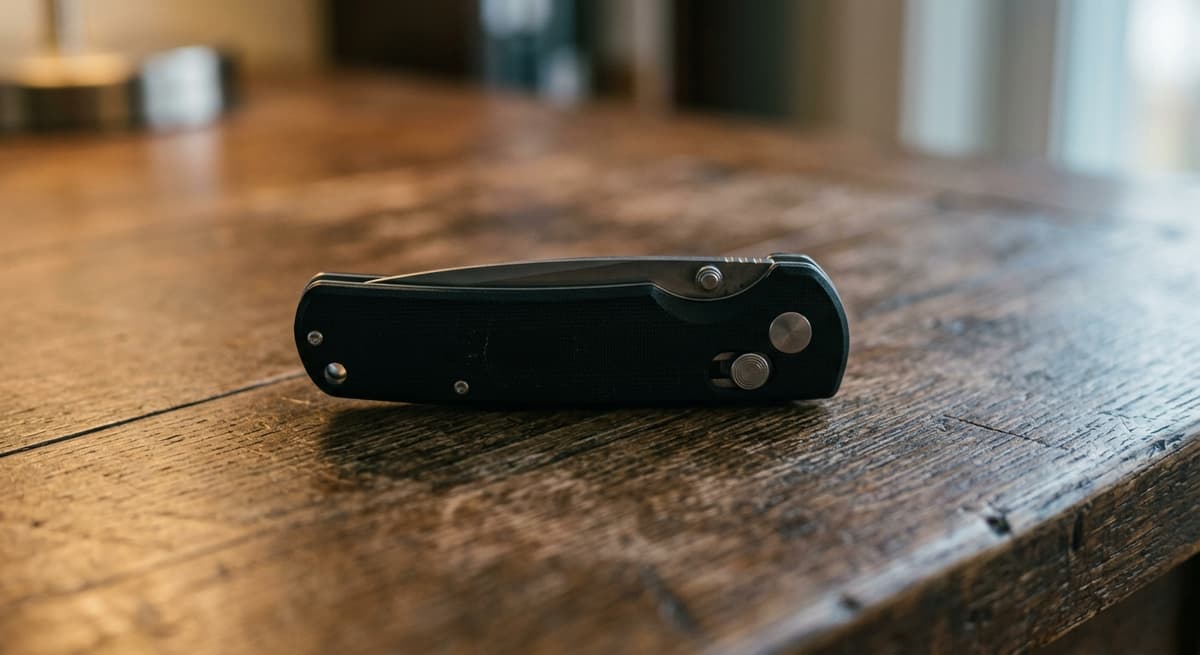
NRS 202.350(1)(d)(3) bans concealed carry of a "[p]istol, revolver or other firearm, other dangerous or deadly weapon or pneumatic gun." The phrase "other dangerous or deadly weapon" is not defined anywhere in the statute. In Knight v. State, 116 Nev. 140, 993 P.2d 67 (2000), the defendant was convicted of carrying a concealed weapon after police found a steak knife hidden in his back pocket. The Nevada Supreme Court first held that a steak knife is not a "dirk" or "dagger" as a matter of law, reasoning that it lacks handguards, is not primarily designed as a weapon, and that the legislature did not intend to bar concealing common household items under that clause.
That did not end the case. The court went on to hold that the separate "other dangerous or deadly weapon" clause could still reach the same knife, and that whether it did was a jury question. The Nevada Supreme Court adopted the approach of the Missouri Supreme Court in State v. Baldwin, 571 S.W.2d 236 (Mo. 1978), quoting the Missouri court's own explanation that "[i]t is obvious that there are many useful and practical items which are carried by persons for peaceful purposes," including pocketknives and steak knives, and that "[s]uch everyday instruments become dangerous or deadly only when they are used or carried for use as a weapon," a determination that depends on "the nature of the instrument itself, the circumstances under which it is carried, including time, place, and situation in which defendant is found in possession, the manner in which it is carried, the particular person carrying it, and perhaps other factors such as possible peaceful uses therefor which the possessor might have." Applying that test, the court affirmed Knight's conviction based on the events shortly before his arrest: the jury's guilty verdict on the trespass count showed it believed testimony that he had improperly entered a Las Vegas apartment without permission, and further testimony established that he behaved in an aggressive and threatening manner while carrying the steak knife at that time. A separate battery-with-a-deadly-weapon count, involving testimony that he had cut a resident's hand, had already been dismissed after the preliminary hearing and formed no part of the court's stated basis for affirmance.
This means the statute's silence on ordinary knives is not the last word. Whether carrying a given knife concealed is lawful in Nevada can turn on the surrounding circumstances, not just the blade itself.
At the time of Knight's arrest, NRS 202.350's concealed-carry clause separately named a "[d]irk, dagger or machete," and the court first had to decide whether a steak knife fell within that named category before turning to the catch-all. It does not today: the current clause lists only "Machete" alongside the undefined "dangerous or deadly weapon" phrase, so a knife once analyzed as a dirk or dagger under this statute is now analyzed, if at all, the same way the steak knife in Knight was, under the catch-all. The Nevada Supreme Court has described a dagger as "a short weapon used for thrusting and stabbing," Huebner v. State, 103 Nev. 29, 30 n.1 (1987), and in Bradvica v. State, 104 Nev. 475 (1988), identified handguards and a blade that locks in place as relevant factors, holding that a small pocketknife with a spring-loaded blade under 2 inches along the sharpened edge was not a dirk or dagger. That definition remains relevant today because "dirk, dagger" is still separately named, and still undefined, in Nevada's school-property statute, NRS 202.265, discussed below.
NRS 202.350's three different rules
NRS 202.350 groups weapons into three categories, each with its own trigger for liability, and reading only one clause misstates the others.
The first category is an outright ban regardless of intent or manner of carry. Except as otherwise provided in the section and in NRS 202.3653 to 202.369, NRS § 202.350(1)(a) provides that a person "shall not: (a) Manufacture or cause to be manufactured, or import into the State, or keep, offer or expose for sale, or give, lend or possess any instrument or weapon of the kind commonly known as a blackjack, slungshot, billy, sand-club, sandbag or metal knuckles." None of these are knives, but they sit in the same subsection as the knife-adjacent items below.
The second category requires intent to harm. NRS § 202.350(1)(c) bans possessing or using "a nunchaku or trefoil" only "with the intent to inflict harm upon the person of another." Simple possession of a nunchaku or trefoil, without that intent, is not an offense under this clause.
The third category is concealed-carry-specific. NRS § 202.350(1)(d) provides that a person shall not "[c]arry concealed upon his or her person any: (1) Explosive substance, other than ammunition or any components thereof; (2) Machete; or (3) Pistol, revolver or other firearm, other dangerous or deadly weapon or pneumatic gun." A machete may be carried openly under this statute; only concealed carry is restricted.
Penalties differ by category. Violating paragraph (a) or (c), or the machete clause in (d)(2), is a gross misdemeanor for a first offense and a category D felony for a subsequent offense, under NRS § 202.350(2)(a). Violating paragraph (b) (machine guns and silencers) or the explosive-substance or firearm clauses in (d)(1) or (d)(3) is a category C felony under § 202.350(2)(b).
The section does not apply to sheriffs, constables, marshals, peace officers, correctional officers, other appointed officers, persons summoned to assist an officer, full-time peace officers of another jurisdiction on duty in Nevada, and members of the armed forces on duty, under subsection 4, or to qualified and qualified retired law enforcement officers authorized to carry concealed under 18 U.S.C. § 926B or § 926C, under subsection 7. A sheriff may issue a permit authorizing an applicant to carry "the concealed weapon described in the permit," under § 202.350(3), but this subsection expressly does not authorize a permit for a pistol, revolver, or other firearm. Because "concealed weapon" is defined broadly in § 202.350(8)(a) as "a weapon described in this section that is carried upon a person in such a manner as not to be discernible by ordinary observation," this permit mechanism could in principle cover a machete carried concealed, though the statute prescribes no application or review procedure for a non-firearm concealed-weapon permit.
Threatening display: NRS 202.320
Separately from the concealed-carry rules above, NRS § 202.320 makes it a misdemeanor for a person carrying "any dirk, dirk-knife, sword, sword cane, pistol, gun or other deadly weapon" to draw or exhibit it "in the presence of two or more persons, ... in a rude, angry or threatening manner not in necessary self-defense," or to unlawfully use that weapon in a fight or quarrel. This offense does not require the weapon to have been carried concealed, and it applies regardless of whether anyone was injured. A sheriff, deputy sheriff, marshal, constable, or other peace officer is not liable under this section for drawing or exhibiting a weapon while lawfully discharging official duties.
Schools and child care facilities
Two separate statutes reach knives around Nevada schools, and they are not the same rule.
NRS § 202.265(1) bars carrying or possessing, on the property of the Nevada System of Higher Education, a private or public school, or a child care facility, or in a vehicle of a private or public school or child care facility, several listed items, including "[a] dirk, dagger or switchblade knife." The statute defines "switchblade knife," for this section, as "a spring-blade knife, snap-blade knife or any other knife having the appearance of a pocketknife, any blade of which is 2 or more inches long and which can be released automatically by a flick of a button, pressure on the handle or other mechanical device, or is released by any type of mechanism," but excludes "a knife which has a blade that is held in place by a spring if the blade does not have any type of automatic release." It does not separately define dirk or dagger; NRS 202.350's concealed-carry clause used to name the same two terms but no longer does, so this is the section where they currently apply, and Nevada courts have looked to whether a knife has handguards and a blade that locks in place when deciding whether it is one, per Bradvica v. State, 104 Nev. 475 (1988). Violation is a gross misdemeanor under § 202.265(2). Exceptions exist for a peace officer, a school security guard, a person with written permission from the college or school's president or principal (or a child care facility's designee), and the operator of a home-based child care facility during business hours, per § 202.265(3)-(4).
A second statute, NRS § 393.410, reaches a different set of conduct on and around a "public schoolhouse" specifically: willfully and maliciously damaging a public schoolhouse or its fixtures, committing a nuisance in a public schoolhouse, loitering on or near the grounds attached to a public schoolhouse, or purposely and maliciously trespassing on those grounds. Simple violation is a public offense scaled to any property damage, no less than a misdemeanor, under § 393.410(2). But possessing a "dangerous weapon" while committing the nuisance, loitering, or trespass violations raises the offense to a gross misdemeanor under § 393.410(3). The statute defines "dangerous knife," for this purpose, as "a knife having a blade that is 2 inches or more in length when measured from the tip of the knife which is customarily sharpened to the unsharpened extension of the blade which forms the hinge connecting the blade to the handle," a measurement of the sharpened edge rather than the knife's overall length, and includes a dirk, dagger, switchblade knife, or dangerous knife within its "dangerous weapon" definition, alongside an explosive or incendiary device, a nunchaku or trefoil, a blackjack, billy club, or metal knuckles, and a pistol, revolver, or other firearm. Unlike § 202.265, which bans simple possession of a listed item on school property generally, § 393.410 applies specifically to a public schoolhouse and its grounds, and sets this sharpened-edge blade-length threshold for a person loitering, trespassing, or committing a nuisance there while carrying a knife.
Correctional facilities
NRS § 212.185(1) makes it a category B felony for a person incarcerated in a Nevada state prison, county or city jail, or other correctional facility (including while being transferred for treatment or in transit) to possess or control a "[d]irk, dagger, switchblade knife or sharp instrument," along with several other listed weapons. Conviction carries a minimum term of 1 year and a maximum of 6 years in state prison. Incarceration, for this statute, "begins upon assignment to a cell or other place within the correctional facility after completion of the initial booking procedure," per § 212.185(2).
No statewide knife preemption
Nevada's three local-control preemption statutes address firearms only, not knives. NRS § 268.418 (cities) provides that "[t]he regulation of the transfer, sale, purchase, possession, carrying, ownership, transportation, storage, registration and licensing of firearms, firearm accessories and ammunition in this State and the ability to define such terms is within the exclusive domain of the Legislature," and voids any conflicting city ordinance. NRS § 244.364 states the identical rule for counties, and NRS § 269.222 states it again for unincorporated towns. All three statutes define "firearm" in their own definitions subsections as including, "without limitation, a pistol, revolver, rifle, shotgun, machine gun, submachine gun, black powder weapon, muzzle-loading firearm or any device which is designed to, able to or able to be readily converted to expel a projectile through the barrel by the action of an explosive, other form of combustion or expanding gases." None of the three definitions subsections, and none of the three statutes' operative text, mentions a knife. A Nevada city, county, or town ordinance that restricts knives is not displaced by any of the three statutes' text.
Federal law: what it does and does not reach
Federal law does not ban an individual from owning or carrying a switchblade. The Federal Switchblade Act, 15 U.S.C. §§ 1241 to 1245, instead restricts interstate commerce in switchblade knives, barring their manufacture for, or introduction, transport, and sale in, interstate commerce, and, in 15 U.S.C. § 1245, makes it a federal offense to knowingly possess, manufacture, sell, or import a ballistic knife in or affecting interstate commerce or within federal territorial jurisdiction. The two switchblade offense sections, §§ 1242 and 1243, do not apply to certain knives and people; § 1244, captioned "Exceptions," lists them. A 2009 amendment, § 1244(5), exempts any knife with a spring, detent, or other closure-bias mechanism that requires hand, wrist, or arm exertion on the blade itself to overcome the bias and assist opening, the carve-out that keeps modern assisted-opening folding knives legal in interstate commerce. A separate exemption, § 1244(4), covers a person with only one arm possessing or carrying a switchblade with a blade three inches or less. Nevada's own switchblade-related restrictions, at NRS 202.265, 393.410, and 212.185, apply only to schools, child-care property, and correctional facilities, not to general possession or interstate transport.
Disclaimer: This article provides general legal information about Nevada's knife laws as of September 2026. It is not legal advice. Consult a lawyer licensed in Nevada for advice about a specific situation. Local city, county, and town ordinances on knives, which Nevada's preemption statutes do not address, can vary and are not covered here.
For a state-by-state comparison, see knife laws by state. Nevada's self-defense statutes are covered separately on the Nevada self-defense laws page.
Statutes cited reflect their in-force version as of 2026-09-18. Last updated: 2026-09-18.
Frequently Asked Questions
Is it legal to carry a knife concealed in Nevada?
It depends on the knife and the circumstances. NRS 202.350 does not set a blade-length limit or ban most knife types by name for concealed carry; it names only a machete, banned concealed outright, and separately bans concealed carry of an unnamed 'other dangerous or deadly weapon.' In Knight v. State (2000), the Nevada Supreme Court held that whether an ordinary knife falls under that last catch-all is a question of fact for the jury, based on the circumstances of the carry, such as the manner in which the knife is carried and whether the person was using it as a weapon, not on the type of knife alone.
Are switchblades illegal in Nevada?
Nevada's general weapons statute, NRS 202.350, does not ban switchblades by name for ordinary adult possession or carry, though carrying one concealed could still fall under the undefined 'dangerous or deadly weapon' catch-all, depending on the circumstances. A switchblade knife, defined as having a blade of 2 or more inches that opens automatically, is separately banned on school and child-care property under NRS 202.265 and for people incarcerated in a correctional facility under NRS 212.185.
Can you carry a machete openly in Nevada?
Yes. NRS 202.350(1)(d)(2) bans carrying a machete only when it is concealed. Open carry of a machete is not restricted by this statute.
Is it illegal to display a knife in a threatening manner in Nevada?
Yes. NRS 202.320 makes it a misdemeanor to draw or exhibit a dirk, dirk-knife, sword, sword cane, or other deadly weapon in front of two or more people in a rude, angry, or threatening manner that is not necessary self-defense, or to use it unlawfully in a fight or quarrel. This applies whether or not the knife was carried concealed.
What knives are banned in Nevada schools?
Two statutes apply. NRS 202.265 bans carrying or possessing a dirk, dagger, or switchblade knife (a knife with a blade of 2 or more inches that opens automatically) on the property of a public or private school, a Nevada System of Higher Education campus, or a child care facility, and in a vehicle of a public or private school or a child care facility (the statute defines 'vehicle' to mean a school bus, and the vehicle branch does not reach Nevada System of Higher Education vehicles), a gross misdemeanor, with exceptions for peace officers, school security guards, and people with written permission. Separately, NRS 393.410 makes it a gross misdemeanor to possess any 'dangerous weapon,' defined there to include a knife with a blade of 2 inches or more measured along the customarily sharpened edge, while loitering on or near the grounds attached to a public schoolhouse, committing a nuisance in a public schoolhouse, or trespassing on those grounds.
Does Nevada preempt local knife ordinances?
No. Nevada's three local-control preemption statutes, NRS 268.418 for cities, NRS 244.364 for counties, and NRS 269.222 for unincorporated towns, are written and defined exclusively in terms of firearms, firearm accessories, and ammunition. None of the three statutes, including their own definitions subsections, mentions a knife, so a local ordinance restricting knives is not displaced by any of them.
Updates
Independently fact-checked against the cited primary sources
Independently fact-checked against the cited primary sources
The Law Behind This Article
This article rests on the statutory provisions below, held in our own legal record and retrieved from the official source. Tap a section to read the operative text.
Nevada Revised Statutes, Chapter 202: CRIMES AGAINST PUBLIC HEALTH AND SAFETY
§ 202.350Manufacture, importation, possession or use of dangerous weapon or silencer; carrying concealed weapon without permit; penalties; issuance of permit to carry concealed weapon; exceptions.In forcecited in 2 of our articles
1. Except as otherwise provided in this section and NRS 202.3653 to 202.369, inclusive, a person within this State shall not: (a) Manufacture or cause to be manufactured, or import into the State, or keep, offer or expose for sale, or give, lend or possess any instrument or weapon of the kind commonly known as a blackjack, slungshot, billy, sand-club, sandbag or metal knuckles; (b) Manufacture or cause to be manufactured, or import into the State, or keep, offer or expose for sale, or give, lend, possess or use a machine gun or a silencer, unless authorized by federal law; (c) With the intent to inflict harm upon the person of another, possess or use a nunchaku or trefoil; or (d) Carry concealed upon his or her person any: (1) Explosive substance, other than ammunition or any components thereof; (2) Machete; or (3) Pistol, revolver or other firearm, other dangerous or deadly weapon or pneumatic gun.
Official text (excerpt) · last checked 2026-07-29 · Read the full text in our law library · Verify at leg.state.nv.us
Cited in 32 court opinions in our collectionLatest citing opinion in our collection: 2025
Opinions citing this section in our collection:
- State v. Lisenbee (Nevada Supreme Court 2000, 116 Nev. 1124)“…l Spyderco knife is not considered a dangerous weapon under NRS 202.350. Therefore, under the purview of NRS 17…”
- Knight v. State (Nevada Supreme Court 2000, 1 Nev. 140)“…to convict him of carrying a concealed weapon, pursuant to NRS 202.350(l)(b). The statute prohibits an individ…”
- Bradvica v. State (Nevada Supreme Court 1988, 104 Nev. 475)“…ed and convicted for carrying a concealed, dangerous knife (NRS 202.350(l)(b)(2» and possession of an illegal w…”
Identified automatically from the court opinions citing this section — not a ranking of which case controls.
Also relied on in: Nevada Pepper Spray and Stun Gun Laws (2026)
§ 202.265Possession of dangerous weapon on property or in vehicle of school or child care facility; penalty; exceptions.In forcecited in 2 of our articles
1. Except as otherwise provided in this section, a person shall not carry or possess while on the property of the Nevada System of Higher Education, a private or public school or child care facility, or while in a vehicle of a private or public school or child care facility: (a) An explosive or incendiary device; (b) A dirk, dagger or switchblade knife; (c) A nunchaku or trefoil; (d) A blackjack or billy club or metal knuckles; (e) A pneumatic gun; (f) A pistol, revolver or other firearm; or (g) Any device used to mark any part of a person with paint or any other substance. 2. Any person who violates subsection 1 is guilty of a gross misdemeanor. 3. This section does not prohibit the possession of a weapon listed in subsection 1 on the property of: (a) A private or public school or child care facility by a: (1) Peace officer; (2) School security guard; or (3) Person having written permission from the president of a branch or facility of the Nevada System of Higher Education or the principal of the school or the person designated by a child care facility to give permission to carry or possess the weapon.
Official text (excerpt) · last checked 2026-07-29 · Read the full text in our law library · Verify at leg.state.nv.us
Cited in 17 court opinions in our collectionLatest citing opinion in our collection: 2022
Opinions citing this section in our collection:
- Berry v. State (Nevada Supreme Court 2009, 125 Nev. 265)“…tructed the jury on the meaning of “deadly weapon” by using NRS 202.265(5)(b)’s and NRS 202.253(2)’s definition…”
- Funderburk v. State (Nevada Supreme Court 2009, 125 Nev. 260)“…e jury that a BB gun constitutes a “firearm,” as defined in NRS 202.265(5)05), 1 a statute referenced in NRS 1…”
- Guerrina v. State (Nevada Supreme Court 2018, 419 P.3d 705)“…some knives as deadly weapons, see NRS 193.165(6)(c) ; NRS 202.265(1)(b), the principle of expressio uniu…”
Identified automatically from the court opinions citing this section — not a ranking of which case controls.
§ 202.320Drawing deadly weapon in threatening manner.In force
1. Unless a greater penalty is provided in NRS 202.287, a person having, carrying or procuring from another person any dirk, dirk-knife, sword, sword cane, pistol, gun or other deadly weapon, who, in the presence of two or more persons, draws or exhibits any of such deadly weapons in a rude, angry or threatening manner not in necessary self-defense, or who in any manner unlawfully uses that weapon in any fight or quarrel, is guilty of a misdemeanor. 2. A sheriff, deputy sheriff, marshal, constable or other peace officer shall not be held to answer, under the provisions of subsection 1, for drawing or exhibiting any of the weapons mentioned therein while in the lawful discharge of his or her duties.
Official text (excerpt) · last checked 2026-07-29 · Read the full text in our law library · Verify at leg.state.nv.us
Cited in 6 court opinions in our collectionLatest citing opinion in our collection: 2018
Opinions citing this section in our collection:
- Asfeha v. State (Nevada Supreme Court 2018, 415 P.3d 14)“…present ability to use a deadly weapon. NRS 200.471(2)(b). NRS 202.320 defines drawing a deadly weapon in a th…”
- Zgombic v. State (Nevada Supreme Court 1990, 106 Nev. 571)“…ferred to by the Nevada legislature as a "deadly weapon" in NRS 202.320 (dirk, dirk-knife, sword, sword cane, p…”
- Cortes v. State (Nevada Supreme Court 2011, 127 Nev. 505)“…its description, qualify as a “deadly weapon” as defined in NRS 202.320 is without merit. “ ‘A Terry…”
Identified automatically from the court opinions citing this section — not a ranking of which case controls.
§ 202.3653Definitions.In force
As used in NRS 202.3653 to 202.369, inclusive, unless the context otherwise requires: 1. “Concealed firearm” means a loaded or unloaded handgun which is carried upon a person in such a manner as not to be discernible by ordinary observation. 2. “Department” means the Department of Public Safety. 3. “Handgun” has the meaning ascribed to it in 18 U.S.C. § 921(a)(30). 4. “Permit” means a permit to carry a concealed firearm issued pursuant to the provisions of NRS 202.3653 to 202.369, inclusive.
Official text (excerpt) · last checked 2026-07-29 · Read the full text in our law library · Verify at leg.state.nv.us
Cited in 1 court opinions in our collectionLatest citing opinion in our collection: 2010
Opinions citing this section in our collection:
- Reno Newspapers, Inc. v. Haley (Nevada Supreme Court 2010, 126 Nev. 211)“…sheriff regarding permits applied for or issued pursuant to NRS 202.3653 to 202.369, inclusive, including, but n…”
Identified automatically from the court opinions citing this section — not a ranking of which case controls.
Nevada Revised Statutes, Chapter 393: SCHOOL PROPERTY
§ 393.410Damage to school property; nuisance; loitering; trespass; penalties.In force
1. It is unlawful for any person: (a) Willfully and maliciously to injure, mark or deface any public schoolhouse, its fixtures, books or appurtenances; (b) To commit any nuisance in any public schoolhouse; (c) To loiter on or near the school grounds; or (d) Purposely and maliciously to commit any trespass upon the grounds attached to a public schoolhouse, or any fixtures placed thereon, or any enclosure or sidewalk about the same. 2. Except as otherwise provided in subsection 3, any person violating any of the provisions of this section is guilty of a public offense, as prescribed in NRS 193.155, proportionate to the value of the property damaged or destroyed and in no event less than a misdemeanor. 3. Any person who is in possession of a dangerous weapon during his or her commission of a violation of paragraph (b), (c) or (d) of subsection 1 is guilty of a gross misdemeanor. 4. As used in this section: (a) “Dangerous knife” means a knife having a blade that is 2 inches or more in length when measured from the tip of the knife which is customarily sharpened to the unsharpened extension of the blade which forms the hinge connecting the blade to the handle.
Official text (excerpt) · last checked 2026-07-29 · Read the full text in our law library · Verify at leg.state.nv.us
Cited in 1 court opinions in our collectionLatest citing opinion in our collection: 2009
Opinions citing this section in our collection:
- Williams v. Underhill (Court of Appeals for the Ninth Circuit 2009, 337 F. App'x 688)“…ee Washoe County Sch. Dist. Admin. Reg. 5144.1; see also Nev.Rev.Stat. § 393.410. The 15-Minute Rule does not, as Willia…”
Identified automatically from the court opinions citing this section — not a ranking of which case controls.
Nevada Revised Statutes, Chapter 212: OFFENSES RELATING TO PRISONS AND PRISONERS
§ 212.185Possession or control of dangerous weapon or facsimile by incarcerated person prohibited.In force
1. A person who is incarcerated in the state prison or any county or city jail or detention facility or other correctional facility in this State, or is transferred for medical or psychiatric treatment at another institution, or is in transit to or from such facility, or is in the legal custody of any correctional officer or employee, and who possesses or has in his or her custody or control any: (a) Instrument or weapon of the kind commonly known as a blackjack, slungshot, billy, sand-club, sandbag or metal knuckles; (b) Explosive substance, including fixed ammunition, or any incendiary or explosive device; (c) Dirk, dagger, switchblade knife or sharp instrument; (d) Pistol, revolver or other firearm; (e) Facsimile of a firearm or an explosive; (f) Device capable of propelling a projectile with sufficient force to cause bodily harm, including, but not limited to, a pellet gun, slingshot, blowgun, crossbow or bow and arrow; or (g) Other similar weapon, instrument or device, Ê is guilty of a category B felony and shall be punished by imprisonment in the state prison for a minimum term of not less than 1 year and a maximum term of not more than 6 years.
Official text (excerpt) · last checked 2026-07-29 · Read the full text in our law library · Verify at leg.state.nv.us
Cited in 3 court opinions in our collectionLatest citing opinion in our collection: 2013
Opinions citing this section in our collection:
- McKenna v. State (Nevada Supreme Court 1982, 98 Nev. 323)“…efore us is whether, in this particular case, violations of NRS 212.185 (possession of a dangerous weapon by an…”
- Fore v. State (Nevada Supreme Court 2002, 118 Nev. 330)“…dangerous weapon or facsimile by a prisoner, a violation of NRS 212.185. The district court sentenced appellant…”
- Zabala (Hank) v. State (Nevada Supreme Court 2013)“…v. 71, 73, 624 P.2d 20, 20 (1981); see also NRS 212.185(1)(a) & (c). Therefore, we conclude tha…”
Identified automatically from the court opinions citing this section — not a ranking of which case controls.
Nevada Revised Statutes, Chapter 268: POWERS AND DUTIES COMMON TO CITIES AND TOWNS INCORPORATED UNDER GENERAL OR SPECIAL LAWS
§ 268.418State control over regulation of firearms, firearm accessories and ammunition; limited regulatory authority of city; conflicting ordinance or regulation void; records of ownership of firearms; civil action by person adversely affected by enforcement of conflicting ordinance or regulation.In forcecited in 2 of our articles
1. The Legislature hereby declares that: (a) The purpose of this section is to establish state control over the regulation of and policies concerning firearms, firearm accessories and ammunition to ensure that such regulation and policies are uniform throughout this State and to ensure the protection of the right to bear arms, which is recognized by the United States Constitution and the Nevada Constitution. (b) The regulation of the transfer, sale, purchase, possession, carrying, ownership, transportation, storage, registration and licensing of firearms, firearm accessories and ammunition in this State and the ability to define such terms is within the exclusive domain of the Legislature, and any other law, regulation, rule or ordinance to the contrary is null and void. (c) This section must be liberally construed to effectuate its purpose.
Official text (excerpt) · last checked 2026-07-29 · Read the full text in our law library · Verify at leg.state.nv.us
Cited in 1 court opinions in our collectionLatest citing opinion in our collection: 2021
Opinions citing this section in our collection:
- PARSONS v. COLT'S MANUFACTURING COMPANY, LLC (NRAP 5) (Nevada Supreme Court 2021, 2021 NV 72)“…earm accessories and ammunition in Nevada." NRS 268.418(2); NRS 269.222(2); NRS 244.364(2); see…”
Identified automatically from the court opinions citing this section — not a ranking of which case controls.
Nevada Revised Statutes, Chapter 244: COUNTIES: GOVERNMENT
§ 244.364State control over regulation of firearms, firearm accessories and ammunition; limited regulatory authority of county; conflicting ordinance or regulation void; records of ownership of firearms; civil action by person adversely affected by enforcement of conflicting ordinance or regulation.In forcecited in 2 of our articles
1. The Legislature hereby declares that: (a) The purpose of this section is to establish state control over the regulation of and policies concerning firearms, firearm accessories and ammunition to ensure that such regulation and policies are uniform throughout this State and to ensure the protection of the right to keep and bear arms, which is recognized by the United States Constitution and the Nevada Constitution. (b) The regulation of the transfer, sale, purchase, possession, carrying, ownership, transportation, storage, registration and licensing of firearms, firearm accessories and ammunition in this State and the ability to define such terms is within the exclusive domain of the Legislature, and any other law, regulation, rule or ordinance to the contrary is null and void. (c) This section must be liberally construed to effectuate its purpose.
Official text (excerpt) · last checked 2026-07-29 · Read the full text in our law library · Verify at leg.state.nv.us
Cited in 3 court opinions in our collectionLatest citing opinion in our collection: 2021
Opinions citing this section in our collection:
- PARSONS v. COLT'S MANUFACTURING COMPANY, LLC (NRAP 5) (Nevada Supreme Court 2021, 2021 NV 72)“…in Nevada." NRS 268.418(2); NRS 269.222(2); NRS 244.364(2); see also NRS 12.107…”
- Flores v. Las Vegas-Clark Cnty. Library Dist. (Nevada Supreme Court 2018, 432 P.3d 173)“…(Nev. 2015), drastically expanded upon the 1989 versions of NRS 244.364, 268.418, and 269.222. By way of exampl…”
Identified automatically from the court opinions citing this section — not a ranking of which case controls.
Nevada Revised Statutes, Chapter 269: UNINCORPORATED TOWNS
§ 269.222State control over regulation of firearms, firearm accessories and ammunition; limited regulatory authority of town; conflicting ordinance or regulation void; records of ownership of firearms; civil action by person adversely affected by enforcement of conflicting ordinance or regulation.In forcecited in 2 of our articles
1. The Legislature hereby declares that: (a) The purpose of this section is to establish state control over the regulation of and policies concerning firearms, firearm accessories and ammunition to ensure that such regulation and policies are uniform throughout this State and to ensure the protection of the right to keep and bear arms, which is recognized by the United States Constitution and the Nevada Constitution. (b) The regulation of the transfer, sale, purchase, possession, carrying, ownership, transportation, storage, registration and licensing of firearms, firearm accessories and ammunition in this State and the ability to define such terms is within the exclusive domain of the Legislature, and any other law, regulation, rule or ordinance to the contrary is null and void. (c) This section must be liberally construed to effectuate its purpose.
Official text (excerpt) · last checked 2026-07-29 · Read the full text in our law library · Verify at leg.state.nv.us
Cited in 1 court opinions in our collectionLatest citing opinion in our collection: 2021
Opinions citing this section in our collection:
- PARSONS v. COLT'S MANUFACTURING COMPANY, LLC (NRAP 5) (Nevada Supreme Court 2021, 2021 NV 72)“…and ammunition in Nevada." NRS 268.418(2); NRS 269.222(2); NRS 244.364(2); see also…”
Identified automatically from the court opinions citing this section — not a ranking of which case controls.
United States Code Title 15
§ 1241DefinitionsIn forcecited in 52 of our articles
As used in this chapter— The term “interstate commerce” means commerce between any State, Territory, possession of the United States, or the District of Columbia, and any place outside thereof. The term “switchblade knife” means any knife having a blade which opens automatically— by hand pressure applied to a button or other device in the handle of the knife, or by operation of inertia, gravity, or both.
Official text (excerpt) · last checked 2026-07-28 · Read the full text in our law library · Verify at uscode.house.gov
Cited in 15 court opinions in our collectionLatest citing opinion in our collection: 2014
Opinions citing this section in our collection:
- Stewart A. Taylor, D/B/A Taylor Cutlery Mfg. Co. v. United States of America (Court of Appeals for the Sixth Circuit 1988, 848 F.2d 715)“…Service, are not switchblade knives within the meaning of 15 U.S.C. § 1241 (b) and 19 C.F.R. § 1295 (a)(1). The d…”
- Crowley Cutlery Company v. United States of America and Commissioner of Customs of the United States Customs Service (Court of Appeals for the Seventh Circuit 1988, 849 F.2d 273)“…Illinois for a declaration that the Switchblade Knife Act, 15 U.S.C. §§ 1241 et seq., which forbids th…”
- Edna Fall, as Administratrix of the Estate of Phillip Fall, Deceased v. Esso Standard Oil Company (Court of Appeals for the Fifth Circuit 1962, 297 F.2d 411)“…25 S.Ct. 158 , 49 L.Ed. 363 . Section 1 of the Act, 15 U.S.C.A. § 1241 (b), defines the term “switchblade knif…”
Identified automatically from the court opinions citing this section — not a ranking of which case controls.
Also relied on in: Knife Laws by State (2026): Carry Rules, Blade Limits, Penalties, Alabama Knife Laws (2026): What Is Legal to Carry, Alaska Knife Laws (2026): Concealed Carry Rules Explained
§ 1244ExceptionsIn forcecited in 52 of our articles
Sections 1242 and 1243 of this title shall not apply to— any common carrier or contract carrier, with respect to any switchblade knife shipped, transported, or delivered for shipment in interstate commerce in the ordinary course of business; the manufacture, sale, transportation, distribution, possession, or introduction into interstate commerce, of switchblade knives pursuant to contract with the Armed Forces; the Armed Forces or any member or employee thereof acting in the performance of his duty; the possession, and transportation upon his person, of any switchblade knife with a blade three inches or less in length by any individual who has only one arm; or a knife that contains a spring, detent, or other mechanism designed to create a bias toward closure of the blade and that requires exertion applied to the blade by hand, wrist, or arm to overcome the bias toward closure to assist in opening the knife.
Official text (excerpt) · last checked 2026-07-28 · Read the full text in our law library · Verify at uscode.house.gov
Also relied on in: Arizona Knife Laws (2026): Carry Rules and Preemption, Arkansas Knife Laws (2026): Intent-Based Carry Rules, California Knife Laws (2026): Four Blade-Length Rules
§ 1245Ballistic knivesIn forcecited in 50 of our articles
Whoever in or affecting interstate commerce, within any Territory or possession of the United States, within Indian country (as defined in section 1151 of title 18), or within the special maritime and territorial jurisdiction of the United States (as defined in section 7 of title 18), knowingly possesses, manufactures, sells, or imports a ballistic knife shall be fined as provided in title 18, or imprisoned not more than ten years, or both. Whoever possesses or uses a ballistic knife in the commission of a Federal crime of violence shall be fined as provided in title 18, or imprisoned not less than five years and not more than ten years, or both. The exceptions provided in paragraphs (1), (2), and (3) of section 1244 of this title with respect to switchblade knives shall apply to ballistic knives under subsection (a) of this section. As used in this section, the term “ballistic knife” means a knife with a detachable blade that is propelled by a spring-operated mechanism.
Official text (excerpt) · last checked 2026-07-28 · Read the full text in our law library · Verify at uscode.house.gov
Cited in 2 court opinions in our collectionLatest citing opinion in our collection: 2008
Opinions citing this section in our collection:
- ALCANTAR (Board of Immigration Appeals 1994, 20 I. & N. Dec. 801)“…ed by an adult, would be felony and crime of violence); cf. 15 U.S.C. § 1245(b) (1988) (use of ballistic knife in co…”
- United States v. Polizzi (District Court, E.D. New York 2008, 549 F. Supp. 2d 308)“…8 Trust in l’estraint of import trade 3 months 15 U.S.C. § 1245 (b) Possession/use of a ballistic knife…”
Identified automatically from the court opinions citing this section — not a ranking of which case controls.
Also relied on in: Colorado Knife Laws (2026): Concealed Carry and Exceptions, Connecticut Knife Laws (2026): Open and Concealed Carry, Delaware Knife Laws (2026): Carry, Switchblades, and Bans
United States Code Title 18
§ 926BCarrying of concealed firearms by qualified law enforcement officersIn forcecited in 2 of our articles
Notwithstanding any other provision of the law of any State or any political subdivision thereof, an individual who is a qualified law enforcement officer and who is carrying the identification required by subsection (d) may carry a concealed firearm that has been shipped or transported in interstate or foreign commerce, subject to subsection (b). This section shall not be construed to supersede or limit the laws of any State that— permit private persons or entities to prohibit or restrict the possession of concealed firearms on their property; or prohibit or restrict the possession of firearms on any State or local government property, installation, building, base, or park.
Official text (excerpt) · last checked 2026-07-28 · Read the full text in our law library · Verify at uscode.house.gov
Cited in 33 court opinions in our collectionLatest citing opinion in our collection: 2025
Opinions citing this section in our collection:
- Ord v. District of Columbia (Court of Appeals for the D.C. Circuit 2009, 587 F.3d 1136)“…concealed firearms notwithstanding contrary state law. See 18 U.S.C. § 926B. Ord owns Falken Industries, a priv…”
- Rodriguez v. City of New York (District Court, S.D. New York 2009, 649 F. Supp. 2d 301)“…interstate or foreign commerce, subject to subsection (b).” 18 U.S.C. § 926B(a). The statute further defines "qualif…”
- Duberry v. Dist. of Columbia (Court of Appeals for the D.C. Circuit 2018, 316 F. Supp. 3d 43)“…rm interstate, contrary state or local law notwithstanding. 18 U.S.C. §§ 926B, 926C. This case, back to this Court on…”
Identified automatically from the court opinions citing this section — not a ranking of which case controls.
Also relied on in: Nebraska Knife Laws (2026): Minors, Prohibited Persons, and Preemption
Search our full record of US law — 2.1 million sections, every state + federal →
Sources and References
- NRS 202.350 - Manufacture, importation, possession or use of dangerous weapon or silencer; carrying concealed weapon without permit; penalties; exceptions(leg.state.nv.us).gov
- NRS 202.265 - Possession of dangerous weapon on property or in vehicle of school or child care facility; penalty; exceptions (switchblade knife definition)(leg.state.nv.us).gov
- NRS 202.320 - Drawing deadly weapon in threatening manner(leg.state.nv.us).gov
- NRS 393.410 - Damage to school property; nuisance; loitering; trespass; penalties (dangerous knife definition)(leg.state.nv.us).gov
- NRS 212.185 - Possession or control of dangerous weapon or facsimile by incarcerated person prohibited(leg.state.nv.us).gov
- NRS 268.418 - State control over regulation of firearms, firearm accessories and ammunition; limited regulatory authority of city(leg.state.nv.us).gov
- NRS 244.364 - State control over regulation of firearms, firearm accessories and ammunition; limited regulatory authority of county(leg.state.nv.us).gov
- NRS 269.222 - State control over regulation of firearms, firearm accessories and ammunition; limited regulatory authority of unincorporated town(leg.state.nv.us).gov
- Knight v. State, 116 Nev. 140, 993 P.2d 67 (2000) - dangerous or deadly weapon catch-all is a jury question(courtlistener.com)
- Bradvica v. State, 104 Nev. 475, 760 P.2d 139 (1988) - dirk or dagger factors(courtlistener.com)
- 15 U.S.C. 1241-1245 - Federal Switchblade Act, interstate commerce and ballistic-knife scope(law.cornell.edu)
- 15 U.S.C. 1244 - exceptions, including the 2009 assisted-opening carve-out and the one-arm exception(law.cornell.edu)