
New Hampshire
New Hampshire Knife Laws (2026): Carry, Felons, and Preemption
Independently fact-checked against primary sources (last audited September 24, 2026). · 13 primary sources cited on this page. How we verify our legal content

New Hampshire has no general statewide knife-type or blade-length ban for an adult member of the public. It reaches knives only through a functional "deadly weapon" definition, a felon-specific possession ban, domestic-violence protective-order relinquishment and possession-ban provisions, a courthouse-security ban, and a minor-sale statute, and it explicitly claims state authority over knife regulation by name.
Jurisdiction scope: This page covers New Hampshire state law only, principally RSA 625:11, V, RSA 159:3, 159:15, 159:19, 159:19-a, 159:24, 159:26, and RSA 173-B:1, 173-B:4, and 173-B:5. It does not cover New Hampshire's firearm-specific license-to-carry statute (RSA 159:6) in detail, since it governs pistols and revolvers rather than knives, or the full scope of relief a domestic violence protective order can impose beyond the weapons-relinquishment provisions discussed here.
Can you carry a knife openly or concealed in New Hampshire?
Yes, for an adult who is not a convicted felon, not subject to a protective order that reaches deadly weapons, and outside a courthouse. New Hampshire has no general statewide statute setting a blade-length limit or naming a knife type as illegal to own, carry openly, or carry concealed for the public at large. RSA § 159:16, the state's general carrying-and-selling weapons offense, was narrowed by a 2010 amendment to reach only "any blackjack, slung shot, or metallic knuckles," and no other section of New Hampshire's weapons chapter (RSA 159) or its general definitions chapter (RSA 625) restricts general knife carry. Knives instead reach the criminal code only through the functional "deadly weapon" definition described below, the felon-specific possession ban, the domestic-violence protective-order relinquishment provision, the courthouse-security ban, and the sale-to-minors statute, each covered in turn.
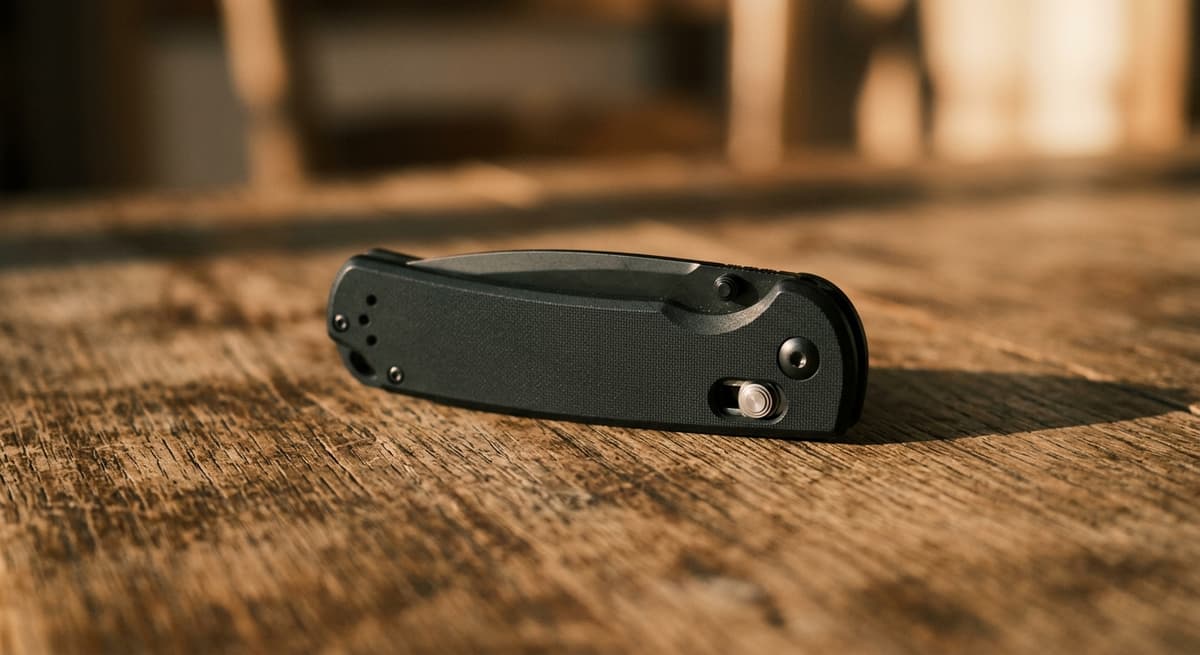
The functional "deadly weapon" definition
RSA § 625:11, V provides: "'Deadly weapon' means any firearm, knife or other substance or thing which, in the manner it is used, intended to be used, or threatened to be used, is known to be capable of producing death or serious bodily injury." This definition does not make a knife illegal to own or carry by itself. It determines whether a knife counts as a "deadly weapon" for the several other statutes described below that turn on that term, based on how the knife was used, intended to be used, or threatened to be used in a given situation, not on its blade length or mechanism.
Convicted felons: a named list of weapons
RSA § 159:3(I) makes it a class B felony if a person "[o]wns or has in his possession or under his control, a pistol, revolver, or other firearm, or slungshot, metallic knuckles, billies, stiletto, switchblade knife, sword cane, pistol cane, blackjack, dagger, dirk-knife, or other deadly weapon as defined in RSA 625:11, V," and has been convicted of a felony against the person or property of another, a felony drug offense under RSA 318-B, or an equivalent out-of-state or federal felony. Paragraph I-a extends liability to a convicted felon who signs a firearm-purchase application. The state confiscates the weapon of a person convicted under this section, per paragraph II, and paragraph III provides an affirmative defense where the underlying felony would not have been a felony in New Hampshire when committed. This list, unlike RSA 625:11's functional test, names specific knife types by type alone, regardless of how the item was used, but it applies only to a person with a qualifying felony conviction, not to the public generally. A domestic violence protective order can impose a comparable restriction on someone who is not a felon, covered below.
Domestic violence protective orders
A person subject to a New Hampshire domestic violence protective order can be ordered to give up a knife, separately from the felon-possession ban above. Under RSA § 173-B:5, I(a)(6), a final protective order may direct "the defendant to relinquish to the peace officer, in addition to the relief specified in RSA 173-B:5, I, any and all deadly weapons specified in the protective order that are in the control, ownership, or possession of the defendant, or any other person on behalf of the defendant." A final order goes further than relinquishment of specified items: RSA § 173-B:5, II provides that "the defendant shall be prohibited from purchasing, receiving, or possessing any deadly weapons and any and all firearms and ammunition for the duration of the order," a mandatory ban reaching any deadly weapon rather than only the ones the order names, and the court may subsequently issue a search warrant authorizing a peace officer to seize deadly weapons and firearms believed to be on the defendant's premises. A temporary order can impose the narrower relinquishment requirement under RSA § 173-B:4, I(a)(9), for the duration of the order, and RSA § 173-B:4, II lets a court prohibit the defendant from purchasing, receiving, or possessing any deadly weapons for the order's duration and authorizes a search warrant if there is probable cause one remains on the defendant's premises. "Deadly weapon," for this chapter, is defined at RSA § 173-B:1, VII as having "the meaning ascribed to it in RSA 625:11, V," the same functional definition that names a knife directly, described above.
Using a deadly weapon during a violent crime
RSA § 159:15(I) provides: "A person shall be guilty of a class A misdemeanor if that person uses or employs slung shot, metallic knuckles, billies, or other deadly weapon as defined in RSA 625:11, V during the commission or attempted commission of a violent crime." "Violent crime," for this section, takes the meaning given in RSA 651:5, XIII. This is a separate, additional offense triggered by using a knife (as a deadly weapon under the functional definition) during a violent crime, not a standalone knife-possession or knife-carry ban.
A related but distinct offense targets two specific bladed items by name rather than through the functional definition. RSA § 159:19-a provides: "I. Any person who uses a pistol cane or sword cane on another person with intent to commit a crime punishable as a misdemeanor shall be guilty of a misdemeanor. II. Any person who uses a pistol cane or sword cane on another person with intent to commit a crime punishable as a felony shall be guilty of a class B felony." Paragraph III bars a sentence under this section from running concurrently with any other term of imprisonment. Like RSA 159:15, this is a use-during-a-crime offense, not a possession or carry ban; simply owning a sword cane or pistol cane is not itself illegal under this section.
Courthouses: a flat ban regardless of license
RSA § 159:19(I) provides: "No person shall knowingly carry a loaded or unloaded pistol, revolver, or firearm or any other deadly weapon as defined in RSA 625:11, V, whether open or concealed or whether licensed or unlicensed, upon the person or within any of the person's possessions owned or within the person's control in a courtroom or area used by a court." Violation is a class B felony. "Area used by a court" is defined in paragraph III to include an entire building dedicated exclusively to court use (except the area between the entrance and courthouse security screening), or, in a shared building, the court facility's courtrooms, jury and deliberation rooms, conference and interview rooms, judge's chambers, other court staff facilities, holding facilities, and connecting corridors, stairways, waiting areas, and elevators. The ban does not apply to marshals, sheriffs, deputy sheriffs, police or other duly appointed or elected law enforcement officers, bailiffs, court security officers, or a person with the court's prior authorization to introduce a weapon into evidence, per paragraph IV. It is an affirmative defense under paragraph V that the required notice was not posted at each public entrance to the courthouse.
Sale to minors: martial arts weapons
RSA § 159:24(I) defines "martial arts weapon" as "any kind of sword, knife, spear, throwing star, throwing dart, or nunchaku or any other object designed for use in the martial arts which is capable of being used as a lethal or dangerous weapon." Paragraph II makes it a misdemeanor to sell, deliver, or otherwise transfer such a weapon to a person under 18 without the written consent of that person's parent or guardian, with an exception in paragraph III for a parent, guardian, administrator, or executor giving the weapon to their own child, ward, or heir.
Safe school zones: a reporting framework, not a possession ban
RSA chapter 193-D, "Safe School Zones," is a discipline and reporting framework, not a standalone weapon-possession offense. It defines an "act of theft, destruction, or violence" to include, among other listed offenses, "[u]nlawful possession or sale of a firearm or other dangerous weapon under RSA 159," under RSA § 193-D:1, I(d), and requires schools to report such acts and permits an extended sentence under RSA § 193-D:3 when one is committed in a safe school zone. The chapter's mandatory-expulsion rulemaking directive, at RSA § 193-D:2, I(b)(2), is written for "knowingly possessing a firearm in a safe school zone" specifically, not for a knife. Chapter 193-D does not itself create a knife-possession offense; it incorporates whichever RSA 159 offense (such as the felon-possession ban) was independently violated.
State authority over knives, named directly
RSA § 159:26, titled "Firearms, Ammunition, and Knives; Authority of the State," addresses knives directly rather than through a firearms-only lens. Paragraph I provides: "To the extent consistent with federal law, the state of New Hampshire shall have authority and jurisdiction over the sale, purchase, ownership, use, possession, transportation, licensing, permitting, taxation, or other matter pertaining to firearms, firearms components, ammunition, firearms supplies, or knives in the state. Except as otherwise specifically provided by statute, no ordinance or regulation of a political subdivision may regulate the sale, purchase, ownership, use, possession, transportation, licensing, permitting, taxation, or other matter pertaining to firearms, firearms components, ammunition, or firearms supplies in the state. Nothing in this section shall be construed as affecting a political subdivision's right to adopt zoning ordinances for the purpose of regulating firearms or knives businesses in the same manner as other businesses or to take any action allowed under RSA 207:59." The middle sentence, the operative "no ordinance...may regulate" clause, lists "firearms, firearms components, ammunition, or firearms supplies" without repeating "knives" from the first sentence's broader jurisdiction declaration. Paragraph II resolves the effect directly: "Upon the effective date of this section, all municipal ordinances and regulations not authorized under paragraph I relative to the sale, purchase, ownership, use, possession, transportation, licensing, permitting, taxation, or other matter pertaining to firearms, firearm components, ammunition, firearms supplies, or knives shall be null and void." Because paragraph II's voiding clause names "knives" directly, an unauthorized local ordinance regulating knives is void under the statute's own text, even though the middle sentence of paragraph I does not repeat the word.
Federal law: what it does and does not reach
Federal law does not ban an individual from owning or carrying a switchblade. The Federal Switchblade Act, 15 U.S.C. §§ 1241 to 1245, instead restricts interstate commerce in switchblade knives, barring their manufacture for, or introduction, transport, and sale in, interstate commerce, and, in 15 U.S.C. § 1245, makes it a federal offense to knowingly possess, manufacture, sell, or import a ballistic knife in or affecting interstate commerce or within federal territorial jurisdiction. The two switchblade offense sections, §§ 1242 and 1243, do not apply to certain knives and people, listed as exemptions in 15 U.S.C. § 1244. A 2009 amendment, § 1244(5), exempts any knife with a spring, detent, or other closure-bias mechanism that requires hand, wrist, or arm exertion on the blade itself to overcome the bias and assist opening, the carve-out that keeps modern assisted-opening folding knives legal in interstate commerce. A separate exemption, § 1244(4), covers a person with only one arm possessing or carrying a switchblade with a blade three inches or less. New Hampshire's switchblade-specific restrictions apply only to convicted felons and to sales to minors, not to general possession or interstate transport.
Disclaimer: This article provides general legal information about New Hampshire's knife laws as of September 2026. It is not legal advice. Consult a lawyer licensed in New Hampshire for advice about a specific situation. A local ordinance may still affect knife carry in specific circumstances not addressed here.
For a state-by-state comparison, see knife laws by state. New Hampshire's self-defense statutes are covered separately on the New Hampshire self-defense laws page.
Statutes cited reflect their in-force version as of 2026-09-18. Last updated: 2026-09-18.
Frequently Asked Questions
Is it legal to carry a knife concealed in New Hampshire?
Yes, for an adult who is not a convicted felon, not subject to a protective order restricting deadly weapons, and outside a courthouse. New Hampshire has no general statewide statute banning concealed knife carry, blade length, or knife type for the public at large. RSA 159:16, the state's general carrying-and-selling weapons offense, was narrowed in 2010 to reach only a blackjack, slung shot, or metallic knuckles, and no other section of New Hampshire's weapons chapter restricts general knife carry.
Are switchblades illegal in New Hampshire?
Not for the general public. A switchblade knife is named in RSA 159:3's list of weapons a convicted felon may not possess, a class B felony, and in RSA 159:24's martial-arts-weapon sale-to-minors statute. No New Hampshire statute bans switchblade ownership or carry for an adult who is not a felon.
Does New Hampshire preempt local knife ordinances?
Yes. RSA 159:26, titled 'Firearms, Ammunition, and Knives; Authority of the State,' declares state authority over knives directly and, in paragraph II, voids any unauthorized municipal ordinance or regulation relative to knives, alongside firearms, ammunition, and firearms components.
Can you carry a knife in a New Hampshire courthouse?
No. RSA 159:19 bans knowingly carrying a deadly weapon, openly or concealed, licensed or unlicensed, in a courtroom or area used by a court. A knife counts as a deadly weapon under RSA 625:11, V's functional definition only if, in the manner it is used, intended to be used, or threatened to be used, it is known to be capable of producing death or serious bodily injury. Violation is a class B felony.
Can a felon possess a knife in New Hampshire?
Not if it falls within RSA 159:3's named list, which includes a stiletto, switchblade knife, sword cane, pistol cane, dagger, dirk-knife, or other deadly weapon as defined in RSA 625:11, V. A convicted felon who owns, possesses, or controls one of these commits a class B felony.
Can a protective order restrict knife possession in New Hampshire?
Yes. RSA 173-B:5, I(a)(6) lets a final domestic violence protective order direct the defendant to relinquish any and all deadly weapons specified in the order, and RSA 173-B:5, II separately imposes a mandatory ban on the defendant purchasing, receiving, or possessing any deadly weapons for the order's duration, not only the ones specified for relinquishment. RSA 173-B:4 allows the narrower relinquishment requirement at the temporary-order stage. A knife qualifies if it meets RSA 625:11, V's functional definition of a deadly weapon, which names a knife directly.
Is using a sword cane or pistol cane a separate crime in New Hampshire?
Yes. RSA 159:19-a makes it a separate offense, on top of whatever crime it was used to commit, to use a pistol cane or sword cane on another person with intent to commit a crime: a misdemeanor if the underlying crime is a misdemeanor, and a class B felony if the underlying crime is a felony. Owning a sword cane or pistol cane by itself is not illegal under this section.
Updates
Independently fact-checked against the cited primary sources
Independently fact-checked against the cited primary sources
The Law Behind This Article
This article rests on the statutory provisions below, held in our own legal record and retrieved from the official source. Tap a section to read the operative text.
New Hampshire Revised Statutes Annotated, TITLE XII PUBLIC SAFETY AND WELFARE, CHAPTER 159 PISTOLS AND REVOLVERS
§ 159:3Convicted Felons.In forcecited in 3 of our articles
I. A person is guilty of a class B felony if he: (a) Owns or has in his possession or under his control, a pistol, revolver, or other firearm, or slungshot, metallic knuckles, billies, stiletto, switchblade knife, sword cane, pistol cane, blackjack, dagger, dirk-knife, or other deadly weapon as defined in RSA 625:11, V; and (b) Has been convicted in either a state or federal court in this or any other state, the District of Columbia, the Commonwealth of Puerto Rico, or any territory or possession of the United States of: (1) A felony against the person or property of another; or (2) A felony under RSA 318-B; or (3) A felony violation of the laws of any other state, the District of Columbia, the United States, the Commonwealth of Puerto Rico or any territory or possession of the United States relating to controlled drugs as defined in RSA 318-B. I-a. A person is guilty of a class B felony if such person completes and signs an application for purchase of a firearm and the person is a convicted felon under the provisions of paragraph I. II. The state shall confiscate to the use of the state the weapon or weapons of persons convicted under this section. III.
Official text (excerpt) · last checked 2026-09-24 · Read the full text in our law library · Verify at gc.nh.gov
Cited in 74 court opinions in our collectionLatest citing opinion in our collection: 2024
Opinions citing this section in our collection:
- State v. Stratton (Supreme Court of New Hampshire 1989, 132 N.H. 451)“…of six counts of being a felon in possession of a firearm, RSA 159:3 (Supp. 1988), and one count of possessi…”
- State v. Gosselin (Supreme Court of New Hampshire 1977, 117 N.H. 115)“…fendant was found guilty of possession of a gun by a felon, RSA 159:3 (Supp. 1975). Subsequently a sentence o…”
- State v. Smith (Supreme Court of New Hampshire 1990, 132 N.H. 756)“…al on a charge of being a felon in possession of a firearm, RSA 159:3 (Supp. 1988), defendant filed a motion…”
Identified automatically from the court opinions citing this section — not a ranking of which case controls.
Also relied on in: New Hampshire Voyeurism Laws, New Hampshire Pepper Spray and Stun Gun Laws (2026)
§ 159:26Firearms, Ammunition, and Knives; Authority of the State.In forcecited in 2 of our articles
I. To the extent consistent with federal law, the state of New Hampshire shall have authority and jurisdiction over the sale, purchase, ownership, use, possession, transportation, licensing, permitting, taxation, or other matter pertaining to firearms, firearms components, ammunition, firearms supplies, or knives in the state. Except as otherwise specifically provided by statute, no ordinance or regulation of a political subdivision may regulate the sale, purchase, ownership, use, possession, transportation, licensing, permitting, taxation, or other matter pertaining to firearms, firearms components, ammunition, or firearms supplies in the state. Nothing in this section shall be construed as affecting a political subdivision's right to adopt zoning ordinances for the purpose of regulating firearms or knives businesses in the same manner as other businesses or to take any action allowed under RSA 207:59. II.
Official text (excerpt) · last checked 2026-07-29 · Read the full text in our law library · Verify at gc.nh.gov
Cited in 2 court opinions in our collectionLatest citing opinion in our collection: 2024
Opinions citing this section in our collection:
- Monadnock Rod and Gun Club v. Town of Peterborough (Supreme Court of New Hampshire 2024, 2024 N.H. 61)“…ranges to be in enclosed, indoor facilities is preempted by RSA 159:26, I, and RSA chapter 159-B; and (5) sect…”
- State of New Hampshire v. Justin Parr (Supreme Court of New Hampshire 2022)“…ing upon references to federal law in RSA 159:1, as well as RSA 159:26 (2014), the defendant argues that the l…”
Identified automatically from the court opinions citing this section — not a ranking of which case controls.
§ 159:19Courthouse Security.In forcecited in 2 of our articles
I. No person shall knowingly carry a loaded or unloaded pistol, revolver, or firearm or any other deadly weapon as defined in RSA 625:11, V, whether open or concealed or whether licensed or unlicensed, upon the person or within any of the person's possessions owned or within the person's control in a courtroom or area used by a court. Whoever violates the provisions of this paragraph shall be guilty of a class B felony. II. Firearms may be secured at the entrance to a courthouse by courthouse security personnel. III. For purposes of paragraph I, "area used by a court" means: (a) In a building dedicated exclusively to court use, the entire building exclusive of the area between the entrance and the courthouse security. (b) In any other building which includes a court facility, courtrooms, jury assembly rooms, deliberation rooms, conference and interview rooms, the judge's chambers, other court staff facilities, holding facilities, and corridors, stairways, waiting areas, and elevators directly connecting these rooms and facilities. IV.
Official text (excerpt) · last checked 2026-07-29 · Read the full text in our law library · Verify at gc.nh.gov
§ 159:19-aCriminal Use of Pistol Cane or Sword Cane.In force
I. Any person who uses a pistol cane or sword cane on another person with intent to commit a crime punishable as a misdemeanor shall be guilty of a misdemeanor. II. Any person who uses a pistol cane or sword cane on another person with intent to commit a crime punishable as a felony shall be guilty of a class B felony. III. Neither the whole nor any part of a sentence of imprisonment imposed for a violation of this section shall be served concurrently with any other term of imprisonment.
Official text (excerpt) · last checked 2026-07-29 · Read the full text in our law library · Verify at gc.nh.gov
§ 159:15Possession of Dangerous Weapon While Committing a Violent Crime.In force
I. A person shall be guilty of a class A misdemeanor if that person uses or employs slung shot, metallic knuckles, billies, or other deadly weapon as defined in RSA 625:11, V during the commission or attempted commission of a violent crime. II. "Violent crime," for purposes of this section, means "violent crime" as defined in RSA 651:5, XIII.
Official text (excerpt) · last checked 2026-07-29 · Read the full text in our law library · Verify at gc.nh.gov
Cited in 2 court opinions in our collectionLatest citing opinion in our collection: 1999
Opinions citing this section in our collection:
- In re Justin D. (Supreme Court of New Hampshire 1999, 144 N.H. 450)“…dangerous weapon at the time of his arrest in violation of RSA 159:15 (1994) (amended 1998).We affirm. The…”
- State v. Piper (Supreme Court of New Hampshire 1977, 117 N.H. 64)“…n when arrested “a weapon to wit, a Dirk knife” contrary to RSA 159:15 (Supp. 1975). The Court, Martin,…”
Identified automatically from the court opinions citing this section — not a ranking of which case controls.
§ 159:24Sale of Martial Arts Weapons.In force
I. "Martial arts weapon" means any kind of sword, knife, spear, throwing star, throwing dart, or nunchaku or any other object designed for use in the martial arts which is capable of being used as a lethal or dangerous weapon. II. Any person who shall sell, deliver, or otherwise transfer any martial arts weapon to a person under the age of 18 without first obtaining the written consent of such person's parent or guardian shall be guilty of a misdemeanor. III. Paragraph II shall not apply to fathers, mothers, guardians, administrators or executors who give a martial arts weapon to their children or wards or to heirs to an estate.
Official text (excerpt) · last checked 2026-07-29 · Read the full text in our law library · Verify at gc.nh.gov
§ 159:16Carrying or Selling Weapons.In force
Whoever, except as provided by the laws of this state, sells, has in his possession with intent to sell, or carries on his person any blackjack, slung shot, or metallic knuckles shall be guilty of a misdemeanor; and such weapon or articles so carried by him shall be confiscated to the use of the state.
Official text (excerpt) · last checked 2026-07-29 · Read the full text in our law library · Verify at gc.nh.gov
Cited in 3 court opinions in our collectionLatest citing opinion in our collection: 2003
Opinions citing this section in our collection:
- State v. Davis (Supreme Court of New Hampshire 2003, 149 N.H. 698)“…ve Sergeant Cavanaugh, *700 looked for weapons declared by RSA 159:16 (2002) to be illegal to sell, possess w…”
- State v. Piper (Supreme Court of New Hampshire 1977, 117 N.H. 64)“…s weapons, ... he shall be guilty of a misdemeanor.” RSA 159:16 (Supp. 1975) provides that “ [W]hoever,…”
- State v. Beckert (Supreme Court of New Hampshire 1999, 144 N.H. 315)“…fe is also demonstrated by other provisions of chapter 159. RSA 159:16 (1994), unlike 159:3, prohibits the sal…”
Identified automatically from the court opinions citing this section — not a ranking of which case controls.
§ 159:6License to Carry.In force
I. (a) The selectmen of a town, the mayor or chief of police of a city or a full-time police officer designated by them respectively, the county sheriff for a resident of an unincorporated place, or the county sheriff if designated by the selectmen of a town that has no police chief, upon application of any resident of such town, city, or unincorporated place, or the director of state police, or some person designated by such director, upon application of a nonresident, shall sign and issue a license to such applicant authorizing the applicant to carry a loaded pistol or revolver in this state for not less than 5 years from the date of issue, if it appears that the applicant has good reason to fear injury to the applicant's person or property or has any proper purpose, unless the applicant is prohibited by New Hampshire or federal statute from possessing a firearm. Hunting, target shooting, or self-defense shall be considered a proper purpose. The license shall be valid for all allowable purposes regardless of the purpose for which it was originally issued.
Official text (excerpt) · last checked 2026-07-29 · Read the full text in our law library · Verify at gc.nh.gov
Cited in 10 court opinions in our collectionLatest citing opinion in our collection: 2016
Opinions citing this section in our collection:
- Garand v. Town of Exeter (Supreme Court of New Hampshire 2009, 159 N.H. 136)“…ded pistol or revolver (license to carry), see RSA 159:6 (Supp. 2008); and (2) denying his motio…”
- Scott L. Bach & a. v. New Hampshire Department of Safety (Supreme Court of New Hampshire 2016, 169 N.H. 87)“…a license to carry a concealed weapon in New Hampshire. See RSA 159:6 (Supp. 2015) (providing that a conceale…”
- Kozerski v. Steere (Supreme Court of New Hampshire 1981, 121 N.H. 469)“…ision of the district court, the plaintiff appealed. RSA 159:6 (Supp. 1979) provides in relevant part…”
Identified automatically from the court opinions citing this section — not a ranking of which case controls.
New Hampshire Revised Statutes Annotated, TITLE LXII CRIMINAL CODE, CHAPTER 625 PRELIMINARY
§ 625:11General Definitions.In forcecited in 2 of our articles
The following definitions apply to this code. I. "Conduct" means an action or omission, and its accompanying state of mind, or, a series of acts or omissions. II. "Person", "he", and "actor" include any natural person and, a corporation or an unincorporated association. III. "Element of an offense" means such conduct, or such attendant circumstances, or such a result of conduct as: (a) Is included in the definition of the offense; or (b) Establishes the required kind of culpability; or (c) Negatives an excuse or justification for such conduct; or (d) Negatives a defense under the statute of limitations; or (e) Establishes jurisdiction or venue. IV. "Material element of an offense" means an element that does not relate exclusively to the statute of limitations, jurisdiction, venue or to any other matter similarly unrelated to (1) the harm sought to be prevented by the definition of the offense, or (2) any justification or excuse for the prescribed conduct. V. "Deadly weapon" means any firearm, knife or other substance or thing which, in the manner it is used, intended to be used, or threatened to be used, is known to be capable of producing death or serious bodily injury.
Official text (excerpt) · last checked 2026-07-29 · Read the full text in our law library · Verify at gc.nh.gov
Cited in 100 court opinions in our collectionLatest citing opinion in our collection: 2025
Opinions citing this section in our collection:
- State v. Hull (Supreme Court of New Hampshire 2003, 149 N.H. 706)“…s B felony if the person uses a deadly weapon as defined in RSA 625:11, V. All other reckless conduct is a mis…”
- State v. Kousounadis (Supreme Court of New Hampshire 2009, 159 N.H. 413)“…iminal threatening, see RSA 631:4, I(a), II(a)(2) (2007); RSA 625:11, V (2007), and violation of a protectiv…”
- State v. Goodwin (Supreme Court of New Hampshire 1978, 118 N.H. 862)“…ing was a class A felony rather than class B. RSA 633:1 II; RSA 625:11 VI. The defendant was sentenced to a te…”
Identified automatically from the court opinions citing this section — not a ranking of which case controls.
New Hampshire Revised Statutes Annotated, TITLE XII PUBLIC SAFETY AND WELFARE, CHAPTER 173-B PROTECTION OF PERSONS FROM DOMESTIC VIOLENCE
§ 173-B:1Definitions.In forcecited in 3 of our articles
In this chapter: I. "Abuse" means the commission or attempted commission of one or more of the acts described in subparagraphs (a) through (h) by a family or household member or by a current or former sexual or intimate partner, where such conduct is determined to constitute a credible present threat to the petitioner's safety. The court may consider evidence of such acts, regardless of their proximity in time to the filing of the petition, which, in combination with recent conduct, reflects an ongoing pattern of behavior which reasonably causes or has caused the petitioner to fear for his or her safety or well-being: (a) Assault or reckless conduct as defined in RSA 631:1 through RSA 631:3. (b) Criminal threatening as defined in RSA 631:4. (c) Sexual assault as defined in RSA 632-A:2 through RSA 632-A:5. (d) Interference with freedom as defined in RSA 633:1 through RSA 633:3-a. (e) Destruction of property as defined in RSA 634:1 and RSA 634:2. (f) Unauthorized entry as defined in RSA 635:1 and RSA 635:2. (g) Harassment as defined in RSA 644:4. (h) Cruelty to animals as defined in RSA 644:8. II.
Official text (excerpt) · last checked 2026-07-29 · Read the full text in our law library · Verify at gc.nh.gov
Cited in 77 court opinions in our collectionLatest citing opinion in our collection: 2025
Opinions citing this section in our collection:
- John Farrelly v. City of Concord & A (Supreme Court of New Hampshire 2015, 168 N.H. 430)“…esent threat to his ex-girlfriend’s safety. See RSA 594:10; RSA 173-B:1, I (Supp. 2014). During his deposition,…”
- Walker v. Walker (Supreme Court of New Hampshire 2009, 158 N.H. 602)“…or attempted commission of one or more [enumerated acts,]” RSA 173-B:1,1 (2002), including “[c]riminal threate…”
- Fisher v. Minichiello (Supreme Court of New Hampshire 2007, 155 N.H. 188)“…e order issued under RSA chapter 173-B. We stated: "Because RSA 173-B:1 contains an enumerated list of prohibit…”
Identified automatically from the court opinions citing this section — not a ranking of which case controls.
Also relied on in: New Hampshire Expands Domestic Violence Law, Adds Sexual Assault Protective Order (2026), New Hampshire Child Custody Laws: Parental Rights, Best Interests, and Your Rights
§ 173-B:4Temporary Relief.In forcecited in 2 of our articles
I. Upon a showing of an immediate and present danger of abuse, the court may enter temporary orders to protect the plaintiff with or without actual notice to defendant. The court may issue such temporary orders by telephone or facsimile. Such telephonically issued orders shall be made by a circuit court judge to a law enforcement officer, shall be valid in any jurisdiction in the state, and shall be effective until the close of the next regular court business day. Such orders shall be returnable to the circuit court where the plaintiff resides or to which the plaintiff has fled, unless otherwise ordered by the issuing judge. If non-telephonic temporary orders are made ex parte, the party against whom such relief is issued may file a written request with the clerk of the court and request a hearing on such orders. Such hearing shall be held no less than 3 business days and no more than 5 business days after the request is received by the clerk. Such hearings may constitute the final hearing described in RSA 173-B:3, VII.
Official text (excerpt) · last checked 2026-07-29 · Read the full text in our law library · Verify at gc.nh.gov
Cited in 20 court opinions in our collectionLatest citing opinion in our collection: 2024
Opinions citing this section in our collection:
- McCarthy v. Wheeler (Supreme Court of New Hampshire 2005, 152 N.H. 643)“…hone through the Lebanon District Court (Sadler, J.). See RSA 173-B:4,1 (2002). On August 13, McCarthy filed…”
- Paul v. Sherburne (Supreme Court of New Hampshire 2006, 153 N.H. 747)“…rte temporary order of protection against Paul. See id:, RSA 173-B:4,1 (2002). A final hearing on the merits…”
- Gray v. Kelly (Supreme Court of New Hampshire 2010, 161 N.H. 160)“…e protection for victims of domestic violence. See, e.g., RSA 173-B:4 (2002) (providing for temporary ex par…”
Identified automatically from the court opinions citing this section — not a ranking of which case controls.
Also relied on in: New Hampshire Restraining Order Laws (2026): How to Get a Domestic Violence Protective Order
§ 173-B:5Relief.In forcecited in 2 of our articles
I. A finding of abuse shall mean the defendant represents a credible threat to the safety of the plaintiff. Upon a showing of abuse of the plaintiff by a preponderance of the evidence, the court shall grant such relief as is necessary to bring about a cessation of abuse. Such relief shall direct the defendant to relinquish to the peace officer any and all firearms and ammunition in the control, ownership, or possession of the defendant, or any other person on behalf of the defendant for the duration of the protective order. Other relief may include: (a) Protective orders: (1) Restraining the defendant from abusing the plaintiff. (2) Restraining the defendant from entering the premises and curtilage where the plaintiff resides, except when the defendant is accompanied by a peace officer and is allowed entry by the plaintiff for the sole purpose of retrieving personal property specified by the court. (3) Restraining the defendant from contacting the plaintiff or entering the plaintiff's place of employment, school, or any specified place frequented regularly by the plaintiff or by any family or household member.
Official text (excerpt) · last checked 2026-09-10 · Read the full text in our law library · Verify at gc.nh.gov
Cited in 75 court opinions in our collectionLatest citing opinion in our collection: 2025
Opinions citing this section in our collection:
- Gray v. Kelly (Supreme Court of New Hampshire 2010, 161 N.H. 160)“…uding resolving disputes regarding personal property. See RSA 173-B:5,1(b)(3) (Supp. 2009). In this case, bot…”
- Walker v. Walker (Supreme Court of New Hampshire 2009, 158 N.H. 602)“…final domestic violence protective order. See RSA 173-B:5 (Supp. 2008). We affirm. The rec…”
- Fisher v. Minichiello (Supreme Court of New Hampshire 2007, 155 N.H. 188)“…contains an enumerated list of prohibited conduct, we read RSA 173-B:5 to require that a trial court must make…”
Identified automatically from the court opinions citing this section — not a ranking of which case controls.
New Hampshire Revised Statutes Annotated, TITLE LXII CRIMINAL CODE, CHAPTER 651 SENTENCES
§ 651:5Annulment of Criminal Records.In forcecited in 6 of our articles
I. Except as provided in paragraphs V-VIII, the record of arrest, conviction and sentence of any person may be annulled by the sentencing court at any time in response to a petition for annulment which is timely brought in accordance with the provisions of this section if in the opinion of the court, the annulment will assist in the petitioner's rehabilitation and will be consistent with the public welfare. The court may grant or deny an annulment without a hearing, unless a hearing is requested by the petitioner. II. For an offense disposed of before January 1, 2019 and any offense not subject to paragraph II-a, any person whose arrest has resulted in a finding of not guilty, or whose case was dismissed or not prosecuted, may petition for annulment of the arrest record or court record, or both, at any time in accordance with the provisions of this section. Any person who was convicted of a criminal offense whose conviction was subsequently vacated by a court may petition for annulment of the arrest record or court record, or both, in accordance with the provisions of this section. Nothing in this paragraph shall limit the provisions of subparagraph XI(b). II-a.
Official text (excerpt) · last checked 2026-09-01 · Read the full text in our law library · Verify at gc.nh.gov
Cited in 26 court opinions in our collectionLatest citing opinion in our collection: 2024
In the courts (editorial summary, independently checked):Panas v. Harakis (1987) held RSA 651:5's "in all respects" language barred disclosure of annulled convictions in a civil suit, though facts underlying a conviction were not erased. Wolfgram v. New Hampshire Department of Safety (2016) held habitual offender notations revealing annulled convictions must stay off a public driving record.
Opinions citing this section in our collection:
- Panas v. Harakis (Supreme Court of New Hampshire 1987, 129 N.H. 591)✓In a false imprisonment and negligent hiring suit over a K-Mart guard whose convictions had been annulled, the court held RSA 651:5 barred even in camera review of the annulment dates, but did not bar evidence of the incident underlying an annulled conviction.
- State v. Comeau (Supreme Court of New Hampshire 1997, 142 N.H. 84)✓Comeau petitioned in 1995 to annul 1991 felony convictions under the shorter old waiting period; the court held the 1994 rewrite of RSA 651:5 governs petitions filed after January 1, 1995, and its longer waiting periods are remedial, not ex post facto punishment.
- Doe v. State (Supreme Court of New Hampshire 1974, 114 N.H. 714)✓An eighteen year old fined $25 in 1971 for concealing a 79 cent ping-pong ball sought annulment under RSA 651:5; the court held the statute reaches convictions predating the 1973 criminal code, covers a fine-only sentence, and does not invade the Governor's pardon power.
Identified automatically from the court opinions citing this section — not a ranking of which case controls.
Also relied on in: New Hampshire Expungement Laws: How Record Annulment Works Under RSA 651:5, New Hampshire Background Check Laws (2026 Guide), New Hampshire Court Records: How to Search the Case Access Portal, What's Public, and How Annulment Works
United States Code Title 15
§ 1241DefinitionsIn forcecited in 52 of our articles
As used in this chapter— The term “interstate commerce” means commerce between any State, Territory, possession of the United States, or the District of Columbia, and any place outside thereof. The term “switchblade knife” means any knife having a blade which opens automatically— by hand pressure applied to a button or other device in the handle of the knife, or by operation of inertia, gravity, or both.
Official text (excerpt) · last checked 2026-07-28 · Read the full text in our law library · Verify at uscode.house.gov
Cited in 15 court opinions in our collectionLatest citing opinion in our collection: 2014
Opinions citing this section in our collection:
- Stewart A. Taylor, D/B/A Taylor Cutlery Mfg. Co. v. United States of America (Court of Appeals for the Sixth Circuit 1988, 848 F.2d 715)“…Service, are not switchblade knives within the meaning of 15 U.S.C. § 1241 (b) and 19 C.F.R. § 1295 (a)(1). The d…”
- Crowley Cutlery Company v. United States of America and Commissioner of Customs of the United States Customs Service (Court of Appeals for the Seventh Circuit 1988, 849 F.2d 273)“…Illinois for a declaration that the Switchblade Knife Act, 15 U.S.C. §§ 1241 et seq., which forbids th…”
- Edna Fall, as Administratrix of the Estate of Phillip Fall, Deceased v. Esso Standard Oil Company (Court of Appeals for the Fifth Circuit 1962, 297 F.2d 411)“…25 S.Ct. 158 , 49 L.Ed. 363 . Section 1 of the Act, 15 U.S.C.A. § 1241 (b), defines the term “switchblade knif…”
Identified automatically from the court opinions citing this section — not a ranking of which case controls.
Also relied on in: Knife Laws by State (2026): Carry Rules, Blade Limits, Penalties, Alabama Knife Laws (2026): What Is Legal to Carry, Alaska Knife Laws (2026): Concealed Carry Rules Explained
§ 1244ExceptionsIn forcecited in 52 of our articles
Sections 1242 and 1243 of this title shall not apply to— any common carrier or contract carrier, with respect to any switchblade knife shipped, transported, or delivered for shipment in interstate commerce in the ordinary course of business; the manufacture, sale, transportation, distribution, possession, or introduction into interstate commerce, of switchblade knives pursuant to contract with the Armed Forces; the Armed Forces or any member or employee thereof acting in the performance of his duty; the possession, and transportation upon his person, of any switchblade knife with a blade three inches or less in length by any individual who has only one arm; or a knife that contains a spring, detent, or other mechanism designed to create a bias toward closure of the blade and that requires exertion applied to the blade by hand, wrist, or arm to overcome the bias toward closure to assist in opening the knife.
Official text (excerpt) · last checked 2026-07-28 · Read the full text in our law library · Verify at uscode.house.gov
Also relied on in: Arizona Knife Laws (2026): Carry Rules and Preemption, Arkansas Knife Laws (2026): Intent-Based Carry Rules, California Knife Laws (2026): Four Blade-Length Rules
§ 1245Ballistic knivesIn forcecited in 50 of our articles
Whoever in or affecting interstate commerce, within any Territory or possession of the United States, within Indian country (as defined in section 1151 of title 18), or within the special maritime and territorial jurisdiction of the United States (as defined in section 7 of title 18), knowingly possesses, manufactures, sells, or imports a ballistic knife shall be fined as provided in title 18, or imprisoned not more than ten years, or both. Whoever possesses or uses a ballistic knife in the commission of a Federal crime of violence shall be fined as provided in title 18, or imprisoned not less than five years and not more than ten years, or both. The exceptions provided in paragraphs (1), (2), and (3) of section 1244 of this title with respect to switchblade knives shall apply to ballistic knives under subsection (a) of this section. As used in this section, the term “ballistic knife” means a knife with a detachable blade that is propelled by a spring-operated mechanism.
Official text (excerpt) · last checked 2026-07-28 · Read the full text in our law library · Verify at uscode.house.gov
Cited in 2 court opinions in our collectionLatest citing opinion in our collection: 2008
Opinions citing this section in our collection:
- ALCANTAR (Board of Immigration Appeals 1994, 20 I. & N. Dec. 801)“…ed by an adult, would be felony and crime of violence); cf. 15 U.S.C. § 1245(b) (1988) (use of ballistic knife in co…”
- United States v. Polizzi (District Court, E.D. New York 2008, 549 F. Supp. 2d 308)“…8 Trust in l’estraint of import trade 3 months 15 U.S.C. § 1245 (b) Possession/use of a ballistic knife…”
Identified automatically from the court opinions citing this section — not a ranking of which case controls.
Also relied on in: Colorado Knife Laws (2026): Concealed Carry and Exceptions, Connecticut Knife Laws (2026): Open and Concealed Carry, Delaware Knife Laws (2026): Carry, Switchblades, and Bans
Search our full record of US law — 2.1 million sections, every state + federal →
Sources and References
- RSA 625:11, V - General Definitions ("deadly weapon")(gc.nh.gov).gov
- RSA 159:3 - Convicted Felons(gc.nh.gov).gov
- RSA 159:15 - Possession of Dangerous Weapon While Committing a Violent Crime(gc.nh.gov).gov
- RSA 159:19 - Courthouse Security(gc.nh.gov).gov
- RSA 159:24 - Sale of Martial Arts Weapons(gc.nh.gov).gov
- RSA 159:26 - Firearms, Ammunition, and Knives; Authority of the State(gc.nh.gov).gov
- RSA 159:6 - License to Carry (pistols and revolvers; firearms-specific, does not govern knives)(gc.nh.gov).gov
- RSA 159:16 - Carrying or Selling Weapons (blackjack, slung shot, metallic knuckles only, as amended 2010)(gc.nh.gov).gov
- RSA 159:19-a - Criminal Use of Pistol Cane or Sword Cane(gc.nh.gov).gov
- RSA 173-B:1, VII - Definitions ("deadly weapon")(gc.nh.gov).gov
- RSA 173-B:4 - Temporary Relief (deadly-weapon relinquishment)(gc.nh.gov).gov
- RSA 173-B:5, I(a)(6), II - Relief (final protective order deadly-weapon relinquishment and mandatory possession ban)(gc.nh.gov).gov
- RSA 193-D:1, 193-D:2, 193-D:3 - Safe School Zones (definitions, rulemaking, criminal penalties)(gc.nh.gov).gov
- 15 U.S.C. 1241-1245 - Federal Switchblade Act, interstate commerce and ballistic-knife scope(law.cornell.edu)
- 15 U.S.C. 1244 - exceptions, including the 2009 assisted-opening carve-out and the one-arm exception(law.cornell.edu)