
South Dakota
South Dakota Knife Laws (2026): No General Carry Restriction
Independently fact-checked against primary sources (last audited September 24, 2026). · 12 primary sources cited on this page. How we verify our legal content
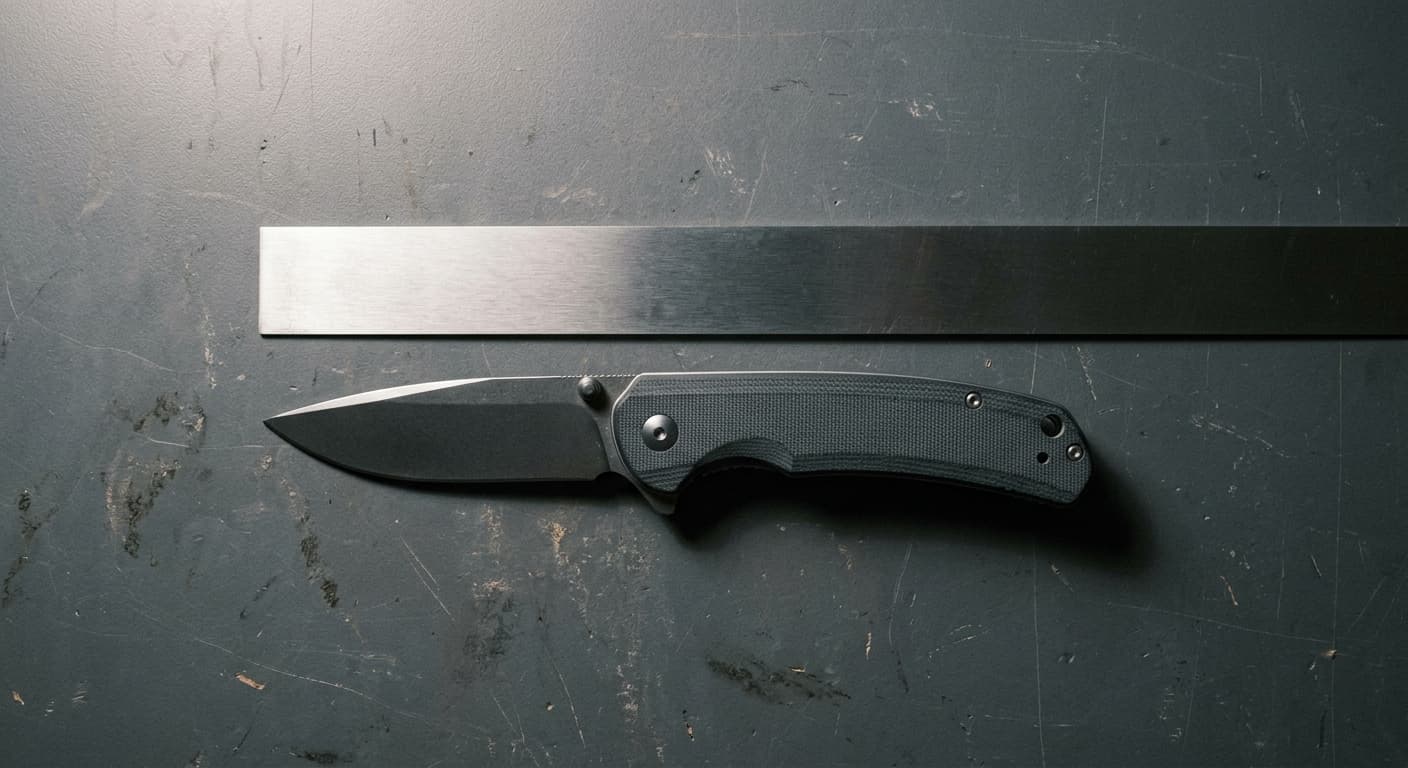
South Dakota has no standalone statute banning the carry of an ordinary knife, openly or concealed. Knives are instead reached only through a generic "dangerous weapon" definition that feeds several separate offenses: concealment with intent to commit a felony, possession in a county courthouse or the state capitol, and possession on public school property. The state's firearms-preemption statutes, at both the municipal and county level, do not extend to knives.
Jurisdiction scope: This page covers South Dakota state law only, principally SDCL §§ 22-1-2, 22-14-8, 22-14-22 through 22-14-28, 13-32-7, 9-19-20, and 7-18A-36. It does not cover South Dakota's concealed pistol permit statutes (Chapter 23-7) in detail, since those govern handguns rather than knives.
No general statewide knife-carry statute
South Dakota does not restrict open or concealed carry of an ordinary knife through any standalone statute. SDCL Chapter 22-14, "Unlawful Use of Weapons," contains no provision that names a knife type or sets a blade-length threshold for general public carry the way many other states do. Instead, a knife becomes legally significant only through the definitions section that governs the entire criminal code, SDCL § 22-1-2, and only when a knife is involved in one of a small number of specific offenses.
§ 22-1-2(10) provides: "'Dangerous weapon' or 'deadly weapon,' any firearm, stun gun, knife, or device, instrument, material, or substance, whether animate or inanimate, which is calculated or designed to inflict death or serious bodily harm, or by the manner in which it is used is likely to inflict death or serious bodily harm." This definition names a knife explicitly, but it is a functional definition used across many separate criminal statutes (enhancement provisions, restricted-place statutes, and forfeiture rules), not itself a carry offense. A separate, narrower term, "controlled weapon," defined at § 22-1-2(8) as including "a machine gun and short shotgun, but does not include a firearm silencer," does not reach a knife at all, a distinction that matters for § 22-14-8 below.
Concealment with intent to commit a felony
SDCL § 22-14-8 provides: "Any person who conceals on or about his or her person a controlled or dangerous weapon with intent to commit a felony is guilty of a Class 5 felony." Because a knife qualifies as a "dangerous weapon" under § 22-1-2(10) even though it is not a "controlled weapon" under § 22-1-2(8), this statute reaches concealed knife carry, but only where the state proves the person concealed the knife with intent to commit a felony. Mere concealment of a knife, without that intent, is not an offense under this section. The Code's only statutory definition of "concealed" is written for a firearm alone: § 22-1-2(6) provides that "'concealed,' any firearm that is totally hidden from view. If any part of the firearm is capable of being seen, it is not concealed." That bright line (any visible part means not concealed) has no textual application to a knife; § 22-14-8's concealment element as applied to a knife is not defined by this statute.
County courthouses and the state capitol
SDCL §§ 22-14-22 to 22-14-28 impose a separate restricted-place rule, and it is worth reading past § 22-14-23 to the sections around it. § 22-14-22 defines "county courthouse" as "any building occupied for the public sessions of a circuit court, with its various offices, including any building appended to or used as a supplementary structure to a county courthouse," so a courthouse's register-of-deeds or treasurer's office is inside the restricted building, not merely the courtroom, and "state capitol" includes any building appended to or used as a supplementary structure to the capitol. § 22-14-23 provides: "Except as provided in § 22-14-24, any person who knowingly possesses or causes to be present any firearm or other dangerous weapon, in any county courthouse or in the state capitol, or attempts to do so, is guilty of a Class 1 misdemeanor." Because a knife is a "dangerous weapon" under § 22-1-2(10), this section reaches knife possession in either location.
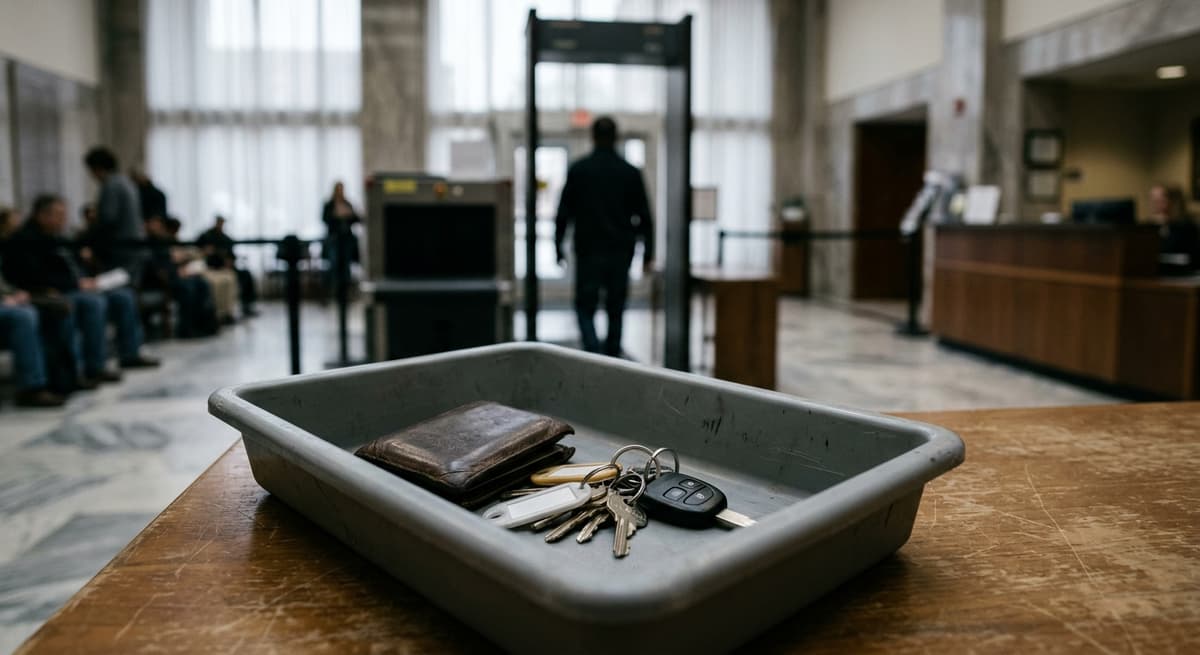
§ 22-14-24 lists seven exceptions, and they do not all apply to both locations. Exceptions (1) through (3) apply generally: the lawful performance of official duties by a law enforcement or court officer; possession by a judge or magistrate; and possession by a federal or state official or member of the armed services acting under lawful authority. Exceptions (4) and (5) apply only in the state capitol: a qualified law enforcement officer's or retired officer's concealed pistol under the federal Law Enforcement Officers Safety Act, and an enhanced-permit holder's concealed pistol in most of the capitol (excluding the Supreme Court chamber and certain access-controlled offices) after a specific advance-notice procedure to the superintendent of the Division of Highway Patrol. Exceptions (6) and (7) apply only in a county courthouse: possession by a county or state employee assigned to work there, outside areas under Unified Judicial System supervision, and, at (7), "the lawful carrying of a firearm or other dangerous weapon in a county courthouse incident to a hunter safety or a gun safety course or for any other lawful purposes." Read most literally, the closing clause, "or for any other lawful purposes," is not limited to hunter-safety or gun-safety courses, and on that reading it could reach ordinary lawful courthouse carry of an item like a knife. That reading is not free of doubt: "incident to" may instead govern the entire series, so the exception would reach carrying incident to a course or incident to some other specific lawful purpose rather than carrying for no particular purpose at all, and a reading that excepts all lawful carrying leaves little for the neighboring sections to do, since (6)'s separate courthouse-employee exception, § 22-14-28's county-waiver power, and § 22-14-26's posting duty would each become unnecessary if ordinary lawful carry were already excepted across the board. No reported South Dakota court decision construes (7). The state capitol, unlike a county courthouse, has no comparable "any other lawful purposes" clause reaching an ordinary knife carrier at all; exceptions (4) and (5) there are limited to specific concealed-pistol scenarios.
Four related sections change the practical answer further. § 22-14-25 opens by subordinating a court's own rule-making power to § 22-14-24: "Except for the authorizations set forth in § 22-14-24, nothing in this chapter limits the power of a court to punish for contempt or to promulgate rules or orders regulating, restricting, or prohibiting the possession of weapons, within any building housing such court or any of its proceedings, or upon any grounds pertinent to such building." A court's contempt authority and its own rules can restrict weapons more tightly than § 22-14-23 alone, but not in a way that overrides the § 22-14-24 exceptions discussed above, including (7). § 22-14-26 requires notice of § 22-14-23 to be "posted conspicuously at each public entrance to a county courthouse and the state capitol." § 22-14-27 bars a defendant from raising a concealed-pistol permit as a defense to a § 22-14-23 prosecution. § 22-14-28 lets a county commission, by a majority vote of its members-elect, waive § 22-14-23's courthouse restriction for that county entirely, a waiver that also supersedes the county-employee exception at § 22-14-24(6). A reader in a specific county courthouse cannot answer the carry question from § 22-14-23 alone without checking whether that county has adopted such a waiver.
Public schools
SDCL § 13-32-7 provides: "Any person who intentionally carries, possesses, stores, keeps, leaves, places, or puts into the possession of another person, any dangerous weapon, firearm, or air gun ... on or in any public elementary or secondary school premises, vehicle, or building, or on or in any premises, vehicle, or building used or leased for public elementary or secondary school functions, whether or not any person is endangered by any action under this section, is guilty of a Class 1 misdemeanor." Because a knife is a "dangerous weapon" under § 22-1-2(10), this section reaches knife possession on public school property. Ten exceptions apply: a law enforcement officer; an individual who has completed a school sentinel training course; an enhanced concealed-pistol permit holder aged 21 or older with written permission from the school's principal or controlling official; any concealed-pistol permit holder while inside a vehicle or securing or retrieving a pistol from one; a starting gun at an athletic event; a firearm or air gun at a firing range, gun show, or supervised training session; the ceremonial presence of an unloaded weapon at a color guard ceremony; and, notably, the section does not apply at all to a nonpublic school, a church or other house of worship, or a nonpublic school located on church or house-of-worship premises.
Firearms preemption does not reach knives
South Dakota has two parallel local-preemption statutes, one for municipalities and one for counties, each limited by its own text to firearms, though the two are not identical. SDCL § 9-19-20 provides: "No municipality may pass an ordinance that restricts or prohibits, or imposes any licensure requirement or licensure fee on the possession, storage, transportation, purchase, sale, transfer, ownership, manufacture, or repair of firearms or ammunition or their components." SDCL § 7-18A-36 applies the same restriction to counties but reaches further: it also bars a county ordinance that "imposes any tax" on that same conduct, a word the municipal statute does not carry. Both statutes go on to say the same thing after that: "This section does not apply to any generally applicable zoning ordinance, building regulation, or fire code so long as the ordinance, regulation, or code is not used to circumvent the prohibition under this section." Both also direct the attorney general to send a cease-and-desist order to a noncompliant local government and, if it does not comply, to sue for injunctive relief, and both require a court to award "reasonable costs, expenses, and attorney's fees" to a person charged under a void ordinance. Neither statute's operative text mentions a knife anywhere, so a municipal or county ordinance that separately regulates knives is not preempted by either statute.
Federal law: what it does and does not reach
Federal law does not ban an individual from owning or carrying a switchblade. The Federal Switchblade Act, 15 U.S.C. §§ 1241 to 1245, restricts interstate commerce in switchblade knives, barring their manufacture for, or introduction, transport, and sale in, interstate commerce, and, in 15 U.S.C. § 1245, makes it a federal offense to knowingly possess, manufacture, sell, or import a ballistic knife in or affecting interstate commerce or within federal territorial jurisdiction. The two switchblade offense sections, §§ 1242 and 1243, do not apply to certain knives and people, listed as exemptions in 15 U.S.C. § 1244. A 2009 amendment, § 1244(5), exempts any knife with a spring, detent, or other closure-bias mechanism that requires hand, wrist, or arm exertion on the blade itself to overcome the bias and assist opening, the carve-out that keeps modern assisted-opening folding knives legal in interstate commerce. A separate exemption, § 1244(4), covers a person with only one arm possessing or carrying a switchblade with a blade three inches or less.
Disclaimer: This article provides general legal information about South Dakota's knife laws as of September 2026. It is not legal advice. Consult a lawyer licensed in South Dakota for advice about a specific situation.
For a state-by-state comparison, see knife laws by state. South Dakota's self-defense statutes are covered separately on the South Dakota self-defense laws page.
Statutes cited reflect their in-force version as of 2026-09-18. Last updated: 2026-09-18.
Frequently Asked Questions
Is it legal to carry a knife in South Dakota?
Generally yes, for an ordinary knife carried openly or concealed without unlawful intent. SDCL Chapter 22-14 contains no standalone statute banning general public knife carry. A knife becomes an issue only through the generic 'dangerous weapon' definition at SDCL 22-1-2(10), applied in specific offenses like concealment with intent to commit a felony, restricted places, and schools.
Are switchblades illegal in South Dakota?
No. South Dakota's statutes name no specific ban on switchblades or automatic-opening knives. A switchblade is treated the same as any other knife under the general 'dangerous weapon' definition, reached only in the specific offenses discussed above, not by a standalone type-specific ban.
Can you carry a knife in a South Dakota county courthouse or the state capitol?
Generally not without falling under an exception. SDCL 22-14-23 makes it a Class 1 misdemeanor to knowingly possess a firearm or other dangerous weapon, which includes a knife under 22-1-2(10), in a county courthouse or the state capitol. Seven exceptions apply in 22-14-24, but not all in both places: two (concealed-pistol carry under specific conditions) apply only in the capitol, and two (a courthouse employee, and lawful carry incident to a hunter-safety or gun-safety course or for any other lawful purpose) apply only in a county courthouse. Read literally, that last clause could reach ordinary lawful courthouse carry of an item like a knife, though the point is not settled by any known court decision, and the capitol has no comparable clause at all. A county may also vote to waive the courthouse restriction entirely under 22-14-28, and a court's own contempt authority and rules under 22-14-25 can restrict weapons further, subject to the 22-14-24 exceptions.
Does South Dakota preempt local knife ordinances?
No. South Dakota has separate municipal (SDCL 9-19-20) and county (SDCL 7-18A-36) firearms-preemption statutes, but both are limited to firearms, ammunition, and their components and do not mention knives, so a local ordinance regulating knives is not preempted by either statute.
Updates
Independently fact-checked against the cited primary sources
Independently fact-checked against the cited primary sources
The Law Behind This Article
This article rests on the statutory provisions below, held in our own legal record and retrieved from the official source. Tap a section to read the operative text.
South Dakota Codified Laws, Chapter 22-14: UNLAWFUL USE OF WEAPONS
§ 22-14-8Concealment of weapon with intent to commit felony--Felony.In forcecited in 2 of our articles
Any person who conceals on or about his or her person a controlled or dangerous weapon with intent to commit a felony is guilty of a Class 5 felony.
Official text (excerpt) · last checked 2026-07-30 · Read the full text in our law library · Verify at sdlegislature.gov
Cited in 3 court opinions in our collectionLatest citing opinion in our collection: 2019
Opinions citing this section in our collection:
- State v. Coe (South Dakota Supreme Court 1979, 286 N.W.2d 340)“…two crimes involved here require proof of different facts. SDCL 22-14-8 and SDCL 22-30-1 through 22-30-6. Addit…”
- State v. Durke (South Dakota Supreme Court 1999, 593 N.W.2d 407)“…5), concealment of a weapon with intent to commit a felony (SDCL 22-14-8), and ingestion of an intoxicating subs…”
- State v. Willingham (South Dakota Supreme Court 2019, 2019 S.D. 55)“…led or dangerous weapon with intent to commit a felony[.]” SDCL 22-14-8. Upon review of the elements of each c…”
Identified automatically from the court opinions citing this section — not a ranking of which case controls.
Also relied on in: South Dakota Pepper Spray and Stun Gun Laws (2026)
§ 22-14-23Possession in county courthouse or state capitol--Misdemeanor.In forcecited in 2 of our articles
Except as provided in § 22-14-24, any person who knowingly possesses or causes to be present any firearm or other dangerous weapon, in any county courthouse or in the state capitol, or attempts to do so, is guilty of a Class 1 misdemeanor.
Official text (excerpt) · last checked 2026-07-30 · Read the full text in our law library · Verify at sdlegislature.gov
Cited in 1 court opinions in our collectionLatest citing opinion in our collection: 2005
Opinions citing this section in our collection:
- State v. Helland (South Dakota Supreme Court 2005, 707 N.W.2d 262)“…uge is guilty of a Class 4 felony.") (emphasis added.); and SDCL 22-14-23 ("Except as provided in § 22-14-24, any…”
Identified automatically from the court opinions citing this section — not a ranking of which case controls.
§ 22-14-24Possession in a county courthouse or state capitol--Exceptions from penalty.In force
The provisions of § 22-14-23 do not apply to: (1) The lawful performance of official duties by an officer, agent, or employee of the United States, the state, political subdivision thereof, or a municipality, who is authorized by law to engage in or supervise the prevention, detection, investigation, or prosecution of any violation of law or who is an officer of the court; (2) The possession of a firearm or other dangerous weapon by a judge or magistrate; (3) The possession of a firearm or other dangerous weapon by a federal or state official or by a member of the armed services, if such possession is authorized by law; (4) The possession of a concealed pistol in the state capitol by a qualified law enforcement officer or a qualified retired law enforcement officer in accordance with the Law Enforcement Officers Safety Act of 2004, 18 U.S.C.
Official text (excerpt) · last checked 2026-07-30 · Read the full text in our law library · Verify at sdlegislature.gov
§ 22-14-25Power of court to punish for contempt and to promulgate rules.In force
Except for the authorizations set forth in § 22-14-24, nothing in this chapter limits the power of a court to punish for contempt or to promulgate rules or orders regulating, restricting, or prohibiting the possession of weapons, within any building housing such court or any of its proceedings, or upon any grounds pertinent to such building.
Official text (excerpt) · last checked 2026-07-30 · Read the full text in our law library · Verify at sdlegislature.gov
§ 22-14-26Notice to be posted at county courthouse and state capitol.In force
Notice of the provisions of § 22-14-23 shall be posted conspicuously at each public entrance to a county courthouse and the state capitol.
Official text (excerpt) · last checked 2026-07-30 · Read the full text in our law library · Verify at sdlegislature.gov
§ 22-14-27Concealed pistol permit not a defense.In force
A defendant to a prosecution under § 22-14-23 may not claim as a defense that the defendant was the holder of a permit to carry a concealed pistol issued under chapter 23-7.
Official text (excerpt) · last checked 2026-07-30 · Read the full text in our law library · Verify at sdlegislature.gov
§ 22-14-28Waiver of provisions.In force
By a majority of the members-elect, the county commission in any county may elect to waive the provisions of § 22-14-23 that apply to a county courthouse. A waiver by the county commission in accordance with this section supersedes subdivision 22-14-24(6) governing county employees.
Official text (excerpt) · last checked 2026-07-30 · Read the full text in our law library · Verify at sdlegislature.gov
§ 22-14-22County courthouse and state capitol defined.In force
For the purposes of §§ 22-14-23 to 22-14-28, inclusive: (1) The term, county courthouse, means any building occupied for the public sessions of a circuit court, with its various offices, including any building appended to or used as a supplementary structure to a county courthouse; and (2) The term, state capitol, includes any building appended to or used as a supplementary structure to the state capitol.
Official text (excerpt) · last checked 2026-07-30 · Read the full text in our law library · Verify at sdlegislature.gov
South Dakota Codified Laws, Chapter 13-32: SUPERVISION OF STUDENTS AND CONDUCT OF SCHOOL
§ 13-32-7Possession of firearm or dangerous weapon--Public elementary or secondary school premises or vehicle--Penalty--Exceptions.In forcecited in 2 of our articles
Any person who intentionally carries, possesses, stores, keeps, leaves, places, or puts into the possession of another person, any dangerous weapon, firearm, or air gun, whether or not the firearm or air gun is designed, adapted, used, or intended to be used primarily for imitative or noisemaking purposes, on or in any public elementary or secondary school premises, vehicle, or building, or on or in any premises, vehicle, or building used or leased for public elementary or secondary school functions, whether or not any person is endangered by any action under this section, is guilty of a Class 1 misdemeanor.
Official text (excerpt) · last checked 2026-07-30 · Read the full text in our law library · Verify at sdlegislature.gov
South Dakota Codified Laws, Chapter 22-1: DEFINITIONS AND GENERAL PROVISIONS
§ 22-1-2Definitions.In forcecited in 3 of our articles
Terms used in this title mean: (1) If applied to the intent with which an act is done or omitted: (a) The words, "malice, maliciously," and all derivatives thereof import a wish to intentionally vex, annoy, or injure another person, established either by proof or presumption of law; (b) The words, "intent, intentionally," and all derivatives thereof, import a specific design to cause a certain result or, if the material part of a charge is the violation of a prohibition against conduct of a certain nature, regardless of what the offender intends to accomplish thereby, a specific design to engage in conduct of that nature; (c) The words, "knowledge, knowingly," and all derivatives thereof, import only a knowledge that the facts exist which bring the act or omission within the provisions of any statute. A person has knowledge if that person is aware that the facts exist which bring the act or omission within the provisions of any statute.
Official text (excerpt) · last checked 2026-07-30 · Read the full text in our law library · Verify at sdlegislature.gov
Cited in 144 court opinions in our collectionLatest citing opinion in our collection: 2026
Opinions citing this section in our collection:
- State v. Heumiller (South Dakota Supreme Court 1982, 317 N.W.2d 126)“…uilty of aggravated assault.” “Deadly weapon” is defined in SDCL 22-1-2(9) as “any firearm, knife or device, in…”
- State v. Jenner (South Dakota Supreme Court 1990, 451 N.W.2d 710)“…ction. See, Weatherford, supra, at 55 (interpreting SDCL 22-1-2(18A), now SDCL 22-1-2(20)). Insanity is…”
- State v. Baker (South Dakota Supreme Court 1989, 440 N.W.2d 284)“…attempts to cast a shadow by innuendo in its brief. [2] SDCL 22-1-2(20) provides: `Insanity,' the condit…”
Identified automatically from the court opinions citing this section — not a ranking of which case controls.
Also relied on in: Pepper Spray and Stun Gun Laws by State (2026)
South Dakota Codified Laws, Chapter 9-19: ORDINANCES AND RESOLUTIONS
§ 9-19-20Firearms regulation prohibited--Action by attorney general.In forcecited in 2 of our articles
No municipality may pass an ordinance that restricts or prohibits, or imposes any licensure requirement or licensure fee on the possession, storage, transportation, purchase, sale, transfer, ownership, manufacture, or repair of firearms or ammunition or their components. Any ordinance prohibited by this section is null and void. The attorney general shall send a cease and desist order to any municipality that passes or enforces an ordinance in violation of this section. If the municipality fails to comply with the order, the attorney general shall bring an action in the name of the state for injunctive relief against any municipality that has passed an ordinance in violation of this section. A court shall grant any person charged with a violation of an ordinance prohibited under this section reasonable costs, expenses, and attorney's fees. This section does not apply to any generally applicable zoning ordinance, building regulation, or fire code so long as the ordinance, regulation, or code is not used to circumvent the prohibition under this section.
Official text (excerpt) · last checked 2026-07-30 · Read the full text in our law library · Verify at sdlegislature.gov
South Dakota Codified Laws, Chapter 7-18A: ORDINANCES AND RESOLUTIONS
§ 7-18A-36Firearms regulation prohibited--Action by attorney general.In forcecited in 2 of our articles
No county may pass an ordinance that restricts or prohibits, or imposes any tax, licensure requirement, or licensure fee on the possession, storage, transportation, purchase, sale, transfer, ownership, manufacture, or repair of firearms or ammunition or their components. Any ordinance prohibited by this section is null and void. The attorney general shall send a cease and desist order to any county that passes or enforces an ordinance in violation of this section. If the county fails to comply with the order, the attorney general shall bring an action in the name of the state for injunctive relief against any county that has passed an ordinance in violation of this section. A court shall grant any person charged with a violation of an ordinance prohibited under this section reasonable costs, expenses, and attorney's fees. This section does not apply to any generally applicable zoning ordinance, building regulation, or fire code so long as the ordinance, regulation, or code is not used to circumvent the prohibition under this section.
Official text (excerpt) · last checked 2026-07-30 · Read the full text in our law library · Verify at sdlegislature.gov
United States Code Title 15
§ 1241DefinitionsIn forcecited in 52 of our articles
As used in this chapter— The term “interstate commerce” means commerce between any State, Territory, possession of the United States, or the District of Columbia, and any place outside thereof. The term “switchblade knife” means any knife having a blade which opens automatically— by hand pressure applied to a button or other device in the handle of the knife, or by operation of inertia, gravity, or both.
Official text (excerpt) · last checked 2026-07-28 · Read the full text in our law library · Verify at uscode.house.gov
Cited in 15 court opinions in our collectionLatest citing opinion in our collection: 2014
Opinions citing this section in our collection:
- Stewart A. Taylor, D/B/A Taylor Cutlery Mfg. Co. v. United States of America (Court of Appeals for the Sixth Circuit 1988, 848 F.2d 715)“…Service, are not switchblade knives within the meaning of 15 U.S.C. § 1241 (b) and 19 C.F.R. § 1295 (a)(1). The d…”
- Crowley Cutlery Company v. United States of America and Commissioner of Customs of the United States Customs Service (Court of Appeals for the Seventh Circuit 1988, 849 F.2d 273)“…Illinois for a declaration that the Switchblade Knife Act, 15 U.S.C. §§ 1241 et seq., which forbids th…”
- Edna Fall, as Administratrix of the Estate of Phillip Fall, Deceased v. Esso Standard Oil Company (Court of Appeals for the Fifth Circuit 1962, 297 F.2d 411)“…25 S.Ct. 158 , 49 L.Ed. 363 . Section 1 of the Act, 15 U.S.C.A. § 1241 (b), defines the term “switchblade knif…”
Identified automatically from the court opinions citing this section — not a ranking of which case controls.
Also relied on in: Knife Laws by State (2026): Carry Rules, Blade Limits, Penalties, Alabama Knife Laws (2026): What Is Legal to Carry, Alaska Knife Laws (2026): Concealed Carry Rules Explained
§ 1244ExceptionsIn forcecited in 52 of our articles
Sections 1242 and 1243 of this title shall not apply to— any common carrier or contract carrier, with respect to any switchblade knife shipped, transported, or delivered for shipment in interstate commerce in the ordinary course of business; the manufacture, sale, transportation, distribution, possession, or introduction into interstate commerce, of switchblade knives pursuant to contract with the Armed Forces; the Armed Forces or any member or employee thereof acting in the performance of his duty; the possession, and transportation upon his person, of any switchblade knife with a blade three inches or less in length by any individual who has only one arm; or a knife that contains a spring, detent, or other mechanism designed to create a bias toward closure of the blade and that requires exertion applied to the blade by hand, wrist, or arm to overcome the bias toward closure to assist in opening the knife.
Official text (excerpt) · last checked 2026-07-28 · Read the full text in our law library · Verify at uscode.house.gov
Also relied on in: Arizona Knife Laws (2026): Carry Rules and Preemption, Arkansas Knife Laws (2026): Intent-Based Carry Rules, California Knife Laws (2026): Four Blade-Length Rules
§ 1245Ballistic knivesIn forcecited in 50 of our articles
Whoever in or affecting interstate commerce, within any Territory or possession of the United States, within Indian country (as defined in section 1151 of title 18), or within the special maritime and territorial jurisdiction of the United States (as defined in section 7 of title 18), knowingly possesses, manufactures, sells, or imports a ballistic knife shall be fined as provided in title 18, or imprisoned not more than ten years, or both. Whoever possesses or uses a ballistic knife in the commission of a Federal crime of violence shall be fined as provided in title 18, or imprisoned not less than five years and not more than ten years, or both. The exceptions provided in paragraphs (1), (2), and (3) of section 1244 of this title with respect to switchblade knives shall apply to ballistic knives under subsection (a) of this section. As used in this section, the term “ballistic knife” means a knife with a detachable blade that is propelled by a spring-operated mechanism.
Official text (excerpt) · last checked 2026-07-28 · Read the full text in our law library · Verify at uscode.house.gov
Cited in 2 court opinions in our collectionLatest citing opinion in our collection: 2008
Opinions citing this section in our collection:
- ALCANTAR (Board of Immigration Appeals 1994, 20 I. & N. Dec. 801)“…ed by an adult, would be felony and crime of violence); cf. 15 U.S.C. § 1245(b) (1988) (use of ballistic knife in co…”
- United States v. Polizzi (District Court, E.D. New York 2008, 549 F. Supp. 2d 308)“…8 Trust in l’estraint of import trade 3 months 15 U.S.C. § 1245 (b) Possession/use of a ballistic knife…”
Identified automatically from the court opinions citing this section — not a ranking of which case controls.
Also relied on in: Colorado Knife Laws (2026): Concealed Carry and Exceptions, Connecticut Knife Laws (2026): Open and Concealed Carry, Delaware Knife Laws (2026): Carry, Switchblades, and Bans
Search our full record of US law — 2.1 million sections, every state + federal →
Sources and References
- SDCL 22-1-2 - Definitions(sdlegislature.gov).gov
- SDCL 22-14-8 - Concealment of weapon with intent to commit felony, Felony(sdlegislature.gov).gov
- SDCL 22-14-23 - Possession in county courthouse or state capitol, Misdemeanor(sdlegislature.gov).gov
- SDCL 22-14-24 - Possession in a county courthouse or state capitol, Exceptions from penalty(sdlegislature.gov).gov
- SDCL 22-14-22 - County courthouse and state capitol defined(sdlegislature.gov).gov
- SDCL 22-14-25 - Power of court to punish for contempt and to promulgate rules(sdlegislature.gov).gov
- SDCL 22-14-26 - Notice to be posted at county courthouse and state capitol(sdlegislature.gov).gov
- SDCL 22-14-27 - Concealed pistol permit not a defense(sdlegislature.gov).gov
- SDCL 22-14-28 - Waiver of provisions(sdlegislature.gov).gov
- SDCL 13-32-7 - Possession of firearm or dangerous weapon, public school premises(sdlegislature.gov).gov
- SDCL 9-19-20 - Firearms regulation prohibited, municipalities(sdlegislature.gov).gov
- SDCL 7-18A-36 - Firearms regulation prohibited, counties(sdlegislature.gov).gov
- 15 U.S.C. 1241-1245 - Federal Switchblade Act, interstate commerce and ballistic-knife scope(law.cornell.edu)
- 15 U.S.C. 1244 - exceptions, including the 2009 assisted-opening carve-out and the one-arm exception(law.cornell.edu)