
Hawaii
Hawaii Knife Laws (2026): Switchblade and Butterfly Rules
Independently fact-checked against primary sources (last audited September 18, 2026). · 5 primary sources cited on this page. How we verify our legal content

Hawaii's core knife statutes are narrower than they first appear. Each of the state's three deadly-weapon provisions, covering a dirk or dagger, a switchblade, and a butterfly knife, bans carrying the item concealed, not owning or carrying it openly, and each carries the same built-in defense for a person lawfully in their own home.
Jurisdiction scope: This page covers Hawaii state law only, principally Haw. Rev. Stat. §§ 134-51, 134-52, 134-53, 134-12.5, and 302A-1134.6. It does not cover Hawaii's separate assault or robbery statutes, which apply to a knife used as a weapon regardless of how it was carried.
Can you own a knife in Hawaii?
Ordinary knife ownership is not restricted by these statutes; each of Hawaii's three deadly-weapon provisions is written as a carrying offense, not a possession ban. Haw. Rev. Stat. § 134-51(a) provides:
Any person, not authorized by law, who knowingly carries concealed on the person, or in a bag or other container carried by the person, any dirk, dagger, blackjack, metal knuckles, or other deadly or dangerous weapon shall be guilty of a misdemeanor; provided that this subsection shall not apply to a billy.
Subsection (e) then expressly excludes a switchblade knife and a butterfly knife from this general section, sending both to their own dedicated statutes instead. A "billy," defined in subsection (f) to include a cudgel, truncheon, police baton, collapsible baton, billy club, or nightstick, is excluded from the concealed-carry misdemeanor but is separately reached by subsection (b)'s during-a-crime felony. Subsection (g) provides a defense to the concealed-carry misdemeanor if the person was lawfully present in their own home at the time. On conviction, subsection (d) requires the weapon to be summarily destroyed by the chief of police or sheriff, and a separate statute, Haw. Rev. Stat. § 134-12.5, independently forfeits any firearm, ammunition, deadly or dangerous weapon, or switchblade knife possessed or used in violation of chapter 134 or the Hawaii Penal Code to the State for destruction or transfer to a police department.
The statute's catch-all, "other deadly or dangerous weapon," is not read broadly. In State v. Rackle, 55 Haw. 531, 523 P.2d 299 (1974), the Hawaii Supreme Court held that the phrase reaches only instruments closely associated with criminal activity whose sole design and purpose is to inflict bodily injury or death upon another human being; an object designed for a lawful purpose does not become a "deadly or dangerous weapon" merely because it could be misused. In State v. Giltner, 56 Haw. 374, 537 P.2d 14 (1975), the court built on Rackle to hold that the instrument proscribed is one designed primarily as a weapon, or one that has been diverted from its normal use and prepared and modified for combat purposes, and on that basis held that a diver's knife recovered from the defendant's person was neither a "dagger" nor a "deadly or dangerous weapon" under the statute. An ordinary pocketknife, utility knife, or work knife, carried for its ordinary purpose, is unlikely to be swept into the catch-all on this reasoning, though the outcome still turns on the specific facts.
Open carry
Hawaii's weapons chapter contains no open-carry-specific ban for a dirk, dagger, switchblade, or butterfly knife. Each of the three core statutes discussed on this page is written as a concealed-carry offense specifically; none bans open carry of these items outright. The practical exposure for most readers is not open-carry at all, but whether an ordinary knife counts as an "other deadly or dangerous weapon" under the general concealed-carry statute, § 134-51(a); Hawaii case law narrows that catch-all significantly, discussed below.
Concealed carry: three separate statutes, same structure
Hawaii regulates concealed carry of these knife types through three parallel statutes rather than one general rule.

A switchblade knife is covered by Haw. Rev. Stat. § 134-52:
(a) Whoever knowingly carries concealed on the person, or in a bag or other container carried by the person, any switchblade knife shall be guilty of a misdemeanor. (b) Whoever knowingly possesses or intentionally uses or threatens to use a switchblade knife while engaged in the commission of a separate felony or misdemeanor shall be guilty of a class C felony; provided that a person shall not be prosecuted under this subsection when the separate felony or misdemeanor is an offense otherwise defined by this chapter. ... (d) It shall be a defense to a prosecution under subsection (a) that the person was lawfully present in the person's own home at the time of the offense.
Subsection (e) defines "switchblade knife" as "any knife having a blade that opens automatically by: (1) Hand pressure applied to a button or other device in the handle of the knife; or (2) Operation of inertia, gravity, or both."
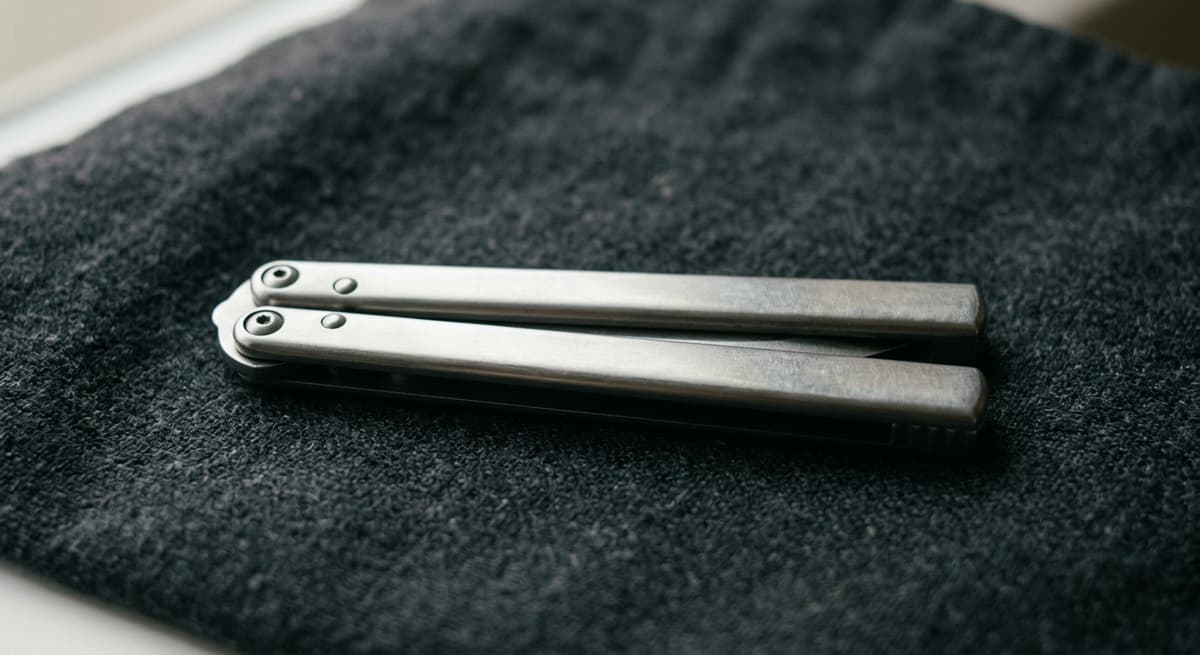
A butterfly knife is covered by an identically structured statute, Haw. Rev. Stat. § 134-53, with the same misdemeanor for concealed carry, the same class C felony escalation during a separate crime (including the same same-chapter proviso against double prosecution), and the same home-possession defense at subsection (d). Subsection (e) defines "butterfly knife" as "any knife having a blade encased in a split handle that manually unfolds with hand or wrist action with the assistance of inertia, gravity, or both."
A dirk, dagger, blackjack, or metal knuckles falls under the general provision, § 134-51, described above, which carries the same misdemeanor-for-concealed-carry and class-C-felony-during-a-crime structure, with the home-possession defense at subsection (g) rather than (d). One difference: § 134-51(b)'s felony escalation does not carry the same-chapter proviso that § 134-52(b) and § 134-53(b) do, so all three statutes are not quite identical.
Sections 134-51, 134-52, and 134-53 were each last amended by 2024 Act 21 (sections 4, 5, and 6 respectively). The rule described on this page reflects the statutes as they currently read.
Where you can't carry at all: schools
Haw. Rev. Stat. § 302A-1134.6, the Department of Education's zero tolerance policy, provides that "a child who possesses, sells, or uses a dangerous weapon or switchblade knife, while attending school or while attending department-supervised activities held on or off school property, may be excluded from attending school for up to ninety-two school days." This is a school-discipline provision, separate from the criminal offenses above, and applies specifically to a "dangerous weapon" or a switchblade knife by name.
Does Hawaii preempt local knife ordinances?
Hawaii has no statewide knife preemption statute. The code also sets no minimum age for purchasing or possessing a knife.

Federal law: what it does and does not reach
Federal law does not ban an individual from owning or carrying a switchblade nationwide. The Federal Switchblade Act, 15 U.S.C. §§ 1241 to 1245, instead regulates interstate commerce in switchblade knives, barring their manufacture, sale, transport, or introduction into interstate commerce, and, in 15 U.S.C. § 1245 makes it a federal offense to knowingly possess, manufacture, sell, or import a ballistic knife in or affecting interstate commerce or within federal territorial jurisdiction. 15 U.S.C. § 1244, captioned "Exceptions," provides that §§ 1242 and 1243 "shall not apply to" a list of specific knives; it is an exemption from those two interstate-commerce and importation offenses, not a change to the switchblade definition itself, which sits in § 1241(b) and was not amended. A 2009 addition, § 1244(5), exempts from §§ 1242 and 1243 any knife with a spring, detent, or other closure-bias mechanism that requires hand, wrist, or arm exertion to overcome the bias and assist opening, the exception that keeps modern assisted-opening folding knives legal in interstate commerce. A separate exception, § 1244(4), exempts a person with only one arm from those same two offenses when possessing or carrying a switchblade with a blade three inches or less. Hawaii's own switchblade definition, keyed to how the blade opens rather than its length, operates independently of this federal exception.
Disclaimer: This article provides general legal information about Hawaii's knife laws as of September 2026. It is not legal advice. Consult a lawyer licensed in Hawaii for advice about a specific situation. Because each of these statutes turns on whether the item was "concealed," how a particular knife is carried in practice can affect whether it falls within the offense.
For a state-by-state comparison, see knife laws by state. Hawaii's self-defense statutes are covered separately on the Hawaii self-defense laws page.
Statutes cited reflect their in-force version as of 2026-09-18. Last updated: 2026-09-18.
Frequently Asked Questions
Are switchblades illegal in Hawaii?
Carrying a switchblade knife concealed on the person or in a bag or container is a misdemeanor under Haw. Rev. Stat. 134-52(a). There is a defense if the person was lawfully present in their own home. The statute does not ban open carry.
Are butterfly knives illegal in Hawaii?
Carrying a butterfly knife concealed is a misdemeanor under Haw. Rev. Stat. 134-53(a), with the same structure and home-possession defense as Hawaii's switchblade statute.
Can I carry a dirk or dagger in Hawaii?
Concealed carry of a dirk or dagger is a misdemeanor under Haw. Rev. Stat. 134-51(a), with a defense for lawful presence in one's own home. Switchblade and butterfly knives are expressly excluded from this general section and governed by their own separate statutes.
Can I carry a knife at school in Hawaii?
A student who possesses, sells, or uses a dangerous weapon or a switchblade knife at school or a school-supervised activity may be excluded from school for up to 92 school days under the Department of Education's zero tolerance policy, Haw. Rev. Stat. 302A-1134.6.
Can I carry an ordinary pocketknife or work knife in Hawaii?
Likely yes, based on how Hawaii courts have read the 'other deadly or dangerous weapon' catch-all in section 134-51. In State v. Rackle, the Hawaii Supreme Court limited that catch-all to instruments whose sole design is to inflict death or bodily injury, and in State v. Giltner, applying that test, the court held that a diver's knife was neither a dagger nor a deadly or dangerous weapon under the statute. An ordinary pocketknife or work knife carried for its ordinary purpose is unlikely to fall within the catch-all, though the specific facts still matter.
Updates
Corrected the description of State v. Giltner so it no longer says the diver's knife came from the defendant's belt, a detail the opinion does not state.
Corrected the school-exclusion summary to say a student may be excluded for up to 92 school days, matching Haw. Rev. Stat. 302A-1134.6.
Independently fact-checked against the cited primary sources
The Law Behind This Article
This article rests on the statutory provisions below, held in our own legal record and retrieved from the official source. Tap a section to read the operative text.
Hawaii Revised Statutes, Chapter 134: FIREARMS, AMMUNITION AND DANGEROUS WEAPONS
§ 134-51Deadly or dangerous weapons; prohibitions; penaltyIn forcecited in 2 of our articles
(a) Any person, not authorized by law, who knowingly carries concealed on the person, or in a bag or other container carried by the person, any dirk, dagger, blackjack, metal knuckles, or other deadly or dangerous weapon shall be guilty of a misdemeanor; provided that this subsection shall not apply to a billy. (b) Any person who knowingly possesses or intentionally uses or threatens to use a dirk, dagger, blackjack, metal knuckles, or other deadly or dangerous weapon, or a billy, while engaged in the commission of a separate felony or misdemeanor shall be guilty of a class C felony. (c) A conviction and sentence under subsection (b) shall be in addition to and not in lieu of any conviction and sentence for the separate felony or misdemeanor; provided that the sentence imposed under subsection (b) may run concurrently or consecutively with the sentence for the separate felony or misdemeanor. (d) Upon conviction of a person for carrying or possessing a deadly or dangerous weapon pursuant to this section, the deadly or dangerous weapon shall be summarily destroyed by the chief of police or sheriff.
Official text (excerpt) · last checked 2026-09-23 · Read the full text in our law library · Verify at capitol.hawaii.gov
Cited in 22 court opinions in our collectionLatest citing opinion in our collection: 2019
Opinions citing this section in our collection:
- State v. Ganal (Hawaii Supreme Court 1996, 81 Haw. 358)“…At the same time, under section 3 of Act 195 (codified as HRS § 134-51(b)), to "knowingly possess[ ] or intent…”
- State v. Sanchez (Hawaii Intermediate Court of Appeals 1996, 82 Haw. 517)“…S § 134-6(a), or be “engaged in the commission of a crime,” HRS § 134-51(b). HRS § 134-7(b) does not require the…”
- State v. Ogata (Hawaii Supreme Court 1977, 58 Haw. 514)“…or the offense of carrying a deadly weapon, in violation of HRS § 134-51. The recovery of a sheathed sword-cane,…”
Identified automatically from the court opinions citing this section — not a ranking of which case controls.
Also relied on in: Hawaii Pepper Spray and Stun Gun Laws (2026)
§ 134-52Switchblade knives; prohibitions; penaltyIn force
(a) Whoever knowingly carries concealed on the person, or in a bag or other container carried by the person, any switchblade knife shall be guilty of a misdemeanor. (b) Whoever knowingly possesses or intentionally uses or threatens to use a switchblade knife while engaged in the commission of a separate felony or misdemeanor shall be guilty of a class C felony; provided that a person shall not be prosecuted under this subsection when the separate felony or misdemeanor is an offense otherwise defined by this chapter. (c) A conviction and sentence under subsection (b) shall be in addition to and not in lieu of any conviction and sentence for the separate felony or misdemeanor; provided that the sentence imposed under subsection (b) may run concurrently or consecutively with the sentence for the separate felony or misdemeanor. (d) It shall be a defense to a prosecution under subsection (a) that the person was lawfully present in the person's own home at the time of the offense.
Official text (excerpt) · last checked 2026-07-30 · Read the full text in our law library · Verify at capitol.hawaii.gov
Cited in 6 court opinions in our collectionLatest citing opinion in our collection: 2020
Opinions citing this section in our collection:
- State v. Jhun (Hawaii Supreme Court 1996, 83 Haw. 472)“…and possession of a switchblade knife in violation of HRS § 134-52 (1998). 2 During his t…”
- In the Interest of Doe (Hawaii Supreme Court 1992, 73 Haw. 89)“…e of switchblade knife under HRS § 134 — 52; and 2) whether HRS § 134-52 is unconstitutionally vague as applied…”
- State v. Rackle (Hawaii Supreme Court 1974, 55 Haw. 531)“…46 . 4 In 1972 the Legislature enacted HRS § 134-52 which provides: “Whoever knowi…”
Identified automatically from the court opinions citing this section — not a ranking of which case controls.
§ 134-53Butterfly knives; prohibitions; penaltyIn force
(a) Whoever knowingly carries concealed on the person, or in a bag or other container carried by the person, any butterfly knife shall be guilty of a misdemeanor. (b) Whoever knowingly possesses or intentionally uses or threatens to use a butterfly knife while engaged in the commission of a separate felony or misdemeanor shall be guilty of a class C felony; provided that a person shall not be prosecuted under this subsection when the separate felony or misdemeanor is an offense otherwise defined by this chapter. (c) A conviction and sentence under subsection (b) shall be in addition to and not in lieu of any conviction and sentence for the separate felony or misdemeanor; provided that the sentence imposed under subsection (b) may run concurrently or consecutively with the sentence for the separate felony or misdemeanor. (d) It shall be a defense to a prosecution under subsection (a) that the person was lawfully present in the person's own home at the time of the offense.
Official text (excerpt) · last checked 2026-07-30 · Read the full text in our law library · Verify at capitol.hawaii.gov
Cited in 3 court opinions in our collectionLatest citing opinion in our collection: 2025
Opinions citing this section in our collection:
- Andrew Teter v. Anne E. Lopez (Court of Appeals for the Ninth Circuit 2023, 76 F.4th 938)“…fer, transport, or possess a butterfly knife—no exceptions. Haw. Rev. Stat. § 134-53(a). Because the possession of butterfly…”
- Teter v. Connors (District Court, D. Hawaii 2020)“…reasons detailed below, the Court finds that HRS § 134-53(a) is not an uncon…”
Identified automatically from the court opinions citing this section — not a ranking of which case controls.
§ 134-12.5Forfeiture of firearms, ammunition, deadly or dangerous weapons, and switchblade knives; whenIn force
All firearms, ammunition, deadly or dangerous weapons, and switchblade knives possessed, used in violation of this chapter or the Hawaii Penal Code shall be forfeited to the State according to the provisions of chapter 712A and shall be destroyed or, if not destroyed, transferred to the chief of police of the county in which the violation took place for use by and under control of the police department. [L 1991, c 166, §9]
Official text (excerpt) · last checked 2026-07-30 · Read the full text in our law library · Verify at capitol.hawaii.gov
Hawaii Revised Statutes, Chapter 302A: EDUCATION
§ 302A-1134.6Zero tolerance policyIn force
. (a) Any child who possesses, sells, or uses a dangerous weapon or switchblade knife, while attending school or while attending department-supervised activities held on or off school property, may be excluded from attending school for up to ninety-two school days, as determined by the principal and approved by the superintendent or other individuals designated pursuant to rules adopted by the board. (b) Except as provided in subsection (f), any child who possesses, sells, consumes, or uses intoxicating liquor or illegal drugs, while attending school or while attending department-supervised activities held on or off school property, may be excluded from attending school for up to ninety-two school days, as determined by the principal and approved by the superintendent or other individuals designated pursuant to rules adopted by the board.
Official text (excerpt) · last checked 2026-07-30 · Read the full text in our law library · Verify at capitol.hawaii.gov
Cited in 1 court opinions in our collectionLatest citing opinion in our collection: 2007
Opinions citing this section in our collection:
- State v. Reis (Hawaii Supreme Court 2007, 115 Haw. 79)“…" and creating a "zero tolerance policy" in public schools, HRS § 302A-1134.6). [44] The reference to a "presumpti…”
Identified automatically from the court opinions citing this section — not a ranking of which case controls.
United States Code Title 15
§ 1241DefinitionsIn forcecited in 52 of our articles
As used in this chapter— The term “interstate commerce” means commerce between any State, Territory, possession of the United States, or the District of Columbia, and any place outside thereof. The term “switchblade knife” means any knife having a blade which opens automatically— by hand pressure applied to a button or other device in the handle of the knife, or by operation of inertia, gravity, or both.
Official text (excerpt) · last checked 2026-07-28 · Read the full text in our law library · Verify at uscode.house.gov
Cited in 15 court opinions in our collectionLatest citing opinion in our collection: 2014
Opinions citing this section in our collection:
- Stewart A. Taylor, D/B/A Taylor Cutlery Mfg. Co. v. United States of America (Court of Appeals for the Sixth Circuit 1988, 848 F.2d 715)“…Service, are not switchblade knives within the meaning of 15 U.S.C. § 1241 (b) and 19 C.F.R. § 1295 (a)(1). The d…”
- Crowley Cutlery Company v. United States of America and Commissioner of Customs of the United States Customs Service (Court of Appeals for the Seventh Circuit 1988, 849 F.2d 273)“…Illinois for a declaration that the Switchblade Knife Act, 15 U.S.C. §§ 1241 et seq., which forbids th…”
- Edna Fall, as Administratrix of the Estate of Phillip Fall, Deceased v. Esso Standard Oil Company (Court of Appeals for the Fifth Circuit 1962, 297 F.2d 411)“…25 S.Ct. 158 , 49 L.Ed. 363 . Section 1 of the Act, 15 U.S.C.A. § 1241 (b), defines the term “switchblade knif…”
Identified automatically from the court opinions citing this section — not a ranking of which case controls.
Also relied on in: Knife Laws by State (2026): Carry Rules, Blade Limits, Penalties, Alabama Knife Laws (2026): What Is Legal to Carry, Alaska Knife Laws (2026): Concealed Carry Rules Explained
§ 1244ExceptionsIn forcecited in 52 of our articles
Sections 1242 and 1243 of this title shall not apply to— any common carrier or contract carrier, with respect to any switchblade knife shipped, transported, or delivered for shipment in interstate commerce in the ordinary course of business; the manufacture, sale, transportation, distribution, possession, or introduction into interstate commerce, of switchblade knives pursuant to contract with the Armed Forces; the Armed Forces or any member or employee thereof acting in the performance of his duty; the possession, and transportation upon his person, of any switchblade knife with a blade three inches or less in length by any individual who has only one arm; or a knife that contains a spring, detent, or other mechanism designed to create a bias toward closure of the blade and that requires exertion applied to the blade by hand, wrist, or arm to overcome the bias toward closure to assist in opening the knife.
Official text (excerpt) · last checked 2026-07-28 · Read the full text in our law library · Verify at uscode.house.gov
Also relied on in: Arizona Knife Laws (2026): Carry Rules and Preemption, Arkansas Knife Laws (2026): Intent-Based Carry Rules, California Knife Laws (2026): Four Blade-Length Rules
§ 1245Ballistic knivesIn forcecited in 50 of our articles
Whoever in or affecting interstate commerce, within any Territory or possession of the United States, within Indian country (as defined in section 1151 of title 18), or within the special maritime and territorial jurisdiction of the United States (as defined in section 7 of title 18), knowingly possesses, manufactures, sells, or imports a ballistic knife shall be fined as provided in title 18, or imprisoned not more than ten years, or both. Whoever possesses or uses a ballistic knife in the commission of a Federal crime of violence shall be fined as provided in title 18, or imprisoned not less than five years and not more than ten years, or both. The exceptions provided in paragraphs (1), (2), and (3) of section 1244 of this title with respect to switchblade knives shall apply to ballistic knives under subsection (a) of this section. As used in this section, the term “ballistic knife” means a knife with a detachable blade that is propelled by a spring-operated mechanism.
Official text (excerpt) · last checked 2026-07-28 · Read the full text in our law library · Verify at uscode.house.gov
Cited in 2 court opinions in our collectionLatest citing opinion in our collection: 2008
Opinions citing this section in our collection:
- ALCANTAR (Board of Immigration Appeals 1994, 20 I. & N. Dec. 801)“…ed by an adult, would be felony and crime of violence); cf. 15 U.S.C. § 1245(b) (1988) (use of ballistic knife in co…”
- United States v. Polizzi (District Court, E.D. New York 2008, 549 F. Supp. 2d 308)“…8 Trust in l’estraint of import trade 3 months 15 U.S.C. § 1245 (b) Possession/use of a ballistic knife…”
Identified automatically from the court opinions citing this section — not a ranking of which case controls.
Also relied on in: Colorado Knife Laws (2026): Concealed Carry and Exceptions, Connecticut Knife Laws (2026): Open and Concealed Carry, Delaware Knife Laws (2026): Carry, Switchblades, and Bans
Search our full record of US law — 2.1 million sections, every state + federal →
Sources and References
- Haw. Rev. Stat. 134-51 - Deadly or dangerous weapons; prohibitions; penalty (dirk, dagger, blackjack, metal knuckles; excludes switchblade/butterfly knife)(capitol.hawaii.gov).gov
- Haw. Rev. Stat. 134-52 - Switchblade knives; prohibitions; penalty(capitol.hawaii.gov).gov
- Haw. Rev. Stat. 134-53 - Butterfly knives; prohibitions; penalty(capitol.hawaii.gov).gov
- Haw. Rev. Stat. 302A-1134.6 - Zero tolerance policy (student exclusion for dangerous weapon or switchblade knife)(capitol.hawaii.gov).gov
- Haw. Rev. Stat. 134-12.5 - Forfeiture of firearms, ammunition, deadly or dangerous weapons, and switchblade knives(capitol.hawaii.gov).gov
- State v. Rackle, 55 Haw. 531, 523 P.2d 299 (1974) - limits 134-51's 'other deadly or dangerous weapon' catch-all to instruments whose sole design is to inflict death or bodily injury(courtlistener.com)
- State v. Giltner, 56 Haw. 374, 537 P.2d 14 (1975) - a diver's knife is neither a dagger nor a deadly or dangerous weapon under 134-51(courtlistener.com)
- 15 U.S.C. 1241-1245 - Federal Switchblade Act, interstate commerce and importation scope(law.cornell.edu)
- 15 U.S.C. 1244 - exceptions, including the 2009 assisted-opening carve-out and the one-arm exception(law.cornell.edu)