
Tennessee
Tennessee Workplace Recording Laws: Employee and Employer Rights
Independently fact-checked against primary sources (last audited August 15, 2026). · Reviewed by the RecordingLaw editorial team. · Law checked current as of August 9, 2026. · 7 primary sources cited on this page. How we verify our legal content

Tennessee employees can lawfully record any workplace conversation they participate in without notifying other parties. Under Tenn. Code Ann. 39-13-601, only one-party consent is required. However, because Tennessee is an at-will state, employers may still terminate workers who violate a company no-recording policy.
Tennessee's one-party consent law gives both employees and employers significant rights when it comes to workplace recording. Under Tenn. Code Ann. section 39-13-601, anyone who is a party to a conversation can record it without telling the other participants. At the same time, Tennessee's at-will employment doctrine means employers can fire workers for violating company recording policies, even when the recording is legal under state law.
This guide covers the full landscape of workplace recording in Tennessee, including employee rights, employer surveillance authority, policy considerations, and federal labor protections.
Employee Recording Rights in Tennessee
The Legal Foundation
As a one-party consent state, Tennessee allows any participant in a conversation to record it. This means employees can legally record:
- Meetings with supervisors and managers
- HR discussions and disciplinary hearings
- Performance reviews and evaluations
- Conversations with coworkers
- Phone calls with clients, vendors, or customers
- Workplace interactions where the employee is present and participating
The employee's own consent to the recording satisfies the legal requirement. No notification to other participants is necessary.
Why Employees Record at Work
Employees commonly record workplace conversations to:
- Document harassment or discrimination for later use in complaints or litigation
- Preserve verbal agreements about compensation, promotions, or work assignments
- Record disciplinary meetings to have an accurate account of what was said
- Gather evidence of illegal activity such as safety violations, fraud, or wage theft
- Protect against false accusations by having a factual record
- Create training notes from meetings or instructions
What Employees Cannot Record
While the one-party consent rule is permissive, employees cannot:
- Plant a recording device and leave the room to capture conversations they are not part of
- Use hidden cameras in areas where coworkers have a reasonable expectation of privacy
- Record for the purpose of committing a criminal or tortious act, such as blackmail or corporate espionage
- Intercept electronic communications they are not a party to, such as reading other employees' emails or text messages
Recording a conversation between two coworkers when you are not present or participating is illegal wiretapping under Tennessee law, regardless of where it happens.
Employer Recording and Surveillance Rights

Video Surveillance
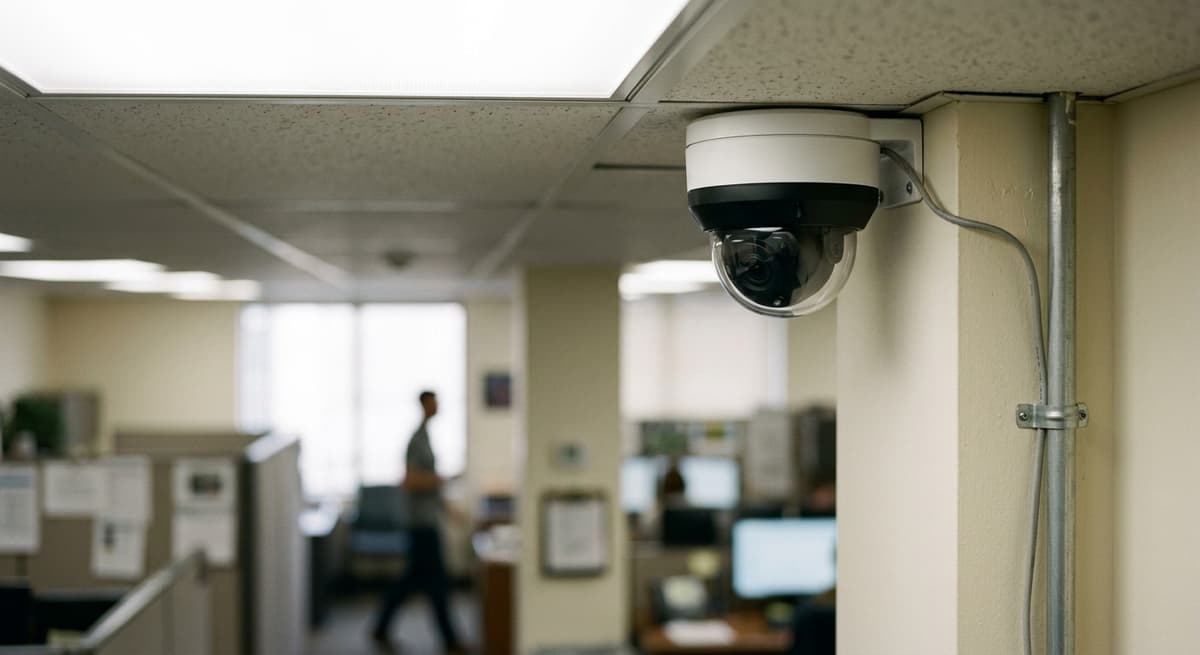
Tennessee employers have broad authority to conduct video surveillance in the workplace. Cameras are permitted in:
- Open office areas and cubicle spaces
- Retail sales floors and customer-facing areas
- Warehouses, manufacturing floors, and loading docks
- Parking lots, building entrances, and exterior areas
- Lobbies, hallways, elevators, and common corridors
- Break rooms (video only; audio requires consent compliance)
Cameras are prohibited in:
- Restrooms and bathrooms
- Changing rooms and locker rooms
- Designated nursing or lactation rooms
- Any area where employees have a reasonable expectation of bodily privacy
Placing cameras in prohibited locations for a sexual or harassing purpose, or in a manner that captures unclothed intimate areas, can expose employers to criminal liability under Tennessee's voyeurism and unlawful photography statutes (Tenn. Code Ann. sections 39-13-605 and 39-13-607); a standard security camera placed for safety or loss-prevention purposes, without that intent, does not violate these statutes.
Audio Surveillance by Employers
Employer audio recording is more restricted than video surveillance. Under the one-party consent rule, at least one party to any recorded conversation must consent. This means:
- An employer cannot install a hidden microphone in a conference room and record conversations without any participant's knowledge
- If an employer directs an employee to record a conversation the employee is participating in, the consent requirement is met
- Recorded phone lines where employees are aware of monitoring satisfy the consent requirement through the employees' knowledge
Many employers address audio recording through written policies that inform employees their calls may be monitored, creating implied consent.
Computer and Electronic Monitoring
Tennessee employers can monitor company-owned computers, email systems, and electronic devices. This includes:
- Monitoring company email accounts
- Tracking web browsing on company networks
- Recording keystrokes on company computers
- Monitoring company-issued phones and devices
Monitoring personal devices and accounts, even when used at work, raises different legal concerns. The Tennessee Information Protection Act (TIPA) and federal privacy laws may limit employer access to employees' personal data.
The At-Will Employment Tension

Recording Is Legal, but Firing for Recording May Also Be Legal
This is the central tension in Tennessee workplace recording law. Tennessee is an at-will employment state, meaning employers can terminate employees for any reason that is not illegal, including violating a company no-recording policy.
Here is how this plays out:
- An employee records a meeting with their supervisor (legal under state law)
- The employer has a policy prohibiting workplace recording
- The employer fires the employee for violating the policy (generally legal under at-will doctrine)
- The recording itself remains legal and may still be admissible as evidence
The employee committed no crime by recording, but the employer committed no crime by firing them for it. This creates a practical tension that employees must weigh carefully before recording.
Exceptions to At-Will Termination
Tennessee recognizes several exceptions to at-will employment that may protect employees who are fired for recording:
Public policy exception: Tennessee courts have recognized that employers cannot fire employees for reasons that violate a clear public policy. If an employee records evidence of illegal activity, such as workplace safety violations or discrimination, and is fired for the recording, they may have a claim under the public policy exception.
Workers' compensation retaliation: Under Tenn. Code Ann. section 50-6-114, employers cannot terminate employees in retaliation for filing workers' compensation claims. Recordings documenting unsafe conditions could be protected.
Whistleblower protection: The Tennessee Public Protection Act (Tenn. Code Ann. section 50-1-304) protects employees who refuse to participate in illegal activities or who report violations of law. Recording to document illegal conduct may fall under this protection.
Anti-discrimination laws: Federal laws including Title VII of the Civil Rights Act, the Americans with Disabilities Act, and the Age Discrimination in Employment Act prohibit retaliation against employees who document discrimination. Recording evidence of discriminatory conduct may be protected activity.
National Labor Relations Act Protections
Section 7 Rights and Recording
The National Labor Relations Act (NLRA) protects employees' rights to engage in "concerted activity" for mutual aid or protection. The National Labor Relations Board (NLRB) has addressed employer recording policies in several important decisions, most recently in Stericycle, Inc., 372 NLRB No. 113 (2023), which is the controlling standard. Under Stericycle, employer work rules (including no-recording policies) are unlawful if they would reasonably tend to chill employees in the exercise of Section 7 rights, even if the employer has a legitimate justification. The burden shifts to the employer to prove any restriction is narrowly tailored.
Blanket No-Recording Policies
Under the Stericycle standard, overly broad no-recording policies can violate Section 7 when they would reasonably chill employees' exercise of protected rights. Examples of protected recording activity include:
- Documenting unsafe working conditions to share with coworkers or report to OSHA
- Recording evidence of wage theft or labor law violations
- Documenting union-related conversations
- Preserving evidence of unfair labor practices by the employer
Employer Policy Best Practices
To avoid NLRA issues, employers should:
- Narrowly tailor recording policies to legitimate business interests (protecting trade secrets, client confidentiality, patient privacy)
- Avoid blanket prohibitions that could be read to restrict protected concerted activity
- Clearly state the business justification for any recording restrictions
- Apply recording policies consistently and without discriminatory intent
Specific Workplace Recording Scenarios
Recording HR Meetings and Disciplinary Hearings
Employees can record HR meetings, write-ups, and disciplinary proceedings in Tennessee. This is one of the most common reasons employees record at work. Considerations include:
- The recording is legal under state law without notifying HR
- The recording can serve as evidence in wrongful termination or discrimination claims
- HR may ask you to stop recording; you are not legally required to comply, but refusing could escalate the situation
- If your employer has a no-recording policy, you face the at-will employment risk discussed above
Recording Job Interviews
Job applicants in Tennessee can record their interviews under the one-party consent law. This can help document promises made about salary, benefits, or job duties. However, if the employer discovers the recording, it could affect the hiring decision.
Remote Work and Virtual Meetings
Tennessee employees working remotely can record virtual meetings they participate in on platforms like Zoom, Microsoft Teams, and Google Meet. The one-party consent rule applies to electronic communications. However, if other meeting participants are located in two-party consent states, the stricter standard may apply.
Recording Conversations About Workplace Safety
Employees who record conversations about safety hazards may have additional protections under OSHA whistleblower provisions. Recording evidence of unsafe conditions, inadequate safety training, or employer retaliation for safety complaints may qualify as protected activity under both the NLRA and OSHA regulations.
Using Workplace Recordings as Evidence
Employment Litigation
Workplace recordings made in compliance with Tennessee's one-party consent law are generally admissible in employment litigation. These recordings have been used in cases involving:
- Wrongful termination claims
- Sexual harassment and hostile work environment cases
- Wage and hour disputes
- Workers' compensation claims
- Discrimination and retaliation cases
- Breach of employment contract claims
Tennessee Rules of Evidence
Under the Tennessee Rules of Evidence, recordings must be authenticated, relevant, and obtained legally to be admissible. The party offering the recording must establish a proper foundation, including identifying the speakers and confirming the recording has not been altered.
EEOC and Administrative Proceedings
Recordings can also be submitted as evidence in proceedings before the Equal Employment Opportunity Commission (EEOC) and the Tennessee Human Rights Commission. Administrative proceedings often have more relaxed evidentiary standards than courts, making recordings particularly useful in these forums.
Penalties for Illegal Workplace Recording
Criminal Consequences
Illegal recording in the workplace carries the same penalties as any other violation of Tenn. Code Ann. section 39-13-601:
| Offense | Classification | Penalty |
|---|---|---|
| Illegal interception of communications | Class D Felony | 2 to 12 years, up to $5,000 fine |
| Illegal disclosure of intercepted communications | Class D Felony | 2 to 12 years, up to $5,000 fine |
Civil Liability
Tennessee repealed the civil cause of action for illegal interception, formerly codified at Tenn. Code Ann. section 39-13-603, effective May 28, 2024 under 2024 Tenn. Pub. Ch. 1045 (SB 2221), section 3. Victims can no longer sue for statutory or punitive damages under that Tennessee statute. Federal law still provides a civil remedy: 18 U.S.C. section 2520 lets victims of a federal Wiretap Act violation sue in federal court for the greater of $100 a day or $10,000, plus punitive damages and attorney fees. Criminal liability under Tennessee law is unchanged; illegal interception remains a Class D felony under sections 39-13-601 and 39-13-602.
Tennessee ELVIS Act and AI-Generated Content in the Workplace
The Ensuring Likeness Voice and Image Security (ELVIS) Act (T.C.A. § 47-25-1101 et seq.), Public Chapter 588 of 2024, effective July 1, 2024, made Tennessee the first state in the nation to extend right-of-publicity protection to a person's voice against unauthorized AI imitation. In the workplace context, this means:
- Employers and coworkers cannot use AI tools to clone or synthesize an employee's voice without consent
- AI-generated training materials, simulations, or internal media using an employee's likeness require consent
- Unauthorized use creates civil liability for actual damages, disgorgement of profits, and injunctive relief
Employers using AI-assisted recording or transcription tools should review their consent disclosures to ensure compliance with the ELVIS Act in addition to the general one-party consent requirement of T.C.A. § 39-13-601.
Tennessee Recording Laws by Topic
Phone Call Recording | Audio Recording | Video Recording | Workplace Recording | Recording Police | Security Cameras | Recording in Public | Landlord-Tenant | Dashcam Laws | Schools | Medical Recording | Voyeurism & Hidden Cameras
Back to Tennessee Recording Laws
More Tennessee Recording Topics
More Tennessee Laws
Frequently Asked Questions
Can I record a conversation with my boss in Tennessee?
Yes. Tennessee is a one-party consent state, so you can legally record any conversation you participate in at work, including meetings with your supervisor, without notifying them. However, if your employer has a no-recording policy, you could face disciplinary action or termination.
Can my employer install cameras in the workplace in Tennessee?
Yes, in common work areas such as offices, retail floors, hallways, and parking lots. Employers cannot install cameras in restrooms, locker rooms, changing rooms, or other areas where employees have a reasonable expectation of bodily privacy.
Can I be fired for recording at work in Tennessee?
Potentially yes. While the recording is legal under state law, Tennessee is an at-will employment state. Your employer can fire you for violating a company no-recording policy. Exceptions may apply if you recorded evidence of illegal activity or discrimination, as various federal and state whistleblower protections may apply.
Can my employer record my phone calls at work?
Yes, as long as the one-party consent requirement is met. If you are informed that calls may be monitored, your continued use of the phone system constitutes consent. Employers cannot secretly record calls without any participant's knowledge.
Are workplace recordings admissible in court in Tennessee?
Yes. Recordings made in compliance with Tennessee's one-party consent law are generally admissible in employment litigation, EEOC proceedings, and other legal forums. The recording must be authenticated and relevant to the issues in the case.
Updates
Fixed a mislabeled link that sent readers to the wrong statute when checking the observation-without-consent citation (section 39-13-607), and replaced two dead citation links (OSHA's whistleblower page and the ELVIS Act governor's-office announcement) with their current live equivalents. No underlying legal facts on this page changed.
Independently fact-checked against the cited primary sources
Governing law re-checked for recent changes
Clarified that employer criminal liability under Tennessee's unlawful photography statute requires a sexual or harassing purpose, not merely a camera's location.
Governing law re-checked for recent changes
Corrected the Civil Liability section: Tennessee repealed the state civil cause of action for illegal interception (Tenn. Code Ann. section 39-13-603) effective May 28, 2024, so it no longer exists under state law; victims may still have a federal remedy under 18 U.S.C. section 2520.
Reviewed and approved by an editor
The Law Behind This Article
This article rests on the statutory provisions below, held in our own legal record and retrieved from the official source. Tap a section to read the operative text.
Tennessee Code Annotated
§ 39-13-601Wiretapping and electronic surveillance — Prohibited acts — Exceptions.In forcecited in 20 of our articles
(a)(1) Except as otherwise specifically provided in §§ 39-13-601 — [former] 39-13-603 [repealed] and title 40, chapter 6, part 3, a person commits an offense who: (A) Intentionally intercepts, endeavors to intercept, or procures any other person to intercept or endeavor to intercept, any wire, oral
Official text (excerpt) · last checked 2026-08-31 · Read the full text in our law library · Verify at publications.tnsosfiles.com
Cited in 25 court opinions in our collectionLatest citing opinion in our collection: 2026
In the courts (editorial summary, independently checked):Lawrence v. Lawrence held a parent may vicariously consent under Section 39-13-601 to recording a 2 1/2-year-old child's phone call with the other parent. State of Tennessee v. Henry Floyd Sanders noted that a body-wire recording made with one party's consent is lawful under the section's exceptions.
Opinions citing this section in our collection:
- Lawrence v. Lawrence (Court of Appeals of Tennessee 2010, 360 S.W.3d 416)“…called upon to construe the term “consent” as it is used in Tenn. Code Ann. § 39-13-601 to determine whether Mother had an “unr…”
- Harold Dean McDaniel v. Kimberly Ruth McDaniel (Court of Appeals of Tennessee 2010)“…ourt: I have had an opportunity to look at T.C.A. 39-13-601(a)(1), (A) and (B), and…”
- State of Tennessee v. Henry Floyd Sanders (Tennessee Supreme Court 2014, 452 S.W.3d 300)✓Police recorded a front yard conversation in which a man admitted touching his ex-partner's daughter; the court upheld admission of the recording as a voluntary statement to a confidante and noted that this type of recording is sanctioned as lawful by 39-13-601(b)(4)-(5).
Identified automatically from the court opinions citing this section — not a ranking of which case controls.
Also relied on in: Tennessee Recording Laws (2026): One-Party Consent Rules, Tennessee Voyeurism and Hidden Camera Laws: Statutes and Penalties, Tennessee Audio Recording Laws: One-Party Consent Rules and Penalties
§ 39-13-603Civil actions — Injunctive relief — Damages — Defenses — Limitation of actions.Repealedcited in 11 of our articles
(a) Except as provided in § 39-13-601(b)(4), any aggrieved person whose wire, oral or electronic communication is intentionally intercepted, disclosed, or used in violation of § 39-13-601 or title 40, chapter 6, part 3 may in a civil action recover from the person or entity that engaged in that…
Official text (excerpt) · last checked 2026-08-06 · Read the full text in our law library · Verify at publications.tnsosfiles.com
Cited in 8 court opinions in our collectionLatest citing opinion in our collection: 2018
Opinions citing this section in our collection:
- Robinson v. Fulliton (Court of Appeals of Tennessee 2003, 140 S.W.3d 312)“…il damages provision of the Tennessee wiretapping statutes, Tenn. Code Ann. § 39-13-603. The trial court, sitting without a jur…”
- Montgomery v. Montgomery (Court of Appeals of Tennessee 2005, 181 S.W.3d 720)“…0), whichever is greater” plus attorney fees and costs. See Tenn. Code Ann. § 39-13-603(a)(1). On appeal, Defendant argues that…”
- State of Tennessee v. William Keith Paulson, alias (Court of Criminal Appeals of Tennessee 2009)“…ted.” Violation of subsection (a) is a Class A misdemeanor. T.C.A. § 39-13-603(a)(3). As previously noted, subsection…”
Identified automatically from the court opinions citing this section — not a ranking of which case controls.
Also relied on in: Tennessee Landlord-Tenant Recording Laws: Rights and Restrictions, Tennessee Medical Recording Laws: Patient Rights and Provider Rules, Tennessee Phone Call Recording Laws: One-Party Consent Rules
§ 39-13-605Unlawful photographing in violation of privacy.In forcecited in 10 of our articles
(a) It is an offense for a person to knowingly photograph, or cause to be photographed an individual, when the individual has a reasonable expectation of privacy, without the prior effective consent of the individual, or in the case of a minor, without the prior effective consent of the minor's…
Official text (excerpt) · last checked 2021-05-21 · Read the full text in our law library
Cited in 14 court opinions in our collectionLatest citing opinion in our collection: 2026
In the courts (editorial summary, independently checked):State of Tennessee v. David Eric Lambert (2020) reversed a conviction under the pre-2018 version of section 39-13-605 because a fully clothed shopper in public had no reasonable expectation of privacy. State of Tennessee v. Brandon Robert Vandenburg (2019) rejected a vagueness challenge to the same element.
Opinions citing this section in our collection:
- State of Tennessee v. Thomas Whited (Tennessee Supreme Court 2016, 506 S.W.3d 416)✓A father hid a phone to video his twelve-year-old daughter and her friend undressing; the court noted the evidence would have supported unlawful photography under section 39-13-605, but charges were dropped because the statute excepts photographing a minor with parental consent.
- State of Tennessee v. David Eric Lambert (Court of Criminal Appeals of Tennessee 2020)✓A man followed a fully clothed woman through a Walmart and aimed his phone at her, but no image was ever found; the court held section 39-13-605 was not satisfied because she had no reasonable expectation of privacy and no photograph existed to judge, and reversed the conviction.
- State of Tennessee v. Brandon Robert Vandenburg (Court of Criminal Appeals of Tennessee 2019)✓A student photographed and filmed an unconscious, intoxicated woman as she was sexually assaulted in his dorm, then sent the files to a friend; the court upheld his felony conviction under section 39-13-605 and rejected his claim that the statute was unconstitutionally vague.
Identified automatically from the court opinions citing this section — not a ranking of which case controls.
Also relied on in: Tennessee School Recording Laws: Student, Parent, and Teacher Rights, Tennessee Security Camera Laws: Home, Business, and HOA Rules, Tennessee Video Recording Laws: What Is Legal and What Is Not
§ 50-1-304Discharge for refusal to participate in or remain silent about illegal activities, or for legal use of agricultural product — Damages — Frivolous lawsuits.In forcecited in 3 of our articles
(a) As used in this section: (1) “Employee” includes, but is not limited to: (A) A person employed by the state or any municipality, county, department, board, commission, agency, instrumentality, political subdivision or any other entity of the state; (B) A person employed by a private…
Official text (excerpt) · last checked 2026-09-08 · Read the full text in our law library · Verify at publications.tnsosfiles.com
Cited in 201 court opinions in our collectionLatest citing opinion in our collection: 2026
Opinions citing this section in our collection:
- Guy v. Mutual of Omaha Insurance Co. (Tennessee Supreme Court 2002, 79 S.W.3d 528)“…in this case is whether the Tennessee “Whistleblower” Act, Tenn.Code Ann. § 50-1-304, preempts the common law tort of retali…”
- Williams v. City of Burns (Tennessee Supreme Court 2015, 465 S.W.3d 96)“…Chism. See 1990 Tenn. Pub. Acts 771 (codified as amended Tenn.Code Ann. § 50-1-304 (2014)). The TPPA gave stat *110 utory…”
- Timmy Sykes v. Chattanooga Housing Authority (Tennessee Supreme Court 2011, 343 S.W.3d 18)“…dgment in favor of the CHA and Chief Hazel-wood pursuant to Tenn.Code Ann. § 50-1-304 is affirmed. Tennessee Human Rights…”
Identified automatically from the court opinions citing this section — not a ranking of which case controls.
Also relied on in: Tennessee At-Will Employment Laws: Exceptions and Your Rights, Tennessee Whistleblower Laws: Protections and How to Report
Tennessee Code Annotated, Title 47, Chapter 25, Part 11: Protection of Personal Rights (Ensuring Likeness, Voice, and Image Security Act of 2024)
§ 47-25-1101Short titleIn forcecited in 50 of our articles
This part shall be known and may be cited as the “Ensuring Likeness, Voice, and Image Security Act of 2024.” History Acts 1984, ch. 945, § 1; 2024, ch. 588, § 1.
Official text (excerpt) · last checked 2021-05-21 · Read the full text in our law library
Cited in 5 court opinions in our collectionLatest citing opinion in our collection: 2011
In the courts (editorial summary, independently checked):Courts cite 47-25-1101 et seq. as the Personal Rights Protection Act of 1984. Gibbons v. Schwartz-Nobel (1996) applied a one-year limitations period because the Act supplies none, and STATE EX REL. ELVIS PRESLEY INTL. MEMORIAL FOUNDATION v. Crowell (1987) said nothing in the Act limits publicity rights vested before its effective date.
Opinions citing this section in our collection:
- Gracey v. Maddin (Court of Appeals of Tennessee 1989, 769 S.W.2d 497)✓A widow sued her late husband's law firm under the Personal Rights Protection Act to stop its use of his surname; the Court of Appeals affirmed an injunction on partnership and name-assignment grounds, and the majority opinion never applied the Act's own provisions.
- STATE EX REL. ELVIS PRESLEY INTL. MEMORIAL FOUNDATION v. Crowell (Court of Appeals of Tennessee 1987, 733 S.W.2d 89)✓Two nonprofits fought over using Elvis Presley's name in their corporate names; the court rested his descendible right of publicity on Tennessee common law rather than the Personal Rights Protection Act, and said nothing in the Act limits rights vested before its effective date.
- State ex rel. Elvis Presley International Memorial Foundation v. Crowell (Court of Appeals of Tennessee 1987, 733 S.W.2d 89)“…General Assembly undertook to do so in 1984 when it enacted Tenn.Code Ann. § 47-25-1101 et seq. which is known as “The Person…”
Identified automatically from the court opinions citing this section — not a ranking of which case controls.
Also relied on in: Tennessee Laws on Recording in Public: What You Can and Cannot Film, Deepfake & AI Voice Cloning Laws by State (2026), Alaska Deepfake Laws: AI Images, Voice Cloning & Penalties (2026)
Search our full record of US law — 2.1 million sections, every state + federal →
Sources and References
- Tenn. Code Ann. section 39-13-601 - Wiretapping and Electronic Surveillance(law.justia.com)
- Tenn. Code Ann. section 39-13-605 - Unlawful Photography(law.justia.com)
- 2024 Tenn. Pub. Ch. 1045 (SB 2221), § 3 — repealed Tenn. Code Ann. § 39-13-603 (civil action for interception) effective May 28, 2024(publications.tnsosfiles.com).gov
- Tennessee Public Protection Act(law.justia.com)
- Tennessee Information Protection Act - Attorney General(tn.gov).gov
- National Labor Relations Act(nlrb.gov).gov
- OSHA Whistleblower Protection Program(whistleblowers.gov).gov
- EEOC - Title VII of the Civil Rights Act(eeoc.gov).gov
- Tennessee Rules of Evidence(tncourts.gov).gov
- Americans with Disabilities Act(ada.gov).gov
- Public Chapter 588 of 2024 (ELVIS Act), T.C.A. section 47-25-1101 et seq., enrolled act text(publications.tnsosfiles.com)