
Kansas
Kansas Landlord-Tenant Recording Laws
Independently fact-checked against primary sources (last audited August 15, 2026). · Reviewed by the RecordingLaw editorial team. · Law checked current as of August 15, 2026. · 5 primary sources cited on this page. How we verify our legal content
Kansas follows one-party consent under K.S.A. 21-6101, so tenants can record any conversation with a landlord as long as they participate. Landlords may install cameras in common areas but face felony charges under K.S.A. 21-6101(a)(6) for using a hidden camera inside a rental unit to record a tenant nude, undressed, or under their clothing without consent.
Kansas landlord-tenant recording issues arise frequently in disputes over lease terms, property conditions, harassment, and illegal entry. Under K.S.A. 21-6101, Kansas one-party consent law allows both tenants and landlords to record conversations they participate in. At the same time, K.S.A. 21-6101 strictly prohibits surveillance cameras in areas where tenants have a reasonable expectation of privacy.
This guide covers tenant recording rights, landlord surveillance rules, security camera restrictions, hidden camera detection, evidence use in housing disputes, and the intersection of recording law with the Kansas Residential Landlord and Tenant Act.
Tenant Recording Rights
Recording Conversations With Your Landlord
Under Kansas one-party consent law, tenants can record conversations with landlords, property managers, maintenance workers, and other property representatives without informing them. Your participation in the conversation satisfies the consent requirement. This includes:
- Phone calls about lease terms, repairs, or rent issues
- In-person conversations during property showings or inspections
- Discussions about security deposits and move-out conditions
- Meetings about lease renewals or terminations
- Conversations with maintenance personnel about repair requests
- Interactions during property inspections
Why Tenants Record Landlord Interactions
Tenants in Kansas commonly record interactions for several important purposes:
Documenting repair requests. When a landlord acknowledges a needed repair verbally but fails to follow through, a recording provides evidence that the request was made and acknowledged.
Preserving verbal agreements. Landlords sometimes make verbal promises about rent, repairs, or lease terms that differ from the written lease. A recording can prove what was actually agreed upon.
Proving harassment or intimidation. If a landlord engages in verbal harassment, threats of illegal eviction, or discriminatory behavior, a recording captures the exact words used.
Recording illegal entry. If a landlord enters a rental unit without proper notice as required by K.S.A. 58-2557, a recording or camera footage can document the violation.
Evidence for legal proceedings. Recordings serve as evidence in eviction proceedings, small claims court, security deposit disputes, and Fair Housing Act complaints.
What Tenants Cannot Record
While Kansas gives tenants broad recording rights for their own conversations, there are limits:
- Other tenants' private conversations. You cannot plant a recording device in a hallway to record conversations between other tenants that you are not part of.
- Landlord conversations you are not part of. You cannot bug the landlord's office or intercept phone calls between the landlord and other parties.
- Other tenants in private spaces. Recording other tenants in bathrooms, bedrooms, or other private areas violates the voyeurism provisions.
Landlord Surveillance Rights and Restrictions
Where Landlords Can Install Cameras
Landlords of multi-unit residential buildings can install security cameras in common areas where tenants do not have a reasonable expectation of privacy:
- Building lobbies and main entrances
- Hallways and corridors
- Stairwells and elevators
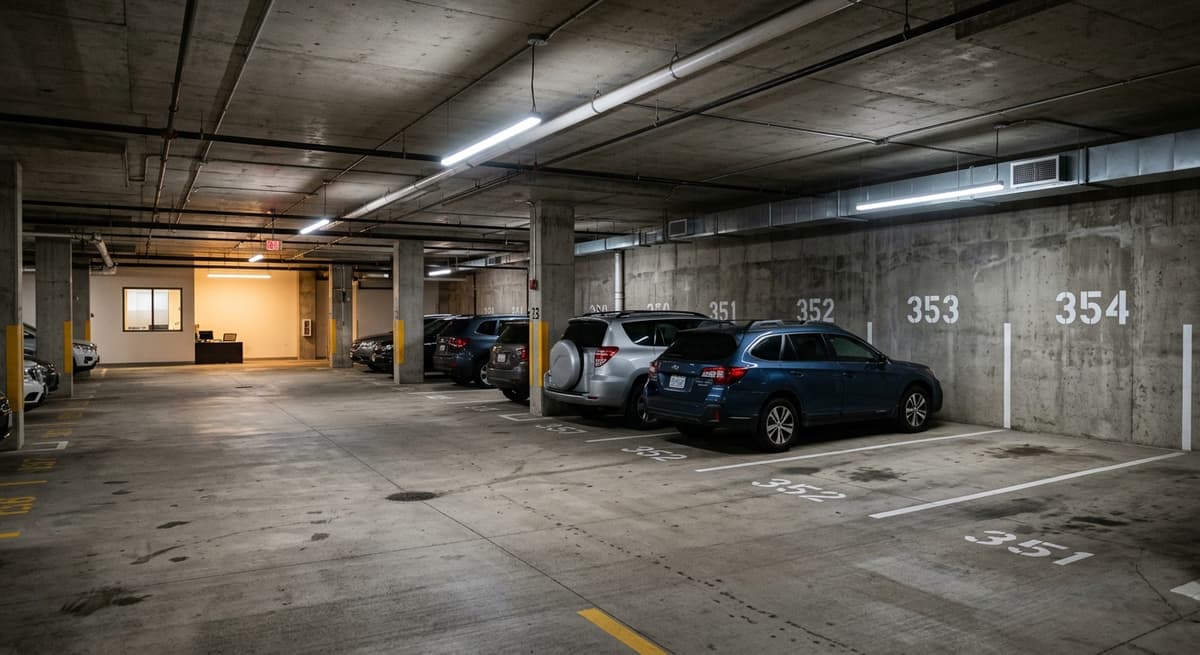
- Parking lots and garages
- Building exteriors and perimeters
- Laundry rooms (common areas only)
- Mail room areas
- Common recreational areas
Where Landlords Cannot Install Cameras
Under K.S.A. 21-6101(a)(6), landlords face felony criminal liability for installing hidden cameras that capture tenants nude, in a state of undress, or under their clothing in areas where tenants have a reasonable expectation of privacy:
- Inside rental units. No hidden cameras capturing a tenant nude, undressed, or under their clothing inside a tenant's apartment, house, or room, regardless of stated purpose.
- Bathrooms. Common area bathrooms, shared bathrooms, and any bathroom space.
- Laundry rooms with changing areas. If a laundry room includes a changing or dressing area, cameras cannot cover that section.
- Pool changing areas. Changing rooms and shower areas at building amenities.
- Storage units. Individual locked storage units assigned to specific tenants may carry a privacy expectation.
A landlord who places a hidden camera inside a tenant's rental unit to capture the tenant nude, undressed, or under their clothing commits a severity level 8 person felony, punishable by 7 to 23 months in prison on a first offense. Disseminating footage obtained through such surveillance is a severity level 5 person felony carrying 31 to 136 months.
Audio Recording in Common Areas
When landlord security cameras include audio recording capability, Kansas one-party consent law applies. Landlords should be cautious about audio recording in common areas where tenants have private conversations that no one on the landlord's behalf is part of. Best practice is to use video-only cameras in common areas or to post clear notice that audio recording is in progress.
Notice of Surveillance
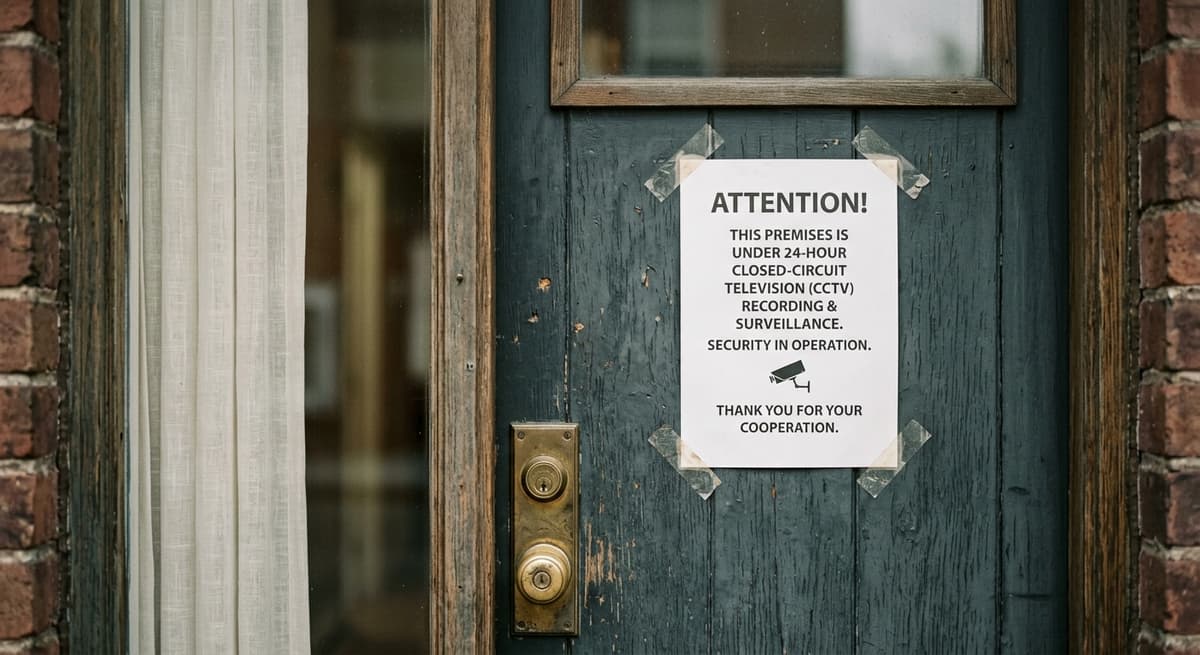
Kansas does not have a specific statute requiring landlords to notify tenants of common-area security cameras. However, providing notice is strongly recommended:
- Include surveillance disclosure in the lease agreement
- Post visible signage in monitored areas
- Inform tenants in writing when new cameras are installed
- Maintain a list of camera locations available to tenants upon request
Notice helps eliminate any claim of a reasonable expectation of privacy in monitored common areas and demonstrates good faith.
Tenant Security Camera Rights
Cameras Inside Your Rental Unit
Tenants can install security cameras inside their own rental unit. This includes:
- Indoor security cameras (Wyze, Blink, Arlo, etc.)
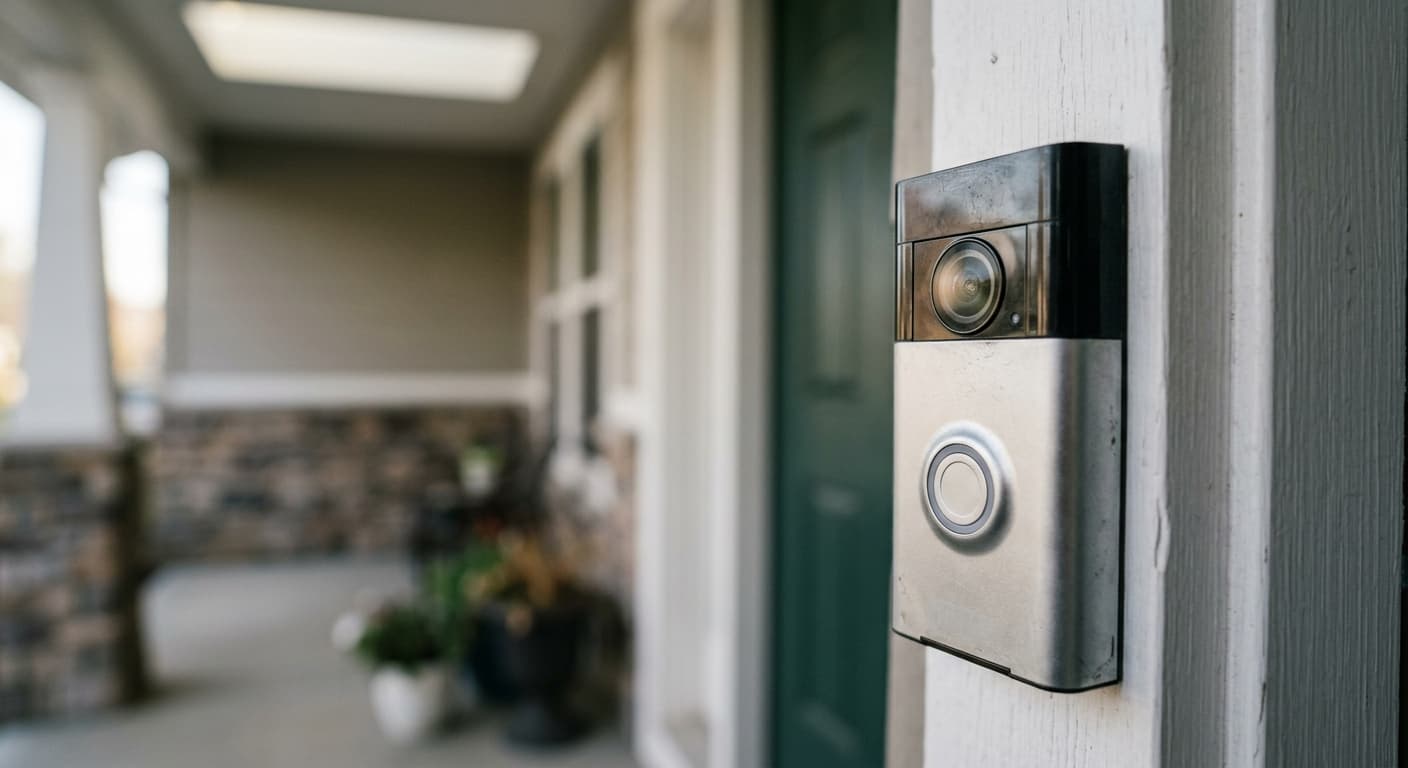
- Doorbell cameras at the unit's entrance
- Pet cameras and baby monitors
- Window-mounted cameras aimed at the tenant's own space
Exterior Cameras and Lease Restrictions
Tenants who want to install exterior cameras (such as doorbell cameras) should check their lease agreement. Common lease provisions may:
- Require landlord approval before installing any exterior fixtures
- Prohibit drilling holes in walls, doors, or frames
- Restrict modifications to the building exterior
- Require restoration of the property to original condition upon move-out
Battery-powered or adhesive-mounted doorbell cameras that do not require drilling are less likely to conflict with lease terms.
Cameras Aimed at Common Areas
A tenant's camera that captures portions of a shared hallway or parking area from the tenant's own doorway is generally permissible, as these are common areas with limited privacy expectations. However, a camera deliberately aimed at another tenant's door to monitor their comings and goings may be considered harassment depending on the circumstances.
Hidden Cameras in Rental Properties
How to Detect Hidden Cameras
Tenants who suspect hidden cameras in their rental unit can take the following steps:
- Visual inspection. Check for small lenses in smoke detectors, alarm clocks, USB chargers, picture frames, air vents, and other objects that seem out of place.
- RF detector. Radio frequency detectors can identify wireless camera transmissions.
- Phone camera method. Some hidden cameras use infrared LEDs that are invisible to the naked eye but visible through a smartphone camera.
- Wi-Fi network scan. Check your Wi-Fi network for unknown devices that may be hidden cameras.
- Professional sweep. Security professionals can conduct comprehensive sweeps for hidden surveillance equipment.
What to Do If You Find a Hidden Camera
If you discover a hidden camera in your rental unit:
- Do not touch or move the camera. Leave it in place to preserve evidence.
- Document its location. Take photographs and video showing the camera's placement, angle, and concealment.
- Contact law enforcement. Report the discovery to local police. A hidden camera that captured you nude, undressed, or under your clothing is a felony under K.S.A. 21-6101(a)(6).
- Contact an attorney. A lawyer can advise you on criminal and civil remedies, including filing a civil lawsuit for damages.
- Notify the landlord in writing. If you suspect the landlord placed the camera, document your notification in writing (email or certified letter).
- Consider moving. If the landlord placed the camera, you may have grounds to terminate the lease immediately based on the landlord's criminal conduct.
Kansas Residential Landlord and Tenant Act
Relevant Provisions
The Kansas Residential Landlord and Tenant Act (K.S.A. 58-2540 et seq.) governs the landlord-tenant relationship in Kansas. Several provisions interact with recording issues:
Landlord access to premises (K.S.A. 58-2557). A landlord can enter a rental unit only at reasonable times and after giving reasonable notice, except in emergencies. Recording a landlord who enters without following these requirements can document the violation.
Habitability requirements (K.S.A. 58-2553). Landlords must maintain rental units in habitable condition. Tenants who record evidence of habitability failures (mold, pest infestations, broken heating/cooling, plumbing leaks) can use those recordings in court.
Retaliation prohibition (K.S.A. 58-2572). Landlords cannot retaliate against tenants for exercising legal rights, including filing complaints or requesting repairs. A recording of retaliatory behavior provides evidence for a retaliation claim.
Security deposit rules (K.S.A. 58-2550). Recordings of move-in and move-out property conditions can serve as evidence in security deposit disputes.
Recording Property Conditions
Tenants should document property conditions through video and photos:
- At move-in. Record the condition of every room, noting any existing damage. Share the recording with the landlord.
- When reporting repairs. Video evidence of leaks, mold, pest infestations, or structural issues supports repair requests.
- At move-out. Record the unit's condition after cleaning to protect against security deposit withholding claims.
Recordings as Evidence in Housing Disputes
Eviction Proceedings
In Kansas eviction (forcible detainer) proceedings, legally obtained recordings are admissible as evidence. Tenants may use recordings to:
- Dispute the landlord's stated reason for eviction
- Prove that rent was paid or a payment agreement was reached
- Document that the landlord failed to follow proper eviction procedures
- Show retaliatory motive behind the eviction
Small Claims Court
Kansas small claims court (limited actions under K.S.A. 61-2701 et seq.) hears many landlord-tenant disputes involving amounts up to $10,000. Recordings are commonly admitted as evidence in small claims cases about security deposits, property damage, and repair failures.
Fair Housing Complaints
If a landlord engages in housing discrimination based on race, color, national origin, religion, sex, familial status, or disability, recordings can support a complaint with the U.S. Department of Housing and Urban Development (HUD) or the Kansas Human Rights Commission (KHRC). Audio recordings of discriminatory statements are particularly powerful evidence in fair housing investigations.
Penalties for Privacy Violations
| Offense | Classification | Maximum Penalty |
|---|---|---|
| Audio recording tenant conversations without consent | Class A nonperson misdemeanor | 1 year jail, $2,500 fine |
| Hidden camera in rental unit capturing nudity or undress (first offense) | Severity level 8 person felony | 7-23 months prison |
| Hidden camera in rental unit capturing nudity or undress (second offense within 5 years) | Severity level 5 person felony | 31-136 months prison |
| Sharing footage from hidden camera | Severity level 5 person felony | 31-136 months prison |
Civil remedies under K.S.A. 22-2518 include actual damages (minimum $1,000), punitive damages, and attorney fees. That statute's civil action is limited by its own text to a wire, oral or electronic communication intercepted in violation of Kansas's separate interception-authorization scheme at K.S.A. 22-2514 et seq. K.S.A. 21-6101 does not cross-reference it, so it does not clearly extend to the camera-placement voyeurism offense described above. A tenant whose landlord placed a hidden camera more clearly has a common-law claim for invasion of privacy (intrusion upon seclusion), which does not depend on K.S.A. 22-2518's communication-interception language.
More Kansas Recording Laws
Audio Recording | Video Recording | Voyeurism Laws | Workplace Recording | Recording Police | Phone Call Recording | Security Cameras | Recording in Public | Landlord-Tenant Recording | Dashcam Laws | School Recording | Medical Recording
More Kansas Recording Topics
More Kansas Laws
Frequently Asked Questions
Can I record my landlord in Kansas?
Yes. Kansas one-party consent law under K.S.A. 21-6101 allows you to record conversations with your landlord as long as you are a participant. You do not need to inform your landlord that you are recording. This applies to phone calls, in-person meetings, and conversations about repairs, lease terms, or other housing issues.
Can my landlord put cameras inside my apartment in Kansas?
Generally no, especially if the camera could capture you nude, undressed, or under your clothing. Installing a hidden camera inside a rental unit to capture a tenant nude, in a state of undress, or under their clothing without the tenant's knowledge or consent violates K.S.A. 21-6101(a)(6) and is a severity level 8 person felony. This applies regardless of the landlord's stated reason for the camera. If you discover a hidden camera, contact law enforcement immediately.
Can a landlord install cameras in the hallway of an apartment building?
Yes. Landlords can install security cameras in common areas of multi-unit buildings, including hallways, lobbies, stairwells, parking lots, and building entrances. These are areas where tenants have a reduced expectation of privacy. Notice through signage or lease disclosures is recommended but not specifically required by Kansas law.
Can I install a doorbell camera at my apartment in Kansas?
Generally yes, but check your lease first. Battery-powered or adhesive-mounted doorbell cameras that do not require drilling are less likely to violate lease terms. If your lease prohibits exterior modifications, you may need landlord approval. The camera can capture your doorway and portions of the hallway visible from your entrance.
Can I use recordings of my landlord as evidence in court?
Yes. Recordings made legally under Kansas one-party consent law are generally admissible in eviction proceedings, small claims court, security deposit disputes, and Fair Housing Act complaints. You must be able to authenticate the recording and show it is relevant to the case.
Updates
Removed a dead Kansas Human Rights Commission citation link that redirected to an unrelated state portal page, and added a caveat that the K.S.A. 22-2518 civil damages statute is written for communication interception and may not clearly cover a landlord's hidden-camera voyeurism, noting the clearer common-law invasion-of-privacy remedy.
Independently fact-checked against the cited primary sources; governing law re-checked for recent changes
Governing law re-checked for recent changes
Corrected two errors: K.S.A. 58-2557 does not require the tenant's consent for landlord entry, only reasonable notice; and K.S.A. 21-6101(a)(6)'s felony hidden-camera provision applies specifically to cameras capturing nudity, undress, or under-clothing images, not to any camera placed inside a rental unit.
Corrected a KeyTakeaways bullet that still stated landlords cannot place any camera inside a rental unit; K.S.A. 21-6101(a)(6) only bars hidden cameras that capture a tenant nude, undressed, or under their clothing.
Governing law re-checked for recent changes
Confirmed one-party consent framework under K.S.A. 21-6101, penalty structure, civil remedy under K.S.A. 22-2518, and Kansas Residential Landlord and Tenant Act provisions. Added UpdatesLog.
Reviewed and approved by an editor
The Law Behind This Article
This article rests on the statutory provisions below, held in our own legal record and retrieved from the official source. Tap a section to read the operative text.
Kansas Statutes Annotated, Chapter 21: CRIMES AND PUNISHMENTS
§ 21-6101Breach of privacy.In forcecited in 26 of our articles
(a) Breach of privacy is knowingly and without lawful authority: (1) Intercepting, without the consent of the sender or receiver, a message by telephone, telegraph, letter or other means of private communication; (2) divulging, without the consent of the sender or receiver, the existence or contents of such message if such person knows that the message was illegally intercepted, or if such person illegally learned of the message in the course of employment with an agency in transmitting such message; (3) entering with intent to listen surreptitiously to private conversations in a private place or to observe the personal conduct of any other person or persons entitled to privacy therein; (4) installing or using outside or inside a private place any device for hearing, recording, amplifying or broadcasting sounds originating in such place, which sounds would not ordinarily be audible or comprehensible without the use of such device, without the consent of the person or persons entitled to privacy therein; (5) installing or using any device or equipment for the interception of any telephone, telegraph or other wire or wireless communication without the consent of the person in…
Official text (excerpt) · last checked 2026-08-31 · Read the full text in our law library · Verify at ksrevisor.gov
Cited in 8 court opinions in our collectionLatest citing opinion in our collection: 2026
In the courts (editorial summary, independently checked):Recent Kansas decisions construe the image-dissemination subsection, K.S.A. 21-6101(a)(8), not the interception subsections. State v. Ivy (2025) held a reasonable expectation of privacy under that subsection has a subjective and an objective component. State v. Jamil (2026), unpublished, found disseminating needs no jury definition.
Opinions citing this section in our collection:
- State v. Ivy (Court of Appeals of Kansas 2025)✓Ivy posted on Snapchat a sexual video his ex-girlfriend had recorded and texted him during their relationship; the court applied a subjective and objective two-part test and held a jury could find she kept a reasonable expectation of privacy, affirming the conviction.
- In re Belcher (Supreme Court of Kansas 2024, 552 P.3d 1213)“…deotape, photograph, film or image obtained in violation of K.S.A. 21-6101(a)(6) or (a)(8), and amendments…”
- State v. Jamil (Court of Appeals of Kansas 2026)✓Jamil secretly filmed a woman undressed and unconscious at his home, then sent the videos to her boyfriend; the court held that sharing with a single recipient can be disseminating under K.S.A. 21-6101(a)(8) and that intent to harass could be inferred from his conduct.
Identified automatically from the court opinions citing this section — not a ranking of which case controls.
Also relied on in: Kansas Audio Recording Laws, Kansas Dashcam Laws: Mounting Rules, Audio Recording, and Evidence (2026), Kansas Phone Call Recording Laws
Kansas Statutes Annotated, Chapter 22: CRIMINAL PROCEDURE
§ 22-2514Authorized interception of wire, oral or electronic communications; definitions.In forcecited in 3 of our articles
This act shall be a part of and supplemental to the code of criminal procedure. As used in this act: (1) "Wire communication" means any aural transfer made in whole or in part through the use of facilities for the transmission of communications by the aid of wire, cable or other like connection between the point of origin and the point of reception, including the use of such connection in a switching station, furnished or operated by any person engaged in providing or operating such facilities for the transmission of intrastate, interstate or foreign communications.
Official text (excerpt) · last checked 2026-07-29 · Read the full text in our law library · Verify at ksrevisor.gov
Cited in 22 court opinions in our collectionLatest citing opinion in our collection: 2021
Opinions citing this section in our collection:
- State v. Farha (Supreme Court of Kansas 1975, 218 Kan. 394)“…ne obtained in Sedgwick county pursuant to our present law (K. S. A. 22-2514 to 22-2519 [Weeks 1974]). 1. Shawnee…”
- State v. Roudybush (Supreme Court of Kansas 1984, 235 Kan. 834)“…nlawful and in violation of K.S.A. 21-4001 and K.S.A. 22-2514 et seq., “in that no warra…”
- State v. Brooks (Court of Appeals of Kansas 2011, 46 Kan. App. 2d 601)“…nition. Brooks notes a broad definition of "intercept" in K.S.A. 22-2514(3) but says it does not apply. The Stat…”
Identified automatically from the court opinions citing this section — not a ranking of which case controls.
Also relied on in: Kansas Security Camera Laws, Kansas Voyeurism Laws
§ 22-2518Same; civil action for damages; defense available in civil and criminal actions.In forcecited in 11 of our articles
(1) Any person whose wire, oral or electronic communication is intercepted, disclosed or used in violation of this act shall have a civil cause of action against any person who intercepts, discloses or uses, or procures any other person to intercept, disclose or use, such communications, and shall be entitled to recover from any such person: (a) Actual damages, but not less than liquidated damages computed at the rate of $100 a day for each day of violation or $1,000, whichever is greater; (b) punitive damages; and (c) reasonable attorneys' fees and other litigation costs reasonably incurred. (2) A good faith reliance by any person on a court order authorizing the interception of any wire, oral or electronic communication shall constitute a complete defense in any civil or criminal action brought against such person based upon such interception.
Official text (excerpt) · last checked 2026-07-29 · Read the full text in our law library · Verify at ksrevisor.gov
Cited in 6 court opinions in our collectionLatest citing opinion in our collection: 2024
Opinions citing this section in our collection:
- State v. Gibson (Supreme Court of Kansas 1994, 255 Kan. 474)“…f unlawfully intercepted *481 wire or oral communications. K.S.A. 22-2518 establishes a civil cause of action for…”
- Fields v. Atchison, Topeka, & Santa Fe Railway Co. (District Court, D. Kansas 1997, 985 F. Supp. 1308)“…18 U.S.C. § 2510 et seq., and the Kansas Wiretap Act, K.S.A. 22-2518, and invaded their privacy by intercept…”
- Banks v. Opat (District Court, D. Kansas 2021)“…ete defense against any civil action. 18 U.S.C. § 2520(d); K.S.A. § 22-2518(2). “To be in good faith, the officers’…”
Identified automatically from the court opinions citing this section — not a ranking of which case controls.
Also relied on in: Kansas Video Recording Laws, Kansas Workplace Recording Laws, Kansas Surveillance Camera Laws (2026 Guide)
Kansas Statutes Annotated, Chapter 58: PERSONAL AND REAL PROPERTY
§ 58-2540Citation of act.In forcecited in 3 of our articles
This act shall be known and may be cited as the "residential landlord and tenant act."
Official text (excerpt) · last checked 2026-07-29 · Read the full text in our law library · Verify at ksrevisor.gov
Cited in 31 court opinions in our collectionLatest citing opinion in our collection: 2026
Opinions citing this section in our collection:
- Williamson v. Amrani (Supreme Court of Kansas 2007, 283 Kan. 227)“…hat the Kansas Residential Landlord and Tenant Act (KRLTA), K.S.A. 58-2540, et seq., is specific legislation, co…”
- Jackson Ex Rel. Jackson v. Wood (Court of Appeals of Kansas 1986, 11 Kan. App. 2d 478)“…nants under the Kansas Residential Landlord and Tenant Act, K.S.A. 58-2540 et seq. Instead the court…”
- Equitable Life Leasing Corp. v. Abbick (Supreme Court of Kansas 1988, 243 Kan. 513)“…relating to the Kansas Residential Landlord and Tenant Act, K.S.A. 58-2540 et seq. As in the landlord act, the K…”
Identified automatically from the court opinions citing this section — not a ranking of which case controls.
Also relied on in: Kansas Landlord-Tenant Laws (2026): Deposits, Notice, and Tenant Rights, Kansas Squatters Rights and Adverse Possession Laws (2026)
§ 58-2550Security deposits; amounts; retention; return; damages for noncompliance.In forcecited in 2 of our articles
(a) A landlord may not demand or receive a security deposit for an unfurnished dwelling unit in an amount or value in excess of one month's periodic rent. If the rental agreement provides for the tenant to use furniture owned by the landlord, the landlord may demand and receive a security deposit not to exceed 1½ months' rent, and if the rental agreement permits the tenant to keep or maintain pets in the dwelling unit, the landlord may demand and receive an additional security deposit not to exceed ½ of one month's rent. A municipal housing authority created under the provisions of K.S.A. 17-2337 et seq., and amendments thereto, which is wholly or partially subsidized by aid from the federal government, pursuant to a rental agreement in which rent is determined solely by the personal income of the tenant, may demand and receive a security deposit in accordance with a schedule established by the housing authority, which is based on the bedroom unit size of the dwelling unit. Any such municipal housing authority which establishes such a schedule shall provide a deferred payment plan whereby the tenant may pay the deposit in reasonable increments over a period of time.
Official text (excerpt) · last checked 2026-09-05 · Read the full text in our law library · Verify at ksrevisor.gov
Cited in 13 court opinions in our collectionLatest citing opinion in our collection: 2024
Opinions citing this section in our collection:
- Clark v. Walker (Supreme Court of Kansas 1979, 225 Kan. 359)“…ing the apartment. In the action, the plaintiff relied upon K.S.A. 58-2550 of the Residential Landlord and Tenant…”
- Heckard v. Martin (Court of Appeals of Kansas 1998, 25 Kan. App. 2d 162)“…oncompliance with K.S.A. 58-2555 and the rental agreement.” K.S.A. 58-2550(b). The statute allows the landlord up…”
- Love v. Monarch Apartments (Court of Appeals of Kansas 1989, 13 Kan. App. 2d 341)“…mages for the wrongful withholding of her security deposit (K.S.A. 58-2550[c]); and (3) denial of damages for the…”
Identified automatically from the court opinions citing this section — not a ranking of which case controls.
§ 58-2553Duties of landlord; agreement that tenant perform landlord's duties; limitations.In forcecited in 2 of our articles
(a) Except when prevented by an act of God, the failure of public utility services or other conditions beyond the landlord's control, the landlord shall: (1) Comply with the requirements of applicable building and housing codes materially affecting health and safety. If the duty imposed by this paragraph is greater than any duty imposed by any other paragraph of this subsection, the landlord's duty shall be determined in accordance with the provisions of this paragraph; (2) exercise reasonable care in the maintenance of the common areas; (3) maintain in good and safe working order and condition all electrical, plumbing, sanitary, heating, ventilating and air-conditioning appliances including elevators, supplied or required to be supplied by such landlord; (4) except where provided by a governmental entity, provide and maintain on the grounds, for the common use by all tenants, appropriate receptacles and conveniences for the removal of ashes, garbage, rubbish and other waste incidental to the occupancy of the dwelling unit and arrange for their removal; and (5) supply running water and reasonable amounts of hot water at all times and reasonable heat, unless the building that…
Official text (excerpt) · last checked 2026-07-29 · Read the full text in our law library · Verify at ksrevisor.gov
Cited in 18 court opinions in our collectionLatest citing opinion in our collection: 2025
Opinions citing this section in our collection:
- Love v. Monarch Apartments (Court of Appeals of Kansas 1989, 13 Kan. App. 2d 341)“…tory duty to provide habitable *342 housing (K.S.A. 58-2553). We affirm on the first issue, reverse…”
- O'NEILL v. Dunham (Court of Appeals of Kansas 2009, 41 Kan. App. 2d 540)“…urt ruled the Kansas Residential Landlord and Tenant Act in K.S.A. 58-2553(a) (1), (2), and (3) imposes three duti…”
- Jackson Ex Rel. Jackson v. Wood (Court of Appeals of Kansas 1986, 11 Kan. App. 2d 478)“…n good and safe working order and condition in violation of K.S.A. 58-2553(a). Although the original petition alle…”
Identified automatically from the court opinions citing this section — not a ranking of which case controls.
§ 58-2557Landlord's right to enter; limitations.In forcecited in 2 of our articles
(a) The landlord shall have the right to enter the dwelling unit at reasonable hours, after reasonable notice to the tenant, in order to inspect the premises, make necessary or agreed repairs, decorations, alterations or improvements, supply necessary or agreed services, or exhibit the dwelling unit to prospective or actual purchasers, mortgagees, tenants, workmen or contractors. (b) The landlord may enter the dwelling unit without consent of the tenant in case of an extreme hazard involving the potential loss of life or severe property damage. (c) The landlord shall not abuse the right of access or use it to harass the tenant.
Official text (excerpt) · last checked 2026-07-29 · Read the full text in our law library · Verify at ksrevisor.gov
Cited in 6 court opinions in our collectionLatest citing opinion in our collection: 2024
Opinions citing this section in our collection:
- Clark v. Walker (Supreme Court of Kansas 1979, 225 Kan. 359)“…leased premises upon reasonable notice at reasonable hours (K.S.A. 58-2557), the tenant may obtain an injunction t…”
- State v. Galentine (Court of Appeals of Kansas 2017)“…331, at *5. Here, the State relies on a portion of K.S.A. 58-2557, part of the Kansas residential landlor…”
- Riney v. McGuire (Court of Appeals of Kansas 2020)“…pp. 60-31a04. The same is true for his passing reference to K.S.A. 58-2557(c), which says a landlord should not us…”
Identified automatically from the court opinions citing this section — not a ranking of which case controls.
§ 58-2572Certain retaliatory actions by landlord prohibited; remedies; increased rent, when; action for possession, when.In force
(a) Except as otherwise provided in this section, a landlord may not retaliate by increasing rent or decreasing services after: (1) The tenant has complained to a governmental agency, charged with responsibility for enforcement of a building or housing code, of a violation applicable to the premises materially affecting health and safety; or (2) the tenant has complained to the landlord of a violation under K.S.A. 58-2553; or (3) the tenant has organized or become a member of a tenants' union or similar organization. (b) If the landlord acts in violation of subsection (a) of this section, the tenant is entitled to the remedies provided in K.S.A. 58-2563 and has a defense in an action against such tenant for possession.
Official text (excerpt) · last checked 2026-07-29 · Read the full text in our law library · Verify at ksrevisor.gov
Cited in 6 court opinions in our collectionLatest citing opinion in our collection: 2025
Opinions citing this section in our collection:
- Case & Assocs. Props. Inc. v. Bribiesca (Court of Appeals of Kansas 2018, 427 P.3d 987)“…iation for her complaints to the city inspectors, violating K.S.A. 58-2572. Bribiesca had not entered into a lease…”
- Clark v. Walker (Supreme Court of Kansas 1979, 225 Kan. 359)“…health code violations, or joining a tenant’s organization (K.S.A. 58-2572). While we have not attempted to list a…”
- Washburn South Apartments v. Hession (Court of Appeals of Kansas 2025)“…orting code violations to the City of Topeka—a violation of K.S.A. 58-2572. About two months later, the apartment…”
Identified automatically from the court opinions citing this section — not a ranking of which case controls.
Kansas Statutes Annotated, Chapter 61: PROCEDURE, CIVIL, FOR LIMITED ACTIONS
§ 61-2701Citation of act.In force
This act shall be known and may be cited as the "small claims procedure act."
Official text (excerpt) · last checked 2026-07-29 · Read the full text in our law library · Verify at ksrevisor.gov
Cited in 16 court opinions in our collectionLatest citing opinion in our collection: 2024
Opinions citing this section in our collection:
- Barton v. Miller (Supreme Court of Kansas 1979, 225 Kan. 624)“…tenants and landlords under the Small Claims Procedure Act. K.S.A. 61-2701 et seq. The facts giving rise to th…”
- Hodges v. Johnson (Supreme Court of Kansas 2009, 288 Kan. 56)“…l Protection Clause. The Small Claims Procedure Act, K.S.A. 61-2701 et seq., was designed to “…”
- Snider v. American Family Mutual Insurance Co. (Supreme Court of Kansas 2013, 298 F.3d 1120)“…06. Haynes concerned mandatory awarding of fees under K.S.A. 61-2701 et seq., the Kansas Small Claims Proc…”
Identified automatically from the court opinions citing this section — not a ranking of which case controls.
Search our full record of US law — 2.1 million sections, every state + federal →
Sources and References
- K.S.A. 21-6101 - Breach of Privacy (Kansas Revisor of Statutes)(ksrevisor.org).gov
- K.S.A. 22-2518 - Civil Action for Damages (Kansas Revisor of Statutes)(ksrevisor.gov).gov
- K.S.A. 58-2540 - Kansas Residential Landlord and Tenant Act (Kansas Revisor of Statutes)(ksrevisor.org).gov
- K.S.A. 58-2557 - Landlord Access to Premises (Kansas Revisor of Statutes)(ksrevisor.org).gov
- HUD - File a Housing Discrimination Complaint(hud.gov).gov