North Dakota
North Dakota Windshield Mounting Laws (2026 Guide)
Independently fact-checked against primary sources (last audited August 17, 2026). · Reviewed by the RecordingLaw editorial team. · Law checked current as of August 9, 2026. · 9 primary sources cited on this page. How we verify our legal content
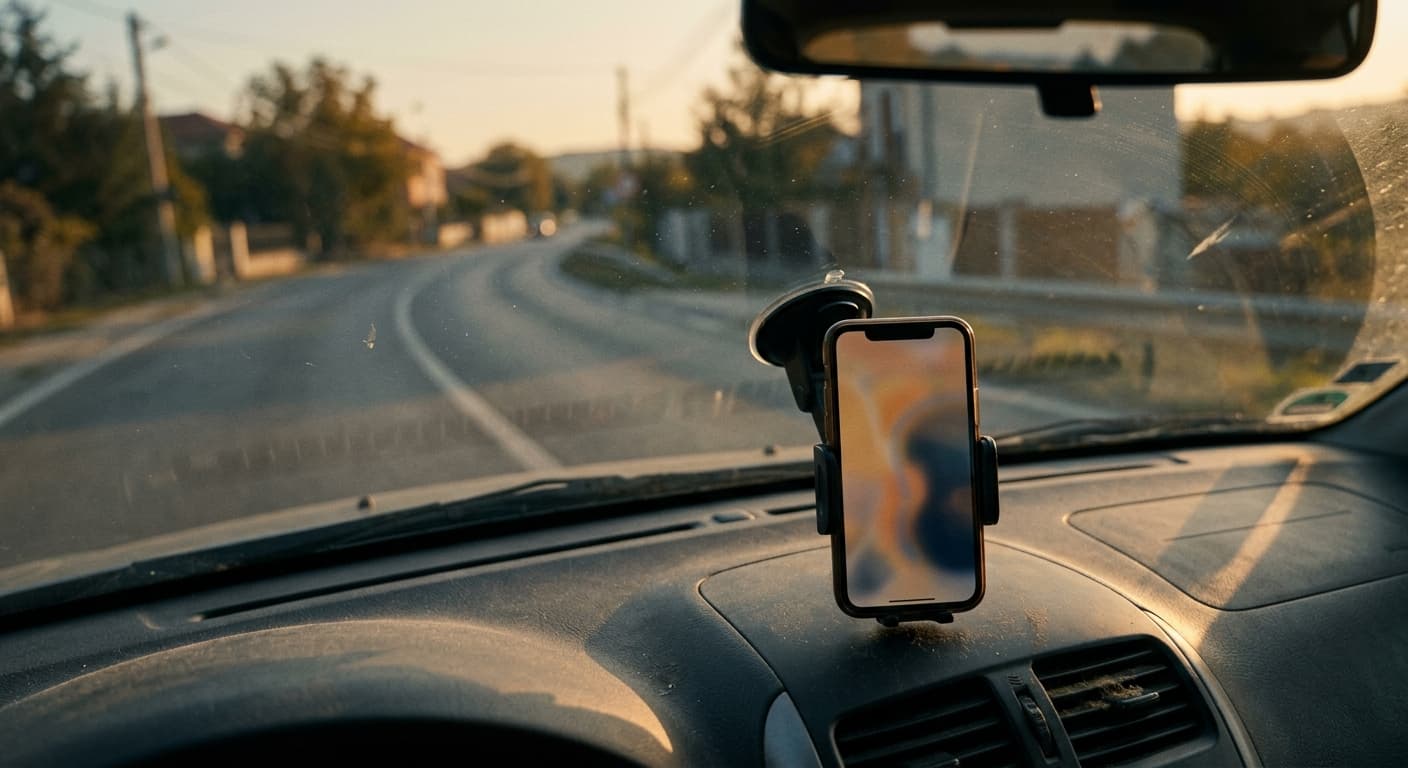
North Dakota allows dashcams, GPS units, and phone mounts on the windshield as long as they do not obstruct the driver's clear view of the highway under N.D.C.C. 39-21-39. No specific device is banned by name. Placing any mount low on the passenger side reduces the risk of an obstruction citation.
North Dakota regulates what can be mounted on or attached to a vehicle's windshield through Chapter 39-21 of the North Dakota Century Code. The state does not impose a complete ban on all windshield-mounted devices, but it does prohibit any object that blocks the driver's clear view of the road.
Understanding these rules matters for anyone who uses a GPS unit, phone mount, dashcam, or other windshield-mounted accessory in North Dakota. This guide covers the key statutes, tinting rules, penalties, and practical advice for staying compliant.
North Dakota Windshield Obstruction Law
The primary statute governing windshield obstructions is N.D.C.C. 39-21-39. This section establishes several requirements for vehicle windshields.
Windshield Required
Every motor vehicle must be equipped with a windshield. This is a baseline requirement that applies to all registered vehicles driven on North Dakota roads.
Nontransparent Material Prohibited
An individual may not drive any motor vehicle with any sign, poster, or other nontransparent material on the front windshield, side wings, or side or rear windows that obstructs the driver's clear view of the highway or any intersecting highway.
The operative phrase here is "obstructs the driver's clear view." North Dakota law does not automatically ban every item placed on a windshield. Instead, the legal test asks whether the item actually blocks the driver's ability to see the road and intersecting highways.
Windshield Wipers Required
The windshield on a motor vehicle must be equipped with a device for cleaning rain, snow, or other moisture from the windshield. This device must be constructed so it can be controlled or operated by the driver of the vehicle. The windshield wiper must be maintained in good working order at all times.
Windshield Condition Requirements
Under N.D.C.C. 39-21-39.1, a windshield may not be shattered or in such a defective condition that the windshield materially impairs or obstructs the driver's clear view. This means cracks, chips, and other damage that interfere with visibility can result in a citation.
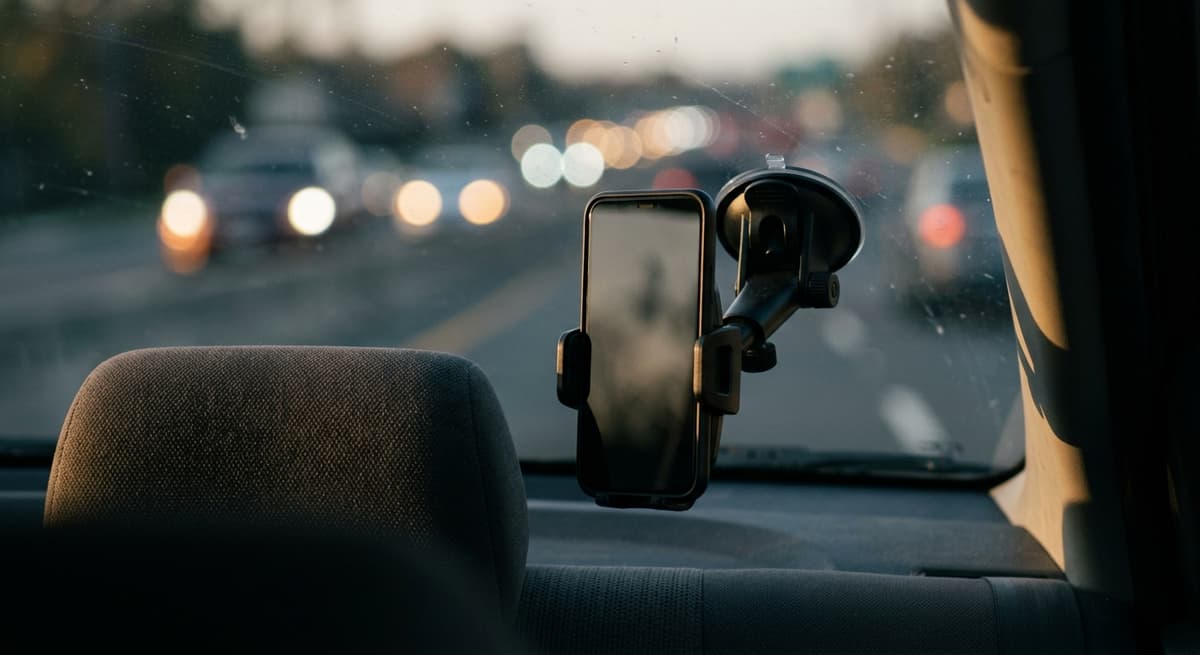
A more specific damage standard exists, but it applies only to commercial motor vehicles. Under 49 CFR 393.60, a federal rule that governs commercial vehicles and that North Dakota applies to motor carriers through the safety rules adopted under N.D.C.C. 39-21-46(3), a damaged area is allowed if it can be covered by a disc three-quarters of an inch in diameter and is not closer than three inches to any other similarly damaged area. Damage is not allowed at all in the part of the windshield extending upward from the top of the steering wheel, excluding a two-inch border at the top and a one-inch border at each side.
Those federal figures do not set the standard for an ordinary passenger car in North Dakota. A private vehicle is measured against the general test in N.D.C.C. 39-21-39.1: whether the damage materially impairs or obstructs the driver's clear view.
GPS and Phone Mounts
North Dakota does not have a specific statute that addresses GPS devices or cell phone mounts by name. These devices fall under the general windshield obstruction rule in N.D.C.C. 39-21-39.
No North Dakota statute names suction cup mounts, GPS units, or phone holders, and none of them is banned as a category. The only test is the one in N.D.C.C. 39-21-39(1): whether the item obstructs the driver's clear view of the highway or any intersecting highway. A GPS unit or phone holder that takes up significant windshield space could fail that test, while a small mount placed out of the sight line generally will not.
Safest Placement Options
To avoid potential enforcement issues, North Dakota drivers should consider these mounting alternatives:
- Dashboard mounts positioned so they do not block the view through the windshield
- Air vent mounts that clip to the vehicle's ventilation system
- Cup holder mounts that keep the device at a lower position
- CD slot mounts for vehicles with disc players
If you choose to use a windshield mount, placing it as low as possible on the passenger side of the windshield reduces the chance of an obstruction finding. However, even a small mount could draw a citation if a law enforcement officer determines it blocks your view.
Dashcam Rules
North Dakota does not have a dedicated dashcam statute. A dashcam is treated the same as any other windshield-mounted device under N.D.C.C. 39-21-39. It is permitted as long as it does not obstruct the driver's clear view of the highway.
The most common and legally secure dashcam placement in North Dakota is behind the rearview mirror, where the camera is largely hidden from the driver's field of vision. Dashboard-mounted dashcams are also an option that avoids the windshield entirely.
For commercial motor vehicles, the Federal Motor Carrier Safety Administration (FMCSA) added an exception in 2016 that allows certain vehicle safety technologies, including dashcams, to be mounted within the area swept by the wipers. This federal rule applies to commercial vehicles operating in North Dakota.
Obstruction to Driver's View
North Dakota has a separate statute addressing general obstructions to the driver's view. N.D.C.C. 39-10-54 addresses obstructions to the driver's view and control that come from the vehicle's load and its occupants.
The section is narrower than its title suggests. Subsection 1 reaches a vehicle that is so loaded, or that carries more than three persons in the front seat, that the driver's view to the front or sides is obstructed or the driver's control over the driving mechanism is impaired. Subsection 2 reaches a passenger who rides in a position that interferes with the driver's view ahead or to the sides, or with control of the driving mechanism.
A device mounted on the dashboard or on the windshield falls outside those terms. Windshield and window obstructions are handled by N.D.C.C. 39-21-39 instead, which is part of why a dashboard mount is the safer placement. A violation of section 39-10-54 is a moving violation carrying the standard $20 statutory fee under N.D.C.C. 39-06.1-06.
Window Tinting Laws
North Dakota regulates window tinting through subsections 4 and 5 of N.D.C.C. 39-21-39. The tinting rules interact with windshield mounting restrictions because any material applied to the windshield must meet light transmittance standards.
Current Tinting Requirements
| Window Location | Minimum Light Transmittance | Notes |
|---|---|---|
| Front windshield (below AS-1 line) | 70% | No aftermarket tint that drops below 70% |
| Front side windows | 35% (effective August 1, 2025) | Changed from 50% by HB 1340 |
| Rear side windows | Any darkness | Must have dual side mirrors if tinted |
| Rear window | Any darkness | Must have dual side mirrors if tinted |
| Windshield (above AS-1 line or top 5 inches) | No restriction | Nonreflective sunscreening permitted |
The 70% Windshield Rule
An individual may not operate a motor vehicle with any object, material, or tinting displayed, affixed, or applied on the front windshield unless the material in conjunction with the windshield has a light transmittance of at least 70%. This means the windshield and any applied material must together allow at least 70% of visible light to pass through.
Calculating Total Tint
Factory-installed windshield glass already has some level of tint. The North Dakota Highway Patrol warns that factory tinting must be included when calculating total tint levels. For example, a windshield with 80% factory light transmittance combined with aftermarket film rated at 90% transmittance would produce a combined transmittance of about 72%, which would pass the 70% threshold. But adding a 70% aftermarket film to that same windshield would yield about 56% combined transmittance, which would violate the law.
Reflectivity
North Dakota's tint statute sets light transmittance limits but does not impose a separate reflectivity, metallic, or mirrored-appearance restriction. Reflectivity appears in this part of Chapter 39-21 only once, in the N.D.C.C. 39-21-39(5) exception for nonreflective sunscreening above the AS-1 line. A reflective or metallic film on a regulated window is measured the same way any other film is: by whether the glass and the film together meet the applicable light transmittance figure.
HB 1340: 2025 Window Tint Update
Governor Kelly Armstrong signed House Bill 1340 into law in March 2025. The bill passed with strong bipartisan support, receiving an 89-2 vote in the House and a 41-6 vote in the Senate.
HB 1340 changed the minimum light transmittance requirement for front side windows from 50% to 35%, effective August 1, 2025. This allows North Dakota drivers to install darker tint on their front side windows than was previously permitted.
The front windshield requirement of 70% light transmittance was not changed by this legislation. Rear window tinting rules also remain the same: any level of darkness is allowed as long as the vehicle has dual side mirrors.
Failed Ballot Measure
A separate effort to eliminate all window tint restrictions was attempted through a ballot petition. The proposed measure would have amended N.D.C.C. 39-21-39 to allow any level of tint on all windows, including the windshield. The petition needed 15,582 valid signatures by February 24, 2026, but the organizer fell approximately 4,000 signatures short and the measure did not qualify for the ballot.
Distracted Driving Laws
North Dakota's distracted driving statutes affect how drivers use mounted devices while behind the wheel. Even a legally mounted phone or GPS can create legal liability if the driver interacts with it improperly.
Texting Ban
N.D.C.C. 39-08-23 prohibits text messaging and accessing web pages for all drivers. This is a primary enforcement law, meaning an officer can pull you over solely for texting. The fine is $100.
Distracted Driving
Effective August 1, 2017, North Dakota expanded its distracted driving law to cover any activity that impairs the ability to safely operate a vehicle. If you are distracted while driving and commit a traffic violation, you face an additional $100 citation for distracted driving on top of the underlying violation. This is a secondary enforcement provision, requiring another violation as a basis for the stop.
Built-in vehicle accessories and voice-operated or navigation devices are permitted under this law.
Drivers Under 18
Drivers under the age of 18 are prohibited from using any electronic communications devices, including cell phones, while driving. Penalties for drivers aged 14 and 15 include a $20 fine and four points on the driving record. Drivers aged 16 and 17 face a $20 fine with no points.
No Statewide Hands-Free Law
North Dakota does not have a comprehensive hands-free law for adult drivers. Drivers aged 18 and older are legally permitted to make phone calls using a handheld device. However, interacting with a handheld phone in a way that causes distracted driving could still result in a citation if you commit a traffic violation while distracted.
Penalties for Windshield Violations
North Dakota handles most equipment and rules-of-the-road violations, including windshield obstruction, as noncriminal violations that are disposed of by paying a statutory fee under N.D.C.C. 39-06.1-06. That is a separate track from an infraction, which is a criminal classification carrying a maximum fine of $1,000 under N.D.C.C. 12.1-32-01(7). The penalty structure is less severe than in many other states.
| Violation | Classification | Fine | Points |
|---|---|---|---|
| Windshield obstruction (39-21-39) | Noncriminal violation | $20 | 0 |
| Defective windshield (39-21-39.1) | Noncriminal violation | $20 | 0 |
| Obstruction to driver's view (39-10-54) | Noncriminal violation, moving | $20 | 0 |
| Illegal window tint (39-21-39) | Noncriminal violation | $20 | 0 |
| Unsafe vehicle operation (39-21-46(2)) | Infraction, a criminal classification | Up to $1,000 | 2 |
| Texting while driving (39-08-23) | Noncriminal violation, moving | $100 | 0 |
| Distracted driving (39-08-25) | Noncriminal violation, moving | $100 | 0 |
For window tint violations, drivers may receive a "fix-it" style warning directing them to remove the illegal tint and demonstrate compliance. Repeat violations can result in increased fines.
Operating a vehicle that the driver knows is in such unsafe condition as to endanger a person is a separate offense under N.D.C.C. 39-21-46(2), and the statute classifies it as an infraction. That matters because it is not on the noncriminal track: N.D.C.C. 39-06.1-05(7) excludes operating an unsafe vehicle from the fee-payment procedure available for ordinary equipment violations. Knowingly driving with defective, nonexistent, or unlawful equipment under section 39-21-46 also carries 2 demerit points under the schedule in N.D.C.C. 39-06.1-10. This broader statute could apply to severely cracked or obstructed windshields that create a genuine safety hazard.
Exemptions
North Dakota law provides several exemptions from windshield and window restrictions:
| Exemption | Authority |
|---|---|
| Nonreflective sunscreening above the AS-1 line or top 5 inches | N.D.C.C. 39-21-39(5) |
| Windows behind the operator (with dual side mirrors) | N.D.C.C. 39-21-39(4) |
| Commercial vehicle safety technology (FMCSA rule) | 49 CFR 393.60(e) |
That list is short because the statute is short. N.D.C.C. 39-21-39 contains no exemption for manufacturer-installed tinting and no carve-out for stickers or certificates required by law. Factory glass is not exempt from the transmittance rule: as explained above, its own light transmittance counts toward the combined figure the statute measures.
North Dakota does not currently offer a medical exemption program for darker window tint on the front windshield or front side windows.
Comparison With Neighboring States
North Dakota's windshield mounting rules fall in the middle compared to its neighbors. South Dakota has a similar obstruction-based standard. Minnesota has a stricter approach, expressly limiting what can be placed on windshields. Montana's rules are also based on whether the item obstructs the driver's view.
If you frequently drive across state lines in the Northern Plains region, be aware that each state has its own tinting and mounting rules. A tint level or mount position that is legal in North Dakota may not be legal in Minnesota or Montana.
More North Dakota Laws
Frequently Asked Questions
Can I mount a GPS or phone on my windshield in North Dakota?
North Dakota does not have a specific statute permitting or banning GPS or phone mounts. Under N.D.C.C. 39-21-39, any sign, poster, or nontransparent material on the windshield is prohibited if it obstructs the driver's clear view. A small mount placed low on the passenger side is less likely to cause an issue, but dashboard or air vent mounts are the safest legal options.
What is the fine for a windshield obstruction in North Dakota?
A windshield obstruction violation under N.D.C.C. 39-21-39 is a noncriminal violation resolved by paying a statutory fee, not a criminal charge. The standard fee is $20. An obstruction to the driver's view under N.D.C.C. 39-10-54 also carries a $20 fee and is treated as a moving violation.
How dark can I tint my windshield in North Dakota?
The front windshield must allow at least 70% light transmittance below the AS-1 line or the top five inches. Above the AS-1 line, nonreflective sunscreening material is permitted without a specific transmittance requirement. Front side windows must allow at least 35% light transmittance as of August 1, 2025.
Are dashcams legal on windshields in North Dakota?
Yes, dashcams are legal in North Dakota as long as they do not obstruct the driver's clear view of the highway. There is no separate dashcam statute. The best placement is behind the rearview mirror or on the dashboard. Commercial vehicles may mount dashcams in the wiper-swept area under federal FMCSA rules.
Does North Dakota have a hands-free driving law?
No. North Dakota does not require adult drivers to use hands-free devices for phone calls. Texting while driving is banned for all drivers with a $100 fine. Drivers under 18 are prohibited from using any electronic communications devices. Distracted driving that leads to a traffic violation carries an additional $100 fine.
Updates
Corrected the penalty classifications, removed two window-tint exemptions and a reflectivity rule that do not appear in North Dakota law, scoped the federal windshield-damage measurements to commercial vehicles, and narrowed the description of N.D.C.C. 39-10-54 to what the section actually covers.
Independently fact-checked against the cited primary sources
Governing law re-checked for recent changes
Reviewed and approved by an editor
The Law Behind This Article
This article rests on the statutory provisions below, held in our own legal record and retrieved from the official source. Tap a section to read the operative text.
North Dakota Century Code
§ 39-21-39Windshield - Must be unobstructed and equipped with wipers - Tinted windowsIn forcecited in 2 of our articles
A motor vehicle must be equipped with a windshield. An individual may not drive any motor vehicle with any sign, poster, or other nontransparent material upon the front windshield, side wings, or side or rear windows which obstructs the driver's clear view of the highway or any intersecting highway. The windshield on a motor vehicle must be equipped with a device for cleaning rain, snow, or other moisture from the windshield, which must be constructed as to be controlled or operated by the driver of the vehicle. The windshield wiper upon a motor vehicle must be maintained in good working order. An individual may not operate a motor vehicle with any object, material, or tinting displayed, affixed, or applied on the front windshield or any window unless the object, material, or tinting in conjunction with the windshield upon which it is displayed, affixed, or applied has a light transmittance of at least seventy percent or the object, material, or tinting in conjunction with a window other than the windshield upon which it is displayed, affixed, or applied has a light transmittance of at least thirty-five percent.
Official text (excerpt) · last checked 2026-09-08 · Read the full text in our law library · Verify at ndlegis.gov
Cited in 3 court opinions in our collectionLatest citing opinion in our collection: 2020
Opinions citing this section in our collection:
- State v. Bartelson (North Dakota Supreme Court 2005, 704 N.W.2d 824)“…that Bartelson's vehicle had tinted windows in violation of N.D.C.C. § 39-21-39. That Trooper Huston had been asked by…”
- State v. Bolme (North Dakota Supreme Court 2020, 952 N.W.2d 75)“…on the passenger side of the vehicle was not a violation of N.D.C.C. § 39-21-39(1) as asserted by the officer and that…”
- State v. Morsette (North Dakota Supreme Court 2019, 2019 ND 84)“…des that meet the requirements of section 39- 21-38. N.D.C.C. § 39-21-39(4) (emphasis added). We have upheld an…”
Identified automatically from the court opinions citing this section — not a ranking of which case controls.
Also relied on in: North Dakota Window Tint Laws (2026): Legal VLT Limits
Code of Federal Regulations Title 49
§ 393.60Glazing in specified openings.In forcecited in 15 of our articles
(a) Glazing material. Glazing material used in windshields, windows, and doors on a motor vehicle manufactured on or after December 25, 1968, shall at a minimum meet the requirements of Federal Motor Vehicle Safety Standard (FMVSS) No. 205 in effect on the date of manufacture of the motor vehicle. The glazing material shall be marked in accordance with FMVSS No. 205 (49 CFR 571.205, S6). (b) Windshields required. Each bus, truck and truck-tractor shall be equipped with a windshield. Each windshield or portion of a multi-piece windshield shall be mounted using the full periphery of the glazing material. (c) Windshield condition. With the exception of the conditions listed in paragraphs (c)(1), (c)(2), and (c)(3) of this section, each windshield shall be free of discoloration or damage in the area extending upward from the height of the top of the steering wheel (excluding a 51 mm (2 inch) border at the top of the windshield) and extending from a 25 mm (1 inch) border at each side of the windshield or windshield panel.
Official text (excerpt) · last checked 2026-07-28 · Read the full text in our law library · Verify at ecfr.gov
Cited in 3 court opinions in our collectionLatest citing opinion in our collection: 2021
In the courts (editorial summary, independently checked):The 70 percent light transmittance floor of 49 CFR 393.60(d) covers the windshield and the windows immediately right and left of the driver. Grooms Hauling, LLC v. Robinson (2020) applied it through Pennsylvania adoption and rejected racial profiling claims over tint citations; State v. Ford (2021) noted that Kansas adopts it too.
Opinions citing this section in our collection:
- United States of America, Government v. Robert L. Pierre, Defendant (District Court, D. New Hampshire 2015, 2015 DNH 083)“…rallel luminous transmittance of not less than 70 percent.” 49 C.F.R. 393.60(c). Neither the Government nor the defe…”
- GROOMS HAULING, LLC v. ROBINSON (District Court, E.D. Pennsylvania 2020)✓Officers repeatedly cited a Black-owned hauling company whose truck windows passed only 17 to 20 percent of light; treating 49 CFR 393.60's 70 percent transmittance standard as the governing rule, the court granted the officers summary judgment on the profiling claims.
- State v. Ford (Court of Appeals of Kansas 2021)“…Relevant to this appeal are regulations on window tinting (49 C.F.R. § 393.60[d]), medical examiner certificates (49…”
Identified automatically from the court opinions citing this section — not a ranking of which case controls.
Also relied on in: Connecticut Windshield Mounting Laws (2026 Guide), Idaho Windshield Mounting Laws (2026 Guide), Kansas Windshield Mounting Laws (2026 Guide)
Explore the law
This article also draws on these acts and chapters (opening at their first section): North Dakota Century Code § 39-08-01 (Persons under the influence of intoxicating liquor or any other drugs or substances not to operate vehicle - Penalty) · North Dakota Century Code § 39-21-01 (When lighted lamps are required) · North Dakota Century Code § 39-10-01 (Provisions of title refer to vehicles upon the highways - Exceptions)
Related law for further reading — not part of this article’s citations.
Search our full record of US law — 2.1 million sections, every state + federal →
Sources and References
- N.D.C.C. Chapter 39-21 - Equipment of Vehicles(ndlegis.gov).gov
- HB 1340 - Window Tint Update (2025)(ndlegis.gov).gov
- N.D.C.C. Chapter 39-08 - Regulations Governing Operators(ndlegis.gov).gov
- N.D.C.C. Chapter 39-10 - General Rules of the Road(ndlegis.gov).gov
- NDDOT Traffic Safety Laws(dot.nd.gov).gov
- NDDOT Vision Zero - Distracted Driving(visionzero.nd.gov).gov
- ND Highway Patrol - Window Tinting FAQ(statepatrol.nd.gov).gov
- ND Secretary of State - Window Tinting Petition Approval(sos.nd.gov).gov
- 49 CFR 393 - FMCSA Vehicle Equipment Standards(ecfr.gov).gov
- Window Tint Petition Fails to Qualify for 2026 Ballot(kfyrtv.com)
- N.D.C.C. Chapter 39-06.1 - Disposition of Traffic Offenses (statutory fees, moving and nonmoving violations, demerit schedule)(ndlegis.gov)
- N.D.C.C. 12.1-32-01 - Classification of Offenses and Penalties (infraction, maximum $1,000 fine)(ndlegis.gov)
- 49 CFR 393.60 - Glazing and window construction for commercial motor vehicles(ecfr.gov)