
Nevada
Nevada Windshield Mounting Laws (2026 Guide)
Independently fact-checked against primary sources (last audited August 17, 2026). · Reviewed by the RecordingLaw editorial team. · Law checked current as of August 17, 2026. · 4 primary sources cited on this page. How we verify our legal content
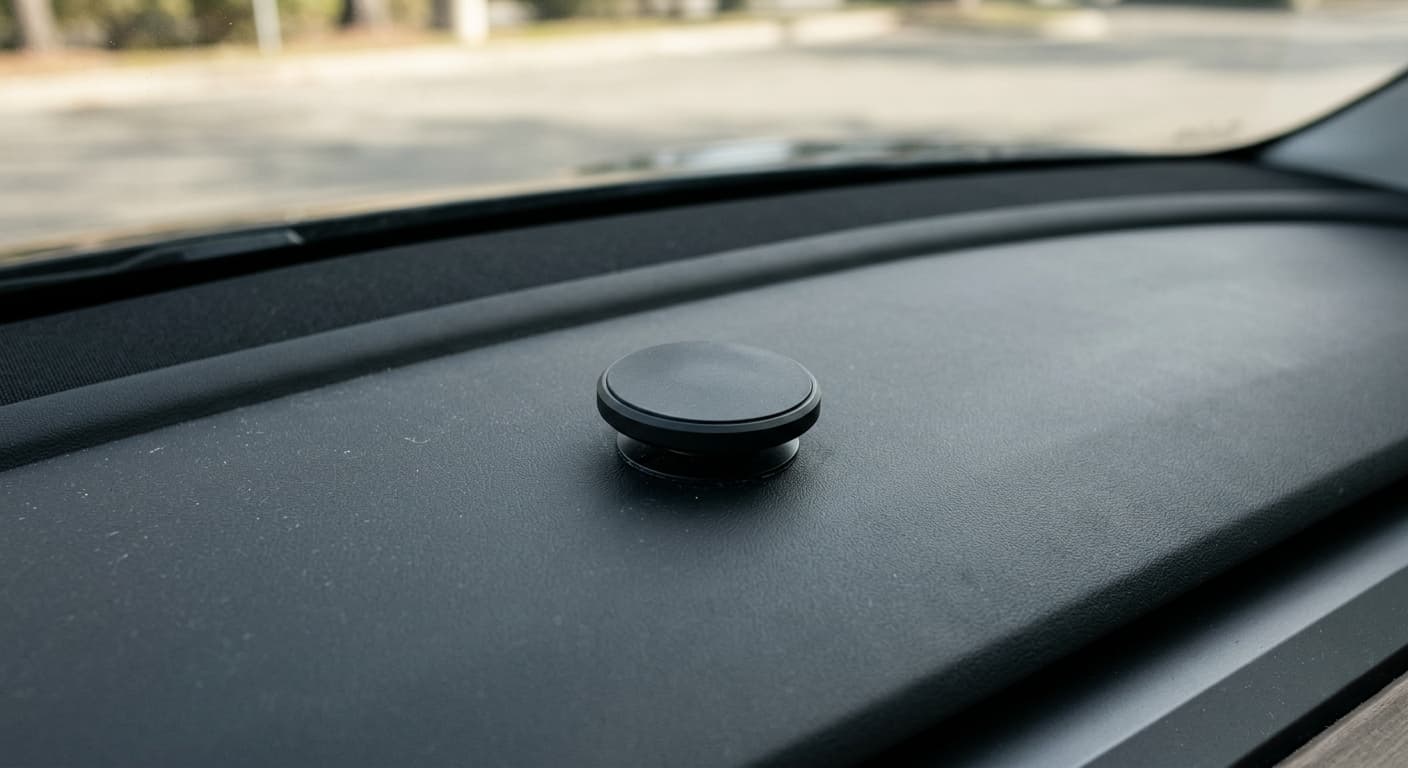
Nevada allows dashcams, GPS units, and phone mounts on the windshield as long as they do not obstruct the driver's clear view under NRS 484D.435. The law permits any mount placed within a 6-inch square in the lower passenger-side corner; a dashboard or vent-clip mount is also fully legal.
Nevada regulates what can be placed on or attached to a vehicle's windshield through several statutes in the Nevada Revised Statutes (NRS). The primary law is NRS 484D.435, which prohibits nontransparent material on the windshield that obstructs the driver's view. A separate hands-free driving law (NRS 484B.165) controls how drivers interact with phones and GPS devices while behind the wheel.
Understanding both statutes is important for anyone who uses a suction cup phone mount, GPS device, dashcam, or any other windshield-mounted accessory while driving in Nevada.
Nevada Windshield Obstruction Law (NRS 484D.435)
NRS 484D.435 states that a person shall not drive any motor vehicle with "any sign, poster or other nontransparent material upon the front windshield, side wings or side or rear windows" that obstructs the driver's clear view of the highway or any intersecting highway.
The law creates two exceptions to this prohibition:
- 6-inch square exception: Material may be displayed in the 6-inch square area of the lower corner of the windshield farthest removed from the driver. On a standard left-hand-drive vehicle, this is the lower right (passenger side) corner.
- Legally required materials: Any material required to be displayed on a windshield or window by federal or state law is exempt.
This means a small device, sticker, or permit placed in the lower passenger-side corner of the windshield is allowed as long as it fits within a 6-inch by 6-inch area. Anything placed elsewhere on the windshield must not obstruct the driver's view.
GPS and Phone Mounts
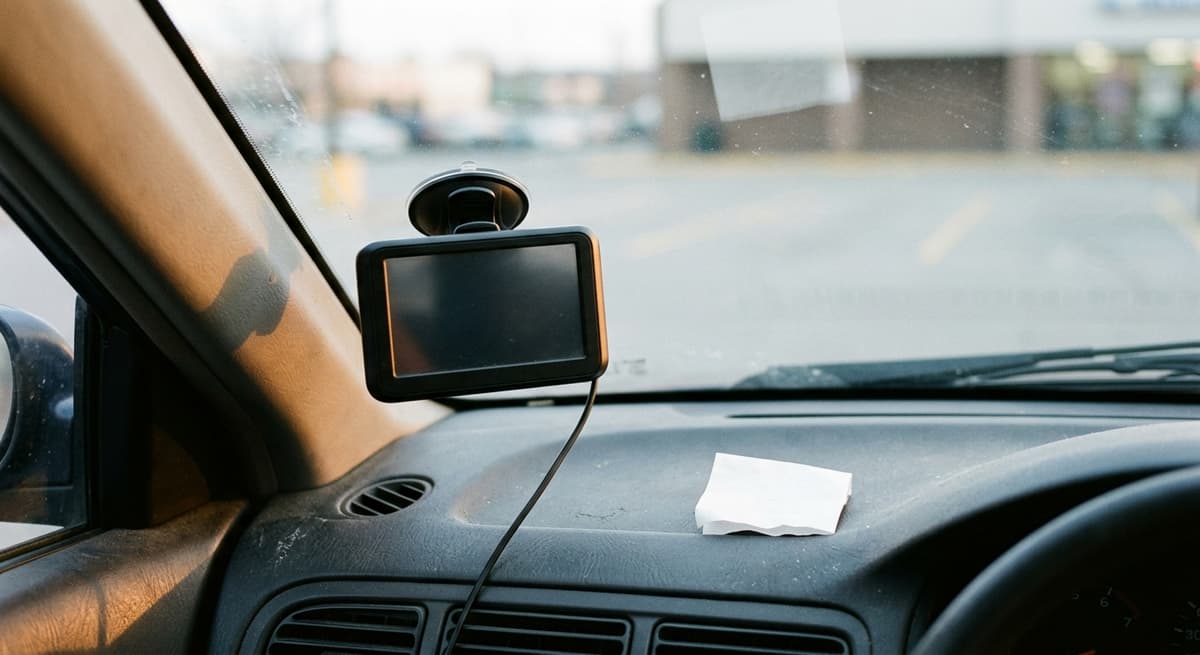
Nevada's hands-free law (NRS 484B.165) requires all cell phone use while driving to be hands-free. The statute explicitly permits "voice-operated GPS/navigation systems affixed to vehicles," creating a legal pathway for mounted navigation devices.
What Is Allowed
- A GPS device or phone used for navigation that is physically attached to the vehicle (mounted on the windshield, dashboard, or vent)
- Voice-activated operation of the device for GPS, calls, or texts
- Briefly touching the device to activate, deactivate, or initiate a feature
What Is Prohibited
- Physically holding a phone or device while driving
- Manually typing or entering text on a handheld device
- Reading or sending texts, emails, or instant messages while holding the device
- Browsing the internet on a handheld device
Best Placement for Mounts
Nevada law does not specify an exact windshield location for phone or GPS mounts beyond the general obstruction rules of NRS 484D.435. To stay within the law:
- Dashboard mount: The safest option because it avoids the windshield entirely and cannot trigger an obstruction citation
- Lower passenger-side corner: Fits within the 6-inch square exception in NRS 484D.435
- Vent-clip mount: Keeps the device off the windshield completely
- Behind the rearview mirror: While commonly used, this location carries some legal risk because it is not within the 6-inch square exception and could be considered an obstruction
The key legal test is whether the device obstructs the driver's clear view of the highway. A small, low-profile mount that does not meaningfully block visibility is less likely to result in a citation than a large device placed directly in the driver's line of sight.
Dashcam Rules
Nevada does not have a specific statute that addresses dashcams by name. A dashcam is treated the same as any other windshield-mounted device under NRS 484D.435. It is permitted as long as it does not obstruct the driver's clear view.

The most legally secure placements for a dashcam in Nevada are:
- Behind the rearview mirror, where the mirror already occupies the driver's field of view
- On the dashboard, avoiding the windshield entirely
- In the lower passenger-side corner within the 6-inch square area
For recording purposes, an in-vehicle conversation picked up by a dashcam's microphone is an in-person conversation, governed by NRS 200.650, which allows recording with the consent of just one person taking part in the conversation. A dashcam that records audio inside the vehicle is legal as long as at least one person in the vehicle (typically the driver) consents to the recording. This is different from Nevada's rule for phone and cellphone calls: the Nevada Supreme Court has construed NRS 200.620 to require the consent of every party to a wire (telephone) communication, not just one (Lane v. Allstate Ins. Co., 114 Nev. 1176, 969 P.2d 938 (1998)), so a dashcam or hands-free system that also captures a phone call should have consent from everyone on that call. Recording conversations of passengers without their knowledge may raise legal issues if the driver is not a party to the conversation.
Windshield Tinting
NRS 484D.440 regulates window tinting in Nevada:
| Window | Tinting Rule |
|---|---|
| Windshield (top area) | Nonreflective tint allowed on the uppermost section, positioned at least 29 inches above the driver's seat. Must not be red or amber. |
| Front side windows | Must allow at least 35% visible light transmission (VLT), with a 7% tolerance |
| Rear side windows | No restrictions on darkness |
| Rear window | Allowed if the vehicle has dual side mirrors reflecting at least 200 feet behind |
Medical Exemptions
The Director of the Nevada Department of Motor Vehicles may authorize exemptions by regulation for drivers with medical conditions that require reduced light exposure. Drivers seeking a medical exemption should contact the Nevada DMV for the application process and required documentation.
Pre-1993 Vehicles
The grandfather clause in NRS 484D.440(4) is narrower than it is often described. It requires two things at once: the vehicle must have a model year of 1993 or older, and the transparent material must have been placed, installed, affixed or applied before July 1, 1993. A newer vehicle gets no benefit from this exemption no matter how old its tint is. The exemption also reaches only the prohibition in paragraph (b) of subsection 2, which covers operating the vehicle, and not the paragraph (a) prohibition on applying the material in the first place.
Separately, NRS 484D.440(5) exempts a vehicle that was sold new, or could have been sold new, with that window treatment as standard or optional equipment without violating a federal statute or regulation in force at the time of manufacture.
Obstruction of Driver's View (NRS 484B.163)
A separate statute, NRS 484B.163, provides additional rules about obstructing the driver's view:
- A vehicle cannot be operated when loaded or when there are more than three people in the front seat if it obstructs the driver's forward or side view
- Passengers cannot sit in positions that interfere with the driver's visibility or control of the vehicle
- A vehicle cannot be operated unless the driver's vision through any required glass equipment is normal
This statute works alongside NRS 484D.435 to give law enforcement broad authority to cite drivers whose visibility is impaired by windshield-mounted items, cracked glass, or other obstructions.
Windshield Condition Requirements
Nevada requires that all motor vehicles equipped with a windshield have a functioning windshield wiper system under NRS 484D.445. The wipers must:
- Be capable of clearing the windshield to provide clear vision under all ordinary conditions of rain, snow, or other moisture
- Be operated while driving during rain, snow, or other moisture conditions
- Be maintained in good operating condition
Under NRS 484D.450, a motor vehicle manufactured after January 1, 1970, must be equipped with safety glazing material wherever glazing is used for partitions, doors, windows, windshields or wind deflectors. A separate statute, NRS 484D.455, governs replacement glass: it is unlawful to replace any of that glazing with anything other than safety glazing material as defined in NRS 484D.450.
A cracked or damaged windshield that impairs the driver's normal vision can result in a citation under NRS 484B.163 (vision through required glass equipment must be normal).
Exemptions
| Exemption | Authority |
|---|---|
| 6-inch square in lower passenger-side windshield corner | NRS 484D.435 |
| Materials required by federal or state law | NRS 484D.435 |
| Voice-operated GPS/navigation systems affixed to the vehicle | NRS 484B.165 |
| Factory-installed tinting meeting federal standards | NRS 484D.440 |
| Model year 1993 or older with tinting applied before July 1, 1993 | NRS 484D.440(4) |
| Medical exemption for window tinting | NRS 484D.440 |
| Emergency service personnel (firefighters, EMTs, paramedics) | NRS 484B.165 |
| Law enforcement officers | NRS 484B.165 |
| Licensed amateur radio operators during emergencies | NRS 484B.165 |
| Persons reporting emergencies or safety hazards | NRS 484B.165 |
| Public utility employees responding to emergencies | NRS 484B.165 |
Penalties
Windshield Obstruction (NRS 484D.435)
NRS 484D.435 prescribes no penalty of its own, so the general penalty provision controls. Under NRS 484A.900, doing any act forbidden by chapters 484A to 484E of NRS, where no specific penalty is declared for that offense, "is a civil infraction punishable pursuant to NRS 484A.703 to 484A.705, inclusive." NRS 484A.7043(1) caps that at "a civil penalty of not more than $500 per violation," with no term of imprisonment. Windshield obstruction is therefore a civil infraction in Nevada, not a misdemeanor: the Legislature reclassified these traffic offenses in 2021 (2021 Nev. Stat. 3325). The court also orders the standard administrative assessments on top of the civil penalty.
NRS 484B.130 and NRS 484B.135 double penalties for a specific, closed list of violations, including NRS 484B.163 (obstructed view) and NRS 484B.165 (hands-free), when committed in a designated work zone or pedestrian safety zone. NRS 484D.435 windshield obstruction is not among the violations listed in either statute, so this doubling does not apply to a windshield obstruction citation.
Hands-Free Law Violations (NRS 484B.165)
| Offense (within 7 years) | Civil penalty |
|---|---|
| First offense | $50 |
| Second offense | $100 |
| Third or subsequent offense | $250 |
NRS 484B.165(4) makes a violation of subsection 1 a civil infraction, so these amounts are civil penalties rather than criminal fines. A first offense is not treated as a moving traffic violation for driver's license purposes. NRS 484B.165 is one of the offenses listed in NRS 484B.130 and NRS 484B.135, so this civil penalty can be doubled if the violation occurs in a work zone or pedestrian safety zone.
Window Tinting Violations (NRS 484D.440)
Under NRS 484D.440(7), a violation of subsection 2 is not a moving traffic violation for driver's license purposes. NRS 484D.440 prescribes no penalty of its own, so NRS 484A.900 controls here as well: an illegal tint violation is a civil infraction carrying a civil penalty of not more than $500 per violation, not a misdemeanor.
Distracted Driving in Nevada
Nevada's hands-free law has been in effect since January 1, 2012, following a warning period that began October 1, 2011. The law is enforced as a primary offense, meaning law enforcement can pull over a driver solely for holding a phone while driving.
According to TRIP National Transportation Research, Nevada recorded 412 traffic deaths in 2024, making it the fourth-deadliest year on record. From 2018 through 2022, there were 46 fatal crashes involving distracted driving in the state, resulting in 47 deaths. The Nevada Office of Traffic Safety reports that approximately 58% of distracted driver fatal crashes in Nevada were single-vehicle crashes.
Properly mounting your phone or GPS device instead of holding it is one of the most effective ways to avoid both a citation and a distracted driving crash.
Commercial Vehicles
Commercial motor vehicle operators in Nevada must comply with both state law and federal regulations. The Federal Motor Carrier Safety Administration (FMCSA) restricts handheld device use by commercial drivers under 49 CFR 392.82. Commercial drivers who use a handheld phone while driving face federal penalties of up to $2,750 per violation.
Electronic Logging Devices (ELDs) required by federal law for many commercial vehicles may be mounted on the windshield or dashboard. Because these devices are required by federal regulation, they fall under the federal law exemption in NRS 484D.435.
More Nevada Laws
Frequently Asked Questions
Can I mount my phone on the windshield in Nevada?
Yes, with restrictions. NRS 484D.435 allows material in a 6-inch square area in the lower passenger-side corner of the windshield. You can also mount a phone on the dashboard or a vent clip. Nevada's hands-free law (NRS 484B.165) requires all phone use to be hands-free, so the phone must be mounted and operated by voice or single-touch activation.
Are dashcams legal in Nevada?
Yes. Nevada does not have a specific dashcam statute, so dashcams are treated under the general windshield obstruction law (NRS 484D.435). The dashcam must not obstruct the driver's clear view. The safest placement is behind the rearview mirror or on the dashboard.
What is the fine for windshield obstruction in Nevada?
It is a civil infraction, not a misdemeanor. NRS 484D.435 sets no penalty of its own, so the general provision in NRS 484A.900 controls, and NRS 484A.7043(1) caps a civil infraction at a civil penalty of not more than $500 per violation with no jail time. The work zone and pedestrian safety zone doubling statutes (NRS 484B.130 and NRS 484B.135) apply only to a specific list of violations that does not include NRS 484D.435, so that doubling does not apply to a windshield obstruction citation.
What are the penalties for using a handheld phone while driving in Nevada?
Under NRS 484B.165, a violation is a civil infraction carrying a civil penalty of $50 for a first offense, $100 for a second offense, and $250 for a third or subsequent offense within a seven-year period. NRS 484B.165 is listed in NRS 484B.130 and NRS 484B.135, so the civil penalty may be doubled in a work zone or pedestrian safety zone. A first offense is not counted as a moving violation.
Can I tint my windshield in Nevada?
Only the uppermost portion of the windshield may be tinted. The tinted material must be positioned at least 29 inches above the driver's seat and cannot be red or amber. Medical exemptions are available through the Nevada DMV for qualifying conditions.
Updates
Corrected the penalty classification throughout: a windshield obstruction, window tint or hands-free violation in Nevada is a civil infraction carrying a civil penalty of up to $500, not a misdemeanor punishable by jail, following the state's 2021 traffic decriminalization; also tightened the pre-1993 window tint exemption to include its model-year condition and attributed the replacement glazing rule to NRS 484D.455.
Independently fact-checked against the cited primary sources; governing law re-checked for recent changes
Corrected the claim that NRS 484B.130/484B.135 work-zone and pedestrian-safety-zone fine doubling applies to a windshield obstruction citation under NRS 484D.435; both statutes' enumerated violation lists are closed lists that do not include 484D.435.
Corrected the dashcam-audio paragraph: in-vehicle conversations are governed by NRS 200.650 (one-party consent for in-person conversations), not NRS 200.620, which the Nevada Supreme Court in Lane v. Allstate (1998) construed to require ALL-party consent for wire/telephone communications. Confirmed via the actual Nevada Supreme Court opinion quoting NRS 200.620's text (via CourtListener) and cross-checked against the site's own dedicated Nevada recording-laws page.
Governing law re-checked for recent changes
Governing law re-checked for recent changes
Reviewed and approved by an editor
The Law Behind This Article
This article rests on the statutory provisions below, held in our own legal record and retrieved from the official source. Tap a section to read the operative text.
Nevada Revised Statutes, Chapter 484D: EQUIPMENT, INSPECTIONS AND SIZE, WEIGHT AND LOAD OF VEHICLES
§ 484D.435Windshield and windows must be unobstructed.In force
1. A person shall not drive any motor vehicle with any sign, poster or other nontransparent material upon the front windshield, side wings or side or rear windows of such vehicle which obstructs the driver’s clear view of the highway or any intersecting highway. 2. This section shall not apply to any sign, poster or other material displayed in the 6-inch square area of the lower corner of the windshield farthest removed from the driver or to any other material required to be displayed on a windshield or window by federal or state law.
Official text (excerpt) · last checked 2026-09-08 · Read the full text in our law library · Verify at leg.state.nv.us
Cited in 3 court opinions in our collectionLatest citing opinion in our collection: 2015
Opinions citing this section in our collection:
- State v. Cantsee (Nevada Supreme Court 2014, 2014 NV 24)“…Cantsee because his cracked windshield violated NRS 484D.435. However, MRS 48411435…”
- United States v. Sanders (District Court, D. Nevada 2015, 95 F. Supp. 3d 1274)“…onable suspicion that a traffic offense had been committed. NRS 484D.435(1) requires that windshield and windows…”
- United States v. $102,836.00 in United States Currency (District Court, D. Nevada 2014, 9 F. Supp. 3d 1152)“…and to drive a vehicle with an obstructed front windshield (NRS 484D.435). . The Court notes that because…”
Identified automatically from the court opinions citing this section — not a ranking of which case controls.
§ 484D.440Restrictions on tinting of windshield or side or rear window.In forcecited in 3 of our articles
1. As used in this section, unless the context otherwise requires, “light transmission” means the ratio of the amount of light which is allowed to pass through a product or material to the amount of light which falls on it. 2. Except as otherwise provided in subsections 3, 4 and 5 a person shall not: (a) Place, install, affix or apply upon the windshield or any side or rear window of a motor vehicle which is required to be registered in this State; or (b) Operate on any highway a motor vehicle required to be registered in this State on which there has been placed, installed, affixed or applied upon the windshield or any side or rear window of the motor vehicle, Ê any transparent material which alters the color or reduces the light transmission of the windshield or side or rear window. 3. The prohibition set forth in subsection 2 does not apply to: (a) A window that is to the immediate right or left of the driver if the window is: (1) Nonreflective; and (2) Has a total light transmission through the combination, if any, of transparent material and safety glazing of not less than 35 percent with a tolerance of 7 percent.
Official text (excerpt) · last checked 2026-09-01 · Read the full text in our law library · Verify at leg.state.nv.us
Also relied on in: Nevada Dashcam Laws: Legal Rules for Dashboard Cameras (2026), Nevada Window Tint Laws (2026): Legal VLT Limits
§ 484D.445Windshield wipers.In force
1. Every motor vehicle, except motorcycles or mopeds, equipped with a windshield shall be equipped with a self-operating windshield wiper system which shall be so constructed as to be controlled by the driver. 2. The windshield wiper system with which the vehicle is equipped shall be maintained in good operating condition and capable of effectively clearing the windshield so as to provide clear vision through the windshield for the driver under all ordinary conditions of rain, snow or other moisture. 3. The wiper system shall be operated while the vehicle is being driven during conditions of rain, snow or other moisture which obstruct or reduce the driver’s clear view through the windshield. 4. Subsection 1 does not apply to highway maintenance vehicles, special mobile equipment, implements of husbandry, or vehicles manufactured before July 1, 1935, with adequate manually operated windshield wipers.
Official text (excerpt) · last checked 2026-07-29 · Read the full text in our law library · Verify at leg.state.nv.us
Nevada Revised Statutes, Chapter 484B: RULES OF THE ROAD
§ 484B.165Using handheld wireless communications device to type or enter text, send or read data, engage in nonvoice communication or engage in voice communications without use of hands-free device unlawful; exceptions; penalty; additional penalty for violation committed in certain zones.In force
1. Except as otherwise provided in this section, a person shall not, while operating a motor vehicle on a highway in this State: (a) Manually type or enter text into a cellular telephone or other handheld wireless communications device, or send or read data using any such device to access or search the Internet or to engage in nonvoice communications with another person, including, without limitation, texting, electronic messaging and instant messaging. (b) Use a cellular telephone or other handheld wireless communications device to engage in voice communications with another person, unless the device is used with an accessory which allows the person to communicate without using his or her hands, other than to activate, deactivate or initiate a feature or function on the device. 2. The provisions of this section do not apply to: (a) A paid or volunteer firefighter, emergency medical technician, advanced emergency medical technician, paramedic, ambulance attendant or other person trained to provide emergency medical services who is acting within the course and scope of his or her employment.
Official text (excerpt) · last checked 2026-07-29 · Read the full text in our law library · Verify at leg.state.nv.us
§ 484B.163Obstruction of or interference with driver’s view; interference with driver’s control over driving mechanism; vision of driver through required glass equipment; additional penalty for violation committed in certain zones.In force
1. A person shall not drive a vehicle when it is so loaded, or when there are in the front seat such number of persons, exceeding three, as to obstruct the view of the driver to the front or sides of the vehicle or as to interfere with the driver’s control over the driving mechanism of the vehicle. 2. A passenger in a vehicle shall not ride in such position as to interfere with the driver’s view ahead or to the sides, or to interfere with the driver’s control over the driving mechanism of the vehicle. 3. Except as otherwise provided in NRS 484D.440, a vehicle must not be operated upon any highway unless the driver’s vision through any required glass equipment is normal. 4. A person who violates any provision of this section may be subject to any additional penalty set forth in NRS 484B.130, 484B.135 or 484B.370.
Official text (excerpt) · last checked 2026-07-29 · Read the full text in our law library · Verify at leg.state.nv.us
Cited in 3 court opinions in our collectionLatest citing opinion in our collection: 2015
Opinions citing this section in our collection:
- State v. Cantsee (Nevada Supreme Court 2014, 2014 NV 24)“…vehicle. The State then argued for the first time that NRS 484B.163(3), 2 rather than NRS 4…”
- United States v. Sanders (District Court, D. Nevada 2015, 95 F. Supp. 3d 1274)“…egarded the air fresheners as an obstruction which violated NRS 484B.163. Defense counsel read that statute to t…”
- United States v. $167,070.00 in United States Currency (District Court, D. Nevada 2015, 112 F. Supp. 3d 1108)“…e "as nearly as practicable entirely within a single lane.” NRS 484B.163(3) provides that "a vehicle must not be…”
Identified automatically from the court opinions citing this section — not a ranking of which case controls.
§ 484B.130Double penalty for certain traffic violations committed in work zones; exception in certain temporary traffic control zones.In force
1. Except as otherwise provided in subsections 2 and 6, a person who is found to have committed a violation of a speed limit, or convicted of or found to have committed a violation of NRS 484B.150, 484B.163, 484B.165, 484B.200 to 484B.217, inclusive, 484B.223, 484B.227, 484B.300, 484B.303, 484B.317, 484B.320, 484B.327, 484B.330, 484B.403, 484B.587, 484B.600, 484B.603, 484B.650, 484B.653, 484B.657, 484C.110 or 484C.120, that occurred: (a) In an area designated as a temporary traffic control zone; and (b) At a time when the workers who are performing construction, maintenance or repair of the highway or other work are present, or when the effects of the act may be aggravated because of the condition of the highway caused by construction, maintenance or repair, including, without limitation, reduction in lane width, reduction in the number of lanes, shifting of lanes from the designated alignment and uneven or temporary surfaces, including, without limitation, modifications to road beds, cement-treated bases, chip seals and other similar conditions, Ê shall, if the violation is a criminal offense, be punished by imprisonment or by a fine, or both, for a term or an…
Official text (excerpt) · last checked 2026-07-29 · Read the full text in our law library · Verify at leg.state.nv.us
Cited in 1 court opinions in our collectionLatest citing opinion in our collection: 2016
Opinions citing this section in our collection:
- CORNELLA (MARY LOU) VS. CHURCHILL CO. (STATE) (Nevada Supreme Court 2016, 2016 NV 58)“…le under certain circumstances set forth in NRS 484B.130. See NRS 484B.657(2). SUPREME COURT…”
Identified automatically from the court opinions citing this section — not a ranking of which case controls.
§ 484B.135Double penalty for certain traffic violations committed in pedestrian safety zones; exception in certain pedestrian safety zones.In force
1. Except as otherwise provided in subsections 2 and 4, a person who is found to have committed a violation of a speed limit, or convicted of or found to have committed a violation of NRS 484B.150, 484B.163, 484B.165, 484B.200 to 484B.217, inclusive, 484B.223, 484B.227, 484B.280, 484B.283, 484B.300, 484B.303, 484B.307, 484B.317, 484B.320, 484B.327, 484B.403, 484B.600, 484B.603, 484B.650, 484B.653, 484B.657, 484C.110 or 484C.120, that occurred in an area designated as a pedestrian safety zone may: (a) If the violation is a criminal offense, be punished by imprisonment or by a fine, or both, for a term or an amount equal to and in addition to the term of imprisonment or amount of the fine, or both, that the court imposes for the primary offense. (b) If the violation is a civil infraction punishable pursuant to NRS 484A.703 to 484A.705, inclusive, be punished by a civil penalty in an amount equal to and in addition to the civil penalty that the court imposes for the primary infraction. Ê Any term of imprisonment imposed pursuant to this subsection runs consecutively with the sentence prescribed by the court for the crime.
Official text (excerpt) · last checked 2026-07-29 · Read the full text in our law library · Verify at leg.state.nv.us
Code of Federal Regulations Title 49
§ 392.82Using a hand-held mobile telephone.In forcecited in 2 of our articles
(a)(1) No driver shall use a hand-held mobile telephone while driving a CMV. (2) No motor carrier shall allow or require its drivers to use a hand-held mobile telephone while driving a CMV. (b) Definitions. For the purpose of this section only, driving means operating a commercial motor vehicle on a highway, including while temporarily stationary because of traffic, a traffic control device, or other momentary delays. Driving does not include operating a commercial motor vehicle when the driver has moved the vehicle to the side of, or off, a highway and has halted in a location where the vehicle can safely remain stationary. (c) Emergency exception. Using a hand-held mobile telephone is permissible by drivers of a CMV when necessary to communicate with law enforcement officials or other emergency services.
Official text (excerpt) · last checked 2026-07-28 · Read the full text in our law library · Verify at ecfr.gov
Cited in 5 court opinions in our collectionLatest citing opinion in our collection: 2024
Opinions citing this section in our collection:
- Bryson v. United States (District Court, District of Columbia 2019, 381 F. Supp. 3d 124)“…e inspector cited plaintiff and the Company for violating 49 C.F.R. § 392.82 (a) which prohibits drivers from using…”
- Clark v. Whaley (District Court, S.D. Ohio 2022)“…ulations also apply specifically to hand-held devices. See 49 C.F.R. § 392.82 (“No driver shall use a hand-held mobil…”
- Denham v. Bark River Transit, Inc. (District Court, S.D. Texas 2019)“…mobile phones while driving a commercial motor vehicle. 49 C.F.R. § 392.82. Several federal district courts have…”
Identified automatically from the court opinions citing this section — not a ranking of which case controls.
Also relied on in: Montana Windshield Mounting Laws (2026 Guide)
Nevada Revised Statutes, Chapter 200: CRIMES AGAINST THE PERSON
§ 200.620Interception and attempted interception of wire communication prohibited; exceptions.In forcecited in 18 of our articles
1. Except as otherwise provided in subsection 5 and NRS 179.410 to 179.515, inclusive, 209.419 and 704.195, it is unlawful for any person to intercept or attempt to intercept any wire communication unless: (a) The interception or attempted interception is made with the prior consent of one of the parties to the communication; and (b) An emergency situation exists and it is impractical to obtain a court order as required by NRS 179.410 to 179.515, inclusive, before the interception, in which event the interception is subject to the requirements of subsection 3. If the application for ratification is denied, any use or disclosure of the information so intercepted is unlawful, and the person who made the interception shall notify the sender and the receiver of the communication that: (1) The communication was intercepted; and (2) Upon application to the court, ratification of the interception was denied.
Official text (excerpt) · last checked 2026-08-28 · Read the full text in our law library · Verify at leg.state.nv.us
Cited in 18 court opinions in our collectionLatest citing opinion in our collection: 2025
In the courts (editorial summary, independently checked):Nevada reads NRS 200.620 as an all-party consent rule for phone recording, with a territorial limit. Lane v. Allstate Insurance held a participant who taped his own calls without the other parties' consent violated it; DITECH FINANCIAL, LLC VS. BUCKLES held it does not reach calls recorded from outside Nevada.
Opinions citing this section in our collection:
- Lane v. Allstate Insurance (Nevada Supreme Court 1998, 114 Nev. 1176)✓A former employee secretly taped hundreds of his own phone calls with his ex-employer's staff to build his suit; the court held NRS 200.620 bars recording a call without every party's consent, so the tapes were excluded and the dismissal of his suit was reversed.
- State v. Reyes (Nevada Supreme Court 1991, 107 Nev. 191)✓Police had an interpreter listen on a station extension phone while an informant set up a drug buy; the court held that officers' use of regularly installed telephone equipment in the ordinary course of their duties is not an interception under NRS 200.620.
- ABID VS. ABID (CHILD CUSTODY) (Nevada Supreme Court 2017, 2017 NV 94)“…corded phone conversations in violation of NRS 200.620 to obtain evidence to support tort…”
Identified automatically from the court opinions citing this section — not a ranking of which case controls.
Also relied on in: Nevada Smart Glasses Recording Laws 2026, Nevada Audio Recording Laws: Split Consent Rules and Penalties (2026), Nevada Landlord-Tenant Recording Laws: Rights for Renters and Property Owners (2026)
§ 200.650Unauthorized, surreptitious intrusion of privacy by listening device prohibited.In forcecited in 19 of our articles
Except as otherwise provided in NRS 179.410 to 179.515, inclusive, and 704.195, a person shall not intrude upon the privacy of other persons by surreptitiously listening to, monitoring or recording, or attempting to listen to, monitor or record, by means of any mechanical, electronic or other listening device, any private conversation engaged in by the other persons, or disclose the existence, content, substance, purport, effect or meaning of any conversation so listened to, monitored or recorded, unless authorized to do so by one of the persons engaging in the conversation.
Official text (excerpt) · last checked 2026-08-26 · Read the full text in our law library · Verify at leg.state.nv.us
Cited in 13 court opinions in our collectionLatest citing opinion in our collection: 2025
In the courts (editorial summary, independently checked):Nevada courts read NRS 200.650 to permit a recording authorized by a participant. Summers v. State (1986) upheld a body-wire recording because the informant taking part in the conversation authorized it. Abid v. Abid (2017) held the section carries no suppression rule, so a custody expert could consider recordings made in violation of it.
Opinions citing this section in our collection:
- Lane v. Allstate Insurance (Nevada Supreme Court 1998, 114 Nev. 1176)✓A former employee secretly taped hundreds of phone calls with company personnel; the court read NRS 200.650 as allowing in-person private conversations to be recorded when one participant authorizes it, and contrasted that in holding NRS 200.620 bars one-party taping of calls.
- Summers v. State (Nevada Supreme Court 1986, 102 Nev. 195)✓Police taped a transmitter to an informant, who recorded his conversation with Summers about the murder guns; the court held such a recording needs no court order so long as the authorization requirement of NRS 200.650 is met, and the informant had authorized it.
- ABID VS. ABID (CHILD CUSTODY) (Nevada Supreme Court 2017, 2017 NV 94)“…to this recording, the father's actions likely violated NRS 200.650, which prohibits the…”
Identified automatically from the court opinions citing this section — not a ranking of which case controls.
Also relied on in: Nevada Recording Laws (2026): Hybrid One-Party/All-Party Consent, Nevada Medical Recording Laws: Patient Rights and Healthcare Privacy (2026), Nevada Phone Call Recording Laws: All-Party Consent Required (2026)
Search our full record of US law — 2.1 million sections, every state + federal →
Sources and References
- NRS 484D.435 - Windshield and Windows Must Be Unobstructed(nevada.public.law)
- NRS 484B.165 - Handheld Wireless Communications Device Prohibition(nevada.public.law)
- NRS 484D.440 - Window Tinting Restrictions(nevada.public.law)
- NRS 484B.163 - Obstruction of Driver View(nevada.public.law)
- NRS 484D.445 - Windshield Wipers(nevada.public.law)
- NRS 484B.130 - Double Penalty in Work Zones(nevada.public.law)
- NRS 484B.135 - Double Penalty in Pedestrian Safety Zones(nevada.public.law)
- Nevada Office of Traffic Safety - Traffic Laws(ots.nv.gov).gov
- Nevada DMV - Traffic Laws and Safety(dmv.nv.gov).gov
- TRIP - Nevada Traffic Safety Crisis Report 2024(tripnet.org)
- 49 CFR 392.82 - FMCSA Handheld Device Restrictions(ecfr.gov).gov
- NRS 200.650 - Unauthorized, Surreptitious Intrusion of Privacy by Listening Device (one-party consent for in-person conversations)(nevada.public.law).gov
- NRS 200.620 - Interception of Wire Communication (construed by Lane v. Allstate to require all-party consent for phone calls)(nevada.public.law)
- NRS 484A.900 - Penalty for violation of traffic law when no penalty provided in statute (violations of NRS chapters 484A to 484E with no specific penalty are civil infractions)(leg.state.nv.us)
- NRS 484A.7043 - Penalties for civil infractions (civil penalty of not more than $500 per violation)(leg.state.nv.us)
- NRS 484D.435 - Windshield and windows must be unobstructed (official Nevada Legislature text)(leg.state.nv.us)
- NRS 484D.440 - Restrictions on tinting of windshield or side or rear window (official Nevada Legislature text)(leg.state.nv.us)
- NRS 484D.450 - Safety glazing material in motor vehicles and campers(leg.state.nv.us)
- NRS 484D.455 - Replacement of glazing materials(leg.state.nv.us)
- NRS 484B.165 - Handheld wireless communications device prohibition; violation is a civil infraction with civil penalties of $50/$100/$250(leg.state.nv.us)
- NRS 484B.130 - Double penalty for certain traffic violations committed in work zones (enumerated list omits NRS 484D.435)(leg.state.nv.us)
- NRS 484B.135 - Double penalty for certain traffic violations committed in pedestrian safety zones (enumerated list omits NRS 484D.435)(leg.state.nv.us)