
Massachusetts
Massachusetts Nursing Home Camera Laws: All-Party Consent Risks
Independently fact-checked against primary sources (last audited August 14, 2026). · 4 primary sources cited on this page. How we verify our legal content
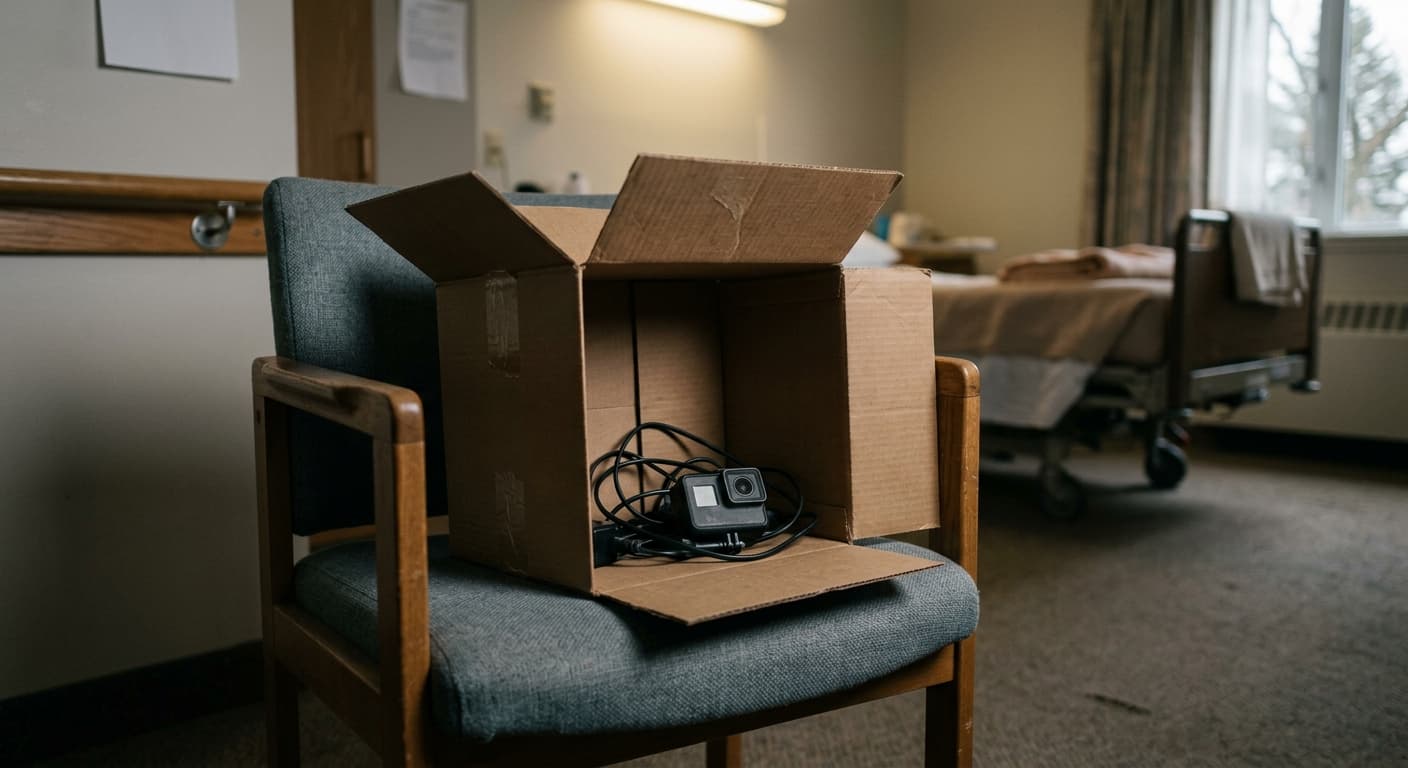
Massachusetts has no statute or regulation addressing cameras in nursing home resident rooms, and no pending bill would create one. What matters most in Massachusetts is the state's strict all-party consent wiretap law, which reaches any camera that also records audio. This page covers what Massachusetts law says today and how the state's recording-consent rule shapes a family's practical options.
This page is part of our Nursing Home Camera Laws hub, which compares all 50 states, and our national Nursing Home Camera Laws guide covering the states that do have an enacted statute.
Massachusetts Has No Nursing Home Camera Statute Today
No Massachusetts statute grants a resident or family a right to install a camera in a nursing home room, and none prohibits it either. Massachusetts's nursing home and long-term care licensing statute, MGL c.111 §§70-76, and its implementing regulation, 105 CMR 150.000 (the Department of Public Health's Standards for Long-Term Care Facilities), have no section addressing electronic monitoring, video, audio recording, or surveillance in resident rooms. Whether a camera is allowed in a Massachusetts nursing home today depends entirely on the individual facility's admission agreement and internal policy, not on any statewide legal right.
Clearing Up the "Leslie Law" Confusion
A bill known as the "Leslie Law," H.294, sometimes comes up in searches about Massachusetts nursing home cameras, but it is not a nursing-home bill. Its actual text covers "out-of-home care," defined as family foster care, family child care, child care centers, group residential care, and temporary shelter for foster children licensed under Chapter 15D of the Massachusetts General Laws, which governs child care facilities. The bill is sponsored by a member of the Committee on Children, Families and Persons with Disabilities, not a committee handling elder or long-term care policy, and its operative provisions concern communication devices for foster children, not electronic monitoring for nursing home residents. As of the most recent status check, H.294 had been accompanied by a study order and remains pending on that unrelated track. It should not be cited, described, or treated as a Massachusetts nursing home electronic-monitoring bill.

No other pending Massachusetts bill addressing cameras or electronic monitoring specifically in nursing homes or skilled nursing facilities has been found. A search of Massachusetts's 194th General Court bill records for electronic monitoring and long-term care turned up only unrelated measures, including workplace-violence-prevention bills that explicitly exclude nursing homes from their scope, and telehealth remote-patient-monitoring bills addressing a different meaning of "monitoring" altogether.
Audio vs. Video: Why Massachusetts's Consent Law Matters More Here Than in Most States
Massachusetts is one of the strictest states in the country on recording, and that matters a great deal for a nursing home camera. Under MGL c.272 §99, Massachusetts requires the consent of every party to a conversation, not just one, before it may lawfully be recorded. The statute defines unlawful interception as secretly hearing or recording the contents of a wire or oral communication "by any person other than a person given prior authority by all parties to such communication." Willful violation is a felony, punishable by a fine of up to $10,000 and up to five years in state prison.
This all-party consent rule reaches any camera that also records audio, including one placed by a resident's own family. A device capturing a resident's own conversations with visitors who know about and consent to the camera is on firmer ground, but a device that also picks up staff talking to each other, or a roommate speaking with their own visitors, where those people have not consented, sits squarely inside the conduct MGL c.272 §99 prohibits.
Silent video sits under a different statute rather than outside the law entirely. Because MGL c.272 §99 reaches "wire or oral communication" and not visual images, video-only recording falls outside the wiretap law. It is still reached by MGL c.272 §105(b), which makes it a crime to willfully photograph, videotape, or "electronically surveil" a person who is nude or partially nude "with the intent to secretly conduct or hide such activity," where that person would reasonably expect privacy and did not know about or consent to the recording. That offense carries up to two and a half years in a house of correction and a fine of up to $5,000. A resident's room is exactly where bathing, toileting, and dressing happen, so a concealed camera there can reach §105 even with the sound switched off. The statute turns on secrecy and the intent to hide the activity, which is why a camera the facility and any roommate have been told about stands on very different footing from one nobody was told about. What no Massachusetts statute does is set rules for in-room video monitoring in nursing homes specifically.
Watch out: Because Massachusetts requires everyone's consent for audio recording, a family installing a camera with sound in a shared room, or anywhere staff conversations might be picked up, faces meaningfully higher legal exposure than in a one-party consent state. If audio consent from everyone who might be recorded cannot realistically be secured, a video-only device substantially reduces that risk. Turning the sound off does not make a hidden camera safe, though: a concealed camera that captures a nude or partially nude resident or roommate can still violate MGL c.272 §105(b).
What This Means in Practice
Because Massachusetts has no statute either granting or barring a resident's right to a camera, the facility's admission agreement controls. Before installing any device:

- Ask the administrator directly and get any permission in writing, including whether the facility has its own notice or consent requirements.
- Favor a video-only device, and do not conceal it. Given Massachusetts's all-party consent rule, audio recording without consent from every person who might be picked up, including staff and a roommate's visitors, is the clearest legal risk on this page. Switching the sound off does not by itself make the camera lawful: a concealed camera that captures a nude or partially nude resident or roommate can violate MGL c.272 §105(b), which turns on secrecy and the intent to hide the device. Open disclosure and written permission are what take that second risk off the table.
- Address a shared room separately. With no statutory framework, a facility that allows cameras will typically set its own rule for a shared room, which may mean seeking the roommate's agreement or requesting a private room.
- An undisclosed camera carries real practical risk. A facility that discovers it may treat it as a violation of the admission agreement, and if the device records audio without the consent of everyone captured, the person who installed it can face felony prosecution under MGL c.272 §99. A hidden camera that captures someone undressed can also draw a charge under MGL c.272 §105(b).
For the general mechanics of Massachusetts's all-party consent rule, see our Massachusetts recording law guide and its security camera page.
If You Suspect Abuse or Neglect
Camera footage, whether from a facility system or a lawfully installed family device, is sometimes the evidence that first reveals abuse or neglect. If footage or another source raises a genuine concern about how a resident is being treated, that concern may support a legal claim separate from whether the camera itself was lawfully placed.
Harmed by a product or exposure? Speak with an attorney about your options
If you or a loved one may have been harmed, you can speak with an attorney about your legal options at no cost. Whether you have a claim depends on the specific facts. This is attorney advertising, not a guarantee that you qualify or of any particular outcome.
Reporting a Concern: The Massachusetts Long-Term Care Ombudsman
Massachusetts residents, families, and staff can raise complaints about facility policy, retaliation, or suspected abuse or neglect with the Massachusetts Long-Term Care Ombudsman Program, which supports residents in nursing homes, rest homes, and assisted living residences. Under the federal Older Americans Act, the program's authority covers assisted living residents as well as nursing home residents, regardless of whether Massachusetts has a camera statute.

Information last verified on 2026-08-31, drawn from Massachusetts General Court records for H.294, MGL c.272 §99, MGL c.272 §105, and MGL c.111 §§70-76. This article has not yet been reviewed by a licensed lawyer and is not legal advice.
Related Resources
- Nursing Home Camera Laws by State
- Nursing Home Camera Laws: 50-State Comparison
- Massachusetts Recording Laws
- Nursing Home Abuse & Neglect Claims
- Massachusetts Power of Attorney Laws
Last updated: 2026-08-31.
Frequently Asked Questions
Is it legal to put a camera in a nursing home room in Massachusetts?
Massachusetts has no statute either granting or barring this right. Whether a camera is allowed depends on the individual facility's admission agreement. Because Massachusetts requires all-party consent for audio recording, a camera that also records sound carries meaningfully higher legal risk than in most states.
Is the 'Leslie Law' a Massachusetts nursing home camera bill?
No. H.294, the Leslie Law, addresses surveillance in out-of-home child care and foster care facilities licensed under Chapter 15D of Massachusetts law. It does not apply to nursing homes or elderly residents and should not be treated as pending nursing-home legislation.
Is Massachusetts a one-party or two-party consent state for recording?
Massachusetts is an all-party (two-party) consent state under MGL c.272 §99. Every party to a conversation must consent before it can lawfully be recorded. Willful violation is a felony carrying up to five years in prison and a $10,000 fine.
Can I record video without audio in a Massachusetts nursing home room?
Massachusetts's wiretap statute reaches wire and oral communications, not silent video, so video-only recording falls outside that law. A different statute still applies: MGL c.272 §105(b) makes it a crime, punishable by up to two and a half years in a house of correction and a fine of up to $5,000, to secretly videotape or electronically surveil someone who is nude or partially nude where that person would reasonably expect privacy. Because §105 turns on secrecy and the intent to hide the activity, a camera the facility and any roommate know about stands on much safer ground than a concealed one. No Massachusetts statute specifically authorizes or governs in-room video monitoring in nursing homes.
Can a nursing home refuse to allow a camera in Massachusetts?
Yes. Because no Massachusetts statute grants residents a right to install a camera, a facility can lawfully permit, condition, or prohibit cameras as a matter of its own admission agreement and policy.
Who do I contact if I suspect abuse at a Massachusetts nursing home?
The Massachusetts Long-Term Care Ombudsman Program investigates complaints about nursing home, rest home, and assisted living residents' care and rights at no cost. Suspected abuse can also be reported to Massachusetts Adult Protective Services or local law enforcement.
Updates
Added Massachusetts General Laws c.272 section 105(b), which criminalizes secretly videotaping a nude or partially nude person, to the guidance on video-only cameras, replacing the earlier statement that no Massachusetts statute addressed silent video.
Independently fact-checked against the cited primary sources
The Law Behind This Article
This article rests on the statutory provisions below, held in our own legal record and retrieved from the official source. Tap a section to read the operative text.
Massachusetts General Laws, Chapter 272
§ 99Interception of wire and oral communicationsIn forcecited in 21 of our articles
Section 99. Interception of wire and oral communications.— A. Preamble. The general court finds that organized crime exists within the commonwealth and that the increasing activities of organized crime constitute a grave danger to the public welfare and safety. Organized crime, as it exists in the commonwealth today, consists of a continuing conspiracy among highly organized and disciplined groups to engage in supplying illegal goods and services. In supplying these goods and services organized crime commits unlawful acts and employs brutal and violent tactics. Organized crime is infiltrating legitimate business activities and depriving honest businessmen of the right to make a living. The general court further finds that because organized crime carries on its activities through layers of insulation and behind a wall of secrecy, government has been unsuccessful in curtailing and eliminating it. Normal investigative procedures are not effective in the investigation of illegal acts committed by organized crime.
Official text (excerpt) · last checked 2026-08-31 · Read the full text in our law library · Verify at malegislature.gov
Cited in 271 court opinions in our collectionLatest citing opinion in our collection: 2026
In the courts (editorial summary, independently checked):Commonwealth v. Blood (1987) read Section 99 as generally proscribing secret recording of oral communications without all parties' consent, and suppressed under art. 14 a warrantless police recording made with one party's consent. Commonwealth v. Vitello (1975) held Section 99 substantially complies with federal Title III.
Opinions citing this section in our collection:
- Commonwealth v. Vitello (Massachusetts Supreme Judicial Court 1975, 367 Mass. 224)✓In a gaming prosecution built on wiretapped phone calls, the SJC gave chapter 272 section 99 its first full review and held the state wiretap statute substantially complies with federal Title III and that the warrants issued under it met both standards.
- Commonwealth v. Blood (Massachusetts Supreme Judicial Court 1987, 400 Mass. 61)✓Police wired an informant who recorded conversations in private homes about a planned break-in; the SJC held the recordings fell within section 99's one-party-consent exception but that article 14 nonetheless required a warrant, and reversed the convictions.
- Commonwealth v. D'Amour (Massachusetts Supreme Judicial Court 1999, 428 Mass. 725)✓The SJC upheld a section 99 wiretap of a widow suspected of arranging her husband's murder for insurance money, holding the district attorney's written designation of an assistant satisfied Vitello and that probable cause supported the organized crime connection.
Identified automatically from the court opinions citing this section — not a ranking of which case controls.
Also relied on in: Massachusetts Recording Laws (2026): Two-Party Consent Rules, Massachusetts Landlord-Tenant Recording Laws, Recordings as Evidence: US Court Rules by State
Code of Federal Regulations Title 42
§ 483.10Resident rights.In forcecited in 19 of our articles
(a) Residents rights. The resident has a right to a dignified existence, self-determination, and communication with and access to persons and services inside and outside the facility, including those specified in this section. (1) A facility must treat each resident with respect and dignity and care for each resident in a manner and in an environment that promotes maintenance or enhancement of his or her quality of life, recognizing each resident's individuality. The facility must protect and promote the rights of the resident. (2) The facility must provide equal access to quality care regardless of diagnosis, severity of condition, or payment source. A facility must establish and maintain identical policies and practices regarding transfer, discharge, and the provision of services under the State plan for all residents regardless of payment source. (b) Exercise of rights. The resident has the right to exercise his or her rights as a resident of the facility and as a citizen or resident of the United States.
Official text (excerpt) · last checked 2026-07-28 · Read the full text in our law library · Verify at ecfr.gov
Cited in 85 court opinions in our collectionLatest citing opinion in our collection: 2026
In the courts (editorial summary, independently checked):Courts reviewing CMS penalties have applied the notice duty then codified at section 483.10(b)(11). Claiborne-Hughes Health Center v. Sebelius (2010) upheld noncompliance where a facility did not promptly consult the physician or notify family after a resident's decline; Senior Rehabilitation (2010) sustained a similar finding.
Opinions citing this section in our collection:
- Roudachevski v. All-American Care Centers, Inc. (Court of Appeals for the Eighth Circuit 2011, 648 F.3d 701)✓A doctor cut off from his nursing home patients sought an injunction, arguing residents' right under Section 483.10(d)(1) to choose a physician made the public interest favor him; the Eighth Circuit affirmed the denial, finding that interest not presently ascertainable.
- CLAIBORNE-HUGHES HEALTH CENTER v. Sebelius (Court of Appeals for the Sixth Circuit 2010, 609 F.3d 839)✓A resident's food intake fell sharply for three weeks and he lost 18.5 pounds before the nursing home called his doctor or family; the Sixth Circuit upheld findings that it violated Section 483.10(b)(11)'s immediate-notification duty and that the lapse was immediate jeopardy.
- Gray Panthers Advocacy Committee v. Louis W. Sullivan, M.D., Secretary, Department of Health and Human Services (Court of Appeals for the D.C. Circuit 1991, 936 F.2d 1284)“…how to apply for and use Medicare and Medicaid benefits.” 42 C.F.R. § 483.10 (b)(9) (1990). On the topic of property…”
Identified automatically from the court opinions citing this section — not a ranking of which case controls.
Also relied on in: Alabama Nursing Home Camera Laws: No Statute, What Applies, Colorado Nursing Home Camera Laws: No Statute, What Applies, Nursing Home Camera Laws by State
Search our full record of US law — 2.1 million sections, every state + federal →
Sources and References
- Massachusetts General Court, H.294 (194th General Court) bill status and text(malegislature.gov).gov
- Massachusetts General Laws c.272 §99, Interception of wire and oral communications(malegislature.gov).gov
- Massachusetts General Laws c.111 §§70-76, Licensing of long-term care facilities(malegislature.gov).gov
- Massachusetts Long-Term Care Ombudsman Program(mass.gov).gov
- 42 CFR § 483.10, Nursing home resident rights (federal)(law.cornell.edu)
- Massachusetts General Laws c.272 s.105, Photographing, videotaping or electronically surveilling a nude or partially nude person(malegislature.gov)