
Montana
Montana Nursing Home Camera Laws: No Statute, Notice Regime
Independently fact-checked against primary sources (last audited August 14, 2026). · 4 primary sources cited on this page. How we verify our legal content
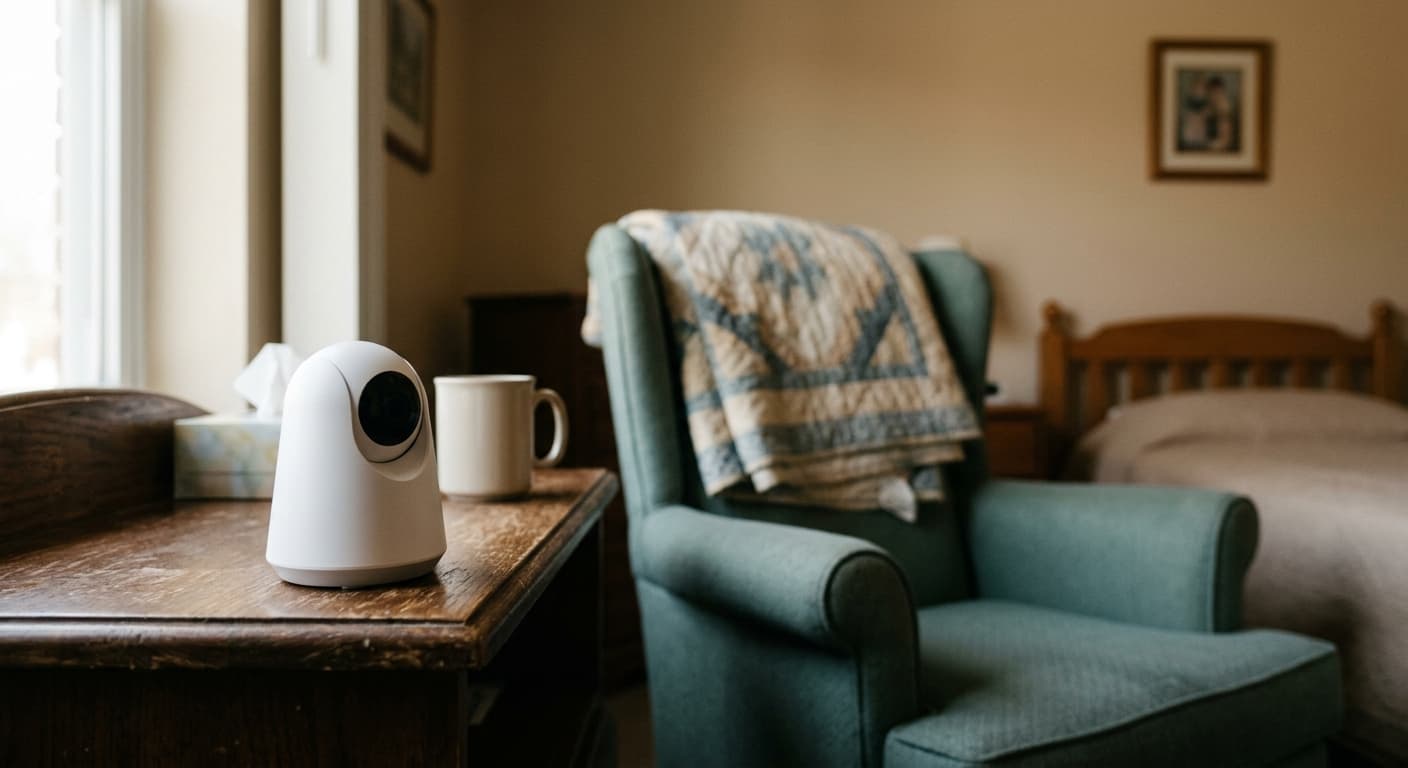
Montana has no statute or rule giving a nursing home resident or family a right to install a camera in a resident's room. This article covers what a real search of Montana law found, the state's distinctive notice-based recording rule that applies instead, and where to turn if a facility interferes.
This page addresses Montana specifically. For the 18 states with an enacted electronic-monitoring statute, see the nursing home camera laws hub and the state-by-state comparison.
Does Montana Have a Nursing Home Camera Law?
No. Montana's Long-Term Health Care Facilities statutes (Mont. Code Ann. Title 50, Chapter 5) were reviewed part by part, including the Safety Devices part, which defines a "safety device" as side rails, tray tables, seatbelts, and similar physical hardware, unrelated to electronic monitoring. The Resident Rights administrative rule for assisted living, Admin. R. Mont. 37.106.2828, does not independently address monitoring either; it only cross-references the statutory Montana Long-Term Care Residents' Bill of Rights and advance-directive rights.
The only camera-related text found anywhere in this review sits inside the assisted living construction rules, Admin. R. Mont. 37.106.2899H, which lists tamper-resistant "cameras" as part of a facility's own seclusion-room construction specification, a behavioral-health safety feature, not a resident or family monitoring right. A direct search of the Montana Legislature's Bill Explorer tool across both the 2023 and 2025 regular sessions, using the terms nursing, monitoring, and camera, turned up nothing on-topic: results traced to facility funding bills, a criminal-justice electronic-monitoring bill, and unrelated traffic- and game-camera bills. Montana is a genuine no-law state on this question.
Montana's Recording Law: A Notice-Based Regime, Not Simple Consent
With no nursing-home-specific statute, Montana's general recording law governs a camera installed without the facility's agreement, and it works differently than most states. Mont. Code Ann. Section 45-8-213 prohibits recording a conversation "by use of a hidden electronic or mechanical device that reproduces a human conversation without the knowledge of all parties." The key word is knowledge, not consent: an announced or visible recording device satisfies this standard without requiring the other party to agree or respond, only that the recording not be secret. Violating the statute is a misdemeanor, punishable by up to six months in county jail and a $500 fine. Note the limit of that provision: subsection (1)(c) is written around a recorded "conversation," so a camera that captures video and no audio is not covered by it. Montana handles surreptitious video under a different statute, covered below.

That framing matters for a nursing home camera. A camera installed openly, disclosed to staff and any roommate, is a materially more favorable starting point in Montana than in a strict all-party-consent state, since no one's active agreement is legally required, only that the device not be hidden. See our Montana recording laws guide for the full framework.
Facility Policy Still Decides Whether a Camera Is Allowed
Montana's notice-based recording rule addresses the criminal-law exposure of using a hidden device; it does not create a resident's right to install a camera over facility objection. That is still a matter of the facility's own admission agreement and internal policy, since no Montana statute grants or forecloses the right. Federal nursing home rules under 42 CFR 483.10 protect resident privacy and dignity broadly but say nothing about cameras, so no federal law fills the gap either.
The Practical Risk of a Hidden Camera
Because Montana's rule turns on secrecy rather than consent, the single biggest legal risk for a family is installing a device covertly. An openly disclosed, visible camera, with staff and any roommate aware of it, is squarely within Montana's own notice standard. A concealed device capturing conversations no one knew about is the scenario Section 45-8-213 was written to reach, regardless of the underlying intent behind installing it.
Section 45-8-213 is only half the picture, though, because it reaches a recorded conversation and nothing else. A camera that records video without audio, which is the device a family most often installs to watch for neglect, falls outside it. Montana addresses surreptitious video separately, in Mont. Code Ann. Section 45-5-223. That statute makes it an offense to hide, wait, or otherwise loiter, in person or by means of a remote electronic device, within or in the vicinity of a private dwelling house, apartment, or other place of residence for the purpose of surreptitiously observing or recording the visual image of any occupant in the residence without the occupant's knowledge. Its penalties escalate well past the recording statute: up to a $500 fine or six months in county jail on a first conviction, up to $1,000 or one year on a second, and up to $10,000 or five years on a third or subsequent conviction. The exceptions cover law enforcement officers, insurer agents and employees, licensed private investigators, and certain fraud investigators acting in the course of their work, none of which describes a resident's family.
Two things keep this a live risk rather than a settled rule. Section 45-5-223 does not define "other place of residence," and that phrase sits alongside "private dwelling house" and "apartment," so whether a room in a licensed long-term-care facility falls inside it is untested in Montana. The statute also protects an "occupant in the residence," which points at the resident and any roommate rather than staff passing through the room. The practical conclusion is the same under both statutes: a camera disclosed to the facility, to the resident, and to any roommate stays clear of each of them, while a concealed one can implicate the recording statute on the audio, the visual-observation statute on the video, or both.

Using Camera Footage as Evidence of Abuse or Neglect
Footage that appears to show abuse or neglect can support a report to Adult Protective Services or the ombudsman, and it can support a civil claim, though it is typically reviewed alongside medical and staffing records rather than on its own. For a broader look at how a nursing home abuse or neglect claim works, see Nursing Home Abuse & Neglect.
Harmed by a product or exposure? Speak with an attorney about your options
If you or a loved one may have been harmed, you can speak with an attorney about your legal options at no cost. Whether you have a claim depends on the specific facts. This is attorney advertising, not a guarantee that you qualify or of any particular outcome.
Where to Turn: Montana's Long-Term Care Ombudsman
The Montana Long-Term Care Ombudsman Program investigates complaints affecting the health, safety, welfare, and rights of residents in nursing homes and assisted living, under authority tracing to the federal Older Americans Act, 42 U.S.C. Section 3058g. A camera dispute, a facility's refusal to discuss monitoring, or a suspected retaliation concern are all within its scope.

Information last verified on 2026-08-14, drawn from Mont. Code Ann. Title 50, Chapter 5, Admin. R. Mont. 37.106 Subchapter 28, Mont. Code Ann. Section 45-8-213, and a Montana Legislature bill-database search of the 2023 and 2025 sessions. This article has not yet been reviewed by a licensed lawyer and is general legal information, not legal advice for your specific situation.
Related Resources
- Nursing Home Camera Laws by State covers every state's regime, including the 18 states with an enacted statute.
- Nursing Home Camera Laws: State-by-State Comparison breaks down the 18 states with a full statutory right.
- Montana Recording Laws covers Montana's notice-based recording framework in full.
- Nursing Home Abuse & Neglect covers how an abuse or neglect claim works once evidence, including camera footage, is in hand.
- US Recording Laws by State covers the general consent framework nationwide.
Last updated: 2026-08-14.
Frequently Asked Questions
Is it legal to put a camera in a nursing home room in Montana?
Montana has no statute addressing the question either way. Whether a camera is allowed depends on the facility's own admission agreement and policy, since no state law grants or forbids the right.
Do I need the facility's or a roommate's consent to record in a Montana nursing home?
Montana's general recording law turns on knowledge, not active consent. A recording device that is openly disclosed and not hidden generally satisfies the state's notice standard under Mont. Code Ann. Section 45-8-213.
Is a hidden camera illegal in a Montana nursing home?
Two statutes matter. A concealed device that secretly records a conversation without the other party's knowledge can violate Mont. Code Ann. Section 45-8-213, a misdemeanor punishable by up to six months in jail and a $500 fine. That statute covers conversations only, so a camera recording video alone is instead governed by Mont. Code Ann. Section 45-5-223, which reaches surreptitiously recording the visual image of an occupant of a residence and carries up to $10,000 or five years on a third conviction. Whether a nursing home room counts as a place of residence under that statute is untested in Montana, so an openly disclosed camera is the far safer course.
Has Montana ever considered a nursing home camera law?
A direct search of the Montana Legislature's own bill database for the 2023 and 2025 regular sessions found no nursing-home electronic-monitoring bill under any relevant search term.
What can I do if a Montana facility refuses to let me install a camera?
Contact the Montana Long-Term Care Ombudsman Program, which investigates complaints affecting resident rights at nursing homes and assisted living facilities and covers monitoring disputes.
Updates
Added Montana's surreptitious visual observation statute, Mont. Code Ann. 45-5-223, which covers the video-only hidden camera that the state's recording statute does not reach, along with its escalating penalties and the untested question of whether a care facility room is a place of residence under it.
Independently fact-checked against the cited primary sources
The Law Behind This Article
This article rests on the statutory provisions below, held in our own legal record and retrieved from the official source. Tap a section to read the operative text.
Montana Code Annotated, Title 45
§ 45-8-213Privacy In CommunicationsIn forcecited in 23 of our articles
45-8-213. Privacy in communications. (1) Except as provided in 69-6-104, a person commits the offense of violating privacy in communications if the person knowingly or purposely: (a) with the purpose to terrify, intimidate, threaten, harass, or injure, communicates with a person by electronic communication and threatens to inflict injury or physical harm to the person or property of the person or makes repeated use of obscene, lewd, or profane language or repeated lewd or lascivious suggestions; (b) uses an electronic communication to attempt to extort money or any other thing of value from a person or to disturb by repeated communications the peace, quiet, or right of privacy of a person at the place where the communications are received; (c) records or causes to be recorded a conversation by use of a hidden electronic or mechanical device that reproduces a human conversation without the knowledge of all parties to the conversation; (d) with the purpose to terrify, intimidate, threaten, harass, or injure or to obtain money or other valuable consideration, publishes, distributes, or discloses real or digitally fabricated printed or electronic photographs, pictures, images, or…
Official text (excerpt) · last checked 2026-08-31 · Read the full text in our law library · Verify at mca.legmt.gov
Cited in 23 court opinions in our collectionLatest citing opinion in our collection: 2025
In the courts (editorial summary, independently checked):State v. Dugan (2013) struck the statute's prima facie intent clause as overbroad. State v. Brown (1988) noted the statute still bars recording without all participants' permission and rejected an overbreadth attack on its public-official exception. State v. DuBray (2003) found no violation where the defendant knew of the recording.
Opinions citing this section in our collection:
- State v. Smith (Montana Supreme Court 2004, 322 Mont. 206)✓A man who phoned threats to kill his estranged wife's boyfriend argued he should have been charged under section 45-8-213(1)(a) instead of assault with a weapon. The court held the two statutes punish different conduct, so the charge was within prosecutorial discretion.
- State v. Dugan (Montana Supreme Court 2013, 369 Mont. 39)“…rbroad, the Court today strikes the prima facie language in § 45-8-213, MCA. However, a narrow application would be…”
- In re C.S. (Montana Supreme Court 1984, 210 Mont. 144)“…n of privacy in communication, a misdemeanor as provided in Section 45-8-213, MCA. The facts underlying the offense were…”
Identified automatically from the court opinions citing this section — not a ranking of which case controls.
Also relied on in: Montana Recording Laws (2026): Announcement Exception and Penalties, Montana Landlord-Tenant Recording Laws: Camera Rules, Privacy Rights, and Disputes (2026), Montana Security Camera Laws: Home, Business, and Surveillance Rules (2026)
Montana Code Annotated, Title 50
§ 50-5-1202DefinitionsIn force
50-5-1202. Definitions. As used in this part, the following definitions apply: (1) "Department" means the department of public health and human services provided for in 2-15-2201. (2) "Long-term care facility" means a licensed facility that provides skilled nursing care or intermediate nursing care or that is an assisted living facility, as defined in 50-5-101. (3) "Medical symptom" means an indication of a physical or psychological condition or of a physical or psychological need expressed by the patient. (4) "Physician" includes an advanced practice registered nurse to the extent permitted by federal law. (5) "Resident" means a person who lives in a long-term care facility. (6) (a) "Safety devices" means side rails, tray tables, seatbelts, and other similar devices. (b) The term does not include protective restraints as defined in 21 CFR 880.6760.
Official text (excerpt) · last checked 2026-07-29 · Read the full text in our law library · Verify at mca.legmt.gov
Code of Federal Regulations Title 42
§ 483.10Resident rights.In forcecited in 19 of our articles
(a) Residents rights. The resident has a right to a dignified existence, self-determination, and communication with and access to persons and services inside and outside the facility, including those specified in this section. (1) A facility must treat each resident with respect and dignity and care for each resident in a manner and in an environment that promotes maintenance or enhancement of his or her quality of life, recognizing each resident's individuality. The facility must protect and promote the rights of the resident. (2) The facility must provide equal access to quality care regardless of diagnosis, severity of condition, or payment source. A facility must establish and maintain identical policies and practices regarding transfer, discharge, and the provision of services under the State plan for all residents regardless of payment source. (b) Exercise of rights. The resident has the right to exercise his or her rights as a resident of the facility and as a citizen or resident of the United States.
Official text (excerpt) · last checked 2026-07-28 · Read the full text in our law library · Verify at ecfr.gov
Cited in 85 court opinions in our collectionLatest citing opinion in our collection: 2026
In the courts (editorial summary, independently checked):Courts reviewing CMS penalties have applied the notice duty then codified at section 483.10(b)(11). Claiborne-Hughes Health Center v. Sebelius (2010) upheld noncompliance where a facility did not promptly consult the physician or notify family after a resident's decline; Senior Rehabilitation (2010) sustained a similar finding.
Opinions citing this section in our collection:
- Roudachevski v. All-American Care Centers, Inc. (Court of Appeals for the Eighth Circuit 2011, 648 F.3d 701)✓A doctor cut off from his nursing home patients sought an injunction, arguing residents' right under Section 483.10(d)(1) to choose a physician made the public interest favor him; the Eighth Circuit affirmed the denial, finding that interest not presently ascertainable.
- CLAIBORNE-HUGHES HEALTH CENTER v. Sebelius (Court of Appeals for the Sixth Circuit 2010, 609 F.3d 839)✓A resident's food intake fell sharply for three weeks and he lost 18.5 pounds before the nursing home called his doctor or family; the Sixth Circuit upheld findings that it violated Section 483.10(b)(11)'s immediate-notification duty and that the lapse was immediate jeopardy.
- Gray Panthers Advocacy Committee v. Louis W. Sullivan, M.D., Secretary, Department of Health and Human Services (Court of Appeals for the D.C. Circuit 1991, 936 F.2d 1284)“…how to apply for and use Medicare and Medicaid benefits.” 42 C.F.R. § 483.10 (b)(9) (1990). On the topic of property…”
Identified automatically from the court opinions citing this section — not a ranking of which case controls.
Also relied on in: Alabama Nursing Home Camera Laws: No Statute, What Applies, Colorado Nursing Home Camera Laws: No Statute, What Applies, Massachusetts Nursing Home Camera Laws: All-Party Consent Risks
United States Code Title 42
§ 3058gState Long-Term Care Ombudsman programIn forcecited in 12 of our articles
In order to be eligible to receive an allotment under section 3058b of this title from funds appropriated under section 3058a of this title and made available to carry out this subpart, a State agency shall, in accordance with this section— establish and operate an Office of the State Long-Term Care Ombudsman; and carry out through the Office a State Long-Term Care Ombudsman program. The Office shall be headed by an individual, to be known as the State Long-Term Care Ombudsman, who shall be selected from among individuals with expertise and experience in the fields of long-term care and advocacy. The Ombudsman shall be responsible for the management, including the fiscal management, of the Office.
Official text (excerpt) · last checked 2026-07-28 · Read the full text in our law library · Verify at uscode.house.gov
Cited in 18 court opinions in our collectionLatest citing opinion in our collection: 2022
In the courts (editorial summary, independently checked):Rackley v. Fairview Care Centers, Inc. (2001) held 42 U.S.C. 3058g(a)(3) and (5) govern the ombudsman office's duties and do not state a public policy clear enough to support a wrongful discharge claim. Northwestern Illinois Area Agency on Aging v. Basta (2022) applied 3058g(f) to uphold a state conflict of interest form.
Opinions citing this section in our collection:
- Puerto Rico Office of the Ombudsman for the Elderly Ex Rel. Leon v. Puerto Rico (District Court, D. Puerto Rico 2009, 665 F. Supp. 2d 74)“…an enforceable right under § 1983). PROOE also cites 42 U.S.C. § 3058g(j), in support of its proposition that…”
- Newman v. Kelly (District Court, District of Columbia 1994, 848 F. Supp. 228)“…uant to the federal Older Americans Act Amendments of 1992, 42 U.S.C. § 3058g, Pub.L. No. 102-375, § 712 , 106 Stat…”
- Northwestern Illinois Area Agency on Aging v. Basta (Appellate Court of Illinois 2022, 468 Ill. Dec. 773)✓An area agency on aging argued a state ombudsman conflict-of-interest form was a rule needing rulemaking. Reading 42 U.S.C. 3058g(f) as putting the duty to identify conflicts on the state agency, the court held the form merely exercised that duty, so no rulemaking was required.
Identified automatically from the court opinions citing this section — not a ranking of which case controls.
Also relied on in: Nursing Home Camera Laws by State, Arkansas Nursing Home Camera Laws: SB616 and What Applies Today, Hawaii Nursing Home Camera Laws: No Statute, Private-Place Risk
Search our full record of US law — 2.1 million sections, every state + federal →
Sources and References
- Mont. Code Ann. § 45-8-213, Privacy in Communications(mca.legmt.gov).gov
- Mont. Code Ann. § 50-5-1202, Safety Devices in Long-Term Care Facilities, Definitions(mca.legmt.gov).gov
- Admin. R. Mont. 37.106, Subchapter 28, Assisted Living Facilities(dphhs.mt.gov).gov
- 42 CFR § 483.10, Resident Rights(law.cornell.edu)
- 42 U.S.C. § 3058g, State Long-Term Care Ombudsman Program(law.cornell.edu)
- Montana Long-Term Care Ombudsman Program(dphhs.mt.gov).gov
- Mont. Code Ann. § 45-5-223, Surreptitious Visual Observation or Recordation, Place of Residence(mca.legmt.gov)