
Montana
Montana Security Camera Laws: Home, Business, and Surveillance Rules (2026)
Independently fact-checked against primary sources (last audited August 22, 2026). · Reviewed by the RecordingLaw editorial team. · Law checked current as of August 22, 2026. · 10 primary sources cited on this page. How we verify our legal content
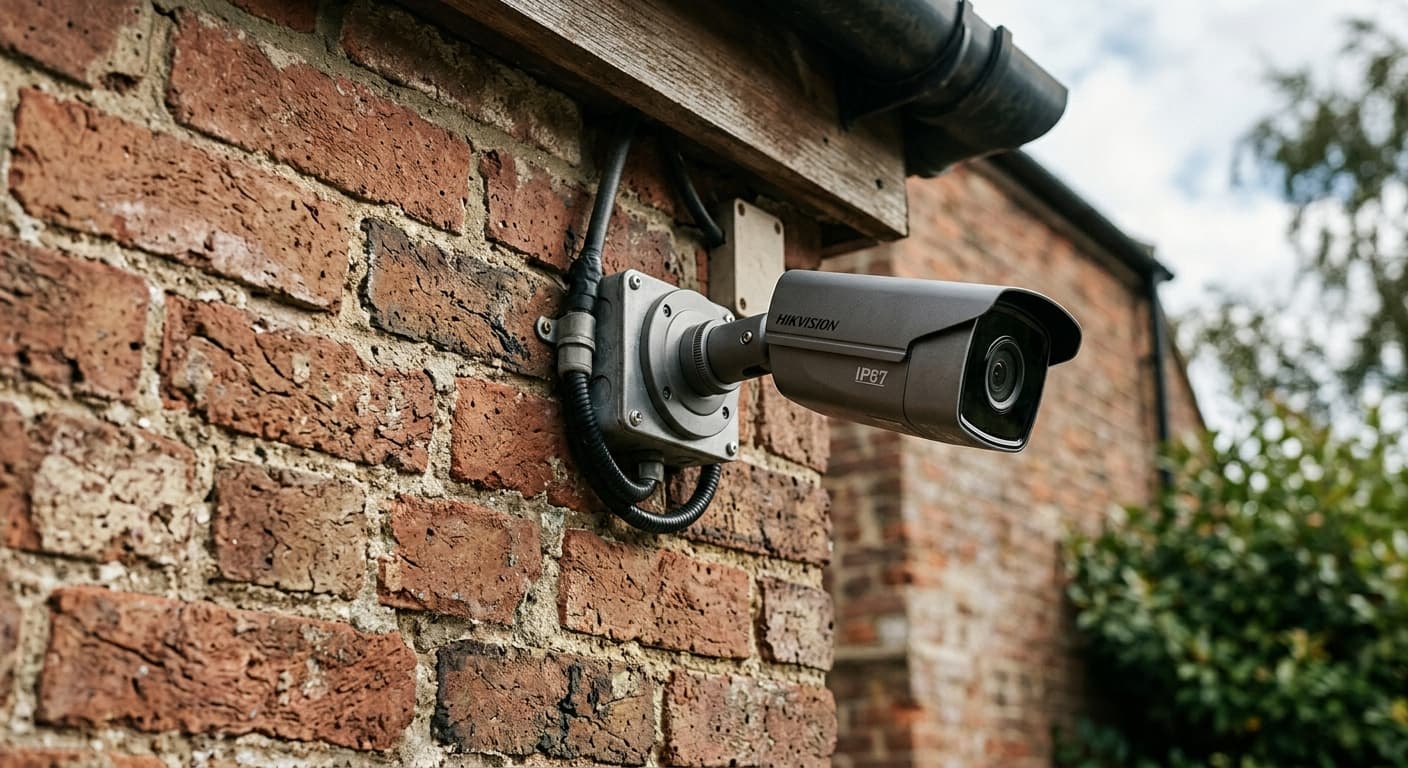
Montana homeowners and businesses may install silent security cameras on their own property in public-facing areas. Cameras that record audio require all-party knowledge under Mont. Code Ann. 45-8-213; visible warning signs satisfy that requirement. Cameras are prohibited in spaces where people have a reasonable expectation of privacy under Mont. Code Ann. 45-5-223.
Montana does not have a dedicated security camera statute. Instead, the legality of security camera use is governed by a combination of the privacy in communications law (MCA 45-8-213), the surreptitious visual observation statute (MCA 45-5-223), the state constitution's privacy protections, and general property rights principles.
This guide covers the rules for residential security cameras, commercial surveillance systems, cameras in common areas, and the boundaries that property owners must respect.
Residential Security Cameras
What Homeowners May Do
Montana homeowners have broad rights to install security cameras on their own property:
- Exterior cameras covering driveways, front doors, backyards, and property perimeters are generally lawful
- Video doorbells (such as Ring or similar devices) are permitted
- Indoor cameras in common areas of your own home (living rooms, kitchens, entryways) are generally permissible
- Motion-activated cameras and floodlight cameras on the exterior of your property are lawful
Restrictions on Residential Cameras
Even on your own property, certain placements are prohibited:
- Cameras must not be aimed to record inside a neighbor's home or into areas where neighbors have a reasonable expectation of privacy
- If your cameras capture audio, Montana's all-party knowledge requirement under MCA 45-8-213 applies; posting visible signage warning of audio recording can satisfy the warning exception
- Hidden cameras in bedrooms or bathrooms used by guests violate MCA 45-5-223, even in your own home
- Cameras should not be positioned to capture activity on neighboring properties where residents have a reasonable expectation of privacy
Audio-Enabled Security Cameras
Many modern security cameras include microphones for two-way audio communication. Under Montana law:
- The audio recording function brings the camera under MCA 45-8-213's consent requirements
- Visible signage warning that audio and video recording is in progress can satisfy the warning exception (MCA 45-8-213(2)(a)(iii))
- Signage should be placed at entry points where visitors will see it before entering the monitored area
- Some homeowners choose to disable the audio function to avoid triggering the consent requirement entirely
Recommended Signage Language
While Montana does not specify exact signage requirements, effective security camera signs should include:
- A clear statement that the area is under video surveillance
- If audio is enabled, a statement that audio may also be recorded
- Placement at conspicuous locations near entry points
Example: "This property is under video and audio surveillance."
Business Security Cameras
Permitted Business Camera Locations
Montana businesses may install security cameras in the following areas:
- Sales floors and retail areas: Cameras monitoring customer-accessible spaces
- Entrances, exits, and lobbies: Standard security monitoring points
- Parking lots and loading docks: Exterior surveillance of business property
- Cash registers and point-of-sale areas: Loss prevention cameras
- Warehouses and storage areas: Inventory protection
- Hallways and common areas: General security coverage
Prohibited Business Camera Locations
Businesses must not place cameras in:
- Restrooms: A camera capturing sexual or intimate parts here violates MCA 45-5-223's public-place prong; general (non-intimate) footage of a business restroom is not clearly reached by this statute's own text since it is not a "place of residence," though it remains unwise and may raise other privacy liability
- Changing rooms and fitting rooms: Same narrower analysis applies; a camera capturing sexual or intimate parts violates MCA 45-5-223
- Locker rooms and shower facilities: Employees and customers have a reasonable expectation of privacy regarding their bodies, and footage capturing sexual or intimate parts violates MCA 45-5-223
- Break rooms used for changing: If a break room doubles as a changing area, a camera capturing sexual or intimate parts there is prohibited under MCA 45-5-223
- Private offices (without employee knowledge): Hidden cameras in individual offices may violate the communications statute if audio is captured, and may violate MCA 45-5-223 if the footage captures sexual or intimate parts
Employee Notification
Montana businesses should notify employees of security camera placement:
- Include surveillance policies in employee handbooks
- Obtain signed acknowledgments from employees
- Post visible signage in monitored areas
- If cameras capture audio, the notification must satisfy MCA 45-8-213's warning requirement
- Montana's WDEA protections may be relevant if camera-related disputes lead to employment actions
Homeowners Associations and Shared Spaces
Homeowners associations (HOAs) in Montana may install security cameras in common areas of multi-unit properties, subject to the same rules that apply to other property surveillance.
HOA Camera Guidelines
- Cameras may be placed in shared hallways, parking garages, lobbies, pools, and fitness areas
- Cameras must not be positioned to view inside individual units
- Audio-enabled cameras in common areas require notice (signage) to satisfy MCA 45-8-213
- HOA governing documents should address camera policies
- Residents should be notified of camera locations and given the opportunity to raise concerns
Neighbor Disputes Over Security Cameras
Security camera disputes between neighbors are among the most common privacy conflicts in Montana. While no specific statute governs neighbor-to-neighbor camera disputes, several legal principles apply.
When a Neighbor's Camera Is Pointed at Your Property
If a neighbor's security camera captures activity on your property:
- Recording of areas visible from a public vantage point (such as your front yard) is generally not a privacy violation because there is a reduced expectation of privacy in areas visible to the public
- Recording into your home through windows or into fenced backyard areas where you have a reasonable expectation of privacy may give rise to legal claims
- Article II, Section 10 of the Montana Constitution provides the basis for privacy claims when a camera captures activity in areas where you reasonably expect privacy
- If a neighbor's camera captures audio of your private conversations, MCA 45-8-213 may be violated
Resolving Disputes
- Direct communication: Discuss the issue with your neighbor and request camera repositioning
- HOA mediation: If applicable, use HOA dispute resolution processes
- Civil action: File an invasion of privacy claim if the camera captures activity in private areas
- Law enforcement: If the camera placement rises to the level of criminal conduct (such as targeting bedrooms or bathrooms), contact local law enforcement
Commercial Surveillance Systems: Technical Requirements
While Montana does not impose specific technical requirements for security cameras, best practices include:
Camera Placement Best Practices
- Position cameras at a height that provides clear footage while being visible to those being recorded
- Aim cameras to cover your own property and public-facing areas, avoiding direct views into neighboring properties or private spaces
- Use signage to indicate monitored areas
- Regularly review camera angles to ensure they have not shifted to cover prohibited areas
Data Retention and Storage
Montana does not have a specific retention requirement for security camera footage. Recommended practices include:
- Establish a retention policy (30 to 90 days is common for general security footage)
- Preserve footage immediately if an incident occurs
- Store footage securely to prevent unauthorized access
- Be prepared to provide footage to law enforcement if lawfully requested (search warrant or subpoena)
Cloud Storage and Privacy
When security camera footage is stored in the cloud:
- The footage may be subject to the service provider's terms of use and privacy policy
- Law enforcement may access cloud-stored footage through a warrant or court order directed at the provider
- Montana's constitutional privacy protections may influence how courts analyze law enforcement requests for cloud-stored surveillance footage
Drone Surveillance
Montana restricts the use of drone-obtained evidence through MCA 46-5-109. Information gathered by a drone is not admissible in a Montana prosecution or other proceeding, and cannot support a search warrant affidavit, unless it was obtained under a search warrant, a judicially recognized exception to the warrant requirement, or during the investigation of a motor vehicle crash scene on a public roadway.
This is an evidentiary rule rather than a general ban on drone surveillance: it does not itself criminalize flying a drone over a neighbor's property, but it does mean that drone footage of a person in a place where they have a reasonable expectation of privacy generally cannot be used in court unless law enforcement obtained it with a warrant or a recognized warrant exception.
Penalties for Illegal Camera Placement
Criminal Penalties
| Offense | Statute | Classification | Maximum Penalty |
|---|---|---|---|
| Hidden camera in private space | MCA 45-5-223 | Misdemeanor | 6 months jail, $500 fine |
| Audio recording without warning | MCA 45-8-213(1)(c) | Misdemeanor (first) | 6 months jail, $500 fine |
| Repeat harassment or extortion violation (not audio recording) | MCA 45-8-213(4)(c) | Felony (third+) | 5 years prison, $10,000 fine |
| Drone-obtained evidence without a warrant | MCA 46-5-109 | Evidentiary bar | Excluded from prosecutions and proceedings |
Civil Liability
Improper security camera placement can also result in civil liability:
- Invasion of privacy tort claims
- Constitutional privacy claims under Article II, Section 10
- Nuisance claims if cameras create an unreasonable interference with a neighbor's use of their property
- Trespass claims if cameras are physically mounted on someone else's property
More Montana Recording Laws
Audio Recording | Video Recording | Voyeurism & Hidden Cameras | Workplace Recording | Recording Police | Phone Call Recording | Security Cameras | Recording in Public | Landlord-Tenant | Dashcam Laws | Schools | Medical Recording
Back to Montana Recording Laws
More Montana Recording Topics
See Also
- Montana Surveillance Camera Laws covers home, HOA, neighbor, workplace, and landlord camera rules in Montana.
More Montana Laws
Frequently Asked Questions
Do I need a permit to install security cameras on my property in Montana?
Montana does not require a permit specifically for installing security cameras on your own property. Standard building permits may apply if the installation involves electrical work. However, you must comply with privacy laws: cameras cannot be aimed into areas where others have a reasonable expectation of privacy, and audio-enabled cameras require notice under MCA 45-8-213.
Can my security camera record audio in Montana?
Security cameras with audio capability trigger MCA 45-8-213. The safest way to comply is to post visible signage warning visitors that audio and video recording is in progress, which satisfies the warning exception. Some homeowners choose to disable the audio function to avoid the consent issue entirely.
Can my neighbor point a security camera at my house in Montana?
It depends on what the camera captures. A camera recording areas visible from public spaces (like your front yard) is generally permissible. A camera aimed to record through your windows or into fenced private areas may violate Montana's constitutional right to privacy. If the camera captures audio of your conversations, MCA 45-8-213 may be violated. You can request repositioning or pursue legal remedies if your privacy is being infringed.
Can a business put cameras in employee break rooms in Montana?
It depends on the nature of the break room. If the break room is used solely for eating and socializing, a visible camera may be permissible with proper notice. If the break room is also used for changing clothes, a camera capturing sexual or intimate parts there is prohibited under MCA 45-5-223; general (non-intimate) footage of the room sits outside this specific statute's text but remains inadvisable. Audio-enabled cameras in any break room require compliance with MCA 45-8-213. Clear signage and written policies are recommended.
How long must I keep security camera footage in Montana?
Montana does not have a specific legal requirement for how long security camera footage must be retained. Most businesses and homeowners follow a 30 to 90 day retention policy for general footage. If an incident occurs, preserve the footage immediately. Law enforcement may request footage through a warrant or subpoena, so having a consistent retention policy is important.
Updates
Narrowed overstated claims that Montana's voyeurism statute bars all camera footage in restrooms, changing rooms, and locker rooms; the statute specifically reaches recording of sexual or intimate parts.
Independently fact-checked against the cited primary sources; governing law re-checked for recent changes
Governing law re-checked for recent changes
Corrected the drone surveillance section to cite Montana's actual UAV statute (MCA 46-5-109, an evidence-admissibility rule) instead of the flag-desecration statute it was mistakenly linked to, fixed a penalties-table row implying repeat audio-recording violations escalate to felony (that escalation applies only to harassment/extortion violations), and fixed a wrong subsection pinpoint cite for the signage warning exception.
Governing law re-checked for recent changes
Reviewed and approved by an editor
The Law Behind This Article
This article rests on the statutory provisions below, held in our own legal record and retrieved from the official source. Tap a section to read the operative text.
Montana Code Annotated, Title 45
§ 45-5-223Surreptitious Visual Observation Or Recordation -- Place Of Residence -- Public Place -- ExceptionsIn forcecited in 9 of our articles
45-5-223. Surreptitious visual observation or recordation -- place of residence -- public place -- exceptions. (1) A person commits the offense of surreptitious visual observation or recordation in a place of residence if the person purposely or knowingly hides, waits, or otherwise loiters in person or by means of a remote electronic device within or in the vicinity of a private dwelling house, apartment, or other place of residence for the purpose of: (a) watching, gazing at, or looking upon any occupant in the residence in a surreptitious manner without the occupant's knowledge; or (b) by means of an electronic device, surreptitiously observing or recording the visual image of any occupant in the residence without the occupant's knowledge. (2) A person commits the offense of surreptitious visual observation or recordation in public if the person purposely or knowingly observes or records a visual image of the sexual or intimate parts of another person in a public place without the other person's knowledge when the victim has a reasonable expectation of privacy.
Official text (excerpt) · last checked 2026-08-31 · Read the full text in our law library · Verify at mca.legmt.gov
Cited in 1 court opinions in our collectionLatest citing opinion in our collection: 2026
Opinions citing this section in our collection:
- United States v. Watkins (Court of Appeals for the Tenth Circuit 2026)“…nn. § 609.746;1 Miss. Code Ann. § 97-29-61;2 MPC § 250.12;1 Mont. Code Ann. 45-5-223;3 Neb. Rev. Stat. § 28-311.08; Nev. Rev…”
Identified automatically from the court opinions citing this section — not a ranking of which case controls.
Also relied on in: Montana Video Recording Laws: Consent Rules, Surveillance, and Penalties (2026), Montana Recording Laws (2026): Announcement Exception and Penalties, Montana Laws on Recording in Public: First Amendment Rights and Limitations (2026)
§ 45-8-213Privacy In CommunicationsIn forcecited in 23 of our articles
45-8-213. Privacy in communications. (1) Except as provided in 69-6-104, a person commits the offense of violating privacy in communications if the person knowingly or purposely: (a) with the purpose to terrify, intimidate, threaten, harass, or injure, communicates with a person by electronic communication and threatens to inflict injury or physical harm to the person or property of the person or makes repeated use of obscene, lewd, or profane language or repeated lewd or lascivious suggestions; (b) uses an electronic communication to attempt to extort money or any other thing of value from a person or to disturb by repeated communications the peace, quiet, or right of privacy of a person at the place where the communications are received; (c) records or causes to be recorded a conversation by use of a hidden electronic or mechanical device that reproduces a human conversation without the knowledge of all parties to the conversation; (d) with the purpose to terrify, intimidate, threaten, harass, or injure or to obtain money or other valuable consideration, publishes, distributes, or discloses real or digitally fabricated printed or electronic photographs, pictures, images, or…
Official text (excerpt) · last checked 2026-08-31 · Read the full text in our law library · Verify at mca.legmt.gov
Cited in 23 court opinions in our collectionLatest citing opinion in our collection: 2025
In the courts (editorial summary, independently checked):State v. Dugan (2013) struck the statute's prima facie intent clause as overbroad. State v. Brown (1988) noted the statute still bars recording without all participants' permission and rejected an overbreadth attack on its public-official exception. State v. DuBray (2003) found no violation where the defendant knew of the recording.
Opinions citing this section in our collection:
- State v. Smith (Montana Supreme Court 2004, 322 Mont. 206)✓A man who phoned threats to kill his estranged wife's boyfriend argued he should have been charged under section 45-8-213(1)(a) instead of assault with a weapon. The court held the two statutes punish different conduct, so the charge was within prosecutorial discretion.
- State v. Dugan (Montana Supreme Court 2013, 369 Mont. 39)“…rbroad, the Court today strikes the prima facie language in § 45-8-213, MCA. However, a narrow application would be…”
- In re C.S. (Montana Supreme Court 1984, 210 Mont. 144)“…n of privacy in communication, a misdemeanor as provided in Section 45-8-213, MCA. The facts underlying the offense were…”
Identified automatically from the court opinions citing this section — not a ranking of which case controls.
Also relied on in: Montana Landlord-Tenant Recording Laws: Camera Rules, Privacy Rights, and Disputes (2026), Montana Voyeurism Laws: Hidden Cameras, Peeping, and Penalties (2026), Montana Smart Glasses Recording Laws (MCA 45-8-213)
Montana Code Annotated, Title 46
§ 46-5-109Limitations On Unmanned Aerial VehiclesIn forcecited in 3 of our articles
46-5-109. Limitations on unmanned aerial vehicles. (1) In any prosecution or proceeding within the state of Montana, information from an unmanned aerial vehicle is not admissible as evidence unless the information was obtained: (a) pursuant to the authority of a search warrant; (b) in accordance with judicially recognized exceptions to the warrant requirement; or (c) during the investigation of a motor vehicle crash scene that occurs on or involves a public roadway. (2) Information obtained from the operation of an unmanned aerial vehicle may not be used in an affidavit of probable cause in an effort to obtain a search warrant unless the information was obtained under the circumstances described in subsection (1)(a), (1)(b), or (1)(c). (3) For the purposes of this section, "unmanned aerial vehicle" means an aircraft that is operated without direct human intervention from on or within the aircraft. The term does not include satellites.
Official text (excerpt) · last checked 2026-08-31 · Read the full text in our law library · Verify at mca.legmt.gov
Also relied on in: Montana Drone Laws (2026): Warrants, Trespass & Hunting
Search our full record of US law — 2.1 million sections, every state + federal →
Sources and References
- Montana Code Annotated 45-8-213 - Privacy in Communications(leg.mt.gov).gov
- Montana Code Annotated 45-5-223 - Surreptitious Visual Observation or Recordation(leg.mt.gov).gov
- Montana Constitution Article II, Section 10 - Right of Privacy(leg.mt.gov).gov
- MCA 46-5-109 - Limitations on Unmanned Aerial Vehicles(mca.legmt.gov).gov
- Montana Wrongful Discharge from Employment Act - MCA 39-2-901 to 39-2-915(leg.mt.gov).gov
- Montana Code Annotated 45-8-213 - Privacy in Communications(mca.legmt.gov).gov
- Montana Code Annotated 45-5-223 - Surreptitious Visual Observation or Recordation(mca.legmt.gov).gov
- Montana Constitution Article II, Section 10 - Right of Privacy(mca.legmt.gov).gov
- MCA 46-5-109 - Limitations on Unmanned Aerial Vehicles(mca.legmt.gov).gov
- Montana Wrongful Discharge from Employment Act - MCA 39-2-901 to 39-2-915(mca.legmt.gov).gov