
Ohio
Ohio Knife Laws (2026): Preemption, Schools, and Ballistic Knives
Independently fact-checked against primary sources (last audited September 24, 2026). · 7 primary sources cited on this page. How we verify our legal content

Ohio's concealed-weapons statute excludes an ordinary knife from the definition of "deadly weapon" unless it was actually used, carried, or possessed as one, so carrying a knife concealed is not, by itself, the crime of carrying a concealed weapon under that statute. That carve-out is limited to the concealed-carry statute itself; it does not extend to a ballistic knife, which the same chapter classifies as "dangerous ordnance" and bans outright, or to Ohio's school-safety-zone and courthouse weapons offenses, which use a broader "deadly weapon" definition with no knife exclusion. Ohio's statewide firearms-preemption statute has covered knives since September 13, 2022, when Senate Bill 156 added them; a later 2025 amendment added a fee-and-insurance clause to that preemption but did not first bring knives under it.
Jurisdiction scope: This page covers Ohio state law only, principally Ohio Rev. Code §§ 2923.11, 2923.12, 2923.17, 2923.122, 2923.123, 3313.66, and 9.68. It does not cover Ohio's concealed handgun license statutes in detail, since those govern handguns rather than knives.
Can you carry a knife openly or concealed in Ohio?
For an ordinary knife not used as a weapon, yes, both openly and concealed, under Ohio's concealed-weapons statute. § 2923.12(H) states: "For purposes of this section, 'deadly weapon' or 'weapon' does not include any knife, razor, or cutting instrument if the instrument was not used as a weapon." That carve-out is limited to § 2923.12 itself; it does not rewrite the general "deadly weapon" definition in § 2923.11(A), which applies throughout §§ 2923.11 to 2923.24 of the Revised Code and has no knife exclusion. Because an unused ordinary knife is not a "deadly weapon" for purposes of the concealed-carry statute, simply carrying one concealed is not, by itself, the offense of carrying a concealed weapon under § 2923.12. This is a use-based test rather than a named-type or blade-length rule: a state with a bowie-knife or switchblade ban asks what kind of knife it is, while Ohio asks what the person did with it in the section where the carve-out applies.
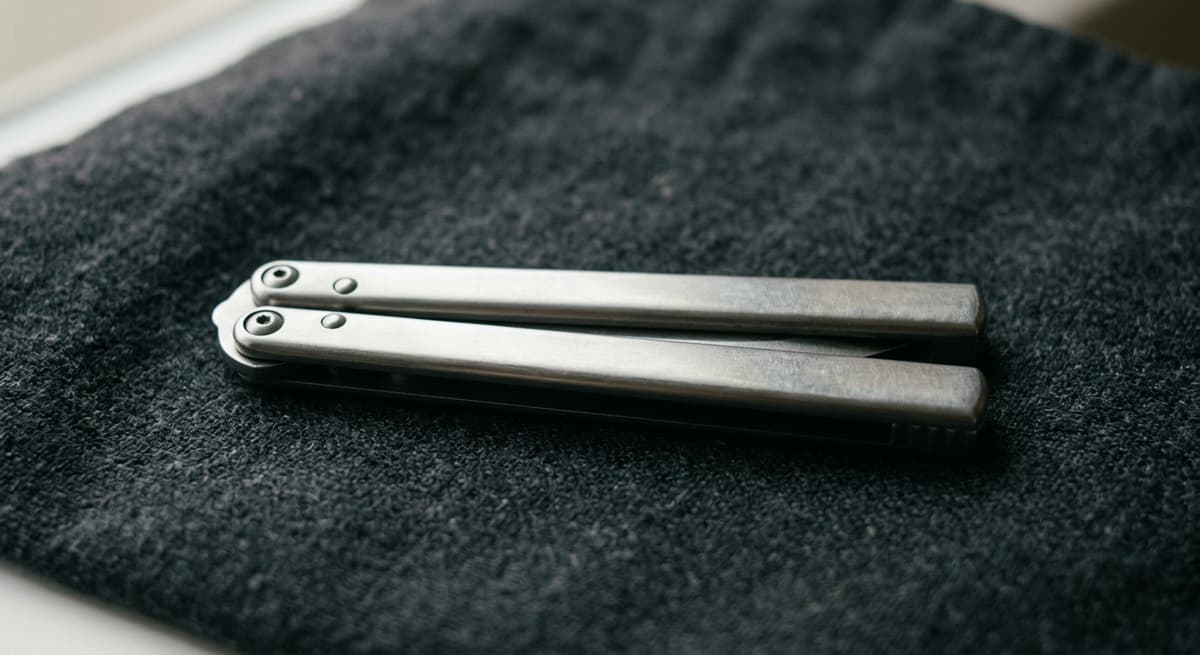
§ 2923.12(A)(1) provides that "no person shall knowingly carry or have, concealed on the person's person or concealed ready at hand," a "deadly weapon other than a handgun." Because § 2923.12(H) excludes an unused knife from that term, this provision does not reach ordinary concealed knife carry. A knife actually used, or carried with the purpose of using it, as a weapon can still qualify as a "deadly weapon" and trigger the statute; the exclusion protects carrying and possession, not use.
Ballistic knives: dangerous ordnance, banned outright
Ohio's knife-friendly definition has one sharp exception. § 2923.11(J) defines a "ballistic knife" as "a knife with a detachable blade that is propelled by a spring-operated mechanism." § 2923.11(K)(1) then classifies a ballistic knife as "dangerous ordnance," a separately defined term that is not subject to the § 2923.12(H) knife carve-out, because that carve-out applies only to "deadly weapon" and "weapon" as used in § 2923.12, not to "dangerous ordnance."
Two statutes follow from that classification. § 2923.12(A)(3) makes it unlawful to knowingly carry or have concealed on the person, or concealed ready at hand, "a dangerous ordnance," with no exception for lawful use and no affirmative defense available (the § 2923.12(D) defensive-purposes defense applies only to a charge under division (A)(1), not (A)(3)). Separately, § 2923.17(A) bans possessing a ballistic knife: "No person shall knowingly acquire, have, carry, or use any dangerous ordnance." § 2923.17(C) exempts eight narrow categories, including law-enforcement and military personnel acting within the scope of their duties and the holder of a license or temporary permit issued under § 2923.18, so the ban is not absolute, but none of those exemptions helps an ordinary owner. A violation of § 2923.17(A) is a felony of the fifth degree under § 2923.17(D). Carrying a ballistic knife concealed under § 2923.12(A)(3) is a felony of the fourth degree under § 2923.12(F)(1), because the weapon involved is dangerous ordnance.
Schools: a safety-zone offense
§ 2923.122(A) and (B) make it a felony to knowingly convey, attempt to convey, or possess a deadly weapon or dangerous ordnance in a school safety zone, a felony of the fifth degree under § 2923.122(E)(1), rising to a fourth-degree felony on a repeat offense. The knife carve-out that protects an unused knife under the concealed-carry statute does not carry over here: § 2923.122 draws on § 2923.11(A)'s general definition of "deadly weapon" ("any instrument, device, or thing capable of inflicting death, and designed or specially adapted for use as a weapon, or possessed, carried, or used as a weapon"), which contains no knife exclusion of its own. A knife designed or specially adapted for use as a weapon, or possessed, carried, or used as one, in a school safety zone can be charged under this section even though the same knife carried the same way outside a school safety zone would fall within the § 2923.12(H) carve-out. A ballistic knife, as dangerous ordnance, is banned in a school safety zone regardless of use.

§ 2923.122(D) exempts law enforcement officers and certain state and federal officers and employees acting within the scope of their duties, a school security officer on duty under a board of education contract, and any other person with written authorization from the board of education or governing body of a school who has completed required training and whose authorization has been publicly disclosed by the board.
A separate, non-criminal exposure runs alongside the safety-zone offense. § 3313.66(B)(3) lets the board of education of a city, exempted village, or local school district adopt a resolution authorizing the superintendent to expel a pupil for up to a year for bringing, or possessing, "a knife capable of causing serious bodily injury" at a school or a board-controlled property, interscholastic competition, extracurricular event, or other school program. § 3313.661 requires the board's policy to define "knife capable of causing serious bodily injury" for that purpose, so the operative standard is set locally, district by district, rather than by a single statewide definition. This expulsion authority is independent of § 2923.122 and can reach an ordinary pocketknife that would clear the § 2923.12(H) carve-out everywhere else.
Courthouses: a parallel offense
§ 2923.123 imposes a parallel felony for a deadly weapon or dangerous ordnance in a courthouse or another building or structure in which a courtroom is located. § 2923.123(A) bans knowingly conveying or attempting to convey such a weapon into a courthouse; § 2923.123(B) bans knowingly possessing it or having it under the person's control there. Like § 2923.122, this section draws on § 2923.11(A)'s general "deadly weapon" definition rather than the § 2923.12(H) concealed-carry carve-out, so the same knife-exclusion limits described above for school safety zones apply here. A violation of (A) or (B) is a felony of the fifth degree under § 2923.123(D), rising to a fourth degree on a prior conviction under (A) or (B). § 2923.123(C) exempts judges, magistrates, peace officers, and other law-enforcement personnel acting within the scope of their duties, along with a weapon conveyed or possessed for use as evidence in a pending case.
Statewide preemption now reaches knives
Ohio Rev. Code § 9.68, the state's uniform-firearms-law statute, was amended effective September 13, 2022 by Senate Bill 156 to add knives to its scope. § 9.68(C)(4) defines "knife" for purposes of the section as "a cutting instrument" that "includes a sharpened or pointed blade." The operative text provides that, subject to exceptions under the federal or state constitutions or federal or state law, a person "may own, possess, purchase, acquire, transport, store, carry, sell, transfer, manufacture, or keep any firearm, part of a firearm, its components, and its ammunition, and any knife, without being required to have firearm liability insurance, and without being required to pay a fee for the possession of a firearm, part of a firearm, its components, its ammunition, or a knife," and that the state "preempts, supersedes, and declares null and void any such further license, permission, restriction, delay, or process" imposed by a political subdivision. The fee-and-insurance clause and a companion definition of "firearm liability insurance" at § 9.68(C)(6) were added by a later amendment, Senate Bill 58, effective April 9, 2025; that 2025 amendment did not first bring knives into the section, which already covered them. § 9.68(D) exempts two categories of local zoning ordinance from this preemption: a zoning ordinance that regulates or prohibits the commercial sale of knives in an area zoned residential or agricultural, and a zoning ordinance that sets the hours or geographic areas for the commercial sale of knives, provided it is consistent with zoning for other retail establishments in the same area and does not amount to a de facto prohibition. § 9.68(B) allows a person, group, or entity adversely affected by a conflicting local ordinance, rule, regulation, resolution, or practice outside those exceptions to bring a civil action against the political subdivision for damages, declaratory relief, injunctive relief, or a combination of those remedies. A local ordinance regulating knives that predates September 2022 may not yet have been repealed even though it has not been enforceable against the preemption statute since that date.

Federal law: what it does and does not reach
Federal law does not ban an individual from owning or carrying a switchblade. The Federal Switchblade Act, 15 U.S.C. §§ 1241 to 1245, restricts interstate commerce in switchblade knives, barring their manufacture for, or introduction, transport, and sale in, interstate commerce, and, in 15 U.S.C. § 1245, makes it a federal offense to knowingly possess, manufacture, sell, or import a ballistic knife in or affecting interstate commerce or within federal territorial jurisdiction. The two switchblade offense sections, §§ 1242 and 1243, do not apply to certain knives and people, listed as exemptions in 15 U.S.C. § 1244. A 2009 amendment, § 1244(5), exempts any knife with a spring, detent, or other closure-bias mechanism that requires hand, wrist, or arm exertion on the blade itself to overcome the bias and assist opening, the carve-out that keeps modern assisted-opening folding knives legal in interstate commerce. A separate exemption, § 1244(4), covers a person with only one arm possessing or carrying a switchblade with a blade three inches or less. Ohio's own dangerous-ordnance ballistic-knife ban under § 2923.17 is a state offense independent of these federal exemptions.
Disclaimer: This article provides general legal information about Ohio's knife laws as of September 2026. It is not legal advice. Consult a lawyer licensed in Ohio for advice about a specific situation.
For a state-by-state comparison, see knife laws by state. Ohio's self-defense statutes are covered separately on the Ohio self-defense laws page.
Statutes cited reflect their in-force version as of 2026-09-18. Last updated: 2026-09-18.
Frequently Asked Questions
Is it legal to carry a pocket knife concealed in Ohio?
Generally yes. Ohio Rev. Code 2923.12(H) excludes a knife, razor, or cutting instrument from the definition of 'deadly weapon' or 'weapon' 'for purposes of this section' unless it was used as a weapon, so an ordinary knife carried concealed but not used as a weapon does not violate the concealed-carry statute, 2923.12.
Are switchblades illegal in Ohio?
An ordinary automatic-opening knife is not named or banned by Ohio's general weapons statutes and is treated the same as any other knife under the 2923.12(H) use-based test. A ballistic knife, which has a detachable, spring-propelled blade, is a different, separately defined item classified as dangerous ordnance and banned outright under 2923.17.
Does Ohio preempt local knife ordinances?
Yes, since 2022. Ohio Rev. Code 9.68 was amended effective September 13, 2022 (Senate Bill 156) to add knives to the state's uniform firearms-preemption statute, so a political subdivision generally cannot regulate the ownership, possession, carrying, sale, or transfer of knives beyond what state law allows. A later amendment effective April 9, 2025 added a fee-and-insurance clause to that preemption; it did not first bring knives into the statute.
Can you carry a knife on school property in Ohio?
Ohio Rev. Code 2923.122 bans conveying or possessing a deadly weapon or dangerous ordnance in a school safety zone, a felony of the fifth degree. The knife carve-out at 2923.12(H) applies only to the concealed-carry statute and does not reach this section, which uses 2923.11(A)'s general 'deadly weapon' definition with no knife exclusion, so a knife designed or used as a weapon in a school safety zone can be charged even though the same knife would be protected under 2923.12 elsewhere. A ballistic knife is banned there regardless of use as dangerous ordnance. Separately, 3313.66(B)(3) lets a local school board adopt a resolution expelling a pupil for up to a year for bringing or possessing a 'knife capable of causing serious bodily injury,' a term each district's policy defines for itself under 3313.661, so an ordinary pocketknife that clears the criminal statutes can still lead to expulsion.
Can you carry a knife into an Ohio courthouse?
No. Ohio Rev. Code 2923.123 bans knowingly conveying or possessing a deadly weapon or dangerous ordnance in a courthouse or another building where a courtroom is located, a felony of the fifth degree. Like the school-safety-zone offense, this section uses 2923.11(A)'s general 'deadly weapon' definition rather than the concealed-carry carve-out, so an ordinary knife designed or used as a weapon is not protected here.
What penalty applies to carrying a concealed knife in Ohio?
Carrying a deadly weapon concealed under 2923.12(A) is generally a first-degree misdemeanor, rising to a fourth-degree felony for a prior conviction, a prior offense of violence, or if the weapon involved is dangerous ordnance, and to a third-degree felony aboard an aircraft. An ordinary knife not used as a weapon is not a 'deadly weapon' and does not trigger this offense at all.
Updates
Independently fact-checked against the cited primary sources
Independently fact-checked against the cited primary sources
The Law Behind This Article
This article rests on the statutory provisions below, held in our own legal record and retrieved from the official source. Tap a section to read the operative text.
Ohio Revised Code
§ 2923.12Carrying concealed weaponsIn forcecited in 3 of our articles
(A) No person shall knowingly carry or have, concealed on the person's person or concealed ready at hand, any of the following: (1) A deadly weapon other than a handgun; (2) A handgun other than a dangerous ordnance; (3) A dangerous ordnance.
Official text (excerpt) · last checked 2026-07-31 · Read the full text in our law library · Verify at codes.ohio.gov
Cited in 1,193 court opinions in our collectionLatest citing opinion in our collection: 2026
Opinions citing this section in our collection:
- State v. Butler (Ohio Supreme Court 1989, 42 Ohio St. 3d 174)“…d with the question of whether carrying a concealed weapon, R.C. 2923.12(A), 2 is a nonprobationable offense pu…”
- Klein v. Leis (Ohio Supreme Court 2003, 99 Ohio St. 3d 537)“…538 {¶ 1} Appellees challenged the constitutionality of R.C. 2923.12, 2923.16, 4749.06, and 4749.10, faciall…”
- State v. Gregory (Ohio Court of Appeals 1993, 90 Ohio App. 3d 124)“…1, and one count of carrying a concealed weapon pursuant to R.C. 2923.12(A). A jury trial commenced on March 15,…”
Identified automatically from the court opinions citing this section — not a ranking of which case controls.
Also relied on in: Knife Laws by State (2026): Carry Rules, Blade Limits, Penalties, Ohio Pepper Spray and Stun Gun Laws (2026)
§ 2923.11Weapons control definitionsIn forcecited in 3 of our articles
As used in sections 2923.11 to 2923.24 of the Revised Code: (A) "Deadly weapon" means any instrument, device, or thing capable of inflicting death, and designed or specially adapted for use as a weapon, or possessed, carried, or used as a weapon.
Official text (excerpt) · last checked 2026-07-31 · Read the full text in our law library · Verify at codes.ohio.gov
Cited in 839 court opinions in our collectionLatest citing opinion in our collection: 2026
Opinions citing this section in our collection:
- State v. Thompkins (Ohio Supreme Court 1997, 78 Ohio St. 3d 380)“…readily rendered operable. Further, firearm is defined in R.C. 2923.11(B)(1) as “any deadly weapon capable of…”
- State v. Murphy (Ohio Supreme Court 1990, 49 Ohio St. 3d 206)“…ame meaning as in section 2923.11 of the Revised Code[.]” R.C. 2923.11(B) defines “firearm” as follows: “ ‘F…”
- State v. Hanning (Ohio Supreme Court 2000, 89 Ohio St. 3d 86)“…r pellet gun does not fit the definition of a firearm under R.C. 2923.11(B), which defines the term as “any dead…”
Identified automatically from the court opinions citing this section — not a ranking of which case controls.
Also relied on in: Pepper Spray and Stun Gun Laws by State (2026)
§ 2923.17Unlawful possession of dangerous ordnance - illegally manufacturing or processing explosivesIn force
(A) No person shall knowingly acquire, have, carry, or use any dangerous ordnance. (B) No person shall manufacture or process an explosive at any location in this state unless the person first has been issued a license, certificate of registration, or permit to do so from a fire official of a…
Official text (excerpt) · last checked 2026-07-31 · Read the full text in our law library · Verify at codes.ohio.gov
Cited in 154 court opinions in our collectionLatest citing opinion in our collection: 2026
Opinions citing this section in our collection:
- State v. Butler (Ohio Supreme Court 1989, 42 Ohio St. 3d 174)“…guilty to unlawful possession of a dangerous ordnance under R.C. 2923.17(A) is eligible for probation pursuant t…”
- State v. Jordan (Ohio Supreme Court 2000, 89 Ohio St. 3d 488)“…ul possession of dangerous ordnance in violation of R.C. 2923.17—State not required to prove that…”
- State v. Musleh (Ohio Court of Appeals 2017, 2017 Ohio 8166)“…nlawful possession of a dangerous ordnance in violation of R.C. 2923.17(A). Musleh contends that the trial cour…”
Identified automatically from the court opinions citing this section — not a ranking of which case controls.
§ 2923.122Illegal conveyance or possession of deadly weapon or dangerous ordnance or of object indistinguishable from firearm in school safety zoneIn forcecited in 2 of our articles
(A) No person shall knowingly convey, or attempt to convey, a deadly weapon or dangerous ordnance into a school safety zone. (B) No person shall knowingly possess a deadly weapon or dangerous ordnance in a school safety zone.
Official text (excerpt) · last checked 2026-07-31 · Read the full text in our law library · Verify at codes.ohio.gov
Cited in 28 court opinions in our collectionLatest citing opinion in our collection: 2025
Opinions citing this section in our collection:
- Gabbard v. Madison Local School Dist. Bd. of Edn. (Slip Opinion) (Ohio Supreme Court 2021, 179 N.E.3d 1169)“…education—School employees—R.C. 109.78(D)—R.C. 2923.122(D)(1)(a)—Authorization to carry a deadl…”
- In Re Gochneaur, 2007-A-0089 (7-25-2008) (Ohio Court of Appeals 2008, 2008 Ohio 3987)“…ng a deadly weapon in a school safety zone, in violation of R.C. 2923.122 (B). We affirm. {¶ 2} March…”
- State v. Ritchie (Ohio Court of Appeals 2007, 174 Ohio App. 3d 582)“…sion of a deadly weapon on school premises, in violation of R.C. 2923.122(A). Appellant appeared before the trial…”
Identified automatically from the court opinions citing this section — not a ranking of which case controls.
§ 2923.123Illegal conveyance of deadly weapon or dangerous ordnance into courthouse - illegal possession or control in courthouseIn forcecited in 2 of our articles
(A) No person shall knowingly convey or attempt to convey a deadly weapon or dangerous ordnance into a courthouse or into another building or structure in which a courtroom is located.
Official text (excerpt) · last checked 2026-07-31 · Read the full text in our law library · Verify at codes.ohio.gov
Cited in 9 court opinions in our collectionLatest citing opinion in our collection: 2024
Opinions citing this section in our collection:
- Gabbard v. Madison Local School Dist. Bd. of Edn. (Slip Opinion) (Ohio Supreme Court 2021, 179 N.E.3d 1169)“…109.69); R.C. 2923.121(F)(2) (referring to R.C. 109.541); R.C. 2923.123(C)(4) (referring to R.C. 109.77). For a…”
- City of Cincinnati v. Baskin (Ohio Supreme Court 2006, 112 Ohio St. 3d 279)“…121), school safety zones (R.C. 2923.122), and courthouses (R.C. 2923.123) and on the discharge of firearms at pe…”
- State v. Peters (Ohio Court of Appeals 2023, 231 N.E.3d 37)“…conveyance of deadly weapon or ordnance into a courthouse [R.C. 2923.123], improperly handling firearms in a mo…”
Identified automatically from the court opinions citing this section — not a ranking of which case controls.
§ 2923.18License or temporary permit to possess or use dangerous ordnanceIn force
(A) Upon application to the sheriff of the county or safety director or police chief of the municipality where the applicant resides or has the applicant's principal place of business, and upon payment of the fee specified in division (B) of this section, a license or temporary permit shall be…
Official text (excerpt) · last checked 2026-07-31 · Read the full text in our law library · Verify at codes.ohio.gov
Cited in 3 court opinions in our collectionLatest citing opinion in our collection: 2002
Opinions citing this section in our collection:
- Northeast Ohio Regional Sewer District v. City of Brooklyn (Ohio Court of Appeals 1989, 64 Ohio App. 3d 57)“…en the ordinance and the general laws of Ohio, specifically R.C. 2923.18 and 715.60, and that the ordinance is n…”
- State v. Thompson (Ohio Court of Appeals 1988, 46 Ohio App. 3d 157)“…counts of having a weapon under disability in violation of R.C. 2923.18(A)(2), and one count of carrying a conc…”
- State v. Newton, Unpublished Decision (9-24-2002) (Ohio Court of Appeals 2002)“…ed one count of carrying a concealed weapon in violation of R.C. 2923.18 and one count of receiving stolen prop…”
Identified automatically from the court opinions citing this section — not a ranking of which case controls.
§ 3313.66Suspension, expulsion or permanent exclusion - removal from curricular or extracurricular activitiesIn force
As specified in section 3314.03 of the Revised Code, each community school established under Chapter 3314. of the Revised Code shall comply with this section as if it were a school district.
Official text (excerpt) · last checked 2026-07-31 · Read the full text in our law library · Verify at codes.ohio.gov
Cited in 38 court opinions in our collectionLatest citing opinion in our collection: 2020
Opinions citing this section in our collection:
- Fenton v. Query (Ohio Court of Appeals 1992, 78 Ohio App. 3d 731)“…rom attending Norwood High School until all requirements of Ohio Rev.Code § 3313.66 have been satisfied.” Except for filing…”
- Helmeci v. Registrar, Bureau of Motor Vehicles (Ohio Court of Appeals 1991, 75 Ohio App. 3d 172)“…appellant’s suspension or expulsion from school pursuant to R.C. 3313.66 due to “the use or possession of alcoho…”
- Neague v. Worthington City School District (Ohio Court of Appeals 1997, 122 Ohio App. 3d 433)“…[sic ] appellee, board of education, from compliance with O.R.C. Sec. 3313.66. “Assignment of Error No. 5…”
Identified automatically from the court opinions citing this section — not a ranking of which case controls.
Ohio Revised Code, Chapter 9: Miscellaneous
§ 9.68Regulation of arms prohibited - challenging political subdivisionsIn forcecited in 3 of our articles
(A) The individual right to keep and bear arms, being a fundamental individual right that predates the United States Constitution and Ohio Constitution, and being a constitutionally protected right in every part of Ohio, the general assembly finds the need to provide uniform laws throughout the…
Official text (excerpt) · last checked 2026-07-31 · Read the full text in our law library · Verify at codes.ohio.gov
United States Code Title 15
§ 1241DefinitionsIn forcecited in 52 of our articles
As used in this chapter— The term “interstate commerce” means commerce between any State, Territory, possession of the United States, or the District of Columbia, and any place outside thereof. The term “switchblade knife” means any knife having a blade which opens automatically— by hand pressure applied to a button or other device in the handle of the knife, or by operation of inertia, gravity, or both.
Official text (excerpt) · last checked 2026-07-28 · Read the full text in our law library · Verify at uscode.house.gov
Cited in 15 court opinions in our collectionLatest citing opinion in our collection: 2014
Opinions citing this section in our collection:
- Stewart A. Taylor, D/B/A Taylor Cutlery Mfg. Co. v. United States of America (Court of Appeals for the Sixth Circuit 1988, 848 F.2d 715)“…Service, are not switchblade knives within the meaning of 15 U.S.C. § 1241 (b) and 19 C.F.R. § 1295 (a)(1). The d…”
- Crowley Cutlery Company v. United States of America and Commissioner of Customs of the United States Customs Service (Court of Appeals for the Seventh Circuit 1988, 849 F.2d 273)“…Illinois for a declaration that the Switchblade Knife Act, 15 U.S.C. §§ 1241 et seq., which forbids th…”
- Edna Fall, as Administratrix of the Estate of Phillip Fall, Deceased v. Esso Standard Oil Company (Court of Appeals for the Fifth Circuit 1962, 297 F.2d 411)“…25 S.Ct. 158 , 49 L.Ed. 363 . Section 1 of the Act, 15 U.S.C.A. § 1241 (b), defines the term “switchblade knif…”
Identified automatically from the court opinions citing this section — not a ranking of which case controls.
Also relied on in: Alabama Knife Laws (2026): What Is Legal to Carry, Alaska Knife Laws (2026): Concealed Carry Rules Explained, Arizona Knife Laws (2026): Carry Rules and Preemption
§ 1244ExceptionsIn forcecited in 52 of our articles
Sections 1242 and 1243 of this title shall not apply to— any common carrier or contract carrier, with respect to any switchblade knife shipped, transported, or delivered for shipment in interstate commerce in the ordinary course of business; the manufacture, sale, transportation, distribution, possession, or introduction into interstate commerce, of switchblade knives pursuant to contract with the Armed Forces; the Armed Forces or any member or employee thereof acting in the performance of his duty; the possession, and transportation upon his person, of any switchblade knife with a blade three inches or less in length by any individual who has only one arm; or a knife that contains a spring, detent, or other mechanism designed to create a bias toward closure of the blade and that requires exertion applied to the blade by hand, wrist, or arm to overcome the bias toward closure to assist in opening the knife.
Official text (excerpt) · last checked 2026-07-28 · Read the full text in our law library · Verify at uscode.house.gov
Also relied on in: Arkansas Knife Laws (2026): Intent-Based Carry Rules, California Knife Laws (2026): Four Blade-Length Rules, Colorado Knife Laws (2026): Concealed Carry and Exceptions
§ 1245Ballistic knivesIn forcecited in 50 of our articles
Whoever in or affecting interstate commerce, within any Territory or possession of the United States, within Indian country (as defined in section 1151 of title 18), or within the special maritime and territorial jurisdiction of the United States (as defined in section 7 of title 18), knowingly possesses, manufactures, sells, or imports a ballistic knife shall be fined as provided in title 18, or imprisoned not more than ten years, or both. Whoever possesses or uses a ballistic knife in the commission of a Federal crime of violence shall be fined as provided in title 18, or imprisoned not less than five years and not more than ten years, or both. The exceptions provided in paragraphs (1), (2), and (3) of section 1244 of this title with respect to switchblade knives shall apply to ballistic knives under subsection (a) of this section. As used in this section, the term “ballistic knife” means a knife with a detachable blade that is propelled by a spring-operated mechanism.
Official text (excerpt) · last checked 2026-07-28 · Read the full text in our law library · Verify at uscode.house.gov
Cited in 2 court opinions in our collectionLatest citing opinion in our collection: 2008
Opinions citing this section in our collection:
- ALCANTAR (Board of Immigration Appeals 1994, 20 I. & N. Dec. 801)“…ed by an adult, would be felony and crime of violence); cf. 15 U.S.C. § 1245(b) (1988) (use of ballistic knife in co…”
- United States v. Polizzi (District Court, E.D. New York 2008, 549 F. Supp. 2d 308)“…8 Trust in l’estraint of import trade 3 months 15 U.S.C. § 1245 (b) Possession/use of a ballistic knife…”
Identified automatically from the court opinions citing this section — not a ranking of which case controls.
Also relied on in: Connecticut Knife Laws (2026): Open and Concealed Carry, Delaware Knife Laws (2026): Carry, Switchblades, and Bans, D.C. Knife Laws (2026): Possession and Carry Rules
Search our full record of US law — 2.1 million sections, every state + federal →
Sources and References
- Ohio Rev. Code 2923.11 - Weapons control definitions(codes.ohio.gov).gov
- Ohio Rev. Code 2923.12 - Carrying concealed weapons(codes.ohio.gov).gov
- Ohio Rev. Code 2923.17 - Unlawful possession of dangerous ordnance; illegally manufacturing or processing explosives(codes.ohio.gov).gov
- Ohio Rev. Code 2923.122 - Illegal conveyance or possession of deadly weapon or dangerous ordnance or of object indistinguishable from firearm in school safety zone(codes.ohio.gov).gov
- Ohio Rev. Code 2923.123 - Illegal conveyance of deadly weapon or dangerous ordnance into courthouse; illegal possession or control in courthouse(codes.ohio.gov).gov
- Ohio Rev. Code 9.68 - Regulation of arms prohibited, challenging political subdivisions(codes.ohio.gov).gov
- Ohio Rev. Code 3313.66 - Suspension, expulsion, removal, and permanent exclusion of pupil(codes.ohio.gov).gov
- 15 U.S.C. 1241-1245 - Federal Switchblade Act, interstate commerce and ballistic-knife scope(law.cornell.edu)
- 15 U.S.C. 1244 - exceptions, including the 2009 assisted-opening carve-out and the one-arm exception(law.cornell.edu)