
Ohio
Ohio Open Container Law (2026): R.C. Section 4301.62 Explained
Independently fact-checked against primary sources (last audited September 17, 2026). · 4 primary sources cited on this page. How we verify our legal content

Ohio bans possessing an open container of alcohol in a vehicle for the driver and every passenger, whether the vehicle is moving or parked, under R.C. Section 4301.62. As of September 2026, the operative text was confirmed against the state's own official code site. Ohio's law is unusually detailed, with a long list of specific exemptions, and it is on FHWA's list of non-conforming open-container states for fiscal year 2026; FHWA's notice lists Ohio without stating a reason.
Jurisdiction scope: This article covers Ohio's state open container law, R.C. Section 4301.62, and its possession rules for drivers and passengers. It does not cover Ohio OVI/DUI law. For that, see Ohio DUI laws.
What Ohio's Open Container Law Prohibits
R.C. Section 4301.62 prohibits any person from having an opened alcoholic-beverage container in their possession inside a vehicle. The offense under this section turns on having an open container.
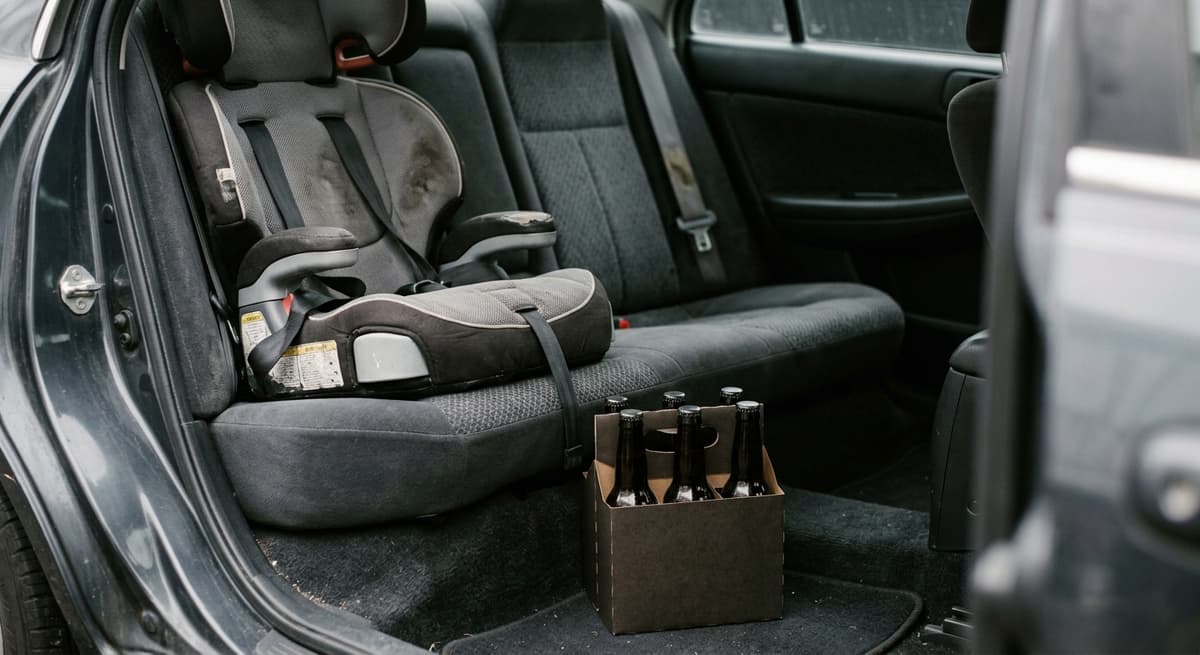
Parked Vehicles Are Covered, Not Just Moving Ones
A detail that sets Ohio apart from many peer states: its statute's divisions (B)(4) and (B)(5) explicitly reach both a moving vehicle and a stationary, parked one. The ban also isn't limited to public streets and highways; it extends to private property that's open to the public for vehicular travel or parking, such as a store parking lot. In many other states, an open container becomes legal the moment the vehicle is parked or leaves the public roadway. Ohio's statute doesn't work that way.
Exemptions
Ohio's exemption list is among the longest and most specific of any state in this dataset:
- A person who pays all or part of the fee for a chauffeured limousine under a prearranged contract, or that person's guest, while riding as a passenger, not occupying the front compartment where the limousine's operator is located, and while the limousine is being operated on a street, highway, or other public or private property open to the public for vehicular travel or parking.
- A cluster of licensed-premises, location-based exceptions: farmers markets, convention facilities, tastings, music festivals, outdoor performing-arts centers, motorsports facilities, designated outdoor refreshment areas, and certain markets.
- Resealed restaurant wine, secured so that it is visibly apparent if the bottle has since been opened or tampered with, and kept in the trunk, or, in a vehicle without a trunk, behind the last upright seat or in an area not normally occupied and not easily accessible to the driver.
- Commercial-quadricycle passengers riding under a prearranged contract, limited to no more than 36 ounces of beer or 18 ounces of wine and not seated in the front where the operator steers or brakes. This is the state's default rule; see the local-option note below.
- A closed, sealed container being transported under R.C. Section 4303.185 to its final destination.
- Possession within a public-use airport terminal area restricted to ticketed passengers, under specified conditions.
- Homemade beer or wine served under R.C. Section 4301.201.
Local Option for Commercial Quadricycles
Ohio's default rule exempts a commercial-quadricycle passenger riding under a prearranged contract. But that default is just that, a default: a municipal corporation or township may enact its own ordinance prohibiting a quadricycle passenger from possessing an open container, opting the locality out of the state exemption for that one category. Check local ordinances in the specific city or township before assuming the quadricycle exemption applies there.
Penalty
A violation of R.C. Section 4301.62 is a minor misdemeanor under R.C. Section 4301.99(A), which groups it with violations of several other liquor-control sections. Ohio's general sentencing statute, R.C. Section 2929.28(A)(2)(a)(v), caps a minor misdemeanor fine at $150; Section 4301.99 itself does not set a separate dollar figure specific to this offense.
The Current Version Took Effect April 30, 2024
The current version of Section 4301.62 took effect April 30, 2024 under House Bill 101 (135th General Assembly), per Ohio's official version history for this section. That does not mean the specific exemptions listed above are new: the official version history shows the outdoor-refreshment-area, motorsports-facility, market, and commercial-quadricycle provisions tracing back to earlier versions of the section effective in 2015 and 2016, not to the 2024 change. If the exact legislative history of a particular exemption matters for your situation, check Ohio's Legislative Service Commission directly.
Federal Compliance: Why Ohio Is on the Non-Conforming List Despite Broad Coverage
Federal law, 23 U.S.C. Section 154, conditions a share of a state's highway funding on an open container law that bans both possession and consumption, covers the whole passenger area, reaches every occupant, and is primarily enforced (23 CFR 1270.4). A state that falls short has 2.5 percent of certain federal highway apportionments reserved each October 1 and redirected to highway safety programs.
Ohio is on FHWA's current FY2026 list of non-conforming states (Notice N4510.905, dated October 1, 2025). The notice lists Ohio by name and states no reason for any state on it. Section 4301.62's text reaches broadly in several respects: it covers the driver and every passenger, both moving and parked vehicles, and public and quasi-public property. Because the notice does not say which federal element Ohio's law was found to lack, the reason for Ohio's listing should not be treated as known. If the reason matters for your purposes, the underlying FHWA or NHTSA determination is the place to check.
Disclaimer: This article provides general information about open container law in Ohio as of September 2026. It is not legal advice and does not create an attorney-client relationship. Verify the current statutory language before relying on a specific claim, and consult a lawyer licensed in Ohio for advice about a specific situation.
Related reading: open container laws by state, Ohio DUI laws, and Ohio window tint laws.
Statutes cited reflect their in-force version as of 2026-09-16. Last updated: 2026-09-16.
Frequently Asked Questions
Is an open container illegal in a parked car in Ohio?
Yes. R.C. Section 4301.62's divisions (B)(4) and (B)(5) explicitly cover both a moving vehicle and a stationary, parked one, and the ban extends beyond public streets to private property open to the public for parking.
What is the penalty for an open container violation in Ohio?
A minor misdemeanor under R.C. Section 4301.99(A). Ohio's general sentencing statute caps a minor misdemeanor fine at $150 under R.C. Section 2929.28(A)(2)(a)(v).
Why is Ohio on the federal government's non-conforming open container list?
Ohio appears on FHWA's FY2026 non-conforming list (Notice N4510.905), and the notice gives no reason for any state on it. The underlying FHWA or NHTSA determination is the place to check for the specific reason.
Are limousine passengers exempt from Ohio's open container law?
Only if they paid all or part of the fee for the chauffeured limousine under a prearranged contract, or are that person's guest, they are not occupying the front compartment where the limousine's operator is located, and the limousine is being operated on a street, highway, or other public or private property open to the public for vehicular travel or parking. A passenger in a limousine hired without a prearranged contract is not covered by this exemption.
Can a city in Ohio ban open containers for commercial quadricycle passengers?
Yes. The state's default rule exempts a quadricycle passenger riding under a prearranged contract, but a municipal corporation or township may enact its own ordinance opting out of that exemption.
Updates
Removed an incorrect statement that Ohio law has no separate ban on drinking in a vehicle, along with a speculative explanation of Ohio's federal non-conforming status that relied on it.
Independently fact-checked against the cited primary sources
The Law Behind This Article
This article rests on the statutory provisions below, held in our own legal record and retrieved from the official source. Tap a section to read the operative text.
Ohio Revised Code
§ 4301.62Opened container of beer or intoxicating liquor prohibited at certain premisesIn forcecited in 2 of our articles
(A) As used in this section: (1) "Chauffeured limousine" means a vehicle registered under section 4503.24 of the Revised Code. (2) "Street," "highway," and "motor vehicle" have the same meanings as in section 4511.01 of the Revised Code.
Official text (excerpt) · last checked 2026-07-31 · Read the full text in our law library · Verify at codes.ohio.gov
Cited in 100 court opinions in our collectionLatest citing opinion in our collection: 2026
Opinions citing this section in our collection:
- Hoyt v. Heindell (Ohio Court of Appeals 2010, 191 Ohio App. 3d 373)“…by violating a duty of care, protection, or support.” See R.C. 4301.62 and 4301.64. There is no evidence that…”
- State v. Van Dyne (Ohio Court of Appeals 1985, 26 Ohio App. 3d 95)“…ourt finding him guilty on his no contest plea of violating R.C. 4301.62. The undisputed facts indicate t…”
- State v. Johns (Ohio Court of Appeals 1993, 90 Ohio App. 3d 456)“…of possession of an open container of beer in violation of R.C. 4301.62(B)(4). Johns’s truck was seized and the…”
Identified automatically from the court opinions citing this section — not a ranking of which case controls.
Also relied on in: Open Container Laws by State (2026): Passengers, Exemptions, Penalties
§ 4301.99PenaltyIn forcecited in 2 of our articles
(A) Whoever violates section 4301.47, 4301.48, 4301.49, 4301.62, or 4301.70 or division (C) of section 4301.65 or division (B) of section 4301.691 of the Revised Code is guilty of a minor misdemeanor.
Official text (excerpt) · last checked 2026-07-31 · Read the full text in our law library · Verify at codes.ohio.gov
Cited in 19 court opinions in our collectionLatest citing opinion in our collection: 2024
Opinions citing this section in our collection:
- Lesnau v. Andate Enterprises, Inc. (Ohio Supreme Court 2001, 93 Ohio St. 3d 467)“…301.69 may result in administrative and criminal penalties. R.C. 4301.99. Contrary to the appellate court’s anal…”
- City of Cleveland v. Scott (Ohio Court of Appeals 1983, 8 Ohio App. 3d 358)“…is apparently not being appealed. Its penalty provision, R.C. 4301.99(C), classifies such a violation as a mi…”
- State v. Barnes (Ohio Court of Appeals 2023, 2023 Ohio 353)“…ts 9-10), a misdemeanor in violation of R.C. 4301.69(A) and R.C. 4301.99(I). {¶3} The charges were tr…”
Identified automatically from the court opinions citing this section — not a ranking of which case controls.
§ 2929.28Financial sanctions - misdemeanorIn forcecited in 4 of our articles
(A) In addition to imposing court costs pursuant to section 2947.23 of the Revised Code, the court imposing a sentence upon an offender for a misdemeanor, including a minor misdemeanor, may sentence the offender to any financial sanction or combination of financial sanctions authorized under this…
Official text (excerpt) · last checked 2026-07-31 · Read the full text in our law library · Verify at codes.ohio.gov
Cited in 251 court opinions in our collectionLatest citing opinion in our collection: 2026
Opinions citing this section in our collection:
- State v. Aguirre (Slip Opinion) (Ohio Supreme Court 2014, 144 Ohio St. 3d 179)“…929.18(A)(1) for felonies) and 3922 (deleting language from R.C. 2929.28(A)(1) for nonfelonies). Give…”
- State v. Johnson (Ohio Court of Appeals 2005, 164 Ohio App. 3d 792)“…of financial sanctions in misdemeanor cases is governed by R.C. 2929.28. Nevertheless, defendant’s complaint ab…”
- State v. Yerkey (Ohio Supreme Court 2022, 171 Ohio St. 3d 367)“…ere statutes governing restitution. See R.C. 2929.18(A)(1); R.C. 2929.28(A)(1). In each of those provisions, the…”
Identified automatically from the court opinions citing this section — not a ranking of which case controls.
Also relied on in: Ohio Windshield Mounting Laws (2026 Guide), Ohio Age of Consent Laws: Statutes, Penalties and Reporting
Code of Federal Regulations Title 23
§ 1270.4Compliance criteria.In forcecited in 20 of our articles
(a) To avoid the reservation of funds specified in § 1270.6, a State must enact and enforce an open container law that prohibits the possession of any open alcoholic beverage container, and the consumption of any alcoholic beverage, in the passenger area of any motor vehicle (including possession or consumption by the driver of the vehicle) located on a public highway, or the right-of-way of a public highway, in the State. (b) The law must apply to: (1) The possession of any open alcoholic beverage container and the consumption of any alcoholic beverage; (2) The passenger area of any motor vehicle; (3) All alcoholic beverages; (4) All occupants of a motor vehicle; and (5) All motor vehicles located on a public highway or the right-of-way of a public highway. (c) The law must provide for primary enforcement. (d) Exceptions.
Official text (excerpt) · last checked 2026-07-28 · Read the full text in our law library · Verify at ecfr.gov
Also relied on in: Maine Open Container Law (2026): Statute and Exemptions, Alaska Open Container Law (2026): A Driver-Only Driving Offense, Arizona Open Container Law (2026): Possession and Drinking Both Banned
United States Code Title 23
§ 154Open container requirementsIn forcecited in 46 of our articles
In this section, the following definitions apply: The term “alcoholic beverage” has the meaning given the term in section 158(c). The term “motor vehicle” means a vehicle driven or drawn by mechanical power and manufactured primarily for use on public highways, but does not include a vehicle operated exclusively on a rail or rails. The term “open alcoholic beverage container” means any bottle, can, or other receptacle— that contains any amount of alcoholic beverage; and that is open or has a broken seal; or the contents of which are partially removed. The term “passenger area” shall have the meaning given the term by the Secretary by regulation. For the purposes of this section, each State shall have in effect a law that prohibits the possession of any open alcoholic beverage container, or the consumption of any alcoholic beverage, in the passenger area of any motor vehicle (including possession or consumption by the driver of the vehicle) located on a public highway, or the right-of-way of a public highway, in the State.
Official text (excerpt) · last checked 2026-09-23 · Read the full text in our law library · Verify at uscode.house.gov
Cited in 20 court opinions in our collectionLatest citing opinion in our collection: 2004
Opinions citing this section in our collection:
- Foremost Insurance v. Richardson (Supreme Court of the United States 1982, 457 U.S. 668)“…er traffic, just as it has done for some land traffic. See 23 U. S. C. § 154 (55 m.p.h. speed limit). Yet no one su…”
- United States v. Kevin Bishop, United States of America v. Edward Stokes (Court of Appeals for the Third Circuit 1995, 66 F.3d 569)“…nder the Spending Clause, not the Commerce Clause. See 23 U.S.C. § 154 (Supp.1995) (conditioning receipt of f…”
- Mrs. Lizzie Beatrice Easterwood v. Csx Transportation, Inc. (Court of Appeals for the Eleventh Circuit 1991, 933 F.2d 1548)“…ce with the national highway speed limit. See 23 U.S.C.A. § 154 (1990). Easterwood argues that an auto…”
Identified automatically from the court opinions citing this section — not a ranking of which case controls.
Also relied on in: Alabama Open Container Law (2026): The $25 Fine and No-Points Rule, Arkansas Open Container Law (2026): Rules, Exemptions, and Penalty, California Open Container Law (2026): The Full Rule
Search our full record of US law — 2.1 million sections, every state + federal →
Sources and References
- R.C. Section 4301.62 - Prohibitions against having opened container of beer or intoxicating liquor in motor vehicle(codes.ohio.gov).gov
- R.C. Section 4301.99 - Penalties (confirms Section 4301.62 violation is a minor misdemeanor; opened directly to verify since states-all.json flagged it unconfirmed)(codes.ohio.gov).gov
- R.C. Section 2929.28(A)(2)(a)(v) - Maximum minor misdemeanor fine ($150), opened directly to confirm the fine amount(codes.ohio.gov).gov
- 23 U.S.C. Section 154 - Open container requirements(law.cornell.edu)
- FHWA Notice N4510.905 - FY2026 Apportionment of Federal-Aid Highway Program Funds (open container non-conforming states list, includes Ohio)(highways.dot.gov).gov