
Michigan
Michigan Knife Laws (2026): Concealed and Vehicle Carry Rules
Independently fact-checked against primary sources (last audited September 18, 2026). · 8 primary sources cited on this page. How we verify our legal content

Michigan splits its knife law across two different offenses that share overlapping terms but different triggers. MCL 750.227 bans carrying a dagger, dirk, stiletto, or double-edged nonfolding stabbing instrument, at any length, or any other dangerous weapon, concealed on or about the person, and separately bans carrying the same items in a vehicle whether concealed or openly, subject to a hunting-knife exception and an exception for the person's own dwelling, business, or land. MCL 750.226 separately bans going armed, openly or concealed, with a knife over 3 inches or several other named weapons, but only when carried with intent to use it unlawfully against another person. A 2017 repeal removed a standalone ban on pocket knives that open by a mechanical device.
Jurisdiction scope: This page covers Michigan state law only, principally MCL 750.226, 750.227, 750.222a, 750.237a, 380.1313, 123.1102, and 259.80f. It does not cover Michigan's concealed pistol licensing statutes in detail or local municipal ordinances outside the firearms-only preemption discussed below.
Can you carry a knife openly in Michigan?
It depends on where the knife is carried. On the person, outside a vehicle, MCL 750.227 bans only concealed carry of a dagger, dirk, stiletto, double-edged nonfolding stabbing instrument, or any other dangerous weapon, so openly carrying one of those types on foot is not restricted by that statute. In a vehicle, the statute drops the concealment element entirely: it bans carrying the same items "concealed on or about his or her person, or whether concealed or otherwise in any vehicle operated or occupied by the person," so carrying a dagger, dirk, stiletto, or double-edged nonfolding stabbing instrument openly on a car seat, console, or dashboard is just as much a felony as hiding it, unless the vehicle is on the carrier's own dwelling, place of business, or other land. Open carry of a knife over 3 inches anywhere, including on foot, can also be a separate felony under MCL 750.226 if the person carries it with intent to use it unlawfully against another person, since that statute bans going armed "with a pistol or other firearm, or a pneumatic gun, dagger, dirk, razor, stiletto, or knife having a blade over 3 inches in length, or any other dangerous or deadly weapon or instrument," regardless of concealment, once that intent element is present.
MCL 750.227: an outright ban on named types, no intent required, broader in a vehicle
MCL 750.227(1) provides:
"A person shall not carry a dagger, dirk, stiletto, a double-edged nonfolding stabbing instrument of any length, or any other dangerous weapon, except a hunting knife adapted and carried as such, concealed on or about his or her person, or whether concealed or otherwise in any vehicle operated or occupied by the person, except in his or her dwelling house, place of business or on other land possessed by the person."
Unlike MCL 750.226, this statute has no unlawful-intent requirement. It creates two separate bans in one sentence. On the person, off a vehicle, only concealed carry of a dagger, dirk, stiletto, double-edged nonfolding stabbing instrument, or any other dangerous weapon is banned; open carry on foot is not reached by this statute. In a vehicle, the statute drops the concealment requirement, banning the same items "whether concealed or otherwise," so carrying one of those items openly in a car is equally an offense. Both branches share the same exceptions: "a hunting knife adapted and carried as such," a functional test about how the knife is equipped and used for hunting rather than a defined blade-length threshold, and carrying the item in the person's own dwelling house, place of business, or other land the person possesses.
MCL 750.222a defines "doubled-edged, nonfolding stabbing instrument" for the whole chapter (the compiled statute prints "doubled-edged," not "double-edged"), and its definition includes a carve-out: the term "does not include a knife, tool, implement, arrowhead, or artifact manufactured from stone by means of conchoidal fracturing." MCL 750.222a(2) then states that "subsection (1) does not apply to an item being transported in a vehicle, unless the item is in a container and inaccessible to the driver," withdrawing that carve-out for an item accessible to the driver in a vehicle. An ordinary single-edge folding pocketknife is not a dagger, dirk, or stiletto and is not a double-edged nonfolding stabbing instrument in the first place, in or out of a vehicle; subsection (2) matters only for an item that otherwise answers the definition's own terms, and it cannot turn a single-edge folding knife into a double-edged nonfolding one. The residual risk for an ordinary pocketknife carried concealed on the person or carried in a vehicle is MCL 750.227's separate catchall, "any other dangerous weapon," a category the named-type list and its carve-out do not address, so an unusually large or modified folding knife could still be argued to fall within that catchall depending on the facts. A conviction under MCL 750.227 is a felony, punishable by up to 5 years' imprisonment, a fine of up to $2,500, or both.
Going armed with unlawful intent: the 3-inch threshold, open or concealed
MCL 750.226 provides: "A person shall not, with intent to use the same unlawfully against the person of another, go armed with a pistol or other firearm, or a pneumatic gun, dagger, dirk, razor, stiletto, or knife having a blade over 3 inches in length, or any other dangerous or deadly weapon or instrument." This offense applies whether the weapon is carried openly or concealed, but it requires the state to prove the person intended to use it unlawfully against another person, an element MCL 750.227 does not require. A knife with a blade of 3 inches or less falls outside this specific "knife" clause, though it could still be reached by the statute's residual "any other dangerous or deadly weapon or instrument" language depending on the facts. Violating MCL 750.226 is a felony, punishable by up to 5 years' imprisonment, a fine of up to $2,500, or both, the same penalty range as MCL 750.227.

The repealed switchblade-style ban
MCL 750.226a formerly banned unlawful possession of a pocket knife opened by a mechanical device, Michigan's functional equivalent of a switchblade ban. That section was repealed by 2017 PA 96, effective October 11, 2017, and its text no longer appears in the Michigan Compiled Laws. Simply possessing or carrying a pocket knife that opens by a mechanical device is not, on its own, a crime under this repealed section. The concept has not disappeared from Michigan law entirely, though: the K-12 school-weapon statute discussed below still lists "pocket knife opened by a mechanical device" in its own, separate definition.
Schools: a confiscation statute and a sentencing enhancement, not a single simple offense
Michigan reaches knives on school property through two different statutes that serve different purposes. MCL 380.1313, part of the Revised School Code, requires a school official to report and may confiscate a "dangerous weapon" found in a pupil's possession while the pupil is at school, at a school activity, or on a school bus. That section defines "dangerous weapon," for its own purposes only, as "a firearm, dagger, dirk, stiletto, knife with a blade over 3 inches in length, pocket knife opened by a mechanical device, iron bar, or brass knuckles." A law enforcement agency that takes custody of a confiscated weapon must attempt to identify and notify the legal owner. This is a reporting and confiscation mechanism, not itself a criminal penalty provision.

Separately, MCL 750.237a(1) enhances the punishment for committing certain already-listed offenses, including the MCL 750.226 and 750.227 knife offenses discussed above, within a "weapon free school zone." The prison ceiling itself does not rise above what the underlying section already authorizes, so for 750.226 or 750.227, both already 5-year felonies, the maximum imprisonment stays at 5 years. What increases is the fine, up to 3 times the maximum otherwise authorized (up to $7,500 for a 750.226 or 750.227 violation), plus up to 150 hours of community service. A separate subsection, MCL 750.237a(4), makes it a misdemeanor, punishable by up to 93 days, up to 100 hours of community service, and a fine of up to $2,000, for an individual to simply "possess a weapon in a weapon free school zone," but the statute's own definitions section states only that "weapon" for this subsection "includes, but is not limited to, a pneumatic gun," without further defining the term or cross-referencing a knife-specific definition, so whether an ordinary knife that does not independently violate MCL 750.226 or 750.227 falls within that undefined "weapon" language is not resolved by the text itself. MCL 750.237a(5) exempts several categories of people from that subsection (4) misdemeanor: school security personnel, peace officers, a person possessing a weapon provided by the school for instructional use, and "an individual licensed by this state or another state to carry a concealed weapon."
Airports: a flat ban on any knife in the sterile area
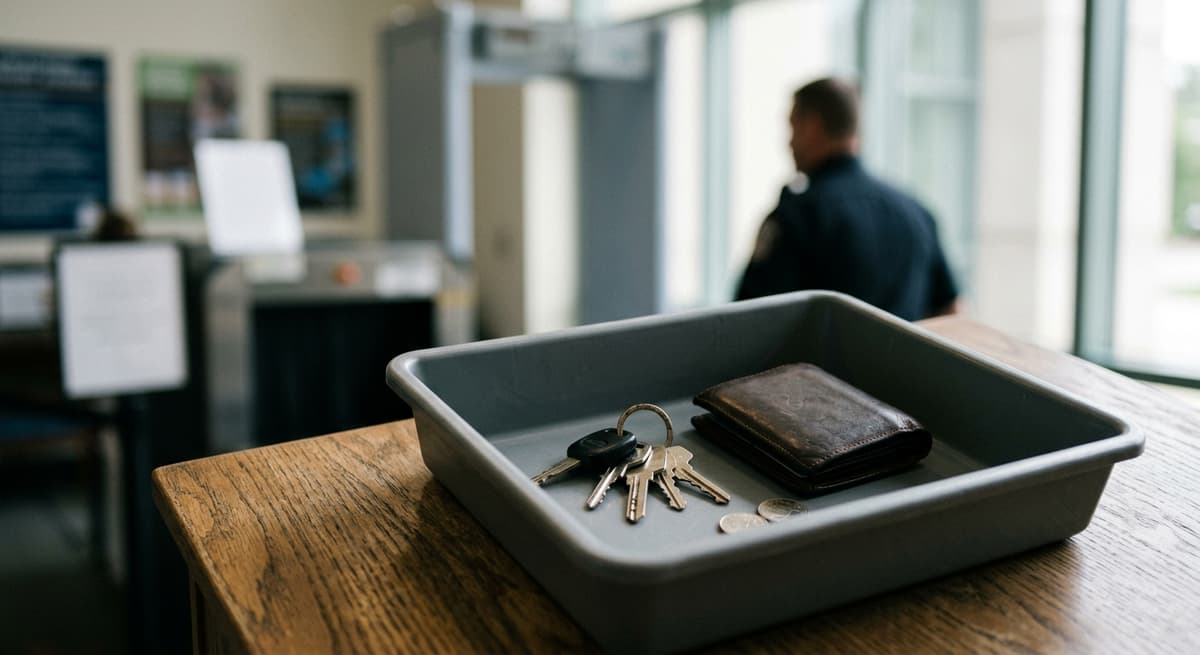
MCL 259.80f bans possessing, carrying, or attempting to possess or carry a "knife with a blade of any length," along with a firearm, explosive, razor, box cutter, or other dangerous weapon, in the sterile area of a commercial airport. A basic violation is a misdemeanor punishable by up to 1 year imprisonment, a fine of up to $1,000, or both. The offense becomes a felony, punishable by up to 10 years and a fine of up to $10,000, if committed while boarding or attempting to board an aircraft, while placing or attempting to place a listed item on an aircraft, or while committing or attempting to commit another felony. The statute exempts on-duty peace officers, certain corrections employees, active military and national guard members on duty, sterile-area security personnel, court officers on duty, and airline or airport employees authorized by their employer.
Does Michigan preempt local knife ordinances?
Only for firearms, not knives. MCL 123.1102 provides that "a local unit of government shall not impose special taxation on, enact or enforce any ordinance or regulation pertaining to, or regulate in any other manner the ownership, registration, purchase, sale, transfer, transportation, or possession of pistols, other firearms, or pneumatic guns, ammunition for pistols or other firearms, or components of pistols or other firearms, except as otherwise provided by federal law or a law of this state." Its text names pistols, other firearms, pneumatic guns, and related ammunition and components only; it does not mention knives, and the penal code's weapons sections, MCL 750.220 through 750.229, contain no preemption provision of any kind. Michigan preempts local regulation of firearms and pneumatic guns but not knives, so a city or county may adopt its own, additional knife ordinance.
Federal law: what it does and does not reach
Federal law does not ban an individual from owning or carrying a switchblade. The Federal Switchblade Act, 15 U.S.C. §§ 1241 to 1245, instead restricts interstate commerce in switchblade knives, barring their manufacture for, or introduction, transport, and sale in, interstate commerce, and, in 15 U.S.C. § 1245 makes it a federal offense to knowingly possess, manufacture, sell, or import a ballistic knife in or affecting interstate commerce or within federal territorial jurisdiction. Sections 1242 and 1243 do not apply to certain knives and people, listed as exemptions in 15 U.S.C. § 1244. A 2009 amendment, § 1244(5), exempts any knife with a spring, detent, or other closure-bias mechanism that requires hand, wrist, or arm exertion on the blade itself to overcome the bias and assist opening, the carve-out that keeps modern assisted-opening folding knives legal in interstate commerce. A separate exemption, § 1244(4), covers a person with only one arm possessing or carrying a switchblade with a blade three inches or less. Neither exemption changes what Michigan's own MCL 750.226 and 750.227 independently ban; state law governs carry within Michigan on its own terms.
Disclaimer: This article provides general legal information about Michigan's knife laws as of September 2026. It is not legal advice. Consult a lawyer licensed in Michigan for advice about a specific situation. Because Michigan's firearms preemption statute does not reach knives, local ordinances can add restrictions beyond the statewide rules described here.
For a state-by-state comparison, see knife laws by state. Michigan's self-defense statutes are covered separately on the Michigan self-defense laws page.
Statutes cited reflect their in-force version as of 2026-09-18. Last updated: 2026-09-18.
Frequently Asked Questions
Is it legal to carry a knife concealed in Michigan?
Not for the specific types listed in MCL 750.227: a dagger, dirk, stiletto, or double-edged nonfolding stabbing instrument of any length concealed on or about the person is banned outright, no unlawful intent required, with only a hunting-knife exception and an exception for the person's own dwelling, business, or land. An ordinary single-edge folding pocketknife is not one of those named types under MCL 750.222a's definition, in or out of a vehicle, so concealing one on the person is not banned by that named-type list, though the statute's 'any other dangerous weapon' catchall could be argued to reach an unusually large or modified knife depending on the facts.
Can you carry a knife openly in Michigan?
On the person, off a vehicle, yes for most knives: MCL 750.227 bans only concealed carry of a dagger, dirk, stiletto, double-edged nonfolding stabbing instrument, or any other dangerous weapon, so carrying one openly on foot is not restricted by that statute, and open carry of a knife is not otherwise restricted by size alone. In a vehicle, that changes: MCL 750.227 bans the same named types 'whether concealed or otherwise,' so carrying a dagger, dirk, stiletto, or double-edged nonfolding stabbing instrument openly in a car is equally a felony, unless the vehicle is on the person's own dwelling, business, or land. Separately, MCL 750.226 makes carrying a knife over 3 inches, open or concealed, a felony when the person carries it with intent to use it unlawfully against another person; without that unlawful intent, that size-based offense does not apply.
Are switchblades legal in Michigan?
The specific ban on possessing a pocket knife that opens by a mechanical device, MCL 750.226a, was repealed by 2017 PA 96, effective October 11, 2017. Simply possessing such a knife is not a crime under that repealed section, though a mechanically-opened pocket knife could still fall within the general concealed-carry ban (MCL 750.227) or the intent-based going-armed offense (MCL 750.226) depending on its features and how it is carried.
Can you carry a knife on Michigan school property?
A pupil's possession of a 'dangerous weapon,' defined under MCL 380.1313 to include a dagger, dirk, stiletto, knife with a blade over 3 inches, or pocket knife opened by a mechanical device, triggers mandatory reporting and confiscation. Separately, committing an MCL 750.226 or 750.227 knife offense within a 'weapon free school zone' triggers MCL 750.237a, which does not raise the prison ceiling above what 750.226 or 750.227 already authorizes but does allow a fine up to 3 times the normal maximum and up to 150 hours of community service. That same statute separately makes bare possession of a 'weapon' in a weapon free school zone a misdemeanor, though the statute does not define 'weapon' beyond stating it includes a pneumatic gun, and that misdemeanor does not apply to school security staff, peace officers, instructional-use possessors, or a person licensed to carry a concealed weapon.
Does Michigan preempt local knife ordinances?
No. MCL 123.1102 preempts local regulation of pistols, other firearms, and pneumatic guns by name; the penal code's weapons sections, MCL 750.220 through 750.229, contain no preemption provision of any kind. A city or county may adopt its own knife ordinance.
Can you bring a knife through a Michigan airport?
Not into the sterile area of a commercial airport. MCL 259.80f bans a knife of any length, along with firearms, explosives, and similar items, in that area, as a misdemeanor that becomes a felony if committed while boarding an aircraft, attempting to place an item on one, or committing another felony, subject to exceptions for on-duty law enforcement and certain other authorized personnel.
Updates
Clarified that Michigan's concealed-weapons statute, MCL 750.227, also covers 'any other dangerous weapon' carried concealed on the person, not only in a vehicle.
Independently fact-checked against the cited primary sources
The Law Behind This Article
This article rests on the statutory provisions below, held in our own legal record and retrieved from the official source. Tap a section to read the operative text.
Michigan Compiled Laws
§ 750.227Concealed weapons; carrying; penaltyIn force
(1) A person shall not carry a dagger, dirk, stiletto, a double-edged nonfolding stabbing instrument of any length, or any other dangerous weapon, except a hunting knife adapted and carried as such, concealed on or about his or her person, or whether concealed or otherwise in any vehicle operated or occupied by the person, except in his or her dwelling house, place of business or on other land possessed by the person. (2) A person shall not carry a pistol concealed on or about his or her person, or, whether concealed or otherwise, in a vehicle operated or occupied by the person, except in his or her dwelling house, place of business, or on other land possessed by the person, without a license to carry the pistol as provided by law and if licensed, shall not carry the pistol in a place or manner inconsistent with any restrictions upon such license. (3) A person who violates this section is guilty of a felony, punishable by imprisonment for not more than 5 years, or by a fine of not more than $2,500.00.
Official text (excerpt) · last checked 2026-09-24 · Read the full text in our law library · Verify at legislature.mi.gov
§ 750.226Firearm or dangerous or deadly weapon or instrument; carrying with unlawful intent; violation as felony; penaltyIn force
(1) A person shall not, with intent to use the same unlawfully against the person of another, go armed with a pistol or other firearm, or a pneumatic gun, dagger, dirk, razor, stiletto, or knife having a blade over 3 inches in length, or any other dangerous or deadly weapon or instrument. (2) A person who violates this section is guilty of a felony punishable by imprisonment for not more than 5 years or a fine of not more than $2,500.00.
Official text (excerpt) · last checked 2026-07-30 · Read the full text in our law library · Verify at legislature.mi.gov
Cited in 210 court opinions in our collectionLatest citing opinion in our collection: 2026
Opinions citing this section in our collection:
- People v. Ackah-Essien (Michigan Court of Appeals 2015, 311 Mich. App. 13)“…e, MCL 750.356a(1), carrying a weapon with unlawful intent, MCL 750.226, unlawfully driving away an automobile,…”
- People v. Mitchell (Michigan Court of Appeals 2013, 301 Mich. App. 282)“…r, MCL 750.317, and carrying a weapon with unlawful intent, MCL 750.226. Defendant was sentenced as a second-of…”
- People v. Parker (Michigan Court of Appeals 2010, 288 Mich. App. 500)“…0.82, and carrying a dangerous weapon with unlawful intent, MCL 750.226. Because the prosecution failed to pres…”
Identified automatically from the court opinions citing this section — not a ranking of which case controls.
§ 750.222a"Double-edged, nonfolding stabbing instrument" definedIn force
(1) As used in this chapter, "doubled-edged, nonfolding stabbing instrument" does not include a knife, tool, implement, arrowhead, or artifact manufactured from stone by means of conchoidal fracturing. (2) Subsection (1) does not apply to an item being transported in a vehicle, unless the item is in a container and inaccessible to the driver.
Official text (excerpt) · last checked 2026-07-30 · Read the full text in our law library · Verify at legislature.mi.gov
§ 750.237aIndividual engaging in proscribed conduct in weapon free school zone; violation; penalties; definitionsIn forcecited in 2 of our articles
(1) An individual who engages in conduct proscribed under section 224, 224a, 224b, 224c, 224e, 226, 227, 227a, 227f, 234a, 234b, or 234c, or who engages in conduct proscribed under section 223(2) for a second or subsequent time, in a weapon free school zone is guilty of a felony punishable by 1 or more of the following: (a) Imprisonment for not more than the maximum term of imprisonment authorized for the section violated. (b) Community service for not more than 150 hours. (c) A fine of not more than 3 times the maximum fine authorized for the section violated. (2) An individual who engages in conduct proscribed under section 223(1), 224d, 227c, 227d, 231c, 232a(1) or (4), 233, 234, 234e, 234f, 235, 236, or 237, or who engages in conduct proscribed under section 223(2) for the first time, in a weapon free school zone is guilty of a misdemeanor punishable by 1 or more of the following: (a) Imprisonment for not more than the maximum term of imprisonment authorized for the section violated or 93 days, whichever is greater. (b) Community service for not more than 100 hours.
Official text (excerpt) · last checked 2026-07-30 · Read the full text in our law library · Verify at legislature.mi.gov
Cited in 7 court opinions in our collectionLatest citing opinion in our collection: 2018
Opinions citing this section in our collection:
- Mich. Gun Owners, Inc. v. Ann Arbor Pub. Sch. (Michigan Supreme Court 2018, 502 Mich. 695)“…onflict with various statutes, particularly MCL 28.425o and MCL 750.237a, which they read as implying a state-la…”
- Michigan Gun Owners Inc v. Ann Arbor Public Schools (Michigan Court of Appeals 2016)“…chool property” mean those terms as defined in . . . MCL 750.237a.…”
- Michigan Open Carry Inc v. Clio Area School District (Michigan Court of Appeals 2016)“…chool property” mean those terms as defined in . . . MCL 750.237a.…”
Identified automatically from the court opinions citing this section — not a ranking of which case controls.
Also relied on in: Michigan Pepper Spray and Stun Gun Laws (2026)
§ 380.1313Dangerous weapon found in possession of pupil; report; confiscation by school official; determination of legal owner; "dangerous weapon" definedIn force
(1) If a dangerous weapon is found in the possession of a pupil while the pupil is in attendance at school or a school activity or while the pupil is enroute to or from school on a school bus, the superintendent of the school district or intermediate school district, or his or her designee, immediately shall report that finding to the pupil's parent or legal guardian and the local law enforcement agency. (2) If a school official finds that a dangerous weapon is in the possession of a pupil as described in subsection (1), the school official may confiscate the dangerous weapon or shall request a law enforcement agency to respond as soon as possible and to confiscate the dangerous weapon. If a school official confiscates a dangerous weapon under this subsection, the school official shall give the dangerous weapon to a law enforcement agency and shall not release the dangerous weapon to any other person, including the legal owner of the dangerous weapon. A school official who complies in good faith with this section is not civilly or criminally liable for that compliance.
Official text (excerpt) · last checked 2026-07-30 · Read the full text in our law library · Verify at legislature.mi.gov
Cited in 5 court opinions in our collectionLatest citing opinion in our collection: 2021
Opinions citing this section in our collection:
- Davis v. Hillsdale Community School District (Michigan Court of Appeals 1997, 226 Mich. App. 375)“…dangerous weapon.” Instead, it refers to the definition in MCL 380.1313; MSA 15.41313 (§ 1313). MCL 380.1311(10…”
- Michigan Open Carry Inc v. Clio Area School District (Michigan Court of Appeals 2016)“…chool zone a weapon that constitutes a dangerous weapon[.]” MCL 380.1313(2) authorizes a school official to conf…”
- Michigan Gun Owners Inc v. Ann Arbor Public Schools (Michigan Court of Appeals 2016)“…chool zone a weapon that constitutes a dangerous weapon[.]” MCL 380.1313(2) authorizes a school official to conf…”
Identified automatically from the court opinions citing this section — not a ranking of which case controls.
§ 259.80fPossessing, carrying, or attempting to possess certain items in sterile area of airport; prohibitions; violations; penalties; exceptions; other violations; consecutive terms of imprisonment; definitionsIn force
(1) An individual shall not possess, carry, or attempt to possess or carry any of the following in a sterile area of a commercial airport: (a) Firearm. (b) Explosive. (c) Knife with a blade of any length. (d) Razor, box cutter, or item with a similar blade. (e) Dangerous weapon. (2) Except as provided in subsection (3), an individual who violates subsection (1) is guilty of a misdemeanor punishable by imprisonment for not more than 1 year or a fine of not more than $1,000.00, or both. (3) An individual who violates subsection (1) while doing any of the following is guilty of a felony punishable by imprisonment for not more than 10 years or a fine of not more than $10,000.00, or both: (a) Getting on or attempting to get on an aircraft. (b) Placing, attempting to place, or attempting to have placed on an aircraft an item listed in subsection (1). (c) Committing or attempting to commit a felony. (4) This section does not apply to any of the following: (a) A peace officer of a duly authorized police agency of this state, a political subdivision of this state, another state, a political subdivision of another state, or the United States.
Official text (excerpt) · last checked 2026-07-30 · Read the full text in our law library · Verify at legislature.mi.gov
§ 123.1102Regulation of pistols, other firearms, pneumatic guns, or ammunitionIn forcecited in 2 of our articles
A local unit of government shall not impose special taxation on, enact or enforce any ordinance or regulation pertaining to, or regulate in any other manner the ownership, registration, purchase, sale, transfer, transportation, or possession of pistols, other firearms, or pneumatic guns, ammunition for pistols or other firearms, or components of pistols or other firearms, except as otherwise provided by federal law or a law of this state.
Official text (excerpt) · last checked 2026-07-30 · Read the full text in our law library · Verify at legislature.mi.gov
Cited in 13 court opinions in our collectionLatest citing opinion in our collection: 2023
Opinions citing this section in our collection:
- Mich. Gun Owners, Inc. v. Ann Arbor Pub. Sch. (Michigan Supreme Court 2018, 502 Mich. 695)“…d directed the parties to brief: (1) whether, in light of MCL 123.1102, it is necessary to consider the factor…”
- Wells Fargo Bank v. Cherryland Mall Ltd. Partnership (Michigan Court of Appeals 2013, 300 Mich. App. 361)“…ims, but held that the nuisance claims were viable and that MCL 123.1102, which prohibits local regulation of fi…”
- Michigan Coalition for Responsible Gun Owners v. City of Ferndale (Michigan Court of Appeals 2003, 256 Mich. App. 401)“…at make local public buildings gun-free zones. We hold that MCL 123.1102 preempts local regulation of this kind,…”
Identified automatically from the court opinions citing this section — not a ranking of which case controls.
§ 750.220Property valuation or indebtedness; false statementsIn force
Any person who willfully and knowingly makes any false statement in writing of his or her property valuation, real or personal, or both, or of his or her indebtedness, for the purpose of obtaining credit from any person, company, co-partnership, association, or corporation, is guilty of a misdemeanor punishable by imprisonment for not more than 1 year or a fine of not more than $1,000.00.
Official text (excerpt) · last checked 2026-07-30 · Read the full text in our law library · Verify at legislature.mi.gov
§ 750.226aRepealedRepealed
Official text (excerpt) · last checked 2026-07-30 · Read the full text in our law library · Verify at legislature.mi.gov
Cited in 2 court opinions in our collectionLatest citing opinion in our collection: 1987
Opinions citing this section in our collection:
- People v. Czerwinski (Michigan Court of Appeals 1980, 99 Mich. App. 304)“…meanor. Defendant claims that the Legislature intended that MCL 750.226a; MSA 28.423(1), a misdemeanor offense,…”
- United States v. Larry D. Cameron (Court of Appeals for the Seventh Circuit 1987, 814 F.2d 403)“…ion of a switchblade is actual possession. See Mich.Comp.Laws Ann. § 750.226a (West 1968). Specific intent to deceive…”
Identified automatically from the court opinions citing this section — not a ranking of which case controls.
United States Code Title 15
§ 1241DefinitionsIn forcecited in 52 of our articles
As used in this chapter— The term “interstate commerce” means commerce between any State, Territory, possession of the United States, or the District of Columbia, and any place outside thereof. The term “switchblade knife” means any knife having a blade which opens automatically— by hand pressure applied to a button or other device in the handle of the knife, or by operation of inertia, gravity, or both.
Official text (excerpt) · last checked 2026-07-28 · Read the full text in our law library · Verify at uscode.house.gov
Cited in 15 court opinions in our collectionLatest citing opinion in our collection: 2014
Opinions citing this section in our collection:
- Stewart A. Taylor, D/B/A Taylor Cutlery Mfg. Co. v. United States of America (Court of Appeals for the Sixth Circuit 1988, 848 F.2d 715)“…Service, are not switchblade knives within the meaning of 15 U.S.C. § 1241 (b) and 19 C.F.R. § 1295 (a)(1). The d…”
- Crowley Cutlery Company v. United States of America and Commissioner of Customs of the United States Customs Service (Court of Appeals for the Seventh Circuit 1988, 849 F.2d 273)“…Illinois for a declaration that the Switchblade Knife Act, 15 U.S.C. §§ 1241 et seq., which forbids th…”
- Edna Fall, as Administratrix of the Estate of Phillip Fall, Deceased v. Esso Standard Oil Company (Court of Appeals for the Fifth Circuit 1962, 297 F.2d 411)“…25 S.Ct. 158 , 49 L.Ed. 363 . Section 1 of the Act, 15 U.S.C.A. § 1241 (b), defines the term “switchblade knif…”
Identified automatically from the court opinions citing this section — not a ranking of which case controls.
Also relied on in: Knife Laws by State (2026): Carry Rules, Blade Limits, Penalties, Alabama Knife Laws (2026): What Is Legal to Carry, Alaska Knife Laws (2026): Concealed Carry Rules Explained
§ 1244ExceptionsIn forcecited in 52 of our articles
Sections 1242 and 1243 of this title shall not apply to— any common carrier or contract carrier, with respect to any switchblade knife shipped, transported, or delivered for shipment in interstate commerce in the ordinary course of business; the manufacture, sale, transportation, distribution, possession, or introduction into interstate commerce, of switchblade knives pursuant to contract with the Armed Forces; the Armed Forces or any member or employee thereof acting in the performance of his duty; the possession, and transportation upon his person, of any switchblade knife with a blade three inches or less in length by any individual who has only one arm; or a knife that contains a spring, detent, or other mechanism designed to create a bias toward closure of the blade and that requires exertion applied to the blade by hand, wrist, or arm to overcome the bias toward closure to assist in opening the knife.
Official text (excerpt) · last checked 2026-07-28 · Read the full text in our law library · Verify at uscode.house.gov
Also relied on in: Arizona Knife Laws (2026): Carry Rules and Preemption, Arkansas Knife Laws (2026): Intent-Based Carry Rules, California Knife Laws (2026): Four Blade-Length Rules
§ 1245Ballistic knivesIn forcecited in 50 of our articles
Whoever in or affecting interstate commerce, within any Territory or possession of the United States, within Indian country (as defined in section 1151 of title 18), or within the special maritime and territorial jurisdiction of the United States (as defined in section 7 of title 18), knowingly possesses, manufactures, sells, or imports a ballistic knife shall be fined as provided in title 18, or imprisoned not more than ten years, or both. Whoever possesses or uses a ballistic knife in the commission of a Federal crime of violence shall be fined as provided in title 18, or imprisoned not less than five years and not more than ten years, or both. The exceptions provided in paragraphs (1), (2), and (3) of section 1244 of this title with respect to switchblade knives shall apply to ballistic knives under subsection (a) of this section. As used in this section, the term “ballistic knife” means a knife with a detachable blade that is propelled by a spring-operated mechanism.
Official text (excerpt) · last checked 2026-07-28 · Read the full text in our law library · Verify at uscode.house.gov
Cited in 2 court opinions in our collectionLatest citing opinion in our collection: 2008
Opinions citing this section in our collection:
- ALCANTAR (Board of Immigration Appeals 1994, 20 I. & N. Dec. 801)“…ed by an adult, would be felony and crime of violence); cf. 15 U.S.C. § 1245(b) (1988) (use of ballistic knife in co…”
- United States v. Polizzi (District Court, E.D. New York 2008, 549 F. Supp. 2d 308)“…8 Trust in l’estraint of import trade 3 months 15 U.S.C. § 1245 (b) Possession/use of a ballistic knife…”
Identified automatically from the court opinions citing this section — not a ranking of which case controls.
Also relied on in: Colorado Knife Laws (2026): Concealed Carry and Exceptions, Connecticut Knife Laws (2026): Open and Concealed Carry, Delaware Knife Laws (2026): Carry, Switchblades, and Bans
Search our full record of US law — 2.1 million sections, every state + federal →
Sources and References
- MCL 750.227 - Concealed weapons, carrying, penalty (dagger, dirk, stiletto, double-edged nonfolding stabbing instrument of any length; concealed on the person, or concealed or open in a vehicle; hunting-knife and own-property exceptions)(legislature.mi.gov).gov
- MCL 750.226 - Firearm or dangerous or deadly weapon or instrument, carrying with unlawful intent (knife over 3 inches, open or concealed)(legislature.mi.gov).gov
- MCL 750.222a - 'Doubled-edged, nonfolding stabbing instrument' defined (excludes a knife, tool, implement, arrowhead, or stone artifact; exclusion switches off for an item in a vehicle unless boxed and inaccessible to the driver)(legislature.mi.gov).gov
- MCL 750.226a - Repealed, 2017 PA 96, eff. Oct. 11, 2017 (formerly pocket knife opened by mechanical device)(legislature.mi.gov).gov
- MCL 750.237a - Weapon free school zone, penalty enhancement and standalone weapon-possession misdemeanor(legislature.mi.gov).gov
- MCL 380.1313 - Dangerous weapon found in possession of pupil, report and confiscation, definition(legislature.mi.gov).gov
- MCL 123.1102 - Regulation of pistols, other firearms, pneumatic guns, or ammunition (firearms-only local preemption)(legislature.mi.gov).gov
- MCL 259.80f - Possessing or carrying certain items in sterile area of a commercial airport (knife of any length)(legislature.mi.gov).gov
- 15 U.S.C. 1241-1245 - Federal Switchblade Act, interstate commerce and ballistic-knife scope(law.cornell.edu)
- 15 U.S.C. 1244 - exceptions, including the 2009 assisted-opening carve-out and the one-arm exception(law.cornell.edu)