
Utah
Utah Windshield Mounting Laws (2026 Guide)
Independently fact-checked against primary sources (last audited August 17, 2026). · Reviewed by the RecordingLaw editorial team. · Law checked current as of August 17, 2026. · 11 primary sources cited on this page. How we verify our legal content
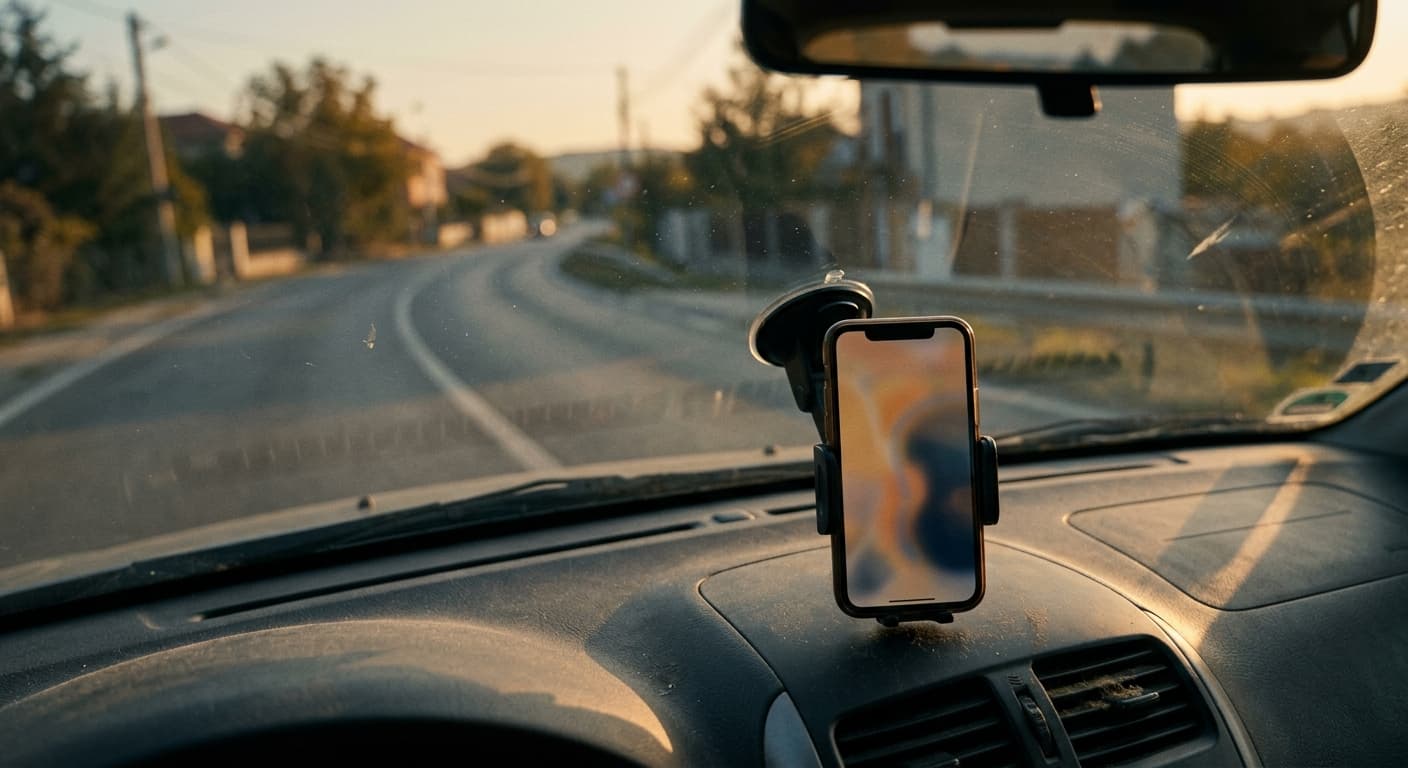
Utah permits windshield-mounted dashcams, GPS units, and phone holders under Utah Code 41-6a-1635, provided the device does not materially obstruct the driver's view. Legal placement options include the top 4 inches of the windshield, the lower-left corner within a 3-inch by 4-inch zone, or the dashboard. No Utah statute bans these devices outright.
Utah regulates windshield-mounted devices through Utah Code 41-6a-1635, titled "Windshields and windows -- Tinting -- Obstructions reducing visibility -- Wipers -- Prohibitions." The statute sets clear rules about what can and cannot be placed on a vehicle's windshield, including GPS units, dashcams, phone mounts, toll transponders, and tinted film.
This guide breaks down the full text of the law, explains where devices can legally be mounted, and covers how the statute interacts with Utah's distracted driving law and safety inspection requirements.
Core Prohibition Under Utah Code 41-6a-1635
The central rule in Utah's windshield law is straightforward: a person may not operate a motor vehicle with an object or device hanging or mounted in a manner that materially obstructs the operator's view.
This language appears in Utah Code 41-6a-1635. The word "materially" is significant. Utah does not prohibit every object on the windshield. Instead, the law targets objects that meaningfully reduce the driver's ability to see the road, traffic signals, signs, and other vehicles.
A separate provision in the same statute adds that a person may not operate a motor vehicle with any sign, poster, or other nontransparent material on the windshield or side windows, except for a certificate or other paper required to be displayed by law, or the vehicle's identification number displayed or etched according to rules made by the department.
The statute also prohibits operating a vehicle with any debris, frost, or other substance that materially obstructs the operator's view.
Where Devices Can Be Mounted on the Windshield
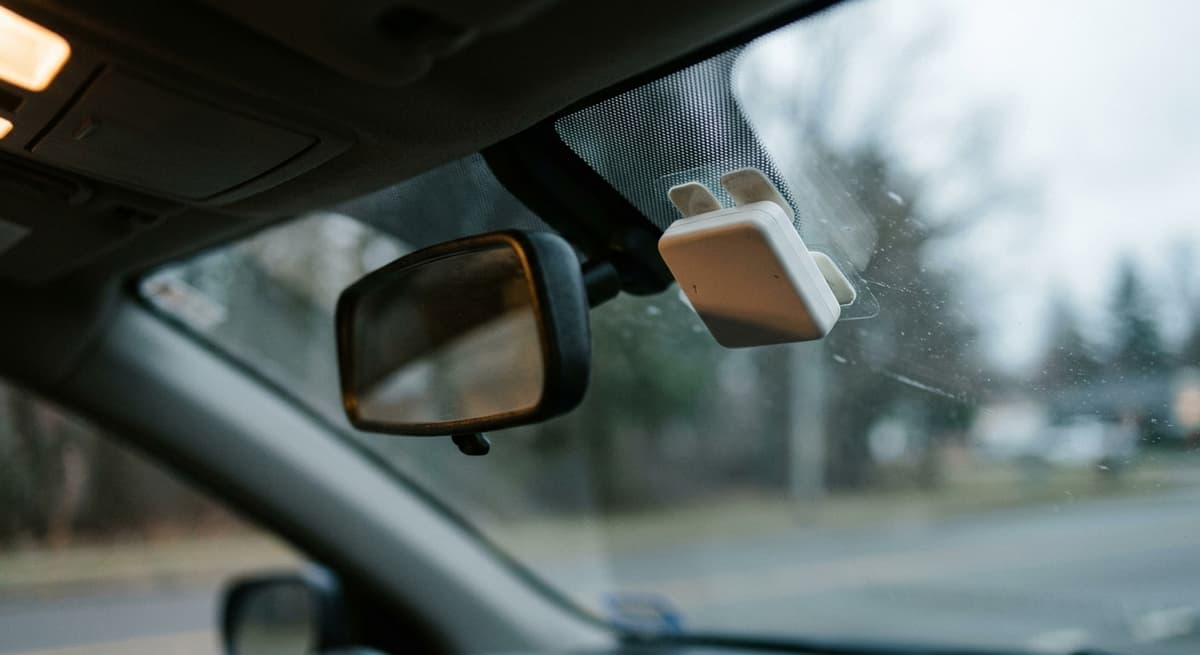
Utah law does not completely ban windshield-mounted devices. Utah Code 41-6a-1635 carves out two specific zones where nontransparent materials may be placed.
The Two Permitted Zones
| Zone | Location | Maximum Dimensions |
|---|---|---|
| Top edge strip | Along the top of the windshield | No more than 4 inches down from the top edge, or below the AS-1 line, whichever is lower |
| Lower left corner | Bottom-left corner of the windshield | No more than 3 inches to the right of the left edge and no more than 4 inches above the bottom edge |
The AS-1 line is a marking on the windshield glass placed there by the manufacturer. It indicates the area where tinted material or coatings may be applied without falling below the minimum light transmittance standard required by federal safety rules. In most passenger vehicles, the AS-1 line runs roughly 5 to 6 inches below the top edge of the windshield.
What the Law Does Not Say
Unlike some states (such as Arizona, which permits mounting in specific square-inch zones in both the lower driver-side and lower passenger-side corners), Utah's statute only explicitly permits nontransparent material in the lower left-hand corner. The statute does not mention a lower right-hand corner zone.
However, the broader obstruction rule still applies. A small device mounted elsewhere on the windshield that does not materially obstruct the driver's view may not violate the statute, but placement in the permitted zones provides the strongest legal protection.
GPS and Phone Mounts
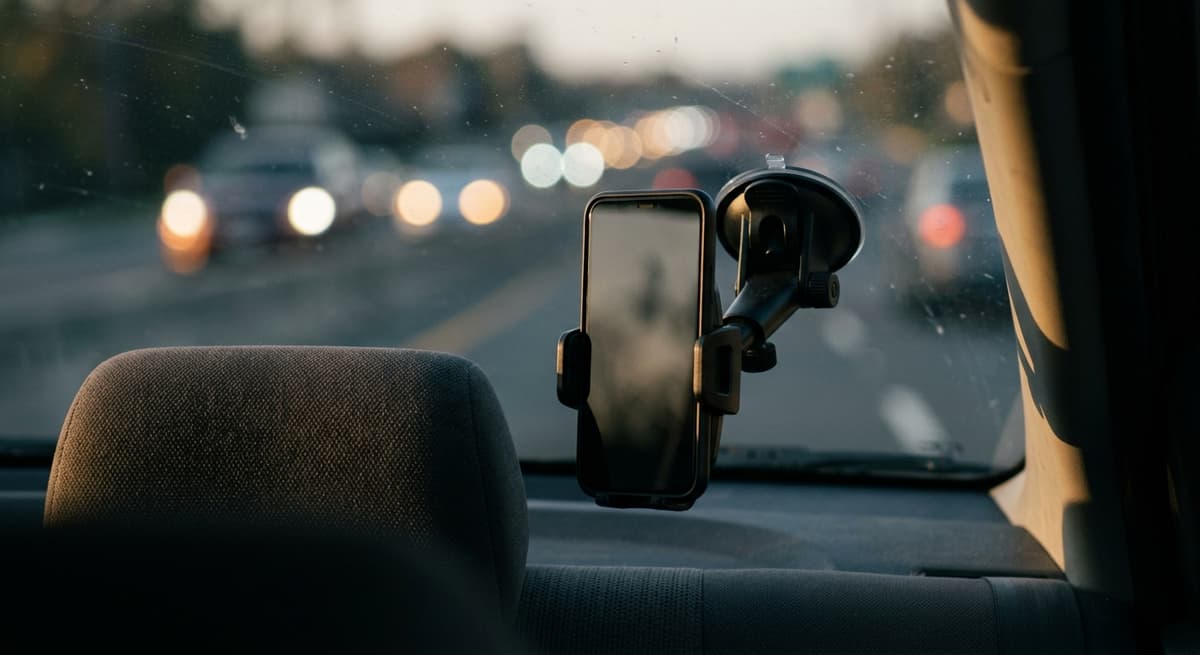
Utah does not have a statute that specifically addresses GPS devices or smartphone mounts by name. These devices fall under the general windshield obstruction rules in Utah Code 41-6a-1635.
Legal Placement Options
A GPS or phone mount is compliant with Utah law if it meets one of these conditions:
- Top edge zone: The device is mounted along the top of the windshield within 4 inches of the top edge (or below the AS-1 line)
- Lower left corner: The device fits within the 3-inch by 4-inch zone in the lower left corner
- Dashboard mount: Mounting on the dashboard avoids windshield restrictions entirely, provided the device does not obstruct the view through the windshield
- No material obstruction: The device is placed elsewhere on the windshield but does not materially obstruct the operator's view
For the greatest legal certainty, dashboard mounting is the safest choice. It removes the device from the windshield entirely and sidesteps any questions about obstruction.
Distracted Driving Law Interaction
Utah Code 41-6a-1716 restricts certain manual uses of a wireless communication device while operating a moving motor vehicle on a highway. Utah is not a hands-free state.
Subsection (2) bans only specified manual actions while the vehicle is moving: writing, sending, or reading a text message, instant message, or email; dialing a phone number; accessing the internet; recording video; taking a photograph; entering data; and viewing a video or photograph.
Subsection (3) expressly permits using the device for voice communication and for viewing a global positioning or navigation device or application. Neither exception is conditioned on the device being mounted or hands-free, so holding a phone to your ear for a call is lawful in Utah. Mounting the phone is still the safer practice, but the statute does not require it.
Penalties under Utah Code 41-6a-1716:
| Offense | Classification | Maximum Fine |
|---|---|---|
| First violation (no injury) | Class C misdemeanor | $100 |
| Violation causing serious bodily injury, or with a prior conviction under this section within three years | Class B misdemeanor | $1,000 plus up to 6 months jail |
These penalties are separate from any windshield obstruction citation. A driver could receive both a windshield obstruction infraction and a citation under 41-6a-1716 if, for example, they were typing a text message while a large mount obstructed the windshield.
Dashcam Laws in Utah
Dashcams are legal in Utah. The state does not prohibit video recording from a vehicle-mounted camera, and no specific statute bans dashcam use.
Mounting Requirements
A dashcam can be legally mounted in Utah in any of these positions:
- Behind the rearview mirror: This is the most common and recommended position. A compact dashcam mounted here typically does not materially obstruct the driver's view.
- Top edge zone: Within 4 inches of the top of the windshield
- Lower left corner: Within the 3-inch by 4-inch permitted zone
- On the dashboard: Outside the windshield entirely
Unlike Arizona, Utah does not have a specific statutory exemption for "safety monitoring equipment" behind the rearview mirror. However, a small dashcam mounted behind the mirror is unlikely to violate the "material obstruction" standard, and this placement is widely used by Utah drivers.
Audio Recording and Consent
Utah is a one-party consent state for audio recording under Utah Code 77-23a-4. This means you can legally record conversations in your vehicle as long as at least one person in the conversation (including you, the driver) consents to the recording.
If your dashcam records audio, it is legal to use in Utah as long as you are present in the vehicle. Recording conversations between passengers when you are not participating would require consent from at least one of those passengers.
Intercepting communications without the consent of any party is a criminal offense under Utah Code 77-23a-4, and violators may face felony charges and civil liability.
Video Recording on Public Roads
Recording video on public roads in Utah does not require anyone's consent. People do not have a reasonable expectation of privacy on public roadways. Standard dashcam footage captured on public streets is legal to record, store, and use.
Toll Transponder Mounting
Utah uses the Express Pass system for toll collection on its Express Lanes. According to UDOT, the Express Pass transponder should be mounted to the inside of the vehicle's windshield, behind the rearview mirror.
This placement is consistent with Utah Code 41-6a-1635. The statute permits certificates and papers required to be displayed by law, and the small transponder mounted behind the mirror does not materially obstruct the driver's view.
Key mounting guidelines from UDOT Express Pass installation instructions:
- Mount the transponder behind the rearview mirror
- Avoid black dotted areas (frit) on the windshield
- Avoid the rearview mirror base
- Some vehicles with electromagnetic shielding may require alternate positioning
Window Tinting Restrictions
Utah Code 41-6a-1635 also governs window tinting. The tinting rules were updated by SB0149 (2022) and further modified by HB0112 (2025).
Current Tinting Standards
| Window | Minimum Light Transmittance | Additional Rules |
|---|---|---|
| Windshield | 70% VLT | Tint strip allowed above AS-1 line or within 4 inches of top edge |
| Front side windows | 35% VLT | 5% variance tolerance for law enforcement metering |
| Rear side windows | Any darkness | No minimum VLT requirement |
| Rear window | Any darkness | Vehicle must have both left and right side mirrors |
The 2022 amendment (SB0149) changed the front side window requirement from 43% VLT to 35% VLT, giving drivers more flexibility for darker tinting on front side windows. The 5% variance tolerance means an officer measuring window tint will not cite a driver unless the reading falls below 30% VLT on front side windows.
Prohibited Tinting
No windshield or window may be composed of, covered by, or treated with any material that presents a metallic or mirrored appearance. Reflective tint is illegal on all windows in Utah.
Mirror Requirements
Any vehicle with tinting or nontransparent material on any window must be equipped with rearview mirrors on both the left and right sides of the vehicle to provide the driver with a view of the highway to the rear.
Medical Exemptions for Window Tint
Utah's approach to medical exemptions for darker window tint has been limited. The statute does not contain a clear exemption process similar to states like Arizona, which has a formal application through its Department of Transportation. Drivers with medical conditions requiring protection from sunlight should consult the Utah Highway Patrol or the Department of Public Safety for the most current guidance on whether any accommodation is available.
Windshield Condition Requirements
Beyond mounting restrictions, Utah law and administrative rules set requirements for the condition of the windshield itself.
Windshield Wipers
Utah Code 41-6a-1635 requires that the windshield on a motor vehicle be equipped with a device for cleaning rain, snow, or other moisture from the windshield. The device must be constructed so it can be operated by the driver. Windshield wipers must be maintained in good working order.
Safety Inspection Standards
Utah requires periodic safety inspections for certain vehicles. According to Utah Highway Patrol safety inspection procedures, windshields are inspected for cracks, chips, and other damage.
The acute area of the windshield (the critical viewing zone) is defined by measuring 6 inches down from the top edge and 6 inches up from the bottom edge where the glass meets the molding. Within this acute area, the following conditions will cause a vehicle to fail inspection:
- Any crack that intersects another crack
- Any star chip or damage that cannot be covered by a disc 3/4 inch in diameter
- Any damage that is within 3 inches of other damage
Damage outside the acute area is evaluated more leniently, but any crack or defect that materially obstructs the driver's view will still fail.
Commercial Vehicle Rules
Commercial motor vehicles operating in Utah must comply with both state and federal windshield mounting rules. The Federal Motor Carrier Safety Administration (FMCSA) amended 49 CFR 393.60(e) in a final rule effective May 6, 2022, expanding the authorized mounting area for vehicle safety technology on commercial motor vehicle windshields.
Under the FMCSA rule, safety technology devices may be mounted:
| Placement Rule | Maximum Distance |
|---|---|
| Below the upper edge of the windshield wiper sweep area | 8.5 inches (216 mm) |
| Above the lower edge of the windshield wiper sweep area | 7 inches (175 mm) |
| Position relative to driver sight lines | Must be outside the driver's sight lines to the road and highway signs |
This is more permissive than the previous 4-inch limit. Covered devices include driver camera systems, braking warning and assist systems, lane departure warning systems, GPS and navigation systems, and traffic sign recognition systems.
For non-safety technology devices (such as antennas), commercial vehicles must keep them within 6 inches of the upper edge of the windshield, outside the wiper sweep area, and outside the driver's sight lines.
For commercial vehicles, where state and federal rules differ, the more restrictive standard governs.
Recent Legislative Changes
Utah's windshield and window laws have been amended several times in recent years:
SB0149 (2022) -- Tinted Vehicle Windows Amendments
SB0149 was the most significant recent change. This bill:
- Reduced the minimum light transmittance requirement for front side windows from 43% VLT to 35% VLT
- Added the 5% variance tolerance for law enforcement metering
- Gained support from law enforcement after initial concerns
HB0112 (2025) -- Motor Vehicle Safety Inspection Modifications
HB0112 took effect on May 7, 2025, and made modifications to the safety inspection process. The bill updated provisions related to windshield inspection requirements as part of broader motor vehicle safety inspection changes.
The current version of Utah Code 41-6a-1635 reflects all amendments through the 2025 legislative session.
Penalties for Violations
Violations of Utah Code 41-6a-1635 are classified as infractions under Utah law. This is the least serious category of offense.
Under Utah Code 76-3-301, the maximum fine for an infraction is $750. Actual fine amounts are set by the Utah Judicial Council's Uniform Fine Schedule, which provides recommended amounts for specific violations.
| Violation Type | Classification | Maximum Fine |
|---|---|---|
| Windshield obstruction | Infraction | Up to $750 |
| Illegal window tint | Infraction | Up to $750 |
| Missing or defective windshield wipers | Infraction | Up to $750 |
| Sale or installation of illegal tint | Infraction | Up to $750 |
An infraction does not result in jail time. It does not create a criminal record. However, it may appear on a driving record and could be considered by insurance companies.
Law enforcement officers have discretion in enforcement. A small dashcam behind the rearview mirror is extremely unlikely to result in a citation. A large GPS unit or phone mount blocking a significant portion of the windshield is more likely to draw attention during a traffic stop or safety inspection.
Summary of Placement Rules
| Device Type | Legal Placement Options | Key Statute |
|---|---|---|
| GPS / Navigation | Top edge (4"), lower left corner, dashboard | Utah Code 41-6a-1635 |
| Phone mount | Top edge (4"), lower left corner, dashboard | Utah Code 41-6a-1635, 41-6a-1716 |
| Dashcam | Behind rearview mirror (recommended), top edge, lower left corner, dashboard | Utah Code 41-6a-1635 |
| Toll transponder (Express Pass) | Behind rearview mirror | Utah Code 41-6a-1635 |
| Parking permit / sticker | Lower left corner (3" x 4" zone) | Utah Code 41-6a-1635 |
| Tint strip | Top of windshield, within 4" or AS-1 line | Utah Code 41-6a-1635 |
More Utah Laws
Frequently Asked Questions
Can I mount a GPS or phone on my windshield in Utah?
Utah does not ban GPS or phone mounts on the windshield, but any mounted device must not materially obstruct the driver's view under Utah Code 41-6a-1635. The safest legal placements are along the top 4 inches of the windshield, in the lower left corner within the 3-inch by 4-inch permitted zone, or on the dashboard. Utah's distracted driving law (41-6a-1716) separately bans manual uses such as texting, dialing, and viewing video while driving, though it expressly allows voice calls and viewing a navigation app.
Where should I mount a dashcam in Utah?
The most common and recommended position is behind the rearview mirror. Although Utah does not have a specific statutory exemption for safety monitoring equipment like some states, a compact dashcam behind the mirror typically does not materially obstruct the driver's view. You can also mount a dashcam in the top 4-inch zone, the lower left corner zone, or on the dashboard.
Is dashcam audio recording legal in Utah?
Yes. Utah is a one-party consent state under Utah Code 77-23a-4. As long as you (the driver) are present and consent to the recording, your dashcam can legally record audio of conversations in your vehicle. Recording conversations you are not part of without any party's consent is a criminal offense.
What is the fine for a windshield obstruction ticket in Utah?
A windshield obstruction violation under Utah Code 41-6a-1635 is classified as an infraction. The maximum fine for an infraction in Utah is $750. Actual fine amounts are determined by the Utah Judicial Council's Uniform Fine Schedule and may vary by court jurisdiction. No jail time applies to infractions.
What are Utah's current window tint limits?
The windshield must allow at least 70% light transmittance (VLT). Front side windows must allow at least 35% VLT, with a 5% enforcement tolerance. Rear side windows and the rear window have no minimum VLT requirement, but vehicles with tinted rear windows must have both left and right side mirrors. Reflective or mirrored tint is illegal on all windows. These limits were updated by SB0149 in 2022.
Updates
Corrected the description of Utah Code 41-6a-1716: Utah is not a hands-free state, and the statute expressly allows voice calls and navigation-app use without requiring the phone to be mounted.
Independently fact-checked against the cited primary sources; governing law re-checked for recent changes
Governing law re-checked for recent changes
Reviewed and approved by an editor
The Law Behind This Article
This article rests on the statutory provisions below, held in our own legal record and retrieved from the official source. Tap a section to read the operative text.
Utah Code, Title 41: Motor Vehicles
§ 41-6a-1635Windshields and windows -- Tinting -- Obstructions reducing visibility -- Wipers -- Prohibitions.In forcecited in 4 of our articles
(1) Except as provided in Subsections (2), (3), and (4) a person may not operate a motor vehicle with: (a) a windshield that allows less than 70% light transmittance; (b) a front side window that allows less than 35% light transmittance, with no more than a 5% variance observed by a peace officer metering the light transmittance; (c) any windshield or window that is composed of, covered by, or treated with any material or component that presents a metallic or mirrored appearance; (d) any sign, poster, or other nontransparent material on the windshield or side windows of the motor vehicle except: (i) a certificate or other paper required to be so displayed by law; or (ii) the vehicle's identification number displayed or etched in accordance with rules made by the department under Section 41-6a-1601; or (e) any debris, frost, or other substance that materially obstructs the operator's view. (2) (a) A person may not operate a motor vehicle with an object or device hanging or mounted in a manner that materially obstructs the operator's view.
Official text (excerpt) · last checked 2026-09-08 · Read the full text in our law library · Verify at le.utah.gov
Cited in 3 court opinions in our collectionLatest citing opinion in our collection: 2023
Opinions citing this section in our collection:
- Harvey v. Butcher (District Court, D. Utah 2023)“…de windows that “allow less than 43% light transmittance.” Utah Code § 41-6a-1635(1)(b) (2015). Officer Simpson measured…”
- Linin v. Neff (District Court, D. Utah 2021)“…ff saw that Linin had a cracked windshield in violation of Utah Code § 41-6A-1635. Neff informed Linin of the reasons for…”
Identified automatically from the court opinions citing this section — not a ranking of which case controls.
Also relied on in: Utah Dashcam Laws, Utah Window Tint Laws (2026): Legal VLT Limits, Illinois Law Bars Police From Stopping Drivers Solely for Windshield Obstructions Like Air Fresheners
§ 41-6a-1716Prohibition on using a wireless communication device while operating a motor vehicle -- Exceptions -- Penalties.In force
(1) As used in this section: (a) "Wireless communication device" means: (i) a cellular phone; (ii) a portable telephone; (iii) a text messaging device; (iv) a personal digital assistant; (v) a stand-alone computer, including a tablet, laptop, or notebook computer; (vi) a global positioning receiver; (vii) a device used to display a video, movie, broadcast television image, or visual image; or (viii) a substantially similar communication device used to initiate or receive communication, information, or data. (b) "Wireless communication device" does not include a two-way radio device described in 47 C.F.R. ext_ref depth="2" refnumber="41-6a-90" start="2" type="Code of Federal Regulations">Part 90/ext_ref>, 95, or 97, or a functional equivalent.
Official text (excerpt) · last checked 2026-07-29 · Read the full text in our law library · Verify at le.utah.gov
Utah Code, Title 77: Criminal Procedure
§ 77-23a-4Offenses -- Criminal and civil -- Lawful interception.In forcecited in 19 of our articles
(1) (a) Except as otherwise specifically provided in this chapter, any person who violates Subsection (1)(b) is guilty of an offense and is subject to punishment under Subsection (10), or when applicable, the person is subject to civil action under Subsection (11). (b) A person commits a violation of this subsection who: (i) intentionally or knowingly intercepts, endeavors to intercept, or procures any other person to intercept or endeavor to intercept any wire, electronic, or oral communication; (ii) intentionally or knowingly uses, endeavors to use, or procures any other person to use or endeavor to use any electronic, mechanical, or other device to intercept any oral communication, when the device is affixed to, or otherwise transmits a signal through a wire, cable, or other like connection used in wire communication or when the device transmits communications by radio, or interferes with the transmission of the communication; (iii) intentionally or knowingly discloses or endeavors to disclose to any other person the contents of any wire, electronic, or oral communication, knowing or having reason to know that the information was obtained through the interception of a wire,…
Official text (excerpt) · last checked 2026-08-31 · Read the full text in our law library · Verify at le.utah.gov
Cited in 5 court opinions in our collectionLatest citing opinion in our collection: 2026
In the courts (editorial summary, independently checked):State v. Wood (2023) held a jail's recording of inmate calls fell within the consent exception in section 77-23a-4(7)(a) because the inmate impliedly consented by using phones he was told were monitored. The Quarasan Group, Inc. v. Nozani, LLC (2020) dismissed an eavesdropping claim once Utah law governed and did not bar the recording.
Opinions citing this section in our collection:
- State v. Wood (Utah Supreme Court 2023, 532 P.3d 997)✓A jail recorded an inmate's calls to his wife after warning him by handbook, placard and a message before each call; the Utah Supreme Court held he impliedly consented, so the interception fell within section 77-23a-4(7)(a) and suppression was denied.
- State v. Draughon (Court of Appeals of Utah 2026, 2026 UT App 52)“…rties to the call—consented to the call being recorded. See Utah Code §§ 77-23a-4(7)(b), -7. He claims Counsel should hav…”
- United States v. Maynard (Court of Appeals for the D.C. Circuit 2010, 615 F.3d 544)“…ined by the police acting pursuant to a warrant. See, e.g., Utah Code Ann. §§ 77-23a-4, 77-23a-7, 77-23a-15.5; Minn Stat §§ 62…”
Identified automatically from the court opinions citing this section — not a ranking of which case controls.
Also relied on in: Utah Smart Glasses Recording Laws (2026), Utah AI Meeting Recording Laws (2026), Utah Surveillance Camera Laws (2026 Guide)
Code of Federal Regulations Title 49
§ 393.60Glazing in specified openings.In forcecited in 15 of our articles
(a) Glazing material. Glazing material used in windshields, windows, and doors on a motor vehicle manufactured on or after December 25, 1968, shall at a minimum meet the requirements of Federal Motor Vehicle Safety Standard (FMVSS) No. 205 in effect on the date of manufacture of the motor vehicle. The glazing material shall be marked in accordance with FMVSS No. 205 (49 CFR 571.205, S6). (b) Windshields required. Each bus, truck and truck-tractor shall be equipped with a windshield. Each windshield or portion of a multi-piece windshield shall be mounted using the full periphery of the glazing material. (c) Windshield condition. With the exception of the conditions listed in paragraphs (c)(1), (c)(2), and (c)(3) of this section, each windshield shall be free of discoloration or damage in the area extending upward from the height of the top of the steering wheel (excluding a 51 mm (2 inch) border at the top of the windshield) and extending from a 25 mm (1 inch) border at each side of the windshield or windshield panel.
Official text (excerpt) · last checked 2026-07-28 · Read the full text in our law library · Verify at ecfr.gov
Cited in 3 court opinions in our collectionLatest citing opinion in our collection: 2021
In the courts (editorial summary, independently checked):The 70 percent light transmittance floor of 49 CFR 393.60(d) covers the windshield and the windows immediately right and left of the driver. Grooms Hauling, LLC v. Robinson (2020) applied it through Pennsylvania adoption and rejected racial profiling claims over tint citations; State v. Ford (2021) noted that Kansas adopts it too.
Opinions citing this section in our collection:
- United States of America, Government v. Robert L. Pierre, Defendant (District Court, D. New Hampshire 2015, 2015 DNH 083)“…rallel luminous transmittance of not less than 70 percent.” 49 C.F.R. 393.60(c). Neither the Government nor the defe…”
- GROOMS HAULING, LLC v. ROBINSON (District Court, E.D. Pennsylvania 2020)✓Officers repeatedly cited a Black-owned hauling company whose truck windows passed only 17 to 20 percent of light; treating 49 CFR 393.60's 70 percent transmittance standard as the governing rule, the court granted the officers summary judgment on the profiling claims.
- State v. Ford (Court of Appeals of Kansas 2021)“…Relevant to this appeal are regulations on window tinting (49 C.F.R. § 393.60[d]), medical examiner certificates (49…”
Identified automatically from the court opinions citing this section — not a ranking of which case controls.
Also relied on in: Connecticut Windshield Mounting Laws (2026 Guide), Idaho Windshield Mounting Laws (2026 Guide), Kansas Windshield Mounting Laws (2026 Guide)
Explore the law
This article also draws on these acts and chapters (opening at their first section): Utah Code, Title 76: Criminal Offenses § 76-3-101 (Sentencing in accordance with chapter.)
Related law for further reading — not part of this article’s citations.
Search our full record of US law — 2.1 million sections, every state + federal →
Sources and References
- Utah Code 41-6a-1635 - Windshields and windows -- Tinting -- Obstructions reducing visibility -- Wipers -- Prohibitions(le.utah.gov).gov
- Utah Code 41-6a-1716 - Prohibition on using a handheld wireless communication device while operating a moving motor vehicle(le.utah.gov).gov
- Utah Code 77-23a-4 - Interception of Communications Act(le.utah.gov).gov
- SB0149 (2022) - Tinted Vehicle Windows Amendments(le.utah.gov).gov
- HB0112 (2025) - Motor Vehicle Safety Inspection Modifications(le.utah.gov).gov
- Utah Code Title 76 Chapter 3 Part 3 - Fines and Special Sanctions(le.utah.gov).gov
- UDOT Express Lanes FAQ(udot.utah.gov).gov
- Express Pass Installation Instructions(expresstollpass.com)
- Utah Highway Patrol - Safety Inspection(highwaypatrol.utah.gov).gov
- Utah Judicial Council - 2025 Uniform Fine Schedule(legacy.utcourts.gov).gov
- FMCSA Final Rule - Authorized Windshield Area for Vehicle Safety Technology (49 CFR 393.60)(federalregister.gov).gov
- 49 CFR 393.60 - Glazing in specified openings(ecfr.gov).gov
- Utah Code 76-3-301 - Fines of individuals(le.utah.gov)