
Georgia
Georgia Windshield Mounting Laws (2026 Guide)
Independently fact-checked against primary sources (last audited August 17, 2026). · Reviewed by the RecordingLaw editorial team. · Law checked current as of August 17, 2026. · 1 primary source cited on this page. How we verify our legal content
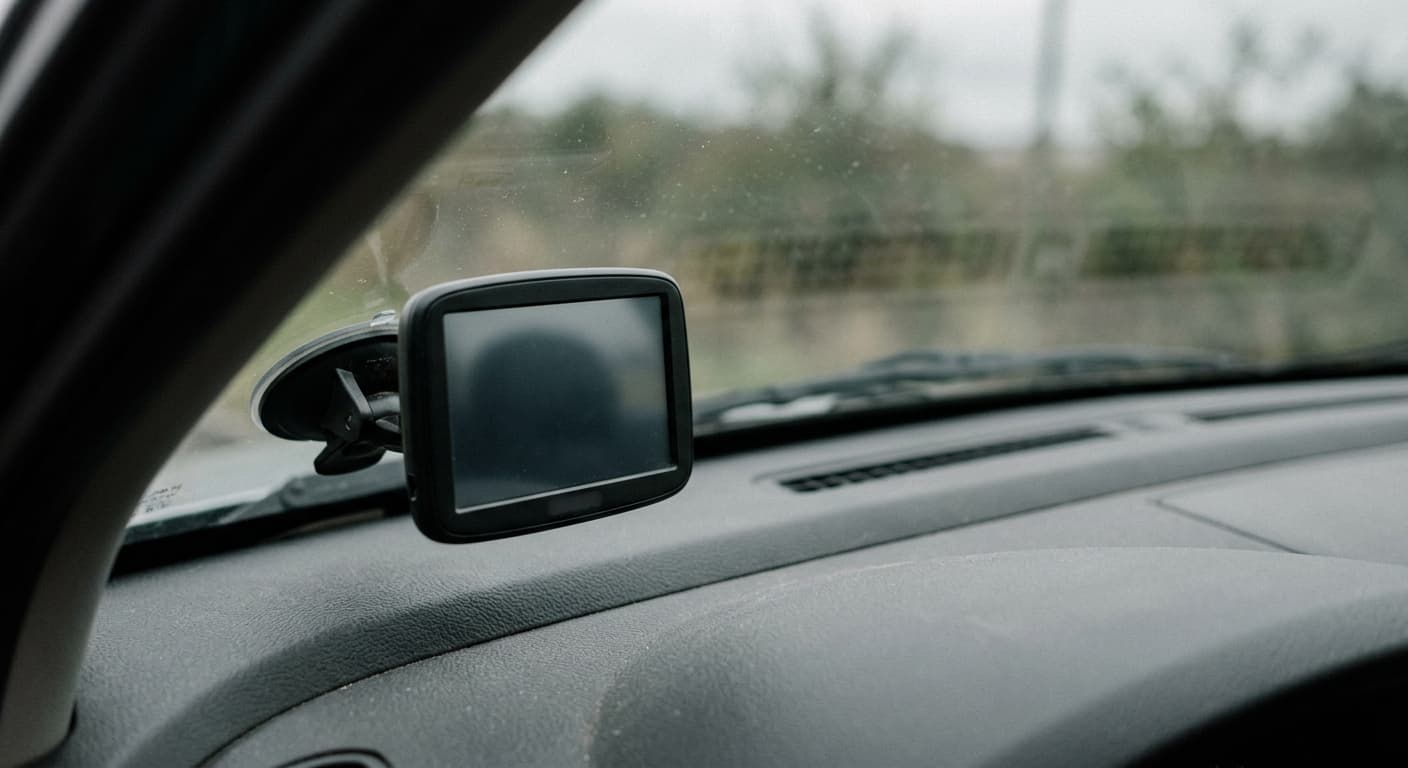
Georgia law explicitly permits windshield mounts for phones, GPS devices, and dashcams under O.C.G.A. 40-8-73, as amended in 2021. Drivers must position the mount to minimize obstruction of their view; Georgia law specifies no fixed measurement for device mounts.
Georgia is one of the more permissive states when it comes to windshield-mounted devices. A 2021 amendment to the state's windshield statute explicitly legalized mounts for phones, GPS units, and other electronic devices on the front windshield, provided they do not significantly block the driver's view.
This page covers the specific statutes governing what you can and cannot place on your windshield in Georgia, including device mounts, stickers, tinting, and dashcams.
Georgia Windshield Obstruction Law (O.C.G.A. 40-8-73)
O.C.G.A. 40-8-73 is the primary statute governing windshields in Georgia. It sets out five requirements, lettered (a) through (e).
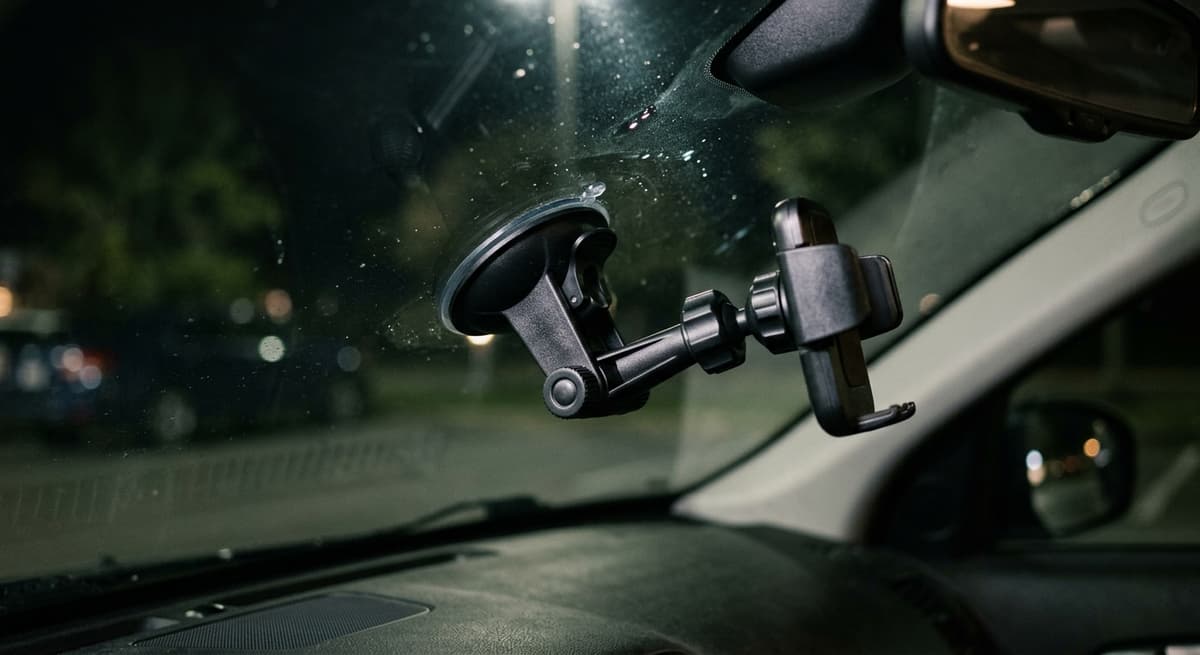
Subsection (a) is the obstruction rule. No person may drive a motor vehicle with any sign, poster, or other nontransparent material on the front windshield, side windows, or rear windows that obstructs the driver's clear view of the highway or any intersecting highway. This is the subsection the 2021 device-mount proviso was added to.
Subsection (b) requires the windshield of every motor vehicle to be equipped with a device for cleaning rain, snow, or other moisture from it, built so that the driver can control or operate it.
Subsection (c) requires every windshield wiper on a motor vehicle to be maintained in good working order.
Subsection (d) prohibits using any opaque or solid material, including cardboard, plastic, and taped glass, in place of a glass windshield or window.
Subsection (e) prohibits operating a motor vehicle with a windshield or rear window having a starburst or spider webbing effect greater than three inches by three inches. This is the provision that reaches a cracked or chipped windshield in Georgia: damage larger than a three-inch square makes the vehicle unlawful to operate, whether or not it sits in the driver's line of sight.
Two rules readers often expect to find in this statute are located elsewhere. Safety glazing is governed by O.C.G.A. 40-8-78, and it applies to the sale and registration of a vehicle rather than to driving one. The requirement that a windshield be free of discoloration or damage is a federal commercial-vehicle standard at 49 CFR 393.60(c), not a Georgia rule for passenger cars.
The 2021 Amendment (HB 165)
Georgia House Bill 165, signed into law on April 28, 2021 and effective July 1, 2021, added a critical proviso to O.C.G.A. 40-8-73(a). The amendment states that a person may drive a motor vehicle with a mount for the support of a wireless telecommunications device or stand-alone electronic device upon the front windshield, provided that the mount is located on the windshield in a manner that minimizes obstruction of the driver's view.
That permission carries an express limit: it applies "except as prohibited by federal law, rules, or regulations in the operation of a commercial motor vehicle." See the commercial vehicles section below.
This was a direct response to Georgia's Hands-Free Law (O.C.G.A. 40-6-241), which took effect in 2018. The Hands-Free Law requires drivers to use hands-free methods to operate their phones, and windshield mounts are one of the approved methods. Before HB 165, there was a legal contradiction: the Hands-Free Law encouraged windshield mounts, but the windshield obstruction statute technically prohibited them.
The 2021 amendment resolved that conflict.
GPS and Phone Mounts
Windshield-mounted GPS devices and phone holders are legal in Georgia under the 2021 amendment to O.C.G.A. 40-8-73. The law does not specify exact placement dimensions for device mounts. Instead, it uses the standard that the mount must minimize obstruction of the driver's view.
Best practices for mounting a device on your windshield in Georgia include placing the mount in the lower portion of the windshield, keeping the device as close to the dashboard as practical, and choosing a mount that does not extend far into the driver's primary line of sight. Commercial drivers are the exception, and the federal rule sends them the other direction; see below.
Connection to the Hands-Free Law
O.C.G.A. 40-6-241 prohibits drivers from physically holding or supporting a wireless telecommunications device while operating a vehicle. The law allows device use only through an earpiece, wrist device, the vehicle's Bluetooth system, or a mounted phone holder.
Because the Hands-Free Law effectively requires a mount for most drivers, the legislature ensured that windshield mounts are explicitly permitted under the equipment statute.
Penalties under the Hands-Free Law are separate from windshield obstruction penalties. O.C.G.A. 40-6-241(f)(1) sets the fines: not more than $50 for a first conviction, not more than $100 for a second conviction within 24 months, and not more than $150 for a third or subsequent conviction within 24 months. The statute itself assigns no license points. The one, two, and three points that attach to those convictions come from the Department of Driver Services point schedule.
Dashcam Mounting Rules
Georgia does not have a specific statute addressing dashcams or video event recorders. A dashcam falls under the general provisions of O.C.G.A. 40-8-73 as a windshield-mounted device.
Under the 2021 amendment, a dashcam qualifies as a "stand-alone electronic device" and is permitted on the windshield as long as it minimizes obstruction of the driver's view. The safest placement is behind the rearview mirror, where it occupies space already blocked from the driver's line of sight.
Georgia is a one-party consent state for audio recording under O.C.G.A. 16-11-62, so a dashcam that records audio inside the vehicle is legal as long as at least one person in the car knows about the recording.
Sticker and Decal Placement Zones
While device mounts follow a "minimize obstruction" standard, stickers and nontransparent materials on the windshield are governed by stricter placement rules under O.C.G.A. 40-8-73.1.
Georgia allows stickers and nontransparent materials in two specific windshield zones:
| Zone | Size | Location |
|---|---|---|
| Passenger side | 7-inch square | Lower corner of the windshield farthest from the driver |
| Driver side | 5-inch square | Lower corner of the windshield nearest the driver |
These zones are for items like registration stickers, parking permits, toll transponders, and inspection decals. Any sticker placed outside these zones, or that exceeds these dimensions, violates the statute.
Other Permitted Windshield Items
O.C.G.A. 40-8-73.1 also exempts the following items from the tinting and obstruction restrictions:
- Adjustable sun visors mounted forward of the side windows (not attached to the glass)
- Any transparent item that is not red or amber in color placed on the uppermost six inches of the windshield
- Direction, destination, or termination signs on passenger common carrier vehicles, provided they do not interfere with the driver's view
- Any federal, state, or local sticker or certificate required by law
Windshield Tinting
Georgia regulates windshield tinting under O.C.G.A. 40-8-73.1. The key rules are as follows.
Georgia does not use the AS-1 line that many other states borrow from federal glazing standards, and there is no "below the line" allowance in the Georgia statute. O.C.G.A. 40-8-73.1(b)(1) makes it unlawful to operate a vehicle with material and glazing applied to the front windshield that reduces light transmission through the windshield at all. There is no permitted tint percentage for the front windshield. The single windshield allowance is subsection (c)(4): a transparent item that is not red or amber in color may be placed on the uppermost six inches of the windshield.
For the rear windshield and the side or door windows, subsection (b)(2) makes it unlawful to reduce light transmission to less than 32 percent, plus or minus 3 percent, or to increase light reflectance to more than 20 percent. The 3 percent tolerance is written into the statute, not a matter of enforcement discretion.
That 32 percent limit does not reach every window on every vehicle. Subsection (c)(6) exempts the rear windshield and the side or door windows other than those to the immediate right and left of the driver on:
- A multipurpose passenger vehicle, defined in the statute as a vehicle designed to carry ten people or fewer that is built on a truck chassis or with special features for occasional off-road operation, which covers most SUVs and many trucks and vans
- A school bus, any other bus used for public transportation, and any bus or van owned or leased by a religious organization or a Georgia nonprofit corporation
- Any limousine owned or leased by a public or private entity
- Any other vehicle whose windows or windshield were tinted or darkened before factory delivery or as permitted by federal law or regulation
On those vehicles the darker rear glass is lawful. The windows to the driver's immediate right and left are never exempt.
Medical Exemption
Georgia does offer a medical exemption for window tinting. Under O.C.G.A. 40-8-73.1, the Department of Public Safety may issue an exemption for any person who, for medical reasons, must be shielded from direct sunlight. The applicant must provide written attestation from a licensed physician or certified optometrist.
The exemption applies to any motor vehicle owned by the applicant or in which the applicant is a habitual passenger.
Toll Transponders and E-ZPass
Toll transponders such as Peach Pass (Georgia's electronic toll collection system) are permitted on the windshield. These devices fall within the exemptions for items required by law or authorized by state agencies.
Peach Pass transponders are typically mounted on the upper-center portion of the windshield, near the rearview mirror. This placement is consistent with both the sticker zone rules and the general obstruction prohibition.
Penalties for Violations
| Violation | Statute | Classification | Maximum Fine |
|---|---|---|---|
| Windshield obstruction (device mount) | O.C.G.A. 40-8-73, made a misdemeanor by 40-8-7(b)(3) and (c) | Misdemeanor | $1,000 |
| Illegal windshield tinting | O.C.G.A. 40-8-73.1(h) | Misdemeanor | $1,000 |
| Hands-Free Law (first offense) | O.C.G.A. 40-6-241(f)(1)(A); points per DDS schedule | Misdemeanor | $50 + 1 point |
| Hands-Free Law (second within 24 months) | O.C.G.A. 40-6-241(f)(1)(B); points per DDS schedule | Misdemeanor | $100 + 2 points |
| Hands-Free Law (third+ within 24 months) | O.C.G.A. 40-6-241(f)(1)(C); points per DDS schedule | Misdemeanor | $150 + 3 points |
The two windshield statutes reach misdemeanor status by different routes. A tint violation is a misdemeanor because O.C.G.A. 40-8-73.1(h) says so directly. O.C.G.A. 40-8-73 prescribes no penalty of its own; the provision that classifies a violation is O.C.G.A. 40-8-7, which makes it a misdemeanor to drive a vehicle equipped in any manner in violation of Georgia's motor vehicle equipment chapter (subsection (b)(3)) or to do any act forbidden or fail to perform any act required under that chapter (subsection (c)).
Either route leads to the same sentence. O.C.G.A. 17-10-3 sets misdemeanor punishment at a fine up to $1,000, confinement up to 12 months, or both. In practice, most windshield violations result in a fine and no jail time.
A first-time Hands-Free Law violator who appears in court and produces a hands-free device (or proof of purchase of one) may have the charge dismissed entirely.
Commercial Vehicles
Commercial motor vehicles operating in Georgia are subject to both state and federal windshield regulations, and where they conflict the federal rule governs. The 2021 mount permission in O.C.G.A. 40-8-73(a) applies "except as prohibited by federal law, rules, or regulations in the operation of a commercial motor vehicle," so it does not shield a commercial driver from the federal mounting rule. O.C.G.A. 40-8-73.1(f) likewise subjects commercial vehicles operated in Georgia to 49 CFR 393.60 for windshield and window glazing.
49 CFR 393.60 does more than tell commercial drivers to avoid obstruction. It fixes where a device may sit, and it points to the top of the windshield rather than the bottom. Under 393.60(e)(1)(i), antennas and similar devices must not be mounted more than 6 inches (152 mm) below the upper edge of the windshield, must sit outside the area swept by the windshield wipers, and must sit outside the driver's sight lines to the road and to highway signs and signals.
Vehicle safety technologies, a category defined at 49 CFR 393.5, get a separate allowance under 393.60(e)(1)(ii). They must be mounted not more than 8.5 inches (216 mm) below the upper edge of the area swept by the wipers, not more than 7 inches (175 mm) above the lower edge of that swept area, and outside the driver's sight lines.
The practical consequence: a commercial driver who moves a GPS unit or electronic logging device down to the bottom of the windshield or onto the dashboard to "keep it out of the way" can fall outside these permitted zones. Mount within the measurements above, outside the wiper sweep where required, and out of the sight lines.
Separately, 393.60(c) requires a commercial vehicle's windshield to be free of discoloration or damage in the area above the top of the steering wheel, with narrow allowances for small chips and non-intersecting cracks. That is a federal standard for commercial vehicles and does not apply to passenger cars.
Recent Changes
The most significant recent change to Georgia's windshield mounting laws was the 2021 amendment (HB 165) that legalized device mounts. No additional amendments to O.C.G.A. 40-8-73 or O.C.G.A. 40-8-73.1 were enacted during the 2024 or 2025 legislative sessions.
Georgia's Hands-Free Law continues to be actively enforced. The Governor's Office of Highway Safety regularly conducts enforcement campaigns targeting distracted driving, making a properly mounted phone or GPS device important for avoiding both obstruction and hands-free violations.
More Georgia Laws
Frequently Asked Questions
Can I mount a GPS or phone on my windshield in Georgia?
Yes. Georgia explicitly allows windshield mounts for wireless telecommunications devices and stand-alone electronic devices under O.C.G.A. 40-8-73, as amended by HB 165 in 2021. The mount must be positioned to minimize obstruction of the driver's view. The permission does not extend to a commercial motor vehicle where federal law prohibits the mounting.
Is it legal to drive with a cracked windshield in Georgia?
O.C.G.A. 40-8-73(e) prohibits operating a motor vehicle with a windshield or rear window having a starburst or spider webbing effect greater than three inches by three inches. Damage smaller than that is not covered by this subsection, but any crack or chip that obstructs the driver's clear view can still raise a problem under subsection (a).
Is it legal to use a dashcam in Georgia?
Yes. A dashcam qualifies as a stand-alone electronic device under the 2021 amendment. It is permitted as long as it minimizes obstruction of the driver's view. The best placement is behind the rearview mirror. Georgia is a one-party consent state for audio recording.
What is the penalty for a windshield obstruction violation in Georgia?
It is a misdemeanor. O.C.G.A. 40-8-73 sets no penalty of its own; O.C.G.A. 40-8-7(b)(3) and (c) make it a misdemeanor to drive a vehicle equipped in violation of Georgia's equipment chapter or to do any act forbidden under it. O.C.G.A. 17-10-3 then sets misdemeanor punishment at a maximum fine of $1,000 and up to 12 months in jail, though most windshield violations result in a fine only.
Can I tint the front windshield in Georgia?
No. O.C.G.A. 40-8-73.1(b)(1) makes it unlawful to operate a vehicle with material and glazing applied to the front windshield that reduces light transmission, with no permitted percentage. The only allowance is a transparent item that is not red or amber in color placed on the uppermost six inches of the windshield. Georgia's statute does not use the AS-1 line.
Where can I place stickers on my windshield in Georgia?
Under O.C.G.A. 40-8-73.1, stickers and nontransparent materials are allowed in a 7-inch square on the lower passenger-side corner and a 5-inch square on the lower driver-side corner. Transparent items that are not red or amber may be placed on the uppermost 6 inches of the windshield.
Does Georgia require hands-free phone use while driving?
Yes. O.C.G.A. 40-6-241, Georgia's Hands-Free Law effective since July 1, 2018, prohibits holding a phone while driving. Drivers must use a mount, earpiece, wrist device, or Bluetooth. A first conviction carries a fine of not more than $50 under the statute, plus one point on your license under the Department of Driver Services point schedule.
Updates
Corrected the summary of O.C.G.A. 40-8-73 to its actual five subsections including the three-inch starburst rule for cracked windshields, removed an AS-1 line tint rule that is not in Georgia law, restored the statutory plus or minus 3 percent tint tolerance and the rear-window exemptions for SUVs, buses and limousines, replaced reversed federal commercial-vehicle mounting guidance with the measurements in 49 CFR 393.60(e), and completed the misdemeanor authority chain through O.C.G.A. 40-8-7.
Independently fact-checked against the cited primary sources; governing law re-checked for recent changes
Governing law re-checked for recent changes
Governing law re-checked for recent changes
Reviewed and approved by an editor
The Law Behind This Article
This article rests on the statutory provisions below, held in our own legal record and retrieved from the official source. Tap a section to read the operative text.
Official Code of Georgia Annotated
§ 40-8-73Windshields, windows, and windshield wipers.In forcecited in 2 of our articles
(a) No person shall drive any motor vehicle with any sign, poster, or other nontransparent material upon the front windshield, side windows, or rear windows of such vehicle which obstructs the driver's clear view of the highway or any intersecting highway;…
Official text (excerpt) · last checked 2021-08-17 · Read the full text in our law library
Cited in 7 court opinions in our collectionLatest citing opinion in our collection: 2014
Opinions citing this section in our collection:
- Darby v. State (Court of Appeals of Georgia 1999, 239 Ga. App. 492)“…beyond the actual starburst. Appellant argues that because OCGA § 40-8-73 (e) provides that “[n]o motor vehicle s…”
- Holt v. State (Court of Appeals of Georgia 1997, 227 Ga. App. 46)“…rized to stop the vehicle due to the broken windshield. See OCGA § 40-8-73(e) (it is unlawful to operate a vehicle…”
- Gutierrez v. State (Court of Appeals of Georgia 1998, 235 Ga. App. 878)“…OCGA § 40-8-76.1 (b)); and driving with improper equipment (OCGA § 40-8-73 (e)). The court merged the felony obstr…”
Identified automatically from the court opinions citing this section — not a ranking of which case controls.
Also relied on in: Georgia Dashcam Laws: Windshield Mounting and Recording Rules (2026)
§ 40-8-73.1Tinting of windows or windshields.In forcecited in 3 of our articles
(a) As used in this Code section, the term: (1) "Light reflectance" means the ratio of the amount of total light that is reflected outward by a product or material to the amount of total light falling on the product or material. (2) "Light transmission" means the ratio of the amount of total light
Official text (excerpt) · last checked 2026-09-01 · Read the full text in our law library · Verify at legis.ga.gov
Cited in 29 court opinions in our collectionLatest citing opinion in our collection: 2020
In the courts (editorial summary, independently checked):Ciak v. State (2004) struck the then-current OCGA 40-8-73.1 on equal protection grounds because it reached only Georgia residents, but held that unconstitutionality did not require suppressing evidence from the stop. Christy v. State (2012) applied that rule and upheld a stop based on an officer's view of dark tint.
Opinions citing this section in our collection:
- Ciak v. State (Supreme Court of Georgia 2004, 278 Ga. 27)✓An officer stopped Ciak solely for dark purple tint on a Georgia-registered car; the court held OCGA 40-8-73.1 denied equal protection because it reached only Georgia residents, but held that the statute's invalidity did not require suppressing the DUI evidence.
- Davis v. State (Court of Appeals of Georgia 2010, 303 Ga. App. 785)“…ehicle Davis was driving, based on a suspected violation of OCGA § 40-8-73.1 (b) (2), which limits the tint allowed…”
- Christy v. State (Court of Appeals of Georgia 2012, 315 Ga. App. 647)✓After the trial court declared OCGA 40-8-73.1 (b) unconstitutional, the court held the officer's observation of very dark tint still gave reasonable suspicion for the stop, and that the statute's invalidity did not require suppressing the DUI evidence.
Identified automatically from the court opinions citing this section — not a ranking of which case controls.
Also relied on in: Georgia Window Tint Laws (2026): Legal VLT Limits
§ 40-6-241Distracted driving; restrictions on operation of wireless telecommunications devices and stand-alone electronic devices; penalty; exceptions.In forcecited in 2 of our articles
(a) As used in this Code section, the term: (1) "Stand-alone electronic device" means a device other than a wireless telecommunications device which stores audio or video data files to be retrieved on demand by a user. (2) "Utility services" means and includes electric, natural gas, water,…
Official text (excerpt) · last checked 2021-08-17 · Read the full text in our law library
Cited in 18 court opinions in our collectionLatest citing opinion in our collection: 2026
Opinions citing this section in our collection:
- John McKnight v. Anthony Love (Court of Appeals of Georgia 2023)“…rs while approaching an intersection). 31 See OCGA § 40-6-241 (c) (1) (A)-(B) (“While operating a mot…”
- Lindsey v. Clinch County Glass, Inc. (Court of Appeals of Georgia 2011, 312 Ga. App. 534)“…duty to exercise due care while operating a motor vehicle. OCGA § 40-6-241. Although Holtzclaw admitted that he wa…”
- MAYNARD v. SNAPCHAT, INC (Supreme Court of Georgia 2022, 313 Ga. 533)“…se a driver also breached a duty imposed by law. See, e.g., OCGA § 40-6-241 (c) (Georgia’s hands-free law prohibiti…”
Identified automatically from the court opinions citing this section — not a ranking of which case controls.
Also relied on in: Georgia Smart Glasses Recording Laws 2026
§ 17-10-3Punishment for misdemeanors generally.In force
(a) Except as otherwise provided by law, every crime declared to be a misdemeanor shall be punished as follows: (1) By a fine not to exceed $1,000.00 or by confinement in the county or other jail, county correctional institution, or such other places as counties may provide for maintenance of…
Official text (excerpt) · last checked 2021-05-06 · Read the full text in our law library
Cited in 88 court opinions in our collectionLatest citing opinion in our collection: 2026
Opinions citing this section in our collection:
- Chastain v. State (Court of Appeals of Georgia 1998, 231 Ga. App. 225)“…apparently relying upon the general penalty provisions of OCGA § 17-10-3 (a) (1), which set the maximum penalty…”
- Yates v. State (Court of Appeals of Georgia 2003, 263 Ga. App. 29)“…misdemeanor to serve time in a probation detention center, OCGA § 17-10-3 (a) (2), was not effective until Januar…”
- Smith v. State (Court of Appeals of Georgia 1985, 174 Ga. App. 238)“…e expressly entered pursuant to OCGA § 17-10-4, rather than OCGA § 17-10-3, the general sentencing provision for o…”
Identified automatically from the court opinions citing this section — not a ranking of which case controls.
§ 16-11-62Eavesdropping, surveillance, or intercepting communication which invades privacy of another; divulging private message.In forcecited in 25 of our articles
It shall be unlawful for: (1) Any person in a clandestine manner intentionally to overhear, transmit, or record or attempt to overhear, transmit, or record the private conversation of another which shall originate in any private place; (2) Any person, through the use of any device, without the
Official text (excerpt) · last checked 2026-08-31 · Read the full text in our law library · Verify at legis.ga.gov
Cited in 94 court opinions in our collectionLatest citing opinion in our collection: 2026
In the courts (editorial summary, independently checked):Kelley v. State (1998) held OCGA 16-11-62(2) reached a guardian who photographed a nude 16-year-old in the family bathroom, with no exception for family members. Burgeson v. State (1996) held a conversation recorded in a patrol car was not covered, because no reasonable expectation of privacy existed there.
Opinions citing this section in our collection:
- Burgeson v. State (Supreme Court of Georgia 1996, 267 Ga. 102)✓Police secretly recorded two arrestees talking in the back of a patrol car. The court held a police car is much like a jail cell, with no reasonable expectation of privacy, so intercepting that conversation did not offend OCGA 16-11-62 and the tape was admissible.
- Kelley v. State (Court of Appeals of Georgia 1998, 233 Ga. App. 244)✓A guardian photographed her 16-year-old niece nude and passed out in the family bathtub. The court held OCGA 16-11-62(2) reaches any person with no family exception, that the film need not be developed, and that a jury could find the bathroom a private place.
- Dobbins v. State (Supreme Court of Georgia 1992, 262 Ga. 161)“…th the consent of one of the parties to the conversation. OCGA § 16-11-62 (1) provides that: It shall be unlawf…”
Identified automatically from the court opinions citing this section — not a ranking of which case controls.
Also relied on in: Georgia Data Privacy Laws: Breach Notification & Consumer Rights (2026), Georgia Ring Doorbell Laws: What You Need to Know in 2026, Georgia Surveillance Camera Laws (2026 Guide)
Code of Federal Regulations Title 49
§ 393.60Glazing in specified openings.In forcecited in 15 of our articles
(a) Glazing material. Glazing material used in windshields, windows, and doors on a motor vehicle manufactured on or after December 25, 1968, shall at a minimum meet the requirements of Federal Motor Vehicle Safety Standard (FMVSS) No. 205 in effect on the date of manufacture of the motor vehicle. The glazing material shall be marked in accordance with FMVSS No. 205 (49 CFR 571.205, S6). (b) Windshields required. Each bus, truck and truck-tractor shall be equipped with a windshield. Each windshield or portion of a multi-piece windshield shall be mounted using the full periphery of the glazing material. (c) Windshield condition. With the exception of the conditions listed in paragraphs (c)(1), (c)(2), and (c)(3) of this section, each windshield shall be free of discoloration or damage in the area extending upward from the height of the top of the steering wheel (excluding a 51 mm (2 inch) border at the top of the windshield) and extending from a 25 mm (1 inch) border at each side of the windshield or windshield panel.
Official text (excerpt) · last checked 2026-07-28 · Read the full text in our law library · Verify at ecfr.gov
Cited in 3 court opinions in our collectionLatest citing opinion in our collection: 2021
In the courts (editorial summary, independently checked):The 70 percent light transmittance floor of 49 CFR 393.60(d) covers the windshield and the windows immediately right and left of the driver. Grooms Hauling, LLC v. Robinson (2020) applied it through Pennsylvania adoption and rejected racial profiling claims over tint citations; State v. Ford (2021) noted that Kansas adopts it too.
Opinions citing this section in our collection:
- United States of America, Government v. Robert L. Pierre, Defendant (District Court, D. New Hampshire 2015, 2015 DNH 083)“…rallel luminous transmittance of not less than 70 percent.” 49 C.F.R. 393.60(c). Neither the Government nor the defe…”
- GROOMS HAULING, LLC v. ROBINSON (District Court, E.D. Pennsylvania 2020)✓Officers repeatedly cited a Black-owned hauling company whose truck windows passed only 17 to 20 percent of light; treating 49 CFR 393.60's 70 percent transmittance standard as the governing rule, the court granted the officers summary judgment on the profiling claims.
- State v. Ford (Court of Appeals of Kansas 2021)“…Relevant to this appeal are regulations on window tinting (49 C.F.R. § 393.60[d]), medical examiner certificates (49…”
Identified automatically from the court opinions citing this section — not a ranking of which case controls.
Also relied on in: Connecticut Windshield Mounting Laws (2026 Guide), Idaho Windshield Mounting Laws (2026 Guide), Kansas Windshield Mounting Laws (2026 Guide)
Search our full record of US law — 2.1 million sections, every state + federal →
Sources and References
- O.C.G.A. 40-8-73 - Windshields, windows, and windshield wipers(law.justia.com)
- O.C.G.A. 40-8-73.1 - Tinting of windows or windshields(law.justia.com)
- O.C.G.A. 40-6-241 - Distracted driving; hands-free restrictions(law.justia.com)
- Georgia Department of Driver Services - Traffic Laws and Safe Driving(dds.georgia.gov).gov
- HB 165 - Georgia House (2021-22 Session)(openstates.org)
- O.C.G.A. 16-11-62 - Georgia recording and eavesdropping statute(law.justia.com)
- O.C.G.A. 17-10-3 - Punishment for misdemeanors(law.justia.com)
- 49 CFR 393.60 - Glazing in specified openings; windshield condition and device mounting requirements for commercial motor vehicles(ecfr.gov)