
Wyoming
Wyoming Knife Laws (2026): Concealed Carry, Schools, Preemption
Independently fact-checked against primary sources (last audited September 24, 2026). · 12 primary sources cited on this page. How we verify our legal content
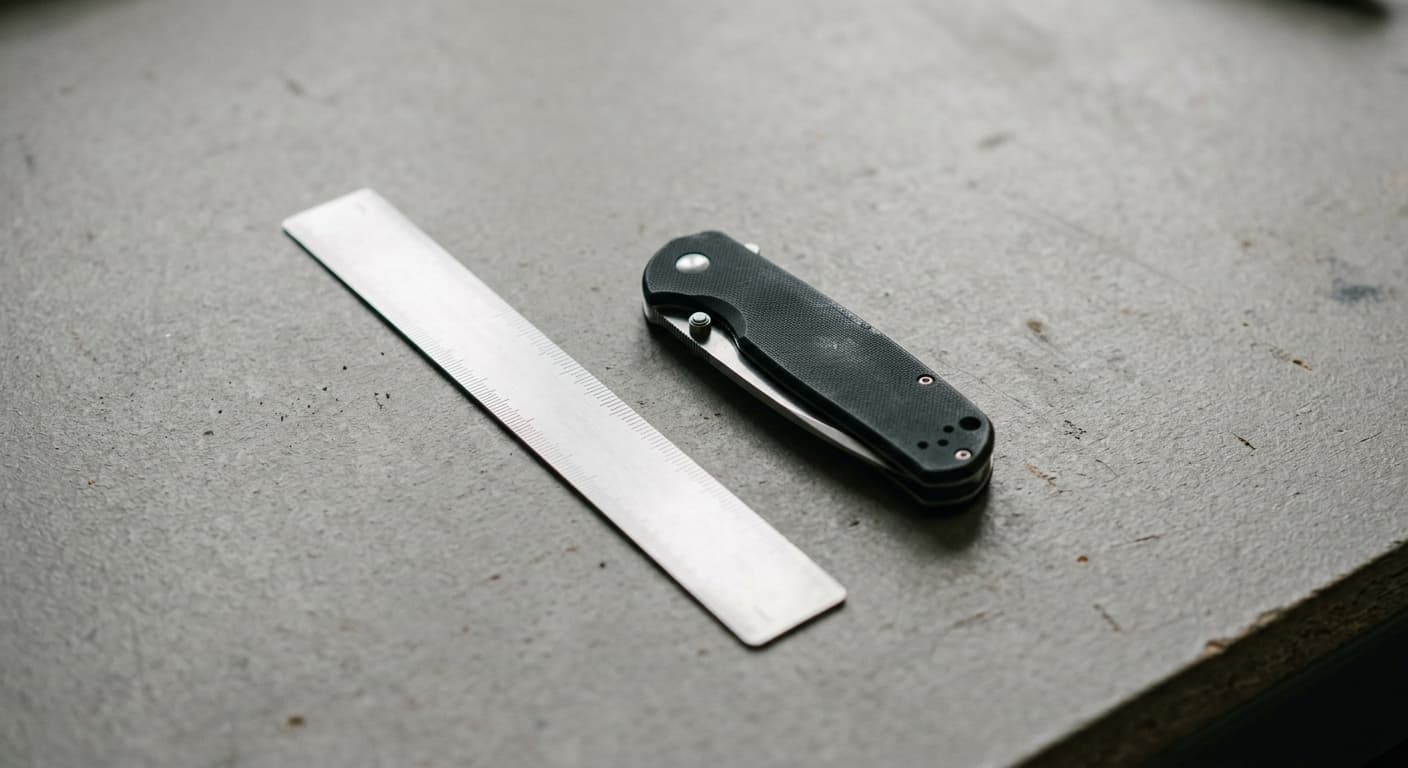
Wyoming has no statute naming a knife by type or setting a blade-length threshold. But Wyoming's core concealed-carry offense, Wyo. Stat. § 6-8-104(a), does not turn on the word "firearm." It bans carrying a concealed "deadly weapon," and Title 6's own definitions section defines "deadly weapon" functionally, as any device or instrument "which in the manner it is used or is intended to be used is reasonably capable of producing death or serious bodily injury." A knife carried or intended to be used that way can meet that test. The statute's own permit and permitless-carry exceptions are described elsewhere in the same chapter as authorizing a concealed "weapon," not only a firearm, so a Wyoming concealed-carry permit holder, or a resident who otherwise qualifies for permitless carry, likely carries that exemption over to a knife too, though no Wyoming court has confirmed this reading. A person without either has no exception, and a Wyoming Supreme Court decision construing this statute is itself a concealed-knife prosecution. Statewide preemption exists, but it names "weapons" without defining the term, and a specific carve-out preserves a city or town's general police power over conduct that disturbs the public peace or safety.
Jurisdiction scope: This article addresses Wyoming state law only, primarily W.S. §§ 6-8-104, 6-8-105, 6-1-104, 6-5-209, 21-4-306, 6-8-401, and 15-1-103. It does not cover the mechanics of applying for a Wyoming concealed-carry permit in detail.
Can you own or carry a knife openly in Wyoming?
Yes. Wyoming law names no knife by type and sets no blade-length threshold, and nothing in Title 6, the Wyoming Criminal Code, restricts carrying a knife openly. Wyoming has no counterpart to the named-type knife statutes (switchblade, dirk, dagger, gravity knife) found in many other states.

Concealed carry: the "deadly weapon" test that reaches a knife used as one
Wyoming's concealed-carry statute is not limited to firearms on its face. W.S. § 6-8-104(a) provides: "A person who wears or carries a concealed deadly weapon is guilty of a misdemeanor punishable by a fine of not more than seven hundred fifty dollars ($750.00), imprisonment in the county jail for not more than six (6) months, or both for a first offense, or a felony punishable by a fine of not more than two thousand dollars ($2,000.00), imprisonment for not more than two (2) years, or both, for a second or subsequent offense," unless one of four exceptions applies.
The operative term is "deadly weapon," not "firearm." W.S. § 6-1-104(a) supplies Title 6's general definitions, and § 6-1-104(a)(xx) confirms "this act," for purposes of that definitions section, "means title 6 of the Wyoming statutes," so its definitions apply to § 6-8-104. Section 6-1-104(a)(iv) defines "deadly weapon" as a device "but is not limited to a firearm, explosive or incendiary material, motorized vehicle, an animal or other device, instrument, material or substance, which in the manner it is used or is intended to be used is reasonably capable of producing death or serious bodily injury." This is a functional, use-based test, not a categorical ban on an item. An ordinary knife carried and used for a lawful, non-threatening purpose does not fit this definition; a knife carried or intended to be used in a manner reasonably capable of producing death or serious bodily injury can.
The four listed exceptions in § 6-8-104(a) are not uniformly limited to a firearm carrier, on a careful reading of how the rest of the chapter describes them. Exception (i) exempts a peace officer. Exception (ii) exempts a person who "possesses a permit under this section," unconditioned on its face, with no reference to what the person is carrying at the time. Subsection (b) explains that the permit issued under this section is "a permit to carry a concealed firearm," but two related provisions describe what that permit actually authorizes more broadly than its own name suggests. § 6-8-104(t) opens: "No person authorized to carry a concealed weapon pursuant to paragraphs (a)(ii) through (iv) of this section shall carry a concealed firearm into" a list of restricted places. W.S. § 6-8-105(b) grants "persons lawfully carrying concealed weapons in Wyoming under W.S. 6-8-104(a)(ii) through (iv)" the right to "carry a concealed weapon" into government meetings, public airports, and public buildings. Both provisions describe the (a)(ii)-through-(iv) class as authorized to carry a concealed weapon generally, not merely a concealed firearm, which points toward reading exception (ii) itself as reaching a knife carried as a deadly weapon, not only the firearm the permit was formally issued for.
Exception (iii), for a person holding "a valid permit authorizing him to carry a concealed firearm" issued by another state, likewise describes only the out-of-state permit, not a limit on what is carried under Wyoming's own statute. Exception (iv), Wyoming's permitless-carry provision for residents, requires meeting several listed conditions "and possession of the firearm by the person is not otherwise unlawful," the one clause among these three exceptions that is unambiguously firearm-specific, though it reads as an eligibility condition (the person must also be someone who could lawfully possess a firearm) rather than a restriction on what object the exception covers. No Wyoming appellate decision has resolved whether a permit holder's or a permitless carrier's exception from § 6-8-104(a) extends to a knife specifically.
What is settled is that a person who holds no permit and does not otherwise qualify for permitless carry has no exception at all, and the base offense has been enforced against exactly that kind of case. In State v. McAdams, 714 P.2d 1236 (Wyo. 1986), deputies stopped a woman for driving without license plates and one noticed a knife in a sheath inside her jacket; she said she carried it for protection as a cocktail waitress, and the state charged her under § 6-8-104(a). The trial court dismissed the charge on state constitutional grounds, and the state brought the question up on a bill of exceptions rather than a conventional appeal. On that record, the Wyoming Supreme Court held "our concealed deadly weapons statute is not an undue restraint upon our constitutional right to bear arms." Under W.S. § 7-12-104(b), a decision on a bill of exceptions "shall not reverse nor in any manner affect the judgment of the court in the case in which the bill of exceptions was taken," so the dismissal against McAdams stood even though the statute itself was upheld for future cases, and the opinion never decides whether her knife met the "deadly weapon" definition. A sheathed knife carried for personal protection was, in other words, actually charged under this statute, and the constitutional challenge to the statute itself failed.
A separate offense, W.S. § 6-8-103, independently makes it a felony (up to 5 years, up to $1,000 fine) to "knowingly possess, manufacture, transport, repair or sell a deadly weapon with intent to unlawfully threaten the life or physical well-being of another or to commit assault or inflict bodily injury on another," which would also reach a knife carried with that specific intent, concealed or not.
Restricted places: jails, courtrooms, and schools
W.S. § 6-5-209 restricts taking a "deadly weapon," the same title-wide functional term, into specific facilities. Subsection (a) provides: "Except as authorized by a person in charge, a person commits a felony punishable by imprisonment for not more than ten (10) years, a fine of not more than ten thousand dollars ($10,000.00), or both, if that person takes or passes a deadly weapon into a jail, a state penal institution, the Wyoming boys' school, Wyoming girls' school, a correctional facility operated by a private entity pursuant to W.S. 7-22-102 or the state hospital." The "Wyoming boys' school" and "Wyoming girls' school" named here are the state's juvenile correctional facilities, not ordinary K-12 public schools. Subsection (b) separately makes it a misdemeanor, a felony on a second or subsequent offense within five years, to take a deadly weapon into a courtroom without the presiding judge's authorization.

For ordinary K-12 schools, the operative Wyoming statute is not a criminal offense but a mandatory school-discipline consequence. W.S. § 21-4-306(a)(v) lists as grounds for suspension or expulsion "possession, use, transfer, carrying or selling a deadly weapon as defined under W.S. 6-1-104(a)(iv) within any school bus... or within the boundaries of real property used by the district primarily for the education of students in grades kindergarten through twelve (12)." Subsection (c) requires the district superintendent to expel a student who violates this provision for one year, subject to case-by-case modification under subsection (d). Because this section expressly incorporates the § 6-1-104(a)(iv) definition of "deadly weapon" by name, the same functional test described above governs whether a knife triggers this mandatory expulsion.
A separate statute that had addressed weapons in a school-related context, W.S. § 21-3-132, was repealed by 2025 Wyoming Session Laws, chapter 61, § 3, and no substantive text remains at that citation in the current code.
The "gun free zones" framework: firearm-only restrictions, weapon-inclusive permissions
Wyoming's concealed-carry permit statute lists additional restricted places for permit holders, but the restriction and the companion permission are not scoped the same way. W.S. § 6-8-104(t) restricts where "a person authorized to carry a concealed weapon pursuant to paragraphs (a)(ii) through (iv)" may carry "a concealed firearm," listing law enforcement facilities, detention facilities, courtrooms, alcohol-serving establishments, any elementary or secondary school facility where the carrier is enrolled as a student (paragraph (ix)), any place where carrying firearms is prohibited by federal or state law (paragraph (xi)), and, until 2025, several other locations. § 6-8-104(y)(ii) defines "firearm," for purposes of this section only, as "any pistol, revolver or derringer, designed to be fired by the use of a single hand," a narrower, handgun-specific definition than the general Title 6 term. On its own terms, this restriction reaches only a firearm; it does not name or otherwise reach a knife.
Its companion statute is not written the same way. W.S. § 6-8-105, "the Wyoming Repeal Gun Free Zones Act," affirmatively grants a qualifying person the right to carry into specific places, and its grant subsections use "weapon," not "firearm." Subsection (b) grants "persons lawfully carrying concealed weapons in Wyoming under W.S. 6-8-104(a)(ii) through (iv)" the right to "carry a concealed weapon" into any governmental-entity meeting, legislative meeting, permitted area of a public airport, or public building not otherwise restricted. Subsection (c) is narrower: "Subject to W.S. 6-8-104(t)(ix) and subsection (f) of this section," it extends the same "carry a concealed weapon" language only to a person holding a § 6-8-104(a)(ii) permit specifically, not to the whole (a)(ii)-through-(iv) class that (b) covers, and it excludes an enrolled student under (t)(ix); subsection (f) separately lets each school district's board of trustees adopt rules governing employees and volunteers who carry on district property. The word "firearm" also appears in § 6-8-105 outside its savings clauses at subsections (d)(ii) and (d)(iii): the campus-housing storage provisions at (d)(vii) and the school-district carry rules at (f) are both written in terms of a "firearm." Read on its own text, § 6-8-105's subsection (b) extends to a concealed knife meeting the deadly-weapon test for anyone who qualifies under § 6-8-104(a)(ii) through (iv); subsection (c) extends the same reading only to an (a)(ii) permit holder who is not an enrolled student, into the athletic-event and school-facility places it lists. Several subsections of § 6-8-104(t), specifically (iv), (v), (vi), and (x), were repealed by 2025 Wyoming Session Laws, chapter 61, § 3, the same enactment that repealed § 21-3-132, consistent with § 6-8-105's broader 2025 expansion of where a qualifying carrier may go.
Statewide preemption, and the carve-out for a city's general police power
W.S. § 6-8-401(c) provides: "The sale, transfer, purchase, delivery, taxation, manufacture, ownership, transportation, storage, use and possession of firearms, weapons and ammunition shall be authorized, regulated and prohibited by the state, and regulation thereof is preempted by the legislature of the state of Wyoming. Except as authorized by W.S. 15-1-103(a)(xviii) and 23-1-302, no state agency, city, town, county, political subdivision or any other entity shall authorize, regulate or prohibit the sale, transfer, purchase, delivery, taxation, manufacture, ownership, transportation, storage, use, carrying or possession of firearms, weapons, accessories, components or ammunition except as specifically provided by this chapter." By listing "weapons" separately from "firearms," the statute's own text suggests it reaches more than firearms alone.
But the term "weapon" is not defined anywhere in the chapter. W.S. § 6-8-403(a), titled "Definitions," defines only "ammunition," "borders of Wyoming," "firearm," "firearms accessories," "generic and insignificant parts," "manufactured," and "antique firearm," and its own subsection (a)(vii) limits "this act" for purposes of those definitions to "W.S. 6-8-402 through 6-8-406," a narrower scope that does not even include § 6-8-401 itself. Title 6's general definitions section, W.S. § 6-1-104, likewise defines "deadly weapon" but not the broader, undefined term "weapon." No definition in Title 6 confirms whether a knife specifically falls within the undefined "weapon" as used in this preemption statute; the statute's structure and its use of "weapon" as a term distinct from "firearm" point toward broader coverage, but that reading is not settled by any definition.
The preemption statute's own carve-out matters here, because it does not exempt weapons regulation specifically, but a much broader municipal power. W.S. § 15-1-103(a)(xviii) authorizes a city or town's governing body to "regulate, prevent or suppress riots, disturbances, disorderly assemblies or parades, or any other conduct which disturbs or jeopardizes the public health, safety, peace or morality, in any public or private place." That general police-power authority is preserved by name in § 6-8-401(c)'s own text, so a municipal ordinance addressing knife-related conduct through that authority, rather than through a weapons-specific regulation, is not obviously reached by the preemption statute at all. The preemption statute's second named carve-out, W.S. § 23-1-302, is unrelated to municipal power: it is the Wyoming game and fish commission's "powers and duties," and its only weapons-relevant clause lets the commission fix hunting seasons and bag limits "for any type of legal weapon," a wildlife-management provision, not another source of local authority.
Federal law: what it does and does not reach
Federal law does not ban an individual from owning or carrying a switchblade. The Federal Switchblade Act, 15 U.S.C. §§ 1241 to 1245, restricts interstate commerce in switchblade knives, barring their manufacture for, or introduction, transport, and sale in, interstate commerce, and, in 15 U.S.C. § 1245, makes it a federal offense to knowingly possess, manufacture, sell, or import a ballistic knife in or affecting interstate commerce or within federal territorial jurisdiction. Sections 1242 and 1243, the two operative offense provisions, do not apply to certain knives and people listed as exceptions in § 1244. A 2009 amendment, § 1244(5), exempts any knife with a spring, detent, or other closure-bias mechanism that requires hand, wrist, or arm exertion on the blade itself to overcome the bias and assist opening, the carve-out that keeps modern assisted-opening folding knives legal in interstate commerce. A separate exemption, § 1244(4), covers a person with only one arm possessing or carrying a switchblade with a blade three inches or less.
Disclaimer: This article provides general legal information about Wyoming's knife laws as of September 2026. It is not legal advice. Consult a lawyer licensed in Wyoming for advice about a specific situation.
For a state-by-state comparison, see knife laws by state. Wyoming's self-defense statutes are covered separately on the Wyoming self-defense laws page.
Statutes cited reflect their in-force version as of 2026-09-18. Last updated: 2026-09-18.
Frequently Asked Questions
Is it legal to carry a knife concealed in Wyoming?
It depends on how the knife is carried or intended to be used, and on whether the carrier has a concealed-carry permit or otherwise qualifies for permitless carry. W.S. § 6-8-104(a) bans carrying a concealed 'deadly weapon,' a term W.S. § 6-1-104(a)(iv) defines functionally as a device 'which in the manner it is used or is intended to be used is reasonably capable of producing death or serious bodily injury.' An ordinary utility knife typically does not meet that test. A Wyoming Supreme Court decision on this statute, State v. McAdams (1986), came from a charge against a woman carrying a sheathed knife she said she carried for personal protection; the trial court dismissed the charge on state constitutional grounds, and the Wyoming Supreme Court upheld the statute against that challenge without deciding whether her knife met the 'deadly weapon' definition. A permit holder or a resident who otherwise qualifies for permitless carry is described elsewhere in the same chapter as authorized to carry a concealed weapon generally, not only a firearm, which likely extends that exemption to a knife as well, though no Wyoming court has confirmed it.
Does Wyoming have a blade-length limit for knives?
No. No Wyoming statute names a knife by type or sets a blade-length threshold for general possession or carry.
Does Wyoming's permitless carry law cover knives?
Likely yes for a person who qualifies for it, though no Wyoming court has confirmed this. The permitless-carry exception is § 6-8-104(a)(iv), and the permit exception is (a)(ii); the surrounding statutes, § 6-8-104(t) and § 6-8-105(b), describe a person who qualifies under either as authorized to carry a concealed 'weapon,' not only a firearm. Only exception (iv)'s closing clause, requiring that 'possession of the firearm by the person is not otherwise unlawful,' is firearm-specific, and it reads as an eligibility condition rather than a limit on what may be carried. A person who holds no permit and does not otherwise qualify for permitless carry has no such exception.
Can a student be expelled for having a knife at school in Wyoming?
Yes. W.S. § 21-4-306(a)(v) requires a one-year expulsion for possessing, using, transferring, carrying, or selling a 'deadly weapon as defined under W.S. 6-1-104(a)(iv)' on a school bus or K-12 school property, and that definition can reach a knife depending on how it is used or intended to be used.
Does Wyoming preempt local knife ordinances?
Wyoming's preemption statute, W.S. § 6-8-401(c), names 'weapons' separately from 'firearms,' suggesting it reaches knives, but the term 'weapon' is not defined anywhere in the chapter or in Title 6's general definitions, so no definition confirms whether it specifically preempts a local knife ordinance. The preemption statute's own carve-out, W.S. § 15-1-103(a)(xviii), preserves a city or town's general power to regulate conduct that disturbs public health, safety, peace, or morality, which is broader than a weapons-specific power and is not obviously displaced by the preemption statute.
Updates
Corrected the description of State v. McAdams (Wyo. 1986) to match the facts and holding stated in the opinion, removing claims the opinion does not make.
Independently fact-checked against the cited primary sources
Independently fact-checked against the cited primary sources
The Law Behind This Article
This article rests on the statutory provisions below, held in our own legal record and retrieved from the official source. Tap a section to read the operative text.
Wyoming Statutes, Title 6 - Crimes and Offenses - Chapter 8: Weapons - Article 1: Weapons Offenses
§ 6-8-104Wearing or carrying concealed weapons; penalties; exceptions; permits.In forcecited in 2 of our articles
(a) A person who wears or carries a concealed deadly weapon is guilty of a misdemeanor punishable by a fine of not more than seven hundred fifty dollars ($750.00), imprisonment in the county jail for not more than six (6) months, or both for a first offense, or a felony punishable by a fine of not more than two thousand dollars ($2,000.00), imprisonment for not more than two (2) years, or both, for a second or subsequent offense, unless: (i) The person is a peace officer; (ii) The person possesses a permit under this section; (iii) The person holds a valid permit authorizing him to carry a concealed firearm authorized and issued by a governmental agency or entity in another state that recognizes Wyoming permits and is a valid statewide permit; or (iv) The person does not possess a permit issued under this section, but is a resident of the United States and otherwise meets the requirements specified in paragraphs (b)(ii) through (vi), (viii) and (ix) of this section and possession of the firearm by the person is not otherwise unlawful. (b) The attorney general is authorized to issue permits to carry a concealed firearm to persons qualified as provided by this subsection.
Official text (excerpt) · last checked 2026-09-24 · Read the full text in our law library · Verify at wyoleg.gov
Cited in 9 court opinions in our collectionLatest citing opinion in our collection: 2022
Opinions citing this section in our collection:
- Griess v. Office of the Attorney General, Division of Criminal Investigation (Wyoming Supreme Court 1997, 932 P.2d 734)“…ntends that the Division did not properly apply language in Wyo. Stat. § 6-8-104 (Supp.1994) in denying his application…”
- Pagel v. Franscell (Wyoming Supreme Court 2002, 57 P.3d 1226)“…ject to release under the concealed firearm permit statute, Wyo. Stat. § 6-8-104? III. Did the district court err as a…”
- King v. Wyoming Division of Criminal Investigation (Wyoming Supreme Court 2004, 89 P.3d 341)“…s denied based upon his 1990 conviction. DCI reasoned that Wyo. Stat. Ann. § 6-8-104 (b)(iv) (LexisNexis 2001) prohibits iss…”
Identified automatically from the court opinions citing this section — not a ranking of which case controls.
Also relied on in: Wyoming Pepper Spray and Stun Gun Laws (2026)
§ 6-8-105Exceptions for state issued concealed carry permits; penalty.In forcecited in 2 of our articles
(a) This section shall be known as and may be cited as the "Wyoming Repeal Gun Free Zones Act." (b) Persons lawfully carrying concealed weapons in Wyoming under W.S. 6-8-104(a)(ii) through (iv) may carry a concealed weapon in the following places: (i) Any meeting of a governmental entity; (ii) Any meeting of the legislature or a committee thereof; (iii) Any public airport in areas of the airport where the carrying of concealed weapons is not prohibited or restricted under federal law or federal regulation; (iv) Any public building not otherwise prohibited under W.S. 6-8-104(t) or regulated under this section. (c) Subject to W.S. 6-8-104(t)(ix) and subsection (f) of this section, persons lawfully carrying concealed weapons in Wyoming with a permit issued under W.S. 6-8-104(a)(ii) may carry a concealed weapon in the following places: (i) Any public school, public college or university athletic event taking place on public property that does not sell alcoholic beverages; (ii) Any public elementary or secondary school facility; (iii) Any public college or university facility.
Official text (excerpt) · last checked 2026-07-30 · Read the full text in our law library · Verify at wyoleg.gov
§ 6-8-103Possession, manufacture or disposition of deadly weapon with unlawful intent; penalties.In forcecited in 2 of our articles
A person who knowingly possesses, manufactures, transports, repairs or sells a deadly weapon with intent to unlawfully threaten the life or physical well-being of another or to commit assault or inflict bodily injury on another is guilty of a felony punishable by imprisonment for not more than five (5) years, a fine of not more than one thousand dollars ($1,000.00), or both.
Official text (excerpt) · last checked 2026-07-30 · Read the full text in our law library · Verify at wyoleg.gov
Cited in 10 court opinions in our collectionLatest citing opinion in our collection: 2018
Opinions citing this section in our collection:
- Jackson v. State (Wyoming Supreme Court 2009, 209 P.3d 897)“…ossession of a Weapon with Unlawful Intent in violation of Wyo. Stat. Ann. § 6-8-103 (LexisNexis 2007), one count of Aggrav…”
- Mickelson v. State (Wyoming Supreme Court 2008, 178 P.3d 1080)“…f possession of a deadly weapon with unlawful intent under Wyo. Stat. Ann. § 6-8-103 (LexisNexis 2007) and was simultaneous…”
- Winsted v. State (Wyoming Supreme Court 2010, 241 P.3d 497)“…y injury to another[.] Count II was charged under Wyo. Stat. Ann. § 6-8-103 : A person who knowingly posse…”
Identified automatically from the court opinions citing this section — not a ranking of which case controls.
Wyoming Statutes, Title 6 - Crimes and Offenses - Chapter 1: General Provisions - Article 1: In General
§ 6-1-104Definitions.In forcecited in 7 of our articles
(a) As used in this act, unless otherwise defined: (i) "Bodily injury" means: (A) A cut, abrasion, burn or temporary disfigurement; (B) Physical pain; or (C) Impairment of the function of a bodily member, organ or mental faculty. (ii) "Coin machine" means a mechanical or electronic device or receptacle designed to: (A) Receive a coin, bill or token made for that purpose; and (B) Automatically offer, provide or assist in providing or permit the acquisition of property or service in return for the insertion of the coin, bill or token. (iii) "Criminal negligence" is defined as the following conduct: A person acts with criminal negligence when, through a gross deviation from the standard of care that a reasonable person would exercise, he fails to perceive a substantial and unjustifiable risk that the harm he is accused of causing will occur, and the harm results.
Official text (excerpt) · last checked 2026-07-30 · Read the full text in our law library · Verify at wyoleg.gov
Cited in 64 court opinions in our collectionLatest citing opinion in our collection: 2026
Opinions citing this section in our collection:
- Wilson v. State (Wyoming Supreme Court 2000, 14 P.3d 912)“…physical condition. Both definitions are taken from Wyo.Stat. Ann. § 6-1-104 (Michie 1997). The district court refus…”
- Schmuck v. State (Wyoming Supreme Court 2017, 406 P.3d 286)“…statutory definition of the term “recklessly” provided by Wyo. Stat. Ann. § 6-1-104 (a)(ix) (LexisNexis 2017): (a) As use…”
- Perritt v. State (Wyoming Supreme Court 2005, 120 P.3d 181)“…ny or any other association or entity, public or private." Wyo. Stat. Ann. § 6-1-104 (a)(vi) (LexisNexis 2005). "Property" i…”
Identified automatically from the court opinions citing this section — not a ranking of which case controls.
Also relied on in: Wyoming AI Laws and Regulation (2026), Wyoming Expungement Laws: Wyo. Stat. §§ 7-13-1401, 7-13-1501, and 7-13-1502 Explained, Wyoming Police Body Camera Laws: W.S. 16-4-203 Access
Wyoming Statutes, Title 6 - Crimes and Offenses - Chapter 5: Offenses Against Public Administration - Article 2: Hindering Government Operations
§ 6-5-209Taking deadly weapons into jails, penal institutions, mental hospitals or courtrooms; penalties.In forcecited in 2 of our articles
(a) Except as authorized by a person in charge, a person commits a felony punishable by imprisonment for not more than ten (10) years, a fine of not more than ten thousand dollars ($10,000.00), or both, if that person takes or passes a deadly weapon into a jail, a state penal institution, the Wyoming boys' school, Wyoming girls' school, a correctional facility operated by a private entity pursuant to W.S. 7-22-102 or the state hospital. (b) Except as authorized by a presiding judge, a person commits a misdemeanor punishable by imprisonment for not more than one (1) year, a fine of not more than five thousand dollars ($5,000.00), or both, if that person takes into a courtroom a deadly weapon. Any person convicted of a second or subsequent offense under this subsection within five (5) years of the first conviction shall be guilty of a felony punishable by a fine of not more than five thousand dollars ($5,000.00), imprisonment for not more than two (2) years, or both. (c) Nothing in this section shall preclude a presiding judge from carrying a weapon or determining who may carry a weapon in the courtroom.
Official text (excerpt) · last checked 2026-07-30 · Read the full text in our law library · Verify at wyoleg.gov
Wyoming Statutes, Title 21 - Education - Chapter 4: Pupils - Article 3: Right to Attend School
§ 21-4-306Suspension or expulsion; grounds.In forcecited in 2 of our articles
(a) The following shall be grounds for suspension or expulsion of a child from a public school during the school year: (i) Continued willful disobedience or open defiance of the authority of school personnel; (ii) Willful destruction or defacing of school property during the school year or any recess or vacation; (iii) Any behavior which in the judgment of the local board of trustees is clearly detrimental to the education, welfare, safety or morals of other pupils, including the use of foul, profane or abusive language or habitually disruptive behavior as defined by subsection (b) of this section; (iv) Torturing, tormenting, or abusing a pupil or in any way maltreating a pupil or a teacher with physical violence; (v) Possession, use, transfer, carrying or selling a deadly weapon as defined under W.S. 6-1-104(a)(iv) within any school bus as defined by W.S. 31-7-102(a)(xl) or within the boundaries of real property used by the district primarily for the education of students in grades kindergarten through twelve (12).
Official text (excerpt) · last checked 2026-07-30 · Read the full text in our law library · Verify at wyoleg.gov
Wyoming Statutes, Title 6 - Crimes and Offenses - Chapter 8: Weapons - Article 4: Regulation by State
§ 6-8-401Firearm, weapon and ammunition regulation and prohibition by state.In forcecited in 3 of our articles
(a) The Wyoming legislature finds that the right to keep and bear arms is a fundamental right. The Wyoming legislature affirms this right as a constitutionally protected right in every part of Wyoming. (b) Repealed By Laws 2010, Ch. 108, § 3. (c) The sale, transfer, purchase, delivery, taxation, manufacture, ownership, transportation, storage, use and possession of firearms, weapons and ammunition shall be authorized, regulated and prohibited by the state, and regulation thereof is preempted by the legislature of the state of Wyoming. Except as authorized by W.S. 15-1-103(a)(xviii) and 23-1-302, no state agency, city, town, county, political subdivision or any other entity shall authorize, regulate or prohibit the sale, transfer, purchase, delivery, taxation, manufacture, ownership, transportation, storage, use, carrying or possession of firearms, weapons, accessories, components or ammunition except as specifically provided by this chapter. This section shall not affect zoning or other ordinances which encompass firearms businesses along with other businesses.
Official text (excerpt) · last checked 2026-07-30 · Read the full text in our law library · Verify at wyoleg.gov
Cited in 2 court opinions in our collectionLatest citing opinion in our collection: 2019
Opinions citing this section in our collection:
- Merchant v. State (Wyoming Supreme Court 2000, 4 P.3d 184)“…the requisite "intent to deprive." "Deprive" is defined in Wyo. Stat. Ann. § 6-8-401 (a)(ii) (Lexis 1999): (A) To wit…”
- Lyle L. Williams v. State of Wyoming ex rel., University of Wyoming Board of Trustees (Wyoming Supreme Court 2019, 2019 WY 90)“…er, after concluding that the Wyoming Firearms Freedom Act, Wyo. Stat. Ann. §§ 6-8-401 through 6-8-406 (WFFA), did not preempt…”
Identified automatically from the court opinions citing this section — not a ranking of which case controls.
Also relied on in: Knife Laws by State (2026): Carry Rules, Blade Limits, Penalties
§ 6-8-403Definitions.In force
(a) As used in this act: (i) "Ammunition" means any projectile expelled by action of an explosive from a firearm but shall not include any projectile designed to pierce armor; (ii) "Borders of Wyoming" means the boundaries of Wyoming as described in Section 2 of the Act of Admission of the state of Wyoming, 26 United States Statutes at Large, 222, chapter 664; (iii) "Firearm" means any weapon which will or is designed to expel a projectile by the action of an explosive. "Firearm" shall not include any fully automatic weapon or any weapon designed to fire a rocket propelled grenade or any explosive projectile; (iv) "Firearms accessories" means items that are used in conjunction with or mounted upon a firearm but are not essential to the basic function of a firearm, including, but not limited to, telescopic or laser sights, magazines, folding or aftermarket stocks and grips, speedloaders, ammunition carriers, optics for target identification and lights for target illumination; (v) "Generic and insignificant parts" includes, but is not limited to, springs, screws, nuts and pins; (vi) "Manufactured" means that a firearm, a firearm accessory or ammunition has been created from…
Official text (excerpt) · last checked 2026-07-30 · Read the full text in our law library · Verify at wyoleg.gov
Cited in 2 court opinions in our collectionLatest citing opinion in our collection: 2019
Opinions citing this section in our collection:
- Vanvorst v. State (Wyoming Supreme Court 2000, 1 P.3d 1223)“…r claimed it. A jury convicted Lumbra for violating Wyo. Stat. Ann. § 6-8-403 (a)(@), and he was sentenced to four to…”
- Lyle L. Williams v. State of Wyoming ex rel., University of Wyoming Board of Trustees (Wyoming Supreme Court 2019, 2019 WY 90)“…as it relates to ‘firearms’ and ‘ammunition’ as defined by W.S. § 6-8-403”; and 3) “UW Regulation 2-178 [] in so…”
Identified automatically from the court opinions citing this section — not a ranking of which case controls.
Wyoming Statutes, Title 15 - Cities and Towns - Chapter 1: General Provisions - Article 1: Powers and Miscellaneous Matters
§ 15-1-103General powers of governing bodies.In forcecited in 3 of our articles
(a) The governing bodies of all cities and towns may: (i) Sue and be sued; (ii) Have and use a common seal; (iii) Purchase and hold real and personal property for their use including real estate sold for taxes; (iv) Sell, convey and lease any estate owned and make any orders respecting it deemed to be in their best interest; (v) Perform all acts in relation to the property and concerns of the city or town necessary to the exercise of its corporate powers; (vi) Receive bequests, gifts and donations of all kinds of property in fee simple, or in trust for public, charitable or other purposes and do all things necessary to carry out their intended purpose; (vii) Control the finances of the corporation, including providing by ordinance for: (A) The preparation, maintenance and retention of required records and accounts; (B) Any required reports to the director of the state department of audit's office; and (C) If deemed necessary the preparation of independent audits of the financial condition of the city or town, which shall be conducted by a certified public accountant or a public accountant who has been in the practice of public accounting for a period of five (5) years as…
Official text (excerpt) · last checked 2026-07-30 · Read the full text in our law library · Verify at wyoleg.gov
Cited in 11 court opinions in our collectionLatest citing opinion in our collection: 2022
Opinions citing this section in our collection:
- OPERATION SAVE AMERICA v. City of Jackson (Wyoming Supreme Court 2012, 275 P.3d 438)“…e Temporary Restraining Order pursuant to W.R.C.P. 65 and W.S. § 15-1-103(a) (xviii). 1. The Town of Jackson ha…”
- K N Energy, Inc. v. City of Casper (Wyoming Supreme Court 1988, 755 P.2d 207)“…e File No. 85 NATURAL GAS FRANCHISES AN ACT to amend W.S. 15-1-103(a)(xxxiii) by creating a new subparagra…”
- Cheyenne Newspapers, Inc., d/b/a the Wyoming Tribune-Eagle, a Wyoming corporation v. City of Cheyenne, Wyoming (Wyoming Supreme Court 2016, 386 P.3d 329)“…the Act because it was “indirectly created,” “pursuant to” Wyo. Stat. Ann. § 15-1-103(a)(viii), which grants the City statuto…”
Identified automatically from the court opinions citing this section — not a ranking of which case controls.
Also relied on in: Wyoming Dog Bite Laws: Liability and Victim Rights
Wyoming Statutes, Title 21 - Education - Chapter 3: School Districts in General - Article 1: In General
§ 21-3-132Repealed by Laws 2025, ch. 61, § 3.Repealed
Official text (excerpt) · last checked 2026-07-30 · Read the full text in our law library · Verify at wyoleg.gov
Cited in 1 court opinions in our collectionLatest citing opinion in our collection: 2020
Opinions citing this section in our collection:
- Timothy O. Beppler and Kathryn L. Beppler, individually and on behalf of their minor grandchildren Nathan Prete, individually and on behalf of his minor children and Tiffany Eskelson-Maestas, individually and on behalf of her minor children v. Uinta County School District Number One, State of Wyoming, a body corporate (Wyoming Supreme Court 2020, 477 P.3d 525)“…lid concealed carry permit . . . on or in” school property. Wyo. Stat. Ann. § 21-3-132 (LexisNexis 2017). The statute requires…”
Identified automatically from the court opinions citing this section — not a ranking of which case controls.
Wyoming Statutes, Title 23 - Game and Fish - Chapter 1: Administration - Article 3: General Powers and Duties of the Commission
§ 23-1-302Powers and duties.In force
(a) The commission is directed and empowered: (i) To fix season and bag limits, open, shorten or close seasons including providing for season extensions for hunters with disabilities as established by commission rules and regulation, on any species or sex of wildlife for any type of legal weapon, except predatory animals, predacious birds, protected animals, and protected birds, in any specified locality of Wyoming, and to give notice thereof; (ii) To establish zones and areas in which trophy game animals may be taken as game animals with a license or, with the exception of gray wolves, in the same manner as predatory animals without a license, giving proper regard to the livestock and game industries in those particular areas; (iii) To acquire lands and waters in the name of Wyoming by purchase, lease, agreement, gift or devise, not including powers of eminent domain, and to develop, improve, operate, and maintain the same for the following purposes: (A) Fish hatcheries, rearing ponds, game farms, and bird farms; (B) Management of game animals, protected animals and birds, furbearing animals, game birds, fish, and their restoration, propagation, or protection; (C) Public…
Official text (excerpt) · last checked 2026-07-30 · Read the full text in our law library · Verify at wyoleg.gov
Cited in 7 court opinions in our collectionLatest citing opinion in our collection: 2003
Opinions citing this section in our collection:
- Parker Land & Cattle Co. v. Wyoming Game & Fish Commission (Wyoming Supreme Court 1993, 845 P.2d 1040)“…ll animals or birds “doing substantial damage to property” [Wyo.Stat. § 23-1-302(a)(viii) ], to kill beaver if their usu…”
- Wyoming Coalition v. Wyoming Game & Fish Commission (Wyoming Supreme Court 1994, 875 P.2d 729)“…thority to the Wyoming Game and Fish Commission pursuant to Wyo.Stat. § 23-1-302 (Supp.1992). The debate is over the que…”
- O'BRIEN v. State (Wyoming Supreme Court 1986, 711 P.2d 1144)“…y created, W.S. 23-1-201, with extensive powers and duties, W.S. 23-1-302, including direction of the Wyoming gam…”
Identified automatically from the court opinions citing this section — not a ranking of which case controls.
Wyoming Statutes, Title 7 - Criminal Procedure - Chapter 12: Appeal, Exceptions and New Trial - Article 1: Appeal and Bill of Exceptions
§ 7-12-104Decision of supreme court upon bill.In force
(a) If the bill of exceptions is allowed to be filed, the supreme court shall render a decision on each point presented. (b) The decision of the supreme court shall determine the law to govern in any similar case which may be pending at the time the decision is rendered, or which may afterwards arise in the state, but shall not reverse nor in any manner affect the judgment of the court in the case in which the bill of exceptions was taken.
Official text (excerpt) · last checked 2026-07-30 · Read the full text in our law library · Verify at wyoleg.gov
Cited in 5 court opinions in our collectionLatest citing opinion in our collection: 2024
Opinions citing this section in our collection:
- State v. Keffer (Wyoming Supreme Court 1993, 860 P.2d 1118)“…e case. State v. Heberling, 553 P.2d 1043 (Wyo.1976); Wyo.Stat. § 7-12-104 (1987). The decision of this court upon…”
- Crozier v. State (Wyoming Supreme Court 1994, 882 P.2d 1230)“…rules as shall be promulgated by the Wyoming supreme court. Wyo.Stat. § 7-12-104(b) (1987) provides: The decision of t…”
- State v. King (Wyoming Supreme Court 2002, 48 P.3d 396)“…reasury of the county in which the bill was taken. . Wyo. Stat. Ann. § 7-12-104 (LexisNexis 2001) states: § 7-12-104…”
Identified automatically from the court opinions citing this section — not a ranking of which case controls.
Wyoming Statutes, Title 7 - Criminal Procedure - Chapter 22: Private Correctional Facilities - Article 1: In General
§ 7-22-102Authority to contract; general conditions.In forcecited in 2 of our articles
(a) The state or a local government may contract with private entities for the construction, lease (as lessor or lessee), acquisition, improvement, operation, maintenance, purchase or management of facilities and services as provided in this article, but only after receiving the consent of the five (5) state elected officials as to site, number of beds and classifications of inmates or prisoners to be housed in the facility. (b) No contract shall be entered into or renewed unless the contracting governmental entity, with the concurrence of the five (5) state elected officials, determines the contract offers substantial cost savings to the contracting governmental entity and at least the same quality of services provided by the state or by similar local governments.
Official text (excerpt) · last checked 2026-07-30 · Read the full text in our law library · Verify at wyoleg.gov
Cited in 2 court opinions in our collectionLatest citing opinion in our collection: 2017
Opinions citing this section in our collection:
- Farnsworth v. State (Wyoming Supreme Court 2017, 405 P.3d 1067)“…rectional facility operated by a private entity pursuant to W.S. 7-22-102. Wyo. Stat. Ann. § 6-5-213 (LexisNe…”
- Jenkins v. State (Wyoming Supreme Court 2002, 49 P.3d 1028)“…cility operated pursuant to a contract with the state under W.S. 7-22-102 or inmates transferred to a community c…”
Identified automatically from the court opinions citing this section — not a ranking of which case controls.
United States Code Title 15
§ 1241DefinitionsIn forcecited in 52 of our articles
As used in this chapter— The term “interstate commerce” means commerce between any State, Territory, possession of the United States, or the District of Columbia, and any place outside thereof. The term “switchblade knife” means any knife having a blade which opens automatically— by hand pressure applied to a button or other device in the handle of the knife, or by operation of inertia, gravity, or both.
Official text (excerpt) · last checked 2026-07-28 · Read the full text in our law library · Verify at uscode.house.gov
Cited in 15 court opinions in our collectionLatest citing opinion in our collection: 2014
Opinions citing this section in our collection:
- Stewart A. Taylor, D/B/A Taylor Cutlery Mfg. Co. v. United States of America (Court of Appeals for the Sixth Circuit 1988, 848 F.2d 715)“…Service, are not switchblade knives within the meaning of 15 U.S.C. § 1241 (b) and 19 C.F.R. § 1295 (a)(1). The d…”
- Crowley Cutlery Company v. United States of America and Commissioner of Customs of the United States Customs Service (Court of Appeals for the Seventh Circuit 1988, 849 F.2d 273)“…Illinois for a declaration that the Switchblade Knife Act, 15 U.S.C. §§ 1241 et seq., which forbids th…”
- Edna Fall, as Administratrix of the Estate of Phillip Fall, Deceased v. Esso Standard Oil Company (Court of Appeals for the Fifth Circuit 1962, 297 F.2d 411)“…25 S.Ct. 158 , 49 L.Ed. 363 . Section 1 of the Act, 15 U.S.C.A. § 1241 (b), defines the term “switchblade knif…”
Identified automatically from the court opinions citing this section — not a ranking of which case controls.
Also relied on in: Alabama Knife Laws (2026): What Is Legal to Carry, Alaska Knife Laws (2026): Concealed Carry Rules Explained, Arizona Knife Laws (2026): Carry Rules and Preemption
§ 1244ExceptionsIn forcecited in 52 of our articles
Sections 1242 and 1243 of this title shall not apply to— any common carrier or contract carrier, with respect to any switchblade knife shipped, transported, or delivered for shipment in interstate commerce in the ordinary course of business; the manufacture, sale, transportation, distribution, possession, or introduction into interstate commerce, of switchblade knives pursuant to contract with the Armed Forces; the Armed Forces or any member or employee thereof acting in the performance of his duty; the possession, and transportation upon his person, of any switchblade knife with a blade three inches or less in length by any individual who has only one arm; or a knife that contains a spring, detent, or other mechanism designed to create a bias toward closure of the blade and that requires exertion applied to the blade by hand, wrist, or arm to overcome the bias toward closure to assist in opening the knife.
Official text (excerpt) · last checked 2026-07-28 · Read the full text in our law library · Verify at uscode.house.gov
Also relied on in: Arkansas Knife Laws (2026): Intent-Based Carry Rules, California Knife Laws (2026): Four Blade-Length Rules, Colorado Knife Laws (2026): Concealed Carry and Exceptions
§ 1245Ballistic knivesIn forcecited in 50 of our articles
Whoever in or affecting interstate commerce, within any Territory or possession of the United States, within Indian country (as defined in section 1151 of title 18), or within the special maritime and territorial jurisdiction of the United States (as defined in section 7 of title 18), knowingly possesses, manufactures, sells, or imports a ballistic knife shall be fined as provided in title 18, or imprisoned not more than ten years, or both. Whoever possesses or uses a ballistic knife in the commission of a Federal crime of violence shall be fined as provided in title 18, or imprisoned not less than five years and not more than ten years, or both. The exceptions provided in paragraphs (1), (2), and (3) of section 1244 of this title with respect to switchblade knives shall apply to ballistic knives under subsection (a) of this section. As used in this section, the term “ballistic knife” means a knife with a detachable blade that is propelled by a spring-operated mechanism.
Official text (excerpt) · last checked 2026-07-28 · Read the full text in our law library · Verify at uscode.house.gov
Cited in 2 court opinions in our collectionLatest citing opinion in our collection: 2008
Opinions citing this section in our collection:
- ALCANTAR (Board of Immigration Appeals 1994, 20 I. & N. Dec. 801)“…ed by an adult, would be felony and crime of violence); cf. 15 U.S.C. § 1245(b) (1988) (use of ballistic knife in co…”
- United States v. Polizzi (District Court, E.D. New York 2008, 549 F. Supp. 2d 308)“…8 Trust in l’estraint of import trade 3 months 15 U.S.C. § 1245 (b) Possession/use of a ballistic knife…”
Identified automatically from the court opinions citing this section — not a ranking of which case controls.
Also relied on in: Connecticut Knife Laws (2026): Open and Concealed Carry, Delaware Knife Laws (2026): Carry, Switchblades, and Bans, D.C. Knife Laws (2026): Possession and Carry Rules
Search our full record of US law — 2.1 million sections, every state + federal →
Sources and References
- Wyo. Stat. § 6-8-104 - Wearing or carrying concealed weapons; penalties; exceptions; permits(wyoleg.gov).gov
- Wyo. Stat. § 6-1-104 - Definitions (deadly weapon)(wyoleg.gov).gov
- Wyo. Stat. § 6-8-103 - Possession, manufacture or disposition of deadly weapon with unlawful intent; penalties(wyoleg.gov).gov
- Wyo. Stat. § 6-5-209 - Taking deadly weapons into jails, penal institutions, mental hospitals or courtrooms; penalties(wyoleg.gov).gov
- Wyo. Stat. § 21-4-306 - Suspension or expulsion; grounds(wyoleg.gov).gov
- Wyo. Stat. § 6-8-105 - Exceptions for state issued concealed carry permits; penalty (Wyoming Repeal Gun Free Zones Act)(wyoleg.gov).gov
- Wyo. Stat. § 6-8-401 - Firearm, weapon and ammunition regulation and prohibition by state(wyoleg.gov).gov
- Wyo. Stat. § 6-8-403 - Definitions(wyoleg.gov).gov
- Wyo. Stat. § 15-1-103 - General powers of governing bodies(wyoleg.gov).gov
- State v. McAdams, 714 P.2d 1236 (Wyo. 1986)(courtlistener.com)
- Wyo. Stat. § 7-12-104 - Effect of decision on bill of exceptions(wyoleg.gov).gov
- Wyo. Stat. § 23-1-302 - Powers and duties of the game and fish commission(wyoleg.gov).gov
- Wyo. Stat. § 21-3-132 - Repealed by Laws 2025, ch. 61, § 3(wyoleg.gov).gov
- 15 U.S.C. 1241-1245 - Federal Switchblade Act, interstate commerce and ballistic-knife scope(law.cornell.edu)
- 15 U.S.C. 1244 - exceptions, including the 2009 assisted-opening carve-out and the one-arm exception(law.cornell.edu)