
Pennsylvania
Pennsylvania Knife Laws (2026): Schools, Courts, No General Ban
Independently fact-checked against primary sources (last audited September 24, 2026). · 5 primary sources cited on this page. How we verify our legal content

Pennsylvania's general offensive-weapons statute no longer names a knife of any kind, following a 2022 amendment. That does not make every knife rule the same statewide: a separate, broader school statute bans any knife or cutting instrument on school grounds outright, and a separate court-facility statute still specifically bans a dagger or an automatic-opening knife, even though the general statute dropped that same language.
Jurisdiction scope: This page covers Pennsylvania state law only, principally 18 Pa.C.S. §§ 907, 908, 912, 913, and 6120. It does not cover Pennsylvania's License to Carry Firearms statutes in detail, since those govern handguns rather than knives. A specific municipality's local ordinance is not addressed here since it is not part of the state code; check the relevant municipal code directly.
Can you carry a knife openly or concealed in Pennsylvania?
For an ordinary knife carried without criminal intent, yes, openly and concealed, outside a school or court facility. 18 Pa.C.S. § 908(c), which defines "offensive weapons" for the state's general prohibited-weapons offense, no longer names a knife, dagger, or automatic-opening blade by type. A 2022 amendment, Act 119, struck a bracketed clause that had read "dagger, knife, razor or cutting instrument, the blade of which is exposed in an automatic way by switch, push-button, spring mechanism, or otherwise" from the definition. "Dirk" and "stiletto" never appeared in § 908(c), and the deleted clause's automatic-exposure qualifier meant the pre-2022 statute did not reach an ordinary, non-automatic knife either. The definition, as it now reads, lists "bomb, grenade, machine gun, sawed-off shotgun with a barrel less than 18 inches, firearm specially made or specially adapted for concealment or silent discharge, any blackjack, sandbag, metal knuckles, any stun gun, stun baton, taser or other electronic or electric weapon or other implement for the infliction of serious bodily injury which serves no common lawful purpose." An ordinary knife, carried for a common lawful purpose, is not named on this list and does not fall within the surviving catch-all, which reaches only an implement that "serves no common lawful purpose."
Concealed carry with criminal intent
§ 907(b) provides a separate, narrower prohibition: "A person commits a misdemeanor of the first degree if he possesses a firearm or other weapon concealed upon his person with intent to employ it criminally." "Weapon" is defined at § 907(d) as "anything readily capable of lethal use and possessed under circumstances not manifestly appropriate for lawful uses which it may have," a definition broad enough to reach a knife. This is an intent-based offense: the statute requires that the person concealed the weapon with intent to use it criminally, not merely that a knife was concealed. § 907(a) similarly bans possessing "any instrument of crime with intent to employ it criminally," covering an item "specially made or specially adapted for criminal use" or an ordinary item "used for criminal purposes and possessed by the actor under circumstances not manifestly appropriate for lawful uses it may have."
Schools: a flat ban with its own broader definition
Pennsylvania's school-weapons statute, § 912, does not rely on § 907's definition and does not carry an intent element. § 912(a) provides: "Notwithstanding the definition of 'weapon' in section 907 ..., 'weapon' for purposes of this section shall include but not be limited to any knife, cutting instrument, cutting tool, nun-chuck stick, firearm, shotgun, rifle and any other tool, instrument or implement capable of inflicting serious bodily injury." § 912(b) makes it a first-degree misdemeanor to possess such a weapon "in the buildings of, on the grounds of, or in any conveyance providing transportation to or from any elementary or secondary publicly-funded educational institution, any elementary or secondary private school licensed by the Department of Education or any elementary or secondary parochial school." Because this definition expressly names "any knife," an ordinary pocketknife that would not be an "offensive weapon" under § 908 or a "weapon" under § 907 absent criminal intent is still a "weapon" for § 912 purposes, and simple possession on school grounds, without any intent element, is enough to violate the statute.

§ 912(c) provides a defense: "the weapon is possessed and used in conjunction with a lawful supervised school activity or course or is possessed for other lawful purpose." § 912's coverage is limited to elementary and secondary institutions: it reaches "any elementary or secondary publicly-funded educational institution, any elementary or secondary private school licensed by the Department of Education or any elementary or secondary parochial school," and no college or university appears anywhere in the section's text.
Court facilities: a narrower list survives
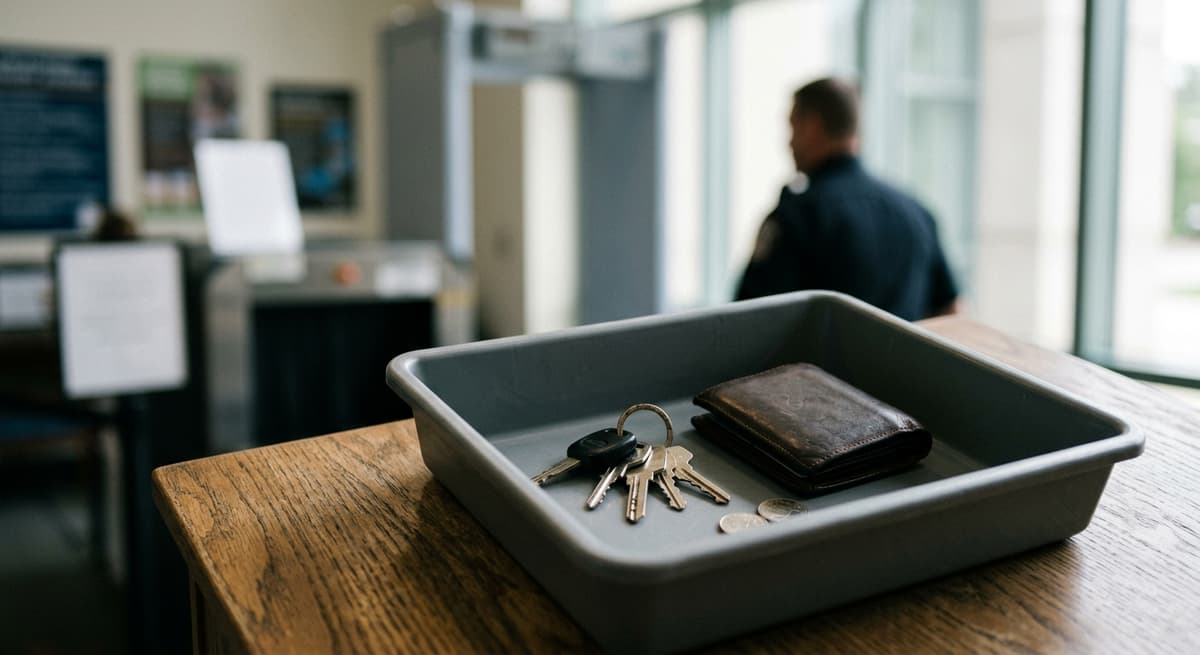
§ 913 restricts firearms and other dangerous weapons in a court facility, but "court facility" is itself a defined term, and it is narrower than most readers would assume. § 913(a) makes it an offense to knowingly possess or cause to be present a firearm or other dangerous weapon in a court facility, and a more serious offense if possessed with intent that it be used to commit a crime. § 913(f) defines "court facility" as "the courtroom of a court of record; a courtroom of a community court; the courtroom of a magisterial district judge; a courtroom of the Philadelphia Municipal Court; a courtroom of the Pittsburgh Magistrates Court; a courtroom of the Traffic Court of Philadelphia; judge's chambers; witness rooms; jury deliberation rooms; attorney conference rooms; prisoner holding cells; offices of court clerks, the district attorney, the sheriff and probation and parole officers; and any adjoining corridors." A courthouse building that also holds offices unrelated to those listed is not, in its entirety, a "court facility" under this definition. § 913(f) separately defines "dangerous weapon" for this section as "a bomb, any explosive or incendiary device or material when possessed with intent to use or to provide such material to commit any offense, graded as a misdemeanor of the third degree or higher, grenade, blackjack, sandbag, metal knuckles, dagger, knife (the blade of which is exposed in an automatic way by switch, push-button, spring mechanism or otherwise) or other implement for the infliction of serious bodily injury which serves no common lawful purpose." A dagger and an automatic-opening knife are both still named here, language that closely tracks what § 908's general offensive-weapons definition contained before its 2022 amendment removed it.
§ 913(b)(1) makes simple possession a third-degree misdemeanor, reduced to a summary offense in the narrow circumstance where the person was lawfully carrying a licensed firearm and simply failed to check it before entering, and § 913(b)(2) makes possession with intent to use the weapon in a crime a first-degree misdemeanor. § 913(c) exempts law enforcement and court officials performing official duties, and an attorney who has written court authorization to bring a weapon into the facility as a trial exhibit or demonstration item, provided the weapon is unloaded and in a secure wrapper. Two more provisions matter to an ordinary carrier: § 913(d) requires notice of subsections (a) and (e) to be posted conspicuously at each public entrance to the courthouse or other building containing a court facility, and bars a conviction under subsection (a)(1) if that notice was not posted (unless the person had actual notice anyway). § 913(e) requires each county to make lockers or similar facilities available, at no charge, at or within the building containing a court facility for the temporary checking of a firearm or other dangerous weapon that is not otherwise prohibited by law, with a receipt issued to the person checking it.
No statewide knife preemption
18 Pa.C.S. § 6120(a) provides: "No county, municipality or township may in any manner regulate the lawful ownership, possession, transfer or transportation of firearms, ammunition or ammunition components when carried or transported for purposes not prohibited by the laws of this Commonwealth." The statute's definitions in § 6120(b) define "firearms" by cross-reference to § 5515, a definition scoped to firearms, and the operative text nowhere mentions a knife. A Pennsylvania county, municipality, or township's own ordinance regulating knives, such as a local blade-length or public-carry restriction, is not addressed or displaced by this preemption statute. A Pennsylvania municipality may have its own knife ordinance; municipal codes are not part of the state statutes covered by this page, so check the local code directly for any knife-specific provision before relying on the state-law answer above.

Federal law: what it does and does not reach
Federal law does not ban an individual from owning or carrying a switchblade. The Federal Switchblade Act, 15 U.S.C. §§ 1241 to 1245, restricts interstate commerce in switchblade knives, barring their manufacture for, or introduction, transport, and sale in, interstate commerce, and, in 15 U.S.C. § 1245, makes it a federal offense to knowingly possess, manufacture, sell, or import a ballistic knife in or affecting interstate commerce or within federal territorial jurisdiction. The two switchblade offense sections, §§ 1242 and 1243, do not apply to certain knives and people, listed as exemptions in 15 U.S.C. § 1244. A 2009 amendment, § 1244(5), exempts any knife with a spring, detent, or other closure-bias mechanism that requires hand, wrist, or arm exertion on the blade itself to overcome the bias and assist opening, the carve-out that keeps modern assisted-opening folding knives legal in interstate commerce. A separate exemption, § 1244(4), covers a person with only one arm possessing or carrying a switchblade with a blade three inches or less. Pennsylvania's own § 913 court-facility ban on an automatic-opening knife is a state offense independent of these federal exemptions.
Disclaimer: This article provides general legal information about Pennsylvania's knife laws as of September 2026. It is not legal advice. Consult a lawyer licensed in Pennsylvania for advice about a specific situation.
For a state-by-state comparison, see knife laws by state. Pennsylvania's self-defense statutes are covered separately on the Pennsylvania self-defense laws page.
Statutes cited reflect their in-force version as of 2026-09-18. Last updated: 2026-09-18.
Frequently Asked Questions
Is it legal to carry a knife in Pennsylvania?
Generally yes, for an ordinary knife carried without criminal intent. 18 Pa.C.S. 908(c), the general offensive-weapons definition, no longer names any knife type after a 2022 amendment (Act 119). Concealed carry with intent to use a knife criminally is separately prohibited under 907(b).
Are switchblades illegal in Pennsylvania?
Not under the general offensive-weapons statute, 18 Pa.C.S. 908, which dropped its automatic-knife language in 2022; that section's surviving catch-all still reaches an implement that serves no common lawful purpose, which an ordinary switchblade carried for lawful use does not fall within. An automatic-opening knife is still specifically named as a 'dangerous weapon' in the narrower court-facility statute, 18 Pa.C.S. 913, and possessing it in a court facility as that section defines the term is a crime regardless of the general statute's current scope.
Can you carry a knife on school property in Pennsylvania?
No, generally, for an elementary or secondary school. 18 Pa.C.S. 912 defines 'weapon' for schools to expressly include any knife or cutting instrument and bans possession on elementary or secondary school grounds, buildings, or transportation, a first-degree misdemeanor, with a defense for a lawful supervised school activity or other lawful purpose. The section's own text does not reach a college or university.
Does Pennsylvania preempt local knife ordinances?
No. Pennsylvania's statewide preemption statute, 18 Pa.C.S. 6120, is limited by its own text to firearms, ammunition, and ammunition components, and does not mention knives, so a local ordinance regulating knives is not preempted by this statute. A Pennsylvania municipality may have its own knife-specific ordinance; check the local code of the municipality or township directly before relying on the state-law answers above.
Updates
Independently fact-checked against the cited primary sources
Independently fact-checked against the cited primary sources
The Law Behind This Article
This article rests on the statutory provisions below, held in our own legal record and retrieved from the official source. Tap a section to read the operative text.
Pennsylvania Consolidated Statutes Title 18 (Crimes and Offenses)
§ 907Possessing instruments of crimeIn force
(a) Criminal instruments generally.--A person commits a misdemeanor of the first degree if he possesses any instrument of crime with intent to employ it criminally. (b) Possession of weapon.--A person commits a misdemeanor of the first degree if he possesses a firearm or other weapon concealed upon his person with intent to employ it criminally. (c) Unlawful body armor.--A person commits a felony of the third degree if in the course of the commission of a felony or in the attempt to commit a felony he uses or wears body armor or has in his control, custody or possession any body armor. (d) Definitions.--As used in this section, the following words and phrases shall have the meanings given to them in this subsection: "Body armor." Any protective covering for the body, or parts thereof, made of any polyaramid fiber or any resin-treated glass fiber cloth or any material or combination of materials made or designed to prevent, resist, deflect or deter the penetration thereof by ammunition, knife, cutting or piercing instrument or any other weapon. "Instrument of crime." Any of the following: (1) Anything specially made or specially adapted for criminal use.
Official text (excerpt) · last checked 2026-09-24 · Read the full text in our law library · Verify at palegis.us
§ 912Possession of weapon on school propertyIn force
(a) Definition.--Notwithstanding the definition of "weapon" in section 907 (relating to possessing instruments of crime), "weapon" for purposes of this section shall include but not be limited to any knife, cutting instrument, cutting tool, nun-chuck stick, firearm, shotgun, rifle and any other tool, instrument or implement capable of inflicting serious bodily injury. (b) Offense defined.--A person commits a misdemeanor of the first degree if he possesses a weapon in the buildings of, on the grounds of, or in any conveyance providing transportation to or from any elementary or secondary publicly-funded educational institution, any elementary or secondary private school licensed by the Department of Education or any elementary or secondary parochial school. (c) Defense.--It shall be a defense that the weapon is possessed and used in conjunction with a lawful supervised school activity or course or is possessed for other lawful purpose.
Official text (excerpt) · last checked 2026-07-29 · Read the full text in our law library · Verify at palegis.us
Cited in 17 court opinions in our collectionLatest citing opinion in our collection: 2024
Opinions citing this section in our collection:
- Commonwealth v. Heidler (Superior Court of Pennsylvania 1999, 1999 Pa. Super. 266)“…y or secondary publicly-funded educational institution...." 18 Pa.C.S. § 912(b). [4] Possession can be found by pro…”
- In the Interest of F.B. (Supreme Court of Pennsylvania 1999, 555 Pa. 661)“…he was arrested for bringing a weapon onto school property. 18 Pa.C.S. § 912. 3 As appellant was a juvenile at th…”
- Picone Ex Rel. Picone v. Bangor Area School District (Commonwealth Court of Pennsylvania 2007, 936 A.2d 556)“…of "weapon" that appears in section 912 of the Crimes Code, 18 Pa.C.S. § 912. Section 912 of the Crimes Code makes i…”
Identified automatically from the court opinions citing this section — not a ranking of which case controls.
§ 913Possession of firearm or other dangerous weapon in court facilityIn force
(a) Offense defined.--A person commits an offense if he: (1) knowingly possesses a firearm or other dangerous weapon in a court facility or knowingly causes a firearm or other dangerous weapon to be present in a court facility; or (2) knowingly possesses a firearm or other dangerous weapon in a court facility with the intent that the firearm or other dangerous weapon be used in the commission of a crime or knowingly causes a firearm or other dangerous weapon to be present in a court facility with the intent that the firearm or other dangerous weapon be used in the commission of a crime. (b) Grading.-- (1) Except as otherwise provided in paragraph (3), an offense under subsection (a)(1) is a misdemeanor of the third degree. (2) An offense under subsection (a)(2) is a misdemeanor of the first degree. (3) An offense under subsection (a)(1) is a summary offense if the person was carrying a firearm under section 6106(b) (relating to firearms not to be carried without a license) or 6109 (relating to licenses) and failed to check the firearm under subsection (e) prior to entering the court facility.
Official text (excerpt) · last checked 2026-07-29 · Read the full text in our law library · Verify at palegis.us
Cited in 40 court opinions in our collectionLatest citing opinion in our collection: 2025
Opinions citing this section in our collection:
- Commonwealth v. Pennix (Superior Court of Pennsylvania 2017, 176 A.3d 340)“…mer Justice specially assigned to the Superior Court. 1 18 Pa.C.S. §§ 913(a)(1)and 5503(a)(3). J-S43022-17…”
- Commonwealth, Aplt. v. Smith, J. (Supreme Court of Pennsylvania 2018, 186 A.3d 397)“…or (ii) Any dangerous weapon (as defined in 18 Pa.C.S. §913), or (iii) Any device, implement, or…”
- Minich v. County of Jefferson (Commonwealth Court of Pennsylvania 2007, 919 A.2d 356)“…See *360 Section 913 of the Crimes Code, 18 Pa.C.S. § 913. B.Nature of the Intrusion…”
Identified automatically from the court opinions citing this section — not a ranking of which case controls.
§ 908Prohibited offensive weaponsIn force
(a) Offense defined.--A person commits a misdemeanor of the first degree if, except as authorized by law, he makes repairs, sells, or otherwise deals in, uses, or possesses any offensive weapon. (b) Exceptions.-- (1) It is a defense under this section for the defendant to prove by a preponderance of evidence that he possessed or dealt with the weapon solely as a curio or in a dramatic performance, or that, with the exception of a bomb, grenade or incendiary device, he complied with the National Firearms Act (26 U.S.C. § 5801 et seq.), or that he possessed it briefly in consequence of having found it or taken it from an aggressor, or under circumstances similarly negativing any intent or likelihood that the weapon would be used unlawfully. (2) This section does not apply to police forensic firearms experts or police forensic firearms laboratories.
Official text (excerpt) · last checked 2026-07-29 · Read the full text in our law library · Verify at palegis.us
Cited in 120 court opinions in our collectionLatest citing opinion in our collection: 2026
Opinions citing this section in our collection:
- Commonwealth v. Stanley (Superior Court of Pennsylvania 1979, 265 Pa. Super. 194)“…[2] 18 Pa.C.S. § 5122. [3] 18 Pa.C.S. § 907(a). [4] 18 Pa.C.S. § 908. [5] 18 Pa.C.S. § 907(b). [6] 18…”
- Commonwealth v. Williams (Supreme Court of Pennsylvania 1985, 344 Pa. Super. 108)“…The firearms offenses appellant committed are defined at 18 Pa.C.S. § 908 (“Prohibited offensive weapons”) and i…”
- Commonwealth v. Ponds (Superior Court of Pennsylvania 1975, 236 Pa. Super. 107)“…ed. NOTES [1] Act of December 6, 1972, P.L. 1482, § 1, 18 Pa.C.S. § 908. [2] At trial the Commonwealth stipu…”
Identified automatically from the court opinions citing this section — not a ranking of which case controls.
§ 6120Limitation on the regulation of firearms and ammunitionIn force
(a) General rule.--No county, municipality or township may in any manner regulate the lawful ownership, possession, transfer or transportation of firearms, ammunition or ammunition components when carried or transported for purposes not prohibited by the laws of this Commonwealth. (a.1) No right of action.-- (1) No political subdivision may bring or maintain an action at law or in equity against any firearms or ammunition manufacturer, trade association or dealer for damages, abatement, injunctive relief or any other relief or remedy resulting from or relating to either the lawful design or manufacture of firearms or ammunition or the lawful marketing or sale of firearms or ammunition to the public. (2) Nothing in this subsection shall be construed to prohibit a political subdivision from bringing or maintaining an action against a firearms or ammunition manufacturer or dealer for breach of contract or warranty as to firearms or ammunition purchased by the political subdivision. (a.2) Relief.--(Unconstitutional). (a.3) Reasonable expenses.--(Unconstitutional).
Official text (excerpt) · last checked 2026-07-29 · Read the full text in our law library · Verify at palegis.us
Cited in 27 court opinions in our collectionLatest citing opinion in our collection: 2026
Opinions citing this section in our collection:
- Ortiz v. Commonwealth (Supreme Court of Pennsylvania 1996, 545 Pa. 279)“…t, 18 Pa.C.S. §§ 6101-6124. The amendment, which appears at 18 Pa.C.S. § 6120, provides: (a) General rule. No count…”
- Leach, D. v. Turzai, M. (Supreme Court of Pennsylvania 2016, 636 Pa. 81)“…transfer, or transportation of firearms and ammunition. See 18 Pa.C.S. §6120(a). These additions gave persons ad…”
- National Rifle Ass'n v. City of Philadelphia (Commonwealth Court of Pennsylvania 2009, 977 A.2d 78)“…a) of the Pennsylvania Uniform Firearms Act (Firearms Act), 18 Pa.C.S. § 6120(a). [4] On April 17, 2008, the trial c…”
Identified automatically from the court opinions citing this section — not a ranking of which case controls.
United States Code Title 15
§ 1241DefinitionsIn forcecited in 52 of our articles
As used in this chapter— The term “interstate commerce” means commerce between any State, Territory, possession of the United States, or the District of Columbia, and any place outside thereof. The term “switchblade knife” means any knife having a blade which opens automatically— by hand pressure applied to a button or other device in the handle of the knife, or by operation of inertia, gravity, or both.
Official text (excerpt) · last checked 2026-07-28 · Read the full text in our law library · Verify at uscode.house.gov
Cited in 15 court opinions in our collectionLatest citing opinion in our collection: 2014
Opinions citing this section in our collection:
- Stewart A. Taylor, D/B/A Taylor Cutlery Mfg. Co. v. United States of America (Court of Appeals for the Sixth Circuit 1988, 848 F.2d 715)“…Service, are not switchblade knives within the meaning of 15 U.S.C. § 1241 (b) and 19 C.F.R. § 1295 (a)(1). The d…”
- Crowley Cutlery Company v. United States of America and Commissioner of Customs of the United States Customs Service (Court of Appeals for the Seventh Circuit 1988, 849 F.2d 273)“…Illinois for a declaration that the Switchblade Knife Act, 15 U.S.C. §§ 1241 et seq., which forbids th…”
- Edna Fall, as Administratrix of the Estate of Phillip Fall, Deceased v. Esso Standard Oil Company (Court of Appeals for the Fifth Circuit 1962, 297 F.2d 411)“…25 S.Ct. 158 , 49 L.Ed. 363 . Section 1 of the Act, 15 U.S.C.A. § 1241 (b), defines the term “switchblade knif…”
Identified automatically from the court opinions citing this section — not a ranking of which case controls.
Also relied on in: Knife Laws by State (2026): Carry Rules, Blade Limits, Penalties, Alabama Knife Laws (2026): What Is Legal to Carry, Alaska Knife Laws (2026): Concealed Carry Rules Explained
§ 1244ExceptionsIn forcecited in 52 of our articles
Sections 1242 and 1243 of this title shall not apply to— any common carrier or contract carrier, with respect to any switchblade knife shipped, transported, or delivered for shipment in interstate commerce in the ordinary course of business; the manufacture, sale, transportation, distribution, possession, or introduction into interstate commerce, of switchblade knives pursuant to contract with the Armed Forces; the Armed Forces or any member or employee thereof acting in the performance of his duty; the possession, and transportation upon his person, of any switchblade knife with a blade three inches or less in length by any individual who has only one arm; or a knife that contains a spring, detent, or other mechanism designed to create a bias toward closure of the blade and that requires exertion applied to the blade by hand, wrist, or arm to overcome the bias toward closure to assist in opening the knife.
Official text (excerpt) · last checked 2026-07-28 · Read the full text in our law library · Verify at uscode.house.gov
Also relied on in: Arizona Knife Laws (2026): Carry Rules and Preemption, Arkansas Knife Laws (2026): Intent-Based Carry Rules, California Knife Laws (2026): Four Blade-Length Rules
§ 1245Ballistic knivesIn forcecited in 50 of our articles
Whoever in or affecting interstate commerce, within any Territory or possession of the United States, within Indian country (as defined in section 1151 of title 18), or within the special maritime and territorial jurisdiction of the United States (as defined in section 7 of title 18), knowingly possesses, manufactures, sells, or imports a ballistic knife shall be fined as provided in title 18, or imprisoned not more than ten years, or both. Whoever possesses or uses a ballistic knife in the commission of a Federal crime of violence shall be fined as provided in title 18, or imprisoned not less than five years and not more than ten years, or both. The exceptions provided in paragraphs (1), (2), and (3) of section 1244 of this title with respect to switchblade knives shall apply to ballistic knives under subsection (a) of this section. As used in this section, the term “ballistic knife” means a knife with a detachable blade that is propelled by a spring-operated mechanism.
Official text (excerpt) · last checked 2026-07-28 · Read the full text in our law library · Verify at uscode.house.gov
Cited in 2 court opinions in our collectionLatest citing opinion in our collection: 2008
Opinions citing this section in our collection:
- ALCANTAR (Board of Immigration Appeals 1994, 20 I. & N. Dec. 801)“…ed by an adult, would be felony and crime of violence); cf. 15 U.S.C. § 1245(b) (1988) (use of ballistic knife in co…”
- United States v. Polizzi (District Court, E.D. New York 2008, 549 F. Supp. 2d 308)“…8 Trust in l’estraint of import trade 3 months 15 U.S.C. § 1245 (b) Possession/use of a ballistic knife…”
Identified automatically from the court opinions citing this section — not a ranking of which case controls.
Also relied on in: Colorado Knife Laws (2026): Concealed Carry and Exceptions, Connecticut Knife Laws (2026): Open and Concealed Carry, Delaware Knife Laws (2026): Carry, Switchblades, and Bans
Search our full record of US law — 2.1 million sections, every state + federal →
Sources and References
- 18 Pa.C.S. 908 - Prohibited offensive weapons(palegis.us).gov
- 18 Pa.C.S. 907 - Possessing instruments of crime(palegis.us).gov
- 18 Pa.C.S. 912 - Possession of weapon on school property(palegis.us).gov
- 18 Pa.C.S. 913 - Possession of firearm or other dangerous weapon in court facility(palegis.us).gov
- 18 Pa.C.S. 6120 - Limitation on the regulation of firearms and ammunition(palegis.us).gov
- 15 U.S.C. 1241-1245 - Federal Switchblade Act, interstate commerce and ballistic-knife scope(law.cornell.edu)
- 15 U.S.C. 1244 - exceptions, including the 2009 assisted-opening carve-out and the one-arm exception(law.cornell.edu)