
Oklahoma
Oklahoma Knife Laws (2026): Carry Rules, Intent Felony, Preemption
Independently fact-checked against primary sources (last audited September 24, 2026). · 7 primary sources cited on this page. How we verify our legal content

Oklahoma's general carry statute no longer names a bowie knife, dirk, dagger, or sword cane; a 2016 amendment removed those terms, and the statute, amended three more times since (most recently in 2021), still reaches only a catch-all "other offensive weapon" and expressly excepts the proper use of guns and knives for self-defense, hunting, fishing, educational, or recreational purposes. A separate intent-based statute makes carrying any deadly weapon, including a knife, to injure someone a felony regardless of what the carry statute names, and a school-property statute, a college and university campus statute, and a state preemption law each reach knives specifically.
Jurisdiction scope: This page covers Oklahoma state law only, principally 21 O.S. §§ 1272, 1276, 1277, 1278, 1280.1, 1287, and 1289.24. It does not cover the Oklahoma Self-Defense Act's handgun-license provisions in detail, since those govern handguns rather than knives.
Can you carry a knife openly or concealed in Oklahoma?
For most knife carry, yes, though a separate statute covers carrying any weapon with intent to injure (see below). 21 O.S. § 1272(A) provides: "Notwithstanding any other provision of law, it shall be unlawful for any person to carry upon or about his or her person, or in a purse or other container belonging to the person, any pistol, revolver, shotgun or rifle whether loaded or unloaded or any blackjack, loaded cane, hand chain, metal knuckles, or any other offensive weapon, whether such weapon be concealed or unconcealed," subject to a list of exceptions. A 2016 amendment, Senate Bill 1159 (Laws 2016, c. 217, effective November 1, 2016), removed the bowie knife, dirk, dagger, and sword cane that earlier versions of this section named. The section's own historical-data note shows it has been amended three more times since then: Laws 2018, HB 3353; Laws 2019, HB 2597; and Laws 2021, SB 672 (c. 292, effective November 1, 2021), which is the current text's most recent amendment. None of those later amendments restored a named knife. The only knife-adjacent terms in the current list are the general catch-all "other offensive weapon" and the specific items above, none of which is a knife by name.
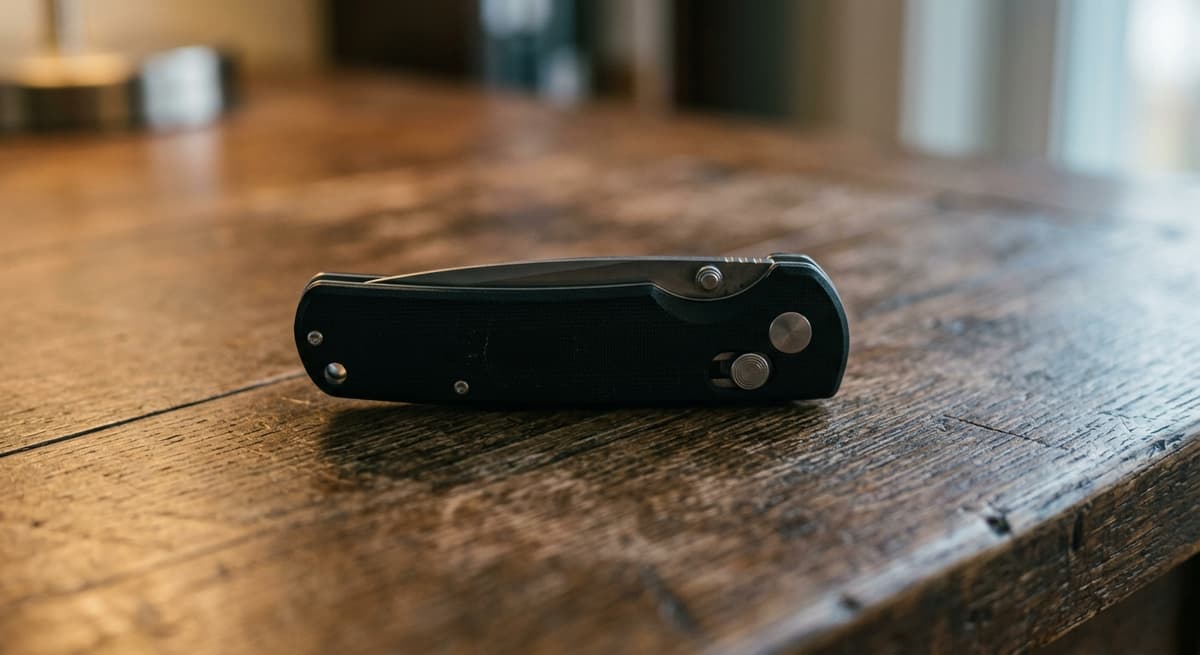
Section 1272(A)(1) then exempts "the proper use of guns and knives for self-defense, hunting, fishing, educational or recreational purposes" from the prohibition entirely. Because this exception applies to guns and knives together and is not limited to a particular knife type or blade length, an ordinary knife carried, openly or concealed, for a purpose the exception covers is not reached by § 1272 at all. The statute does not set a blade-length limit or name any restricted knife type for general public carry.
Other exceptions in § 1272
Beyond the guns-and-knives exception, § 1272(A) exempts weapons carried or used in a manner otherwise permitted by statute or the Oklahoma Self-Defense Act; a peace officer or other person authorized by law to carry a weapon in the performance of official duties; a judge with a valid handgun license carrying in a courthouse; firearms and other weapons used for living-history reenactment; and transporting or carrying a firearm by vehicle or on the person by a person 21 or older, or by a person 18 or older who is a current or honorably discharged member of the U.S. Armed Forces, Reserves, or National Guard and is not otherwise disqualified from possessing a firearm. Most of these exceptions are framed around firearms specifically, but the guns-and-knives self-defense/hunting/fishing/educational/recreational exception in paragraph 1 is the one that principally governs lawful knife carry.
Penalty
§ 1276 provides that a first conviction under § 1272 is a misdemeanor punishable by a fine of "not less than One Hundred Dollars ($100.00) nor more than Two Hundred Fifty Dollars ($250.00), or by imprisonment in the county jail for a period not to exceed thirty (30) days or both." A second or subsequent violation is punishable by a fine of "not less than Two Hundred Fifty Dollars ($250.00) nor more than Five Hundred Dollars ($500.00), or by imprisonment in the county jail for a period not less than thirty (30) days nor more than three (3) months, or by both."
Carrying a knife with intent to injure
21 O.S. § 1278, titled "Unlawful Intent to Carry," reaches beyond the list of items named in § 1272. It provides: "Any person in this state who carries or wears any deadly weapons or dangerous instrument whatsoever with the intent or for the avowed purpose of unlawfully injuring another person shall, upon conviction, be guilty of a Class D1 felony offense punishable by a fine not exceeding Five Thousand Dollars ($5,000.00), or by imprisonment as provided for in subsections B through F of Section 20N of this title, or by both such fine and imprisonment." A knife is a deadly weapon or dangerous instrument for this purpose, so a person who carries one with the intent to unlawfully injure someone else faces a felony charge under § 1278 even where § 1272 does not reach the knife by name. The statute also protects ordinary carry: "The mere possession of such a weapon or dangerous instrument, without more, however, shall not be sufficient to establish intent as required by this section." A handgun-license holder who violates § 1278 also faces license revocation and a $1,000 administrative fine following an Oklahoma State Bureau of Investigation determination.
School property
§ 1280.1(A) makes it "unlawful for any person to have in his or her possession on any public or private school property or while in any school bus or vehicle used by any school for transportation of students or teachers any firearm or weapon designated in Section 1272 of this title," except as the section itself provides. Because § 1272 no longer names any knife, the only term in its list an ordinary knife could fall under is the catch-all "other offensive weapon." § 1280.1(C) exempts, among other things, "a gun or knife designed for hunting or fishing purposes kept in a privately owned vehicle and properly displayed or stored as required by law," where the vehicle is driven onto school property only to transport a student to and from school and does not remain unattended there; a gun or knife used in a certified hunter-training course or an approved hunting, fishing, safety, or firearms training course or event; and a gun, knife, bayonet, or other weapon in the possession of a member of a veterans group, the National Guard, active military, or the Reserve Officers' Training Corps (ROTC) or Junior ROTC, to participate in a ceremony, assembly, or educational program approved by the school's principal or chief administrator. A violation is a misdemeanor punishable by a fine of up to $250 under § 1280.1(D).
College, university, and technology center property
A separate statute reaches a knife by name on higher-education campuses. 21 O.S. § 1277(G) provides: "No person in possession of a valid handgun license issued pursuant to the provisions of the Oklahoma Self-Defense Act or who is carrying or in possession of a firearm as otherwise permitted by law or who is carrying or in possession of a machete, blackjack, loaded cane, hand chain, or metal knuckles shall be authorized to carry the firearm, machete, blackjack, loaded cane, hand chain, or metal knuckles into or upon any college, university, or technology center school property, except as provided in this subsection." The exceptions in § 1277(G)(1) through (3) cover a vehicle parking area with the item stored as legally required, property where the institution's own policy authorizes carrying it, and property where the college or university's president or chief administrator has given written consent. A violation can draw a $250 administrative fine and a three-month suspension of a handgun license. § 1277(A) is a separate, firearms-only list reaching different property entirely, government buildings, courthouses, K-12 schools, sports venues, and gambling establishments, none of which is a college, university, or technology center; § 1277(G) is the section's one knife-specific reach, and it applies only to higher-education property.
Carrying a knife while committing a felony
21 O.S. § 1287, "Use of Firearm While Committing a Felony," names a knife specifically and carries the heaviest knife-related exposure on this page. It provides that a person who, "while committing or attempting to commit a felony, possesses a pistol, shotgun or rifle or any other offensive weapon in such commission or attempt ... or who possesses an air gun or carbon dioxide or other gas-filled weapon, electronic dart gun, conductive energy weapon, knife, dagger, dirk, switchblade knife, blackjack, ax, loaded cane, billy, hand chain or metal knuckles, in addition to the penalty provided by statute for the felony committed or attempted shall, upon conviction, be guilty of a Class B4 felony offense for possessing such weapon or device, which shall be a separate offense from the felony committed or attempted and shall be punishable by imprisonment in the custody of the Department of Corrections for a period of not less than two (2) years nor for more than ten (10) years for the first offense, and guilty of a Class B1 felony offense punishable for a period of not less than ten (10) years nor more than thirty (30) years for any second or subsequent offense." This penalty is separate from and in addition to the sentence for the underlying felony. § 1287(B) adds handgun-license revocation and a $1,000 administrative fine, determined by the Oklahoma State Bureau of Investigation, for a license holder who violates the section.
Statewide preemption reaches knives, with a school-policy carve-out
21 O.S. § 1289.24, part of the Oklahoma Firearms Act of 1971, is a firearm-titled statute whose text expressly reaches knives. § 1289.24(A)(1) provides: "The State Legislature hereby occupies and preempts the entire field of legislation in this state touching in any way firearms, air powered pistols, air powered rifles, knives, components, ammunition and supplies to the complete exclusion of any order, ordinance or regulation by any municipality or other political subdivision of this state. Any existing or future orders, ordinances or regulations in this field, except as provided for in paragraph 2 of this subsection and subsection C of this section, are null and void." § 1289.24(B) similarly bars a municipality or political subdivision from adopting any order, ordinance, or regulation "concerning in any way the sale, purchase, purchase delay, transfer, ownership, use, keeping, possession, carrying, bearing, transportation, licensing, permit, registration, taxation other than sales and compensating use taxes or other controls on firearms, knives, components, ammunition and supplies."
This preemption is not absolute for schools specifically, and it leaves two other qualifiers a knife owner should know. § 1289.24(A)(4) expressly authorizes a school-level knife policy regardless of the preemption above it: "A public or private school may create a policy regulating the possession of knives on school property or in any school bus or vehicle used by the school for purposes of transportation." § 1289.24(C) separately permits a municipal ordinance "concerning the confiscation of property used in violation of the ordinances of the municipality," but adds that "no municipal ordinance relating to transporting a firearm or knife improperly may include a provision for confiscation of property." And § 1289.24(D) gives a remedy: "When a person's rights pursuant to the protection of the preemption provisions of this section have been violated, the person shall have the right to bring a civil action against the persons, municipality, and political subdivision jointly and severally for injunctive relief or monetary damages or both."
Federal law: what it does and does not reach
Federal law does not ban an individual from owning or carrying a switchblade. The Federal Switchblade Act, 15 U.S.C. §§ 1241 to 1245, restricts interstate commerce in switchblade knives, barring their manufacture for, or introduction, transport, and sale in, interstate commerce, and, in 15 U.S.C. § 1245, makes it a federal offense to knowingly possess, manufacture, sell, or import a ballistic knife in or affecting interstate commerce or within federal territorial jurisdiction. The two switchblade offense sections, §§ 1242 and 1243, do not apply to certain knives and people, listed as exemptions in 15 U.S.C. § 1244. A 2009 amendment, § 1244(5), exempts any knife with a spring, detent, or other closure-bias mechanism that requires hand, wrist, or arm exertion on the blade itself to overcome the bias and assist opening, the carve-out that keeps modern assisted-opening folding knives legal in interstate commerce. A separate exemption, § 1244(4), covers a person with only one arm possessing or carrying a switchblade with a blade three inches or less.
Disclaimer: This article provides general legal information about Oklahoma's knife laws as of September 2026. It is not legal advice. Consult a lawyer licensed in Oklahoma for advice about a specific situation.
For a state-by-state comparison, see knife laws by state. Oklahoma's self-defense statutes are covered separately on the Oklahoma self-defense laws page.
Statutes cited reflect their in-force version as of 2026-09-18. Last updated: 2026-09-18.
Frequently Asked Questions
Is it legal to carry a knife in Oklahoma?
Generally yes. 21 O.S. 1272 no longer names any specific knife type; its current text, last amended in 2021, reaches only firearms, blackjacks, loaded canes, hand chains, metal knuckles, and a general 'other offensive weapon' catch-all, and section 1272(A)(1) separately exempts the proper use of guns and knives for self-defense, hunting, fishing, educational, or recreational purposes. A separate felony statute, 21 O.S. 1278, still reaches a knife carried with intent to injure someone, and machetes are barred by name from college, university, and technology center campuses under 21 O.S. 1277(G).
Are switchblades illegal in Oklahoma?
No, not under Oklahoma's current general-carry statute. The version of 21 O.S. 1272 superseded on November 1, 2015 named a 'switchblade knife' and a 'knife having a blade which opens automatically by hand pressure applied to a button, spring, or other device in the handle of the knife'; a 2015 amendment (Laws 2015, HB 1911, effective November 1, 2015) removed those terms, and the statute's current text does not name any knife type. Carrying a knife, including a switchblade, while committing a felony is a separate offense under 21 O.S. 1287, which does name a switchblade knife by name and makes possessing one during a felony a Class B4 felony of two to ten years.
Can you carry a knife on school property in Oklahoma?
21 O.S. 1280.1 bans possessing a firearm or weapon designated in section 1272 on publicly owned elementary, secondary, or vocational-technical school property or a school bus, a misdemeanor with a fine of up to $250, with exceptions for a hunting or fishing knife kept in a vehicle, knives used in approved training courses or events, and a knife carried by a veterans group, military, or ROTC member for an approved school ceremony. A public or private school may also set its own additional knife policy under 21 O.S. 1289.24(A)(4). On a college, university, or technology center campus, 21 O.S. 1277(G) separately bars carrying a machete by name, with exceptions for vehicle parking, institution-authorized property, and property where the administrator gives written consent.
Does Oklahoma preempt local knife ordinances?
Yes. 21 O.S. 1289.24 expressly names knives in the state's preemption of local firearms and weapons regulation, barring a municipality or political subdivision from regulating knife sale, possession, carrying, or transportation, except as that same statute provides. An individual school may still adopt its own knife policy, a municipality may still confiscate property used to violate its own ordinances (though not for improperly transporting a firearm or knife), and a person whose rights under the preemption are violated may sue for injunctive relief or damages.
Can carrying a knife be a felony in Oklahoma?
Yes. 21 O.S. 1278 makes it a Class D1 felony, punishable by a fine of up to $5,000, imprisonment, or both, to carry or wear any deadly weapon or dangerous instrument, including a knife, with the intent or avowed purpose of unlawfully injuring another person. The statute specifies that mere possession of the weapon, without more, is not enough by itself to prove that intent. Separately, 21 O.S. 1287 makes possessing a knife, dagger, dirk, or switchblade knife while committing or attempting a felony its own Class B4 felony, two to ten years, on top of the sentence for the underlying felony, rising to ten to thirty years for a second or subsequent offense.
Updates
Independently fact-checked against the cited primary sources
Independently fact-checked against the cited primary sources
The Law Behind This Article
This article rests on the statutory provisions below, held in our own legal record and retrieved from the official source. Tap a section to read the operative text.
Oklahoma Statutes, Title 21: CRIMES AND PUNISHMENTS
§ 1272Unlawful carryIn force
UNLAWFUL CARRY A. Notwithstanding any other provision of law, it shall be unlawful for any person to carry upon or about his or her person, or in a purse or other container belonging to the person, any pistol, revolver, shotgun or rifle whether loaded or unloaded or any blackjack, loaded cane, hand chain, metal knuckles, or any other offensive weapon, whether such weapon be concealed or unconcealed, except this section shall not prohibit: 1. The proper use of guns and knives for self-defense, hunting, fishing, educational or recreational purposes; 2. The carrying or use of weapons in a manner otherwise permitted by statute or authorized by the Oklahoma Self-Defense Act; 3. The carrying, possession and use of any weapon by a peace officer or other person authorized by law to carry a weapon in the performance of official duties and in compliance with the rules of the employing agency; 4.
Official text (excerpt) · last checked 2026-09-24 · Read the full text in our law library · Verify at oklegislature.gov
§ 1278Unlawful intent to carryIn force
UNLAWFUL INTENT TO CARRY Any person in this state who carries or wears any deadly weapons or dangerous instrument whatsoever with the intent or for the avowed purpose of unlawfully injuring another person shall, upon conviction, be guilty of a Class D1 felony offense punishable by a fine not exceeding Five Thousand Dollars ($5,000.00), or by imprisonment as provided for in subsections B through F of Section 20N of this title, or by both such fine and imprisonment. The mere possession of such a weapon or dangerous instrument, without more, however, shall not be sufficient to establish intent as required by this section. Any person convicted of violating the provisions of this section after having been issued a handgun license pursuant to the provisions of the Oklahoma Self-Defense Act shall have the license revoked and shall be liable for an administrative fine of One Thousand Dollars ($1,000.00) upon a hearing and determination by the Oklahoma State Bureau of Investigation that the person is in violation of the provisions of this section. R.L.1910, § 2552. Amended by Laws 1993, c. 264, § 4, eff. Sept. 1, 1993; Laws 1995, c. 272, § 32, eff. Sept. 1, 1995; Laws 1997, c.
Official text (excerpt) · last checked 2026-07-31 · Read the full text in our law library · Verify at oklegislature.gov
§ 1287Use of firearm while committing a felonyIn force
USE OF FIREARM WHILE COMMITTING A FELONY A. Any person who, while committing or attempting to commit a felony, possesses a pistol, shotgun or rifle or any other offensive weapon in such commission or attempt, whether the pistol, shotgun or rifle is loaded or not, or who possesses a blank or imitation pistol, altered air or toy pistol, shotgun or rifle capable of raising in the mind of one threatened with such device a fear that it is a real pistol, shotgun or rifle, or who possesses an air gun or carbon dioxide or other gas-filled weapon, electronic dart gun, conductive energy weapon, knife, dagger, dirk, switchblade knife, blackjack, ax, loaded cane, billy, hand chain or metal knuckles, in addition to the penalty provided by statute for the felony committed or attempted shall, upon conviction, be guilty of a Class B4 felony offense for possessing such weapon or device, which shall be a separate offense from the felony committed or attempted and shall be punishable by imprisonment in the custody of the Department of Corrections for a period of not less than two (2) years nor for more than ten (10) years for the first offense, and guilty of a Class B1 felony offense punishable for…
Official text (excerpt) · last checked 2026-07-31 · Read the full text in our law library · Verify at oklegislature.gov
Cited in 15 court opinions in our collectionLatest citing opinion in our collection: 2024
Opinions citing this section in our collection:
- LAVORCHEK v. STATE (Court of Criminal Appeals of Oklahoma 2019, 443 P.3d 573)“…Robbery - First Degree - Second Degree Discussed 21 O.S. 1287, Use of Firearm While Committing a Fe…”
- Dawkins v. State (Court of Criminal Appeals of Oklahoma 2011, 252 P.3d 214)“…ssion of specified weapons "in such commission or attempt". 21 O.S.Supp.2007 § 1287; Pebworth v. State, 1993 OK CR 28, ¶1…”
- BRINK v. STATE (Court of Criminal Appeals of Oklahoma 2021, 481 P.3d 1267)“…entage of Sentence - Offenses Specified Discussed 21 O.S. 1287 .1, Penalty Enhancement for Weapon Po…”
Identified automatically from the court opinions citing this section — not a ranking of which case controls.
§ 1277Unlawful carry in certain placesIn force
UNLAWFUL CARRY IN CERTAIN PLACES A. It shall be unlawful for any person, including a person in possession of a valid handgun license issued pursuant to the provisions of the Oklahoma Self-Defense Act, to carry any concealed or unconcealed firearm into any of the following places: 1. Any building or office space which is owned or leased by a city, town, county, or state governmental authority for the purpose of conducting business with the public. However, the governing body of a city or town may authorize the concealed carry of handguns into any building or office space that is owned or leased by a city or town, except those places listed in paragraph 2 of this subsection; 2. Any courthouse, courtroom, prison, jail, detention facility, or any facility used to process, hold, or house arrested persons, prisoners, or persons alleged delinquent or adjudicated delinquent, except as provided in Section 21 of Title 57 of the Oklahoma Statutes; 3. Any public or private elementary or public or private secondary school, except as provided in subsections C and D of this section; 4.
Official text (excerpt) · last checked 2026-07-31 · Read the full text in our law library · Verify at oklegislature.gov
Cited in 2 court opinions in our collectionLatest citing opinion in our collection: 2020
Opinions citing this section in our collection:
- IN RE INITIATIVE PETITION NO. 425, STATE QUESTION NO. 809 (Supreme Court of Oklahoma 2020, 2020 OK 58)“…school property, except as provided in this subsection. 21 O.S.Supp.2019 § 1277(G). Even with the passage of HB 2597 an…”
- Question Submitted by: The Honorable Marty Quinn, State Representative, District 9 (Oklahoma Attorney General Reports 2014, 2014 OK AG 3)“…Carrying Firearms Where Liquor Is Consumed Cited 21 O.S. 1277 , Unlawful Carry in Certain Places D…”
Identified automatically from the court opinions citing this section — not a ranking of which case controls.
§ 1280.1Possession of firearm on school propertyIn force
POSSESSION OF FIREARM ON SCHOOL PROPERTY A. It shall be unlawful for any person to have in his or her possession on any public or private school property or while in any school bus or vehicle used by any school for transportation of students or teachers any firearm or weapon designated in Section 1272 of this title, except as provided in subsection C of this section or as otherwise authorized by law. B. For purposes of this section: 1. "School property" means any publicly owned property held for purposes of elementary, secondary or vocational-technical education, and shall not include property owned by public school districts or where such property is leased or rented to an individual or corporation and used for purposes other than educational; 2. "Private school" means a school that offers a course of instruction for students in one or more grades from prekindergarten through grade twelve and is not operated by a governmental entity; and 3. "Motor vehicle" means any automobile, truck, minivan or sports utility vehicle. C. Firearms and weapons are allowed on school property and deemed not in violation of subsection A of this section as follows: 1.
Official text (excerpt) · last checked 2026-07-31 · Read the full text in our law library · Verify at oklegislature.gov
Cited in 1 court opinions in our collectionLatest citing opinion in our collection: 2007
Opinions citing this section in our collection:
- ConocoPhillips Co. v. Henry (District Court, N.D. Oklahoma 2007, 520 F. Supp. 2d 1282)“…es no mention of day care facilities. See Okla. Stat. tit. 21, § 1280.1 (B). 51 . Many Okl…”
Identified automatically from the court opinions citing this section — not a ranking of which case controls.
§ 1289.24Firearm regulation - State preemptionIn force
FIREARM REGULATION – STATE PREEMPTION A. 1. The State Legislature hereby occupies and preempts the entire field of legislation in this state touching in any way firearms, air powered pistols, air powered rifles, knives, components, ammunition and supplies to the complete exclusion of any order, ordinance or regulation by any municipality or other political subdivision of this state. Any existing or future orders, ordinances or regulations in this field, except as provided for in paragraph 2 of this subsection and subsection C of this section, are null and void. 2. A municipality may adopt any ordinance: a. relating to the discharge of firearms within the jurisdiction of the municipality, b. allowing the municipality to issue a traffic citation for transporting a firearm improperly as provided for in Section 1289.13A of this title, provided, however, that penalties contained for violation of any ordinance enacted pursuant to the provisions of this subparagraph shall not exceed the penalties established in the Oklahoma Self-Defense Act, and c.
Official text (excerpt) · last checked 2026-07-31 · Read the full text in our law library · Verify at oklegislature.gov
Cited in 1 court opinions in our collectionLatest citing opinion in our collection: 2023
Opinions citing this section in our collection:
- Question Submitted by: The Honorable David R. Thomas, District Attorney, District 3 (Oklahoma Attorney General Reports 2023, 2023 OK AG 7)“…es and Punishments Cite Name Level 21 O.S. 1289.24, Firearm Regulation - State Preempti…”
Identified automatically from the court opinions citing this section — not a ranking of which case controls.
§ 1276Penalty for 1272 and 1273In force
PENALTY FOR 1272 AND 1273 Any person violating the provisions of Section 1272 or 1273 of this title shall, upon a first conviction, be adjudged guilty of a misdemeanor and the party offending shall be punished by a fine of not less than One Hundred Dollars ($100.00) nor more than Two Hundred Fifty Dollars ($250.00), or by imprisonment in the county jail for a period not to exceed thirty (30) days or both such fine and imprisonment. On the second and every subsequent violation, the party offending shall, upon conviction, be punished by a fine of not less than Two Hundred Fifty Dollars ($250.00) nor more than Five Hundred Dollars ($500.00), or by imprisonment in the county jail for a period not less than thirty (30) days nor more than three (3) months, or by both such fine and imprisonment.
Official text (excerpt) · last checked 2026-07-31 · Read the full text in our law library · Verify at oklegislature.gov
Cited in 1 court opinions in our collectionLatest citing opinion in our collection: 1969
Opinions citing this section in our collection:
- Lovett v. State (Court of Criminal Appeals of Oklahoma 1969, 455 P.2d 713)“…nt for a violation of 21 O.S. § 1272, supra, is provided in 21 O.S. § 1276, the pertinent part authorizing the imp…”
Identified automatically from the court opinions citing this section — not a ranking of which case controls.
United States Code Title 15
§ 1242Introduction, manufacture for introduction, transportation or distribution in interstate commerce; penaltyIn forcecited in 2 of our articles
Whoever knowingly introduces, or manufactures for introduction, into interstate commerce, or transports or distributes in interstate commerce, any switchblade knife, shall be fined not more than $2,000 or imprisoned not more than five years, or both.
Official text (excerpt) · last checked 2026-07-28 · Read the full text in our law library · Verify at uscode.house.gov
Cited in 6 court opinions in our collectionLatest citing opinion in our collection: 2010
Opinions citing this section in our collection:
- Edna Fall, as Administratrix of the Estate of Phillip Fall, Deceased v. Esso Standard Oil Company (Court of Appeals for the Fifth Circuit 1962, 297 F.2d 411)“…23 § 1 , Aug. 12, 1958, 72 Stat. 562 .” Section 2, 15 U.S.C.A. § 1242 prohibits the manufacture for, or tran…”
- United States v. Baer (Court of Appeals for the Tenth Circuit 2000, 235 F.3d 561)“…318, 1320 (8th Cir. 1988) (upholding Switchblade Knife Act, 15 U.S.C. § 1242, against Second Amendment challenge); U…”
- United States v. Douglas John Nelsen (Court of Appeals for the Eighth Circuit 1988, 859 F.2d 1318)“…om his convictions of violating the Switchblade Knife Act, 15 U.S.C. § 1242 (1982), as well as related convictions…”
Identified automatically from the court opinions citing this section — not a ranking of which case controls.
Also relied on in: Knife Laws by State (2026): Carry Rules, Blade Limits, Penalties
§ 1245Ballistic knivesIn forcecited in 50 of our articles
Whoever in or affecting interstate commerce, within any Territory or possession of the United States, within Indian country (as defined in section 1151 of title 18), or within the special maritime and territorial jurisdiction of the United States (as defined in section 7 of title 18), knowingly possesses, manufactures, sells, or imports a ballistic knife shall be fined as provided in title 18, or imprisoned not more than ten years, or both. Whoever possesses or uses a ballistic knife in the commission of a Federal crime of violence shall be fined as provided in title 18, or imprisoned not less than five years and not more than ten years, or both. The exceptions provided in paragraphs (1), (2), and (3) of section 1244 of this title with respect to switchblade knives shall apply to ballistic knives under subsection (a) of this section. As used in this section, the term “ballistic knife” means a knife with a detachable blade that is propelled by a spring-operated mechanism.
Official text (excerpt) · last checked 2026-07-28 · Read the full text in our law library · Verify at uscode.house.gov
Cited in 2 court opinions in our collectionLatest citing opinion in our collection: 2008
Opinions citing this section in our collection:
- ALCANTAR (Board of Immigration Appeals 1994, 20 I. & N. Dec. 801)“…ed by an adult, would be felony and crime of violence); cf. 15 U.S.C. § 1245(b) (1988) (use of ballistic knife in co…”
- United States v. Polizzi (District Court, E.D. New York 2008, 549 F. Supp. 2d 308)“…8 Trust in l’estraint of import trade 3 months 15 U.S.C. § 1245 (b) Possession/use of a ballistic knife…”
Identified automatically from the court opinions citing this section — not a ranking of which case controls.
Also relied on in: Alaska Knife Laws (2026): Concealed Carry Rules Explained, Arizona Knife Laws (2026): Carry Rules and Preemption, Arkansas Knife Laws (2026): Intent-Based Carry Rules
§ 1244ExceptionsIn forcecited in 52 of our articles
Sections 1242 and 1243 of this title shall not apply to— any common carrier or contract carrier, with respect to any switchblade knife shipped, transported, or delivered for shipment in interstate commerce in the ordinary course of business; the manufacture, sale, transportation, distribution, possession, or introduction into interstate commerce, of switchblade knives pursuant to contract with the Armed Forces; the Armed Forces or any member or employee thereof acting in the performance of his duty; the possession, and transportation upon his person, of any switchblade knife with a blade three inches or less in length by any individual who has only one arm; or a knife that contains a spring, detent, or other mechanism designed to create a bias toward closure of the blade and that requires exertion applied to the blade by hand, wrist, or arm to overcome the bias toward closure to assist in opening the knife.
Official text (excerpt) · last checked 2026-07-28 · Read the full text in our law library · Verify at uscode.house.gov
Also relied on in: Alabama Knife Laws (2026): What Is Legal to Carry, California Knife Laws (2026): Four Blade-Length Rules, Colorado Knife Laws (2026): Concealed Carry and Exceptions
§ 1241DefinitionsIn forcecited in 52 of our articles
As used in this chapter— The term “interstate commerce” means commerce between any State, Territory, possession of the United States, or the District of Columbia, and any place outside thereof. The term “switchblade knife” means any knife having a blade which opens automatically— by hand pressure applied to a button or other device in the handle of the knife, or by operation of inertia, gravity, or both.
Official text (excerpt) · last checked 2026-07-28 · Read the full text in our law library · Verify at uscode.house.gov
Cited in 15 court opinions in our collectionLatest citing opinion in our collection: 2014
Opinions citing this section in our collection:
- Stewart A. Taylor, D/B/A Taylor Cutlery Mfg. Co. v. United States of America (Court of Appeals for the Sixth Circuit 1988, 848 F.2d 715)“…Service, are not switchblade knives within the meaning of 15 U.S.C. § 1241 (b) and 19 C.F.R. § 1295 (a)(1). The d…”
- Crowley Cutlery Company v. United States of America and Commissioner of Customs of the United States Customs Service (Court of Appeals for the Seventh Circuit 1988, 849 F.2d 273)“…Illinois for a declaration that the Switchblade Knife Act, 15 U.S.C. §§ 1241 et seq., which forbids th…”
- Edna Fall, as Administratrix of the Estate of Phillip Fall, Deceased v. Esso Standard Oil Company (Court of Appeals for the Fifth Circuit 1962, 297 F.2d 411)“…25 S.Ct. 158 , 49 L.Ed. 363 . Section 1 of the Act, 15 U.S.C.A. § 1241 (b), defines the term “switchblade knif…”
Identified automatically from the court opinions citing this section — not a ranking of which case controls.
Also relied on in: Connecticut Knife Laws (2026): Open and Concealed Carry, Delaware Knife Laws (2026): Carry, Switchblades, and Bans, D.C. Knife Laws (2026): Possession and Carry Rules
Search our full record of US law — 2.1 million sections, every state + federal →
Sources and References
- 21 O.S. 1272 - Unlawful Carry(oscn.net).gov
- 21 O.S. 1276 - Penalty for 1272 and 1273(oscn.net).gov
- 21 O.S. 1277 - Unlawful Carry in Certain Places(oscn.net).gov
- 21 O.S. 1278 - Unlawful Intent to Carry(oscn.net).gov
- 21 O.S. 1280.1 - Possession of Firearm on School Property(oscn.net).gov
- 21 O.S. 1289.24 - Firearm Regulation, State Preemption(oscn.net).gov
- 21 O.S. 1287 - Use of Firearm While Committing a Felony(oscn.net).gov
- 15 U.S.C. 1241-1245 - Federal Switchblade Act, interstate commerce and ballistic-knife scope(law.cornell.edu)
- 15 U.S.C. 1244 - exceptions, including the 2009 assisted-opening carve-out and the one-arm exception(law.cornell.edu)