
Wyoming
Wyoming Laws on Recording Police: Your Rights and Limits
Independently fact-checked against primary sources (last audited August 15, 2026). · Reviewed by the RecordingLaw editorial team. · Law checked current as of August 15, 2026. · 6 primary sources cited on this page. How we verify our legal content
In Wyoming, you have a First Amendment right to record on-duty police officers in public, and Wyo. Stat. Ann. Section 7-3-702 lets you record any law enforcement interaction you participate in without notifying the officer. The Tenth Circuit Court of Appeals has affirmed this right. You must not physically interfere with police operations while recording.
Recording police officers in Wyoming is protected by both the First Amendment to the U.S. Constitution and the state's one-party consent wiretapping law. The Tenth Circuit Court of Appeals, which includes Wyoming, has recognized the First Amendment right to record police performing their duties in public. Under Wyo. Stat. Ann. Section 7-3-702, you can also record any conversation you participate in, including interactions with law enforcement.
This guide covers every aspect of recording police in Wyoming, including constitutional rights, practical guidelines, what officers can and cannot do, body camera laws, recording in specific contexts, and legal remedies if your rights are violated.
Your Constitutional Right to Record Police
The First Amendment Foundation
The right to record police officers performing their duties in public is grounded in the First Amendment. The U.S. Court of Appeals for the Tenth Circuit, which covers Wyoming, recognized this right in Irizarry v. Yehia, 38 F.4th 1282 (10th Cir. 2022), holding that the First Amendment right to film police performing their duties in public was clearly established as of May 26, 2019. The Tenth Circuit had previously declined to reach the issue in Frasier v. Evans, 992 F.3d 1003 (10th Cir. 2021), so Irizarry now controls in Wyoming.
This right extends to all members of the public, not just journalists. The U.S. Department of Justice has also taken the position that recording police is protected by the First Amendment.
What You Can Record
In Wyoming, you can generally record:
- Traffic stops (including your own)
- Arrests happening in public spaces
- Police interactions with other citizens on public streets
- Officers directing traffic or responding to incidents
- Police presence at protests, demonstrations, and public events
- Your own interactions with officers during questioning
- DUI checkpoints and roadblocks
- Police use of force incidents
- Wildlife enforcement actions on public land
Where You Can Record
| Location | Can You Record Police? | Notes |
|---|---|---|
| Public streets and sidewalks | Yes | Core First Amendment protected space |
| Parks and plazas | Yes | Traditional public forums |
| Government buildings (public areas) | Yes | Open areas accessible to the public |
| Your own property | Yes | Strong property rights support recording |
| Inside your vehicle during a traffic stop | Yes | You are a participant |
| National parks and public lands | Yes | Subject to park-specific rules |
| Inside a police station (public areas) | Generally yes | Lobby and public-facing areas |
| Crime scenes behind police tape | No | Officers can restrict access for safety |
Your Rights During a Police Encounter
What Officers Cannot Do
Law enforcement officers in Wyoming generally cannot:
- Order you to stop recording in a public place if you are not interfering with duties
- Search the contents of your recording device without a warrant, even if the device itself was lawfully seized
- Delete your recordings or force you to delete them
- Arrest you solely for recording them in a public space
- Retaliate against you for exercising your recording rights
- Demand your password or force you to unlock your device
The U.S. Supreme Court held in Riley v. California (2014) that police generally need a warrant to search cell phones, including photos and videos.
What Officers Can Do
Officers have legitimate authority to:
- Ask you to move back to a safe distance
- Establish a perimeter around a crime scene or dangerous situation
- Issue lawful orders related to public safety
- Detain you briefly if they have reasonable suspicion of criminal activity
- Arrest you if you physically interfere with operations or commit another offense
How to Exercise Your Rights Safely
- Maintain a safe distance. 10 to 25 feet is generally reasonable.
- Do not physically interfere. Never step between an officer and a subject.
- Stay calm and respectful. Assert your rights politely.
- Comply with safety orders. Move back if directed, continue recording from greater distance.
- Do not resist if arrested. Assert your rights later through legal channels.
- Know your device. Learn how to quickly start recording. Consider live-streaming apps so footage is preserved if your device is seized.
Wyoming's One-Party Consent and Police Recording

Recording Your Own Police Interactions
Under Wyo. Stat. Ann. Section 7-3-702, you can record any interaction with police where you are a participant:
- Traffic stops where you are the driver or passenger
- Questioning by officers at your home or in public
- Encounters at DUI checkpoints
- Interviews at a police station
- Interactions with officers serving warrants or conducting searches
Recording Police Interactions with Others
When recording police interactions with third parties from a distance, the First Amendment provides your primary legal protection. Conversations occurring in public where there is no reasonable expectation of privacy are generally not protected "oral communications" under the wiretapping statute.
The Criminal or Tortious Purpose Exception
Even when recording police, you cannot record for the purpose of blackmail, witness intimidation, interfering with investigations for corrupt purposes, or facilitating criminal activity. Recording to document conduct, protect your rights, or serve as a witness is always lawful.
Police Body Cameras in Wyoming
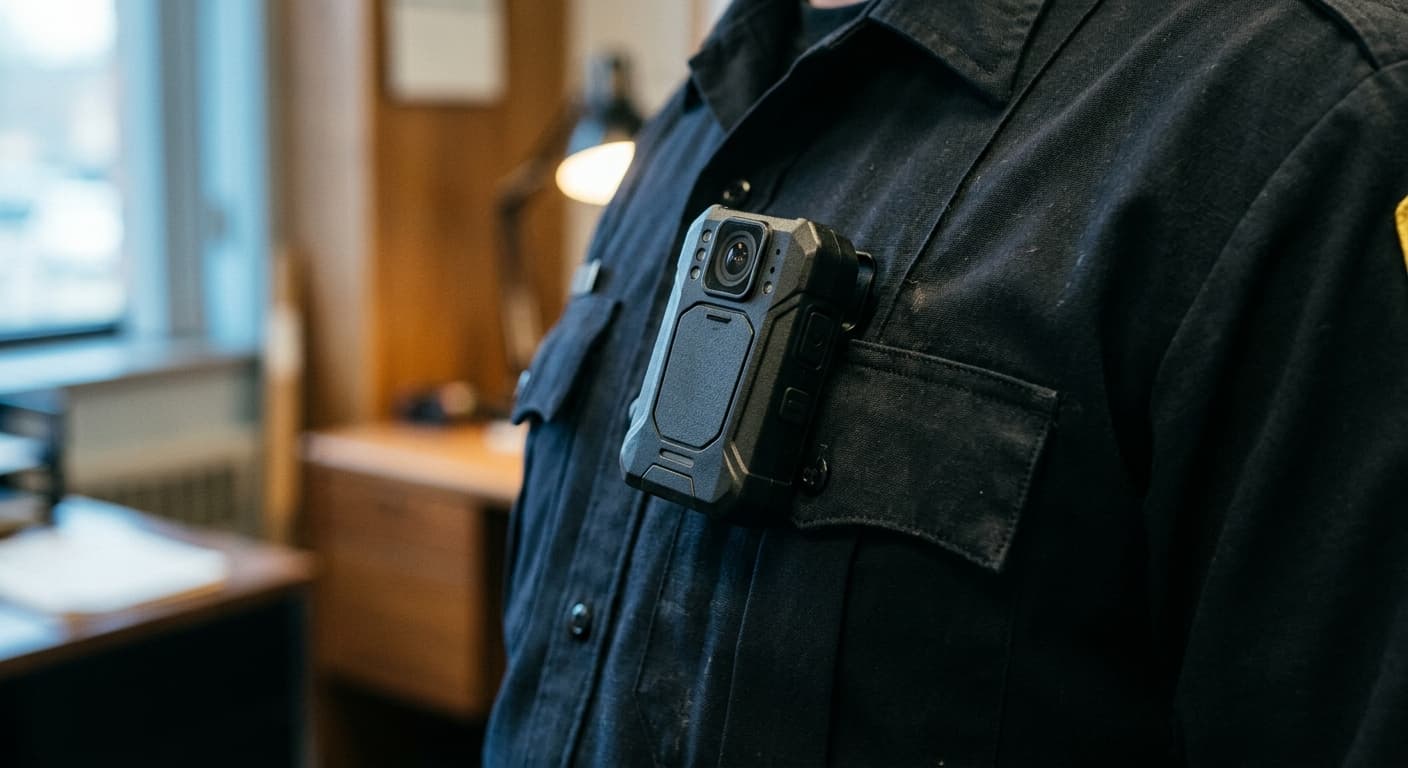
Current Body Camera Requirements
Wyoming has no statewide body-camera mandate. The legislature has not required officers to wear or activate body-worn cameras, and the only direct statutory mention of body-worn footage is Wyo. Stat. Ann. Section 16-4-203(d)(xviii), a Public Records Act exception governing when agencies may withhold body-camera footage from disclosure. Law enforcement agencies across the state adopt body-worn camera programs voluntarily at the local level. The Wyoming Division of Criminal Investigation (DCI) provides guidance but does not impose statewide requirements.
Agencies with body cameras typically establish policies covering when officers must activate cameras, when they may deactivate them, footage retention periods, access and review procedures, and disciplinary consequences for policy violations.
Accessing Police Body Camera Footage
Wyoming's Public Records Act (Wyo. Stat. Ann. Section 16-4-201 et seq.) provides the framework for accessing government records, including body camera footage. Access may be limited by active investigation exemptions, privacy concerns, medical and juvenile protections, court orders, and ongoing litigation.
To request footage, submit a written public records request to the relevant law enforcement agency.
Dashboard Camera Footage
Many Wyoming law enforcement vehicles are equipped with dashboard cameras. This footage is subject to the same public records request process. Dashboard camera footage often captures traffic stops, vehicle pursuits, roadside interactions, and DUI investigations.
Recording in Specific Law Enforcement Contexts
During a Traffic Stop
You can record during a traffic stop in Wyoming:
- Mount your phone on your dashboard or have a passenger record
- Inform the officer of reaching movements before making them
- Keep your hands visible
- The officer may ask about the recording but cannot order you to stop
- Continue recording until the encounter is fully concluded
During a Search
You can record searches of your home, vehicle, or person to document whether officers exceeded the scope of the warrant, the condition of your property, what items were seized, and whether proper procedures were followed.
At a Protest or Demonstration
Wyoming residents have the right to record police at protests. Stay behind barriers if established, record from a safe distance, and do not use the recording device in a way that could be perceived as a weapon.
During an Arrest
You can record your own arrest or another person's arrest in public. If you are being arrested, you may not be able to continue holding a device. Live streaming preserves footage. Your device may be seized incident to arrest, but contents still require a warrant.
On Public Lands
Wyoming has vast federal and state public lands. Recording law enforcement officers (including Bureau of Land Management (BLM) rangers, U.S. Forest Service officers, and Wyoming Game and Fish wardens) performing duties on public land follows the same principles. You can record these interactions from a reasonable distance without interfering.
Obstruction and Interference Laws
Wyo. Stat. Ann. Section 6-5-204: Interference with a Peace Officer
Wyo. Stat. Ann. Section 6-5-204 makes it a misdemeanor to knowingly obstruct, impede, or interfere with a peace officer in the lawful performance of official duties. Recording police, by itself, does not constitute interference. However, certain behaviors while recording could cross the line:
- Physically blocking an officer's path
- Shouting in a way that prevents officers from communicating
- Refusing to move back when ordered for legitimate safety reasons
- Attempting to free someone from custody
- Providing false information during an investigation
The penalty for interference is a misdemeanor with up to 1 year in jail and/or a fine of up to $1,000.
What Constitutes "Interference"
Courts evaluate interference on a case-by-case basis. Simply standing nearby and recording is not interference. Factors include physical proximity, whether the recorder's actions diverted officer attention, whether lawful orders were obeyed, whether a safety hazard was created, and the overall context.
If Your Rights Are Violated
What to Do Immediately
- Stay calm. Do not argue or physically resist.
- Clearly state your rights. "I have a legal right to record in this public place."
- Comply with orders under protest. "I am stopping under protest. I do not consent."
- Note badge numbers and identifying information.
- Write down everything as soon as possible.
- Preserve any footage captured before the interruption.
Legal Remedies
- 42 U.S.C. Section 1983 civil rights lawsuit for First Amendment violations
- Internal affairs complaint with the officer's department
- Complaint to the U.S. DOJ Civil Rights Division
- State tort claims for false arrest, assault, or property seizure
- Public records request for body and dashboard camera footage
More Wyoming Recording Laws
Audio Recording | Video Recording | Voyeurism and Hidden Cameras | Workplace Recording | Recording Police | Phone Call Recording | Security Cameras | Recording in Public | Landlord-Tenant Recording | Dashcam Laws | School Recording | Medical Recording
Back to Wyoming Recording Laws
More Wyoming Recording Topics
More Wyoming Laws
Frequently Asked Questions
Can I record police officers in Wyoming?
Yes. You have a First Amendment right to record police performing their duties in public. The Tenth Circuit, which covers Wyoming, has affirmed this right. Wyoming's one-party consent law also allows you to record any interaction with police that you participate in. You must not interfere with operations while recording.
Can a police officer tell me to stop recording in Wyoming?
An officer cannot lawfully order you to stop recording in a public place if you are not interfering with their duties. If told to stop, calmly assert your right. Comply with legitimate safety orders to move back and continue recording from a greater distance.
Can police confiscate my phone or camera in Wyoming?
Officers can seize your phone or camera without a warrant in some situations, such as incident to a lawful arrest. But under Riley v. California (2014), they generally need a warrant to search its contents, including photos and videos, even after a lawful seizure. Officers cannot delete recordings or force you to delete them.
Do Wyoming police officers have to wear body cameras?
Wyoming does not have a statewide body camera mandate. Individual law enforcement agencies adopt body camera programs based on their own policies and resources. Whether officers at a specific agency use body cameras depends on that department.
What should I do if a Wyoming police officer violates my right to record?
Stay calm, assert your rights, comply under protest, and document everything. You may file an internal affairs complaint, a public records request for body camera footage, or a federal civil rights lawsuit under 42 U.S.C. Section 1983. Consult a civil rights attorney.
Updates
Corrected the page's description of Riley v. California: police generally need a warrant to search a seized device's contents, but seizing the device itself (for example incident to a lawful arrest) does not require a warrant. Also replaced a dead Riley v. California citation link with a live source.
Independently fact-checked against the cited primary sources; governing law re-checked for recent changes
Governing law re-checked for recent changes
Governing law re-checked for recent changes
Reviewed and approved by an editor
The Law Behind This Article
This article rests on the statutory provisions below, held in our own legal record and retrieved from the official source. Tap a section to read the operative text.
Wyoming Statutes, Title 7 - Criminal Procedure - Chapter 3: Fugitives and Prevention of Crime - Article 7: Communication Interception
§ 7-3-702Prohibition against interception or disclosure of wire, oral or electronic communications; exceptions; penalties.In forcecited in 18 of our articles
(a) Except as provided in subsection (b) of this section, no person shall intentionally: (i) Intercept, attempt to intercept, or procure any other person to intercept or attempt to intercept any wire, oral or electronic communication; (ii) Use, attempt to use, or procure any other person to use or attempt to use any electronic, mechanical or other device to intercept any oral communication when: (A) Such device is affixed to, or otherwise transmits a signal through, a wire, cable or other like connection used in wire communication; or (B) Such device transmits communications by radio or interferes with the transmission of such communication.
Official text (excerpt) · last checked 2026-08-31 · Read the full text in our law library · Verify at wyoleg.gov
Cited in 1 court opinions in our collectionLatest citing opinion in our collection: 2015
Opinions citing this section in our collection:
- Serna v. Bureau of Land Management Worland Field Office (Court of Appeals for the Tenth Circuit 2015, 614 F. App'x 384)“…nic communications except under certain circumstances. See Wyo. Stat. Ann. § 7-3-702(a). As relevant here, the statute cont…”
Identified automatically from the court opinions citing this section — not a ranking of which case controls.
Also relied on in: Wyoming Security Camera Laws: Rules for Homes and Businesses, Wyoming Video Recording Laws: Privacy Rules and Consent, Wyoming Voyeurism Laws: Hidden Cameras and Privacy Violations
Wyoming Statutes, Title 16 - City, County, State and Local Powers - Chapter 4: Uniform Municipal Fiscal Procedures; Public Records, Documents and Meetings - Article 2: Public Records
§ 16-4-203Right of inspection; grounds for denial; access of news media; order permitting or restricting disclosure; exceptions.In forcecited in 3 of our articles
(a) The custodian of any public records shall allow any person the right of inspection of the records or any portion thereof except on one (1) or more of the following grounds or as provided in subsection (b) or (d) of this section: (i) The inspection would be contrary to any state statute; (ii) The inspection would be contrary to any federal statute or regulation issued thereunder having the force and effect of law; or (iii) The inspection is prohibited by rules promulgated by the supreme court or by the order of any court of record.
Official text (excerpt) · last checked 2026-09-02 · Read the full text in our law library · Verify at wyoleg.gov
Cited in 22 court opinions in our collectionLatest citing opinion in our collection: 2023
In the courts (editorial summary, independently checked):Houghton v. Franscell (1994) held a hospital district's physician recruitment contract is not a hospital record exempt under section 16-4-203(d)(vii). Powder River Basin Resource Council (2014) adopted a narrow FOIA definition of trade secrets for (d)(v) and required the show cause procedure in (f), with the burden on the custodian.
Opinions citing this section in our collection:
- Gale v. State (Wyoming Supreme Court 1990, 792 P.2d 570)✓A defendant charged with child sexual abuse sought the complaining children's school records; the court treated them as privileged under section 16-4-203(d)(viii), reviewed them in camera under the Ritchie materiality test, and affirmed the refusal to disclose.
- Powder River Basin Resource Council v. Wyoming Oil & Gas Conservation Commission (Wyoming Supreme Court 2014, 320 P.3d 222)✓Conservation groups sought the identity of hydraulic fracturing chemicals the Commission withheld as trade secrets; the court held such a denial must be challenged through the show cause procedure in section 16-4-203(f), not administrative review, and remanded.
- Houghton v. Franscell (Wyoming Supreme Court 1994, 870 P.2d 1050)✓A newspaper sought a hospital district's physician recruitment contract; the court held a record of the public funds paid to induce a doctor to relocate is not a hospital record exempt under section 16-4-203(d)(vii), and affirmed the order to disclose it.
Identified automatically from the court opinions citing this section — not a ranking of which case controls.
Also relied on in: Wyoming Police Body Camera Laws: W.S. 16-4-203 Access, Wyoming Police Report: How to Get a Crash Report from WYDOT, an Incident Report, or Body Camera (Peace Officer Recording) Footage
Wyoming Statutes, Title 6 - Crimes and Offenses - Chapter 5: Offenses Against Public Administration - Article 2: Hindering Government Operations
§ 6-5-204Interference with peace officer; disarming peace officer; penalties.In force
(a) A person commits a misdemeanor punishable by imprisonment for not more than one (1) year, a fine of not more than one thousand dollars ($1,000.00), or both, if he knowingly obstructs, impedes or interferes with or resists arrest by a peace officer while engaged in the lawful performance of his official duties. (b) A person who intentionally and knowingly causes or attempts to cause bodily injury to a peace officer engaged in the lawful performance of his official duties is guilty of a felony punishable by imprisonment for not more than ten (10) years. (c) A person who intentionally and knowingly disarms a peace officer of his firearm while that peace officer is engaged in the lawful performance of his official duties is guilty of a felony punishable by imprisonment for not more than five (5) years. (d) For the purposes of this section only, "peace officer" means as defined in W.S.
Official text (excerpt) · last checked 2026-07-30 · Read the full text in our law library · Verify at wyoleg.gov
Cited in 76 court opinions in our collectionLatest citing opinion in our collection: 2026
Opinions citing this section in our collection:
- Oien v. State (Wyoming Supreme Court 1990, 797 P.2d 544)“…(B) An arrest or charge for a crime. [2] W.S. 6-5-204(a) provides: A person commits a misd…”
- Mueller v. State (Wyoming Supreme Court 2001, 36 P.3d 1151)“…icient evidence of Appellant's violation of each element of W.S. § 6-5-204(b)7 III. Was it proper for the p…”
- Pena v. State (Wyoming Supreme Court 1989, 780 P.2d 316)“…ion for felony assault of a police officer, in violation of W.S. 6-5-204(b), appellant Benny Pena (Pena) claims…”
Identified automatically from the court opinions citing this section — not a ranking of which case controls.
Search our full record of US law — 2.1 million sections, every state + federal →
Sources and References
- Wyo. Stat. Ann. Section 7-3-702 - Interception of Communications(law.justia.com)
- Wyo. Stat. Ann. Section 6-5-204 - Interference with Peace Officer(wyoleg.gov).gov
- Wyoming Public Records Act Section 16-4-203(d)(xviii) (body-camera exception)(wyoleg.gov).gov
- Irizarry v. Yehia, 38 F.4th 1282 (10th Cir. 2022)(cases.justia.com)
- Frasier v. Evans, 992 F.3d 1003 (10th Cir. 2021)(courtlistener.com).gov
- Riley v. California, 573 U.S. 373 (2014)(supremecourt.gov).gov
- DOJ - Addressing Police Misconduct(justice.gov).gov
- BLM Wyoming(blm.gov).gov