
New Jersey
New Jersey Windshield Mounting Laws (2026 Guide)
Independently fact-checked against primary sources (last audited August 17, 2026). · Reviewed by the RecordingLaw editorial team. · Law checked current as of August 17, 2026. · 4 primary sources cited on this page. How we verify our legal content
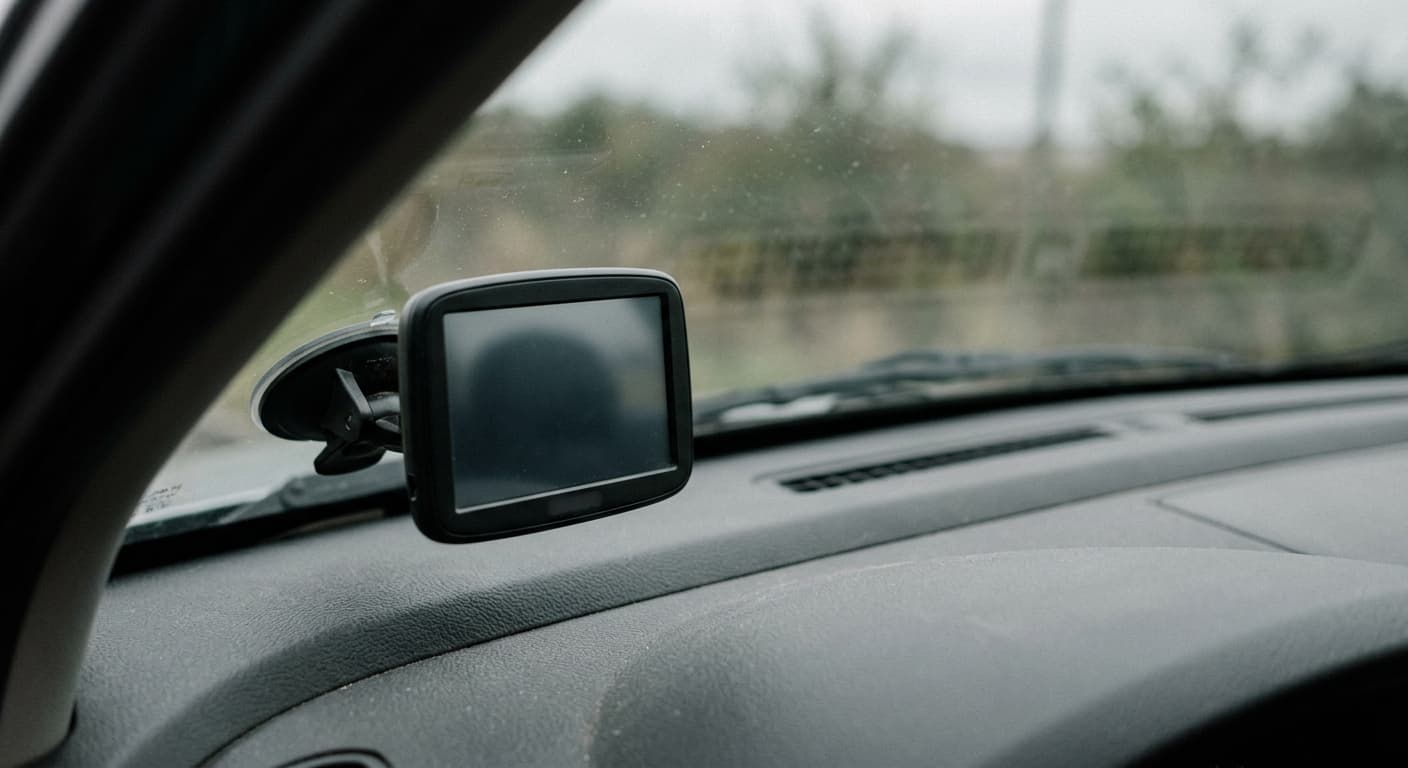
Under N.J.S.A. 39:3-74, New Jersey bans all non-transparent materials on the windshield, making GPS mounts and phone holders technically illegal. Dashcams are permitted when placed directly behind the rearview mirror. Safer alternatives for GPS and phone holders include dashboard, console, or air vent mounts.
New Jersey has some of the most restrictive windshield mounting laws in the United States. The state broadly prohibits any non-transparent material on the front windshield and front side windows, making it one of a handful of states where mounting a GPS, phone holder, or other device on the windshield can result in a ticket.
The primary statute governing windshield obstructions is N.J.S.A. 39:3-74, which has remained largely unchanged for decades. Understanding how this law applies to modern devices like GPS units, dashcams, and smartphone holders requires examining both the statute and the related window tinting regulations.
The Core Statute: N.J.S.A. 39:3-74
N.J.S.A. 39:3-74 is titled "Windshields must be unobstructed and equipped with cleaners." The statute contains three key prohibitions:
Windshield cleaners required. Every motor vehicle with a windshield must have at least one working device for cleaning rain, snow, or other moisture from the windshield to provide clear vision for the driver.
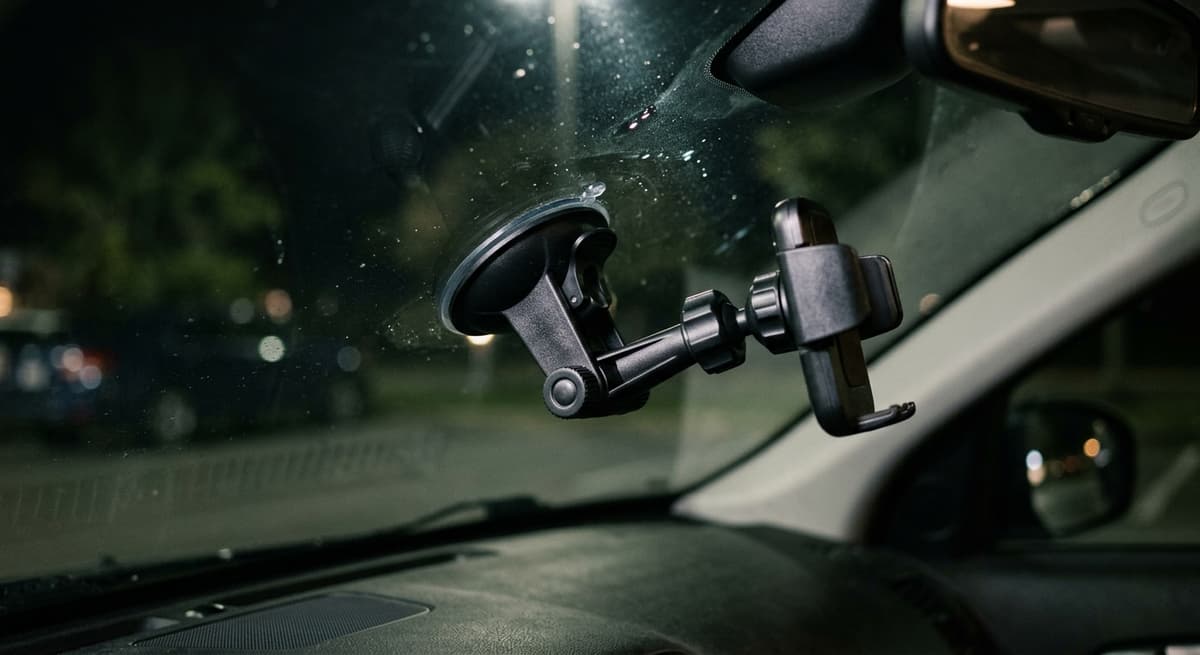
Non-transparent materials banned. No person shall drive any motor vehicle with any sign, poster, sticker, or other non-transparent material on the front windshield, wings, deflectors, side shields, corner lights adjoining the windshield, or front side windows. The only exception is for certificates or articles required to be displayed by statute or by regulations of the Commissioner of Motor Vehicles.
Obstruction of view prohibited. No person shall drive any vehicle so constructed, equipped, or loaded as to unduly interfere with the driver's vision to the front and to the sides.
The broad language of this statute is what makes New Jersey so restrictive. A GPS unit, phone mount, or suction cup holder qualifies as a "non-transparent material" on the windshield, which the statute explicitly prohibits.
GPS and Phone Mounts
Under a strict reading of N.J.S.A. 39:3-74, mounting a GPS device or smartphone holder on the windshield is illegal in New Jersey. The statute does not make exceptions for navigation devices or hands-free phone holders.
This puts New Jersey at odds with practical reality. Millions of drivers use GPS navigation and need to mount their devices somewhere visible. There have been multiple legislative efforts to change this law, including bills that would explicitly permit GPS equipment, smartphone holders, and similar devices on the windshield, dashboard, or console as long as they do not interfere with the driver's vision.
However, as of 2026, the core statute remains unchanged. No amendment has been signed into law that creates an explicit exception for GPS or phone mounts on the windshield.
Enforcement Reality
While the law technically prohibits all windshield-mounted devices, enforcement varies. Police officers generally focus on situations where a mounted device clearly obstructs the driver's view. A small GPS unit mounted near the bottom corner of the windshield is less likely to attract a ticket than a large tablet blocking a significant portion of the windshield.
That said, any windshield-mounted device gives an officer a legal basis for a traffic stop. This is important to understand: even if the device does not meaningfully obstruct your view, the statute makes it a violation to have any non-transparent material on the windshield.
Safer Alternatives
To avoid potential tickets, New Jersey drivers should consider mounting GPS units and phone holders on the dashboard, the center console, or an air vent clip rather than on the windshield. These placements comply with N.J.S.A. 39:3-74 because they do not involve attaching anything to the windshield glass.
Dashcam Rules
New Jersey does not have a specific statute addressing dashcams or video event recorders. A dashcam is treated the same as any other windshield-mounted device under N.J.S.A. 39:3-74.
The safest placement for a dashcam in New Jersey is directly behind the rearview mirror. This location generally does not add to the existing obstruction created by the mirror itself and is widely considered the most compliant mounting position in restrictive states.
Mounting a dashcam elsewhere on the windshield, such as in the lower corner, technically violates the statute, although enforcement against discreet dashcam placements is uncommon.
Audio Recording Considerations
New Jersey is a one-party consent state for audio recording. This means you can legally record conversations in your vehicle with a dashcam that captures audio, as long as you are a party to the conversation. You do not need to inform passengers that audio is being recorded, although doing so is considered a best practice.
Toll Transponders and E-ZPass
N.J.S.A. 39:3-74 carves out "a certificate or other article required to be so displayed by statute or by regulations of the commissioner." That exception is narrow, and it names only two sources: a statute, or a regulation of the Commissioner of Motor Vehicles.
No New Jersey statute or Motor Vehicle Commission regulation has been identified that requires a toll transponder to be displayed on the windshield. Placement instructions published by a toll agency such as the New Jersey Turnpike Authority come from the toll authority, not from the MVC, so they are not one of the two sources the statute names. On the current record, E-ZPass is not expressly covered by the 39:3-74 exception.
As a practical matter, a transponder mounted in the standard position behind the rearview mirror is not a common enforcement target. That is an observation about enforcement, not a statutory permission.
Windshield Tinting Laws
New Jersey regulates window tinting separately from windshield obstructions. The tinting rules fall under N.J.S.A. 39:3-75 and related statutes.
Windshield Tinting
Add-on tinting film may not be installed on a New Jersey windshield unless the driver holds a medical exemption certificate issued by the MVC. N.J.S.A. 56:8-117 requires tint retailers to post a sign reading "NJ STATE LAW PROHIBITS ADD-ON TINTING ON WINDSHIELDS AND FRONT SIDE WINDOWS," and it bars an installer from applying film to the windshield or the windows to the left and right of the driver unless the customer exhibits a certificate or card issued under the medical exemption program.
Within that program, N.J.A.C. 13:20-1.2(a) provides that sun-screening material may not be applied to the windshield if, in conjunction with the factory-installed glazing, it reduces the transmittance of normally incident visible light below 70 percent. Subsection (b) then allows sun-screening material on the portion of the windshield above the AS-1 line without that 70 percent floor. The regulation states no inch measurement for the windshield. The AS-1 line is defined in N.J.A.C. 13:20-1.1 as the mark delineating the area of the windshield requisite for driving visibility, indicating glazing with a luminous transmittance of not less than 70 percent.
Front Side Windows
There is no aftermarket tint darkness a New Jersey driver may lawfully use on the front side windows without a medical exemption. The MVC states that a vehicle's windshield and front side windows may be tinted in New Jersey with a medical exemption only, and N.J.S.A. 56:8-117 bars an installer from applying film to those windows unless the customer produces a medical exemption certificate or card.
For vehicles that do hold a certificate, N.J.A.C. 13:20-1.2(c) sets the floor: sun-screening material may not reduce front side window light transmittance below 60 percent. Subsection (d) adds one narrow further allowance, available to certificate holders only. They may affix readily removable sun-screening material to the uppermost six-inch portion of the front side windows between sunrise and sunset, provided that material does not reduce light transmittance below 35 percent. That six-inch measurement belongs to the front side windows, not to the windshield.
Rear Side Windows and Rear Window
New Jersey places no restrictions on tinting for rear side windows or the rear window. Drivers may apply any darkness level, including limo-style tint, to these windows without violating the law.
VLT Summary Table
| Window | Add-on film without a medical exemption | With an MVC medical exemption certificate |
|---|---|---|
| Windshield | Not permitted | 70% VLT floor, except above the AS-1 line where material is allowed (N.J.A.C. 13:20-1.2(a), (b)) |
| Front side windows | Not permitted | 60% VLT floor (13:20-1.2(c)); readily removable film on the uppermost six inches, sunrise to sunset, 35% VLT floor (13:20-1.2(d)) |
| Rear side windows | No restriction | No restriction |
| Rear window | No restriction | No restriction |
Window Tinting Penalties
N.J.S.A. 39:3-75.3 sets the fines under the medical sun-screening scheme. Both of its subsections are narrower than they are commonly described.
| Offense | Maximum fine | Statute |
|---|---|---|
| Failure to exhibit a valid medical sun-screening certificate or card | $100 | N.J.S.A. 39:3-75.3(a), for violating 39:3-75.2(b) |
| Installer violation of the installation, application or labeling regulations, or of the installer registration requirement (first offense) | $1,000 | N.J.S.A. 39:3-75.3(b), for violating regulations adopted under 39:3-75.2(c) or (d) |
| The same installer violation, second or subsequent offense | $5,000 | N.J.S.A. 39:3-75.3(b) |
Two points matter here. First, the $100 fine is not a general illegal-tint penalty. It attaches to the failure to exhibit the medical certificate or card, and the statute allows the municipal court judge to dismiss the charge if the driver produces a certificate that was valid on the day he was charged, though the judge may still impose court costs. N.J.S.A. 39:3-75 is the safety glazing statute and carries no tint fine of its own.
Second, the $1,000 and $5,000 figures are installer-facing. Subsection (b) reaches violations of the regulations adopted under 39:3-75.2(c) and (d), which govern how approved material is installed, applied and labeled and which require persons in the business of installing or applying that material to register. A driver is not the target of that subsection.
Medical Exemptions for Window Tinting
New Jersey provides a medical exemption process for drivers with qualifying conditions that require protection from sunlight. The exemption is authorized under N.J.S.A. 39:3-75.1 and administered by the New Jersey Motor Vehicle Commission (MVC).
Qualifying Conditions
Medical conditions that may qualify for a sun-screening exemption include:
- Polymorphous light eruption
- Persistent light reactivity
- Actinic reticuloid
- Porphyria
- Solar urticaria
- Lupus erythematosus
- Other conditions involving ophthalmic or dermatological photosensitivity
Application Process
- Request the application form (MVC Sunscreening 1) by emailing SUNSCREENING@mvc.nj.gov or calling 609-984-2973
- Have a certified ophthalmologist or licensed physician complete the medical certification section
- The physician must specify the condition, recommended treatment, and the specific wavelength of light to which the patient is photosensitive
- Submit the completed form with a valid prescription to the NJ MVC Customer Advocacy Office
- If approved, you will receive a temporary 60-day approval and a Sunscreening Installation Confirmation form
- Only licensed sun-screening installers may apply the approved material
- The medical certification must be renewed every 48 months
The exemption certificate must be carried in the vehicle at all times.
Windshield Obstruction Penalties
Violations of N.J.S.A. 39:3-74 (windshield obstruction) carry a fine starting at $54. This is a non-moving violation, meaning no motor vehicle penalty points are assessed on your driving record. Court costs and other fees may increase the total amount owed.
While the fine is relatively modest, the practical consequences can extend beyond the ticket itself. A windshield obstruction citation gives law enforcement a reason to initiate a traffic stop, which can lead to the discovery of other violations.
Hands-Free Device Law
New Jersey's hands-free law (N.J.S.A. 39:4-97.3) requires that wireless telephones and electronic communication devices be used in hands-free mode while driving. This law intersects with windshield mounting rules in an important way.
Even though New Jersey requires hands-free phone use, the state does not provide an exemption from the windshield obstruction law for hands-free phone mounts. A phone mounted on the windshield for hands-free use technically violates N.J.S.A. 39:3-74. The hands-free law specifies that device placement must not interfere with federally required safety equipment and that the driver must exercise a high degree of caution.
Hands-Free Violation Penalties
| Offense | Fine Range | Points |
|---|---|---|
| First offense | $200 to $400 | 0 |
| Second offense | $400 to $600 | 0 |
| Third or subsequent | $600 to $800 | 3 |
A 10-year lookback period applies. Third and subsequent offenses also carry a potential 90-day license suspension at the judge's discretion.
Inspection Considerations
New Jersey requires periodic vehicle inspections. During inspection, vehicles with unlawful window tinting on the windshield or front side windows may fail. Aftermarket film on either of those windows generally has to come off unless the driver holds an MVC medical exemption certificate, which N.J.S.A. 39:3-75.2(b) requires be exhibited to a designated motor vehicle examiner whenever the vehicle is inspected.
Comparison With Neighboring States
New Jersey's windshield mounting restrictions are stricter than most of its neighbors:
| State | Windshield Mounts Allowed | Front Side Window Tint |
|---|---|---|
| New Jersey | No (strict prohibition) | No add-on film without a medical exemption |
| New York | Yes (specific placement rules) | 70% VLT minimum |
| Pennsylvania | Yes (not in driver's sight area) | 70% VLT minimum |
| Delaware | Yes (limited areas) | 70% VLT minimum |
| Connecticut | Yes (with restrictions) | 35% VLT minimum |
New Jersey is the only state in the Northeast with a near-total ban on windshield-mounted devices. Most neighboring states allow mounts in designated areas of the windshield as long as they do not obstruct the driver's view.
More New Jersey Laws
Frequently Asked Questions
Can I mount a GPS or phone holder on my windshield in New Jersey?
Technically, no. N.J.S.A. 39:3-74 prohibits any non-transparent material on the windshield. GPS units and phone holders qualify as non-transparent material. While enforcement varies, the safest option is to mount these devices on your dashboard or air vent instead.
Are dashcams legal in New Jersey?
Dashcams are legal to use, but their placement matters. The safest mounting location is directly behind the rearview mirror, where the camera does not add to the existing obstruction. Mounting a dashcam elsewhere on the windshield technically violates N.J.S.A. 39:3-74.
What is the fine for a windshield obstruction ticket in New Jersey?
The base fine for violating N.J.S.A. 39:3-74 starts at $54 plus court costs. No motor vehicle penalty points are assessed. It is classified as a non-moving, equipment-type violation.
Can I tint my windshield in New Jersey?
Not without a medical exemption. The NJ MVC states that the windshield and front side windows may be tinted in New Jersey with a medical exemption only, and N.J.S.A. 56:8-117 bars installers from applying film to those windows unless the customer produces a medical exemption certificate. For certificate holders, N.J.A.C. 13:20-1.2 allows sun-screening material above the AS-1 line on the windshield and sets a 60 percent light transmittance floor on the front side windows. There are no restrictions on rear side windows or the rear window.
How do I get a medical exemption for window tinting in New Jersey?
Contact the NJ MVC at SUNSCREENING@mvc.nj.gov or 609-984-2973 to request the application form. A licensed physician must certify your qualifying medical condition. If approved, you receive a temporary permit and must have the tinting installed by a licensed installer. The exemption must be renewed every 48 months.
Updates
Corrected the New Jersey window tinting and penalty sections: add-on film on the windshield and front side windows requires an MVC medical exemption certificate rather than meeting a 70 percent light transmittance threshold, the uppermost six-inch allowance is a front side window rule for certificate holders and not a windshield rule, the $100 fine is N.J.S.A. 39:3-75.3(a) for failing to exhibit a medical certificate rather than N.J.S.A. 39:3-75, the $1,000 and $5,000 fines apply to installers rather than drivers, and the claim that E-ZPass transponders are expressly permitted under N.J.S.A. 39:3-74 was removed because no statute or Motor Vehicle Commission regulation supports it.
Independently fact-checked against the cited primary sources; governing law re-checked for recent changes
Removed the nonexistent '(f)' pinpoint subsection cite from the front-window-tint penalty row; N.J.S.A. 39:3-75 is unlettered continuous prose with no subsections.
Governing law re-checked for recent changes
Reviewed and approved by an editor
The Law Behind This Article
This article rests on the statutory provisions below, held in our own legal record and retrieved from the official source. Tap a section to read the operative text.
New Jersey Statutes (Unannotated)
§ 39:3-74Windshields must be unobstructed and equipped with cleanersIn forcecited in 2 of our articles
Every motor vehicle having a windshield shall be equipped with at least one device in good working order for cleaning rain, snow or other moisture from the windshield so as to provide clear vision for the driver, and all such devices shall be so constructed and installed as to be operated or controlled by the driver. No person shall drive any motor vehicle with any sign, poster, sticker or other non-transparent material upon the front windshield, wings, deflectors, side shields, corner lights adjoining windshield or front side windows of such vehicle other than a certificate or other article required to be so displayed by statute or by regulations of the commissioner. No person shall drive any vehicle so constructed, equipped or loaded as to unduly interfere with the driver's vision to the front and to the sides.
Official text (excerpt) · last checked 2026-09-08 · Read the full text in our law library · Verify at lis.njleg.state.nj.us
Cited in 41 court opinions in our collectionLatest citing opinion in our collection: 2026
In the courts (editorial summary, independently checked):State v. Cohen (2002) held N.J.S.A. 39:3-74 reaches tinted windows that fail the administrative light-transmittance standard, and upheld a stop for very dark tint. State v. Barrow (2009) held the statute's constructed, equipped or loaded clause covers objects hung from a rearview mirror that unduly interfere with vision.
Opinions citing this section in our collection:
- State v. Cohen (New Jersey Superior Court Appellate Division 2002, 347 N.J. Super. 375)✓An officer stopped a car at 3 a.m. because black tint on the driver's window kept him from seeing inside; the court held section 39:3-74 does prohibit tinted windows that fail the applicable administrative standard and upheld the stop and the DWI conviction.
- State v. Barrow (New Jersey Superior Court Appellate Division 2009, 408 N.J. Super. 509)✓An officer stopped an Acura for miniature boxing gloves swaying at the driver's eye level; the court held the loaded paragraph of section 39:3-74 reaches items hung from a rearview mirror and that his testimony that they obstructed the view justified the stop.
- State v. Perlstein (New Jersey Superior Court Appellate Division 1985, 206 N.J. Super. 246)“…C:29-1, having a PBA sticker on her windshield contrary to N.J.S.A. 39:3-74, and refusing to display her driver's l…”
Identified automatically from the court opinions citing this section — not a ranking of which case controls.
Also relied on in: New Jersey Window Tint Laws (2026): Legal VLT Limits
§ 39:3-75Safety glassIn force
The term "safety glass" shall be construed as meaning glass so treated or combined with other materials as to reduce, in comparison with ordinary sheet glass or plate glass, the likelihood of injury to persons by objects from exterior sources or by glass when the glass is cracked or broken. The term "safety glazing material" shall be construed as meaning "safety glass" ; or other glazing materials, such as plastics, produced for the purpose of safety in glazing; or a combination of safety glass and other safety glazing material. The term "approved safety glazing material" shall be construed as meaning safety glazing material of a type approved by the director. In the approving of safety glazing materials, the director is hereby given authority to make use of recognized standards to confine the use of certain types of safety glazing materials to a specific location in or on the vehicle, or to a certain purpose. No person shall drive any motor vehicle manufactured on or after July first, nineteen hundred and thirty-five and registered in this State unless such vehicle is equipped with approved safety glazing material wherever glazing is used in doors, windows and windshields.
Official text (excerpt) · last checked 2026-08-01 · Read the full text in our law library · Verify at lis.njleg.state.nj.us
Cited in 18 court opinions in our collectionLatest citing opinion in our collection: 2025
Opinions citing this section in our collection:
- State v. Mandel (New Jersey Superior Court Appellate Division 2018, 455 N.J. Super. 109)“…ession, N.J.S.A. 2C:35-10(a)(4), and improper safety glass, N.J.S.A. 39:3-75. Defendant filed a motion to suppress…”
- Thurman Hogan v. Volkswagen Group of America, Inc. (New Jersey Superior Court Appellate Division 2024)“…should not drive cars with "unduly fractured" windshields. N.J.S.A. 39:3-75. The Lemon Law claim is accordingly re…”
- State v. David L. Smith (085635) (Mercer County & Statewide) (Supreme Court of New Jersey 2022)“…of a tinted windows violation pursuant to adjacent statute N.J.S.A. 39:3-75. Defendant subsequently pled guilty to…”
Identified automatically from the court opinions citing this section — not a ranking of which case controls.
§ 39:3-75.1Certain tinting materials on windshields, windows of motor vehicles, permitted for medical reasonsIn forcecited in 2 of our articles
1. Notwithstanding the provisions of any other law to the contrary, the owner or lessee of a motor vehicle that is driven by or is used to regularly transport a person who has a medical condition involving ophthalmic or dermatologic photosensitivity may apply to the director for permission to have the windshield and windows of that vehicle covered by or treated with a product or material that increases its light reflectance or reduces its light transmittance. The application shall be in a form and manner prescribed by the director and shall include, but not be limited to, a written certification by a certified ophthalmologist or a physician with a plenary license to practice medicine and surgery in this State or a bordering state that the person for whom the application is submitted has a medical condition involving ophthalmic or dermatologic photosensitivity.
Official text (excerpt) · last checked 2026-08-01 · Read the full text in our law library · Verify at lis.njleg.state.nj.us
Cited in 4 court opinions in our collectionLatest citing opinion in our collection: 2024
Opinions citing this section in our collection:
- State of New Jersey v. Khalil H. Haskins (New Jersey Superior Court Appellate Division 2024)“…ont window tint which Corporal D'Ascenzo believed violated N.J.S.A. 39:3-75.1 As noted, our Supreme Court decided Sm…”
- State v. David L. Smith (085635) (Mercer County & Statewide) (Supreme Court of New Jersey 2022)“…afety glazing material, not aftermarket tinted window film. N.J.S.A. 39:3-75.1 provides an exception to window tinting…”
- STATE OF NEW JERSEY v. EDWARD BEJARANO (19-10-0623, SOMERSET COUNTY AND STATEWIDE) (New Jersey Superior Court Appellate Division 2022)“…th, 251 N.J. at 261. Specifically, the Court concluded that N.J.S.A. 39:3-75.1 and 39:3-75.2 did not support the stop…”
Identified automatically from the court opinions citing this section — not a ranking of which case controls.
§ 39:3-75.3Violations, finesIn forcecited in 2 of our articles
3. a. A person who violates the provisions of subsection b. of section 2 of P.L.1999, c.308 (C.39:3-75.2) shall be subject to a fine not exceeding $100; provided, however, if a person charged with such a violation can exhibit a certificate or card which was valid on the day he was charged to the judge of the municipal court before whom he is summoned to answer the charge, the judge may dismiss the charge. The judge, however, may impose court costs. b. A person who violates the provisions of the regulations adopted pursuant to subsection c. or d. of section 2 of P.L.1999, c.308 (C.39:3-75.2) shall be subject to a fine not to exceed $1,000 for a first offense and not to exceed $5,000 for a second or subsequent offense.
Official text (excerpt) · last checked 2026-08-01 · Read the full text in our law library · Verify at lis.njleg.state.nj.us
§ 39:4-97.3Use of wireless telephone, electronic communication device in moving vehicles; definitions; enforcement.In forcecited in 2 of our articles
1. a. The use of a wireless telephone or electronic communication device by an operator of a moving motor vehicle on a public road or highway shall be unlawful except when the telephone is a hands-free wireless telephone or the electronic communication device is used hands-free, provided that its placement does not interfere with the operation of federally required safety equipment and the operator exercises a high degree of caution in the operation of the motor vehicle. For the purposes of this section, an "electronic communication device" shall not include an amateur radio. Nothing in P.L.2003, c.310 (C.39:4-97.3 et seq.) shall apply to the use of a citizen's band radio or two-way radio by an operator of a moving commercial motor vehicle or authorized emergency vehicle on a public road or highway.
Official text (excerpt) · last checked 2026-08-01 · Read the full text in our law library · Verify at lis.njleg.state.nj.us
Cited in 15 court opinions in our collectionLatest citing opinion in our collection: 2026
Opinions citing this section in our collection:
- Kubert v. Best (New Jersey Superior Court Appellate Division 2013, 432 N.J. Super. 495)“…pt in certain specifically-described emergency situations. N.J.S.A. 39:4-97.3. 1 An offender is subject to a fine of…”
- STATE OF NEW JERSEY v. MICHELANGELO TROISI (2019-22, MERCER COUNTY AND STATEWIDE) (New Jersey Superior Court Appellate Division 2022)“…ing against him in Princeton Municipal Court for violating N.J.S.A. 39:4-97.3, use of hands-free and hand-held wirel…”
- STATE OF NEW JERSEY VS. JEFFREY DESIR (008-04-18, BERGEN COUNTY AND STATEWIDE) (New Jersey Superior Court Appellate Division 2020)“…A. 39:4-49.1; improper use of a cell phone while driving, N.J.S.A. 39:4-97.3; delaying traffic, N.J.S.A. 39:4-56; i…”
Identified automatically from the court opinions citing this section — not a ranking of which case controls.
Also relied on in: New Jersey Smart Glasses Recording Laws 2026
Search our full record of US law — 2.1 million sections, every state + federal →
Sources and References
- N.J.S.A. 39:3-74 - Windshields must be unobstructed and equipped with cleaners(law.justia.com)
- N.J.S.A. 39:3-75.1 - Tinting materials permitted for medical reasons(law.justia.com)
- NJ MVC - Window Sun-screening For Medical Reasons(nj.gov).gov
- NJ MVC - Sun Screening Installer Licensing(nj.gov).gov
- N.J.S.A. 39:4-97.3 - Use of wireless telephone in moving vehicles(law.justia.com)
- NJ MVC - Points Schedule(nj.gov).gov
- NJ MVC - Just Drive Campaign(nj.gov).gov
- N.J.A.C. 13:20-1.1 and 13:20-1.2 - NJ MVC sun-screening standards (AS-1 line definition; 70 percent windshield floor with the above-AS-1-line exception; 60 percent front side window floor; 35 percent readily removable uppermost six-inch front side window allowance for medical exemption certificate holders, sunrise to sunset)(nj.gov)