Security Camera Sign Laws by State: Notice Rules
Independently fact-checked against primary sources (last audited September 12, 2026). · 25 primary sources cited on this page. How we verify our legal content
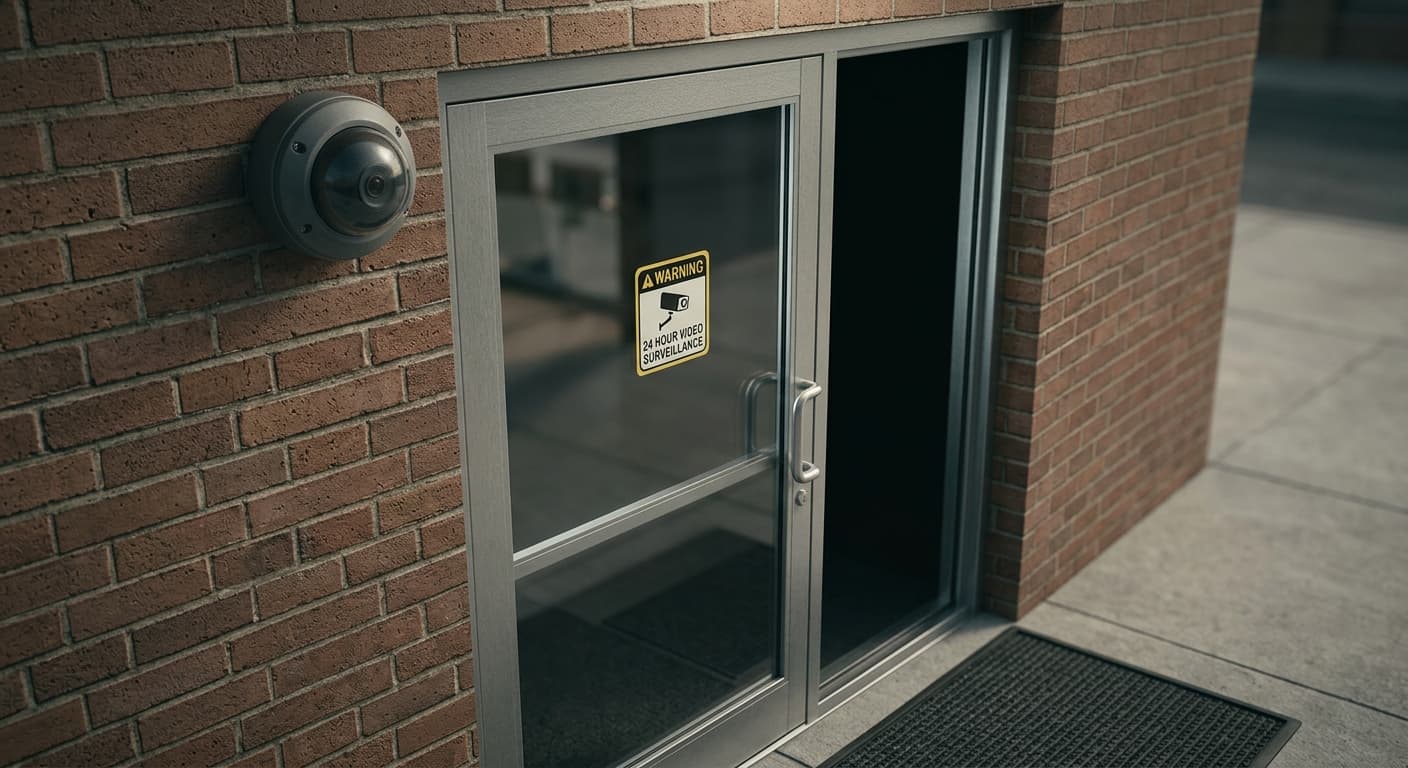
No single U.S. law requires a warning sign for every security camera. A sign can be a statutory requirement, one condition of an exception or defense, a disclosure for a regulated setting, or legally insufficient by itself. The answer depends on the jurisdiction, operator, location, purpose, and whether the device captures sound or biometric identifiers.
Compare all 50 states and D.C. · Explore the cited laws
Jurisdiction scope: This guide compares selected federal, state, District of Columbia, and local camera-notice rules. It does not classify the 35 unresolved jurisdictions as having or lacking a statewide sign law, and it does not replace a current local, sector, audio, employment, biometric, or contract review.
Do You Have to Post a Sign for Security Cameras?
No universal federal rule requires every private camera operator to post a sign. State provisions give notice different legal effects. Some place notice inside a narrowly defined exception or affirmative defense. Some apply to a workplace, care facility, short-term rental, or commercial establishment. Texas supplies the reverse warning by stating that a posted surveillance sign does not alone establish consent for its invasive visual recording offense.
That structure matters because a statement such as “sign required” drops the rest of the statute. An exception may also require a security purpose, a lawful purpose, a particular operator, ordinary-course use, a specific location, or prescribed wording and placement. A defense may matter only after the prosecution establishes the offense. Notice can also be irrelevant if a different provision prohibits the camera's location.
The directory below therefore identifies only 16 source-bound positive or limiting rules. For 35 jurisdictions it gives links to existing camera and audio guides without drawing a statewide signage conclusion. An unresolved row does not mean that a sign is unnecessary. It means this article does not have enough current source support to make that negative claim.
Before relying on notice, identify who operates the device, every area within view, its purpose, who encounters it, and every type of data it creates. A camera may produce ordinary images, sound, face templates, access logs, or employee activity records. Each can fall under a different rule.
Silent Video and Audio-Enabled Cameras Follow Different Rules
A microphone creates a separate interception issue. The official 2024 edition of 18 U.S.C. § 2511 generally prohibits intentional interception of covered communications and includes a party-or-prior-consent exception in subsection (2)(d), subject to its criminal-or-tortious-purpose proviso.
State audio laws can impose different or stricter conditions. A placard reading “video surveillance” does not say that sound is captured, and a sign mentioning audio does not automatically prove the form of consent a governing statute requires. Wording, visibility, timing, the protected nature of the conversation, and the applicable state's law can all matter.
| System feature | Separate legal question | What a sign does not settle |
|---|---|---|
| Silent video | Does a camera or privacy statute apply to this place, purpose, or image? | Whether an exception's other conditions are met |
| Microphone or audio stream | Does federal or state interception law protect the communication? | Whether notice equals valid consent |
| Facial analysis | Is face geometry or another biometric identifier collected or compared? | Whether written release, retention, or use rules apply |
| Employee monitoring | Does the statute cover this technology and location? | Whether a security-camera exclusion or private-area bar applies |
The state links below separate the two inquiries. The camera guide addresses visual surveillance, and the audio guide routes readers to the state's recording-consent analysis. Neither linked page is evidence that a sign resolves both subjects.
Watch out: Many consumer cameras ship with microphones enabled. A lawful placement for silent video does not establish that continuous audio capture is lawful.
Security Camera Sign Requirements by State
The 51 sections below are routing answers. Sixteen describe a bounded notice hook, a rule limiting what notice can accomplish, or a workplace or regulated-sector provision. Every positive description carries its statutory limit. The remaining 35 sections deliberately make no statewide signage classification.

| State or D.C. | Notice: context, rule and limits |
|---|---|
Alabama | No statewide signage classification is made. The Alabama camera law guide and Alabama audio-recording guide are navigation only. Check current state and local law, sector rules, biometric processing, and contracts. |
Alaska | A posted security-surveillance system used only in the interest of crime prevention or prosecution supplies a statutory affirmative defense; this is not a universal mandate for all cameras. See Alaska Stat. § 11.61.123(d). Use the Alaska camera law guide and separate Alaska audio-recording guide for further navigation. |
Arizona | Clearly posted notice in the location is part of the security-purpose exception where the location is one in which the person has a reasonable expectation of privacy. See Ariz. Rev. Stat. § 13-3019(C)(1). Use the Arizona camera law guide and separate Arizona audio-recording guide for further navigation. |
Arkansas | No statewide signage classification is made. The Arkansas camera law guide and Arkansas audio-recording guide are navigation only. Check current state and local law, sector rules, biometric processing, and contracts. |
California | No statewide signage classification is made. The California camera law guide and California audio-recording guide are navigation only. Check current state and local law, sector rules, biometric processing, and contracts. |
Colorado | No statewide signage classification is made. The Colorado camera law guide and Colorado audio-recording guide are navigation only. Check current state and local law, sector rules, biometric processing, and contracts. |
Connecticut | Section 31-48d can require prior written notice and conspicuous posting for covered employee electronic monitoring, but its definition excludes collection in common areas held open to the public for security purposes. Section 31-48b separately bars surveillance in specified employee private areas. See Conn. Gen. Stat. §§ 31-48b, 31-48d. Use the Connecticut camera law guide and separate Connecticut audio-recording guide for further navigation. |
Delaware | Section 705 covers telephone, email, and internet monitoring; it is not a general silent-CCTV notice statute. See 19 Del. C. § 705. Use the Delaware camera law guide and separate Delaware audio-recording guide for further navigation. |
District of Columbia | Prominently displayed signs create a statutory security-monitoring exception for a building or designated portions; home security monitoring has a separate exception. Do not describe the exception as a general duty imposed on every camera operator. See D.C. Code § 22-3531(e)(3). Use the District of Columbia camera law guide and separate District of Columbia audio-recording guide for further navigation. |
Florida | A conspicuously posted written notice stating that video surveillance is installed for premises security is one statutory exception; a clearly and immediately obvious device is a separate exception. See Fla. Stat. § 810.145(5)(b)-(c). Use the Florida camera law guide and separate Florida audio-recording guide for further navigation. |
Georgia | The business/entity surveillance-device exception requires ordinary-course use, conspicuous signage warning of surveillance, and a primary design to detect unlawful activity. Section 16-11-62 does not contain this signage hook. See Ga. Code § 16-11-91(d)(2). Use the Georgia camera law guide and separate Georgia audio-recording guide for further navigation. |
Hawaii | No statewide signage classification is made. The Hawaii camera law guide and Hawaii audio-recording guide are navigation only. Check current state and local law, sector rules, biometric processing, and contracts. |
Idaho | No statewide signage classification is made. The Idaho camera law guide and Idaho audio-recording guide are navigation only. Check current state and local law, sector rules, biometric processing, and contracts. |
Illinois | No statewide signage classification is made. The Illinois camera law guide and Illinois audio-recording guide are navigation only. Check current state and local law, sector rules, biometric processing, and contracts. |
Indiana | No statewide signage classification is made. The Indiana camera law guide and Indiana audio-recording guide are navigation only. Check current state and local law, sector rules, biometric processing, and contracts. |
Iowa | No statewide signage classification is made. The Iowa camera law guide and Iowa audio-recording guide are navigation only. Check current state and local law, sector rules, biometric processing, and contracts. |
Kansas | No statewide signage classification is made. The Kansas camera law guide and Kansas audio-recording guide are navigation only. Check current state and local law, sector rules, biometric processing, and contracts. |
Kentucky | No statewide signage classification is made. The Kentucky camera law guide and Kentucky audio-recording guide are navigation only. Check current state and local law, sector rules, biometric processing, and contracts. |
Louisiana | A short-term-rental owner or lessor may use a camera only in common areas after conspicuously posting the statute's specified notice; this is not a statewide general-business CCTV rule. See La. Rev. Stat. § 21:61(B)(2). Use the Louisiana camera law guide and separate Louisiana audio-recording guide for further navigation. |
Maine | The employer-surveillance law requires advance and annual written notice for covered monitoring, but expressly excludes surveillance cameras used for security or safety from its definition. It became law without the Governor’s signature on January 11, 2026. See 26 M.R.S. § 620-A; P.L. 2025, ch. 524. Use the Maine camera law guide and separate Maine audio-recording guide for further navigation. |
Maryland | No statewide signage classification is made. The Maryland camera law guide and Maryland audio-recording guide are navigation only. Check current state and local law, sector rules, biometric processing, and contracts. |
Massachusetts | Section 105(d) has a merchant changing-room exception tied to conspicuous warning signs at all entrances and inside the monitored room, but chapter 93, section 89 separately bans electronic video cameras in retail dressing rooms. See Mass. Gen. Laws ch. 272, § 105(d); ch. 93, § 89. Use the Massachusetts camera law guide and separate Massachusetts audio-recording guide for further navigation. |
Michigan | No statewide signage classification is made. The Michigan camera law guide and Michigan audio-recording guide are navigation only. Check current state and local law, sector rules, biometric processing, and contracts. |
Minnesota | Under the current text, paragraphs (c), (d), and (e) do not apply in a commercial establishment whose owner posts conspicuous signs warning that the premises are under surveillance. See Minn. Stat. § 609.746, subd. 1(g)(2). Use the Minnesota camera law guide and separate Minnesota audio-recording guide for further navigation. |
Mississippi | No statewide signage classification is made. The Mississippi camera law guide and Mississippi audio-recording guide are navigation only. Check current state and local law, sector rules, biometric processing, and contracts. |
Missouri | Long-term-care electronic-monitoring law includes entrance notice requirements; keep this in the nursing-home cluster and summarize only as a sector overlay. See Mo. Rev. Stat. §§ 198.610-198.632. Use the Missouri camera law guide and separate Missouri audio-recording guide for further navigation. |
Montana | No statewide signage classification is made. The Montana camera law guide and Montana audio-recording guide are navigation only. Check current state and local law, sector rules, biometric processing, and contracts. |
Nebraska | No statewide signage classification is made. The Nebraska camera law guide and Nebraska audio-recording guide are navigation only. Check current state and local law, sector rules, biometric processing, and contracts. |
Nevada | No statewide signage classification is made. The Nevada camera law guide and Nevada audio-recording guide are navigation only. Check current state and local law, sector rules, biometric processing, and contracts. |
New Hampshire | No statewide signage classification is made. The New Hampshire camera law guide and New Hampshire audio-recording guide are navigation only. Check current state and local law, sector rules, biometric processing, and contracts. |
New Jersey | Prior posted or otherwise provided notice plus a lawful purpose supplies the subsection (d) affirmative defense; subsection (e)(1) separately addresses conspicuous notice at a fitting-room or dressing-room entrance. See N.J. Stat. § 2C:14-9(d), (e)(1). Use the New Jersey camera law guide and separate New Jersey audio-recording guide for further navigation. |
New Mexico | No statewide signage classification is made. The New Mexico camera law guide and New Mexico audio-recording guide are navigation only. Check current state and local law, sector rules, biometric processing, and contracts. |
New York | Section 52-c regulates specified telephone, email, and internet monitoring. Its reference to photoelectronic or photo-optical systems does not independently turn ordinary silent CCTV into covered monitoring. Section 203-c separately governs cameras in specified employee private areas. See N.Y. Civil Rights Law § 52-c; N.Y. Labor Law § 203-c. Use the New York camera law guide and separate New York audio-recording guide for further navigation. |
North Carolina | No statewide signage classification is made. The North Carolina camera law guide and North Carolina audio-recording guide are navigation only. Check current state and local law, sector rules, biometric processing, and contracts. |
North Dakota | No statewide signage classification is made. The North Dakota camera law guide and North Dakota audio-recording guide are navigation only. Check current state and local law, sector rules, biometric processing, and contracts. |
Ohio | No statewide signage classification is made. The Ohio camera law guide and Ohio audio-recording guide are navigation only. Check current state and local law, sector rules, biometric processing, and contracts. |
Oklahoma | No statewide signage classification is made. The Oklahoma camera law guide and Oklahoma audio-recording guide are navigation only. Check current state and local law, sector rules, biometric processing, and contracts. |
Oregon | No statewide signage classification is made. The Oregon camera law guide and Oregon audio-recording guide are navigation only. Check current state and local law, sector rules, biometric processing, and contracts. |
Pennsylvania | No statewide signage classification is made. The Pennsylvania camera law guide and Pennsylvania audio-recording guide are navigation only. Check current state and local law, sector rules, biometric processing, and contracts. |
Rhode Island | Resident-room monitoring requires prescribed signs at each visitor-accessible facility entrance and the monitored room entrance, maintained by the facility. Separate statutes restrict employer locker/rest rooms and retail dressing rooms. See R.I. Gen. Laws § 23-17.29-8(a)-(c); §§ 28-6.12-1, 11-41-26. Use the Rhode Island camera law guide and separate Rhode Island audio-recording guide for further navigation. |
South Carolina | No statewide signage classification is made. The South Carolina camera law guide and South Carolina audio-recording guide are navigation only. Check current state and local law, sector rules, biometric processing, and contracts. |
South Dakota | No statewide signage classification is made. The South Dakota camera law guide and South Dakota audio-recording guide are navigation only. Check current state and local law, sector rules, biometric processing, and contracts. |
Tennessee | No statewide signage classification is made. The Tennessee camera law guide and Tennessee audio-recording guide are navigation only. Check current state and local law, sector rules, biometric processing, and contracts. |
Texas | For invasive visual recording, a posted sign stating that surveillance may occur is not sufficient by itself to establish consent. See Tex. Penal Code § 21.15(e). Use the Texas camera law guide and separate Texas audio-recording guide for further navigation. |
Utah | No statewide signage classification is made. The Utah camera law guide and Utah audio-recording guide are navigation only. Check current state and local law, sector rules, biometric processing, and contracts. |
Vermont | No statewide signage classification is made. The Vermont camera law guide and Vermont audio-recording guide are navigation only. Check current state and local law, sector rules, biometric processing, and contracts. |
Virginia | No statewide signage classification is made. The Virginia camera law guide and Virginia audio-recording guide are navigation only. Check current state and local law, sector rules, biometric processing, and contracts. |
Washington | No statewide signage classification is made. The Washington camera law guide and Washington audio-recording guide are navigation only. Check current state and local law, sector rules, biometric processing, and contracts. |
West Virginia | No statewide signage classification is made. The West Virginia camera law guide and West Virginia audio-recording guide are navigation only. Check current state and local law, sector rules, biometric processing, and contracts. |
Wisconsin | No statewide signage classification is made. The Wisconsin camera law guide and Wisconsin audio-recording guide are navigation only. Check current state and local law, sector rules, biometric processing, and contracts. |
Wyoming | No statewide signage classification is made. The Wyoming camera law guide and Wyoming audio-recording guide are navigation only. Check current state and local law, sector rules, biometric processing, and contracts. |
Workplace Cameras and Employee Notice
Workplace notice rules turn on statutory definitions. Connecticut General Statutes § 31-48d requires advance written notice and conspicuous posting for covered electronic monitoring, but the definition excludes information collected for security purposes in common areas held open to the public. Section 31-48b separately restricts surveillance in areas used for employee health or personal comfort or for safeguarding possessions. Posting does not erase that placement restriction.
Maine's section 620-A uses notice for covered employer surveillance but excludes security or safety cameras from the definition. Delaware's 19 Del. C. § 705 and New York's Civil Rights Law § 52-c focus on listed telephone, email, internet, or communications monitoring. They should not be restated as universal silent-CCTV notice statutes.
New York Labor Law § 203-c and Connecticut's separate private-area provision show why an employer must also examine location. Collective bargaining agreements, employment policies, audio law, and biometric processing can add different duties. A posted policy answers only the rule it actually satisfies.
Bathrooms, Locker Rooms, Dressing Rooms, Bedrooms, and Other Private Areas
A warning sign does not independently authorize a camera in a protected private area. State offenses vary sharply. Some identify a bathroom, changing room, locker room, bedroom, residence, or treatment space. Others turn on intimate-area imagery, nudity, sexual purpose, surreptitiousness, trespass, distribution, lack of consent, or the operator's role.
Those elements must remain connected. A general phrase such as “reasonable expectation of privacy” can be too broad for one statute and too narrow for another. Likewise, a notice-based exception cannot be lifted out of its setting and treated as permission for unrelated recording.
Massachusetts illustrates the overlap. Chapter 272, section 105(d) contains a merchant exception tied to conspicuous warnings at entrances and inside the monitored room. Chapter 93, section 89 separately bans electronic video cameras in retail dressing rooms. A sign cannot be treated as a universal cure when another provision applies.
Texas is equally direct in a different context. Penal Code § 21.15(e) says a posted notice that surveillance may occur is insufficient by itself to establish consent for the specified invasive visual recording offense. The full offense elements and exceptions still control.
Facial Recognition and Biometric Camera Notices
Facial recognition adds a legal layer because the system may transform an image into a measurement, template, or comparison. Illinois BIPA defines a scan of hand or face geometry as a biometric identifier. For covered private entities, 740 ILCS 14/15 requires a public retention-and-destruction policy and specified written disclosures and a written release before collection. A generic camera placard does not replace that written release.
New York City uses a different mechanism. Local Law 3 of 2021 requires a clear and conspicuous entrance sign for covered commercial establishments collecting covered customer biometric identifiers. That local entrance-notice rule does not turn into a nationwide standard.
Portland's code illustrates why notice can be beside the point. Section 34.10.020 defines covered face-recognition technology, section 34.10.030 prohibits covered private-entity use in places of public accommodation, and section 34.10.040 lists limited exceptions. Posting notice creates no additional exception.
The first technical question is whether the device merely stores ordinary images or applies an automated or semi-automated process to identify, verify, detect, or characterize facial features. Product labels are not enough. The system's configured functions and actual data flow determine which question needs investigation.
Local Ordinances and Sector-Specific Camera Rules
A statewide chart cannot exhaust city ordinances, licensing conditions, leases, labor agreements, or regulated-sector rules. New York City and Portland demonstrate that a local biometric rule can change the result. Louisiana's short-term-rental provision, Missouri's long-term-care monitoring law, and Rhode Island's resident-room signs demonstrate that a narrow sector can have its own notice method.
A useful source check starts with the official municipal code for the camera's location and the regulator for the actual setting. Relevant sources may include a licensing agency for lodging or care facilities, a labor department for employee monitoring, or a state regulator for a licensed business. Agency guidance can explain administration, but it should not be described as binding law unless it has that force.
Contracts require a separate reading. A lease, condominium document, collective bargaining agreement, or adopted workplace policy may promise notice or limit camera placement. This article does not decide whether a particular term is enforceable or preempted.
Practical check: Record the camera model, enabled features, field of view, retention period, users with access, proposed sign wording and placement, and every governing location. That factual inventory makes the official-law search more precise; it is not a legal safe harbor.
How to Use the State Table Without Overreading It
Start with the row for the physical location of the camera. Read any cited positive rule in full, including definitions, cross-references, exceptions, and effective dates. Then open both internal guides to identify visual and audio questions that the signage row does not answer.
Next, check whether employment, housing, healthcare, education, long-term care, lodging, or another regulated relationship applies. Determine whether the equipment performs facial or other biometric analysis. Search the current official city or county code and the responsible regulator's rules.
Treat an unresolved row as an instruction to investigate, not as a “no sign required” answer. Treat a positive row as no broader than its exact facts. A sign can improve transparency, but this guide does not claim voluntary notice creates consent, defeats a privacy expectation, or supplies a defense outside a cited provision.
For broader context, use the United States surveillance camera laws hub, the employee monitoring laws guide, and the biometric privacy laws hub.
Disclaimer: This guide provides general legal information about selected federal, state, and local camera-notice rules. Thirty-five jurisdictions remain unresolved for a statewide signage classification. Camera rules can depend on the device, location, purpose, audio settings, biometric processing, employment relationship, regulated sector, and local law. Consult a lawyer licensed in the relevant jurisdiction for advice about a specific camera system or dispute.
About the author: The RecordingLaw Editorial Team researches recording, privacy, and surveillance rules from official legal sources.
Last updated: September 12, 2026.
Frequently Asked Questions
Does every security camera require a warning sign?
No single nationwide rule requires a sign for every camera. Some jurisdictions use notice within a narrow exception, defense, workplace rule, or regulated sector, while 35 rows in this guide remain unclassified at the statewide level.
Does a camera sign count as consent to record audio?
Not automatically. Audio interception follows separate federal and state rules, and the effect of notice depends on the governing statute and facts.
Can a sign make a bathroom or locker-room camera lawful?
A sign does not override an applicable private-area prohibition. Each statute's location, imagery, purpose, consent, and other elements must be read together.
Is a camera sign enough for facial recognition?
It may not be. Illinois BIPA can require a written release and policy, New York City uses an entrance-notice rule for covered businesses, and Portland prohibits specified uses subject to listed exceptions.
Updates
Independently fact-checked against the cited primary sources
The Law Behind This Article
This article rests on the statutory provisions below, held in our own legal record and retrieved from the official source. Tap a section to read the operative text.
Alaska Statutes, Title 11. Criminal Law, Chapter 61. Offenses Against Public Order
§ 11.61.123Indecent viewing or production of a pictureIn forcecited in 13 of our articles
(a) A person commits the crime of indecent viewing or production of a picture if the person knowingly (1) views, or views a picture of, the private exposure of the genitals, anus, or female breast of another person; or (2) produces a picture of the private exposure of the genitals, anus, or female breast of another person. (b) Each viewing of a person, and each production of a picture of a person, whose genitals, anus, or female breast are viewed or are shown in a picture constitutes a separate violation of this section. (c) This section does not apply to the viewing or production of a picture conducted by a law enforcement agency for a law enforcement purpose. (d) In a prosecution under this section, it is an affirmative defense that the viewing or production of a picture was conducted as a security surveillance system, notice of the viewing or production was posted, and any viewing or use of pictures produced is done only in the interest of crime prevention or prosecution.
Official text (excerpt) · last checked 2026-08-31 · Read the full text in our law library · Verify at akleg.gov
Cited in 3 court opinions in our collectionLatest citing opinion in our collection: 2015
Opinions citing this section in our collection:
- Knutsen v. State (Court of Appeals of Alaska 2004, 101 P.3d 1065)“…eumstance that makes the defendant's conduct criminal under AS 11.61.123(a), we interpret AS 11.61.123(a) to mea…”
- Faye H. v. James B. (Alaska Supreme Court 2015, 348 P.3d 876)“…(1), .220(a)(1)(c), .436(a)(2). 4 See AS 11.61.123(a)(2). 5 See AS 1…”
- United States v. Moreland (Court of Appeals for the Fifth Circuit 2011, 665 F.3d 137)“…nority of states criminalize viewing child pornography. See Alaska Stat. § 11.61.123 (2009); Ark. Code Ann. § 5-27-602 (2010…”
Identified automatically from the court opinions citing this section — not a ranking of which case controls.
Arizona Revised Statutes, Title 13 (Criminal Code), Chapter 30 (EAVESDROPPING AND COMMUNICATIONS)
§ 13-3019Surreptitious photographing, videotaping, filming or digitally recording or viewing; exemptions; classification; definitionsIn forcecited in 16 of our articles
A. It is unlawful for any person to knowingly photograph, videotape, film, digitally record or by any other means secretly view, with or without a device, another person without that person's consent under either of the following circumstances: 1. In a restroom, bathroom, locker room, bedroom or other location where the person has a reasonable expectation of privacy and the person is urinating, defecating, dressing, undressing, nude or involved in sexual intercourse or sexual contact. 2. In a manner that directly or indirectly captures or allows the viewing of the person's genitalia, buttock or female breast, whether clothed or unclothed, that is not otherwise visible to the public. B. It is unlawful to disclose, display, distribute or publish a photograph, videotape, film or digital recording made in violation of subsection A of this section without the consent or knowledge of the person depicted. C. This section does not apply to: 1.
Official text (excerpt) · last checked 2026-08-31 · Read the full text in our law library · Verify at azleg.gov
Cited in 8 court opinions in our collectionLatest citing opinion in our collection: 2026
In the courts (editorial summary, independently checked):State of Arizona v. Whytte Dragun Duncan (2024) found a hidden bathroom camera established a fair probability of surreptitious recording under 13-3019, supporting a search warrant. State of Arizona v. Agustin Gonzalez Gongora (2014) contrasted the section with the voyeurism statute, which adds a sexual stimulation element.
Opinions citing this section in our collection:
- State of Arizona v. Agustin Gonzalez Gongora (Court of Appeals of Arizona 2014, 235 Ariz. 178)✓A man crouched behind a shopper in a store and looked up her dress; convicted under the separate voyeurism statute, he argued a 2006 draft amendment made upskirt viewing only a section 13-3019 offense, and the court rejected that reading of the two statutes.
- Tucson Unified School District v. Borek (Court of Appeals of Arizona 2014, 234 Ariz. 364)“…g or recording another person without their consent.” See A.R.S. § 13-3019(A), (D).…”
- State of Arizona v. Whytte Dragun Duncan (Court of Appeals of Arizona 2024, 548 P.3d 1128)✓A foster parent hid a camera inside a USB charger in the bathroom and recorded teenage girls showering and undressing; the court held that even with the unlawfully searched SD card excised, the affidavit showed a fair probability of a section 13-3019 offense.
Identified automatically from the court opinions citing this section — not a ranking of which case controls.
Connecticut General Statutes, Title 31 (Labor), Chapter 557
§ 31-48dEmployers engaged in electronic monitoring required to give prior notice to employees. Exceptions. Civil penalty.In forcecited in 22 of our articles
(a) As used in this section: (1) “Employer” means any person, firm or corporation, including the state and any political subdivision of the state which has employees; (2) “Employee” means any person who performs services for an employer in a business of the employer, if the employer has the right to control and direct the person as to (A) the result to be accomplished by the services, and (B) the details and means by which such result is accomplished; and (3) “Electronic monitoring” means the collection of information on an employer's premises concerning employees' activities or communications by any means other than direct observation, including the use of a computer, telephone, wire, radio, camera, electromagnetic, photoelectronic or photo-optical systems, but not including the collection of information (A) for security purposes in common areas of the employer's premises which are held out for use by the public, or (B) which is prohibited under state or federal law.
Official text (excerpt) · last checked 2026-08-31 · Read the full text in our law library · Verify at cga.ct.gov
Cited in 4 court opinions in our collectionLatest citing opinion in our collection: 2021
In the courts (editorial summary, independently checked):Gerardi v. City of Bridgeport (2010) held that section 31-48d creates no private right of action, reading subsection (c) to delegate all enforcement of the electronic monitoring notice duty to the labor commissioner. J.P. Alexandre, LLC v. Egbuna (2012) cited that reading when rejecting an implied right of action under a tax statute.
Opinions citing this section in our collection:
- Gerardi v. City of Bridgeport (Supreme Court of Connecticut 2010, 294 Conn. 461)✓Bridgeport put GPS units in fire inspectors' city vehicles without telling them, then disciplined them; the Connecticut Supreme Court held section 31-48d creates no private right of action because subsection (c) leaves enforcement to the labor commissioner.
- Borelli v. Renaldi (Supreme Court of Connecticut 2020, 336 Conn. 1)“…(2010) (comparing electronic monitoring statute, General Statutes § 31-48d, to other employment statutes…”
- J.P. Alexandre, LLC v. Egbuna (Connecticut Appellate Court 2012, 137 Conn. App. 340)“…idgeport, supra, 294 Conn. 472 (rejecting claim that General Statutes § 31-48d [c] provided private right of action wh…”
Identified automatically from the court opinions citing this section — not a ranking of which case controls.
§ 31-48bUse of electronic surveillance devices by employers limited. Prohibition on recording negotiations between employers and employees.In forcecited in 6 of our articles
(a) For purposes of this section, “employer” means the owner or owners in the case of an unincorporated business, the partners in the case of a partnership, the officers in the case of a corporation or in the case of the state, any town, city or borough, or district, local or regional board of education, or housing authority or district department of health, the chief executive officer thereof. (b) No employer or agent or representative of an employer shall operate any electronic surveillance device or system, including but not limited to the recording of sound or voice or a closed circuit television system, or any combination thereof, for the purpose of recording or monitoring the activities of his employees in areas designed for the health or personal comfort of the employees or for safeguarding of their possessions, such as rest rooms, locker rooms or lounges. (c) Any employer who violates any provision of subsection (b) of this section shall, for the first offense, be fined five hundred dollars, for the second offense, be fined one thousand dollars and, for the third and any subsequent offense, be fined one thousand dollars and imprisoned thirty days.
Official text (excerpt) · last checked 2026-07-29 · Read the full text in our law library · Verify at cga.ct.gov
Cited in 5 court opinions in our collectionLatest citing opinion in our collection: 2010
Opinions citing this section in our collection:
- Cotto v. United Technologies Corp. (Supreme Court of Connecticut 1999, 251 Conn. 1)“…g information about toxic substances used at the workplace; General Statutes § 31-48b, which provides criminal sanctions agai…”
- Gerardi v. City of Bridgeport (Supreme Court of Connecticut 2010, 294 Conn. 461)“…he plaintiffs also alleged that the defendants had violated General Statutes § 31-48b (b) regarding the prohibition of monito…”
- Saloomey v. a Child's Garden, Inc., No. 324092 (Apr. 24, 1996) (Connecticut Superior Court 1996, 1996 Conn. Super. Ct. 3220)“…s §§ 31-71c , 31-76k (wage statutes), and a violation of General Statutes § 31-48b (d) (electronic surveillance). 1 T…”
Identified automatically from the court opinions citing this section — not a ranking of which case controls.
Delaware Code, Title 19 (Labor), Chapter 007 (EMPLOYMENT PRACTICES)
§ 705Notice of monitoring of telephone transmissions, electronic mail and Internet usage.In forcecited in 10 of our articles
(a) As used in this section, “employer” includes any individual, corporation, partnership, firm or association with a place of business in Delaware and the State of Delaware or any agency or political subdivision thereof. (b) No employer, nor any agent or any representative of any employer, shall monitor or otherwise intercept any telephone conversation or transmission, electronic mail or transmission, or Internet access or usage of or by a Delaware employee unless the employer either: (1) Provides an electronic notice of such monitoring or intercepting policies or activities to the employee at least once during each day the employee accesses the employer-provided e-mail or Internet access services; or (2) Has first given a 1-time notice to the employee of such monitoring or intercepting activity or policies. The notice required by this paragraph shall be in writing, in an electronic record, or in another electronic form and acknowledged by the employee either in writing or electronically. The notice required by this subsection shall not apply to activities of any law-enforcement officer acting under the order of a court issued pursuant to Chapter 24 of Title 11.
Official text (excerpt) · last checked 2026-08-31 · Read the full text in our law library · Verify at delcode.delaware.gov
Cited in 1 court opinions in our collectionLatest citing opinion in our collection: 2013
Opinions citing this section in our collection:
- In re Information Management Services, Inc. Derivative Litigation (Court of Chancery of Delaware 2013, 81 A.3d 278)“…r (ii) obtain written consent from the monitored employees. 19 Del. C. § 705(b). Although the court need not reach t…”
Identified automatically from the court opinions citing this section — not a ranking of which case controls.
Code of the District of Columbia, Title 22: Criminal Offenses and Penalties. - Chapter 35A: Voyeurism.
§ 22-3531Voyeurism.In forcecited in 12 of our articles
(a) For the purposes of this section, the term: (1) “Electronic device” means any electronic, mechanical, or digital equipment that captures visual or aural images, including cameras, computers, tape recorders, video recorders, and cellular telephones. (2) “Private area” means the naked or undergarment-clad genitals, pubic area, anus, or buttocks, or female breast below the top of the areola. (b) Except as provided in subsection (e) of this section, it is unlawful for any person to occupy a hidden observation post or to install or maintain a peephole, mirror, or any electronic device for the purpose of secretly or surreptitiously observing an individual who is: (1) Using a bathroom or rest room; (2) Totally or partially undressed or changing clothes; or (3) Engaging in sexual activity. (1) Except as provided in subsection (e) of this section, it is unlawful for a person to electronically record, without the express and informed consent of the individual being recorded, an individual who is: (A) Using a bathroom or rest room; (B) Totally or partially undressed or changing clothes; or (C) Engaging in sexual activity.
Official text (excerpt) · last checked 2026-08-31 · Read the full text in our law library · Verify at github.com
Cited in 14 court opinions in our collectionLatest citing opinion in our collection: 2026
In the courts (editorial summary, independently checked):BERNARD FREUNDEL v. UNITED STATES (2016) held section 22-3531(c) permits a separate punishment for each person unlawfully recorded, upholding 52 counts. In re Prosecution of Clinton Perrow (2017) held subsection (g), which assigned voyeurism prosecutions to the DC Attorney General, invalid under the Home Rule Act.
Opinions citing this section in our collection:
- BERNARD FREUNDEL v. UNITED STATES (District of Columbia Court of Appeals 2016, 146 A.3d 375)✓A rabbi hid cameras in a mikvah changing room and recorded 52 women undressing over several years; the court held section 22-3531(c) is directed at individual privacy and permits a separate conviction and sentence for each victim recorded.
- In re Prosecution of Clinton Perrow (District of Columbia Court of Appeals 2017, 172 A.3d 894)✓A man was charged with voyeurism for using his phone to record under a woman's dress; the court held voyeurism is a distinct offense from disorderly conduct or lewd acts, so subsection (g) assigning it to the DC Attorney General is invalid.
- Mario Giovani Valendzuela-Castillo v. United States (District of Columbia Court of Appeals 2018, 180 A.3d 74)✓A restaurant worker quietly entered a ladies' room and lay on the floor to look under a stall door at a customer; the court held that position was a hidden observation post under section 22-3531(b)(1) even though he was concealed only briefly.
Identified automatically from the court opinions citing this section — not a ranking of which case controls.
Florida Statutes
§ 810.145Digital voyeurism.In forcecited in 17 of our articles
(1) As used in this section, the term:(a) “Broadcast” means electronically transmitting a visual image or visual recording with the intent that it be viewed by another person. (b) “Family or household member” has the same meaning as in s. 741.28. (c) “Imaging device” means any mechanical, digital, or electronic viewing device; still camera; camcorder; motion picture camera; or any other instrument, equipment, or format capable of recording, storing, or transmitting visual images of another person. (d) “Position of authority or trust” means a position occupied by a person 18 years of age or older who is a relative, caregiver, coach, employer, or other person who, by reason of his or her relationship with the victim, is able to exercise undue influence over him or her or exploit his or her trust. (e) “Privately exposing the body” means exposing a sexual organ.
Official text (excerpt) · last checked 2026-08-31 · Read the full text in our law library · Verify at leg.state.fl.us
Cited in 3 court opinions in our collectionLatest citing opinion in our collection: 2024
In the courts (editorial summary, independently checked):Kenneth Isaac Parkerson v. State of Florida (2015) rejected a facial overbreadth challenge to section 810.145, holding the video voyeurism statute regulates conduct, not pure speech. Clemen v. Surterra Holdings, Inc. (2024) drew on its privacy definition and exemption for clearly visible cameras when dismissing an intrusion claim.
Opinions citing this section in our collection:
- Kenneth Isaac Parkerson v. State of Florida (District Court of Appeal of Florida 2015, 163 So. 3d 683)✓A man caught watching people inside their homes, once carrying a camera, argued Florida's video voyeurism statute was facially overbroad because it could reach journalists and investigators; the court held section 810.145 is not overbroad and affirmed his convictions.
- Clemen v. Surterra Holdings, Inc. (District Court, M.D. Florida 2024)✓A worker sued over cameras aimed at a workplace changing area; dismissing her intrusion on seclusion claim, the court drew on section 810.145's privacy definition and its exclusion for obvious cameras, and found no authority making an alleged violation outrageous per se.
- Keith Taig v. City of Vero Beach (Court of Appeals for the Eleventh Circuit 2023)✓A spa customer recorded by covert police cameras installed under a court order argued Florida statutes including section 810.145 gave officers clear notice of customers' privacy rights; the court held those state statutes do not clearly establish a federal constitutional right.
Identified automatically from the court opinions citing this section — not a ranking of which case controls.
Louisiana Revised Statutes
§ 21:61Notice required for use of camera in short-term rental structuresIn forcecited in 6 of our articles
A. For the purposes of this Section, the following definitions apply: (1) "Camera" means a camcorder, motion picture camera, photographic camera of any type, or other equipment that is concealed or disguised to secretly or surreptitiously videotape, film, photograph, record, or view a person by electronic means. (2) "Common area" means all areas of the short-term rental structure, excluding any bedrooms or bathrooms. (3) "Short-term rental structure" means a building which may have previously been used as a one- or two-family dwelling but is rented from the owner of the structure by an unknown number of persons for a period of time not to exceed twenty-nine days. B.(1) Except as provided in Paragraph (2) of this Subsection, an owner or lessor of a short-term rental structure shall not install or use a camera on the premises of a short-term rental structure.
Official text (excerpt) · last checked 2026-07-29 · Read the full text in our law library · Verify at legis.la.gov
Minnesota Statutes, Chapter 609: CRIMINAL CODE
§ 609.746INTERFERENCE WITH PRIVACYIn forcecited in 17 of our articles
Subdivision 1. Surreptitious intrusion; observation device. (a) A person is guilty of a gross misdemeanor who: (1) enters upon another's property; (2) surreptitiously gazes, stares, or peeps in the window or any other aperture of a house or place of dwelling of another; and (3) does so with intent to intrude upon or interfere with the privacy of a member of the household. (b) A person is guilty of a gross misdemeanor who: (1) enters upon another's property; (2) surreptitiously installs or uses any device for observing, photographing, recording, amplifying, or broadcasting sounds or events through the window or any other aperture of a house or place of dwelling of another; and (3) does so with intent to intrude upon or interfere with the privacy of a member of the household.
Official text (excerpt) · last checked 2026-08-31 · Read the full text in our law library · Verify at revisor.mn.gov
Cited in 15 court opinions in our collectionLatest citing opinion in our collection: 2026
In the courts (editorial summary, independently checked):State v. Pakhnyuk (2019) held the intent to intrude on privacy in section 609.746, subd. 1(a) attaches only to the peeping, not to entering the property. State v. Ulmer (2006) applied subd. 1(c) to a public restroom, holding the space above a urinal partition is an aperture and the shielded space is private.
Opinions citing this section in our collection:
- State v. Pakhnyuk (Supreme Court of Minnesota 2019, 926 N.W.2d 914)✓A houseguest sat on the roof and watched a 14-year-old undressing through a bedroom window; the Minnesota Supreme Court held the intent to intrude element attaches only to the peeping clause, not to entering the property, and affirmed the conviction.
- State v. Ulmer (Court of Appeals of Minnesota 2006, 719 N.W.2d 213)✓A man leaned over a urinal partition in a store restroom to watch a seven-year-old boy urinate; the court of appeals held a user has an expectation of privacy in that partitioned space and that the gap above the partition is an aperture under the statute.
- State v. Morris (Court of Appeals of Minnesota 2002, 644 N.W.2d 114)✓A man carried a camera concealed in a bag and filmed up a store clerk's skirt; the court of appeals held the area under a skirt is a place with an expectation of privacy and the camera itself an aperture, and rejected the commercial-establishment exemption.
Identified automatically from the court opinions citing this section — not a ranking of which case controls.
Revised Statutes of Missouri, Title XII (PUBLIC HEALTH AND WELFARE), Chapter 198
§ 198.628Notice of electronic monitoring to be posted.In forcecited in 2 of our articles
Each facility shall post a notice at the entrance to the facility stating that the rooms of some residents may be monitored electronically by, or on behalf of, the residents and that the monitoring is not necessarily open and obvious. The department by rule shall prescribe the format and the precise content of the notice.
Official text (excerpt) · last checked 2026-07-31 · Read the full text in our law library · Verify at revisor.mo.gov
New York Labor Law
§ 203-cEmployee privacy protectionIn forcecited in 2 of our articles
Employee privacy protection. 1. No employer may cause a video recording to be made of an employee in a restroom, locker room, or room designated by an employer for employees to change their clothes, unless authorized by court order. 2. No video recording made in violation of this section may be used by an employer for any purpose. 3. In any civil action alleging a violation of this section, the court may: (a) award damages and reasonable attorneys' fees and costs to a prevailing plaintiff; and (b) afford injunctive relief against any employer that commits or proposes to commit a violation of this section. 4. The rights and remedies provided herein shall be in addition to, and not supersede, any other rights and remedies provided by statute or common law. 5. The provisions of this section do not apply with respect to any law enforcement personnel engaged in the conduct of his or her authorized duties.
Official text (excerpt) · last checked 2026-07-29 · Read the full text in our law library · Verify at legislation.nysenate.gov
Texas Penal Code
§ 21.15INVASIVE VISUAL RECORDINGIn forcecited in 15 of our articles
(a) In this section: (1) "Female breast" means any portion of the female breast below the top of the areola. (2) "Intimate area" means the naked or clothed genitals, pubic area, anus, buttocks, or female breast of a person. (3) "Changing room" means a room or portioned area provided for or primarily used for the changing of clothing and includes dressing rooms, locker rooms, and swimwear changing areas. (3-a) "Place in which a person has a reasonable expectation of privacy" means a place in which a reasonable person would believe that the person could disrobe in privacy, without being concerned that the act of undressing would be photographed or visually recorded by another or that a visual image of the person undressing would be broadcasted or transmitted by another. The term includes a bathroom, bedroom, and changing room. (4) "Promote" has the meaning assigned by Section 43.21.
Official text (excerpt) · last checked 2026-08-31 · Read the full text in our law library · Verify at statutes.capitol.texas.gov
Cited in 44 court opinions in our collectionLatest citing opinion in our collection: 2025
In the courts (editorial summary, independently checked):The Court of Criminal Appeals struck down the 2007 improper photography provision at Penal Code 21.15(b)(1), and Ex parte Shay (2016) set aside a conviction under it. The Legislature re-enacted the section in 2015, and Ex Parte Kamilah a Hamilton (2020) held the current subsection (b)(1) survives strict scrutiny and is not overbroad.
Opinions citing this section in our collection:
- Ex Parte Nyabwa (Texas Court of Appeals, 14th District (Houston) 2011, 366 S.W.3d 719)✓Charged with improper photography, Nyabwa attacked section 21.15(b)(1) by pretrial habeas; the court of appeals held the 2007 subsection regulated the photographer's intent rather than speech and was neither overbroad nor vague. Ex parte Thompson struck it down in 2014.
- Ex parte Shay (Court of Criminal Appeals of Texas 2016, 507 S.W.3d 731)✓Shay pleaded guilty under section 21.15(b)(1) before Ex parte Thompson struck that subsection down; the Court of Criminal Appeals held his favorable plea bargain did not estop habeas relief, set aside the conviction, and remanded to dismiss the indictment.
- Ex Parte Kamilah a Hamilton (Texas Court of Appeals, 14th District (Houston) 2020)✓Indicted under the 2015 version of section 21.15(b)(1) for broadcasting an image of a complainant's intimate area, Hamilton claimed facial overbreadth; the court held the rewritten subsection survives strict scrutiny, is not overbroad, and affirmed denial of relief.
Identified automatically from the court opinions citing this section — not a ranking of which case controls.
United States Code Title 18
§ 2511Interception and disclosure of wire, oral, or electronic communications prohibitedIn forcecited in 422 of our articles
Except as otherwise specifically provided in this chapter any person who— intentionally intercepts, endeavors to intercept, or procures any other person to intercept or endeavor to intercept, any wire, oral, or electronic communication; intentionally uses, endeavors to use, or procures any other person to use or endeavor to use any electronic, mechanical, or other device to intercept any oral communication when— such device is affixed to, or otherwise transmits a signal through, a wire, cable, or other like connection used in wire communication; or such device transmits communications by radio, or interferes with the transmission of such communication; or such person knows, or has reason to know, that such device or any component thereof has been sent through the mail or transported in interstate or foreign commerce; or such use or endeavor to use (A) takes place on the premises of any business or other commercial establishment the operations of which affect interstate or foreign commerce; or (B) obtains or is for the purpose of obtaining information relating to the operations of any business or other commercial establishment the operations of which affect interstate or foreign…
Official text (excerpt) · last checked 2026-08-28 · Read the full text in our law library · Verify at uscode.house.gov
Cited in 2,045 court opinions in our collectionLatest citing opinion in our collection: 2026
In the courts (editorial summary, independently checked):Griggs-Ryan v. Smith (1990) applied the Section 2511(2)(d) prior-consent exception, treating a tenant repeatedly told that all incoming calls were taped as having impliedly consented. United States v. United States District Court (1972) read the then-current Section 2511(3) as conferring no presidential surveillance power.
Opinions citing this section in our collection:
- Mitchell v. Forsyth (Supreme Court of the United States 1985, 472 U.S. 511)✓The Attorney General authorized a warrantless 1970 national security wiretap that caught the plaintiff's calls; the Court held the since-repealed Section 2511(3) disclaimer left the tap lawful under Title III, and that Mitchell had qualified immunity.
- United States v. United States District Court for the Eastern District of Michigan (Supreme Court of the United States 1972, 407 U.S. 297)✓The Attorney General approved warrantless wiretaps on members of a domestic group accused of bombing a CIA office; the Court read Section 2511(3) as a congressional disclaimer conferring no surveillance power, then held the Fourth Amendment required prior judicial approval.
- Forsyth v. Barr (Court of Appeals for the Fifth Circuit 1994, 19 F.3d 1527)✓Dallas police used, in an internal affairs probe of an officer, calls private parties allegedly intercepted illegally; assuming that was unlawful, the Fifth Circuit held Section 2517(1) and (2) allowed the disclosure and use, defeating the Section 2511(1)(c) and (d) claims.
Identified automatically from the court opinions citing this section — not a ranking of which case controls.
Search our full record of US law — 2.1 million sections, every state + federal →
Sources and References
- Alaska Stat. § 11.61.123(d)(www.akleg.gov).gov
- Ariz. Rev. Stat. § 13-3019(C)(1)(www.azleg.gov).gov
- Conn. Gen. Stat. § 31-48d(www.cga.ct.gov).gov
- Conn. Gen. Stat. § 31-48b(www.cga.ct.gov).gov
- 19 Del. C. § 705(delcode.delaware.gov).gov
- D.C. Code § 22-3531(e)(3)(code.dccouncil.gov).gov
- Fla. Stat. § 810.145(5)(b)-(c)(www.leg.state.fl.us).gov
- 2022 Ga. SB 539, enacted § 16-11-91(d)(2)(gov.georgia.gov).gov
- La. Rev. Stat. § 21:61(B)(2)(www.legis.la.gov).gov
- 26 M.R.S. § 620-A, enacted by P.L. 2025, ch. 524, §§ 2, 5(legislature.maine.gov).gov
- Mass. Gen. Laws ch. 272, § 105(d)(malegislature.gov).gov
- Mass. Gen. Laws ch. 93, § 89(malegislature.gov).gov
- Minn. Stat. § 609.746, subd. 1(g)(2)(www.revisor.mn.gov).gov
- Mo. Rev. Stat. § 198.628(revisor.mo.gov).gov
- N.J. Stat. § 2C:14-9(d), (e)(1), reproduced in official model charge(www.njcourts.gov).gov
- N.Y. Civil Rights Law § 52-c*2(www.nysenate.gov).gov
- N.Y. Labor Law § 203-c(www.nysenate.gov).gov
- R.I. Gen. Laws § 23-17.29-8(a)-(c)(webserver.rilegislature.gov).gov
- Tex. Penal Code § 21.15(e)(statutes.capitol.texas.gov).gov
- 18 U.S.C. § 2511(1), (2)(d), official 2023 edition(www.govinfo.gov).gov
- 740 ILCS 14/10 and 14/15(a)-(b)(www.ilga.gov).gov
- New York City Local Law 3 of 2021(legistar.council.nyc.gov).gov
- Portland City Code § 34.10.020(www.portland.gov).gov
- Portland City Code § 34.10.030(www.portland.gov).gov
- Portland City Code § 34.10.040(www.portland.gov).gov