
North Carolina
North Carolina Open Container Law (2026): N.C.G.S. 20-138.7
Independently fact-checked against primary sources (last audited September 17, 2026). · 2 primary sources cited on this page. How we verify our legal content

North Carolina's highway open container statute, N.C.G.S. Section 20-138.7, layers two separate offenses into one section, and both apply only to a vehicle on a highway or the right-of-way of a highway. North Carolina's statutory definition of "highway," in G.S. 20-4.01(13), reaches some privately owned ways when any part of them is open to public vehicular travel as a matter of right, but Section 20-138.7 does not use the broader "public vehicular area" term that a separate North Carolina statute (G.S. 20-138.1, driving while impaired) uses, so an ordinary private lot or driveway that is not open to public travel generally falls outside it. A driver-only misdemeanor requires the driver to have both consumed alcohol (or have alcohol remaining in the driver's body) and had an unsealed container in the passenger area, while a second, broader rule makes it an infraction for any occupant, driver or passenger, to simply possess or consume alcohol in the passenger area, regardless of whether the driver did anything wrong. Both live in N.C.G.S. Section 20-138.7, and as of September 2026, the operative text was confirmed against the state's own official code site.
Jurisdiction scope: This article covers North Carolina's highway open container statute, N.C.G.S. Section 20-138.7, and its two-tier possession and consumption rules for drivers and passengers. It does not cover North Carolina DUI/DWI law or the state's separate pedestrian open-container social-district ordinances. For DUI, see North Carolina DUI laws.
The Two-Tier Structure of North Carolina's Law
Most states write a single open container rule that reaches everyone in the vehicle the same way. North Carolina splits Section 20-138.7 into two distinct offenses, and mixing them up is the most common way to misstate this law.
Tier One: The Driver's Consumption Offense, Subsection (a)
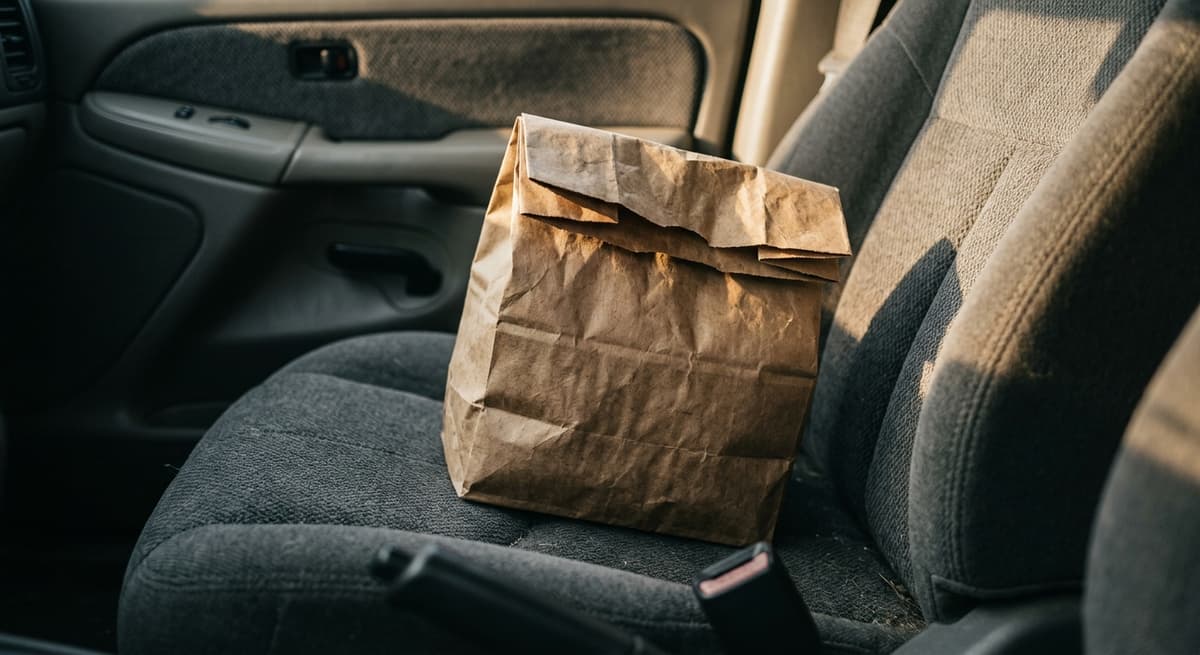
Subsection (a) targets the driver only, and it applies while the vehicle is on a highway or the right-of-way of a highway. It requires two things to be true at once: there must be an unsealed alcoholic beverage container in the vehicle's passenger area, and the driver must be consuming alcohol or have alcohol remaining in the driver's body. Neither element alone is enough. A driver who has been drinking but has no open container in the car isn't guilty under this subsection, and a driver who has an open container in the car but hasn't consumed alcohol and has none remaining in the body isn't guilty under it either. Both elements have to be present together.
Tier Two: The Any-Occupant Possession Infraction, Subsection (a1)
Subsection (a1) is a separate, broader rule, and it too applies only while the vehicle is on a highway or the right-of-way of a highway. It makes it an infraction for any occupant, driver or passenger, to possess or consume an open container of alcohol in the passenger area. This offense doesn't depend on what the driver did. A passenger who has an open beer, or is drinking one, can be cited under (a1) even if the driver hasn't had a drop and even if the driver's own conduct never triggers subsection (a). When it is the driver who violates (a1), that violation is treated as a lesser-included offense of subsection (a).
The practical effect: a sober driver can still have a passenger cited for an open container, and a driver who has been drinking without an open container present isn't reachable under this statute at all. Both tiers are limited to a highway or its right-of-way, as G.S. 20-4.01(13) defines "highway" (a definition that can include a privately owned way when it is open to public vehicular travel as a matter of right). Because Section 20-138.7 omits the broader "public vehicular area" term that G.S. 20-138.1 uses, an ordinary private lot or driveway not open to public travel generally sits outside either tier.
What Counts as the "Passenger Area"
North Carolina defines the passenger area to include the area designed to seat the driver and passengers, plus any area within the reach of a seated driver or passenger, including the glove compartment. It excludes the trunk. In a station wagon, hatchback, or similar vehicle without a separate trunk compartment, it also excludes the area behind the last upright seat.
Exemptions
The exemptions in Section 20-138.7 apply only to the (a1) any-occupant infraction, not to the driver's (a) offense:

- A passenger, but not the driver, riding in a vehicle designed, maintained, or used primarily for the transportation of persons for compensation, such as a bus, limousine, or taxi.
- The living quarters of a motor home or house car, as defined by G.S. 20-4.01(27)k. This does not exempt the rest of the vehicle, including the cab.
- A house trailer.
Because these exemptions are written into (a1) specifically, they don't excuse a driver who meets both elements of subsection (a).
Penalties
The two tiers carry different consequences. A first violation of the driver's offense under subsection (a) is a Class 3 misdemeanor; a subsequent violation is a Class 2 misdemeanor. A conviction under (a) is also treated as an alcohol-related offense subject to North Carolina's implied-consent provisions, is considered a moving violation, and can lead to license revocation, for which a limited driving privilege may be available under G.S. 20-179.3. The any-occupant possession offense under subsection (a1) is an infraction only, not a criminal conviction, and is not considered a moving violation.
Federal Compliance
Federal law, 23 U.S.C. Section 154, conditions a share of a state's highway funding on an open container law that bans both possession and consumption, covers the whole passenger area, reaches every occupant, and is primarily enforced (23 CFR 1270.4). A state that falls short has 2.5 percent of certain federal highway apportionments reserved each October 1 and redirected to highway safety programs. North Carolina's two-tier statute, taken together, reaches both the driver-consumption scenario and any-occupant possession, and North Carolina is not on FHWA's current FY2026 list of non-conforming states (Notice N4510.905, dated October 1, 2025).
Disclaimer: This article provides general information about open container law in North Carolina as of September 2026. It is not legal advice and does not create an attorney-client relationship. Verify the current statutory language before relying on a specific claim, and consult a lawyer licensed in North Carolina for advice about a specific situation.
Related reading: open container laws by state, North Carolina DUI laws, and North Carolina window tint laws.
Statutes cited reflect their in-force version as of 2026-09-16. Last updated: 2026-09-16.
Frequently Asked Questions
Can a passenger be cited for an open container in North Carolina even if the driver hasn't been drinking?
Yes, while the vehicle is on a highway or its right-of-way. Subsection (a1) makes it an infraction for any occupant, including a passenger, to possess or consume an open container in the passenger area, regardless of the driver's own conduct.
What's the difference between the two open container offenses in North Carolina's Section 20-138.7?
Both apply only on a highway or the right-of-way of a highway. Subsection (a) is a driver-only misdemeanor requiring both an unsealed container in the passenger area and that the driver is consuming alcohol or has alcohol remaining in the driver's body. Subsection (a1) is a separate any-occupant infraction for simply possessing or drinking in the passenger area, independent of the driver's conduct.
Is an open container in the glove compartment or trunk illegal in North Carolina?
The glove compartment counts as part of the passenger area, so an open container there is not exempt. The trunk is excluded, as is the area behind the last upright seat in a vehicle without a trunk.
Are bus or limousine passengers exempt from North Carolina's open container law?
A passenger, but not the driver, riding in a vehicle designed, maintained, or used primarily to transport people for compensation, such as a bus, limousine, or taxi, is exempt from the any-occupant infraction under subsection (a1).
Updates
Clarified that the two-tier rules described on this page are the structure of G.S. 20-138.7 specifically, not the whole of North Carolina's alcohol-in-vehicle law.
Independently fact-checked against the cited primary sources
The Law Behind This Article
This article rests on the statutory provisions below, held in our own legal record and retrieved from the official source. Tap a section to read the operative text.
North Carolina General Statutes, Chapter 20: Motor Vehicles.
§ 20-138.7Transporting an open container of alcoholic beverageIn force
(a) Offense. - No person shall drive a motor vehicle on a highway or the right-of-way of a highway while both of the following conditions are met: (1) There is an alcoholic beverage in the passenger area in other than the unopened manufacturer's original container. (2) The driver is consuming alcohol or while alcohol remains in the driver's body. (a1) Offense. - No person shall possess an alcoholic beverage other than in the unopened manufacturer's original container, or consume an alcoholic beverage, in the passenger area of a motor vehicle while the motor vehicle is on a highway or the right-of-way of a highway. For purposes of this subsection, only the person who possesses or consumes an alcoholic beverage in violation of this subsection shall be charged with this offense. (a2) Exception.
Official text (excerpt) · last checked 2026-07-29 · Read the full text in our law library · Verify at ncleg.gov
§ 20-4.01DefinitionsIn forcecited in 3 of our articles
Unless the context requires otherwise, the following definitions apply throughout this Chapter to the defined words and phrases and their cognates: (1) Airbag. - A motor vehicle inflatable occupant restraint system device that is part of a supplemental restraint system. (1a) Alcohol. - Any substance containing any form of alcohol, including ethanol, methanol, propanol, and isopropanol. (1b) Alcohol Concentration. - The concentration of alcohol in a person, expressed either as: a. Grams of alcohol per 100 milliliters of blood; or b. Grams of alcohol per 210 liters of breath. The results of a defendant's alcohol concentration determined by a chemical analysis of the defendant's breath or blood shall be reported to the hundredths. Any result between hundredths shall be reported to the next lower hundredth. (1c) All-Terrain Vehicle or ATV. - A motorized vehicle 50 inches or less in width that is designed to travel on three or more low-pressure tires and manufactured for off-highway use. The terms "all-terrain vehicle" or "ATV" do not include a golf cart or a utility vehicle, as defined in this section, or a riding lawn mower. (1d) Business District.
Official text (excerpt) · last checked 2026-07-29 · Read the full text in our law library · Verify at ncleg.gov
Cited in 175 court opinions in our collectionLatest citing opinion in our collection: 2026
Opinions citing this section in our collection:
- State v. Coker (Supreme Court of North Carolina 1984, 312 N.C. 432)“…r mental faculties or any combination of these substances.” N.C. Gen. Stat. 20-4.01(14a) (1983). We are satisfied th…”
- Smith v. Nationwide Mutual Insurance (Supreme Court of North Carolina 1991, 328 N.C. 139)“…ility Act of 1953, as amended effective 1 October 1985. N.C.G.S. § 20-4.01(26) defines “owner” as: A person hol…”
- Nationwide Mutual Insurance v. Mabe (Supreme Court of North Carolina 1996, 342 N.C. 482)“…e. N.C.G.S. § 58-40-10(1) (1987) (amended 1989). N.C.G.S. § 20-4.01(23) defined a “motor vehicle” as follow…”
Identified automatically from the court opinions citing this section — not a ranking of which case controls.
Also relied on in: North Carolina E-Scooter Laws: Sidewalk, Helmet & Age Rules (2026), North Carolina Lemon Law (2026): How to Qualify & Get a Refund
§ 20-179.3Limited driving privilegeIn force
(a) Definition of Limited Driving Privilege. - A limited driving privilege is a judgment issued in the discretion of a court for good cause shown authorizing a person with a revoked driver's license to drive for essential purposes related to any of the following: (1) The person's employment. (2) The maintenance of the person's household. (3) The person's education. (4) The person's court-ordered treatment or assessment. (5) Community service ordered as a condition of the person's probation. (6) Emergency medical care. (7) Religious worship. (b) Eligibility. - (1) Except as otherwise provided in subdivision (3) of this subsection, a person convicted of the offense of impaired driving under G.S. 20-138.1 is eligible for a limited driving privilege if all of the following requirements are met: a. At the time of the offense the person held either a valid driver's license or a license that had been expired for less than one year. b. At the time of the offense the person had not within the preceding seven years been convicted of an offense involving impaired driving. c. Punishment Level Three, Four, or Five was imposed for the offense of impaired driving. d.
Official text (excerpt) · last checked 2026-07-29 · Read the full text in our law library · Verify at ncleg.gov
Cited in 6 court opinions in our collectionLatest citing opinion in our collection: 2005
Opinions citing this section in our collection:
- State v. Bowes (Court of Appeals of North Carolina 2003, 159 N.C. App. 18)“…The pertinent conclusions of law are as follows: 5. That G.S. 20-179.3(k) authorizing the Division of Motor Ve…”
- State v. Badgett (Court of Appeals of North Carolina 1986, 82 N.C. App. 270)“…ing his limited driving privilege. Although it is true that N.C. Gen. Stat. Sec. 20-179.3 (1983 & 1985 Cum. Supp.) authorizes a c…”
- State v. Benbow (Court of Appeals of North Carolina 2005, 169 N.C. App. 613)“…effective from 13 November 2002 to 13 November 2003. Under N.C. Gen.Stat. § 20-179.3 (2001), a person convicted of driving w…”
Identified automatically from the court opinions citing this section — not a ranking of which case controls.
§ 20-138.1Impaired drivingIn forcecited in 3 of our articles
(a) Offense. - A person commits the offense of impaired driving if he drives any vehicle upon any highway, any street, or any public vehicular area within this State: (1) While under the influence of an impairing substance; or (2) After having consumed sufficient alcohol that he has, at any relevant time after the driving, an alcohol concentration of 0.08 or more. The results of a chemical analysis shall be deemed sufficient evidence to prove a person's alcohol concentration; or (3) With any amount of a Schedule I controlled substance, as listed in G.S. 90-89, or its metabolites in his blood or urine. (a1) A person who has submitted to a chemical analysis of a blood sample, pursuant to G.S. 20-139.1(d), may use the result in rebuttal as evidence that the person did not have, at a relevant time after driving, an alcohol concentration of 0.08 or more. (b) Defense Precluded. - The fact that a person charged with violating this section is or has been legally entitled to use alcohol or a drug is not a defense to a charge under this section. (b1) Defense Allowed.
Official text (excerpt) · last checked 2026-07-29 · Read the full text in our law library · Verify at ncleg.gov
Cited in 316 court opinions in our collectionLatest citing opinion in our collection: 2026
Opinions citing this section in our collection:
- State v. Coker (Supreme Court of North Carolina 1984, 312 N.C. 432)“…n that the citation meets the statutory requirements of N.C.G.S. 20-138.1(c). However, defendant contends that th…”
- State v. Mumford (Supreme Court of North Carolina 2010, 364 N.C. 394)“…n must be “engaged in the offense of impaired driving under G.S. 20-138.1 or G.S. 20-138.2.” N.C.G.S. § 20-141.4(…”
- State Ex Rel. Edmisten v. Tucker (Supreme Court of North Carolina 1984, 312 N.C. 326)“…lina, C-C-83-0809-P) (W.D.N.C.). 4. N.C.G.S. § 20-138.1(a). Impaired driving. Proof of of…”
Identified automatically from the court opinions citing this section — not a ranking of which case controls.
Also relied on in: North Carolina DWI Laws: Penalties, BAC & License (2026), Truck Accident Laws in North Carolina (2026): Deadlines & Liability
United States Code Title 23
§ 154Open container requirementsIn forcecited in 46 of our articles
In this section, the following definitions apply: The term “alcoholic beverage” has the meaning given the term in section 158(c). The term “motor vehicle” means a vehicle driven or drawn by mechanical power and manufactured primarily for use on public highways, but does not include a vehicle operated exclusively on a rail or rails. The term “open alcoholic beverage container” means any bottle, can, or other receptacle— that contains any amount of alcoholic beverage; and that is open or has a broken seal; or the contents of which are partially removed. The term “passenger area” shall have the meaning given the term by the Secretary by regulation. For the purposes of this section, each State shall have in effect a law that prohibits the possession of any open alcoholic beverage container, or the consumption of any alcoholic beverage, in the passenger area of any motor vehicle (including possession or consumption by the driver of the vehicle) located on a public highway, or the right-of-way of a public highway, in the State.
Official text (excerpt) · last checked 2026-09-23 · Read the full text in our law library · Verify at uscode.house.gov
Cited in 20 court opinions in our collectionLatest citing opinion in our collection: 2004
Opinions citing this section in our collection:
- Foremost Insurance v. Richardson (Supreme Court of the United States 1982, 457 U.S. 668)“…er traffic, just as it has done for some land traffic. See 23 U. S. C. § 154 (55 m.p.h. speed limit). Yet no one su…”
- United States v. Kevin Bishop, United States of America v. Edward Stokes (Court of Appeals for the Third Circuit 1995, 66 F.3d 569)“…nder the Spending Clause, not the Commerce Clause. See 23 U.S.C. § 154 (Supp.1995) (conditioning receipt of f…”
- Mrs. Lizzie Beatrice Easterwood v. Csx Transportation, Inc. (Court of Appeals for the Eleventh Circuit 1991, 933 F.2d 1548)“…ce with the national highway speed limit. See 23 U.S.C.A. § 154 (1990). Easterwood argues that an auto…”
Identified automatically from the court opinions citing this section — not a ranking of which case controls.
Also relied on in: Open Container Laws by State (2026): Passengers, Exemptions, Penalties, Maine Open Container Law (2026): Statute and Exemptions, Alabama Open Container Law (2026): The $25 Fine and No-Points Rule
Code of Federal Regulations Title 23
§ 1270.4Compliance criteria.In forcecited in 20 of our articles
(a) To avoid the reservation of funds specified in § 1270.6, a State must enact and enforce an open container law that prohibits the possession of any open alcoholic beverage container, and the consumption of any alcoholic beverage, in the passenger area of any motor vehicle (including possession or consumption by the driver of the vehicle) located on a public highway, or the right-of-way of a public highway, in the State. (b) The law must apply to: (1) The possession of any open alcoholic beverage container and the consumption of any alcoholic beverage; (2) The passenger area of any motor vehicle; (3) All alcoholic beverages; (4) All occupants of a motor vehicle; and (5) All motor vehicles located on a public highway or the right-of-way of a public highway. (c) The law must provide for primary enforcement. (d) Exceptions.
Official text (excerpt) · last checked 2026-07-28 · Read the full text in our law library · Verify at ecfr.gov
Also relied on in: Alaska Open Container Law (2026): A Driver-Only Driving Offense, Arizona Open Container Law (2026): Possession and Drinking Both Banned, Arkansas Open Container Law (2026): Rules, Exemptions, and Penalty
Search our full record of US law — 2.1 million sections, every state + federal →
Sources and References
- N.C.G.S. Section 20-138.7 - Transporting an open container of alcoholic beverage(ncleg.gov).gov
- 23 U.S.C. Section 154 - Open container requirements(law.cornell.edu)
- FHWA Notice N4510.905 - FY2026 Apportionment of Federal-Aid Highway Program Funds (open container non-conforming states list)(highways.dot.gov).gov