China AI Copyright Laws: Protection and Authorship
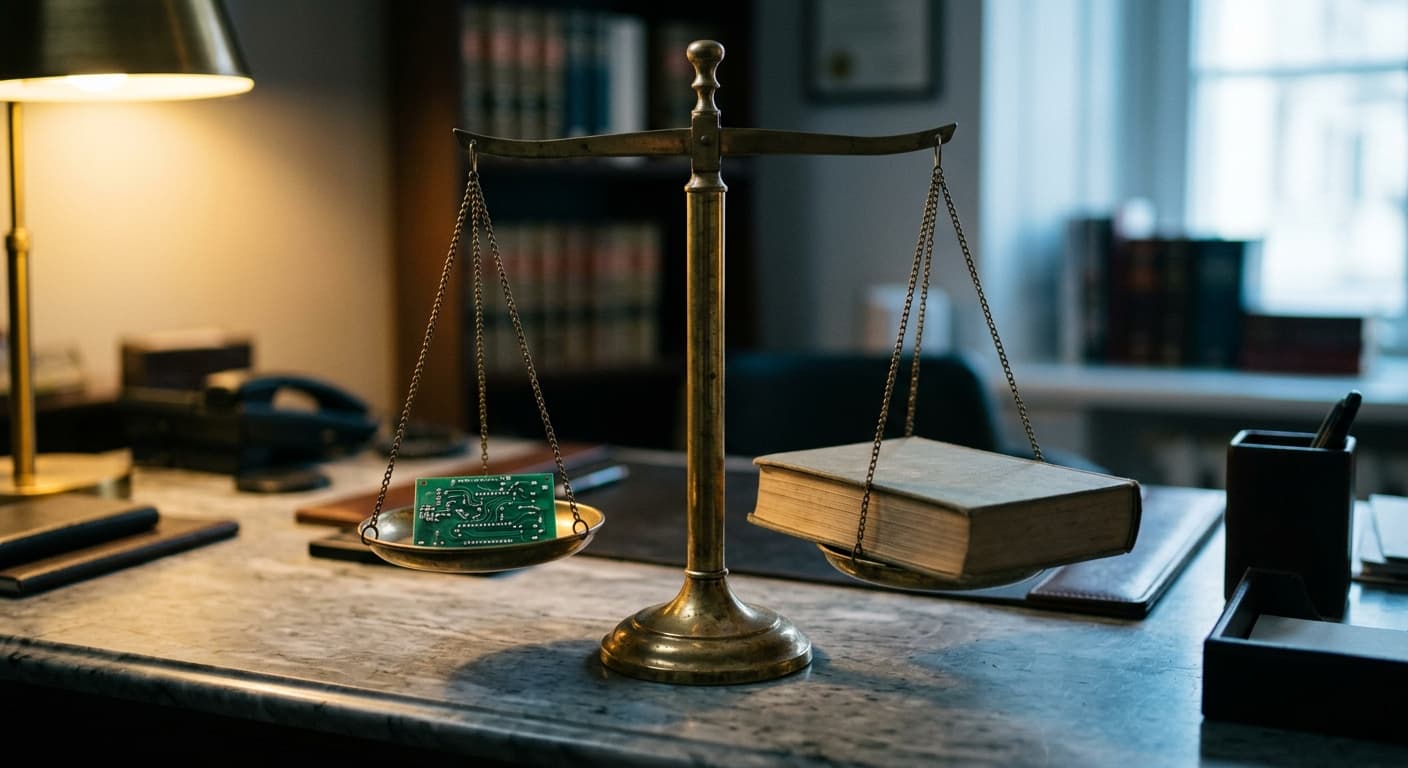
China is among the few jurisdictions where courts have affirmatively granted copyright protection to AI-assisted creative output. A 2023 Beijing Internet Court ruling extended protection to an AI-generated image, marking a notably output-friendly stance compared to most Western systems.
Information last verified on 2026-06-25. This article presents general legal information, not legal advice. Chinese AI-copyright case law is recent and still developing.
Scope: This article covers China's approach to copyright protection for AI-assisted output, AI training data obligations, and software protection under Chinese law. For a comparative global overview, see how AI and copyright differ worldwide.
Whether AI-assisted output can be copyrighted in China
China's case law draws a line between AI-assisted output, which may be protectable, and purely AI-generated output, which is not. The Beijing Internet Court held in Li v. Liu (decided 27 November 2023) that an image created with Stable Diffusion qualified for copyright protection because the human user invested intellectual effort by designing more than 150 prompts, adjusting parameter settings, and refining outputs through multiple iterations. The court treated that selection and arrangement as the user's personalized expression and vested authorship in the human, not the AI tool. Li v. Liu is a first-instance decision and is not binding on courts nationwide.
Earlier, the Shenzhen Nanshan District People's Court reached a comparable conclusion in the Tencent Dreamwriter case (2019). The court held that an AI-assisted financial news article was protectable and identified the human team's development and operation of the Dreamwriter writing tool as the creative act underlying the work.
The Beijing Internet Court drew the limit in Feilin v. Baidu (2019), holding that purely software-generated output does not constitute a "work" under Chinese copyright law because the statute requires a natural person's creation. Notably, the same decision protected the human-authored portions of the document at issue, illustrating the governing principle: demonstrable human intellectual contribution is the threshold.
Statutory framework: PRC Copyright Law 2020
China's copyright framework rests on the PRC Copyright Law, amended for the third time in 2020 and in force from 1 June 2021. Article 3 of the amended law defines protectable "works" as original intellectual achievements that can be expressed in a certain form. Critically, Article 3 includes an open-ended category for "other works that meet the definition of a work," in addition to the enumerated types such as written works, artistic works, and audiovisual works. This open category gives Chinese courts flexibility to classify AI-assisted output as a qualifying work when the human contribution is sufficient.
The statute still anchors protection in intellectual creation, which explains why courts in both Feilin v. Baidu and Li v. Liu focused on the extent and nature of the human user's creative choices rather than on what the AI produced autonomously. The 2020 amendments did not address AI-generated content explicitly, leaving development to courts and administrative guidance.
| Instrument | Year in Force | Key AI Relevance |
|---|---|---|
| PRC Copyright Law (third amendment) | 1 June 2021 | Art. 3 open-ended "works" definition |
| Regulations on the Protection of Computer Software | 2002 (last amended) | AI software protected as software |
| Interim Measures for Generative AI Services | 15 August 2023 | Training data IP obligations |
AI training data and the 2023 Interim Measures
China has not enacted a broad statutory text-and-data-mining exception comparable to Japan's copyright law. The Interim Measures for the Management of Generative AI Services, effective 15 August 2023, address training data obligations from a regulatory rather than a copyright-exemption perspective. The Interim Measures require generative-AI service providers to use training data sourced from legitimate channels that do not infringe third-party intellectual property rights.
This framing means that scraping and using copyrighted text, images, or other works for AI training without a license or other legal basis could expose providers to infringement liability under existing copyright law. The Interim Measures do not create a new safe harbor for training; they reinforce the obligation to respect existing IP rights. The Interim Measures focus on providers offering generative AI services within China and do not function as a comprehensive copyright statute.
For companies developing or deploying AI systems in or from China, training data acquisition strategies should be reviewed against general PRC copyright principles as well as the Interim Measures' compliance requirements. This is particularly important because China has no statutory carve-out to insulate training pipelines from infringement claims the way Japan's 2018 copyright reforms attempted to do.
Software protection for AI systems
AI software itself is protectable in China. The Regulations on the Protection of Computer Software extend protection to software source code and object code as a form of literary work within the PRC copyright framework. Protection does not extend to the ideas, processes, operational methods, or mathematical concepts underlying the software, consistent with the idea-expression dichotomy applied in most major jurisdictions.
A company can protect the specific code implementing an AI model but cannot use copyright to prevent competitors from independently developing software that performs similar functions using different code. Training data sets compiled with sufficient originality may qualify separately as compilation works under the open-ended category of Article 3 of the PRC Copyright Law, provided the selection and arrangement of the data reflects the required intellectual creativity.
How China differs from the United States
The most significant practical divergence between China and the United States is in how each system treats AI-assisted output where the human's principal contribution is prompt engineering and iterative refinement. US copyright authorities, following the analysis in Thaler v. Perlmutter and Copyright Office guidance, have consistently denied registration to AI-generated images where the AI operates without sufficient human creative control over the final expression. The Copyright Office's position is that copyright requires human authorship and that using an AI as a generative tool does not, by itself, supply the required human creative expression.
Chinese courts have reached a more output-friendly conclusion. Li v. Liu (2023) recognized copyright in a Stable Diffusion image on the basis of the user's iterative prompt-engineering process. Both systems require human intellectual contribution, but the Beijing Internet Court credited prompt design and parameter selection as satisfying that requirement, a type of contribution that US authorities have not consistently recognized as sufficient.
| Aspect | China | United States |
|---|---|---|
| AI-assisted image (substantial prompting) | Potentially protectable (Li v. Liu, 2023, first-instance) | Generally not registered without additional human authorship |
| Purely AI-generated output | Not protectable (Feilin v. Baidu, 2019) | Not protectable (Thaler v. Perlmutter) |
| Training data exception | None; providers must respect IP (Interim Measures 2023) | Fair use defense possible; no statutory exception |
| Primary statutory basis | PRC Copyright Law 2020, Art. 3 | 17 U.S.C. § 102; human authorship required |
Note that Li v. Liu is a first-instance decision and does not bind other Chinese courts. The law in both countries remains in active development.
Disclaimer: This article presents general legal information about Chinese AI copyright law as of 2026-06-25. It is not legal advice. Laws and judicial interpretations in China change frequently, and first-instance decisions are not binding nationwide. Translations of Chinese legal texts may differ from official versions. Consult a lawyer qualified to practice in China for advice on your specific situation.
Related articles
- How AI and copyright differ worldwide
- AI copyright law in the United States
- Japan AI copyright laws
- European Union AI copyright laws
Last updated: 2026-06-25.
Frequently Asked Questions
Can I own copyright in an image I created using an AI image generator in China?
Possibly, if you can show meaningful intellectual contribution to the output. The Beijing Internet Court held in Li v. Liu (2023) that an image generated with Stable Diffusion was protectable because the user designed more than 150 prompts, adjusted parameters, and iteratively refined the output, reflecting personalized expression. That human effort satisfied the court's originality requirement. Li v. Liu is a first-instance decision and does not bind other Chinese courts, so outcomes may vary.
What happens if an AI generates content with no human creative involvement?
Purely software-generated output is not protectable under Chinese copyright law. The Beijing Internet Court held in Feilin v. Baidu (2019) that a natural person's creation is required for copyright to attach. Output generated entirely by software, without a demonstrable human intellectual contribution shaping the expression, does not qualify as a 'work' under the PRC Copyright Law.
Does China have a text-and-data-mining exception for AI training?
No. China has not enacted a broad statutory text-and-data-mining exception. The Interim Measures for Generative AI Services (effective 15 August 2023) instead require generative-AI providers to use training data from legitimate sources that do not infringe third-party intellectual property rights. Developers relying on scraped or unlicensed content for training data face potential infringement liability under the PRC Copyright Law.
How is AI software itself protected in China?
AI software is protectable under the Regulations on the Protection of Computer Software, which cover source code and object code as a form of literary work. Protection does not extend to underlying ideas, processes, operational methods, or mathematical concepts. Training data sets compiled with sufficient originality may separately qualify as compilation works under the open-ended category in Article 3 of the PRC Copyright Law.
Are Chinese court decisions on AI copyright binding nationwide?
First-instance decisions, including Li v. Liu (2023) and Feilin v. Baidu (2019), are not binding on other Chinese courts. China does not follow a common-law precedent system. These decisions reflect how particular courts applied the PRC Copyright Law to AI output, but other courts may reach different conclusions on similar facts. Higher-court decisions and future legislative clarification could shift the landscape.
How does China's approach compare to the European Union's on AI copyright?
The EU's approach under the Digital Single Market Directive includes statutory text-and-data-mining exceptions: a broad exception for research purposes and a commercial exception with an opt-out right for rights holders. China, by contrast, has no statutory TDM exception and relies on the Interim Measures to impose positive IP-compliance obligations on AI providers. On output protection, neither system has reached the same degree of legislative clarity, though Chinese courts have shown willingness to protect AI-assisted works where human creative input is substantial.
Updates
Governing law re-checked for recent changes
The Law Behind This Article
This article rests on the statutory provisions below, held in our own legal record and retrieved from the official source. Tap a section to read the operative text.
United States Code Title 17
§ 102Subject matter of copyright: In generalIn forcecited in 2 of our articles
Copyright protection subsists, in accordance with this title, in original works of authorship fixed in any tangible medium of expression, now known or later developed, from which they can be perceived, reproduced, or otherwise communicated, either directly or with the aid of a machine or device. Works of authorship include the following categories: literary works; musical works, including any accompanying words; dramatic works, including any accompanying music; pantomimes and choreographic works; pictorial, graphic, and sculptural works; motion pictures and other audiovisual works; sound recordings; and architectural works. In no case does copyright protection for an original work of authorship extend to any idea, procedure, process, system, method of operation, concept, principle, or discovery, regardless of the form in which it is described, explained, illustrated, or embodied in such work.
Official text (excerpt) · last checked 2026-07-28 · Read the full text in our law library · Verify at uscode.house.gov
Cited in 1,750 court opinions in our collectionLatest citing opinion in our collection: 2026
Opinions citing this section in our collection:
- Harper & Row, Publishers, Inc. v. Nation Enterprises (Supreme Court of the United States 1985, 471 U.S. 539)“…explained, illustrated, or embodied in such *581 work.” 17 U. S. C. § 102 (b). The doctrines of fair use, see 17…”
- Sony Corp. of America v. Universal City Studios, Inc. (Supreme Court of the United States 1984, 464 U.S. 417)“…including “motion pictures and other audiovisual works.” 17 U. S. C. § 102 (a) (1982 ed.). 5 Section 106 of the…”
- Cindy Garcia v. Google, Inc. (Court of Appeals for the Ninth Circuit 2015, 786 F.3d 733)“…copyright principles: An “original work[] of authorship,” 17 U.S.C. § 102 (a), requires only copyrightable subjec…”
Identified automatically from the court opinions citing this section — not a ranking of which case controls.
Also relied on in: Is AI-Generated Code Copyright Infringement? (2026)
Search our full record of US law — 2.1 million sections, every state + federal →
Sources and References
- Beijing Internet Court, Li v. Liu (2023) (AI-generated image held copyrightable)(chinaiplawupdate.com)
- Shenzhen Nanshan District Court, Tencent Dreamwriter case (2019)(chinajusticeobserver.com)
- Beijing Internet Court, Feilin v. Baidu (2019)(english.bjinternetcourt.gov.cn).gov
- Regulations on the Protection of Computer Software (China, WIPO Lex)(wipo.int)
- Interim Measures for the Management of Generative AI Services (China, 2023)(chinalawtranslate.com)