
Vermont
Vermont Fireworks Laws (2026): Permits, Sparklers, and Penalties
Independently fact-checked against primary sources (last audited September 24, 2026). · 8 primary sources cited on this page. How we verify our legal content
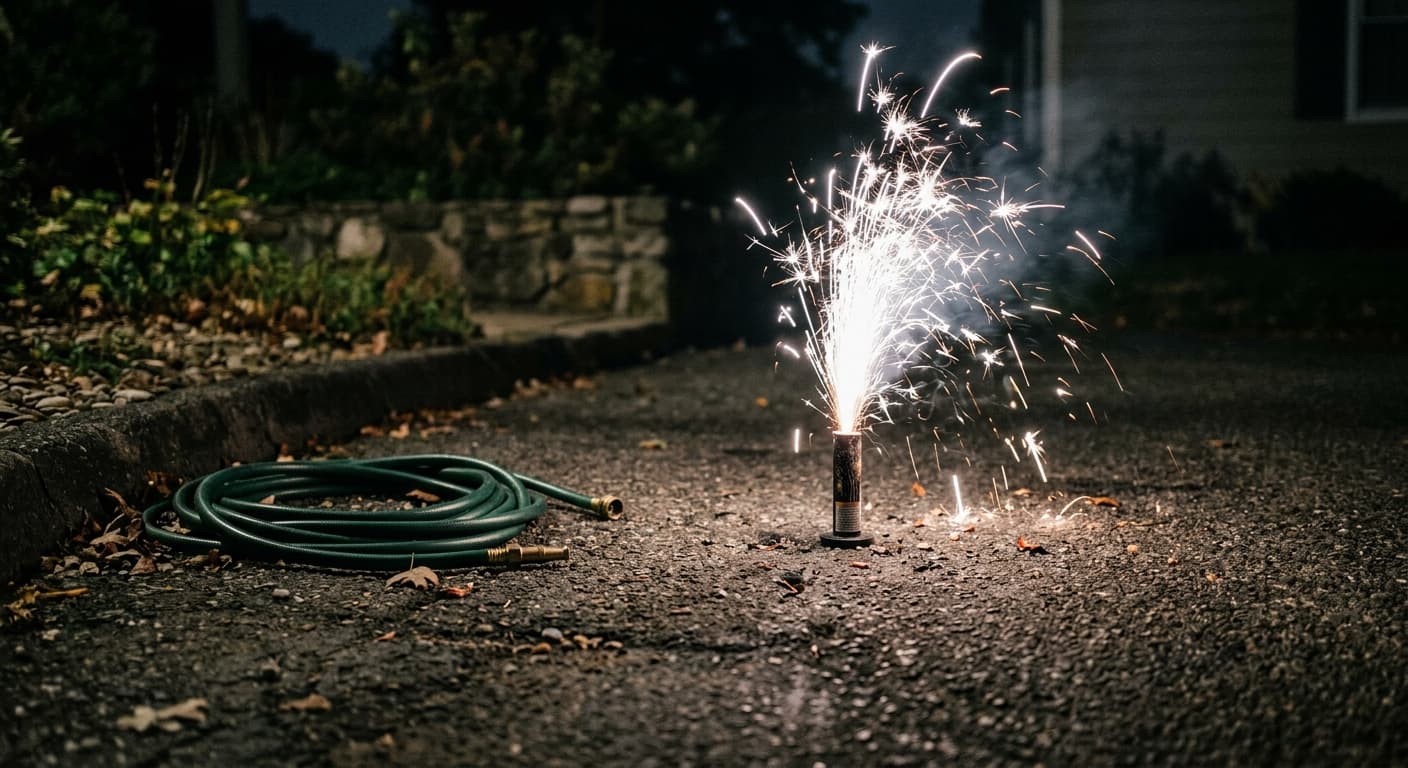
Vermont bars the sale, possession, use, or explosion of "fireworks" without a permit, and its statutory definition of fireworks is broad enough to cover nearly everything people commonly buy for personal use. The only devices excluded from that definition are compliant hand-held sparklers, a handful of low-charge novelty items, and certain toy paper caps, all defined in 20 V.S.A. § 3131. Everything else requires both a federal ATF permit and a municipal permit to sell or possess, and a separate municipal display permit to use.
Jurisdiction scope: This article addresses Vermont's statewide fireworks law under 20 V.S.A. Chapter 177 (§§ 3131-3136), covering the sparkler exception, the dual permit structure for everything else, the permitted-use exemptions, seizure, and the two-tier misdemeanor penalty. It does not address the individual permit fees each Vermont fire department or selectboard sets, or the older individual municipal-charter fireworks clauses in Title 24 Appendix beyond noting one example.
What's Legal Without a Permit: Sparklers and a Few Novelty Items
Vermont's statute defines "fireworks" broadly, then carves a short list of items back out of that definition:

"The term 'fireworks' means any combustible or explosive composition, or any substance or combination of substances, or article prepared for the purpose of producing a visible or an audible effect by combustion, explosion, deflagration, or detonation, including blank cartridges, toy pistols, toy cannons, toy canes, or toy guns in which explosives are used, balloons that are propelled by explosives, firecrackers, torpedoes, sky rockets, Roman candles, cherry bombs, or other fireworks of like construction and any fireworks containing any explosive or flammable compound, or any tablets or other device containing any explosive substance, except sparklers."
20 V.S.A. § 3131
Two categories fall entirely outside that definition and so are unrestricted by Chapter 177's permit scheme. The first is a compliant sparkler:
"The term 'sparkler' means a sparkling item that complies with the U.S. Consumer Product Safety Commission regulations and is one of the following: (1) A hand-held wire or wood sparkler that is less than 14 inches and has no more than 20 grams of pyrotechnic mixture. (2) A snake, party popper, glow worm, smoke device, string popper, snapper, or drop pop with no more than 0.25 grains of explosive mixture."
20 V.S.A. § 3131
The second is a narrow toy paper cap exemption:
"The term 'fireworks' does not include toy pistols, toy canes, toy guns, or other devices in which paper caps containing 0.25 grains or less of explosive compound are used, providing they are so constructed that the hand cannot come in contact with the cap when in place for use, and toy pistol paper caps that contain less than 0.2 grains of explosive mixture."
20 V.S.A. § 3131
The statute also excludes fixed ammunition and primers for firearms from the fireworks definition. Nothing else has a size or weight carve-out; every device that fits the general definition, including firecrackers, torpedoes, sky rockets, Roman candles, and cherry bombs, requires a permit regardless of size.
Permits Required for Everything Else
Chapter 177 prohibits, without the required permits:
"(1) Offer for sale, expose for sale, sell at retail or wholesale, or possess fireworks unless the person has been issued a permit by both the U.S. Bureau of Alcohol, Tobacco, and Firearms and the municipality in which the person offers for sale and stores the fireworks. (2) Use, possess, or explode any fireworks unless the person has been issued a permit to display fireworks pursuant to subsection (c) of this section. (3) Transport fireworks except in interstate commerce."
20 V.S.A. § 3132(a)(1)-(3)
That structure means two different permits govern two different acts: selling or possessing fireworks requires both a federal ATF permit and a municipal permit, while using, possessing for use, or exploding them requires a separate display permit. The State Fire Marshal may adopt rules for granting display permits to municipalities, fair associations, amusement parks, and other groups, under section 3132(b). The display itself must be run by a competent operator approved by the municipality's police and fire chiefs, and, in the fire chief's judgment (or the selectboard's, where there is no fire department), must not be hazardous to property or endanger any person, under section 3132(c). The application process has real procedural weight:
"Application for permits shall be made to the chief of the fire department, or in municipalities with no fire department, the selectboard, in writing, at least 15 days in advance of the date of the display. After the permit has been granted, sales, possessions, use, and distribution of fireworks for the display shall be lawful for that purpose only. No permit granted under this section shall be transferable."
20 V.S.A. § 3132(d)
No Sale Window, Use Window, or Hours Restriction
Vermont's fireworks chapter, sections 3131 through 3136, contains no calendar sale-date window, no calendar use-date window, and no clock-hours restriction on when a permitted display may occur. Timing is instead controlled entirely through the permit application and the fire chief's or selectboard's approval of that specific display.
Sparkler Sales to Minors and Sparkler Compliance
Two additional prohibitions apply specifically to sparklers:
"(4) Offer for sale or sell hand-held sparklers as described in subdivision 3131(1) of this title to a minor. (5) Offer for sale or sell sparklers that are not in compliance with the U.S. Consumer Product Safety Commission regulations."
20 V.S.A. § 3132(a)(4)-(5)
The fireworks chapter itself does not restate a numeric age for "minor." Vermont's general age-of-majority statute supplies that number: "Persons of the age of 18 years shall be considered of age and until they attain that age, shall be minors," under 1 V.S.A. § 173. The sale-to-a-minor bar applies specifically to the hand-held wire or wood sparkler defined in § 3131(1); the statute's text does not extend that same clause to the separate novelty-item category (snakes, party poppers, and similar) defined alongside it.
Exemptions and Permitted Uses
Chapter 177 lists activities the permit requirement does not reach at all:
"Nothing in this subchapter shall be construed to prohibit the use of fireworks by railroads, other transportation agencies, or law enforcement officers for signal purposes or illumination; the sale or use of blank cartridges for a show or theatre, for signal or ceremonial purposes in athletics or sports, or for use by military organizations; the use of explosives for blasting or similar purposes; or the use of fireworks by farmers to control birds in crops."
20 V.S.A. § 3133(a)
The bird-control use gets its own separate permit track: the State Fire Marshal adopts rules for the importation, sale, purchase, and use of fireworks used solely to frighten birds from crops, and a farmer applies to the selectboard or town fire wardens of the town where the fireworks will be used, with permits limited to that use, timing, and location, under section 3133(b).
Local Rules
Both the sale/possession permit and the display permit are issued at the municipal level, so individual towns have real, if informal, control over how easily a permit is granted. Separately, at least one older Vermont municipal charter in Title 24 Appendix predates Chapter 177's current permit scheme and still gives that municipality its own local power over fireworks: the Town of Readsboro's charter lists "sale and use of fireworks" among the activities its ordinances may regulate, restrain, abate, or prohibit, an additional layer that exists alongside the statewide chapter.
Penalties and Seizure
Chapter 177 sets two separate misdemeanor tiers:
"Any person, firm, co-partnership, or corporation that: (1) Violates this subchapter shall be guilty of a misdemeanor and subject to a fine of not more than $100.00 for each violation or imprisoned for not more than 30 days, or both. (2) Presents an indoor firework display without first receiving a permit as required in this subchapter shall be guilty of a misdemeanor and shall be subject to a fine of not more than $5,000.00 or imprisonment of not more than one year, or both."
20 V.S.A. § 3135
The general fine is explicitly assessed "for each violation," which functions as a built-in multiplier for repeated conduct rather than a separate subsequent-offense enhancement. No subsequent-offense provision applies to the indoor-display tier.
Beyond the fine or jail term, Chapter 177 also lets the state or local officer take the fireworks themselves:
"The State Fire Marshal, the Fire Marshal's deputy, a State Police officer, a sheriff, a deputy sheriff, a police officer, or a constable may seize articles held by a person in violation of this subchapter and hold the articles subject to the order of the court taking jurisdiction of the offense."
20 V.S.A. § 3134
So a violation carries a real risk beyond the fine: any of those officers may seize the fireworks outright and hold them pending the court's order in the case.
Federal Law on Transporting Fireworks Across State Lines
Federal law sets the floor: 16 CFR 1500.17 and Part 1507 define which consumer devices may be sold at all; 27 CFR 555.141(a)(7) exempts the importation, distribution and storage of consumer fireworks from ATF licensing (manufacture is not exempt); 18 U.S.C. 836 makes it a federal offense, punishable by up to one year, to transport fireworks into any state whose law specifically prohibits or regulates their use, in violation of that law, except in the course of continuous interstate transportation, with exceptions for common or contract carriers, water carriers, and transport for the use of federal agencies; and USPS Publication 52 § 341.22 bars fireworks from the mail entirely. Vermont's own permit requirement is far narrower than most neighboring states' consumer-fireworks allowances, so bringing in devices bought legally in a state with a broader consumer category risks both Vermont's own permit requirement and this federal transport statute at once.
Fireworks Laws in Nearby States
For neighboring-state comparison, see New Hampshire's fireworks laws, a much broader-allow neighbor, and Massachusetts's fireworks laws, which bans consumer fireworks, including sparklers, outright. For how Vermont compares with every other state, see the fireworks laws by state comparison. For Vermont's separate open-container rules, see Vermont open container laws.
Disclaimer: This article provides general legal information about fireworks laws in Vermont as of September 2026. It is not legal advice. Fireworks statutes, local permit procedures, and penalties change. Verify the current rule with your municipality before buying, possessing, or using anything beyond a compliant sparkler, and consult a lawyer licensed in Vermont for advice about a specific situation.
Statutes cited reflect their in-force version as of 2026-09-17. Last updated: 2026-09-17.
Frequently Asked Questions
Are fireworks legal in Vermont?
Mostly no. Chapter 177 requires both a federal ATF permit and a municipal permit to sell or possess fireworks, and a separate municipal display permit to use them. The only devices excluded from the permit scheme entirely are compliant hand-held sparklers, a short list of low-charge novelty items, and certain toy paper caps, under 20 V.S.A. section 3131.
Can minors buy sparklers in Vermont?
No. Section 3132(a)(4) bars selling or offering a hand-held sparkler to a minor. The fireworks chapter does not restate a numeric age; Vermont's general age-of-majority statute, 1 V.S.A. section 173, sets that age at 18.
How do you get a fireworks display permit in Vermont?
Apply in writing to the local fire chief, or the selectboard where there is no fire department, at least 15 days before the display date. The display must be run by an operator approved by the municipality's police and fire chiefs, and the permit is non-transferable and valid only for that specific display, under section 3132(c)-(d).
Is there a season when fireworks are legal in Vermont?
No. Chapter 177 sets no calendar sale-date window, use-date window, or clock-hours restriction. Access beyond a sparkler turns entirely on permit status, not the date.
What activities are exempt from Vermont's fireworks permit requirement?
Railroad, transportation-agency, and law-enforcement signal or illumination use; theatrical, athletic-ceremonial, and military blank-cartridge use; blasting explosives; and farmer bird-control use under a separate permit issued by the local selectboard or town fire wardens, under section 3133.
What is the penalty for violating Vermont's fireworks law?
A general violation is a misdemeanor with a fine of up to $100 for each violation, up to 30 days in jail, or both. Presenting an indoor display without a permit is a separate misdemeanor with a fine of up to $5,000, up to one year in jail, or both, under section 3135. A State Fire Marshal, State Police officer, sheriff, or local police officer may also seize the fireworks and hold them subject to the court's order, under section 3134.
Updates
Independently fact-checked against the cited primary sources
Independently fact-checked against the cited primary sources
The Law Behind This Article
This article rests on the statutory provisions below, held in our own legal record and retrieved from the official source. Tap a section to read the operative text.
Vermont Statutes Annotated, Title 20: Internal Security and Public Safety, Chapter 177: Explosives and Fireworks, Subchapter: FIREWORKS
§ 3132Prohibitions; permitsIn force
(a) Except as provided in this section, it shall be unlawful for any person, firm, co-partnership, or corporation to do any of the following: (1) Offer for sale, expose for sale, sell at retail or wholesale, or possess fireworks unless the person has been issued a permit by both the U.S. Bureau of Alcohol, Tobacco, and Firearms and the municipality in which the person offers for sale and stores the fireworks. (2) Use, possess, or explode any fireworks unless the person has been issued a permit to display fireworks pursuant to subsection (c) of this section. (3) Transport fireworks except in interstate commerce. (4) Offer for sale or sell hand-held sparklers as described in subdivision 3131(1) of this title to a minor. (5) Offer for sale or sell sparklers that are not in compliance with the U.S. Consumer Product Safety Commission regulations. (b) The State Fire Marshal may adopt reasonable rules for granting permits for supervised public displays of fireworks by municipalities, fair associations, amusement parks, and other organizations or groups of individuals.
Official text (excerpt) · last checked 2026-09-24 · Read the full text in our law library · Verify at legislature.vermont.gov
§ 3131DefinitionsIn force
As used in this subchapter, the term “fireworks” means any combustible or explosive composition, or any substance or combination of substances, or article prepared for the purpose of producing a visible or an audible effect by combustion, explosion, deflagration, or detonation, including blank cartridges, toy pistols, toy cannons, toy canes, or toy guns in which explosives are used, balloons that are propelled by explosives, firecrackers, torpedoes, sky rockets, Roman candles, cherry bombs, or other fireworks of like construction and any fireworks containing any explosive or flammable compound, or any tablets or other device containing any explosive substance, except sparklers. The term “fireworks” does not include toy pistols, toy canes, toy guns, or other devices in which paper caps containing 0.25 grains or less of explosive compound are used, providing they are so constructed that the hand cannot come in contact with the cap when in place for use, and toy pistol paper caps that contain less than 0.2 grains of explosive mixture. The term “fireworks” does not include fixed ammunition for firearms or primers for firearms.
Official text (excerpt) · last checked 2026-08-01 · Read the full text in our law library · Verify at legislature.vermont.gov
Cited in 2 court opinions in our collectionLatest citing opinion in our collection: 2020
Opinions citing this section in our collection:
- State v. Dann (Supreme Court of Vermont 1997, 167 Vt. 119)“…ed for return of the property. The district court held that 20 V.S.A. § 3131, which defines “fireworks,” was unconst…”
- Green Mountain Fireworks, LLC v. Town of Colchester / Matthew Lavigne v. Town of Colchester (Supreme Court of Vermont 2020, 249 A.3d 296)“…ther or both appellants. 2 As defined in 20 V.S.A. § 3131, the term “fireworks” means “any combus…”
Identified automatically from the court opinions citing this section — not a ranking of which case controls.
§ 3135PenaltiesIn force
Any person, firm, co-partnership, or corporation that: (1) Violates this subchapter shall be guilty of a misdemeanor and subject to a fine of not more than $100.00 for each violation or imprisoned for not more than 30 days, or both. (2) Presents an indoor firework display without first receiving a permit as required in this subchapter shall be guilty of a misdemeanor and shall be subject to a fine of not more than $5,000.00 or imprisonment of not more than one year, or both. (Amended 1967, No. 345 (Adj. Sess.), § 30, eff. April 1, 1969; 2003, No. 15, § 3, eff. May 6, 2003.)
Official text (excerpt) · last checked 2026-08-01 · Read the full text in our law library · Verify at legislature.vermont.gov
§ 3133Permitted usesIn force
(a) Nothing in this subchapter shall be construed to prohibit the use of fireworks by railroads, other transportation agencies, or law enforcement officers for signal purposes or illumination; the sale or use of blank cartridges for a show or theatre, for signal or ceremonial purposes in athletics or sports, or for use by military organizations; the use of explosives for blasting or similar purposes; or the use of fireworks by farmers to control birds in crops. (b) The State Fire Marshal shall have the power to adopt reasonable rules for the importation, sale, purchase, and use of fireworks to be used solely for the purpose of frightening birds from crops. Application for permits for importation, purchase, and use by farmers shall be made to the selectboard or town fire wardens of the town in which the farmer intends to use such fireworks for the sole purpose of frightening birds from crops. Permits shall be issued for such use only, at such times and such locations, as to present no fire or safety hazard within the area. (Amended 1959, No. 147; 2021, No. 105 (Adj. Sess.), § 398, eff. July 1, 2022.)
Official text (excerpt) · last checked 2026-08-01 · Read the full text in our law library · Verify at legislature.vermont.gov
§ 3134SeizureIn force
The State Fire Marshal, the Fire Marshal’s deputy, a State Police officer, a sheriff, a deputy sheriff, a police officer, or a constable may seize articles held by a person in violation of this subchapter and hold the articles subject to the order of the court taking jurisdiction of the offense. (Amended 2021, No. 105 (Adj. Sess.), § 399, eff. July 1, 2022.)
Official text (excerpt) · last checked 2026-08-01 · Read the full text in our law library · Verify at legislature.vermont.gov
§ 3136ConstructionIn force
Being in the interest of public safety, the provisions of this subchapter shall be liberally construed.
Official text (excerpt) · last checked 2026-08-01 · Read the full text in our law library · Verify at legislature.vermont.gov
Cited in 1 court opinions in our collectionLatest citing opinion in our collection: 2020
Opinions citing this section in our collection:
- Green Mountain Fireworks, LLC v. Town of Colchester / Matthew Lavigne v. Town of Colchester (Supreme Court of Vermont 2020, 249 A.3d 296)“…danger any person or persons.” 20 V.S.A. § 3132(c). And in 20 V.S.A. § 3136, the Legislature specifically wrote: “…”
Identified automatically from the court opinions citing this section — not a ranking of which case controls.
Vermont Statutes Annotated, Title 1: General Provisions, Chapter 3: Construction of Statutes, Subchapter: RULES OF CONSTRUCTION
§ 173MinorsIn forcecited in 2 of our articles
Persons of the age of 18 years shall be considered of age and until they attain that age, shall be minors. Whenever referred to in the laws of this State, a person who is an adult or who has attained majority shall be a resident or nonresident person of 18 years of age or more. (Amended 1971, No. 90, § 1; 1971, No. 184 (Adj. Sess.), § 1, eff. March 29, 1972.)
Official text (excerpt) · last checked 2026-08-01 · Read the full text in our law library · Verify at legislature.vermont.gov
Cited in 8 court opinions in our collectionLatest citing opinion in our collection: 2026
Opinions citing this section in our collection:
- Beaudry v. Beaudry (Supreme Court of Vermont 1973, 132 Vt. 53)“…The age of majority in Vermont is presently controlled by 1 V.S.A. § 173: Persons of the age of eighteen…”
- Cavallari v. Martin (Supreme Court of Vermont 1999, 169 Vt. 210)“…ity or terminates secondary education whichever is later"); 1 V.S.A. § 173 (fixing age of majority at eighteen). F…”
- Pike v. Chuck's Willoughby Pub, Inc. (Supreme Court of Vermont 2006, 180 Vt. 25)“…t is, when the plaintiff reaches eighteen years of age. See 1 V.S.A. § 173 (designating eighteen as the age of maj…”
Identified automatically from the court opinions citing this section — not a ranking of which case controls.
Also relied on in: Vermont Emancipation Laws: How to Get Emancipated in Vermont (2026)
Code of Federal Regulations Title 16
§ 1500.17Banned hazardous substances.In forcecited in 36 of our articles
(a) Under the authority of section 2(q)(1)(B) of the act, the Commission declares as banned hazardous substances the following articles because they possess such a degree or nature of hazard that adequate cautionary labeling cannot be written and the public health and safety can be served only by keeping such articles out of interstate commerce: (1) Mixtures that are intended primarily for application to interior masonry walls, floors, etc., as a water repellant treatment and that are “extremely flammable” within the meaning of section 2(1) of the act (repeated in § 1500.3(b)(10)). (2) Carbon tetrachloride and mixtures containing it (including carbon tetrachloride and mixtures containing it used in fire extinguishers), excluding unavoidable manufacturing residues of carbon tetrachloride in other chemicals that under reasonably foreseeable conditions of use do not result in an atmospheric concentration of carbon tetrachloride greater than 10 parts per million.
Official text (excerpt) · last checked 2026-09-23 · Read the full text in our law library · Verify at ecfr.gov
Cited in 16 court opinions in our collectionLatest citing opinion in our collection: 2024
Opinions citing this section in our collection:
- United States v. Midwest Fireworks Mfg. Co., Inc. Fireworks of America Ltd. Corp. Pacific Fin. Servs. Of America, Inc. Larry Lomaz David Bowman (Court of Appeals for the Sixth Circuit 2001, 248 F.3d 563)“…venty-nine types of fireworks and the constitutionality of 16 C.F.R. § 1500.17 (a)(3) (2001). We affirm. BACKGR…”
- United States v. Charles Focht, an Individual, and Mark Focht, an Individual, Doing Business Under the Name Liberty Industries (Court of Appeals for the Third Circuit 1989, 882 F.2d 55)“…al, the government asserts the district court misconstrued 16 C.F.R. § 1500.17 (a)(3), (8) when it held the regulation…”
- United States v. Shelton Wholesale, Inc. (District Court, W.D. Missouri 1999, 34 F. Supp. 2d 1147)“…ams) of pyrotechnic composition (the "amount test"). See 16 C.F.R. § 1500.17 (a)(3). 2. for all "[r]eloadable tube…”
Identified automatically from the court opinions citing this section — not a ranking of which case controls.
Also relied on in: Fireworks Laws by State (2026): What Is Legal, Sale Dates, Penalties, Delaware Fireworks Laws (2026): Sparklers, Novelties, Dates, DC Fireworks Laws: Permitted List, Licensing, Penalties
Code of Federal Regulations Title 27
§ 555.141Exemptions.In forcecited in 41 of our articles
(a) General. Except for the provisions of §§ 555.180 and 555.181, this part does not apply to: (1) Any aspect of the transportation of explosive materials via railroad, water, highway, or air which is regulated by the U.S. Department of Transportation and its agencies, and which pertains to safety. For example, regulations issued by the Department of Transportation addressing the security risk of aliens transporting explosives by commercial motor or railroad carrier from Canada preclude the enforcement of 18 U.S.C. 842(i)(5) against persons shipping, transporting, receiving, or possessing explosives incident to and in connection with the commercial transportation of explosives by truck or rail from Canada into the United States. Questions concerning this exception should be directed to ATF's Explosives Industry Program Branch in Washington, DC. (2) The use of explosive materials in medicines and medicinal agents in the forms prescribed by the official United States Pharmacopeia or the National Formulary.
Official text (excerpt) · last checked 2026-07-28 · Read the full text in our law library · Verify at ecfr.gov
Cited in 1 court opinions in our collectionLatest citing opinion in our collection: 2006
Opinions citing this section in our collection:
- Tripoli Rocketry Ass'n v. Bureau of Alcohol, Tobacco, Firearms, & Explosives (Court of Appeals for the D.C. Circuit 2006, 437 F.3d 75)“…imported, or distributed for their intended purposes.” See 27 C.F.R. § 555.141(a)(8) (2005) (current exemption); 26 C.…”
Identified automatically from the court opinions citing this section — not a ranking of which case controls.
Also relied on in: Florida Fireworks Laws (2026): Sparklers vs. Holiday Rules, Georgia Fireworks Laws (2026): Legal Statewide, No Local Ban, Hawaii Fireworks Laws (2026): Permits, Use Windows, and Penalties
United States Code Title 18
§ 836Transportation of fireworks into State prohibiting sale or useIn forcecited in 52 of our articles
Whoever, otherwise than in the course of continuous interstate transportation through any State, transports fireworks into any State, or delivers them for transportation into any State, or attempts so to do, knowing that such fireworks are to be delivered, possessed, stored, transshipped, distributed, sold, or otherwise dealt with in a manner or for a use prohibited by the laws of such State specifically prohibiting or regulating the use of fireworks, shall be fined under this title or imprisoned not more than one year, or both. This section shall not apply to a common or contract carrier or to international or domestic water carriers engaged in interstate commerce or to the transportation of fireworks into a State for the use of Federal agencies in the carrying out or the furtherance of their operations. In the enforcement of this section, the definitions of fireworks contained in the laws of the respective States shall be applied. As used in this section, the term “State” includes the several States, Territories, and possessions of the United States, and the District of Columbia. This section shall be effective from and after July 1, 1954.
Official text (excerpt) · last checked 2026-07-28 · Read the full text in our law library · Verify at uscode.house.gov
Cited in 15 court opinions in our collectionLatest citing opinion in our collection: 2024
Opinions citing this section in our collection:
- United States v. James A. Womack (Court of Appeals for the Fifth Circuit 1981, 654 F.2d 1034)“…eworks has been traditionally left to the states. He cites 18 U.S.C.A. § 836 , which prohibits the transportation of…”
- United States v. Bernard J. Semel (Court of Appeals for the Fourth Circuit 1965, 347 F.2d 228)“…y an information containing eighteen counts with violating 18 U.S.C.A. § 836 by having feloniously caused to be tra…”
- Cohen v. Bredehoeft (District Court, S.D. Texas 1968, 290 F. Supp. 1001)“…the states from legislating in this area. On the contrary, 18 U.S.C. Sec. 836 indicates an intent to encourage state…”
Identified automatically from the court opinions citing this section — not a ranking of which case controls.
Also relied on in: Alabama Fireworks Laws (2026): Legal Fireworks, Age Rules, Penalties, Alaska Fireworks Laws (2026): Age-18 Minimum, No Sale Window, Arizona Fireworks Laws (2026): Legal Devices, Local Rules, Penalties
Search our full record of US law — 2.1 million sections, every state + federal →
Sources and References
- 20 V.S.A. Section 3131 - Definitions (fireworks, sparkler, toy cap exemption)(legislature.vermont.gov).gov
- 20 V.S.A. Section 3132 - Prohibitions; permits(legislature.vermont.gov).gov
- 20 V.S.A. Section 3133 - Permitted uses(legislature.vermont.gov).gov
- 20 V.S.A. Section 3134 - Seizure(legislature.vermont.gov).gov
- 20 V.S.A. Section 3135 - Penalties(legislature.vermont.gov).gov
- 1 V.S.A. Section 173 - Minors (age of majority)(legislature.vermont.gov).gov
- 18 U.S.C. 836 - Transportation of fireworks into a state prohibiting or regulating their use(uscode.house.gov).gov
- 24 V.S.A. Appendix, Chapter 141, Section 32 - Town of Readsboro charter, specific powers (ordinance power over sale and use of fireworks)(legislature.vermont.gov).gov