Delaware
Delaware Fireworks Laws (2026): Sparklers, Novelties, Dates
Independently fact-checked against primary sources (last audited September 18, 2026). · 10 primary sources cited on this page. How we verify our legal content
Delaware bans true fireworks, meaning firecrackers, rockets, torpedoes, Roman candles, and fire balloons, for consumer sale, possession with intent to sell or use, and use. State law carves out sparklers and a defined list of ground-based novelty devices: sale, limited to adults 18 and older, runs during a 30-day window before each of four specific dates, but use is limited to those four dates themselves, under Del. Code Ann. tit. 16, § 6901.
Jurisdiction scope: This article addresses Delaware's state fireworks law, covering the true-fireworks ban, the sparkler and novelty exception, the seasonal sale and use windows, and penalties, under Del. Code Ann. tit. 16, §§ 6901-6906. It does not address federal explosives law beyond the interstate-transport point below, or the content of any specific Delaware municipality's own nuisance ordinance.
What's Legal and What's Banned in Delaware
Delaware law bars anyone from storing, selling, offering or exposing for sale, or possessing with intent to sell or use, discharging, igniting, or firing within the state "any fireworks, firecrackers, rockets, torpedoes, Roman candles, fire balloons, or other fireworks or substances of any combination designed or intended for pyrotechnic display," except under a § 6903 display permit, the § 6906 agricultural exception, or the § 6901(c) exceptions described below. That general ban covers what most people picture as consumer fireworks: aerial shells, firecrackers, rockets, and anything that explodes or launches.
The § 6901(c) exceptions are specific and gram-limited, not a blanket "novelties are fine" rule:
- Wood or wire sparklers producing a shower of sparks, containing not more than 100 grams of pyrotechnic mixture per item.
- Other hand-held or ground-based sparkling devices that are non-explosive and non-aerial (sometimes producing a crackling or whistling effect), capped at 75 grams of pyrotechnic mixture per tube or 500 grams total for multiple tubes.
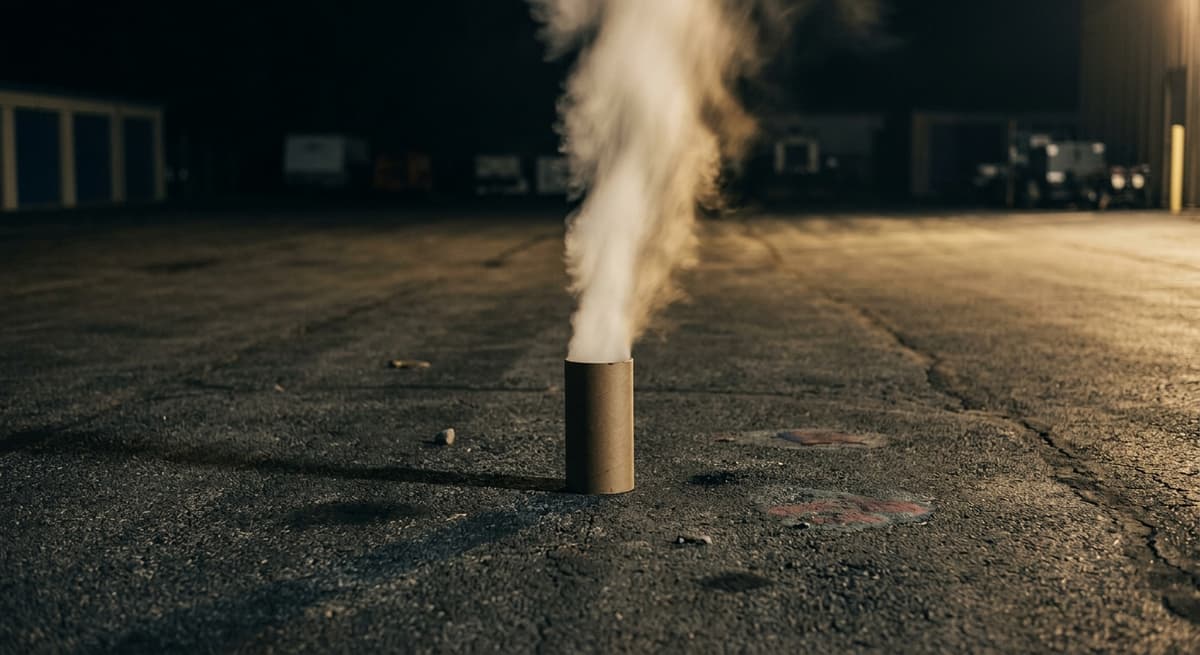
- Snakes, glow worms, and smoke devices containing 20 grams or less of pyrotechnic mixture.
- Trick noisemakers, including party poppers, snappers, and drop pops, each containing 16 milligrams or less of pyrotechnic mixture.
Toy paper caps meeting federal Interstate Commerce Commission packing rules are also excluded from the definition of "fireworks" entirely and are permitted at all times. Everything outside these categories, including firecrackers, rockets, torpedoes, Roman candles, and fire balloons, stays banned for consumers regardless of the date on the calendar.
Chapter 69 also carries a separate ban in § 6902: firing, in or on or into any street, highway, alley, or public place, any appliance exploding a cap (other than a cap excluded under § 6901) or any explosive substance or mixture of chlorates or nitrates, with an exception for peace officers acting in the line of duty and for quarrying, blasting, and other industrial use. A violation of § 6902 carries the same § 6905 fine as a violation of § 6901, so lighting even a legal device in a street or public place can expose someone to that separate ban.
When You Can Buy and Use the Exempted Devices
Delaware ties both the sale and the use of the § 6901(c) exempted devices to four approved dates: July 4, the third day of Diwali, December 31, and January 1. Sale is restricted to persons 18 and older, during the 30-day period immediately before and including each of those dates, so the legal buying window opens roughly a month ahead of a holiday and closes on it. A retailer selling sparklers outside that 30-day pre-holiday window, or a buyer purchasing them in, say, March for July 4 use, falls outside the statute's protection.
Section 6901 sets no restriction on the hour of day for sale or use, only these calendar-date and 30-day-window limits. Storage and retail sale of the exempted items must otherwise be consistent with the standards of NFPA 1124 (2006 edition), which § 6901(d) incorporates by reference.
Age Requirement
The purchase age for sparklers and the other § 6901(c) novelties is 18. Delaware's statute does not create a separate individual purchase permit beyond meeting that age and buying within the seasonal window; a retail sale to an adult during the correct 30-day period is what the law requires.
Public Display Permits
A public fireworks display is a separate track from the consumer exceptions above. Anyone holding one must apply to the Office of the State Fire Marshal for a permit at least 30 days before the display date. The application must state the date, hour, and place of the display and of any pre-display storage, name the permit holder and the person igniting the fireworks, and be accompanied by proof of at least $1,000,000 in liability insurance per event. The Fire Marshal grants the permit if satisfied the display is supervised by a competent, experienced person and will not be a detriment to the community, and separately approves the storage location.
Current Delaware law has no retailer permit or registration system for the businesses that sell sparklers and novelties; the only permitting track in chapter 69 is this display permit. A bill introduced in the 153rd General Assembly, HB 63, would create a retailer registration system with the State Fire Marshal, add legality warnings to fireworks advertising, and raise enforcement fines. As of this writing it has passed both chambers of the Delaware General Assembly but had not been signed into law, so it does not change the rules described on this page.
Local Ordinances
Chapter 69 itself contains no county-, city-, or fire-district-level local-option clause letting a locality opt in or out of the state sparkler-and-novelty exception. The only local fireworks-adjacent power identified is outside Title 16 entirely: under Del. Code Ann. tit. 22, § 102, the commissioners of an unincorporated town with more than 300 inhabitants may pass ordinances, with penalties capped at $100, prohibiting the firing of guns or pistols, bonfires, or "the setting off of fireworks" as part of their general nuisance-control authority. That is a general municipal nuisance power tied to a specific type of town government, not a statewide fireworks local-option framework, and it does not apply to counties or to incorporated cities generally.
Penalties
A violation of Delaware's fireworks chapter is a fine-only offense: not less than $25 nor more than $100, under Del. Code Ann. tit. 16, § 6905(a), with justices of the peace holding jurisdiction over the charge. The chapter sets no jail or imprisonment term and no misdemeanor or felony classification for a violation, and it sets no enhanced fine for a second or later offense; every violation, first or subsequent, falls under the same $25 to $100 range.
Crossing State Lines
Delaware sits between Pennsylvania, Maryland, and New Jersey, each of which handles consumer fireworks differently, which makes cross-border purchases a live question. Federal law adds a layer on top of Delaware's own rule: under 18 U.S.C. § 836, it is a federal offense, punishable by a fine, up to one year in prison, or both, to transport fireworks into a state whose law specifically prohibits or regulates their use, or to deliver them for that transportation, knowing they will be delivered, possessed, stored, sold, or otherwise dealt with in a manner that state's law forbids; the statute excludes fireworks merely passing through a state in continuous interstate transportation, and it does not apply to common or contract carriers, to water carriers engaged in interstate commerce, or to transportation for the use of a federal agency. Separately, the U.S. Postal Service bans all fireworks from the mail entirely, for both international and domestic shipment (USPS Publication 52 § 341.22); federal consumer-product-safety rules set the device and packaging standards fireworks must meet to be sold anywhere in the country (16 C.F.R. § 1500.17 and Part 1507); and a federal explosives-licensing exemption (27 C.F.R. § 555.141(a)(7)) covers only the importation, distribution, and storage of consumer fireworks, not their manufacture. Buying true fireworks legally elsewhere and bringing them into Delaware does not make them legal here, and doing so knowingly can add federal exposure on top of Delaware's own ban.
For the complete state-by-state picture, see the fireworks laws by state comparison. Delaware also maintains a separate open container law worth knowing if fireworks and holiday drinking overlap.
Disclaimer: This article provides general legal information about fireworks laws in the United States as of September 2026. It is not legal advice. Fireworks statutes, local ordinances, sale and use windows, and penalties change frequently and are often further restricted by county or city ordinance beyond what state law requires; verify the current rule for your specific city and county before buying, selling, or using fireworks, and consult a lawyer licensed in your state for advice about a specific situation.
Statutes cited reflect their in-force version as of 2026-09-17. Last updated: 2026-09-17.
Frequently Asked Questions
Is Delaware a full fireworks ban state?
No. Delaware bans true fireworks like firecrackers, rockets, and Roman candles, but it permits the sale of sparklers, ground-based sparkling devices, and a list of novelties to adults 18 and older during a 30-day window before four approved dates, with use limited to those four dates, under Del. Code Ann. tit. 16, § 6901(c).
When can I buy sparklers in Delaware?
During the 30-day period immediately before and including each of four approved dates: July 4, the third day of Diwali, December 31, and January 1. Delaware's statute sets no hour-of-day restriction, only these calendar-date and window limits.
How old do you have to be to buy sparklers in Delaware?
18. Delaware's seasonal sale window under § 6901(d) applies to adults 18 and older buying sparklers, ground-based sparkling devices, or listed novelties.
What is the penalty for a fireworks violation in Delaware?
A fine of not less than $25 nor more than $100 under Del. Code Ann. tit. 16, § 6905(a), heard at the justice-of-the-peace level. The chapter sets no jail term, no misdemeanor or felony classification, and no enhanced fine for a repeat violation.
Can a Delaware town ban fireworks locally?
Chapter 69 itself has no fireworks-specific local-option clause. Separately, Del. Code Ann. tit. 22, § 102 lets an unincorporated town of more than 300 inhabitants pass a general nuisance ordinance, fine capped at $100, that can include prohibiting the setting off of fireworks within town limits.
Can I bring fireworks into Delaware from another state?
Bringing true fireworks into Delaware does not make them legal here. Federal law, 18 U.S.C. § 836, separately makes it a crime to transport fireworks into any state whose law specifically prohibits or regulates their use, not only states with a full ban, knowing they will be delivered, possessed, stored, sold, or otherwise dealt with unlawfully there.
Updates
Clarified that Delaware's age-18 limit applies to buying sparklers and novelties, while use is limited to the four approved dates.
Independently fact-checked against the cited primary sources
The Law Behind This Article
This article rests on the statutory provisions below, held in our own legal record and retrieved from the official source. Tap a section to read the operative text.
Delaware Code, Title 16 (Health and Safety), Chapter 069 (FIREWORKS)
§ 6901Selling or possessing fireworks; exceptions.In force
(a) A person may not store, sell, offer or expose for sale, or have in possession with intent to sell or to use, discharge or cause to be discharged, ignited, fired, or otherwise set in action within this State, any fireworks, firecrackers, rockets, torpedoes, Roman candles, fire balloons, or other fireworks or substances of any combination designed or intended for pyrotechnic display; except after having obtained a permit pursuant to § 6903 of this title, except for agricultural use pursuant to § 6906 of this title, and except pursuant to subsection (c) of this section. This section does not apply to any person established and manufacturing fireworks of any or all kinds in this State on September 5, 1939.
Official text (excerpt) · last checked 2026-09-23 · Read the full text in our law library · Verify at delcode.delaware.gov
§ 6902Discharging rifle or other explosives; exceptions.In force
No person shall fire or discharge in or on or into any street, highway, alley or public place in the State any rifle, gun, pistol, revolver, cane, cannon or other appliance, whether projecting or exploding any bullet, cartridge, blank cartridge, cap (except a cap excluded from the provisions hereof under the definition set forth in § 6901 of this title) or otherwise or any explosive substance or mixture of chlorates or nitrates. This section shall not apply to peace officers in the regular discharge of their duties as such. Nothing in this section shall be construed to prohibit any person from using explosives in quarrying or for blasting or other industrial use.
Official text (excerpt) · last checked 2026-07-29 · Read the full text in our law library · Verify at delcode.delaware.gov
§ 6903Permit for public display of fireworks; actions by injured persons.In force
(a) Any association or company desiring to hold a public display of fireworks may apply to the Office of the State Fire Marshal for a permit to hold such display if application is made 30 days prior to the date of holding the display. (b) The application for a permit shall set forth the date, hour and place of holding such display and place of storing fireworks prior to display, also the name of the person holding the display and name of person in charge of igniting the fireworks. (c) The application shall be accompanied by a certificate of insurance issued by a bona fide insurance company licensed by the State Insurance Commissioner showing a minimum of $1,000,000 liability insurance per event for those persons who suffer injuries as a result of any discharge of the fireworks by the applicant or anyone acting for or on the applicant’s behalf. (d) If the State Fire Marshal is satisfied that the holding of the display is supervised by a competent and experienced person and that the display will not be a detriment to the community or area in which the display is held, the Marshal may grant a permit for the display.
Official text (excerpt) · last checked 2026-07-29 · Read the full text in our law library · Verify at delcode.delaware.gov
§ 6905Penalties; jurisdiction.In force
(a) Whoever violates this chapter shall be fined not less than $25 nor more than $100. (b) Justices of the peace shall have jurisdiction of any violation of this chapter.
Official text (excerpt) · last checked 2026-07-29 · Read the full text in our law library · Verify at delcode.delaware.gov
§ 6906Agricultural use.In force
Nothing in this chapter shall prohibit the importation, sale, purchase or use of fireworks used or to be used solely and exclusively for the purpose of frightening birds from crops and such importation, sale, purchase or use shall be governed by rules and regulations to be prescribed by the Board of Agriculture.
Official text (excerpt) · last checked 2026-07-29 · Read the full text in our law library · Verify at delcode.delaware.gov
Delaware Code, Title 22 (Municipalities), Chapter 001 (GENERAL PROVISIONS)
§ 102Commissioners for unincorporated towns; election and powers.In force
Every unincorporated town having more than 300 inhabitants may annually on the second Saturday in July, by a majority of the voters qualified to vote, or a majority of the voters present at the annual meeting, elect 3 commissioners. For purposes of this section “qualified voters” shall mean the following: Inhabitants qualified to vote for representatives in the General Assembly, property owners and leaseholders of record who shall have attained the legal age of majority. The commissioners may regulate the streets, lanes and alleys of the town, on complaint of any citizen, examine any chimney, stovepipe, fixtures or other matter dangerous to the town, and, if adjudged dangerous, require it to be repaired or remedied to prevent or remove nuisances therein, prohibit firing of guns or pistols, the making of bonfires or setting off of fireworks or any dangerous sport or practice, and prevent or suppress any noisy and turbulent assemblages within the town after night or on the Sabbath Day. For these purposes the commissioners may make and publish ordinances imposing penalties not exceeding $100 in any case.
Official text (excerpt) · last checked 2026-07-29 · Read the full text in our law library · Verify at delcode.delaware.gov
Code of Federal Regulations Title 16
§ 1500.17Banned hazardous substances.In forcecited in 36 of our articles
(a) Under the authority of section 2(q)(1)(B) of the act, the Commission declares as banned hazardous substances the following articles because they possess such a degree or nature of hazard that adequate cautionary labeling cannot be written and the public health and safety can be served only by keeping such articles out of interstate commerce: (1) Mixtures that are intended primarily for application to interior masonry walls, floors, etc., as a water repellant treatment and that are “extremely flammable” within the meaning of section 2(1) of the act (repeated in § 1500.3(b)(10)). (2) Carbon tetrachloride and mixtures containing it (including carbon tetrachloride and mixtures containing it used in fire extinguishers), excluding unavoidable manufacturing residues of carbon tetrachloride in other chemicals that under reasonably foreseeable conditions of use do not result in an atmospheric concentration of carbon tetrachloride greater than 10 parts per million.
Official text (excerpt) · last checked 2026-09-23 · Read the full text in our law library · Verify at ecfr.gov
Cited in 16 court opinions in our collectionLatest citing opinion in our collection: 2024
Opinions citing this section in our collection:
- United States v. Midwest Fireworks Mfg. Co., Inc. Fireworks of America Ltd. Corp. Pacific Fin. Servs. Of America, Inc. Larry Lomaz David Bowman (Court of Appeals for the Sixth Circuit 2001, 248 F.3d 563)“…venty-nine types of fireworks and the constitutionality of 16 C.F.R. § 1500.17 (a)(3) (2001). We affirm. BACKGR…”
- United States v. Charles Focht, an Individual, and Mark Focht, an Individual, Doing Business Under the Name Liberty Industries (Court of Appeals for the Third Circuit 1989, 882 F.2d 55)“…al, the government asserts the district court misconstrued 16 C.F.R. § 1500.17 (a)(3), (8) when it held the regulation…”
- United States v. Shelton Wholesale, Inc. (District Court, W.D. Missouri 1999, 34 F. Supp. 2d 1147)“…ams) of pyrotechnic composition (the "amount test"). See 16 C.F.R. § 1500.17 (a)(3). 2. for all "[r]eloadable tube…”
Identified automatically from the court opinions citing this section — not a ranking of which case controls.
Also relied on in: Fireworks Laws by State (2026): What Is Legal, Sale Dates, Penalties, DC Fireworks Laws: Permitted List, Licensing, Penalties, Florida Fireworks Laws (2026): Sparklers vs. Holiday Rules
Code of Federal Regulations Title 27
§ 555.141Exemptions.In forcecited in 41 of our articles
(a) General. Except for the provisions of §§ 555.180 and 555.181, this part does not apply to: (1) Any aspect of the transportation of explosive materials via railroad, water, highway, or air which is regulated by the U.S. Department of Transportation and its agencies, and which pertains to safety. For example, regulations issued by the Department of Transportation addressing the security risk of aliens transporting explosives by commercial motor or railroad carrier from Canada preclude the enforcement of 18 U.S.C. 842(i)(5) against persons shipping, transporting, receiving, or possessing explosives incident to and in connection with the commercial transportation of explosives by truck or rail from Canada into the United States. Questions concerning this exception should be directed to ATF's Explosives Industry Program Branch in Washington, DC. (2) The use of explosive materials in medicines and medicinal agents in the forms prescribed by the official United States Pharmacopeia or the National Formulary.
Official text (excerpt) · last checked 2026-07-28 · Read the full text in our law library · Verify at ecfr.gov
Cited in 1 court opinions in our collectionLatest citing opinion in our collection: 2006
Opinions citing this section in our collection:
- Tripoli Rocketry Ass'n v. Bureau of Alcohol, Tobacco, Firearms, & Explosives (Court of Appeals for the D.C. Circuit 2006, 437 F.3d 75)“…imported, or distributed for their intended purposes.” See 27 C.F.R. § 555.141(a)(8) (2005) (current exemption); 26 C.…”
Identified automatically from the court opinions citing this section — not a ranking of which case controls.
Also relied on in: Georgia Fireworks Laws (2026): Legal Statewide, No Local Ban, Hawaii Fireworks Laws (2026): Permits, Use Windows, and Penalties, Idaho Fireworks Laws (2026): What's Legal and When
United States Code Title 18
§ 836Transportation of fireworks into State prohibiting sale or useIn forcecited in 52 of our articles
Whoever, otherwise than in the course of continuous interstate transportation through any State, transports fireworks into any State, or delivers them for transportation into any State, or attempts so to do, knowing that such fireworks are to be delivered, possessed, stored, transshipped, distributed, sold, or otherwise dealt with in a manner or for a use prohibited by the laws of such State specifically prohibiting or regulating the use of fireworks, shall be fined under this title or imprisoned not more than one year, or both. This section shall not apply to a common or contract carrier or to international or domestic water carriers engaged in interstate commerce or to the transportation of fireworks into a State for the use of Federal agencies in the carrying out or the furtherance of their operations. In the enforcement of this section, the definitions of fireworks contained in the laws of the respective States shall be applied. As used in this section, the term “State” includes the several States, Territories, and possessions of the United States, and the District of Columbia. This section shall be effective from and after July 1, 1954.
Official text (excerpt) · last checked 2026-07-28 · Read the full text in our law library · Verify at uscode.house.gov
Cited in 15 court opinions in our collectionLatest citing opinion in our collection: 2024
Opinions citing this section in our collection:
- United States v. James A. Womack (Court of Appeals for the Fifth Circuit 1981, 654 F.2d 1034)“…eworks has been traditionally left to the states. He cites 18 U.S.C.A. § 836 , which prohibits the transportation of…”
- United States v. Bernard J. Semel (Court of Appeals for the Fourth Circuit 1965, 347 F.2d 228)“…y an information containing eighteen counts with violating 18 U.S.C.A. § 836 by having feloniously caused to be tra…”
- Cohen v. Bredehoeft (District Court, S.D. Texas 1968, 290 F. Supp. 1001)“…the states from legislating in this area. On the contrary, 18 U.S.C. Sec. 836 indicates an intent to encourage state…”
Identified automatically from the court opinions citing this section — not a ranking of which case controls.
Also relied on in: Alabama Fireworks Laws (2026): Legal Fireworks, Age Rules, Penalties, Alaska Fireworks Laws (2026): Age-18 Minimum, No Sale Window, Arizona Fireworks Laws (2026): Legal Devices, Local Rules, Penalties
Search our full record of US law — 2.1 million sections, every state + federal →
Sources and References
- Del. Code Ann. tit. 16, § 6901 - Definition of fireworks; general ban; exceptions for sparklers and novelties; sale and use windows(delcode.delaware.gov).gov
- Del. Code Ann. tit. 16, § 6902 - Separate ban on firing an exploding cap or explosive substance in or into a street, highway, alley, or public place(delcode.delaware.gov).gov
- Del. Code Ann. tit. 16, § 6903 - Public display permit from the Office of the State Fire Marshal(delcode.delaware.gov).gov
- Del. Code Ann. tit. 16, § 6905 - Penalty; jurisdiction(delcode.delaware.gov).gov
- Del. Code Ann. tit. 22, § 102 - Unincorporated town commissioners' general nuisance-ordinance power, including fireworks(delcode.delaware.gov).gov
- Delaware HB 63 (153rd General Assembly) - Proposed retailer registration system for fireworks sellers, passed both chambers, not yet signed into law(legis.delaware.gov).gov
- 18 U.S.C. § 836 - Transportation of fireworks into a state that specifically prohibits or regulates their use; carrier and federal-agency exclusions; one-year maximum penalty(uscode.house.gov).gov
- USPS Publication 52 § 341.22 - All fireworks are nonmailable explosives, prohibited from domestic and international mail(pe.usps.com).gov
- 16 C.F.R. § 1500.17 - CPSC banned-hazardous-substance device standards for fireworks (audible-effect and firecracker composition limits)(ecfr.gov).gov
- 27 C.F.R. § 555.141(a)(7) - ATF explosives-licensing exemption for the importation, distribution, and storage (not manufacture) of consumer fireworks(ecfr.gov).gov