
Florida
Florida Fireworks Laws (2026): Sparklers vs. Holiday Rules
Independently fact-checked against primary sources (last audited September 23, 2026). · 17 primary sources cited on this page. How we verify our legal content
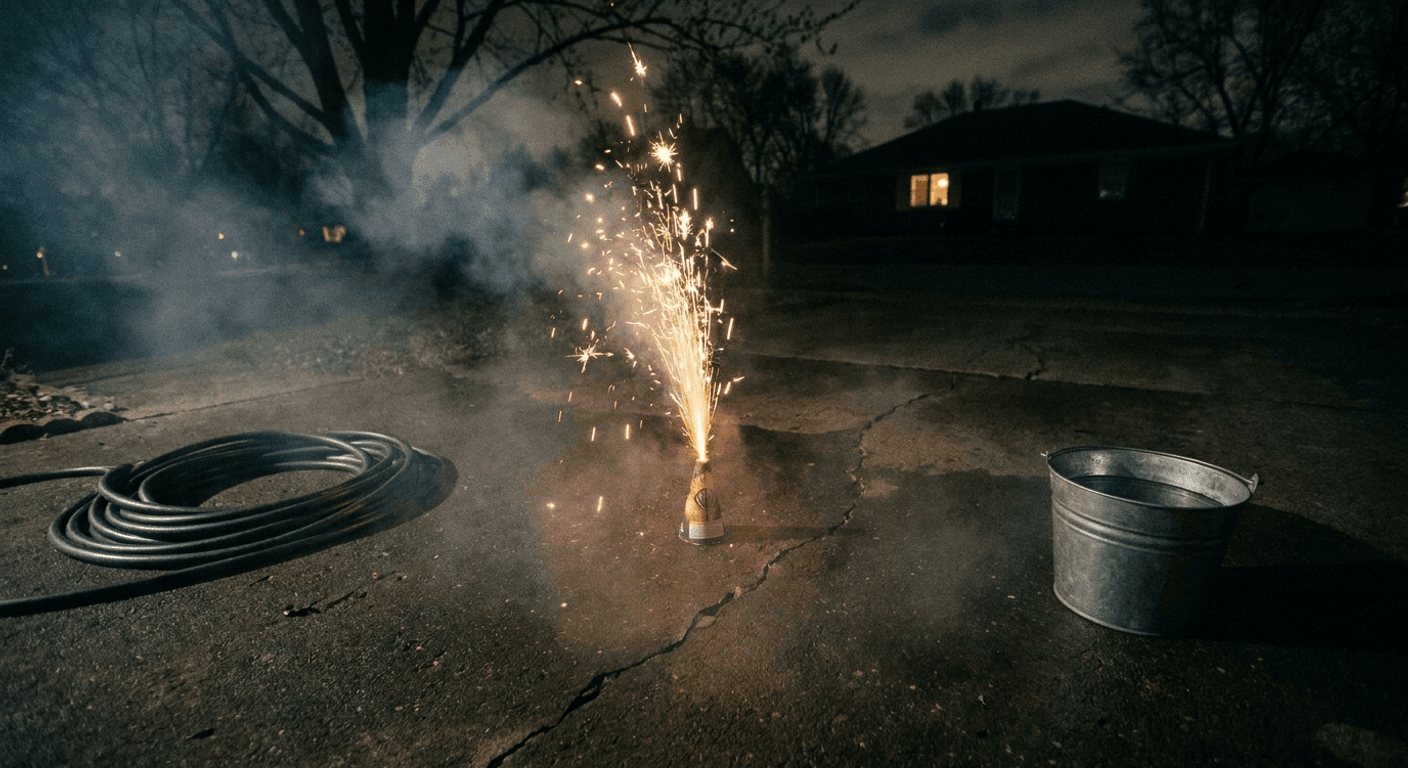
Florida runs two separate legal tracks for fireworks that are easy to collapse into one and get wrong. Sparklers and a statutory list of novelties are defined out of "fireworks" entirely and are legal year-round statewide, with no seasonal sale or use window on them, though chapter 791 separately defines a "seasonal retailer" registration category for sellers who operate only around the summer and winter holidays. True fireworks, the kind Florida's general ban otherwise covers, get their own separate holiday-use exemption for specific dates. Both tracks trace to Fla. Stat. ch. 791.
Jurisdiction scope: This article addresses Florida's state fireworks law, covering the sparkler and novelty definitional exemption, the separate holiday-use exemption for general fireworks, display permits, and penalties, under Fla. Stat. ch. 791. It does not address federal explosives law beyond the interstate-transport point below.
Sparklers and Novelties: Division-Approved, Legal Year-Round
Florida excludes an entire category of devices from the legal definition of "fireworks." The statute defines "fireworks" broadly as "any combustible or explosive composition or substance or combination of substances or, except as hereinafter provided, any article prepared for the purpose of producing a visible or audible effect by combustion, explosion, deflagration, or detonation," and then carves out sparklers, certain toy paper caps, and a named list of novelties and trick noisemakers from that definition. The chapter's general ban, "it is unlawful for any person, firm, copartnership, or corporation to offer for sale, expose for sale, sell at retail, or use or explode any fireworks," simply does not reach devices in the excluded category, so their sale and use is not tied to a holiday or season at all.

That excluded list carries its own composition caps: toy paper caps below 0.25 grains of explosive compound (or 0.20 grains for certain caps), snakes and glow worms up to 10 grams of pyrotechnic composition, smoke devices up to 10 grams, party poppers up to 16 milligrams of explosive composition, booby traps up to 16 milligrams, snappers up to 4 milligrams of explosive mixture (250 milligrams total including sand), trick matches up to 16 milligrams, cigarette loads up to 16 milligrams, and auto burglar alarms up to 10 grams (with up to 50 milligrams allowed for the report-producing component).
Sparklers are treated differently within that same excluded category, but they are not weight-uncapped. Section 791.01(8) defines a "sparkler" as "a device which emits showers of sparks upon burning, does not contain any explosive compounds, does not detonate or explode, is handheld or ground based, cannot propel itself through the air, and contains not more than 100 grams of the chemical compound which produces sparks upon burning." Any product that is not approved by the Division, including one that fails any of those five tests, "is classified as fireworks," not a sparkler. On top of that definitional cap, a sparkler may be sold in Florida only once it has been tested and approved by the Division of the State Fire Marshal, under an annual approval cycle: "Beginning February 1, 1988, only those products approved by the division may be sold in the state," and an approved product's listing runs through January 31 of the following year. That approval requirement is a product-testing gate on top of the 100-gram definitional cap, not a calendar sale window, and it does not limit when a consumer may use a sparkler already legally purchased.
General Fireworks: The Broad Ban and the Holiday-Use Exemption
Devices that do meet the "fireworks" definition, meaning they are not sparklers, toy caps, or listed novelties, remain covered by the general retail-sale and use ban above. Florida law provides several statutory exemptions for those devices outside a permitted public display, the most consumer-facing of which is the holiday-use exemption: "This chapter does not prohibit the use of fireworks solely and exclusively during a designated holiday." The designated holidays named in the statute are New Year's Day, Independence Day (July 4), and New Year's Eve (December 31). Outside those specific dates, using or exploding a device that meets the fireworks definition remains covered by the general ban, subject to the display-permit process described below.
Two other exemptions cover narrower situations. Section 791.07 lets fireworks be imported, purchased, sold, and used "solely and exclusively in frightening birds from agricultural works and fish hatcheries," with that use "governed entirely by the rules prescribed by the Department of Agriculture and Consumer Services." This is the provision behind the agricultural-use waiver that Florida fireworks retailers and roadside tent sellers sometimes ask buyers to sign. Section 791.04 separately exempts, among other things, registered wholesale sales between manufacturers, distributors, and wholesalers; sale for direct out-of-state shipment; sale to a person holding a county display permit, for that display only; use by railroads or other transportation agencies for signal or illumination purposes; use in quarrying, blasting, or other industrial work; blank cartridges used for a show, theater, athletic, or military purpose; and a licensed manufacturer's own manufacturing, experimenting, and storage operations at its own compound.
A 2007 session law attached as a note to § 791.07, section 10(5) of chapter 2007-67, Laws of Florida, froze new permanent retail sales facilities engaged in § 791.07 agricultural-use sales unless the facility already had site-plan approval and construction underway by March 8, 2007, and it capped the number of temporary retail (tent) permits a local government may issue in a year at the number it issued the previous year.
No Statewide Age Minimum
No purchaser age minimum appears anywhere in chapter 791. The sparkler and novelty definition in § 791.01 sets no age threshold, and the manufacturer, distributor, wholesaler, and retailer registration statute, § 791.015, governs only who may register to sell sparklers, not the age of a buyer. If a specific retailer requires an ID for a sparkler or novelty purchase, that is a store policy, not a statewide legal floor.
Chapter 791 also sets no hours-of-day restriction anywhere, including for the three-holiday use exemption for general fireworks under § 791.08.
Display Permits
A public fireworks display needs a permit. County boards of commissioners, for areas outside municipal boundaries, and municipal governing bodies, within their own boundaries, may each "adopt reasonable rules and regulations for the granting of permits for supervised public display of fireworks by fair associations, amusement parks, and other organizations or groups of individuals..." A permit application must go in at least 15 days before the display; the display must be handled by a competent operator approved by the local police or fire chief, and the fire chief inspects for hazard before the display goes forward. A permit is non-transferable, and sale or possession of fireworks becomes lawful only after permit approval, and solely for the authorized display. The board of county commissioners also requires the licensee to carry a bond it deems adequate, of not less than $500, to cover damage the display causes to a person or property.
Outdoor public displays themselves are governed by NFPA 1123 (Code for Fireworks Display), 2018 edition, as the statewide floor: "Any state, county, or municipal law, rule, or ordinance may provide for more stringent regulations," so a Florida county or city can require a higher display standard than NFPA 1123, on top of the state's own permit process. NFPA 1123 itself does not govern a fireworks display on private, residential property, and it does not govern the sparklers and listed novelties authorized for sale under § 791.01(4)(b) and (c).
Local Regulation: Not a Blanket Preemption
Chapter 791 states plainly that it "shall be applied uniformly throughout the state," with "[e]nforcement of this chapter" left to "local law enforcement departments and officials charged with the enforcement of the laws of the state." That uniformity clause is not, on its own, a complete bar on local fireworks regulation. Section 791.08(2), the holiday-use exemption, says directly that it "is not intended to provide for the comprehensive regulation of fireworks as described in s. 10(5), chapter 2007-67, Laws of Florida, or to supersede any local governmental regulation relating to the use of fireworks as provided in s. 10(5), chapter 2007-67, Laws of Florida."

That 2007 session law is the operative local-option rule. After March 8, 2007, a municipality, county, or other unit of local government may not adopt an ordinance, rule, regulation, or other law that "directly prohibits or directly interferes with the safety standards established by state law or the right to purchase, sell, use, or possess consumer fireworks in this state." Read together with the uniformity clause, that means a local government generally cannot adopt a brand-new ordinance banning or directly restricting fireworks sale, use, or possession after that date. It does not erase a local ordinance already on the books before March 8, 2007, which the session law leaves undisturbed. Local authority to set stricter rules for a supervised public display, described above, is a separate and broader power that is not affected by this cutoff.
Homeowners' Association Covenants
Recorded deed restrictions are treated differently from HOA board rules. The Legislature does not intend § 791.08 to override a fireworks prohibition contained in "a legally executed and properly recorded declaration of covenants or covenant running with the land of any homeowners' association" under chapter 720, so an existing recorded covenant banning fireworks in a community can still be enforced. What an HOA cannot do is create that restriction unilaterally: "a homeowners' association, through a board of directors, may not promulgate rules that attempt to abrogate a homeowner's right to use fireworks during a designated holiday or under general law." A board vote is not the same as a covenant on the deed.
Penalties
A violation of chapter 791 is a misdemeanor of the first degree. Individuals, along with the members of a partnership and the responsible officers and agents of an association or corporation, are punishable under Fla. Stat. §§ 775.082 and 775.083, which set a maximum of one year in jail and a fine of up to $1,000 for a first-degree misdemeanor. Chapter 791 does not separately tier the penalty for a second or later violation; the same first-degree-misdemeanor classification applies regardless of how many prior violations a person has.
Crossing State Lines
Federal law adds a layer on top of Florida's own rules for anyone bringing true fireworks in from elsewhere. Under 18 U.S.C. § 836, it is a federal offense, punishable by a fine, up to one year in prison, or both, to transport fireworks into a state whose law specifically prohibits or regulates their use, or to deliver them for that transportation, knowing they will be delivered, possessed, stored, sold, or otherwise dealt with in a manner that state's law forbids; the statute excludes fireworks merely passing through a state in continuous interstate transportation, and it does not apply to common or contract carriers, to water carriers engaged in interstate commerce, or to transportation for the use of a federal agency. Separately, the U.S. Postal Service bans all fireworks from the mail entirely, for both international and domestic shipment (USPS Publication 52 § 341.22); federal consumer-product-safety rules set the device and packaging standards fireworks must meet to be sold anywhere in the country (16 C.F.R. § 1500.17 and Part 1507); and a federal explosives-licensing exemption (27 C.F.R. § 555.141(a)(7)) covers only the importation, distribution, and storage of consumer fireworks, not their manufacture. Since Florida already permits true fireworks during its own holiday-use window and permits sparklers and novelties year-round, this matters most for a device that would still fall outside both of those Florida exemptions.
For a neighboring Southeastern state's approach, see Georgia fireworks laws. For the complete state-by-state picture, see the fireworks laws by state comparison. Florida also maintains a separate open container law worth knowing if fireworks and holiday drinking overlap.
Disclaimer: This article provides general legal information about fireworks laws in the United States as of September 2026. It is not legal advice. Fireworks statutes, local ordinances, sale and use windows, and penalties change frequently and are often further restricted by county or city ordinance beyond what state law requires; verify the current rule for your specific city and county before buying, selling, or using fireworks, and consult a lawyer licensed in your state for advice about a specific situation.
Statutes cited reflect their in-force version as of 2026-09-17. Last updated: 2026-09-17.
Frequently Asked Questions
Are sparklers legal in Florida year-round?
Yes. Florida excludes sparklers, certain toy paper caps, and a list of novelties from the legal definition of "fireworks" entirely under Fla. Stat. § 791.01, and their sale and use is not tied to any holiday or seasonal window. Sparklers must be tested and approved by the Division of the State Fire Marshal before sale.
Can I use regular fireworks in Florida on the 4th of July?
Yes, under a separate statutory exemption. Fla. Stat. § 791.08 permits the use of general fireworks, not just sparklers, "solely and exclusively during a designated holiday," and names New Year's Day, July 4, and New Year's Eve as those holidays.
What is the minimum age to buy fireworks in Florida?
Chapter 791 sets no statewide purchaser age minimum for sparklers or novelties. Neither the definition statute (§ 791.01) nor the seller-registration statute (§ 791.015) sets an age threshold.
Can a Florida county or city ban sparklers even though state law allows them?
Generally not with a new ordinance. Under Fla. Stat. § 791.08(2) and s. 10(5), ch. 2007-67, Laws of Florida, a local government cannot adopt a new ordinance after March 8, 2007 that directly prohibits or interferes with the right to purchase, sell, use, or possess consumer fireworks. A local ordinance already on the books before that date is not undone by this rule, and a county or city can still require stricter standards for a supervised public display.
What is the penalty for a fireworks violation in Florida?
A misdemeanor of the first degree under Fla. Stat. § 791.06, punishable by up to one year in jail and a $1,000 fine under §§ 775.082 and 775.083. The chapter does not set a separate, heavier penalty for a repeat violation.
Updates
Independently fact-checked against the cited primary sources
Independently fact-checked against the cited primary sources
The Law Behind This Article
This article rests on the statutory provisions below, held in our own legal record and retrieved from the official source. Tap a section to read the operative text.
Florida Statutes
§ 791.02Sale of fireworks regulated; rules and regulations.In force
(1) Except as hereinafter provided it is unlawful for any person, firm, copartnership, or corporation to offer for sale, expose for sale, sell at retail, or use or explode any fireworks; provided that the board of county commissioners shall have power to adopt reasonable rules and regulations for the granting of permits for supervised public display of fireworks by fair associations, amusement parks, and other organizations or groups of individuals when such public display is to take place outside of any municipality; provided, further, that the governing body of any municipality shall have power to adopt reasonable rules and regulations for the granting of permits for supervised public display of fireworks within the boundaries of any municipality. Every such display shall be handled by a competent operator to be approved by the chiefs of the police and fire departments of the municipality in which the display is to be held, and shall be of such a character, and so located, discharged, or fired as in the opinion of the chief of the fire department, after proper inspection, shall not be hazardous to property or endanger any person.
Official text (excerpt) · last checked 2026-09-23 · Read the full text in our law library · Verify at leg.state.fl.us
§ 791.01Definitions.In force
As used in this chapter, the term:(1) “Distributor” means any person engaged in the business of selling sparklers to a wholesaler. (2) “Division” means the Division of the State Fire Marshal of the Department of Financial Services. (3) “Explosive compound” means any chemical compound, mixture, or device the primary or common purpose of which is to function by the substantially instantaneous release of gas and heat. (4)(a) “Fireworks” means and includes any combustible or explosive composition or substance or combination of substances or, except as hereinafter provided, any article prepared for the purpose of producing a visible or audible effect by combustion, explosion, deflagration, or detonation. The term includes blank cartridges and toy cannons in which explosives are used, the type of balloons which require fire underneath to propel them, firecrackers, torpedoes, skyrockets, Roman candles, and any fireworks containing any explosives or flammable compound or any tablets or other device containing any explosive substance. (b) “Fireworks” does not include sparklers approved by the division pursuant to s.
Official text (excerpt) · last checked 2026-07-28 · Read the full text in our law library · Verify at leg.state.fl.us
Cited in 2 court opinions in our collectionLatest citing opinion in our collection: 2005
Opinions citing this section in our collection:
- Phantom of Clearwater v. Pinellas County (District Court of Appeal of Florida 2005, 894 So. 2d 1011)“…cturer" shall have the same meaning as specified *1025 in Section 791.01, Florida Statutes as it may, from time to time, be amende…”
- Kane v. State (District Court of Appeal of Florida 1978, 358 So. 2d 53)“…ion specifically excludes “fireworks,” which are defined in Section 791.01, Florida Statutes (1975), as: [A]ny combustible or expl…”
Identified automatically from the court opinions citing this section — not a ranking of which case controls.
§ 791.08Use during designated holidays; exemption.In force
(1) As used in this section, the term “designated holiday” means:(a) New Year’s Day, January 1; (b) Independence Day, July 4; or (c) New Year’s Eve, December 31. (2) This chapter does not prohibit the use of fireworks solely and exclusively during a designated holiday. This section is not intended to provide for the comprehensive regulation of fireworks as described in s. 10(5), chapter 2007-67, Laws of Florida, or to supersede any local governmental regulation relating to the use of fireworks as provided in s. 10(5), chapter 2007-67, Laws of Florida. (3) The Legislature does not intend for the application of this section to supersede any prohibition against the use of fireworks contained within a legally executed and properly recorded declaration of covenants or covenant running with the land of any homeowners’ association pursuant to chapter 720. However, a homeowners’ association, through a board of directors, may not promulgate rules that attempt to abrogate a homeowner’s right to use fireworks during a designated holiday or under general law.
Official text (excerpt) · last checked 2026-07-28 · Read the full text in our law library · Verify at leg.state.fl.us
§ 791.013Testing and approval of sparklers; penalties.In force
(1) A person who wishes to sell sparklers must submit samples of his or her product to the division for testing to determine whether it is a sparkler as defined in s. 791.01. Such samples must be received by the division by September 1 to be considered for approval the following year. On February 1 of each year the division shall approve those products which it has tested and found to meet the requirements for sparklers. All approved sparkler products are legal for sale until January 31 of the following year. The list of approved sparkler products shall be published in the Florida Administrative Register and shall prominently state the dates between which the products may be sold. The division shall make copies of this list available to the public. A product must be tested and approved for sale in accordance with the rules adopted to implement this section. Beginning February 1, 1988, only those products approved by the division may be sold in the state. The State Fire Marshal shall adopt rules describing the testing, approval, and listing procedures. (2) Any person who alters an approved sparkler product, so that it is no longer a sparkler as defined in s.
Official text (excerpt) · last checked 2026-07-28 · Read the full text in our law library · Verify at leg.state.fl.us
§ 791.015Registration of manufacturers, distributors, wholesalers, and retailers of sparklers.In force
(1) REGISTRATION REQUIREMENTS.—Any manufacturer, distributor, wholesaler, retailer, or seasonal retailer of sparklers who wishes to do business in this state or to otherwise sell, ship, or assign for sale its products in this state must register annually with the division on forms prescribed by the division. Any retailer who sells sparklers at more than one retail location may submit one registration form for all such locations but must provide the address of each location with the registration form; however, any retailer may submit multiple registration forms. (2) REGISTRATION FORM.—The registration form filed with the division must be notarized and must include the following information: business name; address; telephone number; officers, if the business is a corporation; and an individual designated as a contact person. (3) FEES.—(a) Each manufacturer, distributor, or wholesaler must pay an annual registration fee to be set by the division not to exceed $1,000. Each seasonal retailer must pay an annual registration fee to be set by the division not to exceed $200.
Official text (excerpt) · last checked 2026-07-28 · Read the full text in our law library · Verify at leg.state.fl.us
Cited in 1 court opinions in our collectionLatest citing opinion in our collection: 2005
Opinions citing this section in our collection:
- Phantom of Clearwater v. Pinellas County (District Court of Appeal of Florida 2005, 894 So. 2d 1011)“…stered with the State Division of Fire Marshall pursuant to Section 791.015, Florida Statutes. 3. A retailer of sparklers shall be…”
Identified automatically from the court opinions citing this section — not a ranking of which case controls.
§ 791.04Sale at wholesale, etc., exempted.In force
Nothing in this chapter shall be construed to prohibit any manufacturer, distributor, or wholesaler who has registered with the division pursuant to s. 791.015 to sell at wholesale such fireworks as are not herein prohibited; to prohibit the sale of any kind of fireworks at wholesale between manufacturers, distributors, and wholesalers who have registered with the division pursuant to s. 791.015; to prohibit the sale of any kind of fireworks provided the same are to be shipped directly out of state by such manufacturer, distributor, or wholesaler; to prohibit the sale of fireworks to be used by a person holding a permit from any board of county commissioners at the display covered by such permit; or to prohibit the use of fireworks by railroads or other transportation agencies for signal purposes or illumination or when used in quarrying or for blasting or other industrial use, or the sale or use of blank cartridges for a show or theater, or for signal or ceremonial purposes in athletics or sports, or for use by military organizations, or organizations composed of the Armed Forces of the United States; provided, nothing in this chapter shall be construed as barring the operations…
Official text (excerpt) · last checked 2026-07-28 · Read the full text in our law library · Verify at leg.state.fl.us
Cited in 2 court opinions in our collectionLatest citing opinion in our collection: 2005
Opinions citing this section in our collection:
- Phantom of Clearwater v. Pinellas County (District Court of Appeal of Florida 2005, 894 So. 2d 1011)“…the Division of the State Fire Marshal and who, pursuant to Section 791.04, Florida Statutes, purchases fireworks for shipment direc…”
- State v. Miketa (District Court of Appeal of Florida 2002, 824 So. 2d 970)“…ion. The statute referenced by the foregoing documents is section 791.04, Florida Statutes. It provides: 791.04 Sale at wholesal…”
Identified automatically from the court opinions citing this section — not a ranking of which case controls.
§ 791.07Agricultural and fish hatchery use.In force
Nothing in this chapter shall prohibit the importation, purchase, sale, or use of fireworks used or to be used solely and exclusively in frightening birds from agricultural works and fish hatcheries; and such use shall be governed entirely by the rules prescribed by the Department of Agriculture and Consumer Services.
Official text (excerpt) · last checked 2026-07-28 · Read the full text in our law library · Verify at leg.state.fl.us
Cited in 1 court opinions in our collectionLatest citing opinion in our collection: 2005
Opinions citing this section in our collection:
- Phantom of Clearwater v. Pinellas County (District Court of Appeal of Florida 2005, 894 So. 2d 1011)“…y the Department of Agriculture and Consumer Services under Section 791.07, Florida Statutes, purchases firecrackers for frightening…”
Identified automatically from the court opinions citing this section — not a ranking of which case controls.
§ 791.012Minimum fireworks safety standards.In force
The outdoor display of fireworks in this state shall be governed by the National Fire Protection Association (NFPA) 1123, Code for Fireworks Display, 2018 Edition. Any state, county, or municipal law, rule, or ordinance may provide for more stringent regulations for the outdoor display of fireworks, but in no event may any such law, rule, or ordinance provide for less stringent regulations for the outdoor display of fireworks. The division shall promulgate rules to carry out the provisions of this section. The Code for Fireworks Display shall not govern the display of any fireworks on private, residential property and shall not govern the display of those items included under s. 791.01(4)(b) and (c) and authorized for sale thereunder.
Official text (excerpt) · last checked 2026-07-28 · Read the full text in our law library · Verify at leg.state.fl.us
Cited in 1 court opinions in our collectionLatest citing opinion in our collection: 2005
Opinions citing this section in our collection:
- Phantom of Clearwater v. Pinellas County (District Court of Appeal of Florida 2005, 894 So. 2d 1011)“…the supervised public display of fireworks. See § 791.02. Section 791.012, Florida Statutes (2003), provides minimum fireworks safe…”
Identified automatically from the court opinions citing this section — not a ranking of which case controls.
§ 791.06Penalties.In force
Any firm, copartnership, or corporation violating the provisions of this chapter shall be guilty of a misdemeanor of the first degree, punishable as provided in s. 775.083 or, in the case of individuals, the members of a partnership and the responsible officers and agents of an association or corporation, punishable as provided in s. 775.082 or s. 775.083.
Official text (excerpt) · last checked 2026-07-28 · Read the full text in our law library · Verify at leg.state.fl.us
Cited in 1 court opinions in our collectionLatest citing opinion in our collection: 2005
Opinions citing this section in our collection:
- Phantom of Clearwater v. Pinellas County (District Court of Appeal of Florida 2005, 894 So. 2d 1011)“…ordinance, which we conclude to be in direct conflict with section 791.06, Florida Statutes (2003). That sentence is severable from…”
Identified automatically from the court opinions citing this section — not a ranking of which case controls.
§ 791.03Bond of licensees.In force
The board of county commissioners shall require a bond deemed adequate by the board of county commissioners from the licensee in a sum not less than $500 conditioned for the payment of all damages which may be caused either to a person or to property by reason of the licensee’s display, and arising from any acts of the licensee, his or her agents, employees or subcontractors.
Official text (excerpt) · last checked 2026-07-28 · Read the full text in our law library · Verify at leg.state.fl.us
Cited in 2 court opinions in our collectionLatest citing opinion in our collection: 2016
Opinions citing this section in our collection:
- Phantom of Clearwater v. Pinellas County (District Court of Appeal of Florida 2005, 894 So. 2d 1011)“…stringent regulations for the outdoor display of fireworks. Section 791.03, Florida Statutes (2003), mandates that boards of county…”
- Classy Cycles, Inc. v. Bay County (District Court of Appeal of Florida 2016, 201 So. 3d 779)“…t preempt a county’s regulation of fire *788 works. In fact section 791.03, Florida Statutes, allows counties to require a bond from…”
Identified automatically from the court opinions citing this section — not a ranking of which case controls.
§ 775.082Penalties; applicability of sentencing structures; mandatory minimum sentences for certain reoffenders previously released from prison.In forcecited in 11 of our articles
(1)(a) Except as provided in paragraph (b), a person who has been convicted of a capital felony shall be punished by death if the proceeding held to determine sentence according to the procedure set forth in s. 921.141 results in a determination that such person shall be punished by death, otherwise such person shall be punished by life imprisonment and shall be ineligible for parole. (b)1. A person who actually killed, intended to kill, or attempted to kill the victim and who is convicted under s. 782.04 of a capital felony, or an offense that was reclassified as a capital felony, which was committed before the person attained 18 years of age shall be punished by a term of imprisonment for life if, after a sentencing hearing conducted by the court in accordance with s. 921.1401, the court finds that life imprisonment is an appropriate sentence. If the court finds that life imprisonment is not an appropriate sentence, such person shall be punished by a term of imprisonment of at least 40 years. A person sentenced pursuant to this subparagraph is entitled to a review of his or her sentence in accordance with s. 921.1402(2)(a). 2.
Official text (excerpt) · last checked 2026-09-23 · Read the full text in our law library · Verify at leg.state.fl.us
Cited in 291 court opinions in our collectionLatest citing opinion in our collection: 2026
In the courts (editorial summary, independently checked):State v. Dixon (1973) held Section 775.082, with sections 782.04 and 921.141, constitutional under the test of Furman v. Georgia. Kenneth R. Jackson v. State of Florida (2017) held that Section 775.082(2)'s automatic life-sentence remedy did not apply after Hurst v. Florida, which invalidated only certain sentencing procedures.
Opinions citing this section in our collection:
- State v. Dixon (Supreme Court of Florida 1973, 283 So. 2d 1)✓Four consolidated murder cases challenged Florida's post-Furman capital scheme; the Florida Supreme Court held sections 775.082, 782.04 and 921.141 constitutional, reading the listed aggravating and mitigating circumstances as definite enough to channel sentencing discretion.
- Woods v. State (District Court of Appeal of Florida 1999, 740 So. 2d 20)✓Woods committed an unarmed robbery about a month after release from prison and was sentenced to 15 years as a prison releasee reoffender under section 775.082(8); the court affirmed, rejecting separation of powers, vagueness and equal protection challenges.
- Kenneth R. Jackson v. State of Florida (Supreme Court of Florida 2017, 42 Fla. L. Weekly Supp. 361)✓Jackson was sentenced to death for a murder during a sexual battery on an 11-1 jury recommendation; the court found Hurst error but held section 775.082(2)'s life-sentence remedy inapplicable, since Hurst voided only part of section 921.141, and ordered a new penalty phase.
Identified automatically from the court opinions citing this section — not a ranking of which case controls.
Also relied on in: Hit and Run Laws in the United States (2026 Guide), How Long Is a Life Sentence in Florida? (2026 Guide), Florida's New Hit-and-Run Law Lets Courts Order Restitution for Property Damage
§ 775.083Fines.In forcecited in 4 of our articles
(1) A person who has been convicted of an offense other than a capital felony may be sentenced to pay a fine in addition to any punishment described in s. 775.082; when specifically authorized by statute, he or she may be sentenced to pay a fine in lieu of any punishment described in s. 775.082. A person who has been convicted of a noncriminal violation may be sentenced to pay a fine. Fines for designated crimes and for noncriminal violations shall not exceed:(a) $15,000, when the conviction is of a life felony. (b) $10,000, when the conviction is of a felony of the first or second degree. (c) $5,000, when the conviction is of a felony of the third degree. (d) $1,000, when the conviction is of a misdemeanor of the first degree. (e) $500, when the conviction is of a misdemeanor of the second degree or a noncriminal violation. (f) Any higher amount equal to double the pecuniary gain derived from the offense by the offender or double the pecuniary loss suffered by the victim. (g) Any higher amount specifically authorized by statute. Fines imposed in this subsection shall be deposited by the clerk of the court in the fine and forfeiture fund established pursuant to s. 142.01.
Official text (excerpt) · last checked 2026-07-28 · Read the full text in our law library · Verify at leg.state.fl.us
Cited in 74 court opinions in our collectionLatest citing opinion in our collection: 2026
Opinions citing this section in our collection:
- Pullam v. State (District Court of Appeal of Florida 2011, 55 So. 3d 674)“…ten judgment for fines and costs includes a $200 fine under section 775.083, Florida Statutes (2009). Fines under section 775.083 are…”
- Stone v. State (District Court of Appeal of Florida 1986, 11 Fla. L. Weekly 2562)“…stem. In contrast, a fine imposed as punishment pursuant to section 775.083, Florida Statutes (1985), is placed into a government's g…”
- Amendments to the Florida Rules of Criminal Procedure (Supreme Court of Florida 2004, 29 Fla. L. Weekly Supp. 568)“…ecked and completed. Fines imposed as part of a sentence to section 775.083, Florida Statutes, are to be recorded on the sentence pag…”
Identified automatically from the court opinions citing this section — not a ranking of which case controls.
Also relied on in: Florida Audio Recording Laws: All-Party Consent Rules and Penalties (2026), Florida Surveillance Camera Laws (2026 Guide), Florida Age of Consent Laws: Statutes, Penalties and Reporting
§ 791.001Application and enforcement.In force
This chapter shall be applied uniformly throughout the state. Enforcement of this chapter shall remain with local law enforcement departments and officials charged with the enforcement of the laws of the state.
Official text (excerpt) · last checked 2026-07-28 · Read the full text in our law library · Verify at leg.state.fl.us
Cited in 4 court opinions in our collectionLatest citing opinion in our collection: 2016
Opinions citing this section in our collection:
- Phantom of Clearwater v. Pinellas County (District Court of Appeal of Florida 2005, 894 So. 2d 1011)“…use of fireworks. This relatively short chapter begins with section 791.001, Florida Statutes *1016 (2003), entitled "Application a…”
- Phantom of Brevard, Inc. v. Brevard County (Supreme Court of Florida 2008, 33 Fla. L. Weekly Supp. 1002)“…nancial responsibility ordinance is in direct conflict with section 791.001, Florida Statutes, which provides that chapter 791 “shall…”
- Classy Cycles, Inc. v. Bay County (District Court of Appeal of Florida 2016, 201 So. 3d 779)“…n Phantom of Brevard, the Florida Supreme Court construed section 791.001, Florida Statutes, a statute which concerns fireworks, an…”
Identified automatically from the court opinions citing this section — not a ranking of which case controls.
Code of Federal Regulations Title 16
§ 1500.17Banned hazardous substances.In forcecited in 36 of our articles
(a) Under the authority of section 2(q)(1)(B) of the act, the Commission declares as banned hazardous substances the following articles because they possess such a degree or nature of hazard that adequate cautionary labeling cannot be written and the public health and safety can be served only by keeping such articles out of interstate commerce: (1) Mixtures that are intended primarily for application to interior masonry walls, floors, etc., as a water repellant treatment and that are “extremely flammable” within the meaning of section 2(1) of the act (repeated in § 1500.3(b)(10)). (2) Carbon tetrachloride and mixtures containing it (including carbon tetrachloride and mixtures containing it used in fire extinguishers), excluding unavoidable manufacturing residues of carbon tetrachloride in other chemicals that under reasonably foreseeable conditions of use do not result in an atmospheric concentration of carbon tetrachloride greater than 10 parts per million.
Official text (excerpt) · last checked 2026-09-23 · Read the full text in our law library · Verify at ecfr.gov
Cited in 16 court opinions in our collectionLatest citing opinion in our collection: 2024
Opinions citing this section in our collection:
- United States v. Midwest Fireworks Mfg. Co., Inc. Fireworks of America Ltd. Corp. Pacific Fin. Servs. Of America, Inc. Larry Lomaz David Bowman (Court of Appeals for the Sixth Circuit 2001, 248 F.3d 563)“…venty-nine types of fireworks and the constitutionality of 16 C.F.R. § 1500.17 (a)(3) (2001). We affirm. BACKGR…”
- United States v. Charles Focht, an Individual, and Mark Focht, an Individual, Doing Business Under the Name Liberty Industries (Court of Appeals for the Third Circuit 1989, 882 F.2d 55)“…al, the government asserts the district court misconstrued 16 C.F.R. § 1500.17 (a)(3), (8) when it held the regulation…”
- United States v. Shelton Wholesale, Inc. (District Court, W.D. Missouri 1999, 34 F. Supp. 2d 1147)“…ams) of pyrotechnic composition (the "amount test"). See 16 C.F.R. § 1500.17 (a)(3). 2. for all "[r]eloadable tube…”
Identified automatically from the court opinions citing this section — not a ranking of which case controls.
Also relied on in: Fireworks Laws by State (2026): What Is Legal, Sale Dates, Penalties, Delaware Fireworks Laws (2026): Sparklers, Novelties, Dates, DC Fireworks Laws: Permitted List, Licensing, Penalties
Code of Federal Regulations Title 27
§ 555.141Exemptions.In forcecited in 41 of our articles
(a) General. Except for the provisions of §§ 555.180 and 555.181, this part does not apply to: (1) Any aspect of the transportation of explosive materials via railroad, water, highway, or air which is regulated by the U.S. Department of Transportation and its agencies, and which pertains to safety. For example, regulations issued by the Department of Transportation addressing the security risk of aliens transporting explosives by commercial motor or railroad carrier from Canada preclude the enforcement of 18 U.S.C. 842(i)(5) against persons shipping, transporting, receiving, or possessing explosives incident to and in connection with the commercial transportation of explosives by truck or rail from Canada into the United States. Questions concerning this exception should be directed to ATF's Explosives Industry Program Branch in Washington, DC. (2) The use of explosive materials in medicines and medicinal agents in the forms prescribed by the official United States Pharmacopeia or the National Formulary.
Official text (excerpt) · last checked 2026-07-28 · Read the full text in our law library · Verify at ecfr.gov
Cited in 1 court opinions in our collectionLatest citing opinion in our collection: 2006
Opinions citing this section in our collection:
- Tripoli Rocketry Ass'n v. Bureau of Alcohol, Tobacco, Firearms, & Explosives (Court of Appeals for the D.C. Circuit 2006, 437 F.3d 75)“…imported, or distributed for their intended purposes.” See 27 C.F.R. § 555.141(a)(8) (2005) (current exemption); 26 C.…”
Identified automatically from the court opinions citing this section — not a ranking of which case controls.
Also relied on in: Georgia Fireworks Laws (2026): Legal Statewide, No Local Ban, Hawaii Fireworks Laws (2026): Permits, Use Windows, and Penalties, Idaho Fireworks Laws (2026): What's Legal and When
United States Code Title 18
§ 836Transportation of fireworks into State prohibiting sale or useIn forcecited in 52 of our articles
Whoever, otherwise than in the course of continuous interstate transportation through any State, transports fireworks into any State, or delivers them for transportation into any State, or attempts so to do, knowing that such fireworks are to be delivered, possessed, stored, transshipped, distributed, sold, or otherwise dealt with in a manner or for a use prohibited by the laws of such State specifically prohibiting or regulating the use of fireworks, shall be fined under this title or imprisoned not more than one year, or both. This section shall not apply to a common or contract carrier or to international or domestic water carriers engaged in interstate commerce or to the transportation of fireworks into a State for the use of Federal agencies in the carrying out or the furtherance of their operations. In the enforcement of this section, the definitions of fireworks contained in the laws of the respective States shall be applied. As used in this section, the term “State” includes the several States, Territories, and possessions of the United States, and the District of Columbia. This section shall be effective from and after July 1, 1954.
Official text (excerpt) · last checked 2026-07-28 · Read the full text in our law library · Verify at uscode.house.gov
Cited in 15 court opinions in our collectionLatest citing opinion in our collection: 2024
Opinions citing this section in our collection:
- United States v. James A. Womack (Court of Appeals for the Fifth Circuit 1981, 654 F.2d 1034)“…eworks has been traditionally left to the states. He cites 18 U.S.C.A. § 836 , which prohibits the transportation of…”
- United States v. Bernard J. Semel (Court of Appeals for the Fourth Circuit 1965, 347 F.2d 228)“…y an information containing eighteen counts with violating 18 U.S.C.A. § 836 by having feloniously caused to be tra…”
- Cohen v. Bredehoeft (District Court, S.D. Texas 1968, 290 F. Supp. 1001)“…the states from legislating in this area. On the contrary, 18 U.S.C. Sec. 836 indicates an intent to encourage state…”
Identified automatically from the court opinions citing this section — not a ranking of which case controls.
Also relied on in: Alabama Fireworks Laws (2026): Legal Fireworks, Age Rules, Penalties, Alaska Fireworks Laws (2026): Age-18 Minimum, No Sale Window, Arizona Fireworks Laws (2026): Legal Devices, Local Rules, Penalties
Search our full record of US law — 2.1 million sections, every state + federal →
Sources and References
- Fla. Stat. § 791.01 - Definitions: fireworks defined broadly; sparkler and novelty/trick-noisemaker exclusions and weight caps(leg.state.fl.us).gov
- Fla. Stat. § 791.013 - Sparkler testing and Division approval required for sale(leg.state.fl.us).gov
- Fla. Stat. § 791.08 - Use of fireworks during designated holidays; exemption(leg.state.fl.us).gov
- Fla. Stat. § 791.02 - General sale/use ban; county and municipal display permits(leg.state.fl.us).gov
- Fla. Stat. § 791.015 - Registration of manufacturers, distributors, wholesalers, and retailers of sparklers(leg.state.fl.us).gov
- Fla. Stat. § 791.012 - Public display safety standard (NFPA 1123, 2018 ed.) and local authority to impose stricter rules(leg.state.fl.us).gov
- Fla. Stat. § 791.001 - Chapter applied uniformly statewide; enforcement left to local law enforcement(leg.state.fl.us).gov
- Fla. Stat. § 791.03 - Bond of display licensees, not less than $500(leg.state.fl.us).gov
- Fla. Stat. § 791.04 - Wholesale, out-of-state shipment, display-permit, railroad, industrial, and military exemptions(leg.state.fl.us).gov
- Fla. Stat. § 791.07 and s. 10(5), ch. 2007-67, Laws of Florida - Agricultural and fish-hatchery use exemption; March 8, 2007 local-ordinance and retail-facility cutoff(flsenate.gov).gov
- Fla. Stat. § 791.06 - Penalty; misdemeanor of the first degree(leg.state.fl.us).gov
- Fla. Stat. § 775.082 - Penalties for felonies and misdemeanors (first-degree misdemeanor jail cap)(leg.state.fl.us).gov
- Fla. Stat. § 775.083 - Fines (first-degree misdemeanor fine cap)(leg.state.fl.us).gov
- 18 U.S.C. § 836 - Transportation of fireworks into a state that specifically prohibits or regulates their use; carrier and federal-agency exclusions; one-year maximum penalty(uscode.house.gov).gov
- USPS Publication 52 § 341.22 - All fireworks are nonmailable explosives, prohibited from domestic and international mail(pe.usps.com).gov
- 16 C.F.R. § 1500.17 - CPSC banned-hazardous-substance device standards for fireworks(ecfr.gov).gov
- 27 C.F.R. § 555.141(a)(7) - ATF explosives-licensing exemption for the importation, distribution, and storage (not manufacture) of consumer fireworks(ecfr.gov).gov