
Texas
Texas Fireworks Laws (2026): Sale Windows, Penalties
Independently fact-checked against primary sources (last audited September 24, 2026). · 12 primary sources cited on this page. How we verify our legal content
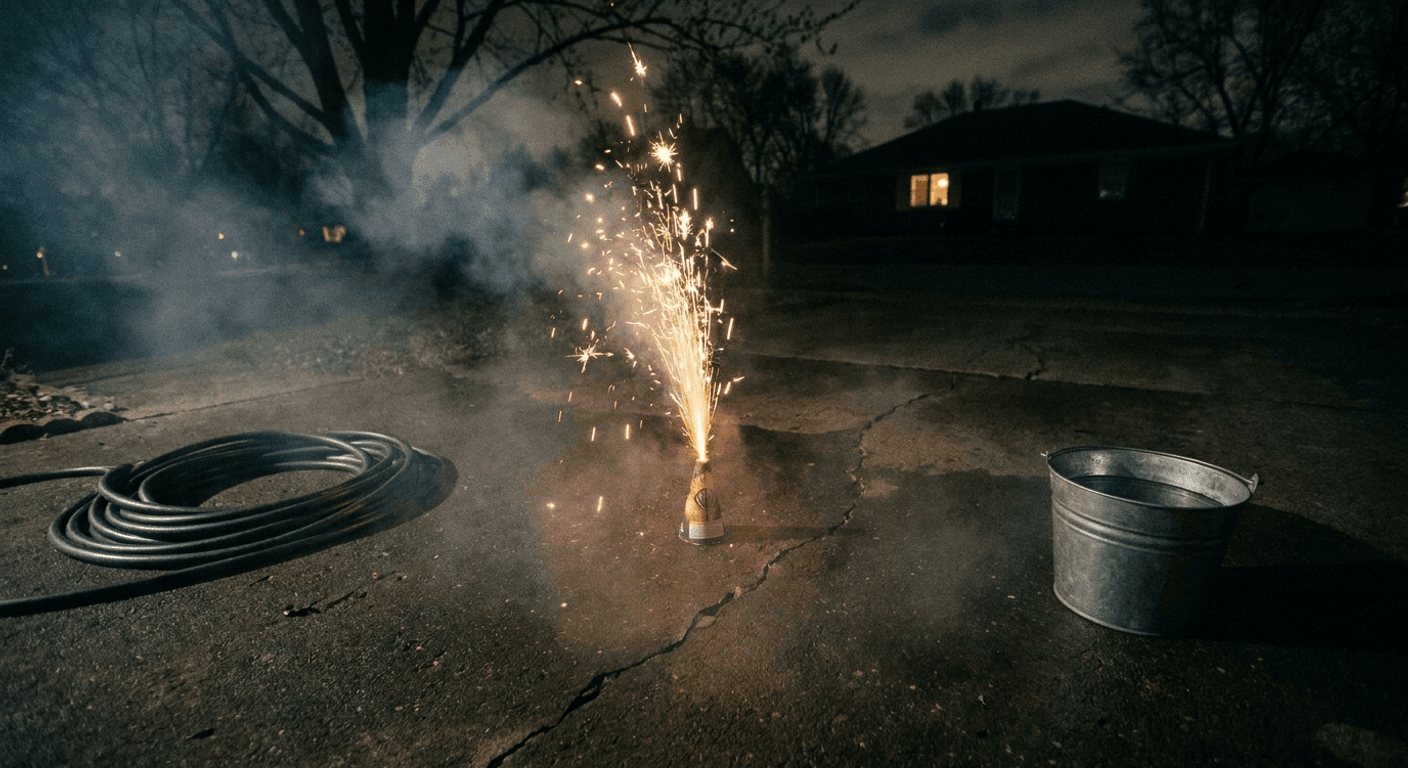
Texas permits "Fireworks 1.4G" statewide by default, sold only by a permitted retailer during specific calendar windows that vary by county option, with a purchase age of 16, location-based use restrictions, and a distinct felony statute for igniting fireworks against a law enforcement officer, under Tex. Occ. Code Chapter 2154 and Tex. Penal Code §50.02.
Jurisdiction scope: This article addresses Texas's state fireworks law under Tex. Occ. Code Chapter 2154 (§§2154.001 to 2154.303) and Tex. Penal Code §50.02: the permissible-devices definition, retail permitting, the sale-window conflict described below, prohibited use and sale, local regulation, and penalties, including the separate offense of using fireworks against a law enforcement officer. It does not address county burn bans or local ordinances beyond the state-level local-option framework described here.
What's Legal: Fireworks 1.4G
Texas's default permissible category is defined directly by federal transportation classification:

"(a) Except as provided by Subsection (b), Fireworks 1.4G are permissible fireworks."
Tex. Occ. Code §2154.003(a)
The larger "Fireworks 1.3G" class is not part of this consumer allowance; §2154.251(a)(6) requires a licensed pyrotechnic operator to conduct any public display involving 1.3G fireworks, and it is never sold directly to a member of the public the way 1.4G fireworks are.
What's Not Allowed: Undersized Rockets, and Anything CPSC Rejects
Three things are excluded from "permissible fireworks" even though a device could otherwise fall in the general 1.4G category: two specifically defined, conjunctively-tested undersized rocket types, and one open-ended catch-all for anything the U.S. Consumer Product Safety Commission determines is not acceptable:
"(1) sky rockets or 'bottle rockets' with: (A) a total propellant charge of less than four grams; (B) a casing size of less than five-eighths of an inch for the outside diameter and less than 3-1/2 inches in length; and (C) an overall length, including stick, of less than 15 inches; and (2) other fireworks determined not acceptable by the United States Consumer Product Safety Commission. ... (c) The term 'bottle rocket' may not be used in association with the advertisement or sale of fireworks. ... (d) ... pop rockets with a propellant casing length of less than five inches, an exterior diameter of less than three-fourths of an inch, and an overall total rocket length of less than 26 inches are not permissible fireworks."
Tex. Occ. Code §2154.003(b)-(d)
The two rocket tests are conjunctive, not a set of independent trip-wires: a sky rocket or "bottle rocket" is excluded only when it is undersized on all three measures at once (propellant charge, casing size, AND overall length), and a pop rocket is excluded only when it is undersized on all three of its own measures (casing length, exterior diameter, AND overall length). A device that meets or exceeds even one of the three thresholds for its category is not caught by these exclusions and remains a permissible Fireworks 1.4G item, subject to §2154.003(b)(2)'s separate, open-ended CPSC catch-all, which can exclude a device for any reason the Commission finds it unacceptable regardless of size. The word "bottle rocket" cannot be used in marketing or selling fireworks at all, regardless of whether the specific device qualifies.
The Retail Sale Window: A Genuine, Unresolved Two-Version Conflict
Texas does not have a single, uncontested sale-window statute right now. In 2025, two different bills, H.B. 554 and H.B. 5084, each amended §2154.202(g) without being reconciled into one text, and the state's own official code site currently displays both versions sequentially rather than as a single merged rule. What both versions agree on: a base retail sale period beginning June 24 and ending at midnight on July 4; a base period beginning December 20 and ending at midnight on January 1 of the following year; and a county-optional period beginning May 1 and ending at midnight on May 5, available only at a location within 150 miles of the Texas-Mexico border and only in a county whose commissioners court has approved it. Where the two versions diverge is a third, separate county-optional window. The H.B. 554 version, effective May 26, 2025, adds:
"(1) beginning June 14 and ending at midnight on June 19 in a county in which the commissioners court of the county has approved the sale of fireworks during the period..."
Tex. Occ. Code §2154.202(g), as amended by Acts 2025, 89th Leg., R.S., Ch. 169 (H.B. 554)
The H.B. 5084 version, effective September 1, 2025 and later in time, drops that Juneteenth window and substitutes a different one instead:
"(4) beginning five days before Lunar New Year and ending at midnight on Lunar New Year in a county in which the commissioners court of the county has approved the sale of fireworks during the period."
Tex. Occ. Code §2154.202(g), as amended by Acts 2025, 89th Leg., R.S., Ch. 673 (H.B. 5084)
This is a genuine, unresolved drafting conflict between two enrolled 2025 acts, not an error in this article. A buyer or seller who wants to know whether a county-optional June 14-19 window or a Lunar New Year window applies locally should confirm directly with that county's commissioners court rather than assume either version controls statewide. Separately, §2154.202(g-1) authorized a one-time sale day, July 5, 2026, as a "notwithstanding" override of subsection (g) rather than an addition to it, but that subsection expired by its own terms on September 1, 2026, and is no longer a live sale window as of this article's last update.
County commissioners courts can layer on further optional windows beyond subsection (g) entirely:
"(1) beginning February 25 and ending at midnight on March 2; (2) beginning April 16 and ending at midnight on April 21; (3) beginning the Wednesday before the last Monday in May and ending at midnight on the last Monday in May; and (4) beginning five days before the first day of Diwali and ending at midnight on the last day of Diwali."
Tex. Occ. Code §2154.202(h)
None of these four is automatic; each requires a specific commissioners court order in that county.
No Statewide Use-Date or Hours Restriction
Chapter 2154 sets no statewide use-date restriction distinct from the sale windows; use is restricted by location and conduct rather than by a separate calendar. It also sets no statewide clock-hours restriction on sale or use; the sale-window sections in §2154.202 state calendar dates and a midnight cutoff on the final day of each window, not a daily open-and-close time.

Purchase Age
A purchaser must be at least 16, and the seller carries an affirmative duty to check:
"Fireworks may not be sold or offered for sale to children under 16 years of age or to an intoxicated or incompetent person. A person selling fireworks at retail shall make a reasonable effort to determine that potential purchasers of fireworks are of the minimum age required by this subsection."
Tex. Occ. Code §2154.252(c)
Where Fireworks May Be Used
Location, not calendar date, is the state's main tool for restricting use:
"(a) A person may not: (1) explode or ignite fireworks within 600 feet of any church, a hospital other than a veterinary hospital, an asylum, a licensed child care center, or a public or private primary or secondary school or institution of higher education unless the person receives authorization in writing from that organization; (2) sell at retail, explode, or ignite fireworks within 100 feet of a place where flammable liquids or flammable compressed gasses are stored and dispensed; (3) explode or ignite fireworks within 100 feet of a place where fireworks are stored or sold; (4) ignite or discharge fireworks in or from a motor vehicle; (5) place ignited fireworks in, or throw ignited fireworks at, a motor vehicle..."
Tex. Occ. Code §2154.251(a)(1)-(5)
The same section also requires a licensed pyrotechnic operator for any public display involving Fireworks 1.3G, and a licensed pyrotechnic special-effects operator with local fire-official approval for any proximate pyrotechnic display before an audience, under §2154.251(a)(6)-(7). Separately, fireworks that do not conform to CPSC and department standards may not be sold, offered for sale, possessed for retail sale, transported, used, or exploded anywhere in the state, and Fireworks 1.4G may be sold to the public only at an authorized retail location, never by mail order, under §2154.252(a)-(b).
Local Option
Texas preserves both older and specifically authorized local regulation:
"(a) A municipal or county ordinance, order, or rule in effect on January 2, 1986, is not invalidated by this chapter. (b) This chapter does not limit or restrict the authority of a county, where specifically authorized by law, or municipality to enact an ordinance or order prohibiting or further regulating fireworks."
Tex. Occ. Code §2154.004
Because several of the sale-window extensions described above are themselves county-optional, commissioners-court approval required for the border window, whichever version of the June/Lunar New Year window applies locally, and each of the four §2154.202(h) windows, the effective retail sale calendar genuinely differs from county to county even before accounting for any separate local ordinance.
Permits
A person selling fireworks directly to the public must obtain a nonrenewable retail fireworks permit for each location, purchased annually online for up to $20, expiring every January 31, under §2154.202(a)-(e). Manufacturer, distributor, jobber, and pyrotechnic-operator roles each require their own separate license under §§2154.101 and 2154.151 through 2154.155. A public fireworks display involving 1.3G fireworks requires a state fire marshal permit and a licensed pyrotechnic operator's supervision, and an indoor retail site must be a single-story freestanding structure with a sales-display area designed to prevent unsupervised customer handling, under §§2154.221 and 2154.222.
Penalties: Five Separate Tracks
Texas runs five distinct penalty tracks rather than one general fireworks offense. The main Chapter 2154 offense is a closed list of what it reaches, naming specific sections rather than the chapter generally:
"(a) A person commits an offense if the person violates Section 2154.101(b), (c)(2), or (d), 2154.151(e), or 2154.201(a), (b)(2), or (c) or Subchapter F. (b) Except as provided by Subsection (c), an offense under this section is a Class B misdemeanor. (c) A violation of Section 2154.251(a)(1), (2), (3), (4), (5), or (8) that results in property damage in an amount of less than $200 and does not result in bodily injury or death, or a violation of Section 2154.254(a) or (b), is a Class C misdemeanor. (d) Each day a violation occurs or continues constitutes a separate offense."
Tex. Occ. Code §2154.303(a)-(d)
Section 2154.202, the sale-window statute described above, is not on that list, so selling outside a window it sets is not a direct §2154.303 violation. It is reachable only indirectly, through Subchapter F: §2154.251(a)(8) separately makes it unlawful to "sell, store, manufacture, distribute, or display fireworks except as provided by this chapter or rules adopted by the commissioner under this chapter," and a sale outside the window Chapter 2154 authorizes falls outside what the chapter "provides," bringing it back into §2154.303(a)'s reach through the Subchapter F clause. The location-based prohibitions in §2154.251(a)(1) through (7), by contrast, are covered directly, along with unlicensed manufacture or sale under §§2154.101 and 2154.151.
Section 2154.303(f) adds a fifth, non-criminal track: the commissioner may sue for an injunction, without bond, to restrain a violation that creates a threat to public safety, independent of any misdemeanor prosecution under the same section.
A flame-effects or proximate-pyrotechnics violation before an assembly of 50 or more people carries its own, harsher Class A misdemeanor under §2154.253(e), also with each day a separate offense. Separate from all of that, Texas Penal Code §50.02 is not a general fireworks-violation felony ladder; it reaches only a narrow, specific act:
"(a) A person commits an offense if the person explodes or ignites fireworks with the intent to: (1) interfere with the lawful performance of an official duty by a law enforcement officer; or (2) flee from a person the actor knows is a law enforcement officer attempting to lawfully arrest or detain the actor. (b) Except as provided by Subsections (c) and (d), an offense under this section is a state jail felony. (c) An offense under this section that involves any firework that is not a consumer firework is a second degree felony. (d) Notwithstanding Subsection (c), an offense under this section is a felony of the first degree if the offense causes serious bodily injury to a person the actor knows is a law enforcement officer..."
Tex. Penal Code §50.02
A state jail felony carries 180 days to two years and up to a $10,000 fine; a second-degree felony carries 2 to 20 years; a first-degree felony carries 5 to 99 years or life, each under Texas's general Penal Code punishment ranges.
Crossing State Lines
Federal law sets the floor: 16 CFR 1500.17 and Part 1507 define which consumer devices may be sold at all; 27 CFR 555.141(a)(7) exempts the importation, distribution and storage of consumer fireworks from ATF licensing (manufacture is not exempt); 18 U.S.C. 836 makes it a federal offense, punishable by up to one year, to transport fireworks into any state whose law specifically prohibits or regulates their use, in violation of that law, except in the course of continuous interstate transportation, with exceptions for common carriers, water carriers and federal agencies; and USPS Publication 52 § 341.22 bars fireworks from the mail entirely. Because Texas's own sale-window statute varies by county and its device exclusions (undersized bottle rockets and pop rockets) apply regardless of a neighboring state's rules, a buyer moving fireworks across a Texas county line, or across the state line, should confirm the local sale window and device rules before assuming a purchase legal in one place is legal in the next.
For a neighboring state with a fixed, uncontested sale window, see Oklahoma's fireworks laws; for another neighboring state's rules, see Louisiana's fireworks laws.
For how Texas's rule compares with every other state, see the fireworks laws by state comparison.
Disclaimer: This article provides general legal information about fireworks laws in the United States as of September 2026. It is not legal advice. Fireworks statutes, county commissioners-court orders, and penalties change frequently, and Texas's own §2154.202(g) currently exists in two different enacted versions that were not reconciled at the time this article was last updated; verify the current rule and the specific windows your county has approved with your county commissioners court or the Texas Department of Insurance before buying, selling, or using fireworks, and consult a lawyer licensed in your state for advice about a specific situation.
Statutes cited reflect their in-force version as of 2026-09-17. Last updated: 2026-09-17.
Frequently Asked Questions
Are fireworks legal in Texas?
Yes. "Fireworks 1.4G" are permissible statewide by default, under Tex. Occ. Code §2154.003(a). A "bottle rocket" or "pop rocket" is excluded from that permission only when it is undersized on all of its propellant, casing, and length thresholds at once, not just one, under §2154.003(b), (d); the CPSC can also separately exclude any other device it finds unacceptable, under §2154.003(b)(2).
When can you buy fireworks in Texas?
The base retail windows are June 24 through midnight July 4 and December 20 through midnight January 1. Texas's own §2154.202(g) currently exists in two different 2025-enacted versions that add a different third county-optional window (a June 14-19 Juneteenth window under one version, a Lunar New Year window under the other), so confirm with your county commissioners court which window it has approved.
Is there an age minimum to buy fireworks in Texas?
16. Fireworks may not be sold to anyone under 16 or to an intoxicated or incompetent person, and the retail seller must make a reasonable effort to verify age, under §2154.252(c).
Where can you legally set off fireworks in Texas?
Not within 600 feet of a church, hospital, asylum, licensed child care center, or school without written authorization, and not within 100 feet of stored flammable liquids or gases or a place where fireworks are stored or sold, under §2154.251(a). Igniting or discharging fireworks in or from a vehicle, or throwing them at one, is also prohibited.
What is the penalty for illegal fireworks in Texas?
Most Chapter 2154 violations are a Class B misdemeanor, with a narrower Class C misdemeanor for specific low-damage location violations, under §2154.303. A flame-effects violation before 50 or more people is a Class A misdemeanor, under §2154.253(e). Igniting fireworks with intent to interfere with or flee a law enforcement officer is a separate offense under Tex. Penal Code §50.02, a state jail felony by default, rising to a second-degree or first-degree felony depending on the device and injury.
Can a county or city in Texas ban fireworks even though state law allows them?
Yes. A county or municipality may prohibit or further regulate fireworks where specifically authorized by law, and any local ordinance, order, or rule in effect on January 2, 1986 is unaffected by Chapter 2154, under §2154.004. Several of the sale-window extensions are also county-optional, so the sale calendar itself varies by county.
Updates
Independently fact-checked against the cited primary sources
Independently fact-checked against the cited primary sources
The Law Behind This Article
This article rests on the statutory provisions below, held in our own legal record and retrieved from the official source. Tap a section to read the operative text.
Texas Occupations Code
§ 2154.003PERMISSIBLE FIREWORKSIn force
(a) Except as provided by Subsection (b), Fireworks 1.4G are permissible fireworks. (b) The following are not permissible fireworks: (1) sky rockets or "bottle rockets" with: (A) a total propellant charge of less than four grams; (B) a casing size of less than five-eighths of an inch for the outside diameter and less than 3-1/2 inches in length; and (C) an overall length, including stick, of less than 15 inches; and (2) other fireworks determined not acceptable by the United States Consumer Product Safety Commission. (c) The term "bottle rocket" may not be used in association with the advertisement or sale of fireworks. (d) In addition to the items described by Subsection (b), pop rockets with a propellant casing length of less than five inches, an exterior diameter of less than three-fourths of an inch, and an overall total rocket length of less than 26 inches are not permissible fireworks.
Official text (excerpt) · last checked 2026-09-24 · Read the full text in our law library · Verify at statutes.capitol.texas.gov
§ 2154.202RETAIL FIREWORKS PERMITIn forcecited in 2 of our articles
(a) A person selling fireworks directly to the public must annually obtain a nonrenewable retail fireworks permit for each retail location. (b) The commissioner shall set and collect a retail fireworks permit fee in an amount not to exceed $20. (c) The commissioner shall provide for the sale of a retail fireworks permit through an Internet website. A person may purchase a permit on the website. The Texas Department of Insurance shall post a link to the website on the department's Internet website. (d) Repealed by Acts 2023, 88th Leg., R.S., Ch. 832 (H.B. 2259), Sec. 2, eff. September 1, 2023. (e) A retail fireworks permit expires on January 31 each year and is not renewable. (f) Repealed by Acts 2023, 88th Leg., R.S., Ch. 832 (H.B. 2259), Sec. 2, eff. September 1, 2023. Text of subsection as amended by Acts 2025, 89th Leg., R.S., Ch. 169 (H.B. 554), Sec.
Official text (excerpt) · last checked 2026-07-28 · Read the full text in our law library · Verify at statutes.capitol.texas.gov
Cited in 2 court opinions in our collectionLatest citing opinion in our collection: 2010
Opinions citing this section in our collection:
- Mr. W. Fireworks, Inc. v. Comal County, Texas (Texas Court of Appeals, 3rd District (Austin) 2010)“…as authorized by statute for the New Year's season. See Tex. Occ. Code Ann. § 2154.202 (g)(2) (West Supp. 2009) (permitting re…”
- Carl T. Wibbenmeyer v. TechTerra Communications, Inc. Christian Behier And Adella Almazan-Seabolt (Texas Court of Appeals, 3rd District (Austin) 2010)“…05, as authorized by statute for the New Year’s season. See Tex. Occ. Code Ann. § 2154.202(g)(2) (West Supp. 2009) (permitting ret…”
Identified automatically from the court opinions citing this section — not a ranking of which case controls.
Also relied on in: Fireworks Laws by State (2026): What Is Legal, Sale Dates, Penalties
§ 2154.251PROHIBITED USE OF FIREWORKSIn force
(a) A person may not: (1) explode or ignite fireworks within 600 feet of any church, a hospital other than a veterinary hospital, an asylum, a licensed child care center, or a public or private primary or secondary school or institution of higher education unless the person receives authorization in writing from that organization; (2) sell at retail, explode, or ignite fireworks within 100 feet of a place where flammable liquids or flammable compressed gasses are stored and dispensed; (3) explode or ignite fireworks within 100 feet of a place where fireworks are stored or sold; (4) ignite or discharge fireworks in or from a motor vehicle; (5) place ignited fireworks in, or throw ignited fireworks at, a motor vehicle; (6) conduct a public fireworks display that includes Fireworks 1.3G unless the person is a licensed pyrotechnic operator; (7) conduct a proximate display of fireworks that includes Fireworks 1.3G or Fireworks 1.4G as defined in NFPA 1126 Standards for the Use of Pyrotechnics Before a Proximate Audience unless the person is a licensed pyrotechnic special effects operator and has the approval of the local fire prevention officer; or (8) sell, store, manufacture,…
Official text (excerpt) · last checked 2026-07-28 · Read the full text in our law library · Verify at statutes.capitol.texas.gov
§ 2154.252CERTAIN SALES OF FIREWORKS PROHIBITEDIn force
(a) Unless the fireworks conform to the standards of the United States Consumer Product Safety Commission and the department, a person in this state may not: (1) sell the fireworks at retail; (2) offer the fireworks for retail sale; (3) possess the fireworks for retail sale in this state; or (4) transport, use, or explode the fireworks in this state. (b) A person may offer for sale to the general public Fireworks 1.4G only at authorized retail locations. All mail order sales of Fireworks 1.4G are prohibited. (c) Fireworks may not be sold or offered for sale to children under 16 years of age or to an intoxicated or incompetent person. A person selling fireworks at retail shall make a reasonable effort to determine that potential purchasers of fireworks are of the minimum age required by this subsection. (d) A licensed manufacturer, distributor, jobber, or importer may not sell fireworks to a person who does not hold a license or permit.
Official text (excerpt) · last checked 2026-07-28 · Read the full text in our law library · Verify at statutes.capitol.texas.gov
Cited in 1 court opinions in our collectionLatest citing opinion in our collection: 2025
Opinions citing this section in our collection:
- Free Speech Coalition, Inc. v. Paxton (Supreme Court of the United States 2025, 606 U.S. 461)“…229.406(a), (b) (2024); a body piercing, ibid.; fireworks, Tex. Occ. Code Ann. §2154.252(c) (2019); and a driver’s license, Tex.…”
Identified automatically from the court opinions citing this section — not a ranking of which case controls.
§ 2154.004EFFECT OF CHAPTER ON LOCAL REGULATIONIn force
(a) A municipal or county ordinance, order, or rule in effect on January 2, 1986, is not invalidated by this chapter. (b) This chapter does not limit or restrict the authority of a county, where specifically authorized by law, or municipality to enact an ordinance or order prohibiting or further regulating fireworks.
Official text (excerpt) · last checked 2026-07-28 · Read the full text in our law library · Verify at statutes.capitol.texas.gov
§ 2154.303PENALTIESIn force
(a) A person commits an offense if the person violates Section 2154.101(b), (c)(2), or (d), 2154.151(e), or 2154.201(a), (b)(2), or (c) or Subchapter F. (b) Except as provided by Subsection (c), an offense under this section is a Class B misdemeanor. (c) A violation of Section 2154.251(a)(1), (2), (3), (4), (5), or (8) that results in property damage in an amount of less than $200 and does not result in bodily injury or death, or a violation of Section 2154.254(a) or (b), is a Class C misdemeanor. (d) Each day a violation occurs or continues constitutes a separate offense. (e) Venue under this section is in the county in which the offense is committed or in Travis County. (f) If the commissioner determines that a violation of this chapter creates a threat to the public safety, the commissioner may bring suit in the district court of the county in which the person who committed the offense resides or has an office to enjoin the person from engaging in the prohibited activity. The commissioner is not required to give bond as a condition to the issuance of injunctive relief.
Official text (excerpt) · last checked 2026-07-28 · Read the full text in our law library · Verify at statutes.capitol.texas.gov
§ 2154.253USE OF FLAME EFFECTS OR PYROTECHNICSIn force
(a) Definitions. In this section: (1) "Authority having jurisdiction" means the fire marshal of a political subdivision. If the political subdivision has no fire marshal, the chief executive of the local fire protection district or emergency services district shall be the authority having jurisdiction. The state fire marshal or the state fire marshal's designee shall be the authority having jurisdiction if the political subdivision has no fire marshal, local fire protection district, or emergency services district. (2) "Flame effects" means a stationary or hand-held device of solid, liquid, or gas, designed specifically to produce an open flame when ignited to display a thermal, physical, visual, or audible phenomenon as defined in NFPA Standard 160. Such devices include paraffin wax candles, LPG candles, torches, and LPG burners. (3) "NFPA Standard 1126" means the edition of the National Fire Protection Association, Standard 1126, "Standard for the Use of Pyrotechnics before a Proximate Audience," as adopted and amended by the commissioner.
Official text (excerpt) · last checked 2026-07-28 · Read the full text in our law library · Verify at statutes.capitol.texas.gov
§ 2154.101GENERAL REQUIREMENTSIn force
(a) A person must obtain an appropriate license to: (1) engage in the business of manufacturing, distributing, jobbing, or importing fireworks to be sold or used in this state; or (2) supervise or conduct public fireworks displays. (b) A person who is younger than 18 years of age may not be issued a license under Subchapter D. (c) A person may not: (1) transfer a license; or (2) obtain or attempt to obtain a license by fraudulent representation. (d) A person may not alter or deface a license. An altered or defaced license is void.
Official text (excerpt) · last checked 2026-07-28 · Read the full text in our law library · Verify at statutes.capitol.texas.gov
§ 2154.151MANUFACTURER'S LICENSEIn force
(a) A person manufacturing, storing, possessing, and selling fireworks constructed by that person must have a manufacturer's license. (b) The commissioner shall set and collect an annual manufacturer's license fee in an amount not to exceed $1,000. (c) A licensed manufacturer may sell: (1) Fireworks 1.4G only to a licensed distributor or jobber; and (2) Fireworks 1.3G only to a licensed distributor or pyrotechnic operator, or to a fireworks public display permit holder for use in public fireworks displays in this state. (d) A licensed manufacturer may manufacture, store, possess, and sell an item other than a permissible firework if the item is only for sale and delivery to authorized persons in a state in which the item is permissible. (e) A licensed manufacturer may be required to submit samples of all fireworks to the state fire marshal for approval.
Official text (excerpt) · last checked 2026-07-28 · Read the full text in our law library · Verify at statutes.capitol.texas.gov
§ 2154.155PYROTECHNIC SPECIAL EFFECTS OPERATOR'S LICENSEIn force
(a) A person must be a licensed pyrotechnic special effects operator if the person assembles, conducts, and supervises proximate displays using Fireworks 1.3G or Fireworks 1.4G as defined in NFPA 1126 Standard of the Use of Pyrotechnics Before a Proximate Audience. (b) The commissioner shall set and collect an annual pyrotechnic special effects operator's license fee in an amount not to exceed $100. (c) To qualify for a pyrotechnic special effects operator's license, a person must take and pass an examination, if required, conducted by the commissioner through the state fire marshal's office. (d) Unless the examination is administered by a testing service, a person shall be charged a nonrefundable initial examination fee in an amount not to exceed $50. Unless the reexamination is administered by a testing service, a person shall be charged a nonrefundable fee in an amount not to exceed $20 for each reexamination.
Official text (excerpt) · last checked 2026-07-28 · Read the full text in our law library · Verify at statutes.capitol.texas.gov
§ 2154.221FIREWORKS SALES BUILDINGIn force
The fireworks sales building of an indoor retail fireworks site must be a freestanding durable structure with only one story of the building accessible to the public. The fireworks sales building of an indoor retail fireworks site may not be: (1) a tent, boat, or mobile vehicle; or (2) part of a multiuse or multi-tenant building.
Official text (excerpt) · last checked 2026-07-28 · Read the full text in our law library · Verify at statutes.capitol.texas.gov
§ 2154.222SALES DISPLAY AREAIn force
The sales display area of an indoor retail fireworks site must be sufficiently designed to prevent customers from handling fireworks unless an attendant is directly assisting the customer.
Official text (excerpt) · last checked 2026-07-28 · Read the full text in our law library · Verify at statutes.capitol.texas.gov
§ 2154.001DEFINITIONSIn force
In this chapter: (1) "Commissioner" means the commissioner of insurance of Texas. (2) "Department" means the United States Department of Transportation. (3) "Distributor" means a person who: (A) imports fireworks into this state; or (B) sells fireworks to: (i) a jobber, retailer, or other distributor for resale; or (ii) a holder of a single public display permit, a multiple public display permit, or another fireworks permit. (4) "Fire prevention officer" means a chief of a fire department, a fire marshal, a county fire marshal, a sheriff, a constable, another local enforcement officer primarily responsible for fire prevention, or, if there is no local fire authority, the state fire marshal. (5) "Fireworks" means a composition or device: (A) designed for entertainment to produce a visible or audible effect by combustion, explosion, deflagration, or detonation; and (B) defined by 49 C.F.R. Section 173.56(j) (1996). (6) "Fireworks 1.3G" means a large fireworks device: (A) primarily designed to produce visible or audible effects by combustion, deflagration, or detonation; and (B) classified as a 1.3G explosive by the department in 49 C.F.R. Part 173 (1996).
Official text (excerpt) · last checked 2026-07-28 · Read the full text in our law library · Verify at statutes.capitol.texas.gov
Texas Penal Code
§ 50.02UNLAWFUL USE OF FIREWORKSIn force
(a) A person commits an offense if the person explodes or ignites fireworks with the intent to: (1) interfere with the lawful performance of an official duty by a law enforcement officer; or (2) flee from a person the actor knows is a law enforcement officer attempting to lawfully arrest or detain the actor. (b) Except as provided by Subsections (c) and (d), an offense under this section is a state jail felony. (c) An offense under this section that involves any firework that is not a consumer firework is a second degree felony. (d) Notwithstanding Subsection (c), an offense under this section is a felony of the first degree if the offense causes serious bodily injury to a person the actor knows is a law enforcement officer while the law enforcement officer is lawfully discharging an official duty or in retaliation or on account of an exercise of official power or performance of an official duty as a law enforcement officer. (e) If conduct constituting an offense under this section also constitutes an offense under any other law, the actor may be prosecuted under this section, the other law, or both.
Official text (excerpt) · last checked 2026-07-28 · Read the full text in our law library · Verify at statutes.capitol.texas.gov
Code of Federal Regulations Title 16
§ 1500.17Banned hazardous substances.In forcecited in 36 of our articles
(a) Under the authority of section 2(q)(1)(B) of the act, the Commission declares as banned hazardous substances the following articles because they possess such a degree or nature of hazard that adequate cautionary labeling cannot be written and the public health and safety can be served only by keeping such articles out of interstate commerce: (1) Mixtures that are intended primarily for application to interior masonry walls, floors, etc., as a water repellant treatment and that are “extremely flammable” within the meaning of section 2(1) of the act (repeated in § 1500.3(b)(10)). (2) Carbon tetrachloride and mixtures containing it (including carbon tetrachloride and mixtures containing it used in fire extinguishers), excluding unavoidable manufacturing residues of carbon tetrachloride in other chemicals that under reasonably foreseeable conditions of use do not result in an atmospheric concentration of carbon tetrachloride greater than 10 parts per million.
Official text (excerpt) · last checked 2026-09-23 · Read the full text in our law library · Verify at ecfr.gov
Cited in 16 court opinions in our collectionLatest citing opinion in our collection: 2024
Opinions citing this section in our collection:
- United States v. Midwest Fireworks Mfg. Co., Inc. Fireworks of America Ltd. Corp. Pacific Fin. Servs. Of America, Inc. Larry Lomaz David Bowman (Court of Appeals for the Sixth Circuit 2001, 248 F.3d 563)“…venty-nine types of fireworks and the constitutionality of 16 C.F.R. § 1500.17 (a)(3) (2001). We affirm. BACKGR…”
- United States v. Charles Focht, an Individual, and Mark Focht, an Individual, Doing Business Under the Name Liberty Industries (Court of Appeals for the Third Circuit 1989, 882 F.2d 55)“…al, the government asserts the district court misconstrued 16 C.F.R. § 1500.17 (a)(3), (8) when it held the regulation…”
- United States v. Shelton Wholesale, Inc. (District Court, W.D. Missouri 1999, 34 F. Supp. 2d 1147)“…ams) of pyrotechnic composition (the "amount test"). See 16 C.F.R. § 1500.17 (a)(3). 2. for all "[r]eloadable tube…”
Identified automatically from the court opinions citing this section — not a ranking of which case controls.
Also relied on in: Delaware Fireworks Laws (2026): Sparklers, Novelties, Dates, DC Fireworks Laws: Permitted List, Licensing, Penalties, Florida Fireworks Laws (2026): Sparklers vs. Holiday Rules
Code of Federal Regulations Title 27
§ 555.141Exemptions.In forcecited in 41 of our articles
(a) General. Except for the provisions of §§ 555.180 and 555.181, this part does not apply to: (1) Any aspect of the transportation of explosive materials via railroad, water, highway, or air which is regulated by the U.S. Department of Transportation and its agencies, and which pertains to safety. For example, regulations issued by the Department of Transportation addressing the security risk of aliens transporting explosives by commercial motor or railroad carrier from Canada preclude the enforcement of 18 U.S.C. 842(i)(5) against persons shipping, transporting, receiving, or possessing explosives incident to and in connection with the commercial transportation of explosives by truck or rail from Canada into the United States. Questions concerning this exception should be directed to ATF's Explosives Industry Program Branch in Washington, DC. (2) The use of explosive materials in medicines and medicinal agents in the forms prescribed by the official United States Pharmacopeia or the National Formulary.
Official text (excerpt) · last checked 2026-07-28 · Read the full text in our law library · Verify at ecfr.gov
Cited in 1 court opinions in our collectionLatest citing opinion in our collection: 2006
Opinions citing this section in our collection:
- Tripoli Rocketry Ass'n v. Bureau of Alcohol, Tobacco, Firearms, & Explosives (Court of Appeals for the D.C. Circuit 2006, 437 F.3d 75)“…imported, or distributed for their intended purposes.” See 27 C.F.R. § 555.141(a)(8) (2005) (current exemption); 26 C.…”
Identified automatically from the court opinions citing this section — not a ranking of which case controls.
Also relied on in: Georgia Fireworks Laws (2026): Legal Statewide, No Local Ban, Hawaii Fireworks Laws (2026): Permits, Use Windows, and Penalties, Idaho Fireworks Laws (2026): What's Legal and When
United States Code Title 18
§ 836Transportation of fireworks into State prohibiting sale or useIn forcecited in 52 of our articles
Whoever, otherwise than in the course of continuous interstate transportation through any State, transports fireworks into any State, or delivers them for transportation into any State, or attempts so to do, knowing that such fireworks are to be delivered, possessed, stored, transshipped, distributed, sold, or otherwise dealt with in a manner or for a use prohibited by the laws of such State specifically prohibiting or regulating the use of fireworks, shall be fined under this title or imprisoned not more than one year, or both. This section shall not apply to a common or contract carrier or to international or domestic water carriers engaged in interstate commerce or to the transportation of fireworks into a State for the use of Federal agencies in the carrying out or the furtherance of their operations. In the enforcement of this section, the definitions of fireworks contained in the laws of the respective States shall be applied. As used in this section, the term “State” includes the several States, Territories, and possessions of the United States, and the District of Columbia. This section shall be effective from and after July 1, 1954.
Official text (excerpt) · last checked 2026-07-28 · Read the full text in our law library · Verify at uscode.house.gov
Cited in 15 court opinions in our collectionLatest citing opinion in our collection: 2024
Opinions citing this section in our collection:
- United States v. James A. Womack (Court of Appeals for the Fifth Circuit 1981, 654 F.2d 1034)“…eworks has been traditionally left to the states. He cites 18 U.S.C.A. § 836 , which prohibits the transportation of…”
- United States v. Bernard J. Semel (Court of Appeals for the Fourth Circuit 1965, 347 F.2d 228)“…y an information containing eighteen counts with violating 18 U.S.C.A. § 836 by having feloniously caused to be tra…”
- Cohen v. Bredehoeft (District Court, S.D. Texas 1968, 290 F. Supp. 1001)“…the states from legislating in this area. On the contrary, 18 U.S.C. Sec. 836 indicates an intent to encourage state…”
Identified automatically from the court opinions citing this section — not a ranking of which case controls.
Also relied on in: Alabama Fireworks Laws (2026): Legal Fireworks, Age Rules, Penalties, Alaska Fireworks Laws (2026): Age-18 Minimum, No Sale Window, Arizona Fireworks Laws (2026): Legal Devices, Local Rules, Penalties
Search our full record of US law — 2.1 million sections, every state + federal →
Sources and References
- Tex. Occ. Code §2154.003 - Permissible fireworks (Fireworks 1.4G, bottle rocket and pop rocket exclusions)(statutes.capitol.texas.gov).gov
- Tex. Occ. Code §2154.004 - Effect of chapter on local regulation(statutes.capitol.texas.gov).gov
- Tex. Occ. Code §2154.202 - Retail fireworks permit and sale periods, including the two conflicting 2025-enacted versions of subsection (g)(statutes.capitol.texas.gov).gov
- Tex. Occ. Code §2154.251 - Prohibited use of fireworks (location restrictions)(statutes.capitol.texas.gov).gov
- Tex. Occ. Code §2154.252 - Certain sales of fireworks prohibited (purchase age, retail-location, mail-order ban)(statutes.capitol.texas.gov).gov
- Tex. Occ. Code §2154.303 - Penalties(statutes.capitol.texas.gov).gov
- Tex. Penal Code §50.02 - Unlawful use of fireworks (against a law enforcement officer)(statutes.capitol.texas.gov).gov
- 16 C.F.R. § 1500.17 - CPSC banned-hazardous-substance device standards for fireworks(ecfr.gov).gov
- 16 C.F.R. Part 1507 - Fireworks devices consumer product safety standard(ecfr.gov).gov
- 27 C.F.R. § 555.141(a)(7) - ATF explosives-licensing exemption for importation, distribution, and storage of consumer fireworks(ecfr.gov).gov
- 18 U.S.C. § 836 - Transportation of fireworks into a state that specifically prohibits or regulates their use(uscode.house.gov).gov
- USPS Publication 52 § 341.22 - All fireworks are nonmailable explosives(pe.usps.com).gov