
Rhode Island
Rhode Island Fireworks Laws (2026): Permits and Penalties
Independently fact-checked against primary sources (last audited September 18, 2026). · 20 primary sources cited on this page. How we verify our legal content
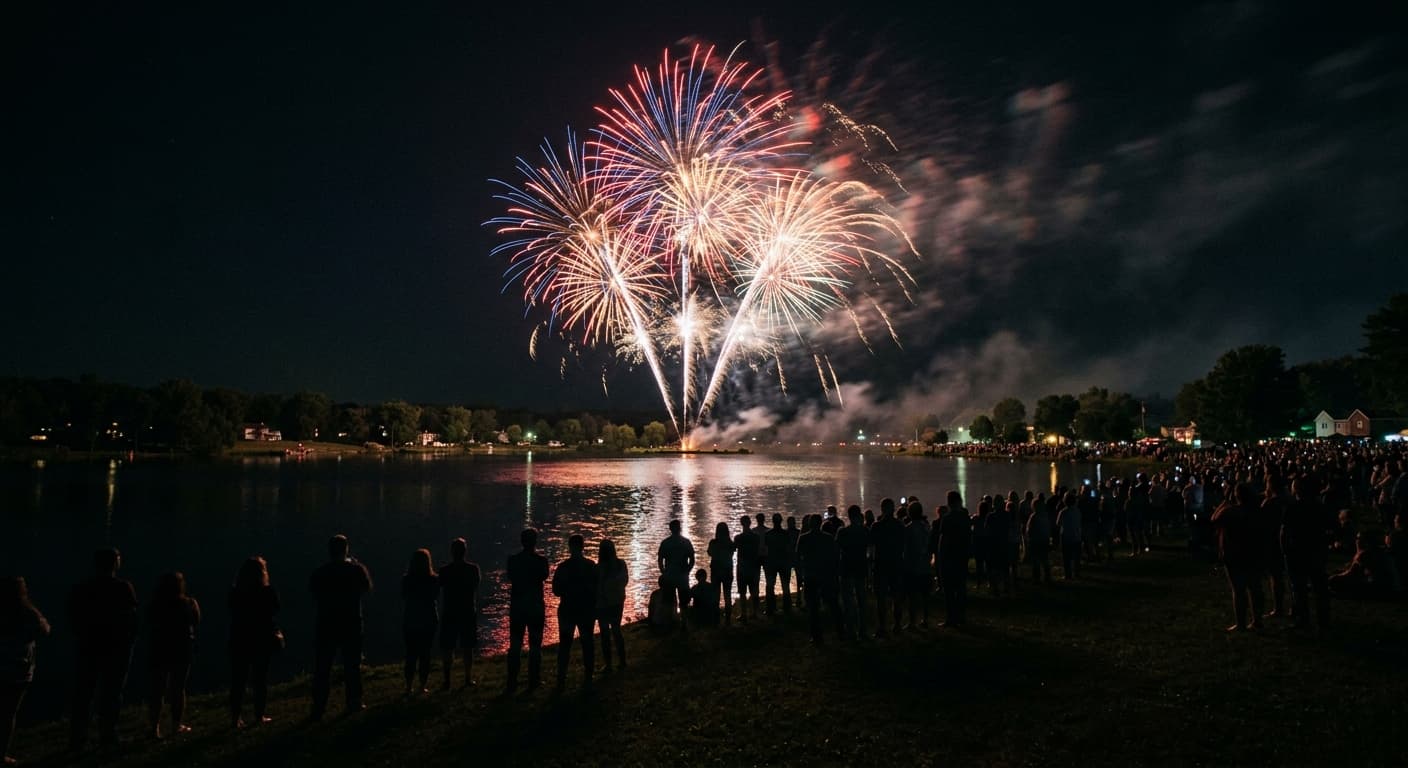
Rhode Island bans "display fireworks" and "aerial consumer fireworks" for the general public outright, absent a state fire marshal certificate of competency and a local fire authority permit, but exempts a defined list of ground-based novelty items from that ban entirely, under R.I. Gen. Laws §11-13-1 and Title 23, Chapter 28.11.
Jurisdiction scope: This article addresses Rhode Island's state fireworks law under R.I. Gen. Laws Chapter 11-13 (§§11-13-1 through 11-13-7) and Title 23, Chapter 28.11 (§§23-28.11-3 through 23-28.11-10): the exempt-novelty category, firecrackers, toy blank-cartridge devices and blank-cartridge sales, the permit and certificate-of-competency scheme for display and aerial consumer fireworks, and penalties. It does not address §11-13-10's definitions of destructive or incendiary devices and explosives (a separate, broader public-safety chapter this article does not otherwise draw on), the state fire marshal's regulatory rules adopted under §23-28.11-10, which are separate administrative code, not General Laws text, or the general Fire Safety Code (Title 23, Chapters 28.1-28.39) beyond the specific cross-references described here.
Display and Aerial Consumer Fireworks Are Banned Without a Permit
Rhode Island's baseline rule is a ban, not an allowance. Under §11-13-1(a):
"No person shall offer for sale at retail or at wholesale, shall possess or have under his or her control, use or explode, or cause to explode for exhibition or amusement, display fireworks or aerial consumer fireworks unless permits are obtained pursuant to this chapter and chapter 23-28.11."
The statute defines the two banned categories by reference to industry and federal transportation standards: "display fireworks" under APA 87-1 (2001 ed.) §2.7.2, classified as DOT explosives 1.3G, UN0335; and "aerial consumer fireworks" under APA 87-1 §3.1.2, classified DOT 1.4G, UN0336. Both require both a state fire marshal certificate of competency and a local fire authority permit before anyone can possess, use, sell, or display them, described in detail below.
The Exempt Novelty List
A specific list of ground-based and hand-held items falls outside the display/aerial ban entirely. The statute enumerates them directly:
"Certain fireworks and devices that are exempt from the definitions of display fireworks and aerial consumer fireworks shall include, but are not limited to, the following: ground-based and hand-held sparkling devices (non-aerial fireworks) ... fountains, illuminating torches, wheels, ground spinners, flitter sparklers, sparkers; novelties ... party poppers, snappers, toy smoke devices, snakes, glow worms, wire sparklers and dipped sticks; paper caps containing not more than twenty-five hundredths (0.025) grains of explosive mixture ... and model rockets and model rocket engines ... The storage, possession, sale, transportation and use of the items in the above reference section that are not included in the definition of display fireworks and aerial consumer fireworks shall be allowed at all times throughout the state for persons at least sixteen (16) years of age."
That list is Rhode Island's real consumer market: §11-13-1(a) sets no permit requirement, no calendar window, and no clock-hours restriction for it, and fixes its purchase and use age at 16, not 18. Chapter 23-28.11's permit and certification requirements expressly do not apply to this exempt category, under §23-28.11-3(a).
Narrow Exceptions to the Permit Requirement
Section 11-13-1(a) also lists specific activities that do not need a display/aerial fireworks permit even though the devices themselves fall in the banned categories: use by a common carrier for signal or illumination purposes, blank cartridges in a show or theater, explosives used for blasting, use as signals in an athletic or sporting event, use for ceremonial or military purposes, sale for shipment out of Rhode Island, and sale for any permitted use, provided the seller holds the Fire Safety Code permit required for storing, selling, or transporting these items under Title 23, Chapters 28.1 through 28.39.
The Permit and Certificate of Competency Process
A person who wants to possess or display display fireworks, aerial consumer fireworks, or pyrotechnics before the public must complete a multi-step process, not a single application. First, a competency exam: an applicant pays a $10 fee to the state fire marshal, who examines the applicant's experience and ability to run a fireworks or pyrotechnics demonstration within 90 days of the application, testing understanding of the applicable National Fire Protection Association standards, under §23-28.11-4(a). A qualifying applicant then pays $50 and submits proof of a satisfactory psychiatric exam completed within the prior year to receive the certificate of competency, under §23-28.11-4(b). Before any permit issues, the applicant must also show at least $1,000,000 in financial responsibility to cover property or person damage claims, which the local fire authority may require in a higher amount depending on local conditions, under §23-28.11-7. Only then can the applicant get the actual permit, issued by the local fire authority on a state fire marshal form, for a $50 fee, and only once the certificate of competency and insurance are confirmed current, under §23-28.11-3(c)-(d). A nonresident applicant faces one more requirement: appointing, in writing, a member of the Rhode Island bar association to accept service of process in any action against the applicant, under §23-28.11-8. The certificate itself is not permanent: it is valid for one year and renews without a new exam on March 1 following the original issue date for a $50 fee, a lost, misplaced, or stolen certificate is replaced for $10, and no renewal issues after July 1, 2003 unless the holder demonstrates adequate familiarity with the applicable NFPA requirements to the fire marshal's satisfaction, which can be shown by passing an exam, under §23-28.11-5.
Storage, handling, transportation, and display of fireworks must follow NFPA 1123 (display) and NFPA 1124 (manufacture, transportation, storage, and retail sale); pyrotechnics performed before a proximate audience must follow NFPA 1126, under §23-28.11-3(a)-(b). The state fire marshal can deny an exam, or suspend or revoke a certificate for a minimum of one year, for a common-law crime conviction, statutory arson, or a violation of any fireworks, explosives, or pyrotechnics law, rule, or regulation, or for falsifying an application, under §23-28.11-6.
Purchase Age
Rhode Island's age floor for the exempt novelty category is 16, not 18: the statute permits storage, possession, sale, transportation, and use of those items "at all times throughout the state for persons at least sixteen (16) years of age," under §11-13-1(a). Chapter 11-13 sets no separate numeric purchaser age for display or aerial consumer fireworks; §§23-28.11-3 and 23-28.11-4 gate that category entirely through the certificate-of-competency and permit process described above, issued to an applicant who passes the fire marshal's exam. Two further, narrower age floors sit elsewhere in the same chapter: no one may sell a blank cartridge to a person under 21, under §11-13-5, and no one may sell a fulminate cartridge, or a gun, pistol, or other device arranged to explode one, to a child under 15 without a parent's or guardian's written consent, under §11-13-3(a).
Firecrackers and Toy Blank-Cartridge Devices
Chapter 11-13 separately bans two more device categories, outside both the exempt-novelty list and the display/aerial permit scheme, each carrying its own $20 penalty rather than the felony tiers described below. A firecracker containing any explosive other than gunpowder cannot lawfully be sold, exposed for sale, possessed with intent to sell, used, or exploded anywhere in the state:
"Every person who shall sell, expose for sale, possess with intent to sell, use, or explode, or use or explode any firecracker containing any explosive other than gunpowder shall be fined not more than twenty dollars ($20.00)."
A toy device made to discharge a blank cartridge, such as a repeating toy cane or a toy pistol, cannot be sold, possessed with intent to sell or use, or discharged anywhere in the state, under §11-13-4. A violation of §11-13-4, or of the under-21 blank-cartridge sale ban described above, is fined up to $20 per offense, under §11-13-6.
Sale Window, Use Window, and Hours
Chapter 11-13's seven sections (§§11-13-1 through 11-13-7) and Chapter 23-28.11 set no statewide calendar sale-date or use-date restriction. The exempt novelty category may be sold and used "at all times throughout the state," and display and aerial consumer fireworks are controlled by the permit and certificate process, which is tied to an approved display and a competent operator, not to a fixed date range. Neither fireworks chapter sets a clock-hours limit on use; any hours rule would come from the state fire marshal's regulations under §23-28.11-10 or from a local ordinance.
Local Option
Neither Chapter 11-13 nor Chapter 23-28.11 contains a fireworks-specific municipal opt-in or opt-out clause. The local authority that does exist is a general one:
"Town and city councils may, from time to time, make and ordain all ordinances and regulations for their respective towns and cities, not repugnant to law, which they deem necessary for the safety of their inhabitants from fire, firearms, and fireworks..."
That is broad police-power language covering fire, firearms, and fireworks safety together, not a chapter-specific fireworks local-option provision, so a Rhode Island reader should check for a town or city ordinance separately rather than assume one of the fireworks chapters itself hands local governments a fireworks-specific power.
Penalties: Two Overlapping Statutes
Rhode Island penalizes fireworks violations under two different sections that do not fully align. Section 11-13-1(b) sets a felony as the default, with a narrow misdemeanor carve-out based on value:
"Any person violating the provisions of this section shall be guilty of a felony and shall be fined not exceeding one thousand dollars ($1,000) for each offense and/or imprisoned for not more than one year for each offense; except that any person using or having in his or her possession without a permit with intent to use display and aerial consumer fireworks with a value of under five hundred dollars ($500) shall be guilty of a misdemeanor and shall upon conviction be fined not exceeding five hundred dollars ($500) for each offense and/or imprisoned for not more than one year for each offense."
R.I. Gen. Laws §11-13-1(b)
Any §11-13-1 prosecution is also time-limited: no complaint for a violation can be sustained unless brought within 30 days of the offense, and fines collected are split evenly between the complainant and the state, under §11-13-2.
Section 23-28.11-9(a) splits the penalty differently, by whether the violation is mere possession or actual use or display, and its use/display felony carries a materially higher ceiling than §11-13-1's:
"Any person found to be in violation of the provisions of this chapter relating to possession of display fireworks and aerial consumer fireworks or pyrotechnics shall be fined not less than one hundred ($100) nor more than five hundred dollars ($500) or imprisoned for not more than one year. Any person found to be in violation of the provisions of this chapter relating to use or display of display fireworks and aerial consumer fireworks or pyrotechnics shall be guilty of a felony, and shall be fined not less than one thousand dollars ($1,000), or imprisoned for not more than five (5) years, or both."
An officer, including the state fire marshal or a deputy, may arrest without a warrant anyone found in violation and must immediately seize the fireworks or pyrotechnics, which are forfeited to the state upon conviction, under §23-28.11-9(b)-(c). None of Chapter 11-13's or Chapter 23-28.11's live sections sets an enhanced penalty for a repeat offense; each fine and sentence ceiling above applies per violation, not on an escalating scale.
Crossing State Lines
Federal law sets the floor: 16 CFR 1500.17 and Part 1507 define which consumer devices may be sold at all; 27 CFR 555.141(a)(7) exempts the importation, distribution and storage of consumer fireworks from ATF licensing (manufacture is not exempt); 18 U.S.C. 836 makes it a federal offense, punishable by up to one year, to transport fireworks into any state whose law specifically prohibits or regulates their use, in violation of that law, except in the course of continuous interstate transportation, with exceptions for common carriers, water carriers and federal agencies; and USPS Publication 52 § 341.22 bars fireworks from the mail entirely. Because Rhode Island bans display and aerial consumer fireworks for the general public outright, bringing one of those devices in from a broader-allow neighboring state risks both Rhode Island's own felony-level penalty and the federal transport statute.
For a neighboring state with a broader consumer-fireworks allowance, see New Hampshire's fireworks laws; for another state that restricts the public to a defined novelty list, see Massachusetts's fireworks laws.
For how Rhode Island's rule compares with every other state, see the fireworks laws by state comparison.
Disclaimer: This article provides general legal information about fireworks laws in the United States as of September 2026. It is not legal advice. Fireworks statutes, local ordinances, permit requirements, and penalties change frequently; verify the current rule with the Rhode Island State Fire Marshal or your local fire authority before possessing, using, or displaying fireworks, and consult a lawyer licensed in your state for advice about a specific situation.
Statutes cited reflect their in-force version as of 2026-09-17. Last updated: 2026-09-17.
Frequently Asked Questions
Are fireworks legal in Rhode Island?
A defined list of ground-based novelties (fountains, sparklers, party poppers, snakes, wire sparklers, and similar items) is legal at all times for a person at least 16, under R.I. Gen. Laws §11-13-1(a). Display fireworks and aerial consumer fireworks are banned for the general public and require a state fire marshal certificate of competency and a local fire authority permit.
How old do you have to be to buy fireworks in Rhode Island?
16, for the exempt novelty category, under §11-13-1(a). There is no separate numeric purchaser age for display or aerial consumer fireworks; that category is instead controlled by the certificate-of-competency and permit process. Two narrower age floors apply elsewhere in the same chapter: 21 to buy a blank cartridge, under §11-13-5, and 15 to buy a fulminate cartridge or a device arranged to explode one without a parent's or guardian's written consent, under §11-13-3(a).
Are firecrackers legal in Rhode Island?
Not if the firecracker contains any explosive other than gunpowder: selling, possessing for sale, using, or exploding one is fined up to $20 per offense, under §11-13-7. That section does not reach a firecracker made with gunpowder alone; such a device is restricted only if it falls within the display fireworks or aerial consumer fireworks categories that §11-13-1 defines by reference to APA 87-1, which are banned without a permit. A toy device made to discharge a blank cartridge is separately banned outright, and selling blank cartridges to anyone under 21 carries the same $20 fine, under §§11-13-4 through 11-13-6.
Can you get a permit to use aerial fireworks in Rhode Island?
Yes, but it is a multi-step process: pass the state fire marshal's competency exam, obtain the certificate of competency (which requires a psychiatric exam within the prior year), show at least $1,000,000 in financial responsibility, and obtain a local fire authority permit, under §§23-28.11-3, 23-28.11-4, and 23-28.11-7. It is designed for a supervised commercial or organizational display, not personal consumer use.
What is the penalty for illegal fireworks in Rhode Island?
It depends on which statute applies. Under §11-13-1(b), an unpermitted display/aerial violation is a felony (up to $1,000 and up to one year), or a misdemeanor if the fireworks are worth under $500, and a prosecution must be brought within 30 days of the offense, under §11-13-2. Under §23-28.11-9(a), bare possession carries $100 to $500 and up to one year, while use or display is a felony carrying at least $1,000 and up to five years. Firecrackers and toy blank-cartridge devices carry a separate, much smaller fine of up to $20.
Is there a specific season or window for using fireworks in Rhode Island?
No statewide calendar sale-date or use-date window exists anywhere in Chapter 11-13 or Chapter 23-28.11. Exempt novelties may be used at all times statewide, and display or aerial consumer fireworks are controlled by permit rather than a calendar date.
Updates
Clarified that Rhode Island's firecracker ban covers firecrackers containing an explosive other than gunpowder, and removed an unsupported adult-age condition on the fireworks certificate of competency.
Independently fact-checked against the cited primary sources
The Law Behind This Article
This article rests on the statutory provisions below, held in our own legal record and retrieved from the official source. Tap a section to read the operative text.
Rhode Island General Laws, Title 11: Criminal Offenses, Chapter 11-13: Explosives and Fireworks
§ 11-13-1Sale, use or possession of fireworksIn force
(a) No person shall offer for sale at retail or at wholesale, shall possess or have under his or her control, use or explode, or cause to explode for exhibition or amusement, display fireworks or aerial consumer fireworks unless permits are obtained pursuant to this chapter and chapter 23-28.11. Display fireworks are defined in the American pyrotechnic association standard 87-1 (APA 87-1) 2001 Edition section 2.7.2 and are classified as explosives 1.3G by the U.S. department of transportation (U.S. DOT), UN0335. Aerial consumer fireworks are defined in APA 87-1 2001 Edition section 3.1.2. and are classified 1.4G U.S. DOT, UN 0336.
Official text (excerpt) · last checked 2026-09-24 · Read the full text in our law library · Verify at webserver.rilegislature.gov
§ 11-13-2Limitation of prosecutions — FinesIn force
No complaint for a violation of any of the provisions of § 11-13-1 shall be sustained unless it shall be brought within thirty (30) days after the commission of the offense, and all fines for such violation shall enure one-half (½) to the complainant and one-half (½) to the state.
Official text (excerpt) · last checked 2026-07-30 · Read the full text in our law library · Verify at webserver.rilegislature.gov
§ 11-13-3Sale of fulminate cartridges or contrivances to minorsIn force
(a) No person shall sell to any child under the age of fifteen (15) years, without the written consent of a parent or guardian of the child, any cartridge or fixed ammunition of which any fulminate is a component part, or any gun, pistol or other mechanical contrivance arranged for the explosion of the cartridge or of any fulminate. Nothing in this section shall authorize the sale of any blank cartridge except as provided in § 11-13-5. (b) Every person violating the provisions of this section shall be fined not less than ten dollars ($10.00) nor more than twenty dollars ($20.00) for each offense.
Official text (excerpt) · last checked 2026-07-30 · Read the full text in our law library · Verify at webserver.rilegislature.gov
§ 11-13-4Toy canes or devices for firing blanksIn force
No person or persons shall sell, expose for sale, possess with intent to sell or use, or discharge or use, within this state, any repeating toy cane for discharging any explosive, any toy pistol, or any other toy device designed or used for the discharge of blank cartridges.
Official text (excerpt) · last checked 2026-07-30 · Read the full text in our law library · Verify at webserver.rilegislature.gov
§ 11-13-5Sale of blanks to minorsIn force
No person shall sell or offer to sell blank cartridges to any person under twenty-one (21) years of age.
Official text (excerpt) · last checked 2026-07-30 · Read the full text in our law library · Verify at webserver.rilegislature.gov
§ 11-13-6Penalty for unlawful devicesIn force
Any person violating any of the provisions of § 11-13-4 or 11-13-5 shall be fined not exceeding twenty dollars ($20.00) for each offense.
Official text (excerpt) · last checked 2026-07-30 · Read the full text in our law library · Verify at webserver.rilegislature.gov
§ 11-13-7Unlawful firecrackersIn force
Every person who shall sell, expose for sale, possess with intent to sell, use, or explode, or use or explode any firecracker containing any explosive other than gunpowder shall be fined not more than twenty dollars ($20.00).
Official text (excerpt) · last checked 2026-07-30 · Read the full text in our law library · Verify at webserver.rilegislature.gov
Rhode Island General Laws, Title 23: Health and Safety, Chapter 23-28.11: Fireworks and Pyrotechnics
§ 23-28.11-9ViolationsIn force
(a) Any person found to be in violation of the provisions of this chapter relating to possession of display fireworks and aerial consumer fireworks or pyrotechnics shall be fined not less than one hundred ($100) nor more than five hundred dollars ($500) or imprisoned for not more than one year. Any person found to be in violation of the provisions of this chapter relating to use or display of display fireworks and aerial consumer fireworks or pyrotechnics shall be guilty of a felony, and shall be fined not less than one thousand dollars ($1,000), or imprisoned for not more than five (5) years, or both. (b) The state fire marshal or the fire marshal’s deputies or any officer qualified to serve criminal process may arrest without a warrant any person found in violation of this chapter and shall seize immediately any and all of the display fireworks and aerial consumer fireworks and/or pyrotechnics in illegal use, possession, or under that person’s control, and the display fireworks and aerial consumer fireworks seized shall upon conviction of the person be forfeited to the state.
Official text (excerpt) · last checked 2026-07-30 · Read the full text in our law library · Verify at webserver.rilegislature.gov
§ 23-28.11-3Permits for storage, handling, transportation and display of display fireworks, aerial consumer fireworks, and pyrotechnicsIn force
(a) All storage, handling, transportation and display of fireworks shall be in accordance with the National Fire Protection Association (NFPA) Standard 1123 entitled “Code for Fireworks Display” 2006 Edition, and NFPA Standard 1124 entitled “Code for the Manufacture, Transportation, Storage, and Retail Sales of Fireworks and Pyrotechnic Articles” 2006 Edition, and the requirements of this chapter. For purposes of this chapter, §§ 28.11-3 — 28.11-10 of title 23 shall not apply to the storage, handling, transportation, use and (display) sale of ground-based hand-held devices (non-aerial consumer fireworks), novelties and other items exempted from the definition of display fireworks and aerial consumer fireworks in § 11-13-1 Rhode Island explosive and fireworks code chapter 13 of title 11.
Official text (excerpt) · last checked 2026-07-30 · Read the full text in our law library · Verify at webserver.rilegislature.gov
§ 23-28.11-4Certificate of competencyIn force
(a) Every person desiring to obtain a certificate of competency to possess and display display fireworks and aerial consumer fireworks and/or pyrotechnics shall make application to the state fire marshal. A fee of ten dollars ($10.00) shall accompany each application and shall be for processing the application and for examination to be given within ninety (90) days of receipt of application to determine applicant’s experience and ability to conduct display fireworks and aerial consumer fireworks and/or pyrotechnics demonstrations. Separate applications, examinations and certificates shall be issued by the state fire marshal for fireworks and pyrotechnics and shall be in such form as the state fire marshal may require. The examinations herein provided for shall require the applicant to demonstrate adequate understanding of applicable NFPA requirements. (b) Each applicant found to be qualified by examination shall forthwith be issued a certificate of competency upon payment of fifty dollars ($50.00) and submission of certification indicating satisfactory completion of psychiatric examination administered by a qualified physician within the previous year.
Official text (excerpt) · last checked 2026-07-30 · Read the full text in our law library · Verify at webserver.rilegislature.gov
§ 23-28.11-7Financial responsibilityIn force
No permit shall be issued to any applicant desiring to possess and display display fireworks and aerial consumer fireworks and/or pyrotechnics until the applicant furnishes to the local fire authority satisfactory proof of financial responsibility in an amount not less than one million dollars ($1,000,000) to satisfy claims for damage to property or persons resulting from the possession or use of display fireworks and aerial consumer fireworks and/or pyrotechnics. The local fire authority may require additional financial responsibility as he or she may deem necessary due to existing conditions.
Official text (excerpt) · last checked 2026-07-30 · Read the full text in our law library · Verify at webserver.rilegislature.gov
§ 23-28.11-8NonresidentIn force
No permit shall be issued under the provisions of this chapter to a nonresident person to conduct a display fireworks and aerial consumer fireworks and/or pyrotechnics display in this state, until that person shall have appointed in writing a member of the Rhode Island bar association to be his or her attorney upon whom all processes in any action or proceeding against the person may be served.
Official text (excerpt) · last checked 2026-07-30 · Read the full text in our law library · Verify at webserver.rilegislature.gov
§ 23-28.11-6Right of denial — Suspension or revocationIn force
The state fire marshal is empowered to deny an examination to any applicant who has been convicted of a common law crime, statutory burning, the violation of any explosive or fireworks or pyrotechnics law or rule or regulation, or who falsely completes an application. The fire marshal is further empowered to immediately suspend or revoke for a minimum period of one year the certificate of any holder found to be in violation of this law or a rule and regulation relating to fireworks, or pyrotechnics or convicted of a crime of common law, or statutory burning.
Official text (excerpt) · last checked 2026-07-30 · Read the full text in our law library · Verify at webserver.rilegislature.gov
§ 23-28.11-5Duration — Expiration — Renewal — DuplicationIn force
Every certificate issued shall be valid for one year, and shall be renewable without examination, except as herein provided, on March first after the original date of issue upon payment of fifty dollars ($50.00). Any holder of a certificate whose certificate was lost, misplaced, or stolen may obtain a duplicate certificate from the state fire marshal upon payment of ten dollars ($10.00). No renewal shall be issued after July 1, 2003, unless the applicant for the renewal shall demonstrate adequate familiarity to the satisfaction of the Fire Marshal with applicable NFPA requirements, which demonstration may be made by passing an appropriate examination.
Official text (excerpt) · last checked 2026-07-30 · Read the full text in our law library · Verify at webserver.rilegislature.gov
§ 23-28.11-10Rules and regulationsIn force
The state fire marshal is hereby authorized and directed to promulgate reasonable rules and regulations governing the possession, sale wholesale and retail, and use of display fireworks and aerial consumer fireworks and pyrotechnics in the state.
Official text (excerpt) · last checked 2026-07-30 · Read the full text in our law library · Verify at webserver.rilegislature.gov
Rhode Island General Laws, Title 45: Towns and Cities, Chapter 45-6: Ordinances
§ 45-6-1Scope of ordinances permissibleIn force
(a) Town and city councils may, from time to time, make and ordain all ordinances and regulations for their respective towns and cities, not repugnant to law, which they deem necessary for the safety of their inhabitants from fire, firearms, and fireworks; to prevent persons standing on any footwalk, sidewalk, doorstep, or in any doorway, or riding, driving, fastening, or leaving any horse or other animal or any carriage, team, or other vehicle on any footwalk, sidewalk, doorstep, or doorway within the town or city, to the obstruction, hindrance, delay, disturbance, or annoyance of passersby or of persons residing or doing business in this vicinity; to regulate the putting up and maintenance of telegraph and other wires and their appurtenances; to prevent the indecent exposure of any one bathing in any of the waters within their respective towns and cities; against breakers of the Sabbath; against habitual drunkenness; respecting the purchase and sale of merchandise or commodities within their respective towns and cities; to protect burial grounds and the graves in these burial grounds from trespassers; and, generally, all other ordinances, regulations and bylaws for the well…
Official text (excerpt) · last checked 2026-07-30 · Read the full text in our law library · Verify at webserver.rilegislature.gov
Code of Federal Regulations Title 16
§ 1500.17Banned hazardous substances.In forcecited in 36 of our articles
(a) Under the authority of section 2(q)(1)(B) of the act, the Commission declares as banned hazardous substances the following articles because they possess such a degree or nature of hazard that adequate cautionary labeling cannot be written and the public health and safety can be served only by keeping such articles out of interstate commerce: (1) Mixtures that are intended primarily for application to interior masonry walls, floors, etc., as a water repellant treatment and that are “extremely flammable” within the meaning of section 2(1) of the act (repeated in § 1500.3(b)(10)). (2) Carbon tetrachloride and mixtures containing it (including carbon tetrachloride and mixtures containing it used in fire extinguishers), excluding unavoidable manufacturing residues of carbon tetrachloride in other chemicals that under reasonably foreseeable conditions of use do not result in an atmospheric concentration of carbon tetrachloride greater than 10 parts per million.
Official text (excerpt) · last checked 2026-09-23 · Read the full text in our law library · Verify at ecfr.gov
Cited in 16 court opinions in our collectionLatest citing opinion in our collection: 2024
Opinions citing this section in our collection:
- United States v. Midwest Fireworks Mfg. Co., Inc. Fireworks of America Ltd. Corp. Pacific Fin. Servs. Of America, Inc. Larry Lomaz David Bowman (Court of Appeals for the Sixth Circuit 2001, 248 F.3d 563)“…venty-nine types of fireworks and the constitutionality of 16 C.F.R. § 1500.17 (a)(3) (2001). We affirm. BACKGR…”
- United States v. Charles Focht, an Individual, and Mark Focht, an Individual, Doing Business Under the Name Liberty Industries (Court of Appeals for the Third Circuit 1989, 882 F.2d 55)“…al, the government asserts the district court misconstrued 16 C.F.R. § 1500.17 (a)(3), (8) when it held the regulation…”
- United States v. Shelton Wholesale, Inc. (District Court, W.D. Missouri 1999, 34 F. Supp. 2d 1147)“…ams) of pyrotechnic composition (the "amount test"). See 16 C.F.R. § 1500.17 (a)(3). 2. for all "[r]eloadable tube…”
Identified automatically from the court opinions citing this section — not a ranking of which case controls.
Also relied on in: Fireworks Laws by State (2026): What Is Legal, Sale Dates, Penalties, Delaware Fireworks Laws (2026): Sparklers, Novelties, Dates, DC Fireworks Laws: Permitted List, Licensing, Penalties
Code of Federal Regulations Title 27
§ 555.141Exemptions.In forcecited in 41 of our articles
(a) General. Except for the provisions of §§ 555.180 and 555.181, this part does not apply to: (1) Any aspect of the transportation of explosive materials via railroad, water, highway, or air which is regulated by the U.S. Department of Transportation and its agencies, and which pertains to safety. For example, regulations issued by the Department of Transportation addressing the security risk of aliens transporting explosives by commercial motor or railroad carrier from Canada preclude the enforcement of 18 U.S.C. 842(i)(5) against persons shipping, transporting, receiving, or possessing explosives incident to and in connection with the commercial transportation of explosives by truck or rail from Canada into the United States. Questions concerning this exception should be directed to ATF's Explosives Industry Program Branch in Washington, DC. (2) The use of explosive materials in medicines and medicinal agents in the forms prescribed by the official United States Pharmacopeia or the National Formulary.
Official text (excerpt) · last checked 2026-07-28 · Read the full text in our law library · Verify at ecfr.gov
Cited in 1 court opinions in our collectionLatest citing opinion in our collection: 2006
Opinions citing this section in our collection:
- Tripoli Rocketry Ass'n v. Bureau of Alcohol, Tobacco, Firearms, & Explosives (Court of Appeals for the D.C. Circuit 2006, 437 F.3d 75)“…imported, or distributed for their intended purposes.” See 27 C.F.R. § 555.141(a)(8) (2005) (current exemption); 26 C.…”
Identified automatically from the court opinions citing this section — not a ranking of which case controls.
Also relied on in: Florida Fireworks Laws (2026): Sparklers vs. Holiday Rules, Georgia Fireworks Laws (2026): Legal Statewide, No Local Ban, Hawaii Fireworks Laws (2026): Permits, Use Windows, and Penalties
United States Code Title 18
§ 836Transportation of fireworks into State prohibiting sale or useIn forcecited in 52 of our articles
Whoever, otherwise than in the course of continuous interstate transportation through any State, transports fireworks into any State, or delivers them for transportation into any State, or attempts so to do, knowing that such fireworks are to be delivered, possessed, stored, transshipped, distributed, sold, or otherwise dealt with in a manner or for a use prohibited by the laws of such State specifically prohibiting or regulating the use of fireworks, shall be fined under this title or imprisoned not more than one year, or both. This section shall not apply to a common or contract carrier or to international or domestic water carriers engaged in interstate commerce or to the transportation of fireworks into a State for the use of Federal agencies in the carrying out or the furtherance of their operations. In the enforcement of this section, the definitions of fireworks contained in the laws of the respective States shall be applied. As used in this section, the term “State” includes the several States, Territories, and possessions of the United States, and the District of Columbia. This section shall be effective from and after July 1, 1954.
Official text (excerpt) · last checked 2026-07-28 · Read the full text in our law library · Verify at uscode.house.gov
Cited in 15 court opinions in our collectionLatest citing opinion in our collection: 2024
Opinions citing this section in our collection:
- United States v. James A. Womack (Court of Appeals for the Fifth Circuit 1981, 654 F.2d 1034)“…eworks has been traditionally left to the states. He cites 18 U.S.C.A. § 836 , which prohibits the transportation of…”
- United States v. Bernard J. Semel (Court of Appeals for the Fourth Circuit 1965, 347 F.2d 228)“…y an information containing eighteen counts with violating 18 U.S.C.A. § 836 by having feloniously caused to be tra…”
- Cohen v. Bredehoeft (District Court, S.D. Texas 1968, 290 F. Supp. 1001)“…the states from legislating in this area. On the contrary, 18 U.S.C. Sec. 836 indicates an intent to encourage state…”
Identified automatically from the court opinions citing this section — not a ranking of which case controls.
Also relied on in: Alabama Fireworks Laws (2026): Legal Fireworks, Age Rules, Penalties, Alaska Fireworks Laws (2026): Age-18 Minimum, No Sale Window, Arizona Fireworks Laws (2026): Legal Devices, Local Rules, Penalties
Search our full record of US law — 2.1 million sections, every state + federal →
Sources and References
- R.I. Gen. Laws §11-13-1 - Sale, use or possession of fireworks (exempt novelties, display/aerial ban, penalties)(webserver.rilegislature.gov).gov
- R.I. Gen. Laws §11-13-2 - Limitation of prosecutions; fines (30-day limitation on an §11-13-1 complaint)(webserver.rilegislature.gov).gov
- R.I. Gen. Laws §11-13-3 - Sale of fulminate cartridges or contrivances to minors(webserver.rilegislature.gov).gov
- R.I. Gen. Laws §11-13-4 - Toy canes or devices for firing blanks(webserver.rilegislature.gov).gov
- R.I. Gen. Laws §11-13-5 - Sale of blanks to minors(webserver.rilegislature.gov).gov
- R.I. Gen. Laws §11-13-6 - Penalty for unlawful devices(webserver.rilegislature.gov).gov
- R.I. Gen. Laws §11-13-7 - Unlawful firecrackers(webserver.rilegislature.gov).gov
- R.I. Gen. Laws §23-28.11-5 - Duration, expiration, renewal, duplication of the certificate of competency(webserver.rilegislature.gov).gov
- R.I. Gen. Laws §23-28.11-3 - Permits for storage, handling, transportation and display of display fireworks, aerial consumer fireworks, and pyrotechnics(webserver.rilegislature.gov).gov
- R.I. Gen. Laws §23-28.11-4 - Certificate of competency(webserver.rilegislature.gov).gov
- R.I. Gen. Laws §23-28.11-6 - Right of denial, suspension or revocation(webserver.rilegislature.gov).gov
- R.I. Gen. Laws §23-28.11-7 - Financial responsibility ($1,000,000 minimum)(webserver.rilegislature.gov).gov
- R.I. Gen. Laws §23-28.11-8 - Nonresident (agent for service of process)(webserver.rilegislature.gov).gov
- R.I. Gen. Laws §23-28.11-9 - Violations (possession vs. use/display penalty tiers, arrest and forfeiture)(webserver.rilegislature.gov).gov
- R.I. Gen. Laws §45-6-1 - Scope of ordinances permissible (general municipal fire/firearms/fireworks safety power)(webserver.rilegislature.gov).gov
- 16 C.F.R. § 1500.17 - CPSC banned-hazardous-substance device standards for fireworks(ecfr.gov).gov
- 16 C.F.R. Part 1507 - Fireworks devices consumer product safety standard(ecfr.gov).gov
- 27 C.F.R. § 555.141(a)(7) - ATF explosives-licensing exemption for importation, distribution, and storage of consumer fireworks(ecfr.gov).gov
- 18 U.S.C. § 836 - Transportation of fireworks into a state that specifically prohibits or regulates their use(uscode.house.gov).gov
- USPS Publication 52 § 341.22 - All fireworks are nonmailable explosives(pe.usps.com).gov